
the Creative Commons Attribution 4.0 License.
the Creative Commons Attribution 4.0 License.
 | 28 Oct 2025
Diurnal and Seasonal Variations of Dust Transport around the Tibetan Plateau: Insights from Multi-Source Observations
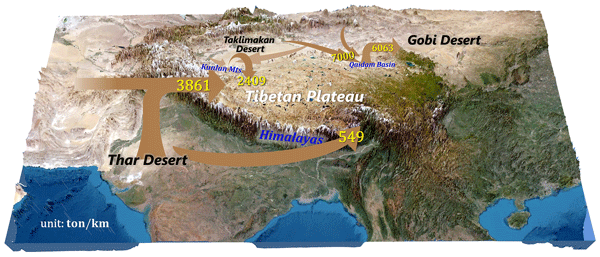
Abstract. Dust transport around the Tibetan Plateau (TP) plays a key role in regional climate and air quality, yet its seasonal and diurnal variability remains insufficiently understood. Here, we presented the spatiotemporal characteristics of dust transport in the TP region combining satellite observations, reanalysis datasets and ground-based measurements. A new method for dust mass concentration was developed and showed strong consistency with multiple products in both spatial and temporal scales. Our results revealed persistent dust transport belts on both the northern and southern sides of TP, with peaks in spring. the amounts of dust flux transported to TP were estimated for different directional sources, seasons and heights. The vertical variation and amount of dust backflow in Taklamakan Desert were analyzed. The diurnal characteristics of vertical resolved dust flux were presented in three-hour interval and four sections around TP. Overall, this study deepened the understanding of the dust climatology over the TP region from a satellite perspective.
-
Notice on discussion status
The requested preprint has a corresponding peer-reviewed final revised paper. You are encouraged to refer to the final revised version.
-
Preprint
(7392 KB)
-
The requested preprint has a corresponding peer-reviewed final revised paper. You are encouraged to refer to the final revised version.
- Preprint
(7392 KB) - Metadata XML
- BibTeX
- EndNote
- Final revised paper


Journal article(s) based on this preprint
Interactive discussion
Status: closed
-
RC1: 'Comment on egusphere-2025-5081', Anonymous Referee #1, 10 Nov 2025
- AC2: 'Reply on RC1', Xiaofeng Xu, 20 Jan 2026
-
RC2: 'Comment on egusphere-2025-5081', Anonymous Referee #2, 14 Nov 2025
This study integrates multiple sources of observational and reanalysis data—including CATS, CALIPSO, ERA5, DustCOMM, MERRA-2, and CHAP—to systematically analyze the seasonal variations, spatial distribution, and diurnal cycle of dust transport over and around the Tibetan Plateau. An attempt is also made to quantify dust fluxes along various transport pathways. The research topic holds considerable scientific value, particularly in its use of CATS data to characterize the diurnal cycle of dust around the Tibetan Plateau and its investigation of phenomena such as dust backflow, which demonstrates a degree of novelty. However, several limitations remain in the data processing details and uncertainty assessment. Further supplementation and technical revisions are necessary to improve the reproducibility and credibility of the findings. The manuscript is recommended for acceptance after minor revisions.It is recommended to add a discussion on the limitations of the methods and the directions for further in-depth research in the discussion section.
Major concerns:
1) Dust concentration and dust flux were derived through inversion from multiple datasets, which inherently involve various uncertainties that may affect the reliability of the results. These include the spatiotemporal sampling limitations of CATS, potential errors in the mass extinction efficiency (MEE) values, and uncertainties related to wavelength extrapolation between CALIPSO and CATS. It is recommended that the authors add a dedicated section (either in the main text or as an appendix) to qualitatively or quantitatively discuss these error sources and their potential impacts on the key conclusions. This would significantly improve the completeness and credibility of the study.
2)The authors used the wavelength ratio from CALIPSO at 1064/532 nm to convert the CATS 1064 nm extinction data. The accuracy of the dust extinction coefficient derived through this approach remains unclear. It is advisable to further validate the quality of the CATS dust extinction inversion over the study region, for instance, by comparing with independent measurements or other relevant datasets.
3)The formula used for the "Dust Exposure" metric appears relatively simplistic and lacks a solid scientific rationale. The authors should provide further justification for the theoretical basis of this indicator and clarify its applicable scope and limitations.
4)While the study estimates dust input from surrounding deserts to the plateau via cross-sectional flux integration, as well as the contribution from the Qaidam Basin to downstream regions, the potential influence of locally emitted dust from within the Tibetan Plateau itself is not sufficiently addressed. Differentiating between the contributions of local soil erosion and long-range transported dust would add significant value to the analysis.
Minor concerns:
1)The points of innovation are currently scattered throughout the manuscript. They should be clearly and concisely summarized in both the introduction and conclusion.
2)In several figures (e.g., Figures 5 and 7), the axis labels, legend text, and color bar scales are too small, making them difficult to read even when zoomed in. It is recommended to increase the font sizes appropriately to improve readability.
3)The latitude and longitude ranges of the cross-sectional lines (S1–S4, X1–X2) in Figure 1 should be clearly labeled to enhance interpretability.
Citation: https://doi.org/10.5194/egusphere-2025-5081-RC2 - AC1: 'Reply on RC2', Xiaofeng Xu, 20 Jan 2026
Peer review completion


Interactive discussion
Status: closed
-
RC1: 'Comment on egusphere-2025-5081', Anonymous Referee #1, 10 Nov 2025
This manuscript aims to quantify the seasonal and diurnal variations of dust transport over and around the Tibetan Plateau (TP) using CATS lidar extinction profiles combined with the DustCOMM dataset and reanalysis winds. Although the topic is interesting and potentially valuable for understanding aerosol–climate interactions, the methodological framework lacks physical robustness and statistical validity, leading to highly uncertain and potentially misleading quantitative results. The paper also suffers from conceptual inconsistencies, incomplete validation, and misinterpretation of several derived parameters. Therefore, I do not recommend publication in its current form.
Major Comments
- The extinction-to-mass conversion is on shaky ground. You’re dividing CATS extinction by a fixed DustCOMM MEE that’s climatological, largely dry, and wavelength/size-agnostic, while the actual extinction depends strongly on size distribution, mineralogy, refractive index, and RH. With regional dust heterogeneity across Tarim/Qaidam and potential 1064 532 nm inconsistencies, this shortcut can introduce order-of-magnitude bias unless you regionalize MEE and propagate its uncertainty.
- The reconstruction of a 3-hour diurnal cycle from CATS observations is statistically invalid. CATS data cover only a short time period and have uneven local-time sampling. Using a 60-day moving window does not compensate for aliasing or sampling bias. Without showing the local-time coverage distribution and weighting scheme, the derived “typical day” is more likely an artifact of orbital sampling than a real physical signal.
- The treatment of the near-surface layer is oversimplified. Assuming a uniformly mixed layer of 0–180 m ignores sharp vertical gradients under stable conditions or during dust storms. This can strongly distort the surface dust concentration and any comparison with ground-based PM10 data. A more realistic boundary-layer height estimates or sensitivity analysis is needed.
- The flux integration across regional boundaries is not well justified. The authors multiply a sparsely sampled DMC profile by ERA5 winds and integrate over large sections, implicitly assuming representativeness and mass conservation that are never verified. There are no flux divergence checks or control-volume closure tests, and the temporal normalization (instantaneous, seasonal, or annual) is unclear. The resulting flux magnitudes, comparable to or exceeding full chemistry models, are likely overestimated.
- Uncertainty assessment is incomplete. Errors from aerosol typing, wavelength conversion, MEE selection, humidity effects, and wind fields should be propagated through each processing step. Simply reporting correlations of 0.4–0.6 with reanalysis products does not demonstrate accuracy. Confidence intervals or uncertainty ranges for all major quantities are necessary for the results to be credible.
- Aerosol classification and cloud filtering are not handled carefully enough. Over complex terrain, small misclassification rates between dust and cloud layers can generate large mass errors after the extinction-to-mass step. Independent validation using AERONET or ground-based lidar data should be provided to quantify such effects.
- The wavelength mismatch between CATS extinction (1064 nm) and DustCOMM MEE (532 or 550 nm) is not properly treated. The study seems to apply a simple or fixed conversion without discussing the spectral dependence of MEE or its influence on retrieved mass (Kok et al., 2021; Vaughan et al., 2019; Song et al., 2022). This needs explicit scaling and sensitivity testing to ensure physical consistency.
- Deposition processes are oversimplified. Estimating basin-to-basin mass budgets using only dry deposition neglects the role of wet removal, which is significant near the Tibetan Plateau margins (Liu et al., 2023; Qian et al., 2011). The “net export” numbers could therefore be biased. Inclusion of precipitation or wet-deposition parameterizations would improve credibility.
- Multiplying column dust mass by population and a temperature factor has no epidemiological validation or defined weighting. Without calibration or comparison to health outcome data, this index serves more as a visualization than a scientific metric.
- Similar analyses of dust pathways and seasonal transport over the Tibetan Plateau have already been reported using better constrained observational and modeling frameworks. Given the limitations of the CATS dataset, the “first 3-hour diurnal characterization” is not convincing.
- Presentation issues make the analysis harder to evaluate. Units and averaging periods are sometimes missing, and the geographic boundaries of the defined sections are not clearly specified. Several figures appear over-smoothed relative to the data resolution. Adding coordinate definitions, uncertainty shading, and data-density information would help.
- Quantitative error metrics such as mean bias, normalized mean bias, or RMSE should be reported, and comparisons should be stratified by season and boundary-layer height. Including at least one well-documented dust event as a case study would make the evaluation more persuasive.
Minor Comments
- The description of MEE (Eq. 2–3) lacks proper wavelength dependence and unit consistency.
- Figure captions are often incomplete and do not specify averaging periods or units.
- The map projections and domain boundaries (S1–S4, X1–X2) are not precisely defined, where is TD, GD, and TH, I cannot find the location.
- References to validation datasets (DustCOMM, CHAP, CNEMC) should include temporal overlap periods.
- The discussion mixes physical interpretation with socio-political implications, which dilutes the scientific focus.
- Some figures (e.g., diurnal cycle composites) are overly smoothed and may give a misleading impression of temporal resolution.
Reference
Liu, W., Zhao, C., Xu, M. et al. Southern Himalayas rainfall as a key driver of interannual variation of pre-monsoon aerosols over the Tibetan Plateau. npj Clim Atmos Sci 6, 57 (2023). https://doi.org/10.1038/s41612-023-00392-5
Qian, Y., Flanner, M. G., Leung, L. R., and Wang, W.: Sensitivity studies on the impacts of Tibetan Plateau snowpack pollution on the Asian hydrological cycle and monsoon climate, Atmos. Chem. Phys., 11, 1929–1948, https://doi.org/10.5194/acp-11-1929-2011, 2011.
Kok, J. F., Adebiyi, A. A., Albani, S., Balkanski, Y., Checa-Garcia, R., Chin, M., Colarco, P. R., Hamilton, D. S., Huang, Y., Ito, A., Klose, M., Leung, D. M., Li, L., Mahowald, N. M., Miller, R. L., Obiso, V., Pérez García-Pando, C., Rocha-Lima, A., Wan, J. S., and Whicker, C. A.: Improved representation of the global dust cycle using observational constraints on dust properties and abundance, Atmos. Chem. Phys., 21, 8127–8167, https://doi.org/10.5194/acp-21-8127-2021, 2021.
Song, Q., Zhang, Z., Yu, H., Kok, J. F., Di Biagio, C., Albani, S., Zheng, J., and Ding, J.: Size-resolved dust direct radiative effect efficiency derived from satellite observations, Atmos. Chem. Phys., 22, 13115–13135, https://doi.org/10.5194/acp-22-13115-2022, 2022.
Vaughan, M., Garnier, A., Josset, D., Avery, M., Lee, K.-P., Liu, Z., Hunt, W., Pelon, J., Hu, Y., Burton, S., Hair, J., Tackett, J. L., Getzewich, B., Kar, J., and Rodier, S.: CALIPSO lidar calibration at 1064 nm: version 4 algorithm, Atmos. Meas. Tech., 12, 51–82, https://doi.org/10.5194/amt-12-51-2019, 2019.
Citation: https://doi.org/10.5194/egusphere-2025-5081-RC1 - AC2: 'Reply on RC1', Xiaofeng Xu, 20 Jan 2026
-
RC2: 'Comment on egusphere-2025-5081', Anonymous Referee #2, 14 Nov 2025
This study integrates multiple sources of observational and reanalysis data—including CATS, CALIPSO, ERA5, DustCOMM, MERRA-2, and CHAP—to systematically analyze the seasonal variations, spatial distribution, and diurnal cycle of dust transport over and around the Tibetan Plateau. An attempt is also made to quantify dust fluxes along various transport pathways. The research topic holds considerable scientific value, particularly in its use of CATS data to characterize the diurnal cycle of dust around the Tibetan Plateau and its investigation of phenomena such as dust backflow, which demonstrates a degree of novelty. However, several limitations remain in the data processing details and uncertainty assessment. Further supplementation and technical revisions are necessary to improve the reproducibility and credibility of the findings. The manuscript is recommended for acceptance after minor revisions.It is recommended to add a discussion on the limitations of the methods and the directions for further in-depth research in the discussion section.
Major concerns:
1) Dust concentration and dust flux were derived through inversion from multiple datasets, which inherently involve various uncertainties that may affect the reliability of the results. These include the spatiotemporal sampling limitations of CATS, potential errors in the mass extinction efficiency (MEE) values, and uncertainties related to wavelength extrapolation between CALIPSO and CATS. It is recommended that the authors add a dedicated section (either in the main text or as an appendix) to qualitatively or quantitatively discuss these error sources and their potential impacts on the key conclusions. This would significantly improve the completeness and credibility of the study.
2)The authors used the wavelength ratio from CALIPSO at 1064/532 nm to convert the CATS 1064 nm extinction data. The accuracy of the dust extinction coefficient derived through this approach remains unclear. It is advisable to further validate the quality of the CATS dust extinction inversion over the study region, for instance, by comparing with independent measurements or other relevant datasets.
3)The formula used for the "Dust Exposure" metric appears relatively simplistic and lacks a solid scientific rationale. The authors should provide further justification for the theoretical basis of this indicator and clarify its applicable scope and limitations.
4)While the study estimates dust input from surrounding deserts to the plateau via cross-sectional flux integration, as well as the contribution from the Qaidam Basin to downstream regions, the potential influence of locally emitted dust from within the Tibetan Plateau itself is not sufficiently addressed. Differentiating between the contributions of local soil erosion and long-range transported dust would add significant value to the analysis.
Minor concerns:
1)The points of innovation are currently scattered throughout the manuscript. They should be clearly and concisely summarized in both the introduction and conclusion.
2)In several figures (e.g., Figures 5 and 7), the axis labels, legend text, and color bar scales are too small, making them difficult to read even when zoomed in. It is recommended to increase the font sizes appropriately to improve readability.
3)The latitude and longitude ranges of the cross-sectional lines (S1–S4, X1–X2) in Figure 1 should be clearly labeled to enhance interpretability.
Citation: https://doi.org/10.5194/egusphere-2025-5081-RC2 - AC1: 'Reply on RC2', Xiaofeng Xu, 20 Jan 2026
Peer review completion
Journal article(s) based on this preprint
Viewed
| HTML | XML | Total | BibTeX | EndNote | |
|---|---|---|---|---|---|
| 733 | 658 | 93 | 1,484 | 76 | 86 |
- HTML: 733
- PDF: 658
- XML: 93
- Total: 1,484
- BibTeX: 76
- EndNote: 86
Viewed (geographical distribution)
| Country | # | Views | % |
|---|
| Total: | 0 |
| HTML: | 0 |
| PDF: | 0 |
| XML: | 0 |
- 1

Zixu Xiong
Jianming Gong
Huilin Zhang
Tianliang Zhao
Qing He
The requested preprint has a corresponding peer-reviewed final revised paper. You are encouraged to refer to the final revised version.
- Preprint
(7392 KB) - Metadata XML
This manuscript aims to quantify the seasonal and diurnal variations of dust transport over and around the Tibetan Plateau (TP) using CATS lidar extinction profiles combined with the DustCOMM dataset and reanalysis winds. Although the topic is interesting and potentially valuable for understanding aerosol–climate interactions, the methodological framework lacks physical robustness and statistical validity, leading to highly uncertain and potentially misleading quantitative results. The paper also suffers from conceptual inconsistencies, incomplete validation, and misinterpretation of several derived parameters. Therefore, I do not recommend publication in its current form.
Major Comments
Minor Comments
Reference
Liu, W., Zhao, C., Xu, M. et al. Southern Himalayas rainfall as a key driver of interannual variation of pre-monsoon aerosols over the Tibetan Plateau. npj Clim Atmos Sci 6, 57 (2023). https://doi.org/10.1038/s41612-023-00392-5
Qian, Y., Flanner, M. G., Leung, L. R., and Wang, W.: Sensitivity studies on the impacts of Tibetan Plateau snowpack pollution on the Asian hydrological cycle and monsoon climate, Atmos. Chem. Phys., 11, 1929–1948, https://doi.org/10.5194/acp-11-1929-2011, 2011.
Kok, J. F., Adebiyi, A. A., Albani, S., Balkanski, Y., Checa-Garcia, R., Chin, M., Colarco, P. R., Hamilton, D. S., Huang, Y., Ito, A., Klose, M., Leung, D. M., Li, L., Mahowald, N. M., Miller, R. L., Obiso, V., Pérez García-Pando, C., Rocha-Lima, A., Wan, J. S., and Whicker, C. A.: Improved representation of the global dust cycle using observational constraints on dust properties and abundance, Atmos. Chem. Phys., 21, 8127–8167, https://doi.org/10.5194/acp-21-8127-2021, 2021.
Song, Q., Zhang, Z., Yu, H., Kok, J. F., Di Biagio, C., Albani, S., Zheng, J., and Ding, J.: Size-resolved dust direct radiative effect efficiency derived from satellite observations, Atmos. Chem. Phys., 22, 13115–13135, https://doi.org/10.5194/acp-22-13115-2022, 2022.
Vaughan, M., Garnier, A., Josset, D., Avery, M., Lee, K.-P., Liu, Z., Hunt, W., Pelon, J., Hu, Y., Burton, S., Hair, J., Tackett, J. L., Getzewich, B., Kar, J., and Rodier, S.: CALIPSO lidar calibration at 1064 nm: version 4 algorithm, Atmos. Meas. Tech., 12, 51–82, https://doi.org/10.5194/amt-12-51-2019, 2019.