
the Creative Commons Attribution 4.0 License.
the Creative Commons Attribution 4.0 License.
 | 14 Nov 2025
Exploring the processes of liquid water path sensitivity to aerosol-cloud interactions using output from a high-resolution large-eddy simulation
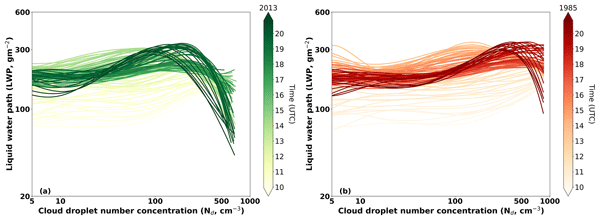
Abstract. Diagnostics from high-resolution Large-Eddy Simulations (LES) are used to investigate aerosol impacts on the liquid water path (LWP) sensitivity in a non-precipitating, single-layer liquid cloud regime. In two LES simulations, the 2013 conditions represent a low aerosol scenario, while the 1985 conditions represent a high aerosol scenario. Joint histograms of cloud droplet number concentration (Nd) and LWP reveal a non-linear relationship, with positive LWP sensitivity (increasing LWP with Nd) at low Nd and negative sensitivity at high Nd. The transition from positive to negative LWP sensitivity occurs at higher Nd values in the 1985 simulation (≈ 300 cm−3) compared to the 2013 simulation (≈ 100 cm−3), indicating that enhanced aerosol loading shifts the transition point. This shift reflects stronger droplet activation and sustained LWP growth under high CCN conditions. Diagnostics of the cloud dilution ratio indicate that negative LWP sensitivity is linked to enhanced cloud-top entrainment. The temporal evolution of the Nd–LWP relationship confirms increasing dominance of negative sensitivity in the 2013 case, while the 1985 case exhibits weaker LWP depletion. Additionally, aerosol perturbations also influence thermodynamic properties such as the apparent heating/cooling (Q1) and the moisture sink (Q2). Specifically, stronger cloud-top heating and moisture sinks are simulated during negative LWP sensitivity phases, particularly for high Nd in 2013, consistent with enhanced evaporation and entrainment. Aerosol perturbations thus modulate both microphysical and thermodynamic processes, producing distinct LWP sensitivity regimes with important implications for understanding aerosol–cloud–climate interactions.
Competing interests: I declare that neither I nor my co-authors have any competing interests.
Publisher's note: Copernicus Publications remains neutral with regard to jurisdictional claims made in the text, published maps, institutional affiliations, or any other geographical representation in this paper. While Copernicus Publications makes every effort to include appropriate place names, the final responsibility lies with the authors. Views expressed in the text are those of the authors and do not necessarily reflect the views of the publisher.-
Notice on discussion status
The requested preprint has a corresponding peer-reviewed final revised paper. You are encouraged to refer to the final revised version.
-
Preprint
(17331 KB)
-
The requested preprint has a corresponding peer-reviewed final revised paper. You are encouraged to refer to the final revised version.
- Preprint
(17331 KB) - Metadata XML
- BibTeX
- EndNote
- Final revised paper


Journal article(s) based on this preprint
Interactive discussion
Status: closed
-
RC1: 'Comment on egusphere-2025-5064', Anonymous Referee #1, 19 Dec 2025
-
AC1: 'Reply on RC1', Sudhakar Dipu, 21 Feb 2026
The comment was uploaded in the form of a supplement: https://egusphere.copernicus.org/preprints/2025/egusphere-2025-5064/egusphere-2025-5064-AC1-supplement.pdf
-
AC1: 'Reply on RC1', Sudhakar Dipu, 21 Feb 2026
-
RC2: 'Comment on egusphere-2025-5064', Anonymous Referee #2, 06 Jan 2026
General comments: This paper presents diagnostics from high-resolution Large-Eddy Simulations to investigate aerosol effect (low vs high concentration) on the liquid water path (LWP) sensitivity in non-precipitating, single-layer liquid clouds. The main analysis is investigating the relationship between Nd and LWP which is non-linear and associated with a transition from a positive to negative relationship at specific Nd value. The study found that aerosol loading shifts this transition point to a higher Nd value and claimed such LWP sensitivity is linked to enhanced cloud-top entrainment. The study further investigated the influence of aerosol perturbations on thermodynamic properties such as the apparent heating/cooling (Q1) and the moisture sink (Q2) in the two contrasting aerosol cases.
The research topic is very relevant and interesting to the scientific community. However, the paper has several concerns in data methods and lacking proper justification/reference. More clarification is also required on the simulation setup, especially how aerosol spatial distribution is initialized and perturbation is imposed.
Another concern arises from the fact that in a real LES simulation where environmental conditions are not identical at all points (as the domain is very large), whether the LWP sensitivity of aerosol can be achieved?. There can be other environmental factors also controlling this sensitivity (Nd – LWP relation). In a sensitivity experiment, in general we keep all other parameters such as environmental conditions same for all the forcing runs to ensure impact of aerosol forcing only. This is more suitable for an ideal LES run.
Considering all these aspects, I feel that the paper is not suitable for publication in its present form and a significant revision is required.
Specific comments:
L12-14: “stronger cloud-top heating and moisture sinks are simulated during negative LWP sensitivity phases, particularly for high Nd in 2013, consistent with enhanced evaporation and entrainment.”
Seems opposite statement as enhanced entrainment and evaporation leads to stronger cooling by latent heat absorption.
L67-70: In this study, we aim to investigate the LWP sensitivity in a non-precipitating continental cloud regime using high-resolution LES model simulation in numerical weather prediction mode, with initial and boundary conditions for a real weather situation, and with interactive land surface (Heinze et al., 2017; Costa-Surós et al., 2020).
Does it mean that two aerosol runs have different initial and boundary conditions?.
L85-87: The CCN concentrations in the model are prescribed as a spatially and temporally varying distribution. The control simulation uses CCN concentrations as estimated for 02 May 2013 (Costa-Surós et al., 2020)., and for the perturbed simulation, CCN concentrations valid for the year approximately 1985 were selected, in which the pollution level in Europe was at its peak (Smith et al., 2011).
How did you consider aerosol perturbation for 1985?. Is it based on observations?
L88 & L89 : Experiment date mismatch.
L95: “we have used the coarse-gridded data with a resolution of 1.2 km”
What is the impact of coarse-gridding in the analysis results?.
L99: The cloud top is defined as the topmost level with Nd > 2 cm−3, which is further filtered for cloud fractions equal to 1 (at the 1.2 km scale) and cloud optical thicknesses greater than 2.
Please give justification or references to support this cloud top detection method. I think Nd > 2 cm-3 is very low value to consider as cloud. Several studies reported cloud detection threshold by LWC > 0.001 g/m3 or Nd > 10 cm-3. In this case, please check if Nd > 2 cm-3 satisfies to the LWC criteria.
L115: The cloud dilution ratio, which serves as a proxy for entrainment, is defined as the ratio of the cloud effective radius to the adiabatic radius.
Provide justification or references to support this statement. As cloud dilution is generally represented by the ratio of LWC to adiabatic LWC.
Now, for this case if LWC/LWC_ad R_eff/R_eff_ad
This simply means that mixing in the clouds is extremely inhomogeneous where evaporation is rapidly adjusted to constant R_eff. Further analysis to support this process is not provided by using time scale analysis. Fig. 3 clearly shows that mixing is not extremely inhomogeneous as indicated by rapidly decreasing R_eff with decreasing Nd.
L119: LWC unit should be g/m3
L130: “However, the LWP distribution shows relatively small shifts towards higher LWP in the 1985 simulation compared to 2013 (Fig. 1b)”
From the figure it seems an insignificant change in the LWP PDFs. This result clearly indicates that aerosol perturbation has no clear impact (positive) on LWP sensitivity.
The analysis related to Nd – LWP joint probability distribution is valid for both low and high CCN cases and produces a similar relation with slight shift. This relation does not produce a LWP sensitivity to aerosol perturbation as similar relation is valid for low and high CCN cases. This relation arises due to spatial variability in aerosol and other environmental conditions. Therefore, it is difficult to understand how aerosol alone impacts LWP in this case.
L145: It is not clear how the transition point of regime shift (positive to negative) is moved to higher side in 1985 case. It is only the aerosol change or the temperature change of global warming is also associated.
L151: “The cloud dilution ratio, which is defined as the ratio of Reff to the adiabatic Rad serves as a proxy for entrainment mixing. Values close to 1 indicate adiabatic clouds, while lower values suggest dilution.”
This statement is not correct. To detect adiabatic clouds, liquid water dilution ratio (LWC/LWC_ad) is best suited. The dilution ratio shown presented in this study depends on mixing type (homogeneous vs. inhomogeneous). For example, in case of extreme inhomogeneous mixing, this ratio (R_eff/R_ad) will be close to 1, even if strong dilution mixing occurred.
L171: “Notably, the 2013 simulation exhibits a stronger negative slope than 1985, highlighting more rapid LWP depletion”…. If I understood correctly, stronger entrainment-evaporation feedback should occur in high aerosol loading case. But here, the response is opposite.
L245: “The analysis clearly indicates that aerosol perturbations and aerosol levels have a significant impact on the LWP sensitivity and associated processes.” This is not really reflected in the presented results. The aerosol perturbation impact on LWP sensitivity is not significant, However, more microphysical and thermodynamical response is found.
L247: “The observed positive tendency in Q1 for negative LWP sensitivity could be due to warm entrainment, which leads to evaporation of cloud droplets”. Entrainment is generally associated with downward motion in cloud top. This should bring colder air inside the cloud?.
Overall, the nobility of the paper/significant result are not clear. The LWP sensitivity to aerosol perturbation is not significant in this study but showed interesting impact on microphysical and thermodynamical properties.
Citation: https://doi.org/10.5194/egusphere-2025-5064-RC2 -
AC2: 'Reply on RC2', Sudhakar Dipu, 21 Feb 2026
The comment was uploaded in the form of a supplement: https://egusphere.copernicus.org/preprints/2025/egusphere-2025-5064/egusphere-2025-5064-AC2-supplement.pdf
-
AC2: 'Reply on RC2', Sudhakar Dipu, 21 Feb 2026
Peer review completion


Interactive discussion
Status: closed
-
RC1: 'Comment on egusphere-2025-5064', Anonymous Referee #1, 19 Dec 2025
In this paper, diagnostics from high-resolution Large-Eddy Simulations (LES) are presented and analyzed to investigate aerosol impacts on LWP sensitivity in a non-precipitating, single-layer liquid cloud regime. The analysis focuses on the non-linear relationship between cloud droplet number concentration and LWP under contrasting aerosol conditions, highlighting distinct regimes of positive and negative LWP sensitivity. The results demonstrate how aerosol loading modulates droplet activation, cloud-top entrainment, and associated thermodynamic responses, thereby shifting the transition between LWP sensitivity regimes. These processes are shown to be highly relevant for understanding aerosol–cloud interactions and for improving the representation of cloud microphysical–dynamical coupling in climate models.
The topic of the manuscript is highly relevant, and the analysis is based on a unique modeling data set. However, I cannot recommend the manuscript for acceptance in its current form, as several aspects of the analysis require clarification. In addition, numerous minor errors and inconsistencies are present throughout the manuscript. I therefore strongly recommend careful proofreading and thorough checking of equations, units, and figures. Some of these issues are outlined below, but the list is by no means exhaustive.
I found it highly interesting that the transition from positive to negative LWP sensitivity occurs at different droplet number concentrations under different aerosol loadings. How does this behavior align with the commonly assumed entrainment feedback? This question is particularly relevant given that the transition occurs at Nd ≈ 300 cm⁻³ in the high-aerosol scenario. At such high concentrations, the mean droplet size is far from having a sedimentation velocity that would be dynamically significant and system shouldn’t be sensitive to changes in Nd.
More detail on the modeling approach is needed to better understand how methodological choices may influence the analysis. Specifically, how is Nd diagnosed from CCN? Is saturation adjustment applied in the cloud microphysics scheme? How is Nd treated during mixing and entrainment processes? What is the vertical resolution near the cloud top? Do updraft velocities differ between the simulations as a result of aerosol perturbations?
Line 35–36: “The numerous small droplets also lead to droplet sedimentation.”
Isn’t the opposite expected, with smaller droplets having reduced sedimentation velocities?Line 36: “Enhance radiative cooling at the cloud top.”
This statement could be more precise, as radiative cooling occurs within a relatively thin layer near the cloud top.Line 37: “Further, the entrainment of warm, dry air into the cloud leads to evaporation of the smaller droplets, resulting in decreases in LWP or negative LWP adjustment.”
Entrainment leads to LWP reduction even if all droplets lose mass homogeneously, not only through preferential evaporation of smaller droplets.Line 49: “The Nd–LWP relationship is non-linear, and the co-variability between LWP and Nd primarily drives it.” While this is true, is it the co-variability between aerosol and meteorological conditions that fundamentally drives both LWP and Nd?
Line 53: Please clarify that the modeling referred to here concerns global, low-resolution models.
Line 95: Could the averaging of data to a coarser grid resolution affect the results? The original LES output likely resolves cloud-scale structures, but aggregation to 1.2 km places the analysis in the “gray zone” for cloud dynamical processes. Was the analysis repeated over smaller spatial scales to confirm that averaging does not affect?
Line 99–100: Why is this criterion used instead of one based on liquid water content? Such a layer may have very low LWC and therefore may not represent the actual cloud top, but rather a layer above it.
Line 102–104: This assumption is unlikely to hold over a one-day simulation. However, I did not find an analysis in the paper that could be affected.
Equation (2): Is the last term correct, given that vertical pressure velocity is used?
Equation (3): This equation appears to describe the mean volume diameter. If so, the subsequent calculation of the cloud dilution factor does not seem to be meaningful. Also the units appear incorrect.
Line 122: “Binned with a bin size of 1000.”
I assume this refers to the number of bins rather than the bin width; please clarify.Line 143: The results are qualitatively consistent but far from being quantitatively consistent.
Line 148: “Which sustained droplet activation.”
The term sustained does not seem appropriate in this context.Line 164: “Initially, both simulations exhibit positive LWP sensitivity.”
What is the reason for this behavior? Is it related to assumptions about the initial conditions? Are the initial thermodynamic profiles identical, differing only in aerosol loading?Line 175: How are the different critical values determined? Are they derived across different spatial domains or over different time intervals?
Line 188: Related to the earlier comment on the definition of cloud top, how representative is Nd at cloud top of Nd throughout the cloud volume?
Line 192: This statement holds only if saturation adjustment is not used and condensation is explicitly calculated.
Line 195 onward: The effects of radiative cooling and heating are not discussed, despite being speculated as key mechanisms driving the negative Nd–LWP relationship. Why are these processes not analyzed in more detail?
Line 198: When discussing high-resolution simulations and processes occurring at the cloud edge, is advection the appropriate term, or would mixing be more accurate? More generally, modeling and also the analysis details may significantly affect the results, as numerical diffusion is unavoidable when Lagrangian processes are simulated in Eulerian framework. This may influence the diagnosed apparent heating and moisture sink terms.
Figure 1: Mean values could be added to both panels.
Figure 2: “the 1985 simulation uses the pre-industrial (1985) CCN”. This is a new definition for pre-industrial era.
Figure 6: left axis is cut of from the figure
Figure 7: ylabel “aparent”
Figure A1: Check the units.
Citation: https://doi.org/10.5194/egusphere-2025-5064-RC1 -
AC1: 'Reply on RC1', Sudhakar Dipu, 21 Feb 2026
The comment was uploaded in the form of a supplement: https://egusphere.copernicus.org/preprints/2025/egusphere-2025-5064/egusphere-2025-5064-AC1-supplement.pdf
-
AC1: 'Reply on RC1', Sudhakar Dipu, 21 Feb 2026
-
RC2: 'Comment on egusphere-2025-5064', Anonymous Referee #2, 06 Jan 2026
General comments: This paper presents diagnostics from high-resolution Large-Eddy Simulations to investigate aerosol effect (low vs high concentration) on the liquid water path (LWP) sensitivity in non-precipitating, single-layer liquid clouds. The main analysis is investigating the relationship between Nd and LWP which is non-linear and associated with a transition from a positive to negative relationship at specific Nd value. The study found that aerosol loading shifts this transition point to a higher Nd value and claimed such LWP sensitivity is linked to enhanced cloud-top entrainment. The study further investigated the influence of aerosol perturbations on thermodynamic properties such as the apparent heating/cooling (Q1) and the moisture sink (Q2) in the two contrasting aerosol cases.
The research topic is very relevant and interesting to the scientific community. However, the paper has several concerns in data methods and lacking proper justification/reference. More clarification is also required on the simulation setup, especially how aerosol spatial distribution is initialized and perturbation is imposed.
Another concern arises from the fact that in a real LES simulation where environmental conditions are not identical at all points (as the domain is very large), whether the LWP sensitivity of aerosol can be achieved?. There can be other environmental factors also controlling this sensitivity (Nd – LWP relation). In a sensitivity experiment, in general we keep all other parameters such as environmental conditions same for all the forcing runs to ensure impact of aerosol forcing only. This is more suitable for an ideal LES run.
Considering all these aspects, I feel that the paper is not suitable for publication in its present form and a significant revision is required.
Specific comments:
L12-14: “stronger cloud-top heating and moisture sinks are simulated during negative LWP sensitivity phases, particularly for high Nd in 2013, consistent with enhanced evaporation and entrainment.”
Seems opposite statement as enhanced entrainment and evaporation leads to stronger cooling by latent heat absorption.
L67-70: In this study, we aim to investigate the LWP sensitivity in a non-precipitating continental cloud regime using high-resolution LES model simulation in numerical weather prediction mode, with initial and boundary conditions for a real weather situation, and with interactive land surface (Heinze et al., 2017; Costa-Surós et al., 2020).
Does it mean that two aerosol runs have different initial and boundary conditions?.
L85-87: The CCN concentrations in the model are prescribed as a spatially and temporally varying distribution. The control simulation uses CCN concentrations as estimated for 02 May 2013 (Costa-Surós et al., 2020)., and for the perturbed simulation, CCN concentrations valid for the year approximately 1985 were selected, in which the pollution level in Europe was at its peak (Smith et al., 2011).
How did you consider aerosol perturbation for 1985?. Is it based on observations?
L88 & L89 : Experiment date mismatch.
L95: “we have used the coarse-gridded data with a resolution of 1.2 km”
What is the impact of coarse-gridding in the analysis results?.
L99: The cloud top is defined as the topmost level with Nd > 2 cm−3, which is further filtered for cloud fractions equal to 1 (at the 1.2 km scale) and cloud optical thicknesses greater than 2.
Please give justification or references to support this cloud top detection method. I think Nd > 2 cm-3 is very low value to consider as cloud. Several studies reported cloud detection threshold by LWC > 0.001 g/m3 or Nd > 10 cm-3. In this case, please check if Nd > 2 cm-3 satisfies to the LWC criteria.
L115: The cloud dilution ratio, which serves as a proxy for entrainment, is defined as the ratio of the cloud effective radius to the adiabatic radius.
Provide justification or references to support this statement. As cloud dilution is generally represented by the ratio of LWC to adiabatic LWC.
Now, for this case if LWC/LWC_ad R_eff/R_eff_ad
This simply means that mixing in the clouds is extremely inhomogeneous where evaporation is rapidly adjusted to constant R_eff. Further analysis to support this process is not provided by using time scale analysis. Fig. 3 clearly shows that mixing is not extremely inhomogeneous as indicated by rapidly decreasing R_eff with decreasing Nd.
L119: LWC unit should be g/m3
L130: “However, the LWP distribution shows relatively small shifts towards higher LWP in the 1985 simulation compared to 2013 (Fig. 1b)”
From the figure it seems an insignificant change in the LWP PDFs. This result clearly indicates that aerosol perturbation has no clear impact (positive) on LWP sensitivity.
The analysis related to Nd – LWP joint probability distribution is valid for both low and high CCN cases and produces a similar relation with slight shift. This relation does not produce a LWP sensitivity to aerosol perturbation as similar relation is valid for low and high CCN cases. This relation arises due to spatial variability in aerosol and other environmental conditions. Therefore, it is difficult to understand how aerosol alone impacts LWP in this case.
L145: It is not clear how the transition point of regime shift (positive to negative) is moved to higher side in 1985 case. It is only the aerosol change or the temperature change of global warming is also associated.
L151: “The cloud dilution ratio, which is defined as the ratio of Reff to the adiabatic Rad serves as a proxy for entrainment mixing. Values close to 1 indicate adiabatic clouds, while lower values suggest dilution.”
This statement is not correct. To detect adiabatic clouds, liquid water dilution ratio (LWC/LWC_ad) is best suited. The dilution ratio shown presented in this study depends on mixing type (homogeneous vs. inhomogeneous). For example, in case of extreme inhomogeneous mixing, this ratio (R_eff/R_ad) will be close to 1, even if strong dilution mixing occurred.
L171: “Notably, the 2013 simulation exhibits a stronger negative slope than 1985, highlighting more rapid LWP depletion”…. If I understood correctly, stronger entrainment-evaporation feedback should occur in high aerosol loading case. But here, the response is opposite.
L245: “The analysis clearly indicates that aerosol perturbations and aerosol levels have a significant impact on the LWP sensitivity and associated processes.” This is not really reflected in the presented results. The aerosol perturbation impact on LWP sensitivity is not significant, However, more microphysical and thermodynamical response is found.
L247: “The observed positive tendency in Q1 for negative LWP sensitivity could be due to warm entrainment, which leads to evaporation of cloud droplets”. Entrainment is generally associated with downward motion in cloud top. This should bring colder air inside the cloud?.
Overall, the nobility of the paper/significant result are not clear. The LWP sensitivity to aerosol perturbation is not significant in this study but showed interesting impact on microphysical and thermodynamical properties.
Citation: https://doi.org/10.5194/egusphere-2025-5064-RC2 -
AC2: 'Reply on RC2', Sudhakar Dipu, 21 Feb 2026
The comment was uploaded in the form of a supplement: https://egusphere.copernicus.org/preprints/2025/egusphere-2025-5064/egusphere-2025-5064-AC2-supplement.pdf
-
AC2: 'Reply on RC2', Sudhakar Dipu, 21 Feb 2026
Peer review completion
Journal article(s) based on this preprint
Viewed
| HTML | XML | Total | BibTeX | EndNote | |
|---|---|---|---|---|---|
| 2,152 | 767 | 228 | 3,147 | 236 | 266 |
- HTML: 2,152
- PDF: 767
- XML: 228
- Total: 3,147
- BibTeX: 236
- EndNote: 266
Viewed (geographical distribution)
| Country | # | Views | % |
|---|
| Total: | 0 |
| HTML: | 0 |
| PDF: | 0 |
| XML: | 0 |
- 1
Sudhakar Dipu

Johannes Mülmenstädt
Johannes Quaas
The requested preprint has a corresponding peer-reviewed final revised paper. You are encouraged to refer to the final revised version.
- Preprint
(17331 KB) - Metadata XML
In this paper, diagnostics from high-resolution Large-Eddy Simulations (LES) are presented and analyzed to investigate aerosol impacts on LWP sensitivity in a non-precipitating, single-layer liquid cloud regime. The analysis focuses on the non-linear relationship between cloud droplet number concentration and LWP under contrasting aerosol conditions, highlighting distinct regimes of positive and negative LWP sensitivity. The results demonstrate how aerosol loading modulates droplet activation, cloud-top entrainment, and associated thermodynamic responses, thereby shifting the transition between LWP sensitivity regimes. These processes are shown to be highly relevant for understanding aerosol–cloud interactions and for improving the representation of cloud microphysical–dynamical coupling in climate models.
The topic of the manuscript is highly relevant, and the analysis is based on a unique modeling data set. However, I cannot recommend the manuscript for acceptance in its current form, as several aspects of the analysis require clarification. In addition, numerous minor errors and inconsistencies are present throughout the manuscript. I therefore strongly recommend careful proofreading and thorough checking of equations, units, and figures. Some of these issues are outlined below, but the list is by no means exhaustive.
I found it highly interesting that the transition from positive to negative LWP sensitivity occurs at different droplet number concentrations under different aerosol loadings. How does this behavior align with the commonly assumed entrainment feedback? This question is particularly relevant given that the transition occurs at Nd ≈ 300 cm⁻³ in the high-aerosol scenario. At such high concentrations, the mean droplet size is far from having a sedimentation velocity that would be dynamically significant and system shouldn’t be sensitive to changes in Nd.
More detail on the modeling approach is needed to better understand how methodological choices may influence the analysis. Specifically, how is Nd diagnosed from CCN? Is saturation adjustment applied in the cloud microphysics scheme? How is Nd treated during mixing and entrainment processes? What is the vertical resolution near the cloud top? Do updraft velocities differ between the simulations as a result of aerosol perturbations?
Line 35–36: “The numerous small droplets also lead to droplet sedimentation.”
Isn’t the opposite expected, with smaller droplets having reduced sedimentation velocities?
Line 36: “Enhance radiative cooling at the cloud top.”
This statement could be more precise, as radiative cooling occurs within a relatively thin layer near the cloud top.
Line 37: “Further, the entrainment of warm, dry air into the cloud leads to evaporation of the smaller droplets, resulting in decreases in LWP or negative LWP adjustment.”
Entrainment leads to LWP reduction even if all droplets lose mass homogeneously, not only through preferential evaporation of smaller droplets.
Line 49: “The Nd–LWP relationship is non-linear, and the co-variability between LWP and Nd primarily drives it.” While this is true, is it the co-variability between aerosol and meteorological conditions that fundamentally drives both LWP and Nd?
Line 53: Please clarify that the modeling referred to here concerns global, low-resolution models.
Line 95: Could the averaging of data to a coarser grid resolution affect the results? The original LES output likely resolves cloud-scale structures, but aggregation to 1.2 km places the analysis in the “gray zone” for cloud dynamical processes. Was the analysis repeated over smaller spatial scales to confirm that averaging does not affect?
Line 99–100: Why is this criterion used instead of one based on liquid water content? Such a layer may have very low LWC and therefore may not represent the actual cloud top, but rather a layer above it.
Line 102–104: This assumption is unlikely to hold over a one-day simulation. However, I did not find an analysis in the paper that could be affected.
Equation (2): Is the last term correct, given that vertical pressure velocity is used?
Equation (3): This equation appears to describe the mean volume diameter. If so, the subsequent calculation of the cloud dilution factor does not seem to be meaningful. Also the units appear incorrect.
Line 122: “Binned with a bin size of 1000.”
I assume this refers to the number of bins rather than the bin width; please clarify.
Line 143: The results are qualitatively consistent but far from being quantitatively consistent.
Line 148: “Which sustained droplet activation.”
The term sustained does not seem appropriate in this context.
Line 164: “Initially, both simulations exhibit positive LWP sensitivity.”
What is the reason for this behavior? Is it related to assumptions about the initial conditions? Are the initial thermodynamic profiles identical, differing only in aerosol loading?
Line 175: How are the different critical values determined? Are they derived across different spatial domains or over different time intervals?
Line 188: Related to the earlier comment on the definition of cloud top, how representative is Nd at cloud top of Nd throughout the cloud volume?
Line 192: This statement holds only if saturation adjustment is not used and condensation is explicitly calculated.
Line 195 onward: The effects of radiative cooling and heating are not discussed, despite being speculated as key mechanisms driving the negative Nd–LWP relationship. Why are these processes not analyzed in more detail?
Line 198: When discussing high-resolution simulations and processes occurring at the cloud edge, is advection the appropriate term, or would mixing be more accurate? More generally, modeling and also the analysis details may significantly affect the results, as numerical diffusion is unavoidable when Lagrangian processes are simulated in Eulerian framework. This may influence the diagnosed apparent heating and moisture sink terms.
Figure 1: Mean values could be added to both panels.
Figure 2: “the 1985 simulation uses the pre-industrial (1985) CCN”. This is a new definition for pre-industrial era.
Figure 6: left axis is cut of from the figure
Figure 7: ylabel “aparent”
Figure A1: Check the units.