
the Creative Commons Attribution 4.0 License.
the Creative Commons Attribution 4.0 License.
 | 22 Oct 2025
Capturing the complete landslide–debris-rich flood continuum for accurate inventory, susceptibility and exposure mapping – lessons from Cyclone Idai
Abstract. In mountainous regions, intense rainfall can trigger thousands of landslides within hours. The drivers that control the occurrence of such landslides, and the methods for predicting the zones susceptible to their initiation have been extensively studied. Yet, for many of the most severe disasters associated with these landslide events, the main impacts on local communities occurred far from the source areas where most modelling efforts are focused. Sediments mobilized high on slopes by rainfall-triggered landslides can be transported many kilometres downstream, causing significant impacts along their path, while also feeding river systems with large amounts of sediments and consequently increasing flood risks. Such chain of cascading hazards significantly increases the destructive potential of landslides as well as their impact zone. Effective risk mitigation must therefore address not just susceptibility to initiation but also landslide mobility and hazard interactions—yet such studies remain rare.
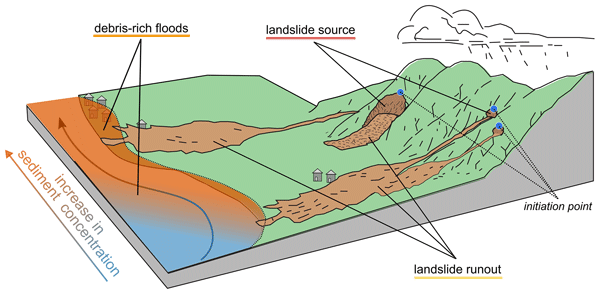
With this work, we emphasize the importance of capturing what we refer to as the landslide–debris-rich flood continuum (landslide source, runout and related debris-rich floods) for accurate inventory, susceptibility and exposure mapping when landslide mobility is high – as it is often the case for extreme rainfall events. We apply this approach in two districts of eastern Zimbabwe (> 8000 km²), severely impacted by Cyclone Idai in March 2019. Using simple, replicable methods, we mapped over 14,000 (mostly) shallow landslides and 94 km² of debris-rich flood-affected zones. These data informed detailed susceptibility and exposure models that distinguish between the processes involved. Our results show that around 226,000 individuals live in areas of moderate to high susceptibility to landslide or debris-rich floods – closely matching official figures of those affected by the cyclone. Notably, landslide sources account for only about one-fifth of this total exposure. This highlights the need to consider the entire hazard continuum. Our approach also exemplifies how simple, open-access tools and data can be highly effective for hazard and risk analyses across of the globe.
Competing interests: At least one of the (co-)authors is a member of the editorial board of Natural Hazards and Earth System Sciences.
Publisher's note: Copernicus Publications remains neutral with regard to jurisdictional claims made in the text, published maps, institutional affiliations, or any other geographical representation in this paper. While Copernicus Publications makes every effort to include appropriate place names, the final responsibility lies with the authors. Views expressed in the text are those of the authors and do not necessarily reflect the views of the publisher.-
Notice on discussion status
The requested preprint has a corresponding peer-reviewed final revised paper. You are encouraged to refer to the final revised version.
-
Preprint
(9772 KB)
-
The requested preprint has a corresponding peer-reviewed final revised paper. You are encouraged to refer to the final revised version.
- Preprint
(9772 KB) - Metadata XML
- BibTeX
- EndNote
- Final revised paper


Journal article(s) based on this preprint
Interactive discussion
Status: closed
-
RC1: 'Comment on egusphere-2025-5056', Anonymous Referee #1, 09 Dec 2025
-
AC1: 'Reply on RC1', Antoine Dille, 23 Apr 2026
We thank the Reviewer for their careful reading and constructive comments. We apologize for the delay in responding - we waited for a second review before engaging. We appreciate that the Reviewer finds the core concept of the landslide–debris-rich flood continuum sound, and raises only points of clarification.
On topographic factors and rainfall
We deliberately chose not to reproduce equations for the topographic variables, as these are now standard in the literature and are fully detailed in the references provided. Given the manuscript's length, we preferred to keep the methods section concise and on the most novel aspects while directing readers to the relevant sources. We are of course happy to include equations if the Reviewer or Editor considers this necessary.Regarding rainfall: it is not used as a predictor variable, as doing so would bias the model toward the specific landscape conditions of the Idai event rather than capturing underlying morphological susceptibility. Rainfall data (IMERG-GPM) are instead used in the event description (Section 1.2) and in the interpretation of results (Section 3.1).
On the DEM choice
A growing body of literature supports the use of the Copernicus GLO-30 DEM over older products such as SRTM (now over 20 years old) for geomorphological applications (e.g., Meadows et al., 2024). That said, at 30 m resolution, we expect differences between equivalent-resolution DEMs to have a minor influence on model outputs. We will add one sentence acknowledging that while Copernicus GLO-30 is preferred, results would likely be similar with other 30 m DEMs.Meadows, M., Jones, S. and Reinke, K., 2024. Vertical accuracy assessment of freely available global DEMs (FABDEM, Copernicus DEM, NASADEM, AW3D30 and SRTM) in flood-prone environments. International Journal of Digital Earth, 17(1), p.2308734.
On transferability to data-scarce regions
This is a valid and practically important question. The methodology was intentionally built around simple morphological and hydrological variables available globally, with replicability in data-scarce environments explicitly in mind. While the model as trained here should be transferable to other regions as relying on predictors that apply to any landslide (and related debris-rich flood) anywhere on Earth (simply capturing where mass is likely to be mobilized, transported, or deposited), accuracy would likely improve when retrained on locally collected inventories, potentially supplemented by region-specific variables reflecting local environmental conditions. We will add a short paragraph in the discussion addressing transferability and the trade-offs involved.On temporal dynamics and DEM updates
The Reviewer raises an interesting point. We fully agree that following a landslide, the likelihood of recurrence at the exact same location decreases over time as mobilizable material is depleted — a dynamic analogous to the one described in post-fire debris flow systems in e.g., McGuire et al., (2024). Yet, such geomorphic considerations have implications when studying the background (historical) susceptibility. Here, while the produced models have clear predictive power for other future events, we aim primarily at mapping the susceptibility (and especially the related population exposure) linked to a specific (extreme) event. We will make sure to better stress this point in the revised version of the manuscript.With respect to the topographic data, a DEM update would indeed capture slope modifications and alter model outputs accordingly. However, three considerations limit the practical impact of this caveat in our framework. First, neighbouring slopes with similar morphological conditions remain susceptible even when a specific location has been destabilized. Second, landslides triggered by Idai being in vast majority shallow, working with 30-m resolution DEM, the impact of landslides on topography is barely visible, and we believe would not really influence the result. Third, our framework explicitly extends beyond landslide initiation to downstream impacts — a domain where sediment remobilization from prior landslides can persist for years (as illustrated in Fig. 1b–d, taken 2.5 years post-event).
McGuire, L.A., Ebel, B.A., Rengers, F.K., Vieira, D.C. and Nyman, P., 2024. Fire effects on geomorphic processes. Nature reviews earth & environment, 5(7), pp.486-503.
On Figure 3 (INV_01-POLY)
The apparent contrast in spatial detail between the northern and southern portions of the panel simply reflects the distribution of landslides and debris-rich floods triggered by Cyclone Idai — concentrated around Chimanimani and east of Chipinge — rather than any difference in mapping protocol or resolution. All four classes were mapped with consistent detail throughout the zones shown in panel a. Inventory polygons were selected to be broadly representative of the range of processes observed across both districts, together covering a very large 15% of the total study area (Section 2.1.1).Citation: https://doi.org/10.5194/egusphere-2025-5056-AC1
-
AC1: 'Reply on RC1', Antoine Dille, 23 Apr 2026
-
RC2: 'Comment on egusphere-2025-5056', Anonymous Referee #2, 27 Apr 2026
This study highlights the importance of mapping the full range of landslide-related hazards associated with cyclones, with a focus on the tropical Cyclone Idai, one of the most costly cyclones to affect the African continent. The authors conducted a very thorough analysis to obtain a complete inventory of landslide-debris-rich flood areas. The methodology is clearly explained, and results are presented in an easy-to-understand fashion.The use of simple methods increases the value of such work; however, for reproducibility in other areas or cyclone-related scenarios within the same area, would it be necessary to manually map newly triggered landslides? Or can the model be used to directly automatically identify the landslide-debris-rich flood areas?Given the increasing frequency of extreme rainfall events, how can the landslide–debris-rich flood continuum approach be operationalised within national and regional disaster risk reduction frameworks to reduce the exposure of vulnerable communities? Was this case received as a lesson, and did the measures taken reduce the impact of the 2020-2025 cyclones?Another easy aspect that needs fixing is the one related to figures. In some cases, the “km” of the scale is obscured by the terrain shading. In Figure 3a, the contrast between classes and shading makes it hard to read. Moreover, there are some rectangular polygons in the central and southern part of the area. Are these just some areas used to train the model?Citation: https://doi.org/
10.5194/egusphere-2025-5056-RC2 -
AC2: 'Reply on RC2', Antoine Dille, 04 May 2026
We thank the Reviewer for their careful reading and constructive comments.
On reproducibility and transferability with/without new data
This is indeed an important aspect that should be clarified in the text. The methodology was intentionally designed around simple morphological and hydrological variables available globally, with replicability in data-scarce environments explicitly in mind. While the model, as trained here, should be transferable to other regions—relying on predictors applicable to any landslide (and related debris-rich flood) anywhere on Earth (simply capturing where mass is likely to be mobilized, transported, or deposited)—its accuracy would likely improve if retrained on locally collected inventories, potentially supplemented by region-specific variables reflecting local environmental conditions.Regarding reproducibility within the same area, it should remain high for events of similar magnitude to Idai, on which the models were trained and evaluated (i.e., quite extreme). However, it would likely be lower for smaller-scale events (zones with the highest risk for landslide initiation remain similar, but with a much more constrained extent for runout and debris-rich floods). We will add a short paragraph in the Discussion to address these aspects of reproducibility and transferability.
On the use in regional disaster risk reduction frameworks
This study was conducted as part of the UNESCO project BE-RESILIENT Zimbabwe, funded by the World Bank and managed by the UNOPS Zimbabwe Idai Recovery Project with disaster risk management directly in mind. The landslide hazard and exposure maps identified critical educational and health institutions that were potentially at risk. This result led to a more in-depth analysis of 15 schools in the region, with respect to their multi-hazard risk, leading to risk profiles for each school and clear investment criteria. Additionally, this pilot case will be further upscaled to a larger area in the following months, covering headwater catchments in the transboundary Busi, Pungwe and Save Catchments, providing support to more operational landslide awareness and preparedness, and providing the building block for a future landslide early warning system in the region.On the Figures
Regarding Fig 3 and Fig Appendix A1 the slight overlay of the "km" label with the map was a deliberate visual choice. While we do believe it does not hinder the reader’s understanding that the unit is kilometers, we will adjust the figure layout in the revision to minimize overlap if the Reviewer prefers. As explained in the method section 2.1.1. and in the Fig 3a legend, the polygons represent “the manual polygon-based inventory (INV_01-POLY) used for training and validating the logistic regression model (cf. sections 2.1.3 and 2.2)”. The green rectangles (which indicate areas manually checked for landslides/debris-rich floods but where none were found) may have caused some confusion.Citation: https://doi.org/10.5194/egusphere-2025-5056-AC2
-
AC2: 'Reply on RC2', Antoine Dille, 04 May 2026
Peer review completion


Interactive discussion
Status: closed
-
RC1: 'Comment on egusphere-2025-5056', Anonymous Referee #1, 09 Dec 2025
This study emphasizes the importance of conducting risk assessments over broad areas with consideration of the entire landslide–debris–rich flood continuum, and it estimates the affected population by examining the relationships between past landslide records and various geomorphological parameters. As there are some unclear points regarding the details, I would like to post a few comments below.
-In lines 190–195, you describe the topographic factors calculated using the Copernicus GLO-30 DEM; however, I think it would be easier to understand if the variables used in the calculations were explicitly presented using equations. In addition, it is not clear how rainfall information is considered in the methodology. Is it incorporated through the TWI? If so, please clarify how rainfall data are included as variables and specify what kind of rainfall dataset is used.
-Related to the above point, the DEM used in this study is the Copernicus GLO-30 DEM; however, there are other DEM products with a 30-m spatial resolution, such as SRTM and ASTER GDEM. It would be useful for readers if you could mention whether similar estimations could be achieved using other DEMs, or whether the Copernicus GLO-30 DEM has particular advantages that make it more suitable for this application.
-If this method were applied to other areas, would it become difficult to estimate the impact in locations where the historical records of landslides are insufficient? Alternatively, would it still be possible to estimate the impact in such locations by using a model trained on landslide records from nearby regions? Discussing this point would provide valuable information for potential users who may consider applying the method to other areas.
-From a long-term perspective, it is generally understood that once a landslide occurs, the likelihood of another landslide occurring at the same location may decrease for some time. Since your method estimates hazards based on topographic factors, it appears that the model may implicitly assume that landslides can occur repeatedly without limitation. When the DEM is updated, the affected slope would become gentler, which should alter the estimated results. It would therefore be helpful if you could discuss how updates to the DEM influence the estimation of landslide impacts, as this would improve readers’ understanding of the general applicability and temporal consistency of the method.
-Regarding the leftmost panel of Figure 3 (INV_01-POLY), the area near Chimanimani in the north appears to be mapped in considerable detail, whereas the southern part is represented in a more coarse, rectangular manner. Does this imply that the areas classified as “no landslide/debris-rich flood” do not require detailed spatial information to the same extent?
Citation: https://doi.org/10.5194/egusphere-2025-5056-RC1 -
AC1: 'Reply on RC1', Antoine Dille, 23 Apr 2026
We thank the Reviewer for their careful reading and constructive comments. We apologize for the delay in responding - we waited for a second review before engaging. We appreciate that the Reviewer finds the core concept of the landslide–debris-rich flood continuum sound, and raises only points of clarification.
On topographic factors and rainfall
We deliberately chose not to reproduce equations for the topographic variables, as these are now standard in the literature and are fully detailed in the references provided. Given the manuscript's length, we preferred to keep the methods section concise and on the most novel aspects while directing readers to the relevant sources. We are of course happy to include equations if the Reviewer or Editor considers this necessary.Regarding rainfall: it is not used as a predictor variable, as doing so would bias the model toward the specific landscape conditions of the Idai event rather than capturing underlying morphological susceptibility. Rainfall data (IMERG-GPM) are instead used in the event description (Section 1.2) and in the interpretation of results (Section 3.1).
On the DEM choice
A growing body of literature supports the use of the Copernicus GLO-30 DEM over older products such as SRTM (now over 20 years old) for geomorphological applications (e.g., Meadows et al., 2024). That said, at 30 m resolution, we expect differences between equivalent-resolution DEMs to have a minor influence on model outputs. We will add one sentence acknowledging that while Copernicus GLO-30 is preferred, results would likely be similar with other 30 m DEMs.Meadows, M., Jones, S. and Reinke, K., 2024. Vertical accuracy assessment of freely available global DEMs (FABDEM, Copernicus DEM, NASADEM, AW3D30 and SRTM) in flood-prone environments. International Journal of Digital Earth, 17(1), p.2308734.
On transferability to data-scarce regions
This is a valid and practically important question. The methodology was intentionally built around simple morphological and hydrological variables available globally, with replicability in data-scarce environments explicitly in mind. While the model as trained here should be transferable to other regions as relying on predictors that apply to any landslide (and related debris-rich flood) anywhere on Earth (simply capturing where mass is likely to be mobilized, transported, or deposited), accuracy would likely improve when retrained on locally collected inventories, potentially supplemented by region-specific variables reflecting local environmental conditions. We will add a short paragraph in the discussion addressing transferability and the trade-offs involved.On temporal dynamics and DEM updates
The Reviewer raises an interesting point. We fully agree that following a landslide, the likelihood of recurrence at the exact same location decreases over time as mobilizable material is depleted — a dynamic analogous to the one described in post-fire debris flow systems in e.g., McGuire et al., (2024). Yet, such geomorphic considerations have implications when studying the background (historical) susceptibility. Here, while the produced models have clear predictive power for other future events, we aim primarily at mapping the susceptibility (and especially the related population exposure) linked to a specific (extreme) event. We will make sure to better stress this point in the revised version of the manuscript.With respect to the topographic data, a DEM update would indeed capture slope modifications and alter model outputs accordingly. However, three considerations limit the practical impact of this caveat in our framework. First, neighbouring slopes with similar morphological conditions remain susceptible even when a specific location has been destabilized. Second, landslides triggered by Idai being in vast majority shallow, working with 30-m resolution DEM, the impact of landslides on topography is barely visible, and we believe would not really influence the result. Third, our framework explicitly extends beyond landslide initiation to downstream impacts — a domain where sediment remobilization from prior landslides can persist for years (as illustrated in Fig. 1b–d, taken 2.5 years post-event).
McGuire, L.A., Ebel, B.A., Rengers, F.K., Vieira, D.C. and Nyman, P., 2024. Fire effects on geomorphic processes. Nature reviews earth & environment, 5(7), pp.486-503.
On Figure 3 (INV_01-POLY)
The apparent contrast in spatial detail between the northern and southern portions of the panel simply reflects the distribution of landslides and debris-rich floods triggered by Cyclone Idai — concentrated around Chimanimani and east of Chipinge — rather than any difference in mapping protocol or resolution. All four classes were mapped with consistent detail throughout the zones shown in panel a. Inventory polygons were selected to be broadly representative of the range of processes observed across both districts, together covering a very large 15% of the total study area (Section 2.1.1).Citation: https://doi.org/10.5194/egusphere-2025-5056-AC1
-
AC1: 'Reply on RC1', Antoine Dille, 23 Apr 2026
-
RC2: 'Comment on egusphere-2025-5056', Anonymous Referee #2, 27 Apr 2026
This study highlights the importance of mapping the full range of landslide-related hazards associated with cyclones, with a focus on the tropical Cyclone Idai, one of the most costly cyclones to affect the African continent. The authors conducted a very thorough analysis to obtain a complete inventory of landslide-debris-rich flood areas. The methodology is clearly explained, and results are presented in an easy-to-understand fashion.The use of simple methods increases the value of such work; however, for reproducibility in other areas or cyclone-related scenarios within the same area, would it be necessary to manually map newly triggered landslides? Or can the model be used to directly automatically identify the landslide-debris-rich flood areas?Given the increasing frequency of extreme rainfall events, how can the landslide–debris-rich flood continuum approach be operationalised within national and regional disaster risk reduction frameworks to reduce the exposure of vulnerable communities? Was this case received as a lesson, and did the measures taken reduce the impact of the 2020-2025 cyclones?Another easy aspect that needs fixing is the one related to figures. In some cases, the “km” of the scale is obscured by the terrain shading. In Figure 3a, the contrast between classes and shading makes it hard to read. Moreover, there are some rectangular polygons in the central and southern part of the area. Are these just some areas used to train the model?Citation: https://doi.org/
10.5194/egusphere-2025-5056-RC2 -
AC2: 'Reply on RC2', Antoine Dille, 04 May 2026
We thank the Reviewer for their careful reading and constructive comments.
On reproducibility and transferability with/without new data
This is indeed an important aspect that should be clarified in the text. The methodology was intentionally designed around simple morphological and hydrological variables available globally, with replicability in data-scarce environments explicitly in mind. While the model, as trained here, should be transferable to other regions—relying on predictors applicable to any landslide (and related debris-rich flood) anywhere on Earth (simply capturing where mass is likely to be mobilized, transported, or deposited)—its accuracy would likely improve if retrained on locally collected inventories, potentially supplemented by region-specific variables reflecting local environmental conditions.Regarding reproducibility within the same area, it should remain high for events of similar magnitude to Idai, on which the models were trained and evaluated (i.e., quite extreme). However, it would likely be lower for smaller-scale events (zones with the highest risk for landslide initiation remain similar, but with a much more constrained extent for runout and debris-rich floods). We will add a short paragraph in the Discussion to address these aspects of reproducibility and transferability.
On the use in regional disaster risk reduction frameworks
This study was conducted as part of the UNESCO project BE-RESILIENT Zimbabwe, funded by the World Bank and managed by the UNOPS Zimbabwe Idai Recovery Project with disaster risk management directly in mind. The landslide hazard and exposure maps identified critical educational and health institutions that were potentially at risk. This result led to a more in-depth analysis of 15 schools in the region, with respect to their multi-hazard risk, leading to risk profiles for each school and clear investment criteria. Additionally, this pilot case will be further upscaled to a larger area in the following months, covering headwater catchments in the transboundary Busi, Pungwe and Save Catchments, providing support to more operational landslide awareness and preparedness, and providing the building block for a future landslide early warning system in the region.On the Figures
Regarding Fig 3 and Fig Appendix A1 the slight overlay of the "km" label with the map was a deliberate visual choice. While we do believe it does not hinder the reader’s understanding that the unit is kilometers, we will adjust the figure layout in the revision to minimize overlap if the Reviewer prefers. As explained in the method section 2.1.1. and in the Fig 3a legend, the polygons represent “the manual polygon-based inventory (INV_01-POLY) used for training and validating the logistic regression model (cf. sections 2.1.3 and 2.2)”. The green rectangles (which indicate areas manually checked for landslides/debris-rich floods but where none were found) may have caused some confusion.Citation: https://doi.org/10.5194/egusphere-2025-5056-AC2
-
AC2: 'Reply on RC2', Antoine Dille, 04 May 2026
Peer review completion
Journal article(s) based on this preprint
Viewed
| HTML | XML | Total | BibTeX | EndNote | |
|---|---|---|---|---|---|
| 1,835 | 2,641 | 188 | 4,664 | 149 | 136 |
- HTML: 1,835
- PDF: 2,641
- XML: 188
- Total: 4,664
- BibTeX: 149
- EndNote: 136
Viewed (geographical distribution)
| Country | # | Views | % |
|---|
| Total: | 0 |
| HTML: | 0 |
| PDF: | 0 |
| XML: | 0 |
- 1
Cited


1 citations as recorded by crossref.

Olivier Dewitte
Jente Broeckx
Koen Verbist
Andile Sindiso Dube
Jean Poesen
Matthias Vanmaercke
The requested preprint has a corresponding peer-reviewed final revised paper. You are encouraged to refer to the final revised version.
- Preprint
(9772 KB) - Metadata XML
This study emphasizes the importance of conducting risk assessments over broad areas with consideration of the entire landslide–debris–rich flood continuum, and it estimates the affected population by examining the relationships between past landslide records and various geomorphological parameters. As there are some unclear points regarding the details, I would like to post a few comments below.
-In lines 190–195, you describe the topographic factors calculated using the Copernicus GLO-30 DEM; however, I think it would be easier to understand if the variables used in the calculations were explicitly presented using equations. In addition, it is not clear how rainfall information is considered in the methodology. Is it incorporated through the TWI? If so, please clarify how rainfall data are included as variables and specify what kind of rainfall dataset is used.
-Related to the above point, the DEM used in this study is the Copernicus GLO-30 DEM; however, there are other DEM products with a 30-m spatial resolution, such as SRTM and ASTER GDEM. It would be useful for readers if you could mention whether similar estimations could be achieved using other DEMs, or whether the Copernicus GLO-30 DEM has particular advantages that make it more suitable for this application.
-If this method were applied to other areas, would it become difficult to estimate the impact in locations where the historical records of landslides are insufficient? Alternatively, would it still be possible to estimate the impact in such locations by using a model trained on landslide records from nearby regions? Discussing this point would provide valuable information for potential users who may consider applying the method to other areas.
-From a long-term perspective, it is generally understood that once a landslide occurs, the likelihood of another landslide occurring at the same location may decrease for some time. Since your method estimates hazards based on topographic factors, it appears that the model may implicitly assume that landslides can occur repeatedly without limitation. When the DEM is updated, the affected slope would become gentler, which should alter the estimated results. It would therefore be helpful if you could discuss how updates to the DEM influence the estimation of landslide impacts, as this would improve readers’ understanding of the general applicability and temporal consistency of the method.
-Regarding the leftmost panel of Figure 3 (INV_01-POLY), the area near Chimanimani in the north appears to be mapped in considerable detail, whereas the southern part is represented in a more coarse, rectangular manner. Does this imply that the areas classified as “no landslide/debris-rich flood” do not require detailed spatial information to the same extent?