
the Creative Commons Attribution 4.0 License.
the Creative Commons Attribution 4.0 License.
 | 12 Dec 2025
Shoreline exposure controls teal carbon accumulation in boreal lakes
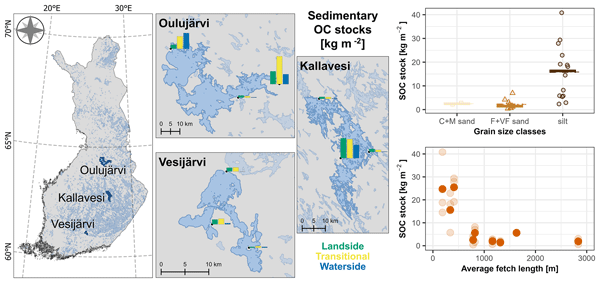
Abstract. Aquatic vegetated ecosystems play an important role in global carbon sequestration. While research on coastal marine environments has expanded in recent decades, freshwater vegetated shorelines remain understudied despite their potential for significant carbon burial. This is especially relevant in boreal landscapes with high numbers of small, shallow lakes. In this study, we quantify organic carbon stocks (mass of carbon per area) in boreal lacustrine vegetated shorelines, so-called teal carbon environments. Moreover, we identified the main environmental drivers of carbon storage in these areas. We took 27 sediment cores from three large lakes in Finland with available satellite data of macrophyte coverage. At each site, sediment cores were sampled along a depth transect through macrophyte zones, from the landside towards the waterside. Sedimentary organic carbon (SOC) stocks ranged from 0 to 40.8 kg m−2, and showed a large spatial variability among lakes, zones and type of vegetation. We identified grain size as the most significant parameter explaining variability in the size of SOC stocks. Sites dominated by silts and with large SOC stocks were found in sheltered embayments, independent of proximity to rivers, density of vegetation or slope of the shoreline, implying a strong control of exposure on SOC accumulation. In more exposed areas, vegetation density might play an additional controlling role in SOC accumulation. Accounting for shoreline exposure is crucial for improving regional carbon budget estimates. This study highlights the central role of teal carbon ecosystems in carbon cycling in the boreal zone, often characterized by very high densities of lakes.
-
Notice on discussion status
The requested preprint has a corresponding peer-reviewed final revised paper. You are encouraged to refer to the final revised version.
-
Preprint
(2031 KB)
-
Supplement
(4676 KB)
-
The requested preprint has a corresponding peer-reviewed final revised paper. You are encouraged to refer to the final revised version.
- Preprint
(2031 KB) - Metadata XML
-
Supplement
(4676 KB) - BibTeX
- EndNote
- Final revised paper


Journal article(s) based on this preprint
Interactive discussion
Status: closed
-
RC1: 'Comment on egusphere-2025-5053', Anonymous Referee #1, 27 Jan 2026
This study entitled “Shoreline exposure controls teal carbon accumulation in boreal lakes” presents valuable insights into soil carbon accumulation in teal carbon environments of boreal lakes. Through a large soil core sampling, the authors quantified sediment organic carbon stocks in shallow vegetated areas of Finland Lakes and identified the main biotic and abiotic parameters controlling these stocks. Additionally, authors compare lake SOC stocks with those of freshwater and marine environments to assess the relative contribution of boreal lakes in teal carbon accumulation. The introduction is logically constructed, and the study's objectives are clear. The authors have made efforts to use statistical tools to highlight the main biotic and abiotic drivers controlling SOC stocks. The manuscript is well written, the results are well presented, and the organization is coherent. The manuscript clearly falls within the scope of the target journal, but several aspects of the analysis, presentation, and interpretation require strengthening before it can be considered for publication.
-
RC2: 'Reply on RC1', Anonymous Referee #2, 26 Feb 2026
This manuscript represents a timely contribution to the journal. Freshwater wetlands along shorelines (“teal carbon” ecosystems) remain underrepresented in continental carbon budgets, despite growing recognition of the importance of inland waters in global carbon cycling. By quantifying sediment organic carbon (SOC) stocks across boreal lake shorelines and identifying shoreline exposure (fetch length) and sediment grain size as primary controls, the study provides insight into the spatial variability in carbon storage.
While the dataset is geographically limited (three Finnish lakes), the study helps in understanding process-based controls and offers transferable implications for carbon budgeting in lake-rich boreal regions. The sampling framework (27 sediment cores across lakes, sites, and shoreline zones) is appropriate for examining small-scale spatial variability.
A notable strength is the explicit evaluation of environmental predictors (vegetation density, water depth, slope, fetch), with average fetch length emerging as the strongest predictor of SOC stocks. The discussion presents results in the context of existing literature on fine-grained sediment controls, wave energy, and wetland carbon storage. One limitation of the study was the inability to establish sediment accumulation rates because the ¹³⁷Cs profiles were unclear, leading to reliance on stock estimates rather than burial rates . The authors acknowledge this clearly and interpret shoreline zones as areas of temporary storage rather than permanent sinks, however, some additional discussion of temporal stability and implications for long-term sequestration would enhance the manuscript.
Other Improvements could include:
- Tightening the discussion to reduce repetition regarding grain-size controls.
- Clarifying the distinction between carbon “storage” and “long-term sequestration,” the latter may not be an appropriate term here given the lack of accumulation-rate estimates.
Because the ¹³⁷Cs profiles could not be used to estimate C accumulation rates and suggest sediment mixing, the authors should be clear that long-term accumulation is not reported (e.g., line 213).
Fetch length was found to be the strongest predictor of SOC stocks. The authors might consider including a simple conceptual diagram summarizing the exposure → wave energy → grain size → SOC pathway.
Finally, and in light of the goals of the paper, the authors might consider adding discussion on how these site-level findings scale to regional boreal carbon budgets, and whether sheltered shoreline areas can be mapped remotely to upscale SOC estimate
Citation: https://doi.org/10.5194/egusphere-2025-5053-RC2 -
AC2: 'Reply on RC2', Ana Lúcia Lindroth Dauner, 25 Mar 2026
Thank you for the constructive review. We will attempt to improve the discussion regarding long-term C sequestration. The detailed modifications are described below.
Other Improvements could include:
• Tightening the discussion to reduce repetition regarding grain-size controls.
• Reply: We will do as suggested.
• Clarifying the distinction between carbon “storage” and “long-term sequestration,” the latter may not be an appropriate term here given the lack of accumulation-rate estimates.
• Reply: We will do as suggested.Because the ¹³⁷Cs profiles could not be used to estimate C accumulation rates and suggest sediment mixing, the authors should be clear that long-term accumulation is not reported (e.g., line 213).
Reply: We will clarify it and avoid the term “sequestration” whenever possible.Fetch length was found to be the strongest predictor of SOC stocks. The authors might consider including a simple conceptual diagram summarizing the exposure → wave energy → grain size → SOC pathway.
Reply: We will attempt to create a conceptual diagram summarizing this idea.Finally, and in light of the goals of the paper, the authors might consider adding discussion on how these site-level findings scale to regional boreal carbon budgets, and whether sheltered shoreline areas can be mapped remotely to upscale SOC estimate
Reply: We will add a few sentences explaining how these findings can be used to upscale SOC estimates. However, we prefer not to discuss it in much detail as this is outside the scope of this manuscript, and we are currently investigating it in further work.Citation: https://doi.org/10.5194/egusphere-2025-5053-AC2
-
AC1: 'Reply on RC1', Ana Lúcia Lindroth Dauner, 25 Mar 2026
Thank you for the constructive review. We will attempt to improve the data analysis and its interpretation. The detailed modifications are described below.
Introduction
Part of the introduction discusses carbon sequestration in freshwater wetlands, whereas your study focuses on the shallow littoral areas of Finnish lakes. Did you take sediment samples from lacustrine wetlands?
Reply: For this manuscript, we analysed samples only from sediment cores retrieved from the shallow littoral areas.Materials and Methods
90-92. Please specify whether the sampled lacustrine zones (i.e. the shallow vegetated littoral zone, called teal carbon environments) represent large or weak surfaces on the scale of the lake.
Reply: We can calculate an estimate of how much these shallow vegetated littoral areas represent of each lake, but it will be an approximation since they vary annually due to natural variability in the vegetation growth and anthropogenic interference.96. What is the trophic state of the Olujarvi lake? Could you explain in more detail why you chose these three lakes?
Reply: Oulujärvi is dysoligotrophic, and we will include this information in the text. We chose these lakes because we had evidence of the existence of large shallow vegetation patches and because they have been sampled before for other projects. So, there is data regarding their overall water and sediment quality. However, we focused on areas that had less sampling coverage based on existing data and covering different regions (sub-basins) of each lake.110. If surficial deposits influence OC accumulation, then add this information to Table 1 by adding a row to better distinguish the variability between the lakes.
Reply: The surficial deposits around each lake will influence the type of sediment found in each lake, which we found that is a key factor influencing the OC accumulation. We will add this information in Table 1.123-126. You can add in parenthesis the range of the standing water depth for each shoreline zone to better distinguish your three sampling areas. From 0.15 to 0.60 m in the landside zones, from 0.29 to 1.13 m in the transitional zones and from 0.37 to 1.23 m in the waterside zones (from Table S2).
Reply: We will add this information as suggested.179. There is an inconsistency between the text (L174-178) and equation 4a. TOC inventory for a given sample [g] was calculated multiplying the TOC content [%] by the DBD [g cm-3] and the sample volume [cm3]. However, in the equation 4a, TOC inventory is: (TOC x DBD x depth) x 1000.
Reply: We will correct the formula. The correct parameter is sample volume, and not only sample depth.Results
Figure 3. Could you add the Tukey test results in the graphs using letters (and the number of samples per group)? Same comment for the figure 5.
In the figure 3, can you add below two other boxplots for TOC distribution grouped by lakes and shoreline zones?
Reply: We will make the suggested modifications.247. Could you add in parenthesis the shoreline zone and grain size class for the minimum and maximum values of SOC stocks?
Reply: We will add the information as suggested.249-254. Could you provide the results of the ANOVA tests for the comparison between lakes and shoreline zones?
Are you able to provide a more accurate statistical analysis in order to rank the contribution of different environmental predictors (lakes, shoreline zones, plant species and grain size class) to SOC stocks using a multiple factor analysis of variance per example?
The results of the generalized linear model can be added to the manuscript (table S6) to strengthen your findings.
Reply: We will add the ANOVA results, including from the multiple factor analysis, in the Supplementary Material. We can move the results of the GLM to the main text.Discussion
285-287. The strong relationship between TOC content and grain size is the first clear finding in your study and this deserves to be included as a figure. I suggest that the authors insert Figure S23 into the manuscript, probably near the Figure 3. Can you study this relationship in more detail using a non-linear equation?
Reply: We will include the plots of Figure S23 in Figure 3, making it a 6-panel figure, and increase the discussion about this relationship using a gamma regression.297-298. This statement is not very detailed and deserves further discussion.
Reply: We can improve the explanation of the effect of water regulation on sediment input to Oulujärvi.300. I encourage the authors to complete this sentence in order to provide greater precision. “As pointed out by Tangen and Bansal (2020) in inland freshwater wetlands, SOC stocks are highly variable …”
Reply: We will modify the text as suggested.302. Please replace “ranging from zero to more 40 kg m-2 ” by “ranging from 0 to 40.8 kg m-2 ” for more precision.
Reply: We will modify the text as suggested.303. To tie in with the previous paragraph, please indicate that fine-grained sediments are rich in organic matter such as: “Several environmental parameters could influence the entrapment of organic-rich fine-grained sediments, such as…”.
Reply: We will modify the text as suggested.309-311. The strength of this statement is not fully supported by your data. From a statistical point of view, we can observe significantly higher SOC stock values without Phragmites compared to the Phragmite group in the Figure 5-e. We can observe this statistical result in the Table S5 and in lines 249-250-251. The type of vegetation is probably not a major factor in SOC stocks compared to sediment size, but you cannot ignore it.
Reply: We understand the reviewer comment. We did not put too much emphasis on the relationship between the vegetation type and SOC stocks because the 2nd and 3rd highest SOC stocks were observed in sites with Phragmites even though the median is much lower. But we will modify the text to reflect that the vegetation might have an impact of SOC accumulation.313-317. Please provide means and standard deviations of SOC stocks for average fetch length < 500 m and for average fetch length > 500 m to strengthen your statement. Please specify whether the trend is similar for SOC stocks (0-20 cm).
Reply: We will modify the text as suggested.319-320. Please add here that vegetation density plays a significant role in SOC stocks in exposed conditions (c.f., figure S25).
Reply: We will modify the text as suggested.339- 345. Please clearly conclude concerning the effects of bathymetry and shoreline’s slope on SOC stocks. Have you tested the influence of bathymetry, shoreline’s slope and stem density on SOC stocks in conditions where the shoreline is protected (average fetch length < 500 m)?
For each lake, you present the ecological status, the main land use type and the main anthropogenic pressures (Table 1). Do these factors influence the grain size distribution and the lake SOC stock?
Reply: We will add a clear conclusion about the effects of bathymetry and shoreline’s slope on SOC stocks. We did not test their influence in only protected sites because the sampled “n” would be too small (only 3 sites, with their zones) to make any inference with confidence.
Regarding the ecological status, the main land use type and the main anthropogenic pressures, they probably don’t play a significant role in controlling grain size distribution in these teal carbon environments. If they did, we would have seen significant differences between the lakes but not between the sites within each lake, what did not happen (Figure 4).375-410. The authors have correctly compared their results with SOC values from freshwater marshes, coastal lagoons, and blue carbon environments in marine areas. However, the authors should also compare their results with similar studies in lakes worldwide. Could the difference in magnitude be related to a difference in sampling strategy? Please discuss the inclusion of shallow vegetated coastal areas in the organic carbon stocks of lakes. Please discuss the importance of sampling shallow coastal areas of lakes in order to obtain a realistic estimate of organic carbon stocks, unlike certain studies that have conducted sediment core sampling in the deepest part of the lake.
Reply: Because the focus of this research was on vegetated areas, we preferred not to compare with data from deeper areas of lakes, as it would lead to a whole new discussion about the controlling factors affecting both areas. But we will emphasize the importance of shallow areas to obtain realistic lacustrine OC stock estimates.Citation: https://doi.org/10.5194/egusphere-2025-5053-AC1
-
RC2: 'Reply on RC1', Anonymous Referee #2, 26 Feb 2026
Peer review completion


Interactive discussion
Status: closed
-
RC1: 'Comment on egusphere-2025-5053', Anonymous Referee #1, 27 Jan 2026
This study entitled “Shoreline exposure controls teal carbon accumulation in boreal lakes” presents valuable insights into soil carbon accumulation in teal carbon environments of boreal lakes. Through a large soil core sampling, the authors quantified sediment organic carbon stocks in shallow vegetated areas of Finland Lakes and identified the main biotic and abiotic parameters controlling these stocks. Additionally, authors compare lake SOC stocks with those of freshwater and marine environments to assess the relative contribution of boreal lakes in teal carbon accumulation. The introduction is logically constructed, and the study's objectives are clear. The authors have made efforts to use statistical tools to highlight the main biotic and abiotic drivers controlling SOC stocks. The manuscript is well written, the results are well presented, and the organization is coherent. The manuscript clearly falls within the scope of the target journal, but several aspects of the analysis, presentation, and interpretation require strengthening before it can be considered for publication.
-
RC2: 'Reply on RC1', Anonymous Referee #2, 26 Feb 2026
This manuscript represents a timely contribution to the journal. Freshwater wetlands along shorelines (“teal carbon” ecosystems) remain underrepresented in continental carbon budgets, despite growing recognition of the importance of inland waters in global carbon cycling. By quantifying sediment organic carbon (SOC) stocks across boreal lake shorelines and identifying shoreline exposure (fetch length) and sediment grain size as primary controls, the study provides insight into the spatial variability in carbon storage.
While the dataset is geographically limited (three Finnish lakes), the study helps in understanding process-based controls and offers transferable implications for carbon budgeting in lake-rich boreal regions. The sampling framework (27 sediment cores across lakes, sites, and shoreline zones) is appropriate for examining small-scale spatial variability.
A notable strength is the explicit evaluation of environmental predictors (vegetation density, water depth, slope, fetch), with average fetch length emerging as the strongest predictor of SOC stocks. The discussion presents results in the context of existing literature on fine-grained sediment controls, wave energy, and wetland carbon storage. One limitation of the study was the inability to establish sediment accumulation rates because the ¹³⁷Cs profiles were unclear, leading to reliance on stock estimates rather than burial rates . The authors acknowledge this clearly and interpret shoreline zones as areas of temporary storage rather than permanent sinks, however, some additional discussion of temporal stability and implications for long-term sequestration would enhance the manuscript.
Other Improvements could include:
- Tightening the discussion to reduce repetition regarding grain-size controls.
- Clarifying the distinction between carbon “storage” and “long-term sequestration,” the latter may not be an appropriate term here given the lack of accumulation-rate estimates.
Because the ¹³⁷Cs profiles could not be used to estimate C accumulation rates and suggest sediment mixing, the authors should be clear that long-term accumulation is not reported (e.g., line 213).
Fetch length was found to be the strongest predictor of SOC stocks. The authors might consider including a simple conceptual diagram summarizing the exposure → wave energy → grain size → SOC pathway.
Finally, and in light of the goals of the paper, the authors might consider adding discussion on how these site-level findings scale to regional boreal carbon budgets, and whether sheltered shoreline areas can be mapped remotely to upscale SOC estimate
Citation: https://doi.org/10.5194/egusphere-2025-5053-RC2 -
AC2: 'Reply on RC2', Ana Lúcia Lindroth Dauner, 25 Mar 2026
Thank you for the constructive review. We will attempt to improve the discussion regarding long-term C sequestration. The detailed modifications are described below.
Other Improvements could include:
• Tightening the discussion to reduce repetition regarding grain-size controls.
• Reply: We will do as suggested.
• Clarifying the distinction between carbon “storage” and “long-term sequestration,” the latter may not be an appropriate term here given the lack of accumulation-rate estimates.
• Reply: We will do as suggested.Because the ¹³⁷Cs profiles could not be used to estimate C accumulation rates and suggest sediment mixing, the authors should be clear that long-term accumulation is not reported (e.g., line 213).
Reply: We will clarify it and avoid the term “sequestration” whenever possible.Fetch length was found to be the strongest predictor of SOC stocks. The authors might consider including a simple conceptual diagram summarizing the exposure → wave energy → grain size → SOC pathway.
Reply: We will attempt to create a conceptual diagram summarizing this idea.Finally, and in light of the goals of the paper, the authors might consider adding discussion on how these site-level findings scale to regional boreal carbon budgets, and whether sheltered shoreline areas can be mapped remotely to upscale SOC estimate
Reply: We will add a few sentences explaining how these findings can be used to upscale SOC estimates. However, we prefer not to discuss it in much detail as this is outside the scope of this manuscript, and we are currently investigating it in further work.Citation: https://doi.org/10.5194/egusphere-2025-5053-AC2
-
AC1: 'Reply on RC1', Ana Lúcia Lindroth Dauner, 25 Mar 2026
Thank you for the constructive review. We will attempt to improve the data analysis and its interpretation. The detailed modifications are described below.
Introduction
Part of the introduction discusses carbon sequestration in freshwater wetlands, whereas your study focuses on the shallow littoral areas of Finnish lakes. Did you take sediment samples from lacustrine wetlands?
Reply: For this manuscript, we analysed samples only from sediment cores retrieved from the shallow littoral areas.Materials and Methods
90-92. Please specify whether the sampled lacustrine zones (i.e. the shallow vegetated littoral zone, called teal carbon environments) represent large or weak surfaces on the scale of the lake.
Reply: We can calculate an estimate of how much these shallow vegetated littoral areas represent of each lake, but it will be an approximation since they vary annually due to natural variability in the vegetation growth and anthropogenic interference.96. What is the trophic state of the Olujarvi lake? Could you explain in more detail why you chose these three lakes?
Reply: Oulujärvi is dysoligotrophic, and we will include this information in the text. We chose these lakes because we had evidence of the existence of large shallow vegetation patches and because they have been sampled before for other projects. So, there is data regarding their overall water and sediment quality. However, we focused on areas that had less sampling coverage based on existing data and covering different regions (sub-basins) of each lake.110. If surficial deposits influence OC accumulation, then add this information to Table 1 by adding a row to better distinguish the variability between the lakes.
Reply: The surficial deposits around each lake will influence the type of sediment found in each lake, which we found that is a key factor influencing the OC accumulation. We will add this information in Table 1.123-126. You can add in parenthesis the range of the standing water depth for each shoreline zone to better distinguish your three sampling areas. From 0.15 to 0.60 m in the landside zones, from 0.29 to 1.13 m in the transitional zones and from 0.37 to 1.23 m in the waterside zones (from Table S2).
Reply: We will add this information as suggested.179. There is an inconsistency between the text (L174-178) and equation 4a. TOC inventory for a given sample [g] was calculated multiplying the TOC content [%] by the DBD [g cm-3] and the sample volume [cm3]. However, in the equation 4a, TOC inventory is: (TOC x DBD x depth) x 1000.
Reply: We will correct the formula. The correct parameter is sample volume, and not only sample depth.Results
Figure 3. Could you add the Tukey test results in the graphs using letters (and the number of samples per group)? Same comment for the figure 5.
In the figure 3, can you add below two other boxplots for TOC distribution grouped by lakes and shoreline zones?
Reply: We will make the suggested modifications.247. Could you add in parenthesis the shoreline zone and grain size class for the minimum and maximum values of SOC stocks?
Reply: We will add the information as suggested.249-254. Could you provide the results of the ANOVA tests for the comparison between lakes and shoreline zones?
Are you able to provide a more accurate statistical analysis in order to rank the contribution of different environmental predictors (lakes, shoreline zones, plant species and grain size class) to SOC stocks using a multiple factor analysis of variance per example?
The results of the generalized linear model can be added to the manuscript (table S6) to strengthen your findings.
Reply: We will add the ANOVA results, including from the multiple factor analysis, in the Supplementary Material. We can move the results of the GLM to the main text.Discussion
285-287. The strong relationship between TOC content and grain size is the first clear finding in your study and this deserves to be included as a figure. I suggest that the authors insert Figure S23 into the manuscript, probably near the Figure 3. Can you study this relationship in more detail using a non-linear equation?
Reply: We will include the plots of Figure S23 in Figure 3, making it a 6-panel figure, and increase the discussion about this relationship using a gamma regression.297-298. This statement is not very detailed and deserves further discussion.
Reply: We can improve the explanation of the effect of water regulation on sediment input to Oulujärvi.300. I encourage the authors to complete this sentence in order to provide greater precision. “As pointed out by Tangen and Bansal (2020) in inland freshwater wetlands, SOC stocks are highly variable …”
Reply: We will modify the text as suggested.302. Please replace “ranging from zero to more 40 kg m-2 ” by “ranging from 0 to 40.8 kg m-2 ” for more precision.
Reply: We will modify the text as suggested.303. To tie in with the previous paragraph, please indicate that fine-grained sediments are rich in organic matter such as: “Several environmental parameters could influence the entrapment of organic-rich fine-grained sediments, such as…”.
Reply: We will modify the text as suggested.309-311. The strength of this statement is not fully supported by your data. From a statistical point of view, we can observe significantly higher SOC stock values without Phragmites compared to the Phragmite group in the Figure 5-e. We can observe this statistical result in the Table S5 and in lines 249-250-251. The type of vegetation is probably not a major factor in SOC stocks compared to sediment size, but you cannot ignore it.
Reply: We understand the reviewer comment. We did not put too much emphasis on the relationship between the vegetation type and SOC stocks because the 2nd and 3rd highest SOC stocks were observed in sites with Phragmites even though the median is much lower. But we will modify the text to reflect that the vegetation might have an impact of SOC accumulation.313-317. Please provide means and standard deviations of SOC stocks for average fetch length < 500 m and for average fetch length > 500 m to strengthen your statement. Please specify whether the trend is similar for SOC stocks (0-20 cm).
Reply: We will modify the text as suggested.319-320. Please add here that vegetation density plays a significant role in SOC stocks in exposed conditions (c.f., figure S25).
Reply: We will modify the text as suggested.339- 345. Please clearly conclude concerning the effects of bathymetry and shoreline’s slope on SOC stocks. Have you tested the influence of bathymetry, shoreline’s slope and stem density on SOC stocks in conditions where the shoreline is protected (average fetch length < 500 m)?
For each lake, you present the ecological status, the main land use type and the main anthropogenic pressures (Table 1). Do these factors influence the grain size distribution and the lake SOC stock?
Reply: We will add a clear conclusion about the effects of bathymetry and shoreline’s slope on SOC stocks. We did not test their influence in only protected sites because the sampled “n” would be too small (only 3 sites, with their zones) to make any inference with confidence.
Regarding the ecological status, the main land use type and the main anthropogenic pressures, they probably don’t play a significant role in controlling grain size distribution in these teal carbon environments. If they did, we would have seen significant differences between the lakes but not between the sites within each lake, what did not happen (Figure 4).375-410. The authors have correctly compared their results with SOC values from freshwater marshes, coastal lagoons, and blue carbon environments in marine areas. However, the authors should also compare their results with similar studies in lakes worldwide. Could the difference in magnitude be related to a difference in sampling strategy? Please discuss the inclusion of shallow vegetated coastal areas in the organic carbon stocks of lakes. Please discuss the importance of sampling shallow coastal areas of lakes in order to obtain a realistic estimate of organic carbon stocks, unlike certain studies that have conducted sediment core sampling in the deepest part of the lake.
Reply: Because the focus of this research was on vegetated areas, we preferred not to compare with data from deeper areas of lakes, as it would lead to a whole new discussion about the controlling factors affecting both areas. But we will emphasize the importance of shallow areas to obtain realistic lacustrine OC stock estimates.Citation: https://doi.org/10.5194/egusphere-2025-5053-AC1
-
RC2: 'Reply on RC1', Anonymous Referee #2, 26 Feb 2026
Peer review completion
Journal article(s) based on this preprint
Viewed
| HTML | XML | Total | Supplement | BibTeX | EndNote | |
|---|---|---|---|---|---|---|
| 1,601 | 809 | 219 | 2,629 | 365 | 187 | 185 |
- HTML: 1,601
- PDF: 809
- XML: 219
- Total: 2,629
- Supplement: 365
- BibTeX: 187
- EndNote: 185
Viewed (geographical distribution)
| Country | # | Views | % |
|---|
| Total: | 0 |
| HTML: | 0 |
| PDF: | 0 |
| XML: | 0 |
- 1
Ana Lúcia Lindroth Dauner
Max O. A. Kankainen
Sakari Väkevä
Eero Asmala
Marko Järvinen
Karoliina Koho
Tom Jilbert
The requested preprint has a corresponding peer-reviewed final revised paper. You are encouraged to refer to the final revised version.
- Preprint
(2031 KB) - Metadata XML
-
Supplement
(4676 KB) - BibTeX
- EndNote
- Final revised paper