
the Creative Commons Attribution 4.0 License.
the Creative Commons Attribution 4.0 License.
 | 24 Oct 2025
The ECOSENSE forest: A distributed sensor and data management system for real-time monitoring of ecosystem processes and stresses
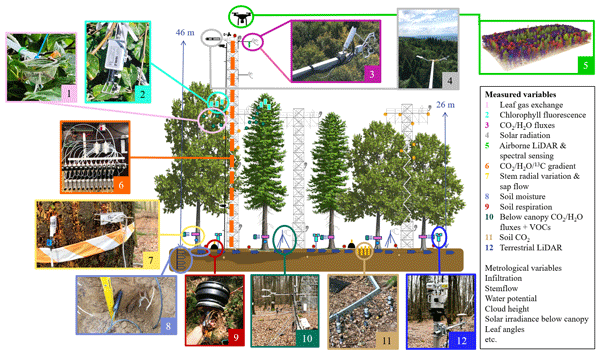
Abstract. Forests provide crucial ecosystem services, but are vulnerable to climate-related physical and biological stresses, such as droughts, pests and pathogens. The rapid climate change currently observed increases the pressure on forest ecosystems, with already drastic consequences, e.g., widespread tree mortality across Central Europe. However, we fall short of understanding underlying process dynamics and their impacts on the Earth system. To better understand and predict forest ecosystem dynamics and the associated energy, carbon and water fluxes, detailed knowledge of ecosystem structure, processes and functioning under constantly varying conditions and across different spatial and temporal scales is needed. The ECOSENSE project brings together engineers, environmental and data scientists to establish novel environmental monitoring approaches and to capture distributed forest carbon and water flux dynamics in space and time with a wide range of established measurement technologies and newly developed sensors. Here, we describe the required infrastructure – called ECOSENSE forest – with regard to physical structures, power supply, communication network and data management, that supports such novel environmental sensor networks. We established a comprehensive monitoring system in this ECOSENSE forest, spanning from below-ground to above-canopy with three large scaffold-towers in different plots. More than 670 commercial and 430 self-built sensors monitor over 90 distinct parameters, fluxes, or processes generating upwards of 4,500 time series that capture soil, tree and atmosphere processes with high spatial and temporal resolution. In particular, our design objective is to provide a stable, flexible and secure forest research infrastructure with power, communication and data management using low-cost and commercially available components that meet the needs of various research disciplines. Our considerations and experiences provide impulses and practical solutions for establishing robust, low-cost distributed field research infrastructures and thus increase data continuity and resilience to disruptions at remote locations. The ECOSENSE forest may thus serve as a blueprint for future projects with similar goals and challenges.
-
Notice on discussion status
The requested preprint has a corresponding peer-reviewed final revised paper. You are encouraged to refer to the final revised version.
-
Preprint
(1658 KB)
-
Supplement
(131 KB)
-
The requested preprint has a corresponding peer-reviewed final revised paper. You are encouraged to refer to the final revised version.
- Preprint
(1658 KB) - Metadata XML
-
Supplement
(131 KB) - BibTeX
- EndNote
- Final revised paper


Journal article(s) based on this preprint
Interactive discussion
Status: closed
- RC1: 'Comment on egusphere-2025-4979', Anonymous Referee #1, 13 Mar 2026
-
RC2: 'Comment on egusphere-2025-4979', Anonymous Referee #2, 29 Jun 2026
This paper addresses the design and the implementation of large scale instrumentation system called ECOSENSE forest. This large-scale environmental monitoring infrastructure aims at studying forest ecosystem dynamics under climate change. The monitoring system incorporates more than 1100 sensors, generating many data to be processed. Such data may be used for post analysis and also for new modeling up to virtual reality developments.
The main contribution is the implementation of a practical framework for using distributed environmental sensor networks that consists of physical structures, dedicated power supply, communication networks and a data management system.
General comments
The manuscript is well written, clear, and comprehensive. The instrumentation presented is diverse, from on the shelf sensors up to in-house developed sensors. The scale of the development in a natural environment is impressive.
Anyway, though the ECOSENSE blueprint is clearly described, some aspects require further explanations.
Detailed remarks and questions:
Large scale instrumentation system are implemented and used in different industrial domains or for transport infrastructures monitoring. Their deployment are still gathered with a maintenance strategy. Could you precise the ECOSENSE strategy implemented for ECOSENSE sensors and the whole system maintenance ?
In field sensors are ageing and could drift with time. Could you precise how you manage for instance periodic calibration or autonomous in-situ solutions to control sensor deviation? Due to the large amount of sensors deployed, it could be interesting to make this description for a macro, a meso and a micro scale for a typical sensor.
How metadata and data management in the ECOSENSE systems takes into account or was influenced by OGC standards, HDF5 group recommendations, ZARR, etc.? Could you precise these aspects in your paper ?
For the reading of the paper, o,e will appreciate to have a separate list of your in-house sensor collection . Could you add such a list and make a schematic view of their location into the ECOSENSE system ?
Could you give an overview of the volumetric amount of data daily or monthly produced (including additional periodic field campaigns)?
Finally, as mentioned in the paper such instrumentation system pave the way to the development of new models up to virtual reality developments. Could you precise geolocalisation and time requirements accuracies required for such research works?
Citation: https://doi.org/10.5194/egusphere-2025-4979-RC2 -
AC1: 'Authors comments on egusphere-2025-4979 (Response to RC1 and RC2)', Jasmin Tesch, 20 Jul 2026
Dear Referees and Members of the Editorial Board,
We would like to thank you for your valuable feedback and the time you devoted to reviewing our manuscript. Many of your comments have helped us improve the manuscript, and we hope that our revisions and responses have adequately addressed your questions and concerns.
Please find attached a PDF containing our detailed responses to Referee Comments RC1 and RC2.
Sincerely,
Jasmin Tesch, Kathrin Kühnhammer & Delon Wagner
Peer review completion


Interactive discussion
Status: closed
-
RC1: 'Comment on egusphere-2025-4979', Anonymous Referee #1, 13 Mar 2026
The authors present the design and instrumentation of ECOSENSE forest, a large-scale environmental monitoring infrastructure that aims at studying forest ecosystem dynamics under climate change. The monitoring system incorporates more than 1100 sensors, generating many data to be processed. Such data may be used for archiving, thus enabling the forest state measurements evolution through time. The main contribution is the implementation of a practical framework for using distributed environmental sensor networks that consists of physical structures, dedicated power supply, communication networks and a data management system. This ECOSENSE forest shows the possibility of monitoring large-scale environments with reliability and resilience.
General comments
The authors are first thanked for their contribution. The manuscript is well written, clear, and comprehensive. The instrumentation presented is particularly impressive, both in terms of the number of deployed sensors and the overall system architecture.
While the main contribution of the article is to present the ECOSENSE infrastructure as a blueprint for similar deployments, the conclusion would benefit from further discussion of the actual use of the collected data. In particular, providing examples of scientific analyses, preliminary results, or research questions already addressed (e.g. part 4) using the dataset would strengthen the paper and better illustrate the value of the proposed infrastructure.
Furthermore, I have minor remarks and questions:
1. Data heterogeneity management
The monitoring system integrates a large number of sensors measuring different variables, likely with different acquisition frequencies, units, and possibly data dimensionality. The manuscript would benefit from a clearer explanation of how this data heterogeneity is handled. In particular:
- How are different acquisition frequencies managed or synchronized?
- How are measurement units standardized across sensors?
- Are there procedures for harmonizing data structures before storage or distribution?2. Data format specification
The manuscript refers to a "standardised format" (L.132) and mentions file access (L.380), but the actual data format used for storage and distribution is not clearly specified, if I am not mistaken. Providing details about the file format (e.g., HDF5, CSV, Zarr, etc.) and the general structure of the datasets would improve reproducibility and usability.
3. Integration of external data sources
External data sources are briefly mentioned, such as LiDAR scans (L.281). Is there other external data sources integrated into the datasets ? If so:
- How are these external datasets incorporated?
- How are they synchronized with in-situ measurements?
- Are they stored within the same data structure?4. Security considerations
Section 2.5 discusses security measures against potential network attacks.
- Is there any protections against local access threats, from Wi-Fi access points, or LoRaWAN gateways (L.245)?5. Architecture terminology (Figures 4 and 6)
Figure 4 provides a useful overview of the system architecture, and the consistent color and naming scheme with Figure 6 helps readability.
However, some terminology may be imprecise, it is a difficult task to formalize accurately the overall process.- The term "2. Detection" may not be fully appropriate. In many contexts, detection refers to extracting information from raw or processed data, whereas this stage appears to correspond to data measurement. The term "Measurement" may therefore be more accurate.
- Some labels are not immediately clear. For instance, examples "Selection, Formats" under "7. Processing" could be clarified. At least those single words are not obvious.
- The association of "Broadcast" with VPN is somewhat confusing (see also L.376). A VPN generally provides a secure point-to-point communication channel rather than a broadcast mechanism. Conceptually, this functionality might fit better under "10. Access."Specific comments
- Figure 3 should be placed after 2.5 because the network infrastructure (right part) is presented in 2.5 and illustrated in Figure 3.
- Figure 4 "8. Broadcast" is not readable (white font color on light gray background)
- L.373: "NodeRed" instead of "NoteRed" (I think)
- L.234: "prevent" instead of "protect" would be more accurate.
- L.396: "ECOSENSE" instead of "EOCSENSE"Citation: https://doi.org/10.5194/egusphere-2025-4979-RC1 -
RC2: 'Comment on egusphere-2025-4979', Anonymous Referee #2, 29 Jun 2026
This paper addresses the design and the implementation of large scale instrumentation system called ECOSENSE forest. This large-scale environmental monitoring infrastructure aims at studying forest ecosystem dynamics under climate change. The monitoring system incorporates more than 1100 sensors, generating many data to be processed. Such data may be used for post analysis and also for new modeling up to virtual reality developments.
The main contribution is the implementation of a practical framework for using distributed environmental sensor networks that consists of physical structures, dedicated power supply, communication networks and a data management system.
General comments
The manuscript is well written, clear, and comprehensive. The instrumentation presented is diverse, from on the shelf sensors up to in-house developed sensors. The scale of the development in a natural environment is impressive.
Anyway, though the ECOSENSE blueprint is clearly described, some aspects require further explanations.
Detailed remarks and questions:
Large scale instrumentation system are implemented and used in different industrial domains or for transport infrastructures monitoring. Their deployment are still gathered with a maintenance strategy. Could you precise the ECOSENSE strategy implemented for ECOSENSE sensors and the whole system maintenance ?
In field sensors are ageing and could drift with time. Could you precise how you manage for instance periodic calibration or autonomous in-situ solutions to control sensor deviation? Due to the large amount of sensors deployed, it could be interesting to make this description for a macro, a meso and a micro scale for a typical sensor.
How metadata and data management in the ECOSENSE systems takes into account or was influenced by OGC standards, HDF5 group recommendations, ZARR, etc.? Could you precise these aspects in your paper ?
For the reading of the paper, o,e will appreciate to have a separate list of your in-house sensor collection . Could you add such a list and make a schematic view of their location into the ECOSENSE system ?
Could you give an overview of the volumetric amount of data daily or monthly produced (including additional periodic field campaigns)?
Finally, as mentioned in the paper such instrumentation system pave the way to the development of new models up to virtual reality developments. Could you precise geolocalisation and time requirements accuracies required for such research works?
Citation: https://doi.org/10.5194/egusphere-2025-4979-RC2 -
AC1: 'Authors comments on egusphere-2025-4979 (Response to RC1 and RC2)', Jasmin Tesch, 20 Jul 2026
Dear Referees and Members of the Editorial Board,
We would like to thank you for your valuable feedback and the time you devoted to reviewing our manuscript. Many of your comments have helped us improve the manuscript, and we hope that our revisions and responses have adequately addressed your questions and concerns.
Please find attached a PDF containing our detailed responses to Referee Comments RC1 and RC2.
Sincerely,
Jasmin Tesch, Kathrin Kühnhammer & Delon Wagner
Peer review completion
Journal article(s) based on this preprint
Viewed
| HTML | XML | Total | Supplement | BibTeX | EndNote | |
|---|---|---|---|---|---|---|
| 3,381 | 1,250 | 195 | 4,826 | 573 | 213 | 164 |
- HTML: 3,381
- PDF: 1,250
- XML: 195
- Total: 4,826
- Supplement: 573
- BibTeX: 213
- EndNote: 164
Viewed (geographical distribution)
| Country | # | Views | % |
|---|
| Total: | 0 |
| HTML: | 0 |
| PDF: | 0 |
| XML: | 0 |
- 1
Cited


4 citations as recorded by crossref.
- Technical note: An innovative monitoring approach to measure spatio-temporal throughfall patterns in forests L. Dedden & M. Weiler https://doi.org/10.5194/hess-30-3245-2026
- Seasonal dynamics and sun/shade heterogeneity of leaf gas exchange and VOC emissions inside a tall temperate forest canopy S. Dumberger et al. https://doi.org/10.1093/treephys/tpag111
- Design of a Chlorophyll Fluorescence Sensor Head for Continuous On-Leaf Measurements J. Klueppel et al. https://doi.org/10.1021/acsomega.6c03026
- Litter vs. Lens: Evaluating LAI from Litter Traps and Hemispherical Photos Across View Zenith Angles and Leaf Fall Phases S. Lotz et al. https://doi.org/10.5194/bg-23-1949-2026
Jasmin Tesch

Kathrin Kühnhammer
Delon Wagner
Andreas Christen
Carsten Dormann
Julian Frey
Rüdiger Grote
Teja Kattenborn
Markus Sulzer
Ulrike Wallrabe
Markus Weiler
Christiane Werner
Samaneh Baghbani
Julian Brzozon
Laura Maria Comella
Lea Dedden
Stefanie Dumberger
Yasmina Frey
Matthias Gassilloud
Timo Gerach
Anna Göritz
Simon Haberstroh
Johannes Klüppel
Luis Kremer
Jürgen Kreuzwieser
Hojin Lee
Joachim Maack
Julian Müller
Oswald Prucker
Sanam Kumari Rajak
Jürgen Rühe
Stefan J. Rupitsch
Helmer Schack-Kirchner
Christian Scharinger
Uttunga Shinde
Till Steinmann
Clara Stock
Josef Strack
The requested preprint has a corresponding peer-reviewed final revised paper. You are encouraged to refer to the final revised version.
- Preprint
(1658 KB) - Metadata XML
-
Supplement
(131 KB) - BibTeX
- EndNote
- Final revised paper
The authors present the design and instrumentation of ECOSENSE forest, a large-scale environmental monitoring infrastructure that aims at studying forest ecosystem dynamics under climate change. The monitoring system incorporates more than 1100 sensors, generating many data to be processed. Such data may be used for archiving, thus enabling the forest state measurements evolution through time. The main contribution is the implementation of a practical framework for using distributed environmental sensor networks that consists of physical structures, dedicated power supply, communication networks and a data management system. This ECOSENSE forest shows the possibility of monitoring large-scale environments with reliability and resilience.
General comments
The authors are first thanked for their contribution. The manuscript is well written, clear, and comprehensive. The instrumentation presented is particularly impressive, both in terms of the number of deployed sensors and the overall system architecture.
While the main contribution of the article is to present the ECOSENSE infrastructure as a blueprint for similar deployments, the conclusion would benefit from further discussion of the actual use of the collected data. In particular, providing examples of scientific analyses, preliminary results, or research questions already addressed (e.g. part 4) using the dataset would strengthen the paper and better illustrate the value of the proposed infrastructure.
Furthermore, I have minor remarks and questions:
1. Data heterogeneity management
The monitoring system integrates a large number of sensors measuring different variables, likely with different acquisition frequencies, units, and possibly data dimensionality. The manuscript would benefit from a clearer explanation of how this data heterogeneity is handled. In particular:
- How are different acquisition frequencies managed or synchronized?
- How are measurement units standardized across sensors?
- Are there procedures for harmonizing data structures before storage or distribution?
2. Data format specification
The manuscript refers to a "standardised format" (L.132) and mentions file access (L.380), but the actual data format used for storage and distribution is not clearly specified, if I am not mistaken. Providing details about the file format (e.g., HDF5, CSV, Zarr, etc.) and the general structure of the datasets would improve reproducibility and usability.
3. Integration of external data sources
External data sources are briefly mentioned, such as LiDAR scans (L.281). Is there other external data sources integrated into the datasets ? If so:
- How are these external datasets incorporated?
- How are they synchronized with in-situ measurements?
- Are they stored within the same data structure?
4. Security considerations
Section 2.5 discusses security measures against potential network attacks.
- Is there any protections against local access threats, from Wi-Fi access points, or LoRaWAN gateways (L.245)?
5. Architecture terminology (Figures 4 and 6)
Figure 4 provides a useful overview of the system architecture, and the consistent color and naming scheme with Figure 6 helps readability.
However, some terminology may be imprecise, it is a difficult task to formalize accurately the overall process.
- The term "2. Detection" may not be fully appropriate. In many contexts, detection refers to extracting information from raw or processed data, whereas this stage appears to correspond to data measurement. The term "Measurement" may therefore be more accurate.
- Some labels are not immediately clear. For instance, examples "Selection, Formats" under "7. Processing" could be clarified. At least those single words are not obvious.
- The association of "Broadcast" with VPN is somewhat confusing (see also L.376). A VPN generally provides a secure point-to-point communication channel rather than a broadcast mechanism. Conceptually, this functionality might fit better under "10. Access."
Specific comments
- Figure 3 should be placed after 2.5 because the network infrastructure (right part) is presented in 2.5 and illustrated in Figure 3.
- Figure 4 "8. Broadcast" is not readable (white font color on light gray background)
- L.373: "NodeRed" instead of "NoteRed" (I think)
- L.234: "prevent" instead of "protect" would be more accurate.
- L.396: "ECOSENSE" instead of "EOCSENSE"