
the Creative Commons Attribution 4.0 License.
the Creative Commons Attribution 4.0 License.
 | 13 Nov 2025
Impact of Primarily Emitted Oxygenated Volatile Organic Compounds on Ozone Formation in the Yangtze River Delta Region
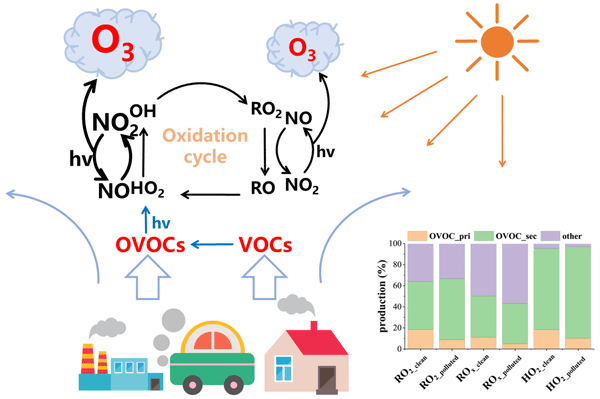
Abstract. Oxygenated volatile organic compounds (OVOCs) play a crucial role in tropospheric radical chemistry, which in turn enhances atmospheric oxidation capacity and drives the formation of secondary pollutants. However, large uncertainties in their emissions pose challenges to accurately assessing their impacts on regional air quality. This study incorporates updated anthropogenic emission inventories, featuring source-resolved OVOC profiles derived from measurements and literature, into the Community Multiscale Air Quality (CMAQ) model to improve OVOC simulations over the Yangtze River Delta (YRD) region. The model well captured the diurnal and seasonal variations of most OVOCs, especially carbonyls. Primary emissions accounted for 30−70 % of total OVOC concentrations, with higher contributions during colder months due to weaker atmospheric oxidation capacity. Hydroperoxyl radicals (HO2), the primary oxidant driving NO-to-NO2 conversion in urban areas, were substantially produced through OVOC photooxidation. Of the HO2 produced by this process, approximately 15−40 % originated from directly emitted OVOCs rather than from secondary OVOCs formed via VOC oxidation. Sensitivity analysis further indicated that key emitted OVOCs contributed to ozone formation at levels comparable to traditional VOC precursors. These findings underscore the critical yet often overlooked role of primary OVOC emissions in urban ozone formation, highlighting the need for more comprehensive assessments in regions like the YRD.
-
Notice on discussion status
The requested preprint has a corresponding peer-reviewed final revised paper. You are encouraged to refer to the final revised version.
-
Preprint
(1724 KB)
-
Supplement
(3574 KB)
-
The requested preprint has a corresponding peer-reviewed final revised paper. You are encouraged to refer to the final revised version.
- Preprint
(1724 KB) - Metadata XML
-
Supplement
(3574 KB) - BibTeX
- EndNote
- Final revised paper


Journal article(s) based on this preprint
Interactive discussion
Status: closed
-
RC1: 'Comment on egusphere-2025-4919', Anonymous Referee #1, 26 Nov 2025
The comment was uploaded in the form of a supplement: https://egusphere.copernicus.org/preprints/2025/egusphere-2025-4919/egusphere-2025-4919-RC1-supplement.pdfCitation: https://doi.org/
10.5194/egusphere-2025-4919-RC1 -
AC1: 'Reply on RC1', Jingyi Li, 14 Feb 2026
The comment was uploaded in the form of a supplement: https://egusphere.copernicus.org/preprints/2025/egusphere-2025-4919/egusphere-2025-4919-AC1-supplement.pdf
-
AC1: 'Reply on RC1', Jingyi Li, 14 Feb 2026
-
RC2: 'Comment on egusphere-2025-4919', Anonymous Referee #3, 03 Dec 2025
This study focuses on the impact of primarily emitted oxygenated volatile organic compounds (OVOCs) on ozone formation in the Yangtze River Delta region. By integrating an updated anthropogenic emission inventory with source-resolved profiles and the CMAQ model, it optimizes the simulation of OVOCs in the region. Combined with observational data from spring and autumn 2019, the study systematically analyzes the spatiotemporal distribution, source characteristics of OVOCs and their role in the ozone formation chain. The research is solid with sufficient data support, filling the research gap in the region and providing important scientific basis for targeted ozone pollution control with clear practical guiding significance. While the paper demonstrates a clear structure and standardized methods that meet journal publication requirements, it requires further revisions before being recommended for acceptance.
General Comments:
It is recommended that the authors strengthen the analysis of the synergistic effects between primary OVOC emissions and other key pollutants (e.g., NOₓ, CO, and traditional VOCs) across different source sectors. The study has well quantified the individual contributions of OVOCs to ozone formation, but it lacks in-depth discussion on how the interactions between OVOCs from specific sources (e.g., industrial processes, solvent use, and transportation) and other pollutants regulate the radical budget (especially HO₂ and RO₂) and ozone production efficiency. For instance, the differential impacts of OVOC-sourced HO₂ radicals on NO-to-NO₂ conversion under varying NOₓ levels (high-NOₓ urban areas vs. low-NOₓ suburban areas) are not fully elaborated. It is suggested to supplement comparative analysis of such synergistic mechanisms, combined with source-resolved sensitivity simulations, to clarify the context-dependent roles of primary OVOCs in ozone formation, thereby enhancing the practical relevance for targeted emission control strategies.
Specific Comments:
- Line 150. The study mentions that emissions of highly volatile OVOCs such as ethanol are significantly affected by temperature, but the current model has not fully incorporated temperature-dependent parameterization. It is recommended to supplement the basis for the setting of temperature-related parameters in the existing emission inventory, or provide a sensitivity analysis to verify the degree of temperature's impact on the simulation results.
- Line 170. The model shows consistent underestimation of species such as formic acid and acetic acid, and seasonal differences in the simulation of acetone (ACET). In addition to the uncertainties in the emission inventory and missing secondary formation pathways mentioned in the paper, have the local source impacts of the observation site been considered? It is recommended to supplement a brief description of the pollution source distribution around the site.
- Section 3.2. Since RO₂, HO₂, and OH can interconvert through the ROₓ radical cycle, and the contribution of RO₂ to P(O₃) cannot be ignored, especially in northern Zhejiang Province. It is requested to provide the contributions of OVOCs to primary ROₓ radicals and RO₂ radicals. Which OVOCs are relatively important in this process?
- Section 3.3. When evaluating the sensitivity of ozone formation to OVOCs, explain why the emission reductions of some OVOCs lead to a nonlinear response of slight increases in ozone concentration, and whether this is related to the regional NOₓ concentration levels? Will the experimental setup change NOX? It is recommended to add relevant discussions in this section.
- Line 127. Since PTR can only measure the total molecular signal, how to process its measured data to distinguish the concentration of specific OVOCs? Alcohols produce fragments during proton transfer reactions, such as (C2H6OH+H+→ C2H4H++H2O). How to handle the concentration of alcohols measured by PTR? How is the quantification of OVOCs done? Can you supplement the comparison of two MSs?
- With reference to Table S6, could the contribution ratios of different sources to each OVOC in EP1 and EP2 be provided separately?
- It is recommended that the fonts in the figures and tables be consistent.
- Fig. 1 (2) b, (3) c, and (4) d. Why do the diurnal variations of model-simulated Isoprene and its oxidation products MVK and MACR exhibit a bimodal distribution, which is opposite to the observed diurnal characteristics? Since isoprene is a typical biogenic VOC, it is reasonable for its concentration to be high during the daytime, while the model-simulated values are close to zero at noon.
- Line 44. Delete “and thus deviate from observations”.
Citation: https://doi.org/10.5194/egusphere-2025-4919-RC2 -
AC2: 'Reply on RC2', Jingyi Li, 14 Feb 2026
The comment was uploaded in the form of a supplement: https://egusphere.copernicus.org/preprints/2025/egusphere-2025-4919/egusphere-2025-4919-AC2-supplement.pdf
-
RC3: 'Comment on egusphere-2025-4919', Anonymous Referee #4, 03 Dec 2025
Review of “Impact of Primarily Emitted Oxygenated Volatile Organic Compounds on Ozone Formation in the Yangtze River Delta Region”.
Overview:
The manuscript presents a timely and valuable investigation into the role of oxygenated volatile organic compounds (OVOCs) in atmospheric chemistry and regional air quality, with a specific focus on the Yangtze River Delta (YRD) region. OVOCs remain a major source of uncertainty in air quality modeling due to poorly constrained emissions, and this study addresses an important gap by incorporating updated, source-resolved OVOC emission profiles into the CMAQ model. The topic is highly relevant to both atmospheric chemistry research and practical air quality management, particularly in rapidly urbanizing and polluted regions such as the YRD. However, several aspects of the manuscript require revision before it can be deemed acceptable for publication in ACP.
Comments:
- Section 2.1: While the paper states that “source-resolved OVOC profiles derived from measurements and literature” were used, additional details on how these profiles were constructed would enhance reproducibility and allow readers to assess potential uncertainties.
- Section 3.1: The authors attribute the overestimation of ethanol in EP2 to the model’s omission of temporary emission restrictions during and before the 2019 China International Import Expo (CIIE). To better evaluate the impact of these restrictions, could you provide model results excluding the CIIE period (e.g., by removing those days from the evaluation dataset)? This would help clarify how much of the bias is directly linked to unaccounted emission reductions and improve confidence in attributing the overestimation to this specific event.
- Figure S7: Observational data indicate that ethanol concentrations were markedly lower during the CIIE period. Given that approximately 30−70% of total OVOCs originated from primary emissions, did other OVOC species such as HCHO show a similar decreasing trend during the same period?
- Line 171: In the manuscript, the authors state a temperature difference as “2.5 ℃ (16.8%) higher”. Expressing a temperature change as a percentage can be misleading because the result depends on the choice of reference temperature and temperature scale (°C vs. K). For example, the same ΔT corresponds to ~16.8% if referenced to 14.9 °C, but only ~0.87% if referenced to the absolute temperature in Kelvin.
- Lines 213-214: The authors state that “Most OVOCs exhibited higher concentrations in EP2 than in EP1, except for MEOH”, but this is not entirely consistent with the observational results, at least based on the comparison between Figs 2 and S6. Considering the short-term emission reductions during the CIIE period, the substantial decrease in anthropogenic OVOC emissions during EP2 should lead to reduced concentrations for some OVOCs.
- Line 341: “facilitate” should be “facilitates”.
- The authors mention that “In the HO2 pool, approximately 16.6% was newly generated, with OVOC photolysis being the dominant source (94.1%)”. However, the presentation in Fig. 2c is somewhat misleading. It is recommended that the authors further clarify the relative proportions of “newly generated” HO2 and “primary” HO2 in Figure 2.
Citation: https://doi.org/10.5194/egusphere-2025-4919-RC3 -
AC3: 'Reply on RC3', Jingyi Li, 14 Feb 2026
The comment was uploaded in the form of a supplement: https://egusphere.copernicus.org/preprints/2025/egusphere-2025-4919/egusphere-2025-4919-AC3-supplement.pdf
-
RC4: 'Comment on egusphere-2025-4919', Anonymous Referee #2, 04 Dec 2025
The manuscript entitled “Impact of Primarily Emitted Oxygenated Volatile Organic Compounds (OVOCs) on Ozone Formation in the Yangtze River Delta Region” presents a timely and valuable contribution to understanding the role of OVOCs in radical chemistry and ozone production. By integrating source-resolved OVOC emission profiles into the CMAQ model and evaluating them against observations during two typical pollution episodes, the study provides new insights into the contributions of primary OVOCs to HO₂ production and O₃ formation. Overall, the manuscript is well structured, the topic is highly relevant to ACP, and the results are scientifically meaningful. The use of source-resolved emission profiles and process-based analysis represents a methodological advancement with clear implications for regional air quality management. I believe the study has strong potential for publication after revisions. The specific comments are as follows.
- While the Introduction section provides a comprehensive overview of OVOC chemistry, emission uncertainties, and model limitations, the scientific gap addressed by the present study is not explicitly articulated. The manuscript would benefit from clearly stating (1) what aspects of primary OVOC contributions to HO₂ and O₃ formation remain unresolved in current literature. (2) How existing CTM/box model approaches fall short in quantifying emitted vs. secondary OVOC pathways. (3) Why a sector-resolved emission inventory is essential for addressing these limitations. More explicit formulation of these open questions at the end of the Introduction would help readers better understand the novelty and motivation of the study.
- The updated 2019 YRD emission inventory incorporates extensive source-resolved OVOC profiles, which is a major strength of the study. However, the methodology would benefit from a more explicit discussion of the uncertainties associated with these refinements. For example, it is not entirely clear how the 160 localized measurements and literature-based profiles were weighted or harmonized across sectors, and whether any sensitivity tests were performed to evaluate the impact of these updates on simulated OVOC concentrations.
- The description of observational data is generally clear, but the treatment of PTR-QiTOF measurements requires slightly more detail. In particular, clarification on how fragmentation of alcohols was handled, how specific OVOC species were isolated from total protonated ion signals, and whether cross-validation with GC-MS was performed would enhance methodological transparency.
- This manuscript repeatedly distinguishes among “primary HO2,” “newly generated HO2,” and HO2 derived from OVOC_pri, OVOC_sec, and RO₂ pathways. However, the conceptual boundaries among these categories remain somewhat unclear, especially regarding whether RO₂-to-HO₂ conversions are counted as primary or secondary production. I recommend adding a concise schematic or a table summarizing the definitions and accounting logic to help readers interpret Figs. 3c–e more clearly.
- The description of ozone changes (∆O3) would benefit from clearer definition. It is currently unclear whether the reported values (e.g., 0.90 ppb for HCHO) refer to domain-averaged responses, grid-level maxima, Shanghai city averages, or daytime peak ozone. Explicitly defining the metric, averaging period, and spatial domain would greatly improve interpretability and comparability of the sensitivity results.
Citation: https://doi.org/10.5194/egusphere-2025-4919-RC4 -
AC4: 'Reply on RC4', Jingyi Li, 14 Feb 2026
The comment was uploaded in the form of a supplement: https://egusphere.copernicus.org/preprints/2025/egusphere-2025-4919/egusphere-2025-4919-AC4-supplement.pdf
Peer review completion


Interactive discussion
Status: closed
-
RC1: 'Comment on egusphere-2025-4919', Anonymous Referee #1, 26 Nov 2025
The comment was uploaded in the form of a supplement: https://egusphere.copernicus.org/preprints/2025/egusphere-2025-4919/egusphere-2025-4919-RC1-supplement.pdf
-
AC1: 'Reply on RC1', Jingyi Li, 14 Feb 2026
The comment was uploaded in the form of a supplement: https://egusphere.copernicus.org/preprints/2025/egusphere-2025-4919/egusphere-2025-4919-AC1-supplement.pdf
-
AC1: 'Reply on RC1', Jingyi Li, 14 Feb 2026
-
RC2: 'Comment on egusphere-2025-4919', Anonymous Referee #3, 03 Dec 2025
This study focuses on the impact of primarily emitted oxygenated volatile organic compounds (OVOCs) on ozone formation in the Yangtze River Delta region. By integrating an updated anthropogenic emission inventory with source-resolved profiles and the CMAQ model, it optimizes the simulation of OVOCs in the region. Combined with observational data from spring and autumn 2019, the study systematically analyzes the spatiotemporal distribution, source characteristics of OVOCs and their role in the ozone formation chain. The research is solid with sufficient data support, filling the research gap in the region and providing important scientific basis for targeted ozone pollution control with clear practical guiding significance. While the paper demonstrates a clear structure and standardized methods that meet journal publication requirements, it requires further revisions before being recommended for acceptance.
General Comments:
It is recommended that the authors strengthen the analysis of the synergistic effects between primary OVOC emissions and other key pollutants (e.g., NOₓ, CO, and traditional VOCs) across different source sectors. The study has well quantified the individual contributions of OVOCs to ozone formation, but it lacks in-depth discussion on how the interactions between OVOCs from specific sources (e.g., industrial processes, solvent use, and transportation) and other pollutants regulate the radical budget (especially HO₂ and RO₂) and ozone production efficiency. For instance, the differential impacts of OVOC-sourced HO₂ radicals on NO-to-NO₂ conversion under varying NOₓ levels (high-NOₓ urban areas vs. low-NOₓ suburban areas) are not fully elaborated. It is suggested to supplement comparative analysis of such synergistic mechanisms, combined with source-resolved sensitivity simulations, to clarify the context-dependent roles of primary OVOCs in ozone formation, thereby enhancing the practical relevance for targeted emission control strategies.
Specific Comments:
- Line 150. The study mentions that emissions of highly volatile OVOCs such as ethanol are significantly affected by temperature, but the current model has not fully incorporated temperature-dependent parameterization. It is recommended to supplement the basis for the setting of temperature-related parameters in the existing emission inventory, or provide a sensitivity analysis to verify the degree of temperature's impact on the simulation results.
- Line 170. The model shows consistent underestimation of species such as formic acid and acetic acid, and seasonal differences in the simulation of acetone (ACET). In addition to the uncertainties in the emission inventory and missing secondary formation pathways mentioned in the paper, have the local source impacts of the observation site been considered? It is recommended to supplement a brief description of the pollution source distribution around the site.
- Section 3.2. Since RO₂, HO₂, and OH can interconvert through the ROₓ radical cycle, and the contribution of RO₂ to P(O₃) cannot be ignored, especially in northern Zhejiang Province. It is requested to provide the contributions of OVOCs to primary ROₓ radicals and RO₂ radicals. Which OVOCs are relatively important in this process?
- Section 3.3. When evaluating the sensitivity of ozone formation to OVOCs, explain why the emission reductions of some OVOCs lead to a nonlinear response of slight increases in ozone concentration, and whether this is related to the regional NOₓ concentration levels? Will the experimental setup change NOX? It is recommended to add relevant discussions in this section.
- Line 127. Since PTR can only measure the total molecular signal, how to process its measured data to distinguish the concentration of specific OVOCs? Alcohols produce fragments during proton transfer reactions, such as (C2H6OH+H+→ C2H4H++H2O). How to handle the concentration of alcohols measured by PTR? How is the quantification of OVOCs done? Can you supplement the comparison of two MSs?
- With reference to Table S6, could the contribution ratios of different sources to each OVOC in EP1 and EP2 be provided separately?
- It is recommended that the fonts in the figures and tables be consistent.
- Fig. 1 (2) b, (3) c, and (4) d. Why do the diurnal variations of model-simulated Isoprene and its oxidation products MVK and MACR exhibit a bimodal distribution, which is opposite to the observed diurnal characteristics? Since isoprene is a typical biogenic VOC, it is reasonable for its concentration to be high during the daytime, while the model-simulated values are close to zero at noon.
- Line 44. Delete “and thus deviate from observations”.
Citation: https://doi.org/10.5194/egusphere-2025-4919-RC2 -
AC2: 'Reply on RC2', Jingyi Li, 14 Feb 2026
The comment was uploaded in the form of a supplement: https://egusphere.copernicus.org/preprints/2025/egusphere-2025-4919/egusphere-2025-4919-AC2-supplement.pdf
-
RC3: 'Comment on egusphere-2025-4919', Anonymous Referee #4, 03 Dec 2025
Review of “Impact of Primarily Emitted Oxygenated Volatile Organic Compounds on Ozone Formation in the Yangtze River Delta Region”.
Overview:
The manuscript presents a timely and valuable investigation into the role of oxygenated volatile organic compounds (OVOCs) in atmospheric chemistry and regional air quality, with a specific focus on the Yangtze River Delta (YRD) region. OVOCs remain a major source of uncertainty in air quality modeling due to poorly constrained emissions, and this study addresses an important gap by incorporating updated, source-resolved OVOC emission profiles into the CMAQ model. The topic is highly relevant to both atmospheric chemistry research and practical air quality management, particularly in rapidly urbanizing and polluted regions such as the YRD. However, several aspects of the manuscript require revision before it can be deemed acceptable for publication in ACP.
Comments:
- Section 2.1: While the paper states that “source-resolved OVOC profiles derived from measurements and literature” were used, additional details on how these profiles were constructed would enhance reproducibility and allow readers to assess potential uncertainties.
- Section 3.1: The authors attribute the overestimation of ethanol in EP2 to the model’s omission of temporary emission restrictions during and before the 2019 China International Import Expo (CIIE). To better evaluate the impact of these restrictions, could you provide model results excluding the CIIE period (e.g., by removing those days from the evaluation dataset)? This would help clarify how much of the bias is directly linked to unaccounted emission reductions and improve confidence in attributing the overestimation to this specific event.
- Figure S7: Observational data indicate that ethanol concentrations were markedly lower during the CIIE period. Given that approximately 30−70% of total OVOCs originated from primary emissions, did other OVOC species such as HCHO show a similar decreasing trend during the same period?
- Line 171: In the manuscript, the authors state a temperature difference as “2.5 ℃ (16.8%) higher”. Expressing a temperature change as a percentage can be misleading because the result depends on the choice of reference temperature and temperature scale (°C vs. K). For example, the same ΔT corresponds to ~16.8% if referenced to 14.9 °C, but only ~0.87% if referenced to the absolute temperature in Kelvin.
- Lines 213-214: The authors state that “Most OVOCs exhibited higher concentrations in EP2 than in EP1, except for MEOH”, but this is not entirely consistent with the observational results, at least based on the comparison between Figs 2 and S6. Considering the short-term emission reductions during the CIIE period, the substantial decrease in anthropogenic OVOC emissions during EP2 should lead to reduced concentrations for some OVOCs.
- Line 341: “facilitate” should be “facilitates”.
- The authors mention that “In the HO2 pool, approximately 16.6% was newly generated, with OVOC photolysis being the dominant source (94.1%)”. However, the presentation in Fig. 2c is somewhat misleading. It is recommended that the authors further clarify the relative proportions of “newly generated” HO2 and “primary” HO2 in Figure 2.
Citation: https://doi.org/10.5194/egusphere-2025-4919-RC3 -
AC3: 'Reply on RC3', Jingyi Li, 14 Feb 2026
The comment was uploaded in the form of a supplement: https://egusphere.copernicus.org/preprints/2025/egusphere-2025-4919/egusphere-2025-4919-AC3-supplement.pdf
-
RC4: 'Comment on egusphere-2025-4919', Anonymous Referee #2, 04 Dec 2025
The manuscript entitled “Impact of Primarily Emitted Oxygenated Volatile Organic Compounds (OVOCs) on Ozone Formation in the Yangtze River Delta Region” presents a timely and valuable contribution to understanding the role of OVOCs in radical chemistry and ozone production. By integrating source-resolved OVOC emission profiles into the CMAQ model and evaluating them against observations during two typical pollution episodes, the study provides new insights into the contributions of primary OVOCs to HO₂ production and O₃ formation. Overall, the manuscript is well structured, the topic is highly relevant to ACP, and the results are scientifically meaningful. The use of source-resolved emission profiles and process-based analysis represents a methodological advancement with clear implications for regional air quality management. I believe the study has strong potential for publication after revisions. The specific comments are as follows.
- While the Introduction section provides a comprehensive overview of OVOC chemistry, emission uncertainties, and model limitations, the scientific gap addressed by the present study is not explicitly articulated. The manuscript would benefit from clearly stating (1) what aspects of primary OVOC contributions to HO₂ and O₃ formation remain unresolved in current literature. (2) How existing CTM/box model approaches fall short in quantifying emitted vs. secondary OVOC pathways. (3) Why a sector-resolved emission inventory is essential for addressing these limitations. More explicit formulation of these open questions at the end of the Introduction would help readers better understand the novelty and motivation of the study.
- The updated 2019 YRD emission inventory incorporates extensive source-resolved OVOC profiles, which is a major strength of the study. However, the methodology would benefit from a more explicit discussion of the uncertainties associated with these refinements. For example, it is not entirely clear how the 160 localized measurements and literature-based profiles were weighted or harmonized across sectors, and whether any sensitivity tests were performed to evaluate the impact of these updates on simulated OVOC concentrations.
- The description of observational data is generally clear, but the treatment of PTR-QiTOF measurements requires slightly more detail. In particular, clarification on how fragmentation of alcohols was handled, how specific OVOC species were isolated from total protonated ion signals, and whether cross-validation with GC-MS was performed would enhance methodological transparency.
- This manuscript repeatedly distinguishes among “primary HO2,” “newly generated HO2,” and HO2 derived from OVOC_pri, OVOC_sec, and RO₂ pathways. However, the conceptual boundaries among these categories remain somewhat unclear, especially regarding whether RO₂-to-HO₂ conversions are counted as primary or secondary production. I recommend adding a concise schematic or a table summarizing the definitions and accounting logic to help readers interpret Figs. 3c–e more clearly.
- The description of ozone changes (∆O3) would benefit from clearer definition. It is currently unclear whether the reported values (e.g., 0.90 ppb for HCHO) refer to domain-averaged responses, grid-level maxima, Shanghai city averages, or daytime peak ozone. Explicitly defining the metric, averaging period, and spatial domain would greatly improve interpretability and comparability of the sensitivity results.
Citation: https://doi.org/10.5194/egusphere-2025-4919-RC4 -
AC4: 'Reply on RC4', Jingyi Li, 14 Feb 2026
The comment was uploaded in the form of a supplement: https://egusphere.copernicus.org/preprints/2025/egusphere-2025-4919/egusphere-2025-4919-AC4-supplement.pdf
Peer review completion
Journal article(s) based on this preprint
Viewed
| HTML | XML | Total | Supplement | BibTeX | EndNote | |
|---|---|---|---|---|---|---|
| 1,149 | 544 | 124 | 1,817 | 220 | 73 | 90 |
- HTML: 1,149
- PDF: 544
- XML: 124
- Total: 1,817
- Supplement: 220
- BibTeX: 73
- EndNote: 90
Viewed (geographical distribution)
| Country | # | Views | % |
|---|
| Total: | 0 |
| HTML: | 0 |
| PDF: | 0 |
| XML: | 0 |
- 1
Xun Li
Xuan Li
Rusha Yan
Yaqin Gao
Kangjia Gong
Hongli Wang
Momei Qin
Jianlin Hu

The requested preprint has a corresponding peer-reviewed final revised paper. You are encouraged to refer to the final revised version.
- Preprint
(1724 KB) - Metadata XML
-
Supplement
(3574 KB) - BibTeX
- EndNote
- Final revised paper