
the Creative Commons Attribution 4.0 License.
the Creative Commons Attribution 4.0 License.
 | 03 Nov 2025
Experimental Study of Time-Averaged Flow and Turbulence Structures over Low-Angle Tidal Dunes under Steady Bidirectional Flows
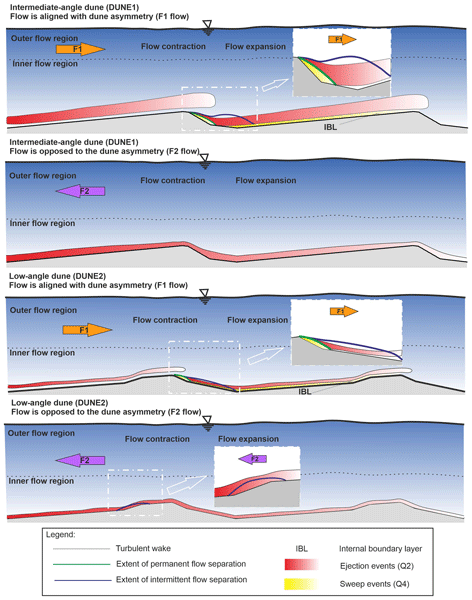
Abstract. Large-scale, high-resolution flume experiments were conducted under representative steady bidirectional flows in a large recirculating flume to investigate the time-averaged flow and turbulence structures over two-dimensional (2D) fixed tidal dunes. Two dune morphologies were considered for representing asymmetric dunes with low to intermediate-angle slopes. The dune morphologies are an idealised representation of natural tidal dunes. Specifically, the study aims to characterise in detail the influence of dune morphology on the properties of flow separation zones and turbulence structures above these dunes subjected to bidirectional flows, which are a representation of tidal flows. Results show that a smaller permanent flow separation zone is found over the tested intermediate-angle dune (mean lee slope of 12°, steep face of 22 compared to those found over angle-of-repose dunes detected close to the bed where a larger intermittent flow separation is found. The corresponding turbulent wake expands downwards to the trough before dissipating further downstream. Over the tested low-angle dune (mean lee slope of 10°, steep face of 15°), both small permanent and intermittent flow separations are observed. When the flow is opposed to the dune asymmetry and flows over a very gentle side (4°) with a short steep portion (10°), only a very small intermittent flow separation is detected. Over only a straight gentle side (4°), both flow separations are nonexistent. Neither intermediate- or low-angle dunes exhibit a distinct turbulent wake when the flow is opposed to the dune asymmetry, and a turbulence structure similar to that under a flatbed condition can be observed. Large-scale turbulence associated with both types of dunes is observed through the high occurrence of energy containing ejection and sweep events as revealed by quadrant analysis. Overall, our study demonstrates the significant impact of dune morphology, particularly the mean lee slope and steep face on the emerging flow and turbulence structures above intermediate- to low-angle tidal dunes.
-
Notice on discussion status
The requested preprint has a corresponding peer-reviewed final revised paper. You are encouraged to refer to the final revised version.
-
Preprint
(2727 KB)
-
The requested preprint has a corresponding peer-reviewed final revised paper. You are encouraged to refer to the final revised version.
- Preprint
(2727 KB) - Metadata XML
- BibTeX
- EndNote
- Final revised paper


Journal article(s) based on this preprint
Interactive discussion
Status: closed
- RC1: 'Comment on egusphere-2025-4883', Sjoukje de Lange, 05 Nov 2025
-
RC2: 'Comment on egusphere-2025-4883', Anonymous Referee #2, 27 Nov 2025
The manuscript titled “Experimental Study of Time-averaged Flow and Turbulence Structures over Low-Angle Tidal Dunes under Steady Bidirectional Flows” addresses an important knowledge gap in our understanding of flow structure over bedforms under bidirectional flow conditions. This paper uses physical flume experiments to examine how two fixedconcrete dunes, representing low- and intermediate-angle tidal dunes, scaled from the Weser Estuary, shape flow separation, turbulence, and bed shear stress under reversing flows. For each dune, steady flow is run in two directions representing ebb and flood flows, and velocity fields are measured with an ADV and interpolated to 2D sections over the dunes. From these, the authors derive mean flow, separation zones, turbulent kinetic energy, Reynolds stress, and the distribution of turbulent events.
In this manuscript, the authors highlight previously unknown flow characteristics over tidal bedforms. They show that even intermediate- and low-angle tidal dunes can sustain permanent flow separation during ebb flows, but that separation length and thickness shrink markedly as lee slope decreases. Bed shear stress and the frequency of energetic ejection and sweep events are maximized over the intermediate-angle dune with flow over the steep face. Flow reversal (i.e., flood flows) eliminates permanent flow separation and any coherent bed-attached wakes. The study concludes that lee-slope geometry and flow direction together control separation, macroturbulence, and effective hydraulic roughness of tidal dunes.
The manuscript presents new and interesting results, the and the figures are clear and well-labelled; however, the current results and discussion would benefit from reorganization and clearer, more consistent writing so that these novel findings are easier to follow and more effectively highlighted. The following are some suggested changes that the authors should consider during revisions:
- It would be great if the authors could adopt systematic configuration labeling for the four flow configurations throughout the manuscript (e.g., DUNE1_F1, DUNE2_F2), rather than using phrases such as “here” or “in this case.”For instance: “High TKE is concentrated within the immediate vicinity of the bed and diminishes towards the upper portion of the water column. Although not as strong as the previous case (Fig. 11a), high TKE occurs within the trough and the immediate downstream portion of the gentle side.” — I assumed that the authors were discussing TKE for DUNE2_F1. However, this is not very clear because, even though they say, “although not as strong as the previous case,” they did not discuss TKE for DUNE1_F1 (which I assume is the previous case) immediately beforehand.
- In some parts of the Results and Discussion sections, the authors use phrases such as “flow over the steep slope” and “flow over the gentle slope,” etc. I suggest changing these to “flow directed from the gentle to the steep slope” and “flow directed from the steep to the gentle slope,” or using F1/F2 within parentheses. While I understand that “flow over the steep slope” would represent the F1 condition, this is confusing because the flow would technically pass over both the steep and gentle slopes regardless of flow direction.
- In the same vein, the authors should consider a consistent sequence within each Results subsection: for each metric (such as TKE or velocity), a configuration-by-configuration description, with paragraph breaks or clear indications when switching to a different flow direction. Given that the motivation is understanding tidal flows, each subsection should explicitly report how reversing flow (F1 to F2) alters each metric for each dune, rather than introducing bidirectionality in isolated passages that read as ancillary.4
- In Section 4.1, the authors state: “The present findings demonstrate that both permanent flow separation and intermittent flow separation can exist for intermediate and low angle dunes depending on the lee side morphology, in particular the presence of a steep slope.” — I believe they are referring to F1 flows only, but it would be helpful if they could state that for clarity, since “stoss/lee slope” is flow-direction-dependent. For DUNE2_F2, based on the results/figures, there is no flow separation on the lee side (which would correspond to the gentle slope in the F2 case).
- In Section 4.2 (lines 405–415), the authors summarize several criteria used in prior studies to define the extent of a turbulent wake. In the subsequent paragraph, they introduce the criterion adopted in this study, but it is unclear whether this approach is taken directly from Lefebvre et al. (2014) or newly proposed here. If the criterion is based on Lefebvre et al. (2014), it should be explicitly cited at the point where it is introduced. If it is the authors’ own choice, it would be helpful to briefly justify why this particular threshold/definition was selected.
- Overall, in the Discussion section, there seems to be a greater focus on ebb flows (i.e., when flow is going from the gentle to the steep side). There is relatively less discussion of what happens when “flow is opposed to dune asymmetry.” Since bidirectionality is a central motivation, it would be valuable to expand the interpretation and implications of the F2 flows as well.
- The conceptual model should possibly be part of the Discussion, not the Results section, where it can read as though it is an additional empirical finding rather than a synthesis.
- The authors have done an excellent job in the Discussion section, especially in comparing the results to other studies. However, it would further strengthen the manuscript to explicitly discuss what the identified turbulence/separation structures imply for hydraulic roughness parameterizations in tidal settings, the implications for effective roughness arising from these bedforms, and real tidal flows that are not steady (e.g., how unsteadiness through a tidal cycle might modulate these patterns).
Citation: https://doi.org/10.5194/egusphere-2025-4883-RC2 -
CC1: 'Comment on egusphere-2025-4883', Tom Coulthard, 27 Nov 2025
Thanks to both reviewers for the very constructive comments. Much appreciated. TC
Citation: https://doi.org/10.5194/egusphere-2025-4883-CC1 -
AC1: 'Comment on egusphere-2025-4883', Kevin Bobiles, 26 Jan 2026
Dear reviewers,
Thank you for the constructive reviews you have provided to our manuscript.
The reviews will help improve a lot the readability and structure of the manuscript ensuring that the significance of the study is fully reflected in the text.
In view of this, we have revised the manuscript incorporating the comments and suggestions from both reviews. These are reflected now in the revised manuscript.
We have addressed each of the reviewer's comment and suggestion as well as the detailed inline questions or suggestions from reviewer 1. The details of our response to both reviewer's comments are contained in the attached supplemental pdf file.
We would like to thank again the reviewers for providing valuable comments which will truly help improve the overall quality of our manuscript.
Kind regards on behalf of the co-authors,
Kevin Bobiles
Peer review completion


Interactive discussion
Status: closed
-
RC1: 'Comment on egusphere-2025-4883', Sjoukje de Lange, 05 Nov 2025
This manuscript presents a high-quality and original study that successfully fills a relevant gap in the current research field. The experimental design is robust, and the data analysis is thorough and convincing. Overall, the scientific contribution is significant. Most of my feedback therefore concerns aspects of writing style, structure, and clarity rather than the scientific content itself. These revisions would enhance readability and ensure that the strength of the work is fully reflected in the text. Below I highlight major concerns, while in the attached pdf I added in-line questions and suggestions.
Title: The title currently includes the phrase “Steady bidirectional flow”, which is conceptually problematic, since a bidirectional flow, which fluctuates between +u_max and –u_max, cannot be steady by definition (as du/dt≠0). Upon reading further, it becomes clear that the authors refer to two separate experimental settings: a steady flow in one direction, and a steady flow in the opposite direction. While this design is valid, the term “steady bidirectional flow” may lead to initial confusion. I therefore recommend removing the word “steady” or rephrasing the title for improved clarity.
Abstract: The abstract contains all relevant information, but its organization could be improved. The current structure appears somewhat disordered, which obscures the central message of the paper. A clearer and more conventional scientific structure is recommended. The sections that I miss or would improve include:
- Motivation: Briefly state why the research topic is important and what knowledge gap is being addressed.
- Research question/objective: Clearly formulate the central question or hypothesis.
- Methods: this could be slightly less detailed.
- Broader implications: End with the wider significance or applications of the findings.
The main findings—especially regarding non-steep dunes, irregular dune shapes, and the importance of leeside angle and steep-face morphology—should be emphasized more clearly. At present, the abstract does not adequately convey the strength and clarity of the paper’s contributions.
Introduction: The introduction reads somewhat unstructured and would benefit from clearer logical progression and stronger narrative coherence. The reader needs more guidance throughout the section: Why is each paragraph or subtopic relevant? How does each section build toward the research question? What is the main message or takeaway from each part?
Additionally, the introduction would be strengthened by including more recent literature, since many references are from 20 years ago, and much progress has been made in the field since then.
Methods and results: These sections are excellent. The analysis is detailed, systematic, and well-executed. The figures and interpretations convincingly support the conclusions. The only thing I would appreciate is a bit more explanation on the quandrant analysis and the interpretation of these results.
Discussion: The discussion is generally well written and organised. It could be expanded slightly to answer three of my remaining questions.
Firstly, it would be valuable to include a short section on implications for the field, addressing how these findings might influence or refine conclusions from previous field studies (e.g., de Lange et al, 2021 (https://doi.org/10.1029/2021WR030329), Prokocki et al., 2022 (https://doi.org/10.1002/ esp.5364), de Lange et al. 2024 (https://doi. org/10.1029/2023JF007340), and others).
Moreover, since the experimental design uses two opposing steady flows to approximate tidal dynamics, it would be useful to reflect on how an actual tidal flow—characterized by gradual acceleration and deceleration—might affect the observed results.
Finally, how would superimposed dunes affect your findings? Could you just add one or two sentence speculating on this? The reason I’m suggesting this is that superimposed dunes are recently found to be very important for sediment transport (I refer to the work of Judith Zomer), and clearly superimposed dunes impact the leeside and steep side angle of the primary dune.
-
RC2: 'Comment on egusphere-2025-4883', Anonymous Referee #2, 27 Nov 2025
The manuscript titled “Experimental Study of Time-averaged Flow and Turbulence Structures over Low-Angle Tidal Dunes under Steady Bidirectional Flows” addresses an important knowledge gap in our understanding of flow structure over bedforms under bidirectional flow conditions. This paper uses physical flume experiments to examine how two fixedconcrete dunes, representing low- and intermediate-angle tidal dunes, scaled from the Weser Estuary, shape flow separation, turbulence, and bed shear stress under reversing flows. For each dune, steady flow is run in two directions representing ebb and flood flows, and velocity fields are measured with an ADV and interpolated to 2D sections over the dunes. From these, the authors derive mean flow, separation zones, turbulent kinetic energy, Reynolds stress, and the distribution of turbulent events.
In this manuscript, the authors highlight previously unknown flow characteristics over tidal bedforms. They show that even intermediate- and low-angle tidal dunes can sustain permanent flow separation during ebb flows, but that separation length and thickness shrink markedly as lee slope decreases. Bed shear stress and the frequency of energetic ejection and sweep events are maximized over the intermediate-angle dune with flow over the steep face. Flow reversal (i.e., flood flows) eliminates permanent flow separation and any coherent bed-attached wakes. The study concludes that lee-slope geometry and flow direction together control separation, macroturbulence, and effective hydraulic roughness of tidal dunes.
The manuscript presents new and interesting results, the and the figures are clear and well-labelled; however, the current results and discussion would benefit from reorganization and clearer, more consistent writing so that these novel findings are easier to follow and more effectively highlighted. The following are some suggested changes that the authors should consider during revisions:
- It would be great if the authors could adopt systematic configuration labeling for the four flow configurations throughout the manuscript (e.g., DUNE1_F1, DUNE2_F2), rather than using phrases such as “here” or “in this case.”For instance: “High TKE is concentrated within the immediate vicinity of the bed and diminishes towards the upper portion of the water column. Although not as strong as the previous case (Fig. 11a), high TKE occurs within the trough and the immediate downstream portion of the gentle side.” — I assumed that the authors were discussing TKE for DUNE2_F1. However, this is not very clear because, even though they say, “although not as strong as the previous case,” they did not discuss TKE for DUNE1_F1 (which I assume is the previous case) immediately beforehand.
- In some parts of the Results and Discussion sections, the authors use phrases such as “flow over the steep slope” and “flow over the gentle slope,” etc. I suggest changing these to “flow directed from the gentle to the steep slope” and “flow directed from the steep to the gentle slope,” or using F1/F2 within parentheses. While I understand that “flow over the steep slope” would represent the F1 condition, this is confusing because the flow would technically pass over both the steep and gentle slopes regardless of flow direction.
- In the same vein, the authors should consider a consistent sequence within each Results subsection: for each metric (such as TKE or velocity), a configuration-by-configuration description, with paragraph breaks or clear indications when switching to a different flow direction. Given that the motivation is understanding tidal flows, each subsection should explicitly report how reversing flow (F1 to F2) alters each metric for each dune, rather than introducing bidirectionality in isolated passages that read as ancillary.4
- In Section 4.1, the authors state: “The present findings demonstrate that both permanent flow separation and intermittent flow separation can exist for intermediate and low angle dunes depending on the lee side morphology, in particular the presence of a steep slope.” — I believe they are referring to F1 flows only, but it would be helpful if they could state that for clarity, since “stoss/lee slope” is flow-direction-dependent. For DUNE2_F2, based on the results/figures, there is no flow separation on the lee side (which would correspond to the gentle slope in the F2 case).
- In Section 4.2 (lines 405–415), the authors summarize several criteria used in prior studies to define the extent of a turbulent wake. In the subsequent paragraph, they introduce the criterion adopted in this study, but it is unclear whether this approach is taken directly from Lefebvre et al. (2014) or newly proposed here. If the criterion is based on Lefebvre et al. (2014), it should be explicitly cited at the point where it is introduced. If it is the authors’ own choice, it would be helpful to briefly justify why this particular threshold/definition was selected.
- Overall, in the Discussion section, there seems to be a greater focus on ebb flows (i.e., when flow is going from the gentle to the steep side). There is relatively less discussion of what happens when “flow is opposed to dune asymmetry.” Since bidirectionality is a central motivation, it would be valuable to expand the interpretation and implications of the F2 flows as well.
- The conceptual model should possibly be part of the Discussion, not the Results section, where it can read as though it is an additional empirical finding rather than a synthesis.
- The authors have done an excellent job in the Discussion section, especially in comparing the results to other studies. However, it would further strengthen the manuscript to explicitly discuss what the identified turbulence/separation structures imply for hydraulic roughness parameterizations in tidal settings, the implications for effective roughness arising from these bedforms, and real tidal flows that are not steady (e.g., how unsteadiness through a tidal cycle might modulate these patterns).
Citation: https://doi.org/10.5194/egusphere-2025-4883-RC2 -
CC1: 'Comment on egusphere-2025-4883', Tom Coulthard, 27 Nov 2025
Thanks to both reviewers for the very constructive comments. Much appreciated. TC
Citation: https://doi.org/10.5194/egusphere-2025-4883-CC1 -
AC1: 'Comment on egusphere-2025-4883', Kevin Bobiles, 26 Jan 2026
Dear reviewers,
Thank you for the constructive reviews you have provided to our manuscript.
The reviews will help improve a lot the readability and structure of the manuscript ensuring that the significance of the study is fully reflected in the text.
In view of this, we have revised the manuscript incorporating the comments and suggestions from both reviews. These are reflected now in the revised manuscript.
We have addressed each of the reviewer's comment and suggestion as well as the detailed inline questions or suggestions from reviewer 1. The details of our response to both reviewer's comments are contained in the attached supplemental pdf file.
We would like to thank again the reviewers for providing valuable comments which will truly help improve the overall quality of our manuscript.
Kind regards on behalf of the co-authors,
Kevin Bobiles
Peer review completion
Journal article(s) based on this preprint
Viewed
| HTML | XML | Total | BibTeX | EndNote | |
|---|---|---|---|---|---|
| 656 | 401 | 67 | 1,124 | 59 | 81 |
- HTML: 656
- PDF: 401
- XML: 67
- Total: 1,124
- BibTeX: 59
- EndNote: 81
Viewed (geographical distribution)
| Country | # | Views | % |
|---|
| Total: | 0 |
| HTML: | 0 |
| PDF: | 0 |
| XML: | 0 |
- 1
Kevin Bobiles
Bernhard Kondziella
Christina Carstensen
Elda Miramontes
Ingrid Holzwarth
Alice Lefebvre
The requested preprint has a corresponding peer-reviewed final revised paper. You are encouraged to refer to the final revised version.
- Preprint
(2727 KB) - Metadata XML
This manuscript presents a high-quality and original study that successfully fills a relevant gap in the current research field. The experimental design is robust, and the data analysis is thorough and convincing. Overall, the scientific contribution is significant. Most of my feedback therefore concerns aspects of writing style, structure, and clarity rather than the scientific content itself. These revisions would enhance readability and ensure that the strength of the work is fully reflected in the text. Below I highlight major concerns, while in the attached pdf I added in-line questions and suggestions.
Title: The title currently includes the phrase “Steady bidirectional flow”, which is conceptually problematic, since a bidirectional flow, which fluctuates between +u_max and –u_max, cannot be steady by definition (as du/dt≠0). Upon reading further, it becomes clear that the authors refer to two separate experimental settings: a steady flow in one direction, and a steady flow in the opposite direction. While this design is valid, the term “steady bidirectional flow” may lead to initial confusion. I therefore recommend removing the word “steady” or rephrasing the title for improved clarity.
Abstract: The abstract contains all relevant information, but its organization could be improved. The current structure appears somewhat disordered, which obscures the central message of the paper. A clearer and more conventional scientific structure is recommended. The sections that I miss or would improve include:
The main findings—especially regarding non-steep dunes, irregular dune shapes, and the importance of leeside angle and steep-face morphology—should be emphasized more clearly. At present, the abstract does not adequately convey the strength and clarity of the paper’s contributions.
Introduction: The introduction reads somewhat unstructured and would benefit from clearer logical progression and stronger narrative coherence. The reader needs more guidance throughout the section: Why is each paragraph or subtopic relevant? How does each section build toward the research question? What is the main message or takeaway from each part?
Additionally, the introduction would be strengthened by including more recent literature, since many references are from 20 years ago, and much progress has been made in the field since then.
Methods and results: These sections are excellent. The analysis is detailed, systematic, and well-executed. The figures and interpretations convincingly support the conclusions. The only thing I would appreciate is a bit more explanation on the quandrant analysis and the interpretation of these results.
Discussion: The discussion is generally well written and organised. It could be expanded slightly to answer three of my remaining questions.
Firstly, it would be valuable to include a short section on implications for the field, addressing how these findings might influence or refine conclusions from previous field studies (e.g., de Lange et al, 2021 (https://doi.org/10.1029/2021WR030329), Prokocki et al., 2022 (https://doi.org/10.1002/ esp.5364), de Lange et al. 2024 (https://doi. org/10.1029/2023JF007340), and others).
Moreover, since the experimental design uses two opposing steady flows to approximate tidal dynamics, it would be useful to reflect on how an actual tidal flow—characterized by gradual acceleration and deceleration—might affect the observed results.
Finally, how would superimposed dunes affect your findings? Could you just add one or two sentence speculating on this? The reason I’m suggesting this is that superimposed dunes are recently found to be very important for sediment transport (I refer to the work of Judith Zomer), and clearly superimposed dunes impact the leeside and steep side angle of the primary dune.