
the Creative Commons Attribution 4.0 License.
the Creative Commons Attribution 4.0 License.
 | 12 Nov 2025
Hybrid forest disturbance classification using Sentinel-1 and inventory data: a case-study for Southeastern USA
Abstract. Forest ecosystems are increasingly threatened by disturbances such as fires, droughts, storms, and insect and pathogen outbreaks. Accurate and timely disturbance mapping is essential for understanding their dynamics and informing mitigation strategies to combat widespread forest decline. Traditional inventories, such as the U.S. Forest Service's Insect and Disease Survey (IDS), provide detailed information on biotic and abiotic disturbances; however, they have varying coverage and inherent uncertainties in disturbance location, extent, and timing due to data collection constraints. Other approaches, such as satellite remote sensing, can in principle overcome some of these challenges by providing large-scale coverage and continuous spatio-temporal observations. However, robust classification algorithms need to be developed, which in turn require good-quality labels.
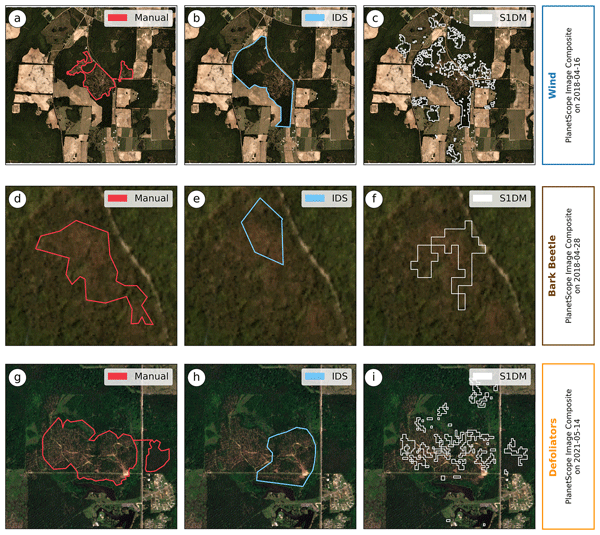
We present a novel approach for refining disturbance classification by combining IDS with Sentinel-1 radar backscatter change detection. The disturbed patches identified by Sentinel-1 are typically within 200–950 meters of IDS locations and generally agree on timing. When statistically examined against manual labels from PlanetScope, we found that S1DM performed better than IDS for wind and bark beetle disturbances, but not for defoliators. We find that Sentinel-1 tends to detect bark beetle disturbances earlier than IDS. We then combine spatial and temporal information about disturbance occurrence from Sentinel-1 change detection with information about the corresponding agent from IDS to produce a new high-quality forest disturbance reference dataset, Sentinel-1 Disturbance Mapping (S1DM), that can be used to develop remote sensing forest classification models.
Our approach highlights the benefits of combining satellite-based remote sensing with traditional aerial survey data, reducing costs associated with aerial surveys while providing a scalable method that can be adapted to various regions.
-
Notice on discussion status
The requested preprint has a corresponding peer-reviewed final revised paper. You are encouraged to refer to the final revised version.
-
Preprint
(21751 KB)
-
The requested preprint has a corresponding peer-reviewed final revised paper. You are encouraged to refer to the final revised version.
- Preprint
(21751 KB) - Metadata XML
- BibTeX
- EndNote
- Final revised paper


Journal article(s) based on this preprint
Interactive discussion
Status: closed
-
RC1: 'Comment on egusphere-2025-4880', Anonymous Referee #1, 08 Jan 2026
-
AC1: 'Reply on RC1', Franziska Müller, 16 Feb 2026
Dear Reviewer,
We would like to sincerely thank you for the thorough review of our manuscript. We greatly appreciate the time and effort you invested in providing detailed and constructive feedback.
We have carefully considered all your comments and revised the manuscript accordingly.
Please find our detailed, point-by-point response attached.
Kind regards,
Franziska Müller (On behalf of all authors)
-
AC1: 'Reply on RC1', Franziska Müller, 16 Feb 2026
-
RC2: 'Comment on egusphere-2025-4880', Anonymous Referee #2, 08 Jan 2026
Hybrid forest disturbance classification using Sentinel-1 and inventory data: a case study for the Southeastern USA
General comment:
This manuscript combines Sentinel-1 with IDS data for disturbance mapping (wind, bark beetles, defoliators) in a forest region, addressing legacy dataset limitations. However, the text structure is often confusing and lacks explicit research questions. Pervasive formatting inconsistencies further impede readability. Minor revisions for structural clarity, quantitative validation beyond manual polygon delineation using PlanetScope, and thorough clean-up are essential before resubmission.
Specific comments:
[Introduction:] The introduction is well explained but provides excessive detail on general topics such as DL training, labeling challenges, and legacy datasets, which are not clearly linked to the study’s focus on bark beetle, defoliator, and wind disturbances. The research questions or specific objectives the authors intend to address should be stated explicitly.
[Results] Despite the preprint relying on spatial agreement and manual labels without such metrics, I missed a confusion matrix analysis quantifying omission and commission errors for each disturbance type (wind, bark beetles, defoliators). This quantitative error breakdown is essential for transparent S1DM validation and comparability with IDS/alternatives.
[Discussion:] The section effectively highlights S1DM strengths but omits essential components: a dedicated limitations subsection (buffer choices, IDS error propagation, lack of field validation, regional limits); quantitative benchmarking against alternatives such as GLAD/ESDAC; explicit linkage back to the research questions with key results summaries; and implications for operational scalability and DL training. These omissions weaken the broader impact and dataset positioning.
[Conclusion:] The conclusion requires substantial restructuring to enhance its impact and avoid redundancy. The first paragraph repetitively restates the global data gap and IDS limitations already discussed in the Introduction and Discussion. While subsequent paragraphs adequately summarize the hybrid S1DM method, they underemphasize the ecological implications—for example, how refined timing enables bark beetle outbreak forecasting, realistic wind patches inform gap dynamics and succession, or defoliator improvements correct carbon flux biases. The authors should explicitly position S1DM as a public benchmark for DL training (linking back to the labeling challenges in the Introduction) and replace vague future work with specific proposals.
[General formatting:] Please ensure consistent paragraph indentation (either all first‑line indents or none) and uniform spacing between paragraphs throughout the manuscript. Currently, indentation is inconsistent, and spacing varies.
Additionally, fix inconsistencies such as missing figure citations in the text (e.g., L427 “Panel a” without “Figure 5”), incorrect numbering in subsections (e.g., “5.1.2 (2)” in the Discussion), and other formatting artifacts. A thorough clean‑up is essential for readability.
Minor comments:
*L16: The acronym “Sentinel‑1 Disturbance Mapping (S1DM)” should be introduced when it first appears (around line 12), rather than later in the abstract. Define the term before using the abbreviation.
*L40: Clarify early in the paragraph that these percentages refer to the coverage of disturbance reports (i.e., data availability) rather than the actual affected forest area, to avoid possible misinterpretation.
*L58: The phrase “more recently, the Sentinel fleet” should specify the approximate launch period to better clarify the temporal contrast with MODIS and Landsat.
*The study area description in Section 2.1 lacks quantitative climate data (e.g., precipitation, temperature) essential for contextualizing disturbances. Please add a brief summary.
*L153: The Tree Canopy Cover (TCC) dataset is mentioned for the first time without introduction. Consider briefly referencing it in the Introduction when discussing validation approaches.
*L157: This sentence repeats IDS basics already covered in the Introduction.
*L216: The text states that TCC data are available for 2015–2020, but Table 1 lists only 2017. Please clarify whether only 2017 data were used (and why), whether it is a time series, or describe the selection criteria to avoid confusion.
*L235: PlanetScope is introduced here without prior mention in the Introduction or Table 1. Please clarify its specific role in the analysis (e.g., manual validation, comparison with S1DM/IDS) and explain why it was not included in Table 1 alongside the key datasets.
*L411: Standardize result reporting (e.g., all as “% IDS events with S1DM match”) for consistency across disturbance types. Also clarify in the text whether percentages refer to totals across all years (matching absolute numbers in the caption: wind 478 IDS/469 S1DM, etc.).
*L427: The text refers to “Panel a” without specifying “Figure 5.” Please include the full figure number (e.g., “Figure 5, Panel a”) and correct similar minor inconsistencies throughout.
*L428: The figure interrupts the paragraph. Please follow standard formatting by placing figures at the beginning or end of relevant paragraphs or sections.
*Figure 8: The legend shows a black star, but the plot uses an asterisk (*). Please standardize the symbols.
*Sections “5.1.1 (1) Location and delineation of disturbance patches” and “5.1.2 (2) Timing of disturbances:” Please correct subsection numbering errors (remove numbers in parentheses).
Citation: https://doi.org/10.5194/egusphere-2025-4880-RC2 -
AC2: 'Reply on RC2', Franziska Müller, 16 Feb 2026
Dear Reviewer,
We would like to sincerely thank you for the thorough review of our manuscript. We greatly appreciate the time and effort you invested in providing detailed and constructive feedback.
We have carefully considered all your comments and revised the manuscript accordingly.
Please find our detailed, point-by-point response attached.
Kind regards,
Franziska Müller (On behalf of all authors)
-
AC2: 'Reply on RC2', Franziska Müller, 16 Feb 2026
Peer review completion


Interactive discussion
Status: closed
-
RC1: 'Comment on egusphere-2025-4880', Anonymous Referee #1, 08 Jan 2026
The paper combines three different datasets on forest disturbances for a large region in the Southern and Eastern US: IDS, S1DM, and Planetscope. The first one is a routine product freely accessible with yearly updates, the second one is generated by the authors based on Sentinel-1 time series, and the third one is merely a case-based evaluation tool including manual delineation of polygons with damaged forest.
Out of the many disturbances, the authors select windthrow, bark beetle attacks, and defoliators, representing important categories, but leaving out fire. Which areas are considered and which are excluded is largely determined by the flight trajectories leading to the IDS dataset - this is a bit disappointing since S1 tiles have global coverage, and the advantage of satellite remote sensing is the ability to conclude on patterns outside ground-based (or aerial for that matter) observations, provided sufficient training data. It would be interesting to see an area with a damage according to the Planetscope manual delineation and the S1 trend detection there, but not covered by the IDS. Of course, the TCC might still be used to exclude non-forested areas. The exercise would demonstrate the power of the S1 disturbance detection completely independent from the IDS data; in general, the two approaches are just compared, they do not depend on each other.
Concerning the exclusion of non-forest areas, the authors set an unnecessary strict threshold for the presence of a forest, i.e. 30% canopy cover. This is not aligned with the FAO definition of a forest as any are of minimum size 0.5 ha with a canopy cover (for trees which can grow to more than 5 meters) of only 10% (https://fra-data.fao.org/definitions/fra/2020/en/tad). As the minimum area required according to FAO is only 12.5 pixels for S-1, the 30% seems to be overly restrictive.
On page 3, l. 84-92, ML and DL are mentioned. While it is largely correct what is written here, it seems that not a single ML or DL method is applied in the rest of the paper. What is the purpose of that paragraph? Is it a leftover from earlier versions of the manuscript? It might as well be deleted.
Regarding the size of disturbed areas, a maximum size of 15 km2 is used. This seems to be an arbitrary threshold and a huge difference to the maximum size of 2000 km2 used by Eifler et al. (2024). The only justification is (l. 278) “we applied a stricter filter”. Certainly you did, but why? Many beetle attacks happen on or spread to larger areas, similar with defoliators.
The polygon sizes mentioned in Table 1 are hard to believe. The smallest one (0.5 m2) would cover a single tree at most, and would be undetectable in aerial imagery. The largest one would be a significant fraction of all forest in region 8. Double-check these numbers.
The RQA TREND method for change detection is perfectly valid; however, the method has three parameters: the embedding dimension m, the recurrence threshold ε, and the delay τ. The results for the slope away from the main diagonal depends on them. None of the parameters is provided in the text; unfortunately, Cremer et al. (2020) does not mention them either; you also refer to the “European Commission…(2023)” proceedings, what you really mean is the Cremer et al. article on pp. 361-364 in that book (please be more precise in your referencing), but that article does not contain the values for the parameters either. Thus, the threshold for the trend -1.28 (l. 316 – what you probably mean is -1.28 yr-1) appears completely arbitrary (again, also this threshold is not mentioned in the Cremer et al. articles), what is its justification? It seems to be THE crucial parameter to distinguish non-disturbance to disturbance – how robust are your results against changing it? The extreme patchiness of the disturbance areas (e.g. as seen in Figure 7) could be a result of that choice. – You are also stating the opposite of what you intend to say in l. 316f, the correct version would be “Pixels with a RQA-Trend value ABOVE the threshold of -1.28 were considered to show no significant change.” Please be more explicit here, and check the consequences of changing the trend threshold. Did you calculate one RP per time series, or did you move a window (e.g. of one year length) across the time series and calculated a separate RP and thus a TREND each time? If a disturbance sets in, it is to be expected that some of the RQA variables (TREND, but possibly also DET) “react” more or less suddenly (e.g. for wind). That would provide an opportunity to put a more precise date for the onset of the disturbance.
Concerning the IDS dataset, you mention “over 1000 selectable agents” (l. 162). This is surely a source of uncertainty; how can any image interpreter ever pick the right one out of so many choices under time pressure etc.? How many of these 1000 did you have to aggregate to get to the broad categories “wind”, “bark beetle”, “defoliator”? Please discuss. What is the connection between the > 1000 choices and Table A.3 (the transformation of the choices into DCA_ID)?
The annotated pdf attached to this review contains a further 31 comments, mostly rather specific ones. Please consider them as well.
The paper has some strong points on being self-critical, indicating the limitations of the study, the problems with spatial inaccuracy and thus the necessity to introduce a buffer zone around the polygons, etc. It becomes obvious that the three disturbance categories are very different in their spatial structure. Rendering IDS and S1DM truly comparable for bark beetle and defoliator attacks is a long way to go, as Figure 4 demonstrates.
A rather tricky issue is the timing of the onset of a disturbance; here, the authors go to a very coarse resolution of even more than one year, indicating that “online detection” of new damages is impossible. This is really a pity, since the strength of S-1 (and also S-2 for that matter) is short revisit cycles, with the potential to detect emerging attacks early and potentially act accordingly, very relevant for ecosystem managers! (See Jamali et al. 2023 for an approach using S-2). As the setup is now, the S1DM is for documentation of past events only.
The last sentence (l. 649f.) is talking about an “alternative to manual labeling”; ironically, you are judging the quality of the S1DM as compared to IDS based on a third dataset which was obtained by manual labeling. The “fully automatic forest disturbance classification methods” (l. 645) are still to be developed.
The changes suggested still add up to “minor revisions” only, this is regarding the text. The sensitivity analysis for the TREND threshold and the selection of PlanetScope/S1DM but NOT IDS damaged areas require additional work however.
Reference
Jamali, S., P.-O. Olsson, A. Ghorbanian and M. Müller (2023). "Examining the potential for early detection of spruce bark beetle attacks using multi-temporal Sentinel-2 and harvester data." ISPRS Journal of Photogrammetry and Remote Sensing 205: 352-366. https://doi.org/10.1016/j.isprsjprs.2023.10.013
-
AC1: 'Reply on RC1', Franziska Müller, 16 Feb 2026
Dear Reviewer,
We would like to sincerely thank you for the thorough review of our manuscript. We greatly appreciate the time and effort you invested in providing detailed and constructive feedback.
We have carefully considered all your comments and revised the manuscript accordingly.
Please find our detailed, point-by-point response attached.
Kind regards,
Franziska Müller (On behalf of all authors)
-
AC1: 'Reply on RC1', Franziska Müller, 16 Feb 2026
-
RC2: 'Comment on egusphere-2025-4880', Anonymous Referee #2, 08 Jan 2026
Hybrid forest disturbance classification using Sentinel-1 and inventory data: a case study for the Southeastern USA
General comment:
This manuscript combines Sentinel-1 with IDS data for disturbance mapping (wind, bark beetles, defoliators) in a forest region, addressing legacy dataset limitations. However, the text structure is often confusing and lacks explicit research questions. Pervasive formatting inconsistencies further impede readability. Minor revisions for structural clarity, quantitative validation beyond manual polygon delineation using PlanetScope, and thorough clean-up are essential before resubmission.
Specific comments:
[Introduction:] The introduction is well explained but provides excessive detail on general topics such as DL training, labeling challenges, and legacy datasets, which are not clearly linked to the study’s focus on bark beetle, defoliator, and wind disturbances. The research questions or specific objectives the authors intend to address should be stated explicitly.
[Results] Despite the preprint relying on spatial agreement and manual labels without such metrics, I missed a confusion matrix analysis quantifying omission and commission errors for each disturbance type (wind, bark beetles, defoliators). This quantitative error breakdown is essential for transparent S1DM validation and comparability with IDS/alternatives.
[Discussion:] The section effectively highlights S1DM strengths but omits essential components: a dedicated limitations subsection (buffer choices, IDS error propagation, lack of field validation, regional limits); quantitative benchmarking against alternatives such as GLAD/ESDAC; explicit linkage back to the research questions with key results summaries; and implications for operational scalability and DL training. These omissions weaken the broader impact and dataset positioning.
[Conclusion:] The conclusion requires substantial restructuring to enhance its impact and avoid redundancy. The first paragraph repetitively restates the global data gap and IDS limitations already discussed in the Introduction and Discussion. While subsequent paragraphs adequately summarize the hybrid S1DM method, they underemphasize the ecological implications—for example, how refined timing enables bark beetle outbreak forecasting, realistic wind patches inform gap dynamics and succession, or defoliator improvements correct carbon flux biases. The authors should explicitly position S1DM as a public benchmark for DL training (linking back to the labeling challenges in the Introduction) and replace vague future work with specific proposals.
[General formatting:] Please ensure consistent paragraph indentation (either all first‑line indents or none) and uniform spacing between paragraphs throughout the manuscript. Currently, indentation is inconsistent, and spacing varies.
Additionally, fix inconsistencies such as missing figure citations in the text (e.g., L427 “Panel a” without “Figure 5”), incorrect numbering in subsections (e.g., “5.1.2 (2)” in the Discussion), and other formatting artifacts. A thorough clean‑up is essential for readability.
Minor comments:
*L16: The acronym “Sentinel‑1 Disturbance Mapping (S1DM)” should be introduced when it first appears (around line 12), rather than later in the abstract. Define the term before using the abbreviation.
*L40: Clarify early in the paragraph that these percentages refer to the coverage of disturbance reports (i.e., data availability) rather than the actual affected forest area, to avoid possible misinterpretation.
*L58: The phrase “more recently, the Sentinel fleet” should specify the approximate launch period to better clarify the temporal contrast with MODIS and Landsat.
*The study area description in Section 2.1 lacks quantitative climate data (e.g., precipitation, temperature) essential for contextualizing disturbances. Please add a brief summary.
*L153: The Tree Canopy Cover (TCC) dataset is mentioned for the first time without introduction. Consider briefly referencing it in the Introduction when discussing validation approaches.
*L157: This sentence repeats IDS basics already covered in the Introduction.
*L216: The text states that TCC data are available for 2015–2020, but Table 1 lists only 2017. Please clarify whether only 2017 data were used (and why), whether it is a time series, or describe the selection criteria to avoid confusion.
*L235: PlanetScope is introduced here without prior mention in the Introduction or Table 1. Please clarify its specific role in the analysis (e.g., manual validation, comparison with S1DM/IDS) and explain why it was not included in Table 1 alongside the key datasets.
*L411: Standardize result reporting (e.g., all as “% IDS events with S1DM match”) for consistency across disturbance types. Also clarify in the text whether percentages refer to totals across all years (matching absolute numbers in the caption: wind 478 IDS/469 S1DM, etc.).
*L427: The text refers to “Panel a” without specifying “Figure 5.” Please include the full figure number (e.g., “Figure 5, Panel a”) and correct similar minor inconsistencies throughout.
*L428: The figure interrupts the paragraph. Please follow standard formatting by placing figures at the beginning or end of relevant paragraphs or sections.
*Figure 8: The legend shows a black star, but the plot uses an asterisk (*). Please standardize the symbols.
*Sections “5.1.1 (1) Location and delineation of disturbance patches” and “5.1.2 (2) Timing of disturbances:” Please correct subsection numbering errors (remove numbers in parentheses).
Citation: https://doi.org/10.5194/egusphere-2025-4880-RC2 -
AC2: 'Reply on RC2', Franziska Müller, 16 Feb 2026
Dear Reviewer,
We would like to sincerely thank you for the thorough review of our manuscript. We greatly appreciate the time and effort you invested in providing detailed and constructive feedback.
We have carefully considered all your comments and revised the manuscript accordingly.
Please find our detailed, point-by-point response attached.
Kind regards,
Franziska Müller (On behalf of all authors)
-
AC2: 'Reply on RC2', Franziska Müller, 16 Feb 2026
Peer review completion
Journal article(s) based on this preprint
Viewed
| HTML | XML | Total | BibTeX | EndNote | |
|---|---|---|---|---|---|
| 2,566 | 1,547 | 188 | 4,301 | 155 | 181 |
- HTML: 2,566
- PDF: 1,547
- XML: 188
- Total: 4,301
- BibTeX: 155
- EndNote: 181
Viewed (geographical distribution)
| Country | # | Views | % |
|---|
| Total: | 0 |
| HTML: | 0 |
| PDF: | 0 |
| XML: | 0 |
- 1
Cited


1 citations as recorded by crossref.
Franziska Müller

Laura Eifler
Felix Cremer
Pieter Beck
Gustau Camps-Valls
Ana Bastos
The requested preprint has a corresponding peer-reviewed final revised paper. You are encouraged to refer to the final revised version.
- Preprint
(21751 KB) - Metadata XML
The paper combines three different datasets on forest disturbances for a large region in the Southern and Eastern US: IDS, S1DM, and Planetscope. The first one is a routine product freely accessible with yearly updates, the second one is generated by the authors based on Sentinel-1 time series, and the third one is merely a case-based evaluation tool including manual delineation of polygons with damaged forest.
Out of the many disturbances, the authors select windthrow, bark beetle attacks, and defoliators, representing important categories, but leaving out fire. Which areas are considered and which are excluded is largely determined by the flight trajectories leading to the IDS dataset - this is a bit disappointing since S1 tiles have global coverage, and the advantage of satellite remote sensing is the ability to conclude on patterns outside ground-based (or aerial for that matter) observations, provided sufficient training data. It would be interesting to see an area with a damage according to the Planetscope manual delineation and the S1 trend detection there, but not covered by the IDS. Of course, the TCC might still be used to exclude non-forested areas. The exercise would demonstrate the power of the S1 disturbance detection completely independent from the IDS data; in general, the two approaches are just compared, they do not depend on each other.
Concerning the exclusion of non-forest areas, the authors set an unnecessary strict threshold for the presence of a forest, i.e. 30% canopy cover. This is not aligned with the FAO definition of a forest as any are of minimum size 0.5 ha with a canopy cover (for trees which can grow to more than 5 meters) of only 10% (https://fra-data.fao.org/definitions/fra/2020/en/tad). As the minimum area required according to FAO is only 12.5 pixels for S-1, the 30% seems to be overly restrictive.
On page 3, l. 84-92, ML and DL are mentioned. While it is largely correct what is written here, it seems that not a single ML or DL method is applied in the rest of the paper. What is the purpose of that paragraph? Is it a leftover from earlier versions of the manuscript? It might as well be deleted.
Regarding the size of disturbed areas, a maximum size of 15 km2 is used. This seems to be an arbitrary threshold and a huge difference to the maximum size of 2000 km2 used by Eifler et al. (2024). The only justification is (l. 278) “we applied a stricter filter”. Certainly you did, but why? Many beetle attacks happen on or spread to larger areas, similar with defoliators.
The polygon sizes mentioned in Table 1 are hard to believe. The smallest one (0.5 m2) would cover a single tree at most, and would be undetectable in aerial imagery. The largest one would be a significant fraction of all forest in region 8. Double-check these numbers.
The RQA TREND method for change detection is perfectly valid; however, the method has three parameters: the embedding dimension m, the recurrence threshold ε, and the delay τ. The results for the slope away from the main diagonal depends on them. None of the parameters is provided in the text; unfortunately, Cremer et al. (2020) does not mention them either; you also refer to the “European Commission…(2023)” proceedings, what you really mean is the Cremer et al. article on pp. 361-364 in that book (please be more precise in your referencing), but that article does not contain the values for the parameters either. Thus, the threshold for the trend -1.28 (l. 316 – what you probably mean is -1.28 yr-1) appears completely arbitrary (again, also this threshold is not mentioned in the Cremer et al. articles), what is its justification? It seems to be THE crucial parameter to distinguish non-disturbance to disturbance – how robust are your results against changing it? The extreme patchiness of the disturbance areas (e.g. as seen in Figure 7) could be a result of that choice. – You are also stating the opposite of what you intend to say in l. 316f, the correct version would be “Pixels with a RQA-Trend value ABOVE the threshold of -1.28 were considered to show no significant change.” Please be more explicit here, and check the consequences of changing the trend threshold. Did you calculate one RP per time series, or did you move a window (e.g. of one year length) across the time series and calculated a separate RP and thus a TREND each time? If a disturbance sets in, it is to be expected that some of the RQA variables (TREND, but possibly also DET) “react” more or less suddenly (e.g. for wind). That would provide an opportunity to put a more precise date for the onset of the disturbance.
Concerning the IDS dataset, you mention “over 1000 selectable agents” (l. 162). This is surely a source of uncertainty; how can any image interpreter ever pick the right one out of so many choices under time pressure etc.? How many of these 1000 did you have to aggregate to get to the broad categories “wind”, “bark beetle”, “defoliator”? Please discuss. What is the connection between the > 1000 choices and Table A.3 (the transformation of the choices into DCA_ID)?
The annotated pdf attached to this review contains a further 31 comments, mostly rather specific ones. Please consider them as well.
The paper has some strong points on being self-critical, indicating the limitations of the study, the problems with spatial inaccuracy and thus the necessity to introduce a buffer zone around the polygons, etc. It becomes obvious that the three disturbance categories are very different in their spatial structure. Rendering IDS and S1DM truly comparable for bark beetle and defoliator attacks is a long way to go, as Figure 4 demonstrates.
A rather tricky issue is the timing of the onset of a disturbance; here, the authors go to a very coarse resolution of even more than one year, indicating that “online detection” of new damages is impossible. This is really a pity, since the strength of S-1 (and also S-2 for that matter) is short revisit cycles, with the potential to detect emerging attacks early and potentially act accordingly, very relevant for ecosystem managers! (See Jamali et al. 2023 for an approach using S-2). As the setup is now, the S1DM is for documentation of past events only.
The last sentence (l. 649f.) is talking about an “alternative to manual labeling”; ironically, you are judging the quality of the S1DM as compared to IDS based on a third dataset which was obtained by manual labeling. The “fully automatic forest disturbance classification methods” (l. 645) are still to be developed.
The changes suggested still add up to “minor revisions” only, this is regarding the text. The sensitivity analysis for the TREND threshold and the selection of PlanetScope/S1DM but NOT IDS damaged areas require additional work however.
Reference
Jamali, S., P.-O. Olsson, A. Ghorbanian and M. Müller (2023). "Examining the potential for early detection of spruce bark beetle attacks using multi-temporal Sentinel-2 and harvester data." ISPRS Journal of Photogrammetry and Remote Sensing 205: 352-366. https://doi.org/10.1016/j.isprsjprs.2023.10.013