
the Creative Commons Attribution 4.0 License.
the Creative Commons Attribution 4.0 License.
 | 28 Nov 2025
Geochemical characteristics of suspended particulate matter around Piscadera Bay and its influence on near shore ecosystems, Curaçao (Caribbean Sea)
Abstract. Caribbean coral reefs face rising pressure from coastal development, yet the pathways by which urban pollution reaches these endangered ecosystems remain poorly understood. Bays act as dynamic channels, trapping, transforming, and releasing materials that can impact adjacent reef systems. We investigated the seasonal and spatial variability of suspended particulate matter (SPM)—a key vector for pollutants and nutrients— coming from an urbanized bay in Curaçao and determined its effect on surrounding coral reefs. Using sediment traps deployed across spatial gradients (bay mouth to nearby reefs in the East and West) during the dry (April–May) and wet (October–November) seasons, we measured mass, carbon, and nitrogen fluxes and associated grain-size and geochemical particle composition. Results were compared to environmental conditions (e.g. rain fall, current speed) and revealed a clear spatial gradient of bay influence: the bay mouth showed the strongest terrestrial signal, followed by the eastern reef (sheltered from currents) with elevated SPM fluxes of fine particles enriched in terrigenous elements (Si, Fe, Al, and Mn), while the western reef (exposed to open-ocean flow) exhibited lower fluxes of coarser particles with elevated Ca/Fe, Pb, Cu and Ni. This indicates diminished bay effect and stronger marine influence mixed with localized pollution. During the dry season, differences in SPM fluxes and composition between reef sites were minimal, but wet season conditions amplified spatial patterns, with rainfall-driven runoff locally increasing dissolved and particular matter delivery. This implies that reef vulnerability to bay-derived pollution locally depends on both proximity to source waters and seasonal hydrodynamic variability, with sheltered reefs experiencing the greatest impacts during periods of enhanced terrestrial runoff.
-
Notice on discussion status
The requested preprint has a corresponding peer-reviewed final revised paper. You are encouraged to refer to the final revised version.
-
Preprint
(7817 KB)
-
Supplement
(2422 KB)
-
The requested preprint has a corresponding peer-reviewed final revised paper. You are encouraged to refer to the final revised version.
- Preprint
(7817 KB) - Metadata XML
-
Supplement
(2422 KB) - BibTeX
- EndNote
- Final revised paper


Journal article(s) based on this preprint
Interactive discussion
Status: closed
-
RC1: 'Comment on egusphere-2025-4873', Anonymous Referee #1, 24 Dec 2025
-
AC1: 'Reply on RC1', Virginia Sánchez Barranco, 10 May 2026
We thank Reviewer 1 for their careful reading of the manuscript and constructive comments. We have addressed all points below; changes are indicated with line numbers referring to the revised (clean) manuscript. The main revisions concern (1) framing of temporal representativeness, where we now explicitly describe the wet-season deployment as an event-integrated snapshot rather than a climatological baseline, and avoid claims about inter-seasonal variability; (2) flux interpretation, where we now consistently refer to measured fluxes as suspended matter exposure rather than net sedimentation, and clarify that gross versus net flux cannot be distinguished with the present methodology; (3) geochemical attribution, where we have tempered language around trace-metal sourcing, now framing anthropogenic attribution as consistent with rather than diagnostic of sewage and maritime inputs, and addressed the limitations of Al-normalisation in carbonate-rich environments; and (4) ecological inference, where we have revised causal language around benthic phase shifts to reflect that contemporary sediment fluxes more likely maintain rather than initiate the current algal-dominated state. Additional clarifications were made regarding the El Niño context of the study period, the limited spatial scope of the findings, and the speculative nature of proposed decoupling mechanisms at the Western reef.
Review Comments on “Suspended Particulate Matter (SPM) dynamics around Piscadera Bay”.
This manuscript presents Important information on the spatial gradient of land-sea connection. However, in order to rule out normalisation artefacts, the interpretation of trace metal enrichment at the distal site necessitates thorough verification against absolute concentrations. Accurately estimating the new pollution load entering the reef system also depends on differentiating resuspension from primary flow. Some of the observations for the document are as follows:
1. The dry and wet seasons are represented by two 30-day deployment periods used in the study. Although this provides an overview, previous research on sediment dynamics (e.g., Storlazzi et al., 2011) highlights that sediment movement is frequently very episodic and event-driven. One high-rainfall event on November 2 has a significant impact on the "wet season" results in this publication. Therefore, a 30-day window might not be adequate to describe the inter-seasonal fluctuation. The clear wet season signal may not be a seasonal baseline, but rather an anomaly. Since the frequency of these pulse episodes is still unknown, care must be taken while comparing these short-term fluxes to yearly benthic degradation rates.
We agree that sediment dynamics in coastal systems can be episodic/event driven and that short deployment periods may integrate pulse-driven events rather than long-term seasonal baselines. We have therefore revised the manuscript to explicitly describe the wet-season deployment as an event-integrated snapshot that includes a major rainfall episode, rather than a representative climatological mean. We have also changed the wording to make sure we don’t make claims about seasonality but compare the 2 periods that we sampled. A new paragraph in the discussion now clarifies that the observed wet-season signal may reflect episodic forcing, and that care should be taken when extrapolating these short-term fluxes to annual benthic degradation rates (see L 518-534).
2. In shallow, high-energy settings, sediment traps were placed 0.7–0.8 meters above the seafloor. The study acknowledges that resuspension likely affects the material collected, but the precise amount of new sediment entering the reef remains unknown due to the lack of techniques to distinguish between primary terrestrial input and resuspended bottom sand (gross vs. net flux).
We acknowledge that sediment traps inherently collect both newly settling material and resuspended bottom sediment in shallow, high-energy environments, representing gross particle fluxes rather than net sedimentation. This is a widely recognized limitation of the methodology (e.g., Storlazzi et al., 2015). We have clarified this distinction in the Methods and Discussion, and now explicitly note that the amount of sediment permanently entering the reef framework cannot be quantified with the present approach (L158–160). We analyzed the manuscript and now refer to the observed fluxes as representing ‘suspended matter, rather than ‘sedimentation’.
3. The Western reef has the highest ratios of anthropogenic trace elements (Pb/Al, Cu/Al, Ni/Al), while being the furthest from the bay and having the lowest terrestrial signal (low Al, Fe). Aluminium (Al) normalisation is commonly used to account for dilution effects and grain size. Aluminium (Al) might falsely inflate these ratios when used to normalise data in carbonate-rich environments with extremely low Al concentrations. However, in carbonate-rich, low-terrigenous environments (like the Western reef), Al concentrations become extremely low. This could result in a false positive for high pollution intensity while absolute concentrations may actually be low. The authors attribute this to marine influence or localised pollution. To ascertain whether this is actual accumulation or a concentration by lack of dilution artefact, a critical examination of the absolute fluxes of these metals, rather than merely ratios is required.
We agree that aluminum normalisation in carbonate-rich, low-terrigenous environments may artificially elevate metal/Al ratios due to extremely low Al concentrations. To evaluate whether elevated metal/Al ratios at the Western reef reflect denominator effects, we examined CLR-transformed elemental intensities (Fig. S4). Ni and Pb remain elevated relative to other sites, indicating that enrichment is not solely driven by low Al concentrations. We have also addressed this in the discussion (See L485-490 and 685-69).
4. X-ray fluorescence (XRF) intensities expressed as centred log-ratios (CLR) are the basis for the elemental analysis. Absolute concentrations (such as mg/kg) are not provided by this semi-quantitative approach. As a result, it is impossible to ascertain whether the elevated metal levels are simply high in comparison to the background or truly above established toxicity criteria.
We agree that the semi-quantitative XRF-CLR approach does not provide absolute concentrations and therefore cannot be used to assess exceedance of toxicity thresholds. Therefore, we have revised the text to avoid the suggestion that we estimated toxicological risks and now clearly state that the observed enrichments are relative to background conditions rather than concentrations (L672-675 and 733-733).
5. The study uses spatial patterns rather than conclusive source tracking (e.g., stable isotope analysis) to attribute trace metals (Pb, Ni) to anthropogenic sources like sewage or maritime activity. Pb and Ni may be scavenging onto marine organic matter rather than terrestrial clays, based on their clustering with marine/organic vectors. Organic matter is a powerful scavenger of metals in the water column, according to earlier research (e.g., Salomons and Ostner). The difference between bio-accumulation and clay-bound movement is crucial for deciphering anthropogenic or terrestrial source.
We acknowledge that spatial co-variation alone cannot conclusively identify trace-metal sources and that Pb and Ni may also be scavenged onto marine organic matter rather than transported exclusively via terrestrial clays. We have expanded the discussion to explicitly distinguish between source origin and transport pathway, and now frame anthropogenic attribution as consistent with, rather than diagnostic of, sewage and maritime inputs (See L685-688 and 733-737).
6. In this study, SPM is attributed to resuspension during the dry season at the Western Reef. Both primary settling flux and resuspended bottom sediment are collected by sediment traps in high-energy shallow reefs (current speeds 0.01–0.07 m/s). It is challenging to differentiate new terrestrial input from old resuspended sediment in the absence of differential settling velocity data or bottom-stress modelling. Because resuspension events are temporary and may not indicate permanent burial, the measured mass fluxes (>10 g m-2 d-1) may exceed the true sedimentation burden on the corals.
We agree that sediment trap–derived mass fluxes in shallow reefs may overestimate the effective sedimentation load experienced by corals, as resuspended material may not result in permanent burial, but stay in suspension for long time periods. We have therefore revised the discussion to emphasize that the reported fluxes reflect exposure to suspended matter rather than net sediment accumulation on coral surfaces (e.g. L590-592).
7. The study connects the observed dominance of cyanobacteria and turf algae, especially in the Eastern reef, to the significant SPM fluxes. The typical 10 g m-2 d-1 stress threshold suggested by Rogers (1990) is greatly exceeded by the reported fluxes (18–40 g m-2 d-1) during the wet season. Nonetheless, the analysis suggests a clear causal relationship between the long-term benthic shift and the bay's present flow. It is crucial to consider whether the present SPM regime is responsible for the transition or for maintaining the current algal-dominated state given the 40-year history of degradation stated. The manuscript mentions a feedback loop that might be further investigated because turf algae are better at capturing sediments than corals.
We agree that the present SPM regime cannot be assumed to have (fully) caused the initial benthic phase shift given the documented multi-decadal history of degradation. We have revised the manuscript to clarify that our data more directly support a role for contemporary sediment fluxes in maintaining, rather than initiating, the current algal-dominated state, potentially through positive feedbacks involving sediment retention by turf algae. We have addressed this in L649-663.
8. Based on historical data and general literature, the study deduces ecological effects (such as algal dominance and coral damage). To directly connect the reported SPM flows to the current state of reef health, no concomitant biological health measures (such as tissue analysis, photosynthetic efficiency, or coral bleaching surveys) were taken during the investigation.
We acknowledge that no concurrent biological health metrics were collected in this study, as assessing reef physiology was outside its scope. The discussion frames potential ecological implications based on historical benthic cover data and general literature, rather than direct measurements (see also our previous reply).
9. For the dry season, current speed and direction (ADCP) data were gathered for very brief periods of time (e.g., just 7 days at the mouth and 4 days at the eastern reef). The flushing theory cannot be fully validated, nor can sediment transport pathways be robustly modelled due to the lack of extensive dry-season hydrodynamic data.
We agree that the limited duration of dry-season ADCP deployments restricts our ability to fully validate flushing mechanisms or robustly model sediment transport pathways. However, previous studies (e.g., Sánchez Barranco et al., 2025) have documented and confirmed seasonal changes in bay–ocean exchange, supporting the conceptual framework we use. We have revised the text to clarify this and substantiate our initial claims (see L802-703).
10. The study was carried out in 2023, an El Niño year, and the authors report increased rainfall and runoff. As a result, the indicated fluxes and terrestrial inputs can be unusually high and not indicative of Curaçao's regular climatological circumstances.
We acknowledge that an El Niño year may represent an extreme scenario. In the discussion, we note that the study period coincided with an El Niño year with elevated rainfall and runoff, so the observed fluxes may reflect extreme conditions rather than long-term climatological averages (L519-639 and 726-730). Nevertheless, these results are valuable for understanding how bays and reefs may respond to increasingly frequent extreme events under climate change. This has been explicitly addressed in the revised limitations section.
11. The Piscadera Bay is the only subject of the investigation in the present study. Since differing bay geometries and orientations would alter the hydrodynamic shadow effects observed here, the authors acknowledge that it is challenging to extrapolate these particular spatial gradients to other bays in the absence of comparable data.
We agree that Piscadera Bay represents a single-case system and that differences in bay geometry and orientation may alter hydrodynamic shadow effects elsewhere. We have clarified that the observed spatial gradients should be interpreted as system-specific, with broader applicability requiring comparative studies across bays (see L734-737). A paper currently in preparation will compare multiple bays with differing orientations, with one of its goals being to assess how bay orientation influences hydrodynamic patterns and sediment fluxes in nearby reefs.
12. In order to explain the strong pollution signal despite low terrestrial flow, the study suggests that fluxes and deposits are decoupled at the Western reef. The precise mechanism whether it results from biofilm scavenging or reef structure trapping remains speculative and has not been investigated experimentally.
We agree that the mechanisms underlying the apparent decoupling between low terrestrial input and elevated pollution signals at the Western reef remain speculative. We have revised the text to clearly frame biofilm scavenging and reef-structure trapping as hypotheses rather than demonstrated processes and identify these as priorities for future experimental investigation (L685-694).
Citation: https://doi.org/10.5194/egusphere-2025-4873-AC1
-
AC1: 'Reply on RC1', Virginia Sánchez Barranco, 10 May 2026
-
RC2: 'Comment on egusphere-2025-4873', Anonymous Referee #2, 06 Apr 2026
Review Comments on “Geochemical characteristics of suspended particulate matter around Piscadera Bay and its influence on near shore ecosystems, Curaçao (Caribbean Sea)”.
This manuscript investigates SPM magnitude and composition around Piscadera Bay on the southern coast of Curaçao. This study investigates the potential sources of SPM inputs based on environmental data and the elemental composition of SPM at the bay's mouth and at two reef locations east and west of the mouth during the dry and wet seasons of 2023. The manuscript is well-written, clear, and concise, but the figures need significant work.
- The use of two 30-day periods from a single year (2023) is insufficient to characterize the true "seasonal variability", which typically requires observations spanning multiple years. Please revise the text to avoid broad terms like "seasonal variation" or "seasonal patterns". Instead, specifically refer to the "2023 wet and dry season conditions" or equivalent. If the term "seasonal" must be used, it should be explicitly qualified as the variability specific to the 2023 study period. I recommend adding a comparison of the key environmental forcings (e.g., wind, precipitation, currents) from 2023 against long-term historical records. This will help evaluate how representative 2023 was compared to a "typical" year. If the environmental conditions in 2023 are shown to be equivalent to long-term averages, the authors may then extend their conclusions and speculate on broader seasonal variability within the Discussion section.
- I suggest adding current direction to Figure 2 (see comment below) to evaluate which side (east or west) of the mouth will be more impacted by sediment deposition. If the dominant currents are westward, this could explain why more pollutants settle on the western reef. Moreover, the shape of the coastline likely impacts the hydrodynamic profiles of each reef differently, especially because the dominant current flows northeast. The first mention of the current direction I found is line 676, even though lines 585-586 suggest that “differences in current speeds and direction … may influence the transport and resuspension”. Having the current direction in Figure 2 will already tip the reader off that the current is an important factor for the observed differences between the eastern and the western reefs. I suggest reorganizing the discussion accordingly.
- Is there any data on wave energy and swell direction? While tidal currents increase the extraction of SPM from the bay, once deposited outside the bay, I would expect the wave and swell energy to be important factors for the resuspension of already deposited materials. The wind is mostly coming from the east-southeast, which would suggest the eastern reef is, on average, more sheltered than the western reef if the swell is also coming from the same direction. This difference may also explain the differences between sites and perhaps between the dry and wet seasons.
- Can the presence of higher Pb and Ni on the western reef also be markers of pollution carried northwest by current coming from the Willemstad and Schottegat more than the Piscadera Bay, which has less industrial infrastructure? In the open ocean, higher concentrations of trace metals can be detected several hundreds of kilometers (if not more) from their source of input. Some of the measured signals might not only come from the Piscadera Bay but could also come from the nearby port of Schottegat, which is much larger, is much more industrialized, and has its mouth located “upstream” of the dominant currents. The authors should discuss this hypothesis more in depth, especially because it is difficult to trace the source of the pollutants with the set of measurements used. I suggest revising the interpretation of the results to consider this hypothesis.
- Temperature and salinity data would have been a good markers for runoff to help link the high fluxes measured with increased runoff, and to highlight the differences between the elements coming from the Piscadera Bay versus those coming from Willemstad and Schottegat. A map of these parameters would have helped visualize the potential spatial extent of the sediment deposition affecting the reef without too much sampling effort.
- Figure 2: Wind speed and direction panel: It is difficult to see the changes in wind speed via color change alone. I suggest using fixed-length and shorter vectors to represent wind direction only. Position the origin (starting point) of each vector along the Y-axis to represent the wind speed magnitude. Keep the current colormap for the vectors. This will provide an additional visual cue that, when combined with the Y-axis position, will significantly improve the readability of wind speed variations. Widen the colorbar of the temperature and pressure panel to improve readability. It would be useful to plot the direction of currents on the panel of current speed using the same plot style as the suggested plot of wind speed and direction (see above comment).
- Figure 6: This figure should be improved. The PCA is not very informative, besides telling us that the terrigenous markers, the marine elements, and the others, cluster together, which is to be expected. I suggest re-doing this analysis and showing where the mouth, and east, and west reef sampling sites (dry and wet seasons separated) are located in the PCA space and plotting the variables measured (the elements) as vectors on the same space. That way, at a glance, the reader can compare the sampling locations (mouth, east reef, west reef) and the wet and dry seasons with respect to all the elements analyzed. Regarding the bottom panels, it took me some time to realize that the box plots do not represent concentrations of the elements but represent the distribution of the sampling sites in PCA space. I thought the results did not make any sense because I thought the differences in concentration between wet and dry seasons were opposite to what I would expect with increased runoff (and opposite to the results in the text). I find it very confusing and counter intuitive. I go back to my first suggestion to plot all the samples on the PCA space directly with different marker styles/colors for the dry and wet seasons, the west and east sides, and depths, and adding the vectors of the variables scaled to the PC1 and PC2 axes’ scales. Box plots could still be informative (if the new PCA is not just by itself already) but should represent concentrations of elements and not positions in PCA space. I also suggest renaming the cluster currently named “Trace metals” into something else (maybe related to pollution such as described in the text) because several elements in the other clusters are also trace metals.
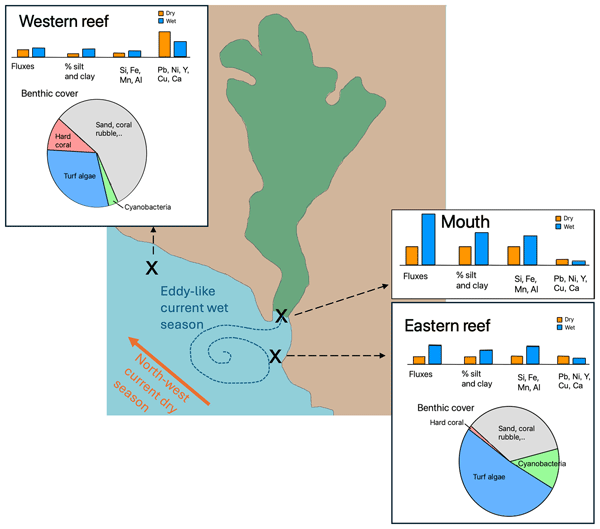
- Figure 9: The box for the eastern reef hides the part of the coast that I imagine plays an important role in the hydrodynamic differences between the eastern and western reefs under northwest current influence. I suggest moving these large boxes away from important spatial features to be shown on the map and using arrows to point to where these sampling sites are precisely located. The map coverage should be extended further south to show the shape of the coast and the point on the western side of the Piscadera neighborhood that likely impacts the hydrodynamics of the Piscadera Bay mouth significantly. I suggest adding a vector representing the dominant current (for both wet and dry seasons if different).
- Lines 655-657: Please define “this material”, is it the pollutants, SPM or something else?
- Please review the manuscript and figures for typos (see one example in the Figure 9 pie chart: “Cyanibacteria”).
Citation: https://doi.org/10.5194/egusphere-2025-4873-RC2 -
AC2: 'Reply on RC2', Virginia Sánchez Barranco, 10 May 2026
We thank Reviewer 2 for their thorough and constructive review. We have addressed all points below; changes are indicated with line numbers referring to the revised (clean) manuscript. The main revisions focus on: 1. temporal framing, where we have revised the language throughout to avoid broad claims about seasonality and instead refer specifically to the 2023 wet and dry sampling periods; 2. hydrodynamic interpretation, where Figure 2 has been redesigned to include current direction vectors for the wet season, and the discussion has been reorganized to introduce current direction earlier and explicitly link west-southward and eddy-driven circulation to the elevated trace metal signal at the western reef; 3. figure redesign, where Figure 6 has been fully redrawn as a PCA biplot with sample scores, element loading vectors, and improved labelling, and Figure 9 has been revised to extend the map coverage, reposition site labels, and include dominant current vectors; and (4) interpretive language, where anthropogenic trace metal attribution has been broadened to explicitly consider distal marine sources, and speculative mechanisms have been clearly flagged as hypotheses requiring further investigation.
Review Comments on “Geochemical characteristics of suspended particulate matter around Piscadera Bay and its influence on near shore ecosystems, Curaçao (Caribbean Sea)”.
This manuscript investigates SPM magnitude and composition around Piscadera Bay on the southern coast of Curaçao. This study investigates the potential sources of SPM inputs based on environmental data and the elemental composition of SPM at the bay's mouth and at two reef locations east and west of the mouth during the dry and wet seasons of 2023. The manuscript is well-written, clear, and concise, but the figures need significant work.
1. The use of two 30-day periods from a single year (2023) is insufficient to characterize the true "seasonal variability", which typically requires observations spanning multiple years. Please revise the text to avoid broad terms like "seasonal variation" or "seasonal patterns". Instead, specifically refer to the "2023 wet and dry season conditions" or equivalent. If the term "seasonal" must be used, it should be explicitly qualified as the variability specific to the 2023 study period. I recommend adding a comparison of the key environmental forcings (e.g., wind, precipitation, currents) from 2023 against long-term historical records. This will help evaluate how representative 2023 was compared to a "typical" year. If the environmental conditions in 2023 are shown to be equivalent to long-term averages, the authors may then extend their conclusions and speculate on broader seasonal variability within the Discussion section.
We agree that sediment dynamics in tropical reef systems can be episodic and that short deployment periods may integrate pulse-driven events rather than long-term seasonal baselines. We have therefore revised the manuscript to explicitly describe the wet-season deployment as an event-integrated snapshot that includes a major rainfall episode, rather than a representative climatological mean. We have also changed the wording to make sure we don’t make claims about seasonality but compare the 2 periods that we sampled. A new paragraph now clarifies that the observed wet-season signal may reflect episodic forcing, and that care should be taken when extrapolating these short-term fluxes to annual benthic degradation rates (see L 522-534).
2. I suggest adding current direction to Figure 2 (see comment below) to evaluate which side (east or west) of the mouth will be more impacted by sediment deposition. If the dominant currents are westward, this could explain why more pollutants settle on the western reef. Moreover, the shape of the coastline likely impacts the hydrodynamic profiles of each reef differently, especially because the dominant current flows northeast. The first mention of the current direction I found is line 676, even though lines 585-586 suggest that “differences in current speeds and direction … may influence the transport and resuspension”. Having the current direction in Figure 2 will already tip the reader off that the current is an important factor for the observed differences between the eastern and the western reefs. I suggest reorganizing the discussion accordingly.
We have updated Figure 2 to include current direction (velocity vectors) for both the eastern and western reef during the wet season, as shown in the revised figure. However, for the dry season we had very few data points per location, and given that current direction can be highly variable, including direction vectors would not be informative. We therefore retained a speed-only plot for the dry season, which we use as a general comparison of current speed across locations and seasons rather than a detailed directional analysis.
The dominant current at the western reef flows in a west-southward direction, which aligns with the eddy-like circulation described and predicted for this time by Bertoncelj et al. (2025). Rather than a simple along-coast transport toward the west, this eddy-driven flow may recirculate material, including anthropogenic contaminants from the urbanized coastline near Willemstad, back toward the western reef, contributing to the elevated trace metal concentrations (e.g. Pb, Ni, Cu) observed there despite lower direct terrestrial input. In contrast, the eastern reef is situated in a more sheltered location with weaker and more variable currents, leading to longer residence times and preferential accumulation of fine terrigenous material from the bay. We have reorganized the discussion to introduce current direction earlier and to explicitly link it to the observed spatial contrasts between the reefs (see L583-591 and 692-700).
3. Is there any data on wave energy and swell direction? While tidal currents increase the extraction of SPM from the bay, once deposited outside the bay, I would expect the wave and swell energy to be important factors for the resuspension of already deposited materials. The wind is mostly coming from the east-southeast, which would suggest the eastern reef is, on average, more sheltered than the western reef if the swell is also coming from the same direction. This difference may also explain the differences between sites and perhaps between the dry and wet seasons.
Wave and swell energy are indeed important drivers of sediment resuspension in shallow reef environments, and we agree that they likely contribute to the spatial differences observed between the eastern and western reefs. Unfortunately, wave height, swell direction, and wave energy were not measured during our sampling campaigns, and we therefore cannot directly assess their role in resuspension dynamics at our study sites. We have added, however, a note on the potential importance of wave energy (See L592-596). Unfortunately, no wave buoy or water level data are available at or near the study site; the only tide gauge in Curaçao is located at Schottegat (Willemstad harbour), approximately 6 km away making it unsuitable as a proxy for open-coast wave conditions at the reef sites.
4. Can the presence of higher Pb and Ni on the western reef also be markers of pollution carried northwest by current coming from the Willemstad and Schottegat more than the Piscadera Bay, which has less industrial infrastructure? In the open ocean, higher concentrations of trace metals can be detected several hundreds of kilometers (if not more) from their source of input. Some of the measured signals might not only come from the Piscadera Bay but could also come from the nearby port of Schottegat, which is much larger, is much more industrialized, and has its mouth located “upstream” of the dominant currents. The authors should discuss this hypothesis more in depth, especially because it is difficult to trace the source of the pollutants with the set of measurements used. I suggest revising the interpretation of the results to consider this hypothesis.
As the reviewer points out, the port of Schottegat is a significantly larger and more industrialized harbor than Piscadera Bay, and critically, its mouth is located upstream of the dominant west-southward current measured at the western reef. Trace metals such as Pb and Ni, which are persistent in the marine environment, can be transported considerable distances from their source, making it plausible that a portion of the elevated trace metal signal at the western reef originates from Schottegat rather than Piscadera Bay (but would not help in explaining differences observed between sites). In the discussion, we already refer to non-bay anthropogenic sources, mentioning maritime activities, coastal infrastructure, and proximity to Willemstad and how the current regime (strong north-west current in the dry season (April-May) or eddy-like circulation in the wet season (October-November) play a role. We have expanded this part of the discussion (lines 502-505).
5. Temperature and salinity data would have been a good markers for runoff to help link the high fluxes measured with increased runoff, and to highlight the differences between the elements coming from the Piscadera Bay versus those coming from Willemstad and Schottegat. A map of these parameters would have helped visualize the potential spatial extent of the sediment deposition affecting the reef without too much sampling effort.
We agree with the reviewer that temperature and salinity data would have been valuable additional markers for tracing runoff and distinguishing between sources. We here refer to concurrent CTD transects conducted around Piscadera Bay during the same year (Sánchez Barranco et al., 2025) which provide seasonal snapshots of bay-ocean exchange and demonstrate how the bay's physicochemical signature attenuates rapidly with distance from the mouth (e.g. L 476-478).
6. Figure 2: Wind speed and direction panel: It is difficult to see the changes in wind speed via color change alone. I suggest using fixed-length and shorter vectors to represent wind direction only. Position the origin (starting point) of each vector along the Y-axis to represent the wind speed magnitude. Keep the current colormap for the vectors. This will provide an additional visual cue that, when combined with the Y-axis position, will significantly improve the readability of wind speed variations. Widen the colorbar of the temperature and pressure panel to improve readability. It would be useful to plot the direction of currents on the panel of current speed using the same plot style as the suggested plot of wind speed and direction (see above comment).
Thank you for these suggestions. The wind speed and direction panels have been redesigned: y axis has been rescaled and we have removed arrows’ colors to avoid redundancy, and the y-axis length of each arrow now represents wind speed magnitude. We opted to keep all arrow origins at the same y-position rather than staggering them by speed, as our data is daily and staggering resulted in a cluttered, difficult-to-interpret figure. The color bars in the temperature and pressure panels have been widened as suggested. Regarding current direction, we have added current speed and direction for both reefs in the wet season following the reviewer's suggestion.
7. Figure 6: This figure should be improved. The PCA is not very informative, besides telling us that the terrigenous markers, the marine elements, and the others, cluster together, which is to be expected. I suggest re-doing this analysis and showing where the mouth, and east, and west reef sampling sites (dry and wet seasons separated) are located in the PCA space and plotting the variables measured (the elements) as vectors on the same space. That way, at a glance, the reader can compare the sampling locations (mouth, east reef, west reef) and the wet and dry seasons with respect to all the elements analyzed. Regarding the bottom panels, it took me some time to realize that the box plots do not represent concentrations of the elements but represent the distribution of the sampling sites in PCA space. I thought the results did not make any sense because I thought the differences in concentration between wet and dry seasons were opposite to what I would expect with increased runoff (and opposite to the results in the text). I find it very confusing and counter intuitive. I go back to my first suggestion to plot all the samples on the PCA space directly with different marker styles/colors for the dry and wet seasons, the west and east sides, and depths, and adding the vectors of the variables scaled to the PC1 and PC2 axes’ scales. Box plots could still be informative (if the new PCA is not just by itself already) but should represent concentrations of elements and not positions in PCA space. I also suggest renaming the cluster currently named “Trace metals” into something else (maybe related to pollution such as described in the text) because several elements in the other clusters are also trace metals.
Figure 6 has been fully redesigned as a PCA biplot, showing both the sample scores and element loading vectors in the same PC1/PC2 space. Samples are plotted using distinct shapes for each location (East 8, East 18, Mouth, West 8, West 18) and colors for season (dry and wet), allowing direct visual comparison across all groups simultaneously. Element vectors are scaled to the PC axes and color-coded by element group (Terrigenous, Marine, Carbonate/Detrital, and Pollution-associated), making it straightforward to assess which elements drive the separation between sampling locations and seasons. The cluster previously labelled "Trace Metals" has been renamed "Pollution-associated" to better reflect the geochemical interpretation discussed in the text, and to avoid confusion with the other clusters which also contain trace-level elements.
8. Figure 9: The box for the eastern reef hides the part of the coast that I imagine plays an important role in the hydrodynamic differences between the eastern and western reefs under northwest current influence. I suggest moving these large boxes away from important spatial features to be shown on the map and using arrows to point to where these sampling sites are precisely located. The map coverage should be extended further south to show the shape of the coast and the point on the western side of the Piscadera neighborhood that likely impacts the hydrodynamics of the Piscadera Bay mouth significantly. I suggest adding a vector representing the dominant current (for both wet and dry seasons if different).
Thank you for this helpful suggestion. We have revised Figure 9 accordingly: the sampling site boxes have been repositioned to avoid obscuring key coastal features, arrows have been added to indicate the precise locations, the map extent has been extended further south to better show the coastline, and vectors representing the dominant currents have been included.
9. Lines 655-657: Please define “this material”, is it the pollutants, SPM or something else?
This sentence has been modified.
10. Please review the manuscript and figures for typos (see one example in the Figure 9 pie chart: “Cyanibacteria”).
We have thoroughly checked the manuscript and figures for typographical errors and corrected all identified issues, including the example in Figure 9 (“Cyanibacteria,” now corrected to “Cyanobacteria”).
Citation: https://doi.org/10.5194/egusphere-2025-4873-AC2
Peer review completion


Interactive discussion
Status: closed
-
RC1: 'Comment on egusphere-2025-4873', Anonymous Referee #1, 24 Dec 2025
Review Comments on “Suspended Particulate Matter (SPM) dynamics around Piscadera Bay”.
This manuscript presents Important information on the spatial gradient of land-sea connection. However, in order to rule out normalisation artefacts, the interpretation of trace metal enrichment at the distal site necessitates thorough verification against absolute concentrations. Accurately estimating the new pollution load entering the reef system also depends on differentiating resuspension from primary flow. Some of the observations for the document are as follows:
- The dry and wet seasons are represented by two 30-day deployment periods used in the study. Although this provides an overview, previous research on sediment dynamics (e.g., Storlazzi et al., 2011) highlights that sediment movement is frequently very episodic and event-driven. One high-rainfall event on November 2 has a significant impact on the "wet season" results in this publication. Therefore, a 30-day window might not be adequate to describe the inter-seasonal fluctuation. The clear wet season signal may not be a seasonal baseline, but rather an anomaly. Since the frequency of these pulse episodes is still unknown, care must be taken while comparing these short-term fluxes to yearly benthic degradation rates.
- In shallow, high-energy settings, sediment traps were placed 0.7–0.8 meters above the seafloor. The study acknowledges that resuspension likely affects the material collected, but the precise amount of new sediment entering the reef remains unknown due to the lack of techniques to distinguish between primary terrestrial input and resuspended bottom sand (gross vs. net flux).
- The Western reef has the highest ratios of anthropogenic trace elements (Pb/Al, Cu/Al, Ni/Al), while being the furthest from the bay and having the lowest terrestrial signal (low Al, Fe). Aluminium (Al) normalisation is commonly used to account for dilution effects and grain size. Aluminium (Al) might falsely inflate these ratios when used to normalise data in carbonate-rich environments with extremely low Al concentrations. However, in carbonate-rich, low-terrigenous environments (like the Western reef), Al concentrations become extremely low. This could result in a false positive for high pollution intensity while absolute concentrations may actually be low. The authors attribute this to marine influence or localised pollution. To ascertain whether this is actual accumulation or a concentration by lack of dilution artefact, a critical examination of the absolute fluxes of these metals, rather than merely ratios is required.
- X-ray fluorescence (XRF) intensities expressed as centred log-ratios (CLR) are the basis for the elemental analysis. Absolute concentrations (such as mg/kg) are not provided by this semi-quantitative approach. As a result, it is impossible to ascertain whether the elevated metal levels are simply high in comparison to the background or truly above established toxicity criteria.
- The study uses spatial patterns rather than conclusive source tracking (e.g., stable isotope analysis) to attribute trace metals (Pb, Ni) to anthropogenic sources like sewage or maritime activity. Pb and Ni may be scavenging onto marine organic matter rather than terrestrial clays, based on their clustering with marine/organic vectors. Organic matter is a powerful scavenger of metals in the water column, according to earlier research (e.g., Salomons and Ostner). The difference between bio-accumulation and clay-bound movement is crucial for deciphering anthropogenic or terrestrial source.
- In this study, SPM is attributed to resuspension during the dry season at the Western Reef. Both primary settling flux and resuspended bottom sediment are collected by sediment traps in high-energy shallow reefs (current speeds 0.01–0.07 m/s). It is challenging to differentiate new terrestrial input from old resuspended sediment in the absence of differential settling velocity data or bottom-stress modelling. Because resuspension events are temporary and may not indicate permanent burial, the measured mass fluxes (>10 g m-2 d-1) may exceed the true sedimentation burden on the corals.
- The study connects the observed dominance of cyanobacteria and turf algae, especially in the Eastern reef, to the significant SPM fluxes. The typical 10 g m-2 d-1 stress threshold suggested by Rogers (1990) is greatly exceeded by the reported fluxes (18–40 g m-2 d-1) during the wet season. Nonetheless, the analysis suggests a clear causal relationship between the long-term benthic shift and the bay's present flow. It is crucial to consider whether the present SPM regime is responsible for the transition or for maintaining the current algal-dominated state given the 40-year history of degradation stated. The manuscript mentions a feedback loop that might be further investigated because turf algae are better at capturing sediments than corals.
- Based on historical data and general literature, the study deduces ecological effects (such as algal dominance and coral damage). To directly connect the reported SPM flows to the current state of reef health, no concomitant biological health measures (such as tissue analysis, photosynthetic efficiency, or coral bleaching surveys) were taken during the investigation.
- For the dry season, current speed and direction (ADCP) data were gathered for very brief periods of time (e.g., just 7 days at the mouth and 4 days at the eastern reef). The flushing theory cannot be fully validated, nor can sediment transport pathways be robustly modelled due to the lack of extensive dry-season hydrodynamic data.
- The study was carried out in 2023, an El Niño year, and the authors report increased rainfall and runoff. As a result, the indicated fluxes and terrestrial inputs can be unusually high and not indicative of Curaçao's regular climatological circumstances.
- The Piscadera Bay is the only subject of the investigation in the present study. Since differing bay geometries and orientations would alter the hydrodynamic shadow effects observed here, the authors acknowledge that it is challenging to extrapolate these particular spatial gradients to other bays in the absence of comparable data.
- In order to explain the strong pollution signal despite low terrestrial flow, the study suggests that fluxes and deposits are decoupled at the Western reef. The precise mechanism whether it results from biofilm scavenging or reef structure trapping remains speculative and has not been investigated experimentally.
Before this manuscript can be taken into consideration, the authors must address the aforementioned issues. The manuscript has to be significantly revised.
Citation: https://doi.org/10.5194/egusphere-2025-4873-RC1 -
AC1: 'Reply on RC1', Virginia Sánchez Barranco, 10 May 2026
We thank Reviewer 1 for their careful reading of the manuscript and constructive comments. We have addressed all points below; changes are indicated with line numbers referring to the revised (clean) manuscript. The main revisions concern (1) framing of temporal representativeness, where we now explicitly describe the wet-season deployment as an event-integrated snapshot rather than a climatological baseline, and avoid claims about inter-seasonal variability; (2) flux interpretation, where we now consistently refer to measured fluxes as suspended matter exposure rather than net sedimentation, and clarify that gross versus net flux cannot be distinguished with the present methodology; (3) geochemical attribution, where we have tempered language around trace-metal sourcing, now framing anthropogenic attribution as consistent with rather than diagnostic of sewage and maritime inputs, and addressed the limitations of Al-normalisation in carbonate-rich environments; and (4) ecological inference, where we have revised causal language around benthic phase shifts to reflect that contemporary sediment fluxes more likely maintain rather than initiate the current algal-dominated state. Additional clarifications were made regarding the El Niño context of the study period, the limited spatial scope of the findings, and the speculative nature of proposed decoupling mechanisms at the Western reef.
Review Comments on “Suspended Particulate Matter (SPM) dynamics around Piscadera Bay”.
This manuscript presents Important information on the spatial gradient of land-sea connection. However, in order to rule out normalisation artefacts, the interpretation of trace metal enrichment at the distal site necessitates thorough verification against absolute concentrations. Accurately estimating the new pollution load entering the reef system also depends on differentiating resuspension from primary flow. Some of the observations for the document are as follows:
1. The dry and wet seasons are represented by two 30-day deployment periods used in the study. Although this provides an overview, previous research on sediment dynamics (e.g., Storlazzi et al., 2011) highlights that sediment movement is frequently very episodic and event-driven. One high-rainfall event on November 2 has a significant impact on the "wet season" results in this publication. Therefore, a 30-day window might not be adequate to describe the inter-seasonal fluctuation. The clear wet season signal may not be a seasonal baseline, but rather an anomaly. Since the frequency of these pulse episodes is still unknown, care must be taken while comparing these short-term fluxes to yearly benthic degradation rates.
We agree that sediment dynamics in coastal systems can be episodic/event driven and that short deployment periods may integrate pulse-driven events rather than long-term seasonal baselines. We have therefore revised the manuscript to explicitly describe the wet-season deployment as an event-integrated snapshot that includes a major rainfall episode, rather than a representative climatological mean. We have also changed the wording to make sure we don’t make claims about seasonality but compare the 2 periods that we sampled. A new paragraph in the discussion now clarifies that the observed wet-season signal may reflect episodic forcing, and that care should be taken when extrapolating these short-term fluxes to annual benthic degradation rates (see L 518-534).
2. In shallow, high-energy settings, sediment traps were placed 0.7–0.8 meters above the seafloor. The study acknowledges that resuspension likely affects the material collected, but the precise amount of new sediment entering the reef remains unknown due to the lack of techniques to distinguish between primary terrestrial input and resuspended bottom sand (gross vs. net flux).
We acknowledge that sediment traps inherently collect both newly settling material and resuspended bottom sediment in shallow, high-energy environments, representing gross particle fluxes rather than net sedimentation. This is a widely recognized limitation of the methodology (e.g., Storlazzi et al., 2015). We have clarified this distinction in the Methods and Discussion, and now explicitly note that the amount of sediment permanently entering the reef framework cannot be quantified with the present approach (L158–160). We analyzed the manuscript and now refer to the observed fluxes as representing ‘suspended matter, rather than ‘sedimentation’.
3. The Western reef has the highest ratios of anthropogenic trace elements (Pb/Al, Cu/Al, Ni/Al), while being the furthest from the bay and having the lowest terrestrial signal (low Al, Fe). Aluminium (Al) normalisation is commonly used to account for dilution effects and grain size. Aluminium (Al) might falsely inflate these ratios when used to normalise data in carbonate-rich environments with extremely low Al concentrations. However, in carbonate-rich, low-terrigenous environments (like the Western reef), Al concentrations become extremely low. This could result in a false positive for high pollution intensity while absolute concentrations may actually be low. The authors attribute this to marine influence or localised pollution. To ascertain whether this is actual accumulation or a concentration by lack of dilution artefact, a critical examination of the absolute fluxes of these metals, rather than merely ratios is required.
We agree that aluminum normalisation in carbonate-rich, low-terrigenous environments may artificially elevate metal/Al ratios due to extremely low Al concentrations. To evaluate whether elevated metal/Al ratios at the Western reef reflect denominator effects, we examined CLR-transformed elemental intensities (Fig. S4). Ni and Pb remain elevated relative to other sites, indicating that enrichment is not solely driven by low Al concentrations. We have also addressed this in the discussion (See L485-490 and 685-69).
4. X-ray fluorescence (XRF) intensities expressed as centred log-ratios (CLR) are the basis for the elemental analysis. Absolute concentrations (such as mg/kg) are not provided by this semi-quantitative approach. As a result, it is impossible to ascertain whether the elevated metal levels are simply high in comparison to the background or truly above established toxicity criteria.
We agree that the semi-quantitative XRF-CLR approach does not provide absolute concentrations and therefore cannot be used to assess exceedance of toxicity thresholds. Therefore, we have revised the text to avoid the suggestion that we estimated toxicological risks and now clearly state that the observed enrichments are relative to background conditions rather than concentrations (L672-675 and 733-733).
5. The study uses spatial patterns rather than conclusive source tracking (e.g., stable isotope analysis) to attribute trace metals (Pb, Ni) to anthropogenic sources like sewage or maritime activity. Pb and Ni may be scavenging onto marine organic matter rather than terrestrial clays, based on their clustering with marine/organic vectors. Organic matter is a powerful scavenger of metals in the water column, according to earlier research (e.g., Salomons and Ostner). The difference between bio-accumulation and clay-bound movement is crucial for deciphering anthropogenic or terrestrial source.
We acknowledge that spatial co-variation alone cannot conclusively identify trace-metal sources and that Pb and Ni may also be scavenged onto marine organic matter rather than transported exclusively via terrestrial clays. We have expanded the discussion to explicitly distinguish between source origin and transport pathway, and now frame anthropogenic attribution as consistent with, rather than diagnostic of, sewage and maritime inputs (See L685-688 and 733-737).
6. In this study, SPM is attributed to resuspension during the dry season at the Western Reef. Both primary settling flux and resuspended bottom sediment are collected by sediment traps in high-energy shallow reefs (current speeds 0.01–0.07 m/s). It is challenging to differentiate new terrestrial input from old resuspended sediment in the absence of differential settling velocity data or bottom-stress modelling. Because resuspension events are temporary and may not indicate permanent burial, the measured mass fluxes (>10 g m-2 d-1) may exceed the true sedimentation burden on the corals.
We agree that sediment trap–derived mass fluxes in shallow reefs may overestimate the effective sedimentation load experienced by corals, as resuspended material may not result in permanent burial, but stay in suspension for long time periods. We have therefore revised the discussion to emphasize that the reported fluxes reflect exposure to suspended matter rather than net sediment accumulation on coral surfaces (e.g. L590-592).
7. The study connects the observed dominance of cyanobacteria and turf algae, especially in the Eastern reef, to the significant SPM fluxes. The typical 10 g m-2 d-1 stress threshold suggested by Rogers (1990) is greatly exceeded by the reported fluxes (18–40 g m-2 d-1) during the wet season. Nonetheless, the analysis suggests a clear causal relationship between the long-term benthic shift and the bay's present flow. It is crucial to consider whether the present SPM regime is responsible for the transition or for maintaining the current algal-dominated state given the 40-year history of degradation stated. The manuscript mentions a feedback loop that might be further investigated because turf algae are better at capturing sediments than corals.
We agree that the present SPM regime cannot be assumed to have (fully) caused the initial benthic phase shift given the documented multi-decadal history of degradation. We have revised the manuscript to clarify that our data more directly support a role for contemporary sediment fluxes in maintaining, rather than initiating, the current algal-dominated state, potentially through positive feedbacks involving sediment retention by turf algae. We have addressed this in L649-663.
8. Based on historical data and general literature, the study deduces ecological effects (such as algal dominance and coral damage). To directly connect the reported SPM flows to the current state of reef health, no concomitant biological health measures (such as tissue analysis, photosynthetic efficiency, or coral bleaching surveys) were taken during the investigation.
We acknowledge that no concurrent biological health metrics were collected in this study, as assessing reef physiology was outside its scope. The discussion frames potential ecological implications based on historical benthic cover data and general literature, rather than direct measurements (see also our previous reply).
9. For the dry season, current speed and direction (ADCP) data were gathered for very brief periods of time (e.g., just 7 days at the mouth and 4 days at the eastern reef). The flushing theory cannot be fully validated, nor can sediment transport pathways be robustly modelled due to the lack of extensive dry-season hydrodynamic data.
We agree that the limited duration of dry-season ADCP deployments restricts our ability to fully validate flushing mechanisms or robustly model sediment transport pathways. However, previous studies (e.g., Sánchez Barranco et al., 2025) have documented and confirmed seasonal changes in bay–ocean exchange, supporting the conceptual framework we use. We have revised the text to clarify this and substantiate our initial claims (see L802-703).
10. The study was carried out in 2023, an El Niño year, and the authors report increased rainfall and runoff. As a result, the indicated fluxes and terrestrial inputs can be unusually high and not indicative of Curaçao's regular climatological circumstances.
We acknowledge that an El Niño year may represent an extreme scenario. In the discussion, we note that the study period coincided with an El Niño year with elevated rainfall and runoff, so the observed fluxes may reflect extreme conditions rather than long-term climatological averages (L519-639 and 726-730). Nevertheless, these results are valuable for understanding how bays and reefs may respond to increasingly frequent extreme events under climate change. This has been explicitly addressed in the revised limitations section.
11. The Piscadera Bay is the only subject of the investigation in the present study. Since differing bay geometries and orientations would alter the hydrodynamic shadow effects observed here, the authors acknowledge that it is challenging to extrapolate these particular spatial gradients to other bays in the absence of comparable data.
We agree that Piscadera Bay represents a single-case system and that differences in bay geometry and orientation may alter hydrodynamic shadow effects elsewhere. We have clarified that the observed spatial gradients should be interpreted as system-specific, with broader applicability requiring comparative studies across bays (see L734-737). A paper currently in preparation will compare multiple bays with differing orientations, with one of its goals being to assess how bay orientation influences hydrodynamic patterns and sediment fluxes in nearby reefs.
12. In order to explain the strong pollution signal despite low terrestrial flow, the study suggests that fluxes and deposits are decoupled at the Western reef. The precise mechanism whether it results from biofilm scavenging or reef structure trapping remains speculative and has not been investigated experimentally.
We agree that the mechanisms underlying the apparent decoupling between low terrestrial input and elevated pollution signals at the Western reef remain speculative. We have revised the text to clearly frame biofilm scavenging and reef-structure trapping as hypotheses rather than demonstrated processes and identify these as priorities for future experimental investigation (L685-694).
Citation: https://doi.org/10.5194/egusphere-2025-4873-AC1
-
RC2: 'Comment on egusphere-2025-4873', Anonymous Referee #2, 06 Apr 2026
Review Comments on “Geochemical characteristics of suspended particulate matter around Piscadera Bay and its influence on near shore ecosystems, Curaçao (Caribbean Sea)”.
This manuscript investigates SPM magnitude and composition around Piscadera Bay on the southern coast of Curaçao. This study investigates the potential sources of SPM inputs based on environmental data and the elemental composition of SPM at the bay's mouth and at two reef locations east and west of the mouth during the dry and wet seasons of 2023. The manuscript is well-written, clear, and concise, but the figures need significant work.
- The use of two 30-day periods from a single year (2023) is insufficient to characterize the true "seasonal variability", which typically requires observations spanning multiple years. Please revise the text to avoid broad terms like "seasonal variation" or "seasonal patterns". Instead, specifically refer to the "2023 wet and dry season conditions" or equivalent. If the term "seasonal" must be used, it should be explicitly qualified as the variability specific to the 2023 study period. I recommend adding a comparison of the key environmental forcings (e.g., wind, precipitation, currents) from 2023 against long-term historical records. This will help evaluate how representative 2023 was compared to a "typical" year. If the environmental conditions in 2023 are shown to be equivalent to long-term averages, the authors may then extend their conclusions and speculate on broader seasonal variability within the Discussion section.
- I suggest adding current direction to Figure 2 (see comment below) to evaluate which side (east or west) of the mouth will be more impacted by sediment deposition. If the dominant currents are westward, this could explain why more pollutants settle on the western reef. Moreover, the shape of the coastline likely impacts the hydrodynamic profiles of each reef differently, especially because the dominant current flows northeast. The first mention of the current direction I found is line 676, even though lines 585-586 suggest that “differences in current speeds and direction … may influence the transport and resuspension”. Having the current direction in Figure 2 will already tip the reader off that the current is an important factor for the observed differences between the eastern and the western reefs. I suggest reorganizing the discussion accordingly.
- Is there any data on wave energy and swell direction? While tidal currents increase the extraction of SPM from the bay, once deposited outside the bay, I would expect the wave and swell energy to be important factors for the resuspension of already deposited materials. The wind is mostly coming from the east-southeast, which would suggest the eastern reef is, on average, more sheltered than the western reef if the swell is also coming from the same direction. This difference may also explain the differences between sites and perhaps between the dry and wet seasons.
- Can the presence of higher Pb and Ni on the western reef also be markers of pollution carried northwest by current coming from the Willemstad and Schottegat more than the Piscadera Bay, which has less industrial infrastructure? In the open ocean, higher concentrations of trace metals can be detected several hundreds of kilometers (if not more) from their source of input. Some of the measured signals might not only come from the Piscadera Bay but could also come from the nearby port of Schottegat, which is much larger, is much more industrialized, and has its mouth located “upstream” of the dominant currents. The authors should discuss this hypothesis more in depth, especially because it is difficult to trace the source of the pollutants with the set of measurements used. I suggest revising the interpretation of the results to consider this hypothesis.
- Temperature and salinity data would have been a good markers for runoff to help link the high fluxes measured with increased runoff, and to highlight the differences between the elements coming from the Piscadera Bay versus those coming from Willemstad and Schottegat. A map of these parameters would have helped visualize the potential spatial extent of the sediment deposition affecting the reef without too much sampling effort.
- Figure 2: Wind speed and direction panel: It is difficult to see the changes in wind speed via color change alone. I suggest using fixed-length and shorter vectors to represent wind direction only. Position the origin (starting point) of each vector along the Y-axis to represent the wind speed magnitude. Keep the current colormap for the vectors. This will provide an additional visual cue that, when combined with the Y-axis position, will significantly improve the readability of wind speed variations. Widen the colorbar of the temperature and pressure panel to improve readability. It would be useful to plot the direction of currents on the panel of current speed using the same plot style as the suggested plot of wind speed and direction (see above comment).
- Figure 6: This figure should be improved. The PCA is not very informative, besides telling us that the terrigenous markers, the marine elements, and the others, cluster together, which is to be expected. I suggest re-doing this analysis and showing where the mouth, and east, and west reef sampling sites (dry and wet seasons separated) are located in the PCA space and plotting the variables measured (the elements) as vectors on the same space. That way, at a glance, the reader can compare the sampling locations (mouth, east reef, west reef) and the wet and dry seasons with respect to all the elements analyzed. Regarding the bottom panels, it took me some time to realize that the box plots do not represent concentrations of the elements but represent the distribution of the sampling sites in PCA space. I thought the results did not make any sense because I thought the differences in concentration between wet and dry seasons were opposite to what I would expect with increased runoff (and opposite to the results in the text). I find it very confusing and counter intuitive. I go back to my first suggestion to plot all the samples on the PCA space directly with different marker styles/colors for the dry and wet seasons, the west and east sides, and depths, and adding the vectors of the variables scaled to the PC1 and PC2 axes’ scales. Box plots could still be informative (if the new PCA is not just by itself already) but should represent concentrations of elements and not positions in PCA space. I also suggest renaming the cluster currently named “Trace metals” into something else (maybe related to pollution such as described in the text) because several elements in the other clusters are also trace metals.
- Figure 9: The box for the eastern reef hides the part of the coast that I imagine plays an important role in the hydrodynamic differences between the eastern and western reefs under northwest current influence. I suggest moving these large boxes away from important spatial features to be shown on the map and using arrows to point to where these sampling sites are precisely located. The map coverage should be extended further south to show the shape of the coast and the point on the western side of the Piscadera neighborhood that likely impacts the hydrodynamics of the Piscadera Bay mouth significantly. I suggest adding a vector representing the dominant current (for both wet and dry seasons if different).
- Lines 655-657: Please define “this material”, is it the pollutants, SPM or something else?
- Please review the manuscript and figures for typos (see one example in the Figure 9 pie chart: “Cyanibacteria”).
Citation: https://doi.org/10.5194/egusphere-2025-4873-RC2 -
AC2: 'Reply on RC2', Virginia Sánchez Barranco, 10 May 2026
We thank Reviewer 2 for their thorough and constructive review. We have addressed all points below; changes are indicated with line numbers referring to the revised (clean) manuscript. The main revisions focus on: 1. temporal framing, where we have revised the language throughout to avoid broad claims about seasonality and instead refer specifically to the 2023 wet and dry sampling periods; 2. hydrodynamic interpretation, where Figure 2 has been redesigned to include current direction vectors for the wet season, and the discussion has been reorganized to introduce current direction earlier and explicitly link west-southward and eddy-driven circulation to the elevated trace metal signal at the western reef; 3. figure redesign, where Figure 6 has been fully redrawn as a PCA biplot with sample scores, element loading vectors, and improved labelling, and Figure 9 has been revised to extend the map coverage, reposition site labels, and include dominant current vectors; and (4) interpretive language, where anthropogenic trace metal attribution has been broadened to explicitly consider distal marine sources, and speculative mechanisms have been clearly flagged as hypotheses requiring further investigation.
Review Comments on “Geochemical characteristics of suspended particulate matter around Piscadera Bay and its influence on near shore ecosystems, Curaçao (Caribbean Sea)”.
This manuscript investigates SPM magnitude and composition around Piscadera Bay on the southern coast of Curaçao. This study investigates the potential sources of SPM inputs based on environmental data and the elemental composition of SPM at the bay's mouth and at two reef locations east and west of the mouth during the dry and wet seasons of 2023. The manuscript is well-written, clear, and concise, but the figures need significant work.
1. The use of two 30-day periods from a single year (2023) is insufficient to characterize the true "seasonal variability", which typically requires observations spanning multiple years. Please revise the text to avoid broad terms like "seasonal variation" or "seasonal patterns". Instead, specifically refer to the "2023 wet and dry season conditions" or equivalent. If the term "seasonal" must be used, it should be explicitly qualified as the variability specific to the 2023 study period. I recommend adding a comparison of the key environmental forcings (e.g., wind, precipitation, currents) from 2023 against long-term historical records. This will help evaluate how representative 2023 was compared to a "typical" year. If the environmental conditions in 2023 are shown to be equivalent to long-term averages, the authors may then extend their conclusions and speculate on broader seasonal variability within the Discussion section.
We agree that sediment dynamics in tropical reef systems can be episodic and that short deployment periods may integrate pulse-driven events rather than long-term seasonal baselines. We have therefore revised the manuscript to explicitly describe the wet-season deployment as an event-integrated snapshot that includes a major rainfall episode, rather than a representative climatological mean. We have also changed the wording to make sure we don’t make claims about seasonality but compare the 2 periods that we sampled. A new paragraph now clarifies that the observed wet-season signal may reflect episodic forcing, and that care should be taken when extrapolating these short-term fluxes to annual benthic degradation rates (see L 522-534).
2. I suggest adding current direction to Figure 2 (see comment below) to evaluate which side (east or west) of the mouth will be more impacted by sediment deposition. If the dominant currents are westward, this could explain why more pollutants settle on the western reef. Moreover, the shape of the coastline likely impacts the hydrodynamic profiles of each reef differently, especially because the dominant current flows northeast. The first mention of the current direction I found is line 676, even though lines 585-586 suggest that “differences in current speeds and direction … may influence the transport and resuspension”. Having the current direction in Figure 2 will already tip the reader off that the current is an important factor for the observed differences between the eastern and the western reefs. I suggest reorganizing the discussion accordingly.
We have updated Figure 2 to include current direction (velocity vectors) for both the eastern and western reef during the wet season, as shown in the revised figure. However, for the dry season we had very few data points per location, and given that current direction can be highly variable, including direction vectors would not be informative. We therefore retained a speed-only plot for the dry season, which we use as a general comparison of current speed across locations and seasons rather than a detailed directional analysis.
The dominant current at the western reef flows in a west-southward direction, which aligns with the eddy-like circulation described and predicted for this time by Bertoncelj et al. (2025). Rather than a simple along-coast transport toward the west, this eddy-driven flow may recirculate material, including anthropogenic contaminants from the urbanized coastline near Willemstad, back toward the western reef, contributing to the elevated trace metal concentrations (e.g. Pb, Ni, Cu) observed there despite lower direct terrestrial input. In contrast, the eastern reef is situated in a more sheltered location with weaker and more variable currents, leading to longer residence times and preferential accumulation of fine terrigenous material from the bay. We have reorganized the discussion to introduce current direction earlier and to explicitly link it to the observed spatial contrasts between the reefs (see L583-591 and 692-700).
3. Is there any data on wave energy and swell direction? While tidal currents increase the extraction of SPM from the bay, once deposited outside the bay, I would expect the wave and swell energy to be important factors for the resuspension of already deposited materials. The wind is mostly coming from the east-southeast, which would suggest the eastern reef is, on average, more sheltered than the western reef if the swell is also coming from the same direction. This difference may also explain the differences between sites and perhaps between the dry and wet seasons.
Wave and swell energy are indeed important drivers of sediment resuspension in shallow reef environments, and we agree that they likely contribute to the spatial differences observed between the eastern and western reefs. Unfortunately, wave height, swell direction, and wave energy were not measured during our sampling campaigns, and we therefore cannot directly assess their role in resuspension dynamics at our study sites. We have added, however, a note on the potential importance of wave energy (See L592-596). Unfortunately, no wave buoy or water level data are available at or near the study site; the only tide gauge in Curaçao is located at Schottegat (Willemstad harbour), approximately 6 km away making it unsuitable as a proxy for open-coast wave conditions at the reef sites.
4. Can the presence of higher Pb and Ni on the western reef also be markers of pollution carried northwest by current coming from the Willemstad and Schottegat more than the Piscadera Bay, which has less industrial infrastructure? In the open ocean, higher concentrations of trace metals can be detected several hundreds of kilometers (if not more) from their source of input. Some of the measured signals might not only come from the Piscadera Bay but could also come from the nearby port of Schottegat, which is much larger, is much more industrialized, and has its mouth located “upstream” of the dominant currents. The authors should discuss this hypothesis more in depth, especially because it is difficult to trace the source of the pollutants with the set of measurements used. I suggest revising the interpretation of the results to consider this hypothesis.
As the reviewer points out, the port of Schottegat is a significantly larger and more industrialized harbor than Piscadera Bay, and critically, its mouth is located upstream of the dominant west-southward current measured at the western reef. Trace metals such as Pb and Ni, which are persistent in the marine environment, can be transported considerable distances from their source, making it plausible that a portion of the elevated trace metal signal at the western reef originates from Schottegat rather than Piscadera Bay (but would not help in explaining differences observed between sites). In the discussion, we already refer to non-bay anthropogenic sources, mentioning maritime activities, coastal infrastructure, and proximity to Willemstad and how the current regime (strong north-west current in the dry season (April-May) or eddy-like circulation in the wet season (October-November) play a role. We have expanded this part of the discussion (lines 502-505).
5. Temperature and salinity data would have been a good markers for runoff to help link the high fluxes measured with increased runoff, and to highlight the differences between the elements coming from the Piscadera Bay versus those coming from Willemstad and Schottegat. A map of these parameters would have helped visualize the potential spatial extent of the sediment deposition affecting the reef without too much sampling effort.
We agree with the reviewer that temperature and salinity data would have been valuable additional markers for tracing runoff and distinguishing between sources. We here refer to concurrent CTD transects conducted around Piscadera Bay during the same year (Sánchez Barranco et al., 2025) which provide seasonal snapshots of bay-ocean exchange and demonstrate how the bay's physicochemical signature attenuates rapidly with distance from the mouth (e.g. L 476-478).
6. Figure 2: Wind speed and direction panel: It is difficult to see the changes in wind speed via color change alone. I suggest using fixed-length and shorter vectors to represent wind direction only. Position the origin (starting point) of each vector along the Y-axis to represent the wind speed magnitude. Keep the current colormap for the vectors. This will provide an additional visual cue that, when combined with the Y-axis position, will significantly improve the readability of wind speed variations. Widen the colorbar of the temperature and pressure panel to improve readability. It would be useful to plot the direction of currents on the panel of current speed using the same plot style as the suggested plot of wind speed and direction (see above comment).
Thank you for these suggestions. The wind speed and direction panels have been redesigned: y axis has been rescaled and we have removed arrows’ colors to avoid redundancy, and the y-axis length of each arrow now represents wind speed magnitude. We opted to keep all arrow origins at the same y-position rather than staggering them by speed, as our data is daily and staggering resulted in a cluttered, difficult-to-interpret figure. The color bars in the temperature and pressure panels have been widened as suggested. Regarding current direction, we have added current speed and direction for both reefs in the wet season following the reviewer's suggestion.
7. Figure 6: This figure should be improved. The PCA is not very informative, besides telling us that the terrigenous markers, the marine elements, and the others, cluster together, which is to be expected. I suggest re-doing this analysis and showing where the mouth, and east, and west reef sampling sites (dry and wet seasons separated) are located in the PCA space and plotting the variables measured (the elements) as vectors on the same space. That way, at a glance, the reader can compare the sampling locations (mouth, east reef, west reef) and the wet and dry seasons with respect to all the elements analyzed. Regarding the bottom panels, it took me some time to realize that the box plots do not represent concentrations of the elements but represent the distribution of the sampling sites in PCA space. I thought the results did not make any sense because I thought the differences in concentration between wet and dry seasons were opposite to what I would expect with increased runoff (and opposite to the results in the text). I find it very confusing and counter intuitive. I go back to my first suggestion to plot all the samples on the PCA space directly with different marker styles/colors for the dry and wet seasons, the west and east sides, and depths, and adding the vectors of the variables scaled to the PC1 and PC2 axes’ scales. Box plots could still be informative (if the new PCA is not just by itself already) but should represent concentrations of elements and not positions in PCA space. I also suggest renaming the cluster currently named “Trace metals” into something else (maybe related to pollution such as described in the text) because several elements in the other clusters are also trace metals.
Figure 6 has been fully redesigned as a PCA biplot, showing both the sample scores and element loading vectors in the same PC1/PC2 space. Samples are plotted using distinct shapes for each location (East 8, East 18, Mouth, West 8, West 18) and colors for season (dry and wet), allowing direct visual comparison across all groups simultaneously. Element vectors are scaled to the PC axes and color-coded by element group (Terrigenous, Marine, Carbonate/Detrital, and Pollution-associated), making it straightforward to assess which elements drive the separation between sampling locations and seasons. The cluster previously labelled "Trace Metals" has been renamed "Pollution-associated" to better reflect the geochemical interpretation discussed in the text, and to avoid confusion with the other clusters which also contain trace-level elements.
8. Figure 9: The box for the eastern reef hides the part of the coast that I imagine plays an important role in the hydrodynamic differences between the eastern and western reefs under northwest current influence. I suggest moving these large boxes away from important spatial features to be shown on the map and using arrows to point to where these sampling sites are precisely located. The map coverage should be extended further south to show the shape of the coast and the point on the western side of the Piscadera neighborhood that likely impacts the hydrodynamics of the Piscadera Bay mouth significantly. I suggest adding a vector representing the dominant current (for both wet and dry seasons if different).
Thank you for this helpful suggestion. We have revised Figure 9 accordingly: the sampling site boxes have been repositioned to avoid obscuring key coastal features, arrows have been added to indicate the precise locations, the map extent has been extended further south to better show the coastline, and vectors representing the dominant currents have been included.
9. Lines 655-657: Please define “this material”, is it the pollutants, SPM or something else?
This sentence has been modified.
10. Please review the manuscript and figures for typos (see one example in the Figure 9 pie chart: “Cyanibacteria”).
We have thoroughly checked the manuscript and figures for typographical errors and corrected all identified issues, including the example in Figure 9 (“Cyanibacteria,” now corrected to “Cyanobacteria”).
Citation: https://doi.org/10.5194/egusphere-2025-4873-AC2
Peer review completion
Journal article(s) based on this preprint
Viewed
| HTML | XML | Total | Supplement | BibTeX | EndNote | |
|---|---|---|---|---|---|---|
| 1,731 | 1,663 | 177 | 3,571 | 312 | 154 | 168 |
- HTML: 1,731
- PDF: 1,663
- XML: 177
- Total: 3,571
- Supplement: 312
- BibTeX: 154
- EndNote: 168
Viewed (geographical distribution)
| Country | # | Views | % |
|---|
| Total: | 0 |
| HTML: | 0 |
| PDF: | 0 |
| XML: | 0 |
- 1
Virginia Sánchez Barranco

Nienke C. J. van de Loosdrecht
Furu Mienis
Jasper M. de Goeij
Rick Hennekam
Gert-Jan Reichart
Jan-Berend Stuut
Lennart J. de Nooijer
The requested preprint has a corresponding peer-reviewed final revised paper. You are encouraged to refer to the final revised version.
- Preprint
(7817 KB) - Metadata XML
-
Supplement
(2422 KB) - BibTeX
- EndNote
- Final revised paper
Review Comments on “Suspended Particulate Matter (SPM) dynamics around Piscadera Bay”.
This manuscript presents Important information on the spatial gradient of land-sea connection. However, in order to rule out normalisation artefacts, the interpretation of trace metal enrichment at the distal site necessitates thorough verification against absolute concentrations. Accurately estimating the new pollution load entering the reef system also depends on differentiating resuspension from primary flow. Some of the observations for the document are as follows:
Before this manuscript can be taken into consideration, the authors must address the aforementioned issues. The manuscript has to be significantly revised.