
the Creative Commons Attribution 4.0 License.
the Creative Commons Attribution 4.0 License.
 | 16 Oct 2025
Influence of water extraction on subglacial hydrology and glacier velocity
Abstract. Subglacial water modulates glacier velocity across a wide range of space and time scales by influencing friction at the glacier bed. Observations show ice acceleration due to supraglacial lake drainage and water draining through moulins, where both configurations involve water inputs to the bed. Here we consider the reverse: water extraction from the subglacial system. Removing subglacial water results in different dynamics than injecting water, and we hypothesize that understanding these processes will allow for improved characterization of the physics of subglacial hydrology. Water extraction is a proposed intervention method for slowing glaciers that requires significant further investigation before it should be tested or implemented in the field. Here we set up model experiments in the Subglacial Hydrology And Kinetic, Transient Interactions (SHAKTI) model coupled with the Ice-sheet and Sea-level System Model (ISSM). By analyzing the problem of an isolated borehole in a background pressure field to determine the region of extraction influence, we find an analytical solution which shows that the water pressure returns to the background value approximately as a logarithm with distance. The benefit of the analytical solution is that the dependence of uncertain parameters is clear and may be used to constrain subglacial hydrology models. We find good agreement between this analytical result and full SHAKTI simulations. Using the coupled SHAKTI-ISSM model, we perform transient model experiments on an idealized tidewater glacier geometry and on Helheim Glacier in Greenland to determine the effects of water extraction on glacier velocity. With continuous pumping, we simulate a modest impact on velocity, which is sensitive to the extraction rate and site location. The response time to pumping initiation and the recovery time following cessation scale according to effective pressure, with typical times on the order of hours to days. These results are encouraging that water extraction is a method of probing the subglacial hydrologic system to better constrain the uncertain physics, with further research required to determine if it is an effective intervention method.
Competing interests: The authors declare that they have no conflict of interest. CRM and BM are co-founders of Arête Glacier Initiative (areteglaciers.org), a non-profit organization that is fiscally spon- sored by Digital Harbor Foundation. Arête was founded in 2024 to provide funding to glaciological research community, develop sea-level rise forecasts, and to research glacier interventions. CRM and BM’s consulting work with Arête is separate from their university research activities
Publisher's note: Copernicus Publications remains neutral with regard to jurisdictional claims made in the text, published maps, institutional affiliations, or any other geographical representation in this paper. While Copernicus Publications makes every effort to include appropriate place names, the final responsibility lies with the authors. Views expressed in the text are those of the authors and do not necessarily reflect the views of the publisher.-
Notice on discussion status
The requested preprint has a corresponding peer-reviewed final revised paper. You are encouraged to refer to the final revised version.
-
Preprint
(6934 KB)
-
The requested preprint has a corresponding peer-reviewed final revised paper. You are encouraged to refer to the final revised version.
- Preprint
(6934 KB) - Metadata XML
- BibTeX
- EndNote
- Final revised paper


Journal article(s) based on this preprint
Interactive discussion
Status: closed
-
RC1: 'Comment on egusphere-2025-4867', Anonymous Referee #1, 03 Dec 2025
-
AC1: 'Reply on RC1', Colin Meyer, 19 Feb 2026
The comment was uploaded in the form of a supplement: https://egusphere.copernicus.org/preprints/2025/egusphere-2025-4867/egusphere-2025-4867-AC1-supplement.pdf
-
AC1: 'Reply on RC1', Colin Meyer, 19 Feb 2026
-
RC2: 'Comment on egusphere-2025-4867', Anonymous Referee #2, 15 Jan 2026
This is a theoretical study that uses a model of the subglacial drainage system and ice mechanics to asses the effect of extracting water from the glacier bed. The study is motivated by an interesting (though frankly ludicrous) proposal that such extraction could be used as a mechanism to slow down the motion of parts of a glacier and thereby (perhaps) delay ice loss and consequent sea level rise.
I found the study interesting, but I feel that aspects of it are quite confused and it seems a bit rushed. In particular, I found the approximate analytical solutions - with many terms neglected initially and then slowly re-introduced - quite hard to follow, and then when it came to the fuller numerical solutions coupled to ice velocity I felt that the restriction to winter conditions when the basal water fluxes are small rather limits what can be concluded about the influence on glacier velocity.
The general approach of looking at simplified solutions (where certain terms are neglected) is potentially useful, but I felt it was quite confusing here, with so many different approximations introduced that it was hard to keep track of what the point was, or which of the results/figures were relevant in the end. I think the section 3 with approximate solutions could usefully be made more concise, and perhaps be guided more by what has been learnt through these (which seems to be that it is important to account for the melt from dissipation and the impact this has on the flux, and that the prescribed effective pressure at the ‘outer radius’ is important). E.g. you could just analyse the system in section 3.2.2 from the outset, perhaps noting simplifications that occur if/when some of the parameters are small.
A second issue I have with the simplified solutions is that they seem quite dependent on what is taken as the outer radius (r_d), and what value of effective pressure is prescribed there. Ideally you’d like the solutions not to depend too much on this but just to tend to some far-field undisturbed behaviour, but it doesn’t look like that’s what happens (the equations don’t allow it, I suppose). Instead, you have to prescribe a value of effective pressure N_0 at a particular radius, and the solutions seem to depend quite a lot on that. I felt that there should be more discussion about what is an appropriate value for both r_d and N_0.
Below I list line by line comments.
Line 28 - This sentence doesn’t seem quite right to me. At least, I think it is trying to get at the difference between so-called ‘efficient’ and ‘inefficient’ drainage systems, which are characterised by the steady-state response of the pressure to an increase in discharge, but this is not necessarily the same as ‘higher effective pressure’ and ‘lower effective pressure’.
Line 46 - this description of ‘type-I’ and ‘type-II’ glaciers is a bit mysterious to me as I don’t think that is quite what is described in the referenced papers, which had more than two ‘types’ and where the distinction is based more on the patten of velocity change - with apparent influence of the glacier terminus as well as basal lubrication - rather than on the hypothesised response of the subglacial water pressure to adding meltwater. Whilst there are clearly differences in the ways that different glaciers respond to seasonal meltwater forcing, I’m not sure that the observations can be summarised this simplistically.
Line 53 - I found this discussion of how such glaciers would respond to meltwater extraction a slightly bizarre thought experiment. If the glacier is responding seasonally to surface melt reaching the bed, it would surely be easier to find a mechanism to prevent the water from reaching the bed in the first place, rather than extracting it back from the bed (back to the surface presumably, from which it would just find its way to the bed again!).
Line 155. What motivates the choice of the value of N_0? This seems like it may be quite important here, along with the size of the domain. r_d is not defined, and nor is f(r).
Line 167 - what is r_t? This doesn’t seem to be used.
Line 190 - this sentence saying the SHAKTI simulations do not always evolve the gap height in time was a bit confusing - given that you’ve just described the model with an equation for the evolution of the gap height - and isn’t really discussed later. It would be good to describe the model fully upfront.
Line 208 - this condition on where the effective pressure blows up seems like it may depend on the size of R. For small R, I’d have thought the logarithmic term in (20) is more important, with N blowing up when r ~ e^(-8M).
Figure 4 - the blank region of the lower plot looks a bit odd. Why are there no points with larger gap heights close to the extraction site?
Figure 6 - it’s not clear what parameters have been used for the left hand panel. In the right panel it is very hard to tell how much of the difference between the points for different values of N_0 is due to the different value of N_0 or due to different values of N. It might make more sense to plot N rather than N-N_0. Secondly in this plot why are the points all over the place? This looks to me like the numerical solution is not working, or producing numerical errors, in which case how can you have faith in these results?
Figure 7 - I am quite confused by the plot, which seems to show very different behaviour to what’s discussed around figure 6, in which it is suggested that N tends towards a constant value as r tends to 0 (i.e. as you approach the borehole), whereas here you seem to show N ever-increasing at small r. Maybe I am not understanding what is being shown here.
Line 279 - continuing this confusion, you earlier suggested that the solutions had a constant effective pressure as r tends to zero, given approximately by (29). What is different here?
Figure 8 - the axes labelling seems confused about whether it is the dimensional or non-dimensional radius.
Figure 9 - why does the effective pressure seem to be insensitive to Q here (at least for smaller values of N_0), but not in figure 6. Which is ‘correct’?
Line 351 - the expected timescale of 1 hour doesn’t fit within the expected range of time scales just mentioned on line 345 (90 years to 4 days), or the value on line 343. It is a lot shorter. This is rather confusing.
Figure 10 - is this figure well-resolved in time? If it’s supposed to be showing the transient dynamics it doesn’t show them very well - it suggests an essentially instantaneous adjustment, but the marker at the maximum suggests the plot may not be resolving the transient.
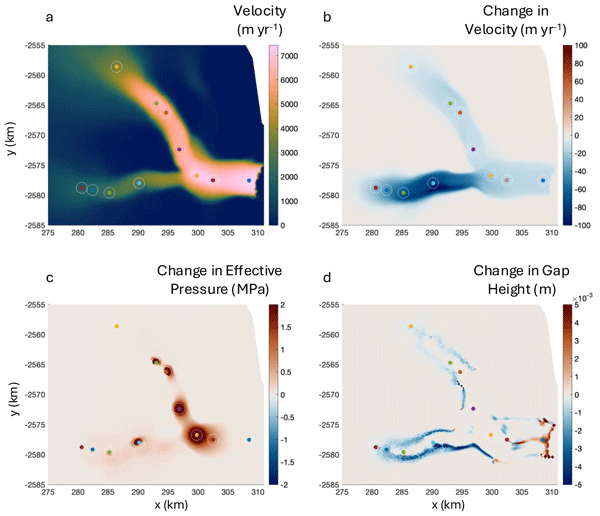
Figure 11 - it would be helpful to give an indication on this figure or in the caption how appreciable these velocity changes are, and to indicate that this is for a winter situation. It is hard to imagine how extracting 1m^3/s in the summer can have much effect at all (this is much smaller than the uncertainty in the surface runoff), and even in the winter it looks like the velocity change is quite small. Perhaps plot the percentage slow-down? The colour scale in panel (b) looks to be saturated so we can’t see how much the effective pressure changes near the borehole.
Figure 13 - there are issues with labels on many of these panels. What are the units of the values of [t] quoted? It might also be emphasised that the magnitude of the effective pressure changes is very different between different panels, e.g. in the top panel the effective pressure is hardly changing at all.
Line 417 - I suppose this conclusion is somewhat in the eye of the beholder. I read this study and thought the results confirm that as a glacier intervention strategy this is not a viable idea! The reduction in ice speed is minimal, and the amounts of water that it seems to be possible to extract per borehole (~1m^3/s) are also small.
Line 422 - simulations of ‘the Greenland ice sheet’, rather than of ‘Greenland’ I think.
Line 423 - indeed this does beg the question why this study is not already looking at a west Antarctic setting if the proposal is not really being considered for the Greenland ice sheet. The neglect of the seasonal melt cycle seems an enormous caveat for this work - and makes its relevance quite questionable - whereas if you actually have the Antarctic setting in mind, why confuse the issue by looking at a Greenlandic setting?
Line 444 - I’m confused by this statement, as I think the issue at small extraction fluxes is that the fluid is exiting the domain at its outer edge, not entering it. (i.e. the radial fluid flux is negative, since the way you define your radial flux is that positive q is inwards).
Citation: https://doi.org/10.5194/egusphere-2025-4867-RC2 -
AC2: 'Reply on RC2', Colin Meyer, 19 Feb 2026
The comment was uploaded in the form of a supplement: https://egusphere.copernicus.org/preprints/2025/egusphere-2025-4867/egusphere-2025-4867-AC2-supplement.pdf
-
AC2: 'Reply on RC2', Colin Meyer, 19 Feb 2026
Peer review completion


Interactive discussion
Status: closed
-
RC1: 'Comment on egusphere-2025-4867', Anonymous Referee #1, 03 Dec 2025
Review of Meyer et al. (2025)- The Cryosphere
‘Influence of water extraction on subglacial hydrology and glacier velocity’
This paper presents modelling work investigating subglacial water extraction, first of idealised simulations and then applied to Helheim Glacier, Greenland. Overall, the work provides important first steps into understanding the possible influences of water extraction on glacier velocity by examining a specific case of wintertime extraction. The work is extremely relevant to the community and suitable for publication of The Cryosphere. However, it needs some substantial re-framing to clearly state the contribution to the field and limitations of the work.
General comments:
The title of this paper is too general to represent the contents of the article accurately. The scenarios examined are very specific (e.g. wintertime only) and this should be acknowledged in the title. The influence of water extraction goes far beyond this work.
The level of mathematical detail here was appreciated, but I found it frequently to be at the cost of the ease of understanding of the paper overall. For a journal such as The Cryosphere it should be possible for a reader without a detailed mathematical background to still understand the overall study, but the details of the simulations run and their purpose are often lost in the weeds of the mathematical solutions.
The authors frequently do a good job of stating the assumptions made and the limitations of this work in the main body of the text. They do, however, then jump to much more general conclusions that go beyond what their results show in the discussion section. The results do not suggest that water extraction can slow glaciers, except under very specific circumstances. More work is needed to determine if glaciers can be slowed under realistic scenarios (i.e. with summer melt). The paper is a little inconsistent in sometimes doing a good job of being realistic about the results (i.e. that more modelling work is needed) and sometimes making broader statements that could be taken out of context.
While the authors state that the practical, moral, ethical implications of field testing are not considered, the fact that possible future field deployment is mentioned and the location studied has a local population should not be ignored. Can the authors please acknowledge the Indigenous population of Greenland and their rights to decide about possible future field testing that happens in their home.
The authors have acknowledged that two of them have connections to the Arête Glacier Initiative, yet describe this as ‘focussed on sea level rise’ whereas Arete’s home page states ‘Arête is leading sea-level rise forecasting and glacier stabilization efforts’. While it is appreciated that the authors are declaring this interest, the fact that this is an initiative with a specific goal to research glacier stabilization should be made clear. For a topic that has attracted a lot of controversy to the cryospheric community 100% openness is essential.
Specific line by line comments:
Line 71- Could the authors please expand on why the Theis method would be expected to be applicable to a subglacial environment e.g. as presumably this evolves much more quickly than a groundwater system
Line 105 (equation 1)- How much does the choice of sliding law matter here? Given it’s directly proportional to N it seems quite important.
Table 1- This would be much easier to follow if the parameters were also named as for anyone not familiar with SHAKTI there is a lot of back of forth to try and understand the equations.
Line 134- Does the continuous pumping assume no movement of the glacier (i.e. connection to the bed at the same place)? How might that impact future work that looks at feasibility of keeping drill holes open?
Line 146- I got a little confused between q, q and if these equations are looking at total water flux from the whole circle in figure 2 or just water movement across the boundary at the circumference. Possibly the above suggestion of making parameter names clearer might help with this,
Line 187/ Figure 4- More details about the simulations carried out here would be helpful, is this revisiting simulations from another paper? There aren’t any other simulations plotted previously.
Line 369- This is a very minor impact, but is described as a ‘modest’ impact in the abstract which is overstating 0.5-1%.
Figure 10- Can the authors please explain what is happening around day 90, and what the small fluctuations in the effective pressure are showing?
Line 377- Can you see the reconfiguration of the drainage network with SHAKTI?
Line 379- typo
Line 417- The results don’t show this, they show it can slow them under winter conditions only.
Citation: https://doi.org/10.5194/egusphere-2025-4867-RC1 -
AC1: 'Reply on RC1', Colin Meyer, 19 Feb 2026
The comment was uploaded in the form of a supplement: https://egusphere.copernicus.org/preprints/2025/egusphere-2025-4867/egusphere-2025-4867-AC1-supplement.pdf
-
AC1: 'Reply on RC1', Colin Meyer, 19 Feb 2026
-
RC2: 'Comment on egusphere-2025-4867', Anonymous Referee #2, 15 Jan 2026
This is a theoretical study that uses a model of the subglacial drainage system and ice mechanics to asses the effect of extracting water from the glacier bed. The study is motivated by an interesting (though frankly ludicrous) proposal that such extraction could be used as a mechanism to slow down the motion of parts of a glacier and thereby (perhaps) delay ice loss and consequent sea level rise.
I found the study interesting, but I feel that aspects of it are quite confused and it seems a bit rushed. In particular, I found the approximate analytical solutions - with many terms neglected initially and then slowly re-introduced - quite hard to follow, and then when it came to the fuller numerical solutions coupled to ice velocity I felt that the restriction to winter conditions when the basal water fluxes are small rather limits what can be concluded about the influence on glacier velocity.
The general approach of looking at simplified solutions (where certain terms are neglected) is potentially useful, but I felt it was quite confusing here, with so many different approximations introduced that it was hard to keep track of what the point was, or which of the results/figures were relevant in the end. I think the section 3 with approximate solutions could usefully be made more concise, and perhaps be guided more by what has been learnt through these (which seems to be that it is important to account for the melt from dissipation and the impact this has on the flux, and that the prescribed effective pressure at the ‘outer radius’ is important). E.g. you could just analyse the system in section 3.2.2 from the outset, perhaps noting simplifications that occur if/when some of the parameters are small.
A second issue I have with the simplified solutions is that they seem quite dependent on what is taken as the outer radius (r_d), and what value of effective pressure is prescribed there. Ideally you’d like the solutions not to depend too much on this but just to tend to some far-field undisturbed behaviour, but it doesn’t look like that’s what happens (the equations don’t allow it, I suppose). Instead, you have to prescribe a value of effective pressure N_0 at a particular radius, and the solutions seem to depend quite a lot on that. I felt that there should be more discussion about what is an appropriate value for both r_d and N_0.
Below I list line by line comments.
Line 28 - This sentence doesn’t seem quite right to me. At least, I think it is trying to get at the difference between so-called ‘efficient’ and ‘inefficient’ drainage systems, which are characterised by the steady-state response of the pressure to an increase in discharge, but this is not necessarily the same as ‘higher effective pressure’ and ‘lower effective pressure’.
Line 46 - this description of ‘type-I’ and ‘type-II’ glaciers is a bit mysterious to me as I don’t think that is quite what is described in the referenced papers, which had more than two ‘types’ and where the distinction is based more on the patten of velocity change - with apparent influence of the glacier terminus as well as basal lubrication - rather than on the hypothesised response of the subglacial water pressure to adding meltwater. Whilst there are clearly differences in the ways that different glaciers respond to seasonal meltwater forcing, I’m not sure that the observations can be summarised this simplistically.
Line 53 - I found this discussion of how such glaciers would respond to meltwater extraction a slightly bizarre thought experiment. If the glacier is responding seasonally to surface melt reaching the bed, it would surely be easier to find a mechanism to prevent the water from reaching the bed in the first place, rather than extracting it back from the bed (back to the surface presumably, from which it would just find its way to the bed again!).
Line 155. What motivates the choice of the value of N_0? This seems like it may be quite important here, along with the size of the domain. r_d is not defined, and nor is f(r).
Line 167 - what is r_t? This doesn’t seem to be used.
Line 190 - this sentence saying the SHAKTI simulations do not always evolve the gap height in time was a bit confusing - given that you’ve just described the model with an equation for the evolution of the gap height - and isn’t really discussed later. It would be good to describe the model fully upfront.
Line 208 - this condition on where the effective pressure blows up seems like it may depend on the size of R. For small R, I’d have thought the logarithmic term in (20) is more important, with N blowing up when r ~ e^(-8M).
Figure 4 - the blank region of the lower plot looks a bit odd. Why are there no points with larger gap heights close to the extraction site?
Figure 6 - it’s not clear what parameters have been used for the left hand panel. In the right panel it is very hard to tell how much of the difference between the points for different values of N_0 is due to the different value of N_0 or due to different values of N. It might make more sense to plot N rather than N-N_0. Secondly in this plot why are the points all over the place? This looks to me like the numerical solution is not working, or producing numerical errors, in which case how can you have faith in these results?
Figure 7 - I am quite confused by the plot, which seems to show very different behaviour to what’s discussed around figure 6, in which it is suggested that N tends towards a constant value as r tends to 0 (i.e. as you approach the borehole), whereas here you seem to show N ever-increasing at small r. Maybe I am not understanding what is being shown here.
Line 279 - continuing this confusion, you earlier suggested that the solutions had a constant effective pressure as r tends to zero, given approximately by (29). What is different here?
Figure 8 - the axes labelling seems confused about whether it is the dimensional or non-dimensional radius.
Figure 9 - why does the effective pressure seem to be insensitive to Q here (at least for smaller values of N_0), but not in figure 6. Which is ‘correct’?
Line 351 - the expected timescale of 1 hour doesn’t fit within the expected range of time scales just mentioned on line 345 (90 years to 4 days), or the value on line 343. It is a lot shorter. This is rather confusing.
Figure 10 - is this figure well-resolved in time? If it’s supposed to be showing the transient dynamics it doesn’t show them very well - it suggests an essentially instantaneous adjustment, but the marker at the maximum suggests the plot may not be resolving the transient.
Figure 11 - it would be helpful to give an indication on this figure or in the caption how appreciable these velocity changes are, and to indicate that this is for a winter situation. It is hard to imagine how extracting 1m^3/s in the summer can have much effect at all (this is much smaller than the uncertainty in the surface runoff), and even in the winter it looks like the velocity change is quite small. Perhaps plot the percentage slow-down? The colour scale in panel (b) looks to be saturated so we can’t see how much the effective pressure changes near the borehole.
Figure 13 - there are issues with labels on many of these panels. What are the units of the values of [t] quoted? It might also be emphasised that the magnitude of the effective pressure changes is very different between different panels, e.g. in the top panel the effective pressure is hardly changing at all.
Line 417 - I suppose this conclusion is somewhat in the eye of the beholder. I read this study and thought the results confirm that as a glacier intervention strategy this is not a viable idea! The reduction in ice speed is minimal, and the amounts of water that it seems to be possible to extract per borehole (~1m^3/s) are also small.
Line 422 - simulations of ‘the Greenland ice sheet’, rather than of ‘Greenland’ I think.
Line 423 - indeed this does beg the question why this study is not already looking at a west Antarctic setting if the proposal is not really being considered for the Greenland ice sheet. The neglect of the seasonal melt cycle seems an enormous caveat for this work - and makes its relevance quite questionable - whereas if you actually have the Antarctic setting in mind, why confuse the issue by looking at a Greenlandic setting?
Line 444 - I’m confused by this statement, as I think the issue at small extraction fluxes is that the fluid is exiting the domain at its outer edge, not entering it. (i.e. the radial fluid flux is negative, since the way you define your radial flux is that positive q is inwards).
Citation: https://doi.org/10.5194/egusphere-2025-4867-RC2 -
AC2: 'Reply on RC2', Colin Meyer, 19 Feb 2026
The comment was uploaded in the form of a supplement: https://egusphere.copernicus.org/preprints/2025/egusphere-2025-4867/egusphere-2025-4867-AC2-supplement.pdf
-
AC2: 'Reply on RC2', Colin Meyer, 19 Feb 2026
Peer review completion
Journal article(s) based on this preprint
Model code and software
Code for water extraction analysis and SHAKTI-ISSM Colin R. Meyer and Aleah N. Sommers https://github.com/colinrmeyer/water-extraction
Viewed
| HTML | XML | Total | BibTeX | EndNote | |
|---|---|---|---|---|---|
| 2,311 | 1,025 | 190 | 3,526 | 161 | 212 |
- HTML: 2,311
- PDF: 1,025
- XML: 190
- Total: 3,526
- BibTeX: 161
- EndNote: 212
Viewed (geographical distribution)
| Country | # | Views | % |
|---|
| Total: | 0 |
| HTML: | 0 |
| PDF: | 0 |
| XML: | 0 |
- 1
Colin R. Meyer

Katarzyna L. P. Warburton
Aleah N. Sommers
Brent M. Minchew
The requested preprint has a corresponding peer-reviewed final revised paper. You are encouraged to refer to the final revised version.
- Preprint
(6934 KB) - Metadata XML
Review of Meyer et al. (2025)- The Cryosphere
‘Influence of water extraction on subglacial hydrology and glacier velocity’
This paper presents modelling work investigating subglacial water extraction, first of idealised simulations and then applied to Helheim Glacier, Greenland. Overall, the work provides important first steps into understanding the possible influences of water extraction on glacier velocity by examining a specific case of wintertime extraction. The work is extremely relevant to the community and suitable for publication of The Cryosphere. However, it needs some substantial re-framing to clearly state the contribution to the field and limitations of the work.
General comments:
The title of this paper is too general to represent the contents of the article accurately. The scenarios examined are very specific (e.g. wintertime only) and this should be acknowledged in the title. The influence of water extraction goes far beyond this work.
The level of mathematical detail here was appreciated, but I found it frequently to be at the cost of the ease of understanding of the paper overall. For a journal such as The Cryosphere it should be possible for a reader without a detailed mathematical background to still understand the overall study, but the details of the simulations run and their purpose are often lost in the weeds of the mathematical solutions.
The authors frequently do a good job of stating the assumptions made and the limitations of this work in the main body of the text. They do, however, then jump to much more general conclusions that go beyond what their results show in the discussion section. The results do not suggest that water extraction can slow glaciers, except under very specific circumstances. More work is needed to determine if glaciers can be slowed under realistic scenarios (i.e. with summer melt). The paper is a little inconsistent in sometimes doing a good job of being realistic about the results (i.e. that more modelling work is needed) and sometimes making broader statements that could be taken out of context.
While the authors state that the practical, moral, ethical implications of field testing are not considered, the fact that possible future field deployment is mentioned and the location studied has a local population should not be ignored. Can the authors please acknowledge the Indigenous population of Greenland and their rights to decide about possible future field testing that happens in their home.
The authors have acknowledged that two of them have connections to the Arête Glacier Initiative, yet describe this as ‘focussed on sea level rise’ whereas Arete’s home page states ‘Arête is leading sea-level rise forecasting and glacier stabilization efforts’. While it is appreciated that the authors are declaring this interest, the fact that this is an initiative with a specific goal to research glacier stabilization should be made clear. For a topic that has attracted a lot of controversy to the cryospheric community 100% openness is essential.
Specific line by line comments:
Line 71- Could the authors please expand on why the Theis method would be expected to be applicable to a subglacial environment e.g. as presumably this evolves much more quickly than a groundwater system
Line 105 (equation 1)- How much does the choice of sliding law matter here? Given it’s directly proportional to N it seems quite important.
Table 1- This would be much easier to follow if the parameters were also named as for anyone not familiar with SHAKTI there is a lot of back of forth to try and understand the equations.
Line 134- Does the continuous pumping assume no movement of the glacier (i.e. connection to the bed at the same place)? How might that impact future work that looks at feasibility of keeping drill holes open?
Line 146- I got a little confused between q, q and if these equations are looking at total water flux from the whole circle in figure 2 or just water movement across the boundary at the circumference. Possibly the above suggestion of making parameter names clearer might help with this,
Line 187/ Figure 4- More details about the simulations carried out here would be helpful, is this revisiting simulations from another paper? There aren’t any other simulations plotted previously.
Line 369- This is a very minor impact, but is described as a ‘modest’ impact in the abstract which is overstating 0.5-1%.
Figure 10- Can the authors please explain what is happening around day 90, and what the small fluctuations in the effective pressure are showing?
Line 377- Can you see the reconfiguration of the drainage network with SHAKTI?
Line 379- typo
Line 417- The results don’t show this, they show it can slow them under winter conditions only.