
the Creative Commons Attribution 4.0 License.
the Creative Commons Attribution 4.0 License.
 | 15 Oct 2025
Integrating Fire-Induced Meteorological Changes into Plume Rise Modeling for Extreme Wildfire Simulations
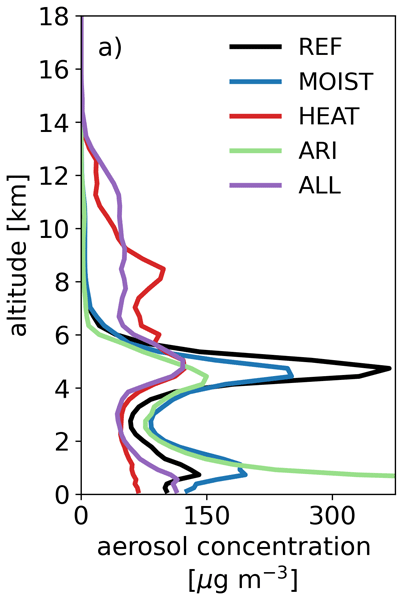
Abstract. Wildfire emissions are a major environmental concern, especially as climate change increases the frequency of extreme events. Our study investigates the limitations of the widely used Freitas plume-rise model during the Australian New Year’s wildfires of 2019/2020, focusing on how accounting for fire-atmosphere feedbacks in the host model affects plume rise. Simulations were conducted at a 6.6 km grid resolution, where convection is parameterized but fire-induced meteorological effects remain significant. Including fire-induced moisture release led to increased cloud formation, but had minimal impact on plume dynamics. In contrast, accounting for fire-induced heat release significantly increased the plume height due to enhanced buoyancy and cloud formation, even without added moisture.
Simulating aerosol–radiation interactions initially reduced injection height, as solar absorption by dense aerosols stabilized the atmosphere. However, a lofting effect emerged from the second day onward. The combined simulation—incorporating heat and moisture release and aerosol-radiation interaction—produced the highest plume rise and best matched satellite observations, including the aerosol layer in the upper troposphere/lower stratosphere. The effects were strongest on the first day, when fire intensity peaked. For less intense fires, the Freitas plume-rise model performed well without additional feedback mechanisms.
-
Notice on discussion status
The requested preprint has a corresponding peer-reviewed final revised paper. You are encouraged to refer to the final revised version.
-
Preprint
(2703 KB)
-
The requested preprint has a corresponding peer-reviewed final revised paper. You are encouraged to refer to the final revised version.
- Preprint
(2703 KB) - Metadata XML
- BibTeX
- EndNote
- Final revised paper


Journal article(s) based on this preprint
Interactive discussion
Status: closed
-
RC1: 'Comment on egusphere-2025-4853', Anonymous Referee #1, 02 Nov 2025
The comment was uploaded in the form of a supplement: https://egusphere.copernicus.org/preprints/2025/egusphere-2025-4853/egusphere-2025-4853-RC1-supplement.pdfCitation: https://doi.org/
10.5194/egusphere-2025-4853-RC1 - RC2: 'Comment on egusphere-2025-4853', Anonymous Referee #2, 23 Nov 2025
- AC1: 'Comment on egusphere-2025-4853', Lisa Muth, 16 Jan 2026
Peer review completion


Interactive discussion
Status: closed
-
RC1: 'Comment on egusphere-2025-4853', Anonymous Referee #1, 02 Nov 2025
The comment was uploaded in the form of a supplement: https://egusphere.copernicus.org/preprints/2025/egusphere-2025-4853/egusphere-2025-4853-RC1-supplement.pdf
- RC2: 'Comment on egusphere-2025-4853', Anonymous Referee #2, 23 Nov 2025
- AC1: 'Comment on egusphere-2025-4853', Lisa Muth, 16 Jan 2026
Peer review completion
Journal article(s) based on this preprint
Viewed
| HTML | XML | Total | BibTeX | EndNote | |
|---|---|---|---|---|---|
| 2,158 | 1,076 | 216 | 3,450 | 152 | 150 |
- HTML: 2,158
- PDF: 1,076
- XML: 216
- Total: 3,450
- BibTeX: 152
- EndNote: 150
Viewed (geographical distribution)
| Country | # | Views | % |
|---|
| Total: | 0 |
| HTML: | 0 |
| PDF: | 0 |
| XML: | 0 |
- 1

Gholam Ali Hoshyaripour
Bernhard Vogel
Heike Vogel
Corinna Hoose
The requested preprint has a corresponding peer-reviewed final revised paper. You are encouraged to refer to the final revised version.
- Preprint
(2703 KB) - Metadata XML