
the Creative Commons Attribution 4.0 License.
the Creative Commons Attribution 4.0 License.
 | 28 Oct 2025
Forecast-based operation of re-purposed small reservoirs for floods, farms, and (low) flows
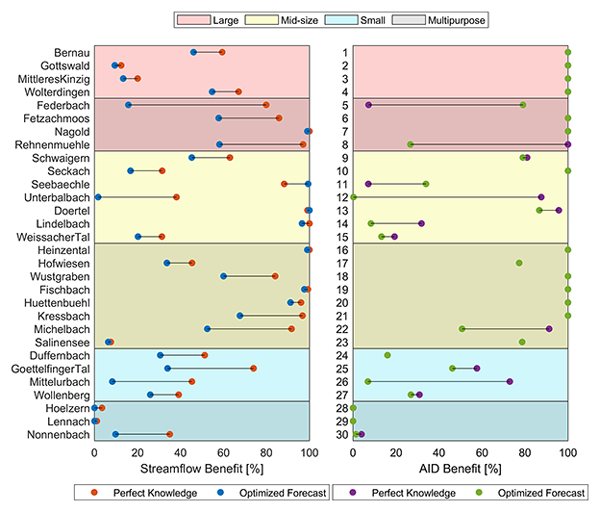
Abstract. The increased frequency and intensity of hydrological extremes, including drought, due to anthropogenic climate change will drive the need for enhanced water supply resilience, even in water-rich countries. Previous studies have shown that small reservoirs have considerable potential for expanding water supply for various purposes, including when repurposed from flood-only reservoirs for both flood and drought protection. However, whether these repurposed reservoirs retain the same flood protection ability when operating under forecasts is still unclear, as reservoir operation under forecasts has primarily been researched in the context of large reservoirs. In this study, we investigated potential operating rules under forecasts for 30 small-to-midsize flood reservoirs to a) determine if the uncertainty introduced by forecasts degrades the performance of repurposed reservoirs so significantly as to render the concept unusable, b) identify patterns in the relationship between forecast accuracy and optimal reservoir performance, and c) identify patterns in optimal reservoir operation rules, under the constraint that flood protection should not be compromised. Performance is determined by the modelled ability to either supplement streamflow to avoid low flows or to provide water for irrigation purposes in the area of the reservoir. 1000 combinations of three operation parameters—the warning threshold at which flood pre-release begins, the rate at which water is released from the reservoir for flood pre-release, and the inflow at which the reservoir begins storing water—were tested for maintenance of flood protection (viability) and benefit for the reservoir’s additional uses. While some reservoirs indeed were no longer beneficial when optimized to operate under forecasts, many still maintained benefits above 40 %, with a couple even surpassing their performance under perfect knowledge. Comparing changes in benefit from the perfect-knowledge operation to forecast accuracy indicated that high rates of hits, false alarms and misses, and misses (HFM) could explain the largest decreases in performance, while other forecast accuracy metrics were less impactful. However, even if HFM were low but nonzero, a poorly-timed false alarm could drain a reservoir’s storage before a spike in demand, causing a noticeable loss in performance. Investigation of reservoirs’ potential benefits under forecasts should therefore be done via simulation rather than approximated via characterizing indices. Optimal operation rules tended to be those that most closely mimicked the perfect knowledge operation, i.e. aggressive storage thresholds and a tendency to hold onto the water storage for as long as is safe, but more conservative operating rules were also able to provide benefits as well. The models for forecast operation and optimization produced for this study can be used by water managers to assess if existing small flood reservoirs can feasibly be used to increase water supply resilience in a changing world.
-
Notice on discussion status
The requested preprint has a corresponding peer-reviewed final revised paper. You are encouraged to refer to the final revised version.
-
Preprint
(1148 KB)
-
The requested preprint has a corresponding peer-reviewed final revised paper. You are encouraged to refer to the final revised version.
- Preprint
(1148 KB) - Metadata XML
- BibTeX
- EndNote
- Final revised paper


Journal article(s) based on this preprint
Interactive discussion
Status: closed
-
RC1: 'Comment on egusphere-2025-4739', Anonymous Referee #1, 04 Feb 2026
-
AC1: 'Reply on RC1', Sarah Ho, 19 Feb 2026
We thank the reviewer for their time in reviewing our manuscript and hope that our responses resolve the outstanding issues:
- Our optimization consisted of finding the highest-performing parameter by sampling the viable parameter spaces for each of our three operation parameters (Qr, percQ_thresh, and percQ_release). For each parameter, we tested 10 evenly-spaced samples in combination with the other parameter combinations; this resulted in 1,000 runs. The highest-performing combinations were selected as the optimal rules. We will re-emphasize this in the revision.
- We agree and will add a brief discussion to the introduction in the revision.
- We will clarify these in the revision. For the reviewer’s reference, the shorthands are a combination of first the reservoir’s size category (L = large, M = mid-size, S = small according to the German standard) and the current operation (F = flood-only, M = multipurpose).
- We will extend our discussion of the appendix figures in lines 285 and 288 to re-emphasize that different parameter combinations can still result in similar benefits.
Citation: https://doi.org/10.5194/egusphere-2025-4739-AC1
-
AC1: 'Reply on RC1', Sarah Ho, 19 Feb 2026
-
RC2: 'Comment on egusphere-2025-4739', Anonymous Referee #2, 22 May 2026
This study investigates if small reservoirs provide significant benefits when they are managed using operational forecasts. It builds upon two recent studies with the same sets of reservoirs located in Germany, and with very similar methods (operation rules, simulated streamflow). The materials and results are well described and discussed. I just have minor points that are detailed hereafter.
Main comment
There are many references to Ho and Ehret, 2025; Ho et al., 2025 (l. 109-110 for catchment selection, l. 147-149 for simulated streamflow, l. 183 for the forecast operation model). It can be explained by the fact that most of the methods and materials in this study have been developed in these two papers. However, in my opinion, any paper should be self-contained. At many places in the manuscript (e.g. 147-149), it seems expected that the reader knows the previous papers. I strongly recommend limiting the references to these studies, especially for technical aspects. For example, section 2.7.2 should describe the perfect-knowledge scenarios used in this study, and not the differences with the previous papers. Another example, at l. 160, it is mentioned that the irrigation demand time series were already derived in Ho et al. (2025) and it is also indicated that more details can be found in this paper (e.g. l. 165-166), which gives the impression that this paragraph is not sufficient to understand what AID represents. Beyond presentation aspects, it also gives the impression that this study is too incremental compared to Ho and Ehret, 2025.
Minor comments
- Title: I do not think that “re-purposed” needs a hyphen (actually it is written without a hyphen at l. 13). I recommend replacing “floods, farms, and (low) flows” by “high and low flows” for the sake of concision.
- l. 16: “small-to-midsize”: I suggest providing a range of sizes.
- l. 49: Otherwise -> different.
- l. 50: “much more easily adapted to local conditions and can be managed locally” seems redundant.
- l. 58; missing space before “remain”.
- l. 83: “,,”.
- l. 200: What is the consequence of multiplying arbitrarily by 5 ? If it has no consequences, I do not understand why it is needed. If it has consequences, then it should not be arbitrary, isn’t it ?
- Figure 3: I would add a circle in the legend along with the triangle.
- l. 261: I miss a presentation of the experiments here, and a general presentation of Figure 4. I would also remind the reader what a viable parameter set is.
Citation: https://doi.org/10.5194/egusphere-2025-4739-RC2 -
AC2: 'Reply on RC2', Sarah Ho, 05 Jun 2026
Dear Reviewer 2,
Thank you for your comments. We agree that scientific papers should be more self-contained and recognize that the manuscript in this form is not quite as self-contained as it could be. In our revision, we’ll rely less on references to the two previous papers and instead elaborate more on the technical aspects of the methods section to ensure that this paper contains enough information to understand the study on its own. Thank you for the hints on where to begin with this effort.
As for the minor comments, here are our responses:
• Title: we agree that “re-purposed” doesn’t need a hyphen and will edit for consistency. However, while the changed title might be a little more concise, the agricultural part is still a big part of this paper, and we would like to otherwise keep the title as is.• L16: thanks for the suggestion; we will add that.• L49: thanks for the suggestion; we will incorporate that.• L50: we’ll look into rewording this for concision.• L58, 83: thanks for catching these typos!• L200: this penalty function was created as a placeholder for other flood damage functions. The point of multiplying by a scalar was under the assumption that damages from floods scaled with the excess volume, with 5 being an arbitrary placeholder value. We will add this context in the revision.• Figure 3: thanks for the suggestion; we will incorporate that.• L261 / Figure 4: thanks for the suggestions; we will incorporate them.Citation: https://doi.org/10.5194/egusphere-2025-4739-AC2
Peer review completion


Interactive discussion
Status: closed
-
RC1: 'Comment on egusphere-2025-4739', Anonymous Referee #1, 04 Feb 2026
The manuscript is relevant to the journal, and although the research questions are important, it has the following shortcomings before it is accepted for publication.
1. Line 24 talks about testing or simulation for different combinations defined. Section 3.1 says optimization results. There are no details on optimization, such as which algorithm was used, different solutions from optimization, and so on.
2. The introduction section could discuss the recent studies on Forecast-informed reservoir operations (FIRO), highlighting the novelty
3. Table 1 - the category shorthands are not described
4. The appendix figures have not been referenced and discussedCitation: https://doi.org/10.5194/egusphere-2025-4739-RC1 -
AC1: 'Reply on RC1', Sarah Ho, 19 Feb 2026
We thank the reviewer for their time in reviewing our manuscript and hope that our responses resolve the outstanding issues:
- Our optimization consisted of finding the highest-performing parameter by sampling the viable parameter spaces for each of our three operation parameters (Qr, percQ_thresh, and percQ_release). For each parameter, we tested 10 evenly-spaced samples in combination with the other parameter combinations; this resulted in 1,000 runs. The highest-performing combinations were selected as the optimal rules. We will re-emphasize this in the revision.
- We agree and will add a brief discussion to the introduction in the revision.
- We will clarify these in the revision. For the reviewer’s reference, the shorthands are a combination of first the reservoir’s size category (L = large, M = mid-size, S = small according to the German standard) and the current operation (F = flood-only, M = multipurpose).
- We will extend our discussion of the appendix figures in lines 285 and 288 to re-emphasize that different parameter combinations can still result in similar benefits.
Citation: https://doi.org/10.5194/egusphere-2025-4739-AC1
-
AC1: 'Reply on RC1', Sarah Ho, 19 Feb 2026
-
RC2: 'Comment on egusphere-2025-4739', Anonymous Referee #2, 22 May 2026
This study investigates if small reservoirs provide significant benefits when they are managed using operational forecasts. It builds upon two recent studies with the same sets of reservoirs located in Germany, and with very similar methods (operation rules, simulated streamflow). The materials and results are well described and discussed. I just have minor points that are detailed hereafter.
Main comment
There are many references to Ho and Ehret, 2025; Ho et al., 2025 (l. 109-110 for catchment selection, l. 147-149 for simulated streamflow, l. 183 for the forecast operation model). It can be explained by the fact that most of the methods and materials in this study have been developed in these two papers. However, in my opinion, any paper should be self-contained. At many places in the manuscript (e.g. 147-149), it seems expected that the reader knows the previous papers. I strongly recommend limiting the references to these studies, especially for technical aspects. For example, section 2.7.2 should describe the perfect-knowledge scenarios used in this study, and not the differences with the previous papers. Another example, at l. 160, it is mentioned that the irrigation demand time series were already derived in Ho et al. (2025) and it is also indicated that more details can be found in this paper (e.g. l. 165-166), which gives the impression that this paragraph is not sufficient to understand what AID represents. Beyond presentation aspects, it also gives the impression that this study is too incremental compared to Ho and Ehret, 2025.
Minor comments
- Title: I do not think that “re-purposed” needs a hyphen (actually it is written without a hyphen at l. 13). I recommend replacing “floods, farms, and (low) flows” by “high and low flows” for the sake of concision.
- l. 16: “small-to-midsize”: I suggest providing a range of sizes.
- l. 49: Otherwise -> different.
- l. 50: “much more easily adapted to local conditions and can be managed locally” seems redundant.
- l. 58; missing space before “remain”.
- l. 83: “,,”.
- l. 200: What is the consequence of multiplying arbitrarily by 5 ? If it has no consequences, I do not understand why it is needed. If it has consequences, then it should not be arbitrary, isn’t it ?
- Figure 3: I would add a circle in the legend along with the triangle.
- l. 261: I miss a presentation of the experiments here, and a general presentation of Figure 4. I would also remind the reader what a viable parameter set is.
Citation: https://doi.org/10.5194/egusphere-2025-4739-RC2 -
AC2: 'Reply on RC2', Sarah Ho, 05 Jun 2026
Dear Reviewer 2,
Thank you for your comments. We agree that scientific papers should be more self-contained and recognize that the manuscript in this form is not quite as self-contained as it could be. In our revision, we’ll rely less on references to the two previous papers and instead elaborate more on the technical aspects of the methods section to ensure that this paper contains enough information to understand the study on its own. Thank you for the hints on where to begin with this effort.
As for the minor comments, here are our responses:
• Title: we agree that “re-purposed” doesn’t need a hyphen and will edit for consistency. However, while the changed title might be a little more concise, the agricultural part is still a big part of this paper, and we would like to otherwise keep the title as is.• L16: thanks for the suggestion; we will add that.• L49: thanks for the suggestion; we will incorporate that.• L50: we’ll look into rewording this for concision.• L58, 83: thanks for catching these typos!• L200: this penalty function was created as a placeholder for other flood damage functions. The point of multiplying by a scalar was under the assumption that damages from floods scaled with the excess volume, with 5 being an arbitrary placeholder value. We will add this context in the revision.• Figure 3: thanks for the suggestion; we will incorporate that.• L261 / Figure 4: thanks for the suggestions; we will incorporate them.Citation: https://doi.org/10.5194/egusphere-2025-4739-AC2
Peer review completion
Journal article(s) based on this preprint
Model code and software
Forecast-based operation of re-purposed small reservoirs for floods, farms, and (low) flows Sarah Quynh-Giang Ho and Uwe Ehret https://doi.org/10.5281/zenodo.17183389
Viewed
| HTML | XML | Total | BibTeX | EndNote | |
|---|---|---|---|---|---|
| 1,720 | 769 | 201 | 2,690 | 125 | 147 |
- HTML: 1,720
- PDF: 769
- XML: 201
- Total: 2,690
- BibTeX: 125
- EndNote: 147
Viewed (geographical distribution)
| Country | # | Views | % |
|---|
| Total: | 0 |
| HTML: | 0 |
| PDF: | 0 |
| XML: | 0 |
- 1

Robert Lang
Uwe Ehret
The requested preprint has a corresponding peer-reviewed final revised paper. You are encouraged to refer to the final revised version.
- Preprint
(1148 KB) - Metadata XML
The manuscript is relevant to the journal, and although the research questions are important, it has the following shortcomings before it is accepted for publication.
1. Line 24 talks about testing or simulation for different combinations defined. Section 3.1 says optimization results. There are no details on optimization, such as which algorithm was used, different solutions from optimization, and so on.
2. The introduction section could discuss the recent studies on Forecast-informed reservoir operations (FIRO), highlighting the novelty
3. Table 1 - the category shorthands are not described
4. The appendix figures have not been referenced and discussed