
the Creative Commons Attribution 4.0 License.
the Creative Commons Attribution 4.0 License.
 | 10 Oct 2025
Synthesis of ARM User Facility Surface Precipitation Datasets to Construct a Best Estimate Value Added Product (PrecipBE)
Abstract. Surface precipitation measurements are essential for Earth system model (ESM) evaluation and understanding cloud processes. An ever-growing need for robust, temporally evolving, and easy-to-use statistical datasets provides motivation for a baseline ground-based precipitation properties data product. The U.S. Department of Energy Atmospheric Radiation Measurement (ARM) user facility operates an extensive suite of precipitation instruments with various sensitivities and operating mechanisms, which render the decision of which instrument to use based on one or more fixed thresholds challenging and prone to errors and bias. Using a long-term instrument inter-comparison from a unique per-precipitation event perspective, rather than instantaneous sample comparison, we demonstrate that ARM precipitation instruments are generally consistent with each other at the statistical level. Inter-instrument deviations at the single event level can be large, especially at specific precipitation event properties such as maximum precipitation rates. A machine-learning (ML) analysis indicates that in some cases (e.g., certain instruments or deployments), atmospheric state variables influence the measured quantities and therefore the observed deviations between instruments. These results motivate the design of the ARM precipitation best-estimate (PrecipBE) value-added product, which incorporates all valid precipitation data while considering data quality and other instrument limitations.
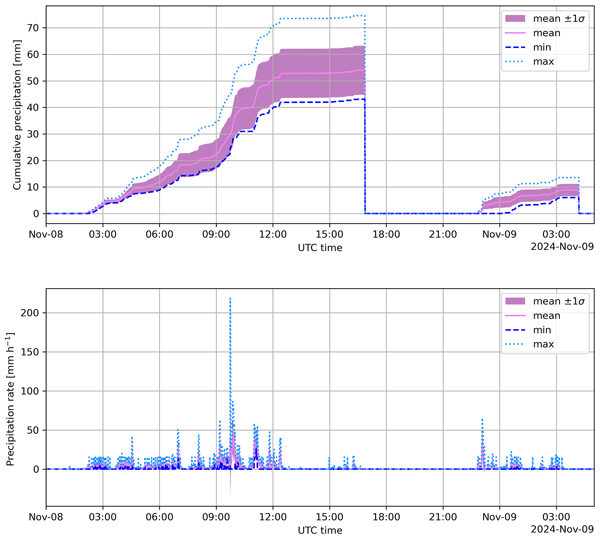
PrecipBE consists of time series and tabular statistics datasets in an easy-to-use and insightful per-precipitation event format. It provides a large set of precipitation event properties supplemented with ancillary data from various ARM datasets that correspond to the detected precipitation events. We describe the PrecipBE algorithm and demonstrate its use via the examination of a single-day output as well as a long-term trend analysis of precipitation events at the ARM Southern Great Plains (SGP) site, covering more than 30 years of data. The trend analysis tentatively suggests a long-term tendency for mainly shorter and less intense precipitation events at the SGP site, but a long-term increase in annual rainfall by more than 36 mm (5 %) per decade. This rainfall trend is catalyzed primarily by more extreme event properties of relatively rare, intense precipitation events, with event total and 1-minute maximum precipitation rate at a 1-year timeframe increasing up to 5 mm and 9 mm/hr (several percent) per decade, respectively. While the currently available PrecipBE datasets (at https://adc.arm.gov/discovery/) cover multiple ARM deployments up until March 2025, PrecipBE will soon become an operational product with a several-day lag from real-time, and we invite the ARM user community to leverage this new product and welcome user feedback to enhance it further.
-
Notice on discussion status
The requested preprint has a corresponding peer-reviewed final revised paper. You are encouraged to refer to the final revised version.
-
Preprint
(2626 KB)
-
The requested preprint has a corresponding peer-reviewed final revised paper. You are encouraged to refer to the final revised version.
- Preprint
(2626 KB) - Metadata XML
- BibTeX
- EndNote
- Final revised paper


Journal article(s) based on this preprint
Interactive discussion
Status: closed
-
RC1: 'Comment on egusphere-2025-4723', Alain Protat, 13 Nov 2025
- AC1: 'Response to reviewer comments', Israel Silber, 08 Dec 2025
-
RC2: 'Comment on egusphere-2025-4723', David Dufton, 14 Nov 2025
The paper presents a thorough cross comparison of multiple precipitation sensors deployed at the ARM Southern Great Plains site over the last 30 years alongside a methodology for, description and application of a new data product which combines those sensors. The paper is well written and easy to understand. My review focuses mainly on the first cross comparison section as the new value added product, while not ground breaking in its methodology, is a sensible addition, and is well described with a fitting application chosen to use as an example.
In addition to the comments within the attached pdf I have the following more general comments which are easier to present here:
1. The authors do not give reference at any point to the WMO intercomparison studies (both field and laboratory) of rain gauges (see citations in the pdf). I believe these papers may provide the authors with extra context for their findings and can be incorporated well into the paper. In particular, they should provide more information around the choice of the PWD as the reference sensor, and the potential implications for bias this may introduce.
2. The random forest application add little value to the paper. Only 2 of the models have an R2 above 0.5 and in both those cases the RF is dominated by the event mean and max rate. I'd suggest removing it, especially as its findings don't impact the resulting development of the new combined product.
3. The methodology chosen for the combined methodology does not take into account the findings from the previous section beyond the removal of the two gauges that deviate most strongly. I believe if the WMO intercomparison results are considered and the findings in section 2 there is potential future scope for an update which weights the instruments based on previously published accuracy findings and their accuracy within each event (based on duration and total accumulation). For instance the TBR and Pluvio would seem to be the more accurate choices based on the WMO results, and the mean could be weighted to account for this in events which suit their use. I'd suggest the authors consider this as a future extension/improvement rather than discounting the current methodology which provides a sensible first step.
- AC1: 'Response to reviewer comments', Israel Silber, 08 Dec 2025


Interactive discussion
Status: closed
-
RC1: 'Comment on egusphere-2025-4723', Alain Protat, 13 Nov 2025
- AC1: 'Response to reviewer comments', Israel Silber, 08 Dec 2025
-
RC2: 'Comment on egusphere-2025-4723', David Dufton, 14 Nov 2025
The paper presents a thorough cross comparison of multiple precipitation sensors deployed at the ARM Southern Great Plains site over the last 30 years alongside a methodology for, description and application of a new data product which combines those sensors. The paper is well written and easy to understand. My review focuses mainly on the first cross comparison section as the new value added product, while not ground breaking in its methodology, is a sensible addition, and is well described with a fitting application chosen to use as an example.
In addition to the comments within the attached pdf I have the following more general comments which are easier to present here:
1. The authors do not give reference at any point to the WMO intercomparison studies (both field and laboratory) of rain gauges (see citations in the pdf). I believe these papers may provide the authors with extra context for their findings and can be incorporated well into the paper. In particular, they should provide more information around the choice of the PWD as the reference sensor, and the potential implications for bias this may introduce.
2. The random forest application add little value to the paper. Only 2 of the models have an R2 above 0.5 and in both those cases the RF is dominated by the event mean and max rate. I'd suggest removing it, especially as its findings don't impact the resulting development of the new combined product.
3. The methodology chosen for the combined methodology does not take into account the findings from the previous section beyond the removal of the two gauges that deviate most strongly. I believe if the WMO intercomparison results are considered and the findings in section 2 there is potential future scope for an update which weights the instruments based on previously published accuracy findings and their accuracy within each event (based on duration and total accumulation). For instance the TBR and Pluvio would seem to be the more accurate choices based on the WMO results, and the mean could be weighted to account for this in events which suit their use. I'd suggest the authors consider this as a future extension/improvement rather than discounting the current methodology which provides a sensible first step.
- AC1: 'Response to reviewer comments', Israel Silber, 08 Dec 2025
Peer review completion


Journal article(s) based on this preprint
Viewed
| HTML | XML | Total | BibTeX | EndNote | |
|---|---|---|---|---|---|
| 265 | 88 | 26 | 379 | 24 | 26 |
- HTML: 265
- PDF: 88
- XML: 26
- Total: 379
- BibTeX: 24
- EndNote: 26
Viewed (geographical distribution)
| Country | # | Views | % |
|---|
| Total: | 0 |
| HTML: | 0 |
| PDF: | 0 |
| XML: | 0 |
- 1
Jennifer M. Comstock
Adam K. Theisen
Michael R. Kieburtz
Jenni Kyrouac
The requested preprint has a corresponding peer-reviewed final revised paper. You are encouraged to refer to the final revised version.
- Preprint
(2626 KB) - Metadata XML
See review attached