
the Creative Commons Attribution 4.0 License.
the Creative Commons Attribution 4.0 License.
 | 28 Oct 2025
Relative uptake of carbonyl sulphide to CO2: insights from a coupled boundary layer – canopy inverse modelling framework
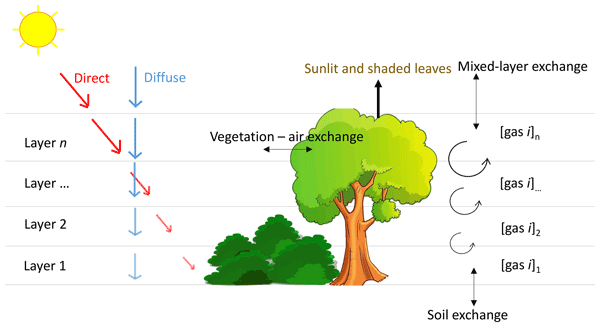
Abstract. Carbonyl sulphide (COS) is an atmospheric trace gas that has been suggested as a proxy to estimate carbon uptake by plants. To this end, the concept of leaf relative uptake (LRU), the ratio of deposition velocities of COS and CO2, has been introduced to obtain plant CO2 uptake fluxes from COS flux measurements. In our study we use a coupled soil – canopy – atmospheric mixed layer model to simulate CO2 and COS uptake by vegetation explicitly, and derive LRU. In this modelling framework, the exchange of COS is coupled to the exchange of H2O and CO2 via stomatal conductance. The latter is calculated using an A-gs (Assimilation–stomatal conductance) photosynthesis model, accounting for separate exchange at sunlit and shaded leaves. Despite limited complexity, our coupled model include most key processes involved in daytime land atmosphere exchange. The models are embedded in an inverse modelling framework, allowing for a structured model parameter estimation. We performed a parameter optimisation for a boreal forest in Finland (Hyytiälä), using observation data from July 2015. We took a holistic approach and aimed to obtain model parameters consistent with a large set of observations, including COS and CO2 molar fractions (measured in and above the canopy) and fluxes. By optimising parameters, we obtained a good fit to many observation types simultaneously. Analysing the corresponding modelled LRU, we found strong within-canopy variations at the leaf scale, with highest LRU values for shaded leaves near the bottom of the canopy. These variations can be explained to a large extent by differences in photosynthetically active radiation (PAR), vapour pressure and leaf temperature. Based on these findings, we propose a new parameterisation of canopy-scale LRU based on absorbed PAR and vapour-pressure deficit of sunlit leaves near the canopy top. We performed several additional optimisations, without re-optimising leaf exchange parameters: two for the same location, but for the months August and September, and two for a needleleaf forest in Austria (Mieming). We obtained a generally good fit with observations in all of these optimations, suggesting transferability of model parameters to different months and locations. When testing the LRU parameterisation using Hyytiälä model data from August and September (data not used for deriving the parameterisation), the results of the physical model were well-approximated, although observations suggest somewhat lower LRU values for a large part of the day. For Mieming, the parameterisation also provided a satisfactory fit to the physical model. For both locations we found that the LRU of sunlit leaves near the top of the canopy provides a good approximation of the canopy-scale LRU. Our results provide insight in the behaviour of LRU in the canopy, and the new parameterisation, based on both absorbed PAR and VPD, can contribute to improving COS-based ecosystem plant carbon uptake estimates in needleleaf ecosystems, but further validation is needed.
-
Notice on discussion status
The requested preprint has a corresponding peer-reviewed final revised paper. You are encouraged to refer to the final revised version.
-
Preprint
(1127 KB)
-
Supplement
(467 KB)
-
The requested preprint has a corresponding peer-reviewed final revised paper. You are encouraged to refer to the final revised version.
- Preprint
(1127 KB) - Metadata XML
-
Supplement
(467 KB) - BibTeX
- EndNote
- Final revised paper


Journal article(s) based on this preprint
Interactive discussion
Status: closed
-
RC1: 'Comment on egusphere-2025-4714', Joseph Berry, 03 Dec 2025
- AC1: 'Reply on RC1', Peter Bosman, 09 Feb 2026
-
RC2: 'Comment on egusphere-2025-4714', Anonymous Referee #2, 20 Jan 2026
The authors present their work developing a coupled modelling framework simulating the exchange of CO2, OCS and H2O between surface processes and the lower atmosphere – including throughout the canopy. Parameterisations in the coupled model are adjustable and are done so by assimilating observations using an inverse modelling framework. The aim of this work is to improve representation of the ratio of exchange between CO2 and OCS, the leaf relative uptake (LRU), for needleleaf boreal forest biomes. The methodology used here is robust and is exceptionally important in the field of OCS and the carbon cycle in general. The comparison across multiple sites and variations within-canopy are of particular note and interest for the OCS and carbon cycle community.
The strength of this work is the improved understanding of LRU variations within the canopy and on the development of a simple and well represented regression model. More work is required if the goal is to make model parameterisations transferrable between biomes (in further publications, not this one). While the performance of the physical and regression models at Mieming are slightly overplayed, it is worth noting that results do not necessarily have to be sold as ‘good’ or ‘better’ to be interesting and valuable. A little more in-depth discussion on the cause of the discrepancy between the physical model and Lai24, and the performance against measurements would enhance this already well-written publication.
Please see the supplementary document for more in-depth and specific comments. Note they are written up chronologically, not ranked by importance or significance.
- AC2: 'Reply on RC2', Peter Bosman, 09 Feb 2026
Peer review completion


Interactive discussion
Status: closed
-
RC1: 'Comment on egusphere-2025-4714', Joseph Berry, 03 Dec 2025
This paper analyzes OCS exchange in pine canopies using inversion of an intermediate-scale model that simulates vertical gradients of temperature, humidity, and wind speed, along with trace gas concentrations in the canopy, coupled to a convective boundary layer and the overlying troposphere. The main focus is on OCS exchange and on the parameter LRU, which relates the deposition velocities of CO2 and OCS to their local concentrations. The inversions indicate a vertical gradient of LRU within the canopy, which is qualitatively consistent with previous studies showing that LRU responds to PAR and VPD. This modeling framework is unique and potentially valuable for interpreting eddy covariance observations of OCS exchange.
However, the emphasis on the absolute values of LRU produced by the model appears overstated. Robust evaluation of these values requires careful consideration of (i) the observational constraints used in the inversion and (ii) the realism of the model parameterizations. While the study uses a widely applied parameterization for OCS exchange, the descriptions of CO2 uptake and stomatal conductance—both critical for determining LRU—are unfamiliar, non-standard, and not well explained in the main text. Beyond the list of equations in the supplementary material, there is no clear description of the response characteristics of this parameterization or how it compares with more established approaches. A direct comparison with the parameterization used by Kooijmans et al. at this site would be particularly informative.
The reported LRU values fall within a reasonable range, but it is not clear that they represent independent estimates directly comparable to those in the literature. The most reliable way to determine LRU remains direct gas-exchange measurements of CO2 and OCS fluxes and concentrations (e.g., Stimler et al. 2011; Kooijmans et al. 2019). In this study, the [OCS] and [CO2] measurements appear sparse and, at times, show gradients with the opposite sign to what would be expected. This raises doubts about whether there is sufficient information to constrain LRU directly from the observed concentrations and fluxes. Instead, it seems likely that the inversion primarily fits stomatal conductance and photosynthesis to the vertical profiles of temperature, VPD, CO2, and PAR, with LRU then emerging as an implicit consequence of applying the chosen OCS parameterization. In that sense, the regression that they propose linking LRU to VPD and PAR may mainly reflect the built-in response behavior of the parameterization rather than the physiological behavior of the leaves themselves.
The study nevertheless provides a useful illustration of how vertical gradients in light, CO2, and humidity can generate vertical structure in LRU, and it demonstrates an interesting modeling capability to quantify the gradients in [OCS] betwee the bulk atmosphere and the leaf surface that confound estimation of GPP from the OCS flux and LRU. From this perspective, the work is valuable. However, it should not be presented as an alternative to direct gas-exchange measurements for determining LRU, and the manuscript should be revised to clarify this distinction. The Kooijmans et al. paper cited above provides code and data that could be used to calibrate, test, or possibly replace the current parameterization, and the manuscript would benefit from more extensive explanation of the parameterizations and inversion framework in the main text. Finally, the comments regarding the failure of the Lai et al. model to reproduce the study’s results are not currently supported by data and should either be removed or substantiated with appropriate analysis.
Citation: https://doi.org/10.5194/egusphere-2025-4714-RC1 - AC1: 'Reply on RC1', Peter Bosman, 09 Feb 2026
-
RC2: 'Comment on egusphere-2025-4714', Anonymous Referee #2, 20 Jan 2026
The authors present their work developing a coupled modelling framework simulating the exchange of CO2, OCS and H2O between surface processes and the lower atmosphere – including throughout the canopy. Parameterisations in the coupled model are adjustable and are done so by assimilating observations using an inverse modelling framework. The aim of this work is to improve representation of the ratio of exchange between CO2 and OCS, the leaf relative uptake (LRU), for needleleaf boreal forest biomes. The methodology used here is robust and is exceptionally important in the field of OCS and the carbon cycle in general. The comparison across multiple sites and variations within-canopy are of particular note and interest for the OCS and carbon cycle community.
The strength of this work is the improved understanding of LRU variations within the canopy and on the development of a simple and well represented regression model. More work is required if the goal is to make model parameterisations transferrable between biomes (in further publications, not this one). While the performance of the physical and regression models at Mieming are slightly overplayed, it is worth noting that results do not necessarily have to be sold as ‘good’ or ‘better’ to be interesting and valuable. A little more in-depth discussion on the cause of the discrepancy between the physical model and Lai24, and the performance against measurements would enhance this already well-written publication.
Please see the supplementary document for more in-depth and specific comments. Note they are written up chronologically, not ranked by importance or significance.
- AC2: 'Reply on RC2', Peter Bosman, 09 Feb 2026
Peer review completion
Journal article(s) based on this preprint
Model code and software
The (inverse) model code (the code of ICLASS-can) and the data and Python scripts we used for making figures and tables Peter Bosman, Maarten Krol, Laurens Ganzeveld, Felix Spielmann, Georg Wohlfahrt https://doi.org/10.5281/zenodo.17166145
Viewed
| HTML | XML | Total | Supplement | BibTeX | EndNote | |
|---|---|---|---|---|---|---|
| 1,897 | 608 | 239 | 2,744 | 447 | 158 | 163 |
- HTML: 1,897
- PDF: 608
- XML: 239
- Total: 2,744
- Supplement: 447
- BibTeX: 158
- EndNote: 163
Viewed (geographical distribution)
| Country | # | Views | % |
|---|
| Total: | 0 |
| HTML: | 0 |
| PDF: | 0 |
| XML: | 0 |
- 1
Peter J. M. Bosman

Maarten C. Krol
Laurens N. Ganzeveld
Felix M. Spielmann
Georg Wohlfahrt
The requested preprint has a corresponding peer-reviewed final revised paper. You are encouraged to refer to the final revised version.
- Preprint
(1127 KB) - Metadata XML
-
Supplement
(467 KB) - BibTeX
- EndNote
- Final revised paper
This paper analyzes OCS exchange in pine canopies using inversion of an intermediate-scale model that simulates vertical gradients of temperature, humidity, and wind speed, along with trace gas concentrations in the canopy, coupled to a convective boundary layer and the overlying troposphere. The main focus is on OCS exchange and on the parameter LRU, which relates the deposition velocities of CO2 and OCS to their local concentrations. The inversions indicate a vertical gradient of LRU within the canopy, which is qualitatively consistent with previous studies showing that LRU responds to PAR and VPD. This modeling framework is unique and potentially valuable for interpreting eddy covariance observations of OCS exchange.
However, the emphasis on the absolute values of LRU produced by the model appears overstated. Robust evaluation of these values requires careful consideration of (i) the observational constraints used in the inversion and (ii) the realism of the model parameterizations. While the study uses a widely applied parameterization for OCS exchange, the descriptions of CO2 uptake and stomatal conductance—both critical for determining LRU—are unfamiliar, non-standard, and not well explained in the main text. Beyond the list of equations in the supplementary material, there is no clear description of the response characteristics of this parameterization or how it compares with more established approaches. A direct comparison with the parameterization used by Kooijmans et al. at this site would be particularly informative.
The reported LRU values fall within a reasonable range, but it is not clear that they represent independent estimates directly comparable to those in the literature. The most reliable way to determine LRU remains direct gas-exchange measurements of CO2 and OCS fluxes and concentrations (e.g., Stimler et al. 2011; Kooijmans et al. 2019). In this study, the [OCS] and [CO2] measurements appear sparse and, at times, show gradients with the opposite sign to what would be expected. This raises doubts about whether there is sufficient information to constrain LRU directly from the observed concentrations and fluxes. Instead, it seems likely that the inversion primarily fits stomatal conductance and photosynthesis to the vertical profiles of temperature, VPD, CO2, and PAR, with LRU then emerging as an implicit consequence of applying the chosen OCS parameterization. In that sense, the regression that they propose linking LRU to VPD and PAR may mainly reflect the built-in response behavior of the parameterization rather than the physiological behavior of the leaves themselves.
The study nevertheless provides a useful illustration of how vertical gradients in light, CO2, and humidity can generate vertical structure in LRU, and it demonstrates an interesting modeling capability to quantify the gradients in [OCS] betwee the bulk atmosphere and the leaf surface that confound estimation of GPP from the OCS flux and LRU. From this perspective, the work is valuable. However, it should not be presented as an alternative to direct gas-exchange measurements for determining LRU, and the manuscript should be revised to clarify this distinction. The Kooijmans et al. paper cited above provides code and data that could be used to calibrate, test, or possibly replace the current parameterization, and the manuscript would benefit from more extensive explanation of the parameterizations and inversion framework in the main text. Finally, the comments regarding the failure of the Lai et al. model to reproduce the study’s results are not currently supported by data and should either be removed or substantiated with appropriate analysis.