
the Creative Commons Attribution 4.0 License.
the Creative Commons Attribution 4.0 License.
 | 12 Nov 2025
The Oxygen Minimum Zones (OMZs) in the Indian Ocean
Abstract. The Oxygen Minimum Zones (OMZs) in the northern Indian Ocean (i.e., the Arabian Sea and the Bay of Bengal) are among the most intense OMZs in the world’s oceans. While there is no clear evidence of a significant change in the Bay of Bengal (BoB) OMZ, the Arabian Sea (AS) OMZ followed the global trend and expanded in the last decades until 2013. Since then, however, this trend has reversed, and the AS OMZ seems to have shrunk. The stability of the BoB OMZ as well as the expansion and shrinkage of the AS OMZ in response to global warming is poorly understood. In this study we redefined the water masses and employed an extended Optimum Multiparameter (eOMP) Analysis to investigate changes in the oxygen supply due to mixing and biological oxygen consumption dynamics in these OMZs based on empirical field data from the Global Ocean Data Analysis Project version 2 (GLODAPv2) and a research cruise conducted with a German research vessel Sonne in 2024. Our findings reveal in line with previous studies a reversal in the expansion trend of the AS OMZ but also a shrinkage of the BoB OMZ between 1995 and 2016. In both regions this is due to an increased northward influx of oxygen-rich water masses from southern Indian Ocean, combined with a reduced contribution from relatively oxygen-poor local and equatorial water masses. However, we also observed that increased physical oxygen supply was accompanied by an increased biological oxygen consumption. These changes are likely linked to the slowdown of the global thermohaline circulation in the Indian Ocean. The slowdown is accompanied by a reduced inflow of the Indonesian Throughflow Water into the Indian Ocean and a lower output of Indian Ocean waters via the Agulhas Current/Leakage (at 32° S) into the Atlantic Ocean. A resulting increase in the residence time of water masses in the Indian Ocean is consistent with the detected biological oxygen consumption while the weaker zonal circulation seems have favored the meridional circulation which carried water from the southern Indian Ocean northwards. This implies a coupling between the OMZ in the Indian Ocean and climate change via the effect of the latter on the global thermohaline circulation as also seen in palaeoceanographic archives, whereas the drivers in past and today differs.
-
Notice on discussion status
The requested preprint has a corresponding peer-reviewed final revised paper. You are encouraged to refer to the final revised version.
-
Preprint
(1640 KB)
-
Supplement
(538 KB)
-
The requested preprint has a corresponding peer-reviewed final revised paper. You are encouraged to refer to the final revised version.
- Preprint
(1640 KB) - Metadata XML
-
Supplement
(538 KB) - BibTeX
- EndNote
- Final revised paper


Journal article(s) based on this preprint
Interactive discussion
Status: closed
-
RC1: 'Comment on egusphere-2025-4712', Anonymous Referee #1, 15 Dec 2025
-
AC2: 'Reply on RC1', Eugene Oboh, 13 Feb 2026
Dear editor and reviewers,
First of all, thank you very much for your support and constructive comments on our manuscript. We respond to all comments below. However, there are some critical points that were raised by several reviewers. These relate to ambiguities in the a) selection and b) characterization of source water types, the c) robustness of our OMP analysis with regard to the oxygen and nutrient definition of source water types (SWTs), d) long-term changes and e) title of the manuscript. Furthermore, we were asked to follow a uniform and comprehensible approach to resolve these ambiguities.
Below, we respond to these overarching points and hope to thereby resolve the issues raised by the reviewers. This is followed by point-by-point responses.
a) Selection of source water types:
There are two main reasons for our decision to focus on the water masses that form near the surface of the Indian Ocean: 1. These water masses are essentially responsible for the ventilation of the OMZs, which takes place at depths between 100 and 1000 m. 2. These are the water masses that carry the influence of global warming on the properties of source water types into the depths of the ocean. The OMP analyses carried out with data from the same region but for different time periods can then in turn be used to estimate the influence of mixing on the development of the OMZ in response to global warming and its effects on circulation in the ocean.
The number of SWTs we considered was reduced to six by means of an exclusion process, as will be explained in more detail later, for methodological reasons, as suggested by reviewer 1. However, in addition to four water masses that outcrop at the surface in the Indian Ocean, the six water masses also include the Indonesian Throughflow water (ITFW) and modified Antarctic bottom water ( mAABW). These two water masses are exceptions in that they are not formed at the surface of the Indian Ocean but in the Indonesian Seas and the deep sea, respectively. Unlike reviewer 1, however, we also consider the Bay of Bengal water (BOBW) to be a source water formed at the surface of the Indian Ocean (Shetye et al., 1996). In any case, both the ITFW and the mAABW are important water masses for the ventilation of the OMZ in the Indian Ocean. We have therefore taken them into account and assumed that they influence the ventilation of the OMZ due to changing mixing ratios. We will explain these reasons for the selection of source water masses and the exclusion process in more detail in the revised manuscript to make our approach more comprehensible to readers.
b) Characterization of source water types
We have compiled the published properties of all SWTs relevant to the OMZ of the Indian Ocean in Table 1, which shows that there is no uniform definition of source water properties. This is due to the fact that the properties of the source water types were defined at different times in different locations (i.e., geographical region and water depth) and are based on different data sources. Taking these variabilities into account, we agree with the reviewer that a well-founded, systematic and, above all, comprehensible approach is necessary to achieve a consistent picture that enables us to compare different time periods. Critical elements brought up by the reviewer to achieve this, are 1) PGW and RSW defined downstream within the Arabian Sea rather than formation or entry point. 2) the selection of the database.
b.1) PGW and RSW defined downstream within the Arabian Sea
In defining source water properties, it is important to note that water masses are not exported to depth continuously from the surface, and therefore surface mean properties are often not representative of the water that ultimately ventilates the ocean interior. For this reason, source water types are commonly characterized just below the surface mixed layer, where waters begin their subsurface pathways. In the case of PGW and RSW, both the outcropping regions and the depths at which these waters descend vary spatially, and source properties are therefore typically defined at their entry into the subsurface Indian Ocean, rather than at their exact formation sites. We agree that Persian Gulf water (PGW) and Red Sea water (RSW) properties are defined downstream within the Arabian Sea rather than at their exact formation sites or entry point. According to the pathways described by Tchernia (1980), we have revised the definition regions for PGW and RSW to around the Oman slope and sill, respectively. These are the entry points into the Arabian Sea. The defined source water types represent slightly modified primary water masses. This choice is intentional as properties defined here therefore represent the ventilating PGW and RSW as they actually enter and influence the Arabian Sea OMZ. As a result, oxygen concentrations increase and nutrient concentrations decrease, i.e., water masses more closely resemble the properties of surface water, as suggested by the reviewers. We have revised the methods section of the manuscript to clarify source water types selection and definition.
b.2) Database
With regard to the database, we have chosen the World Ocean Atlas (WOA) because it is freely accessible and summarizes all available and quality-checked data that can be used to calculate the properties of water masses for specific regions and depth intervals. For temperatures and salinity, there are average values for different decades, so we have data available for the periods from 1995 to 2004 and from 2015 to 2022 with high density of observations in source regions according to WOA “number of observations” documentation.
c) Robustness of our OMP analysis
One major concern by the referee was the robustness of our eOMP solution to variability in oxygen and nutrient properties of the SWTs, since we assumed constant oxygen and nutrient values for 1995 and later years.
There are no decadal averages for oxygen and nutrients in the WOA database, as the data base is presumably insufficient. However, the distribution of nutrients is strongly influenced by the biological carbon pump, which ensures that nutrients that reach the euphotic zone are also exported again. As far as we know, there is no evidence to date that the carbon storage of the biological pump has changed, so we assume that also the nutrient concentration in the SWTs have not changed significantly between 1995 and 2016. This assumption is also based on the fact that the defined SWTs are not the product of mixtures of different water masses.
Unlike nutrient concentration, changes in oxygen concentration can be assumed, as the solubility of oxygen depends on temperature and salinity. We have now calculated the change in oxygen solubility based on WOA temperatures and salinity for the two selected decades, the difference was added and subtracted from the oxygen concentration that we calculated from WOA data and we used the resulting oxygen values for each source water type to test the robustness of the eOMP solution to increase or decrease in oxygen values of SWTs in the later years, as explained later. The oxygen variability test confirms the robustness of our eOMP solution and conclusions. This is not perfect, but in our opinion, it is a comprehensible approach that represents the influence of warming on oxygen concentration in a representative manner. Additionally, the changes to the definition of source water types proposed by the reviewers have had only minor effect on the results, which is a clear indication of the robustness of our OMP analysis.
d) Long-term trends versus snapshots at different points in time
In the manuscript, we do indeed refer to long-term trends, but we compared two periods (1995 and 2016/2018) with each other. We agree with the reviewers that such a comparison does not indicate a trend. However, the evaluation of the literature, in line with our previous results, clearly shows that the OMZ was in a phase of expansion in 1995 (Banse et al., 2014; Rixen et al., 2014, 2020; Goes et al., 2020). Argo float data show now that the OMZ in the Arabian Sea has been shrinking massively since around 2013 (Liu et al., 2024). The GLODAP database enables us to conduct OMP analysis for the years 1995 and 2016, representing periods of OMZ expansion and shrinking in the Arabian Sea..
Furthermore, the compared periods do not represent persistently opposite or extreme ENSO or IOD phases, but rather a mixture of weak, moderate, and neutral conditions, suggesting that pronounced climate anomalies are of little significance for the differences observed. Differences between 1995 and 2016 thus allow conclusions to be drawn about processes that could explain a phase transition from expansion to contraction of OMZs. We have also included a paragraph in the discussion section to clarify the influence of interannual and decadal variability. Our conclusion that underlying processes is a zonal circulation that weakens in favor of a meridional circulation, are also largely consistent with model results (Ditkovsky et al., 2023), which reinforces confidence in OMP and the models. However, we can just conclude that such a transition seems to have occurred and not that this is a trend which would point to an increasing contraction in future. We will express this clearer in the revised versions of the manuscript.
e) Title
As suggested by the reviewers we have revised the title of the manuscript to reflect the new contributions of the article to: “Recent changes in dissolved oxygen concentration in the Indian Ocean Oxygen Minimum Zones driven by reorganization of water masses”
We hope that this has addressed the main points of criticism raised by the reviewers.
Please find below the point-by-point response.
POINT-BY-POINT RESPONSE
1. COMMENTS ON eOMP METHOD:
Thank you for this constructive comment. Regarding the formulation of the eOMP analysis. We agree that, as originally presented, the inclusion of 8 source water types (SWTs) plus a remineralization term leads to an underdetermined system when constrains are only 6 (temperature, salinity, oxygen, phosphate, nitrate, and mass).
To address this concern and ensure a determined set of equation, we have added a new constraint (silicate) and methodologically reduced the SWTs to 6. This brings the number of unknown to 7 and number of constraints to 7.In the paragraph text below we explained the procedure used to reduce the SWTs, we have added this paragraph to the method section of the revised manuscript:
“We performed a preliminary underdetermined eOMP analysis using the entire (8) SWTs. Thereafter, we separated the SWTs into major SWTs (PGW, STSW, mAABW, ITFW) and minor SWTs (AAIW, ASHSW, RSW and BoBW) based on their contributions in the Arabian Sea OMZ. Then, we performed 4 sets of overdetermined eOMP analysis using 5 SWTs and 7 constraints (temperature, salinity, oxygen, phosphate, nitrate, silicate and mass). The 5 SWTs included 4 constant major SWTs plus 1 minor SWTs at a time. Using this method, we identify PGW, RSW, STSW, mAABW and ITFW as the major contributors to the OMZ with the least residuals, and the combination of PGW, RSW, STSW, mAABW, ITFW and AAIW as the major contributors in the entire western Indian Ocean transect with the least residuals (see figures in supplementary document). Since these six SWTs resulted in even smaller residuals in the Eastern Indian Ocean transect, we used them in the final eOMP analysis.”
2. COMMENT ON DEFINITION OF PGW:
We earlier explained (kindly refer to the summary above) that we agree that the PGW used in the original analysis represents a higher nutrient form of PGW because its properties were defined closer to the Arabian Sea. We have revised the definition of PGW parameters to better reflect outflow properties. We re-defined the properties of PGW using the World Ocean Atlas (WOA) data around the Oman slope at depth between 100-300m, latitude between 23.6 -27.1°N and longitude 55.5 -57.5°E according to the PGW pathway described by Tchernia (1980). Defining the properties around this region helps us capture climate driven changes in the source region and outflow properties as observed in the increase in temperature value. Defining PGW properties closer to their entry regions therefore provides a more realistic representation of the oxygen and nutrient characteristics that actually ventilate the Indian Ocean/OMZs.
3. COMMENTS ON SURFACE ORIGINATED WATER MASSES:
As earlier explained (kindly refer to summary above), the major aim of selecting our source water types was to take the effects of global warming into account.
We intentionally defined Source water type (SWT) properties at the regions where these waters enter and influence the Indian Ocean/OMZs, rather than at their distant outcrop or formation sites. For SWTs formed within the Indian Ocean, Arabian Sea and Bay of Bengal (e.g., STSW, ASHSW, BoBW), we defined their properties from the WOA data based on formation region and pathways described in literature. SWTs whose outcrop region/formation sites are not within the Indian Ocean (i.e., PGW, RSW, mAABW, ITFW), were defined in regions where there enter into the Indian Ocean/Arabian Sea based on their pathways described in literature. We agree that SWTs are much more oxygen saturated at their outcrop region, however, defining SWT properties closer to their entry regions therefore provides a more realistic representation of the oxygen and nutrient characteristics that actually ventilate the Indian Ocean/OMZs.
Our approach is consistent with previous Indian Ocean OMP and water-mass studies, which commonly define water masses within the basin or at entry points, rather than strictly at outcrop locations (e.g., Tomczak & Large, 1989; You, 1998; Hupe & Karstensen, 2000; Acharya & Panigrahi, 2016). These studies similarly show that water masses experience substantial modification between formation and ventilation of the northern Indian Ocean, particularly with respect to oxygen concentration of SWTs. Furthermore, our defined SWT properties is quite similar to the values in literature when you compare Table 1 and 2.In the revised manuscript, we have replaced this term “surface-originated water masses” with “primary source water type” the meaning of this term has also been defined within the manuscript (i.e., source water types which have not undergone rigorous mixing) and are distinct from secondary mixtures such as Arabian Sea Water (ASW) which is a strong mixture of Red Sea Water (RSW) and Persian Gulf Water (PGW), or Indian Central Water (ICW), which is a mixture of Antarctic Intermediate Water (AAIW) and Subtropical Surface Water (STSW). For example, we defined the PGW and RSW around the slope of Oman and around the sill respectively, where they have not undergone much mixing within the Arabian Sea, we also defined STSW around the formation region and AAIW around the entrance region into the Indian Ocean.
4. COMMENTS ON INFERRED CLIMATE-DRIVEN CHANGES AND VARIABILITY:
As explained earlier (kindly refer to summary above) evidence suggests that the observed differences between the analyzed periods likely reflect a longer-term shift in the mean state rather than short-lived variability. The compared periods do not represent persistently opposite or extreme ENSO or IOD phases, but rather a mix of weak, moderate, and neutral conditions, suggesting that the observed changes reflect longer-term circulation variability rather than short-lived climate events. According to the Japan Meteorological Agency (JMA) IOD and ENSO events record (https://ds.data.jma.go.jp/tcc/tcc/products/elnino/iodevents.html), the year 1995 coincided with a negative IOD event, occurring alongside a developing La Niña in autumn, conditions that can influence regional circulation and productivity but were limited in duration. The later period exhibits greater variability: 2016 followed the strong 2015 El Niño and was associated with a negative IOD, with neutral ENSO conditions, while 2017 experienced a weak positive IOD under neutral ENSO conditions. In 2018, a weak positive IOD occurred from summer to autumn concurrently with a weak El Niño. Overall, this sequence reflects alternating and moderate ENSO–IOD states rather than a persistent bias toward either extreme phase. Consequently, the observed changes in dissolved oxygen and water mass composition are unlikely to be driven by individual ENSO or IOD events alone, but instead point to circulation changes and basin-scale reorganization as the dominant controls on recent OMZ variability.
We have also discussed the influence of inter-annual and decadal variability in the revised manuscript and included a limitation section, to discuss limitations of the methodology.5. COMMENTS ON STRUCTURE, PRESENTATION AND TITLE:
We agree that the original title and parts of the Introduction could give the impression of a broad review rather than a focused research article. To address this, we have revised the Introduction and the Study area to be more precise and change the title to:
“Recent changes in dissolved oxygen concentration in the Indian Ocean Oxygen Minimum Zones driven by reorganization of water masses”6. COMMENTS ON SEPARATING RESULTS AND DISCUSSION:
We have revised the manuscript by separating the 'Results' and 'Discussion' sections, with the aim of clarifying the conclusions.
7. COMMENTS ON MANUSCRIPT FIGURES:
We have included more lines of discussion for figure 4 and 5 while figure 7 would be moved to the supplementary figures.
OTHER POINTS
8. SUGGESTION ON USING SOURCE WATER TYPES:
Thank you for this suggestion, we have adopted the term “source water types” for source waters across the manuscript.
9. COMMENTS ON EQUATION 4:
Equation 4 : oxygen consumption = measured oxygen – oxygen supply + oxygen residual
This equation represents biological oxygen consumption due to remineralization, and it is exactly equal to the remineralization term calculated within the eOMP framework which can be retrieved with the equation below:
oxygen consumption2 = -155*1 * phosphate remin.
-155*1 is the conversion ratio of oxygen/phosphate
And phosphate remin. is the phosphate remineralization values from the eOMP solution.
Both equations give exactly the same value for oxygen consumption, we have included the residual in equation 4 for this reason to make it equal to the term calculated using phosphate remineralization. The difference however without the residual is very small and negligible.10. ADDING REFERENCE TO FIGURE 1:
We have added a reference to Figure 1. And highlighted the region where the source water types were measured in this figure as well.
11. COMMENTS ON LINE 668:
What we intend to imply is that despite increased oxygen consumption, there is an overall increase in dissolved oxygen. We have revised the section of the manuscript to read as follows:
“…the enhanced inflow of oxygen-rich southern waters increases physical oxygen supply. Although this is accompanied by higher biological oxygen consumption, the net result is an overall increase in dissolved oxygen...”12. COMMENTS ON LINE 680:
We have separated the results and discussion sections and emphasized the speculative nature of our connection. The text has been revised as follows:
“While the present analysis cannot resolve multi-centennial variability, the observed changes are conceptually consistent with paleo and historical evidence for long-term variability in Indian Ocean OMZ intensity. Importantly, our study compares two periods (1995 and 2016/2018) in which the AS OMZ expanded and contracted as discussed earlier. By comparing these contrasting periods, our analysis provides insight into how a phase transition in OMZ behavior may have occurred. The current reversal is driven by circulation reorganization rather than sea-level or glacial forcing, indicating that the present phase transition operates under a different climatic background than in the past.”Citation: https://doi.org/10.5194/egusphere-2025-4712-AC2
-
AC2: 'Reply on RC1', Eugene Oboh, 13 Feb 2026
-
CC1: 'Comment on egusphere-2025-4712', Yun Qiu, 27 Dec 2025
This study investigates the recent trend reversal of the Arabian Sea (AS) Oxygen Minimum Zone (OMZ) and the shrinkage of the Bay of Bengal (BoB) OMZ. By applying an extended Optimum Multiparameter (eOMP) analysis to historical data and cruise observations, the authors attribute these changes to a basin-wide shift in water mass composition. They found that increased ventilation by oxygen-rich water masses from the southern Indian Ocean (e.g., STSW, mAABW), which outpaced increased biological oxygen consumption, is the primary driver of the trend reversal of AS OMZ. The manuscript addresses a timely and important topic, and the data-driven approach provides valuable insights. However, several issues regarding the clarity of the mechanistic narrative and the presentation of evidence need substantial revisions. In addition, the manuscript still contains some grammatical errors and inappropriate use of transition words throughout (e.g., However, Nevertheless, In contrast), which significantly affect readability and the clarity of the scientific arguments. A thorough language revision is required. I therefore recommend major revision.
Major comments:
- The current title is overly broad and does not reflect the actual scope of the study. A more specific, process-oriented title is recommended. For example: Recent changes in oxygen minimum zones of the northern Indian Ocean.
- The abstract is overly long. The authors are encouraged to streamline the abstract by focusing on the main findings and their key implications.
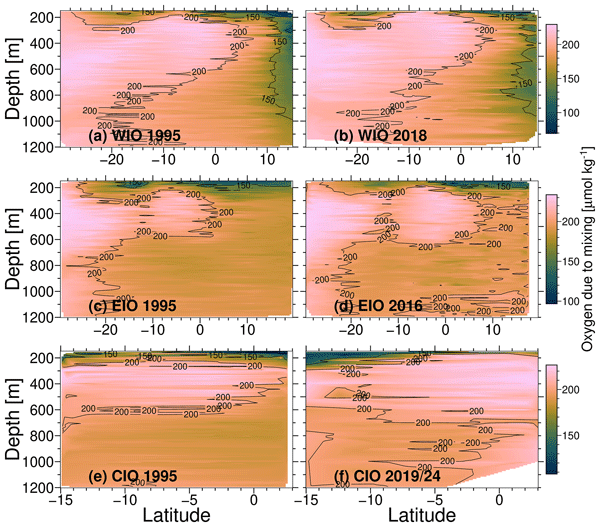
- The conclusions of this study about the water mass composition are impressive. However, the argumentation could be made more intuitive and compelling. I recommend that the authors include basic dissolved oxygen (DO) distribution maps in the revised manuscript. For instance, providing vertical section plots of DO concentration along key transects, comparing data from 1995 (or earlier) with recent years, would visually demonstrate the changes in oxygen content within the OMZ core and the migration of its boundaries. Furthermore, a direct comparison between the observed DO changes and the shifts in water mass composition identified by the eOMP analysis would significantly strengthen the paper. Correlating these spatial and temporal patterns would provide a clearer,more direct factual foundation for the subsequent complex mechanistic eOMP analysis, directly linking the physical oxygen supply to the documented oxygen changes.This would greatly enhance the clarity and persuasive power of the manuscript.
- About Figure 6: It is unclear how the observed dissolved oxygen changes shown in Figure 6 were calculated. If these values represent regional or OMZ-core averages, the corresponding spatial boundaries and averaging method should be clearly specified to ensure consistency with the oxygen supply estimates derived from the water mass analysis. Furthermore, the interpretation that the difference between mixing-derived oxygen supply changes and observed oxygen changes directly reflects variations in biological oxygen consumption requires further justification. In particular, this approach appears to implicitly assume that other processes affecting oxygen, such as local mixing or diffusive transport, remain unchanged or negligible. Please clarify and discuss the validity of this assumption.
Minor comments:
- Line 44: does not only affect -> not only affects.
- Line 60: are the semi-enclosed basins …-> are semi-enclosed basins …
- Lines 59-65: This paragraph suffers from major language issues and an unclear conceptual framework. The definitions of hypoxia and microbial hypoxia are currently confusing and partially incorrect, and the sentence “Hypoxia defines the oxygen threshold…”is grammatically incorrect. Please revise for both language and conceptual clarity.
- Line 68: Nevertheless, …-> In particular, …
- Line 75: OMZ -> OMZs
- Line 89: close link between …to …-> a close link between … with …
- In Figure 3, the seven bar charts have very similar visual appearance, while the panel sizes and alignment are inconsistent. A reorganization of the figure layout, along with clear indication of the study region in each subpanel, would substantially improve clarity.
Citation: https://doi.org/10.5194/egusphere-2025-4712-CC1 -
AC1: 'Reply on CC1', Eugene Oboh, 07 Jan 2026
Thanks, your suggestions will be considered in our revised manuscript.
Citation: https://doi.org/10.5194/egusphere-2025-4712-AC1 -
AC4: 'Reply on CC1', Eugene Oboh, 13 Feb 2026
1. Thanks for your comments, we have revised the manuscript title to reflect our findings:
“Recent changes in dissolved oxygen concentration in the Indian Ocean Oxygen Minimum Zones driven by reorganization of water masses”
2. Thanks for this suggestion about the abstract. We have streamlined the abstract in the revised manuscript to focus on main findings.
3. Thanks for your recommendation. We will be adding the suggested distribution maps.
4. Thank you for this comment about Figure 6, we have clarified the calculation and interpretation in the methods as well as in the Figure caption.
The measured oxygen values represent average dissolved oxygen within the OMZ core (O₂ < 20 µmol kg⁻¹) over the same depth ranges used in the eOMP analysis (Arabian Sea: 150–1000 m; Bay of Bengal: 150–800 m). These spatial boundaries and the averaging method are now explicitly stated to ensure consistency with the oxygen supply estimates.
Oxygen supplied by mixing is calculated from the eOMP-derived water-mass fractions and their source oxygen concentrations, averaged over the same OMZ volume. Biological oxygen consumption is then estimated as the difference between mixing-derived oxygen supply and measured oxygen, following standard eOMP practice. Local mixing and diffusive processes are implicitly included in the mixing term, while unresolved small-scale effects are assumed to be minor relative to the basin-wide changes observed.
MINOR COMMENTS AND RESPONSES (Comments in bold letters)
5. Line 44: does not only affect -> not only affects.
Changes implemented in the revised manuscript
- Line 60: are the semi-enclosed basins …-> are semi-enclosed basins …
Changes implemented in the revised manuscript
- Lines 59-65: This paragraph suffers from major language issues and an unclear conceptual framework. The definitions of hypoxia and microbial hypoxia are currently confusing and partially incorrect, and the sentence “Hypoxia defines the oxygen threshold…”is grammatically incorrect. Please revise for both language and conceptual clarity.
The paragraph has been revised to improve clarity.
- Line 68: Nevertheless, …-> In particular, …
Changes implemented in the revised manuscript
- Line 75: OMZ -> OMZs
Changes implemented in the revised manuscript
- Line 89: close link between …to …-> a close link between … with …
Changes implemented in the revised manuscript
- In Figure 3, the seven bar charts have very similar visual appearance, while the panel sizes and alignment are inconsistent. A reorganization of the figure layout, along with clear indication of the study region in each subpanel, would substantially improve clarity.
Thanks for your comment, the figure has been revised to improve clarity as suggested.
Citation: https://doi.org/10.5194/egusphere-2025-4712-AC4
-
RC2: 'Comment on egusphere-2025-4712', Anonymous Referee #2, 13 Jan 2026
General Assessment
The manuscript by Oboh et al. examines recent changes in dissolved oxygen in the northern Indian Ocean, with a focus on the Arabian Sea and Bay of Bengal Oxygen Minimum Zones (OMZs). Using hydrographic observations from GLODAPv2 (1995–2024), the authors apply an Extended Optimum Multiparameter (eOMP) analysis to investigate the drivers of reported oxygenation trends in the Arabian Sea and the apparent lack of deoxygenation in the Bay of Bengal. They attribute oxygenation at intermediate depths primarily to weakened local ventilation and a reduced contribution from the Indonesian Throughflow (ITF), accompanied by increased inflow of oxygen-rich waters from the Southern Indian Ocean.
While documenting recent changes in Indian Ocean OMZs is scientifically important, and the manuscript is generally well written, I have serious concerns regarding both the methodology and the interpretation of the results. In particular, the application of the eOMP framework relies on assumptions of stationarity in source water properties that are unlikely to hold over decadal timescales. Moreover, attributing differences between two temporal snapshots to long-term climate trends without explicitly accounting for natural decadal variability is problematic. Owing to these fundamental issues, I cannot recommend publication in Biogeosciences in its current form. My major concerns are detailed below.
Major Comment #1: Methodological limitations of eOMP analysis under non-stationary conditions
My primary concern relates to the application of the eOMP analysis and its suitability for diagnosing decadal oxygen changes using the available data. The authors define source water mass properties using World Ocean Atlas (WOA) climatologies, implicitly assuming that the biogeochemical properties (particularly dissolved oxygen) of these source waters remain constant over time. However, ventilation changes can manifest not only through variations in water mass fractions (mixing ratios), but also through temporal changes in the properties of the source waters themselves.
Dissolved oxygen concentrations in source waters can vary substantially on interannual to decadal timescales. If, for example, a source water mass such as the ITF becomes more oxygenated during the study period relative to its climatological definition, the OMP algorithm—constrained by mass conservation—may artificially reduce the estimated fraction of that water mass (or increase the contribution of a high-oxygen end-member such as mAABW) in order to satisfy the oxygen budget. This can lead to spurious attribution of changes in water mass contributions. The authors should explicitly test and demonstrate the robustness of their conclusions to plausible temporal variability in end-member properties.
Major Comment #2. Selection of source water masses and physical consistency
The selection of source water masses appears incomplete and, in some cases, physically inconsistent with the timescales considered. Key water masses known to ventilate the Indian Ocean thermocline and intermediate depths—such as Indian Central Water (ICW) and Subantarctic Mode Water (SAMW)—are not included in the analysis. Omitting these major ventilators may force the OMP solution to compensate by assigning unrealistic fractions to other water masses (e.g., STSW or mAABW), resulting in biased or physically implausible mixing ratios.
Attributing oxygenation of intermediate layers (upper ~1200 m) to Modified Antarctic Bottom Water (mAABW) is difficult to reconcile with physical constraints. Ventilation of OMZ cores by bottom waters originating at depths >3000 m within a ~20-year interval appears implausible.
The analysis compares two snapshots separated by approximately two decades. However, transit times for Southern Ocean-derived waters to reach the northern Indian Ocean via mean circulation are typically longer than this interval. It is therefore unclear how the reported changes between 1995 and 2018 can be attributed to remote Southern Ocean ventilation rather than to local or regional processes.
Major Comment #3. Distinction between decadal variability and long-term trends
The manuscript frequently interprets differences between the two analyzed periods as indicative of long-term climate trends. However, the analysis is based on comparisons between two discrete snapshots rather than continuous time series. Numerous studies (e.g., Long et al., 2016) have shown that internal climate variability can drive large-amplitude oxygen fluctuations that mask or even reverse long-term trends over multi-decadal timescales.
No justification is provided for assuming that the difference between the selected years represents a secular trend rather than a phase of natural variability. The discussion should explicitly address this limitation and more carefully distinguish between internal variability and forced trends.
Major Comment 4. Study objectives, scope, and presentation
The scope and objectives of the study require clearer definition. The title (“The Oxygen Minimum Zones…”) is overly broad and does not reflect the limited spatial and temporal scope of the analysis. The introduction should more clearly state whether the primary objective is to evaluate the eOMP methodology, document a specific observational change, or attribute long-term trends.
In addition, the eOMP methodology requires clearer documentation. The definition of properties A and B, the choice of weights (lines 255–258), and the selection of source water masses should be more thoroughly justified based on existing literature and physical constraints, including transport timescales. The spatial extents of the Arabian Sea (AS) and Bay of Bengal (BoB) OMZs, as well as the portions of the transects used to estimate OMZ oxygen budgets, should be explicitly indicated in Figure 2.
Some more specific comments
- P4, line 111:
Section 1.1 is awkwardly placed. Key background information on OMZs appears after the research questions are formulated. This material should be moved earlier in the Introduction and should not appear as a subsection. - P6, line 189:
The steady-state assumption underlying the eOMP method—that source water biogeochemical properties (oxygen, nutrients) do not change over time—should be explicitly discussed. How do the authors address the possibility that source water oxygen concentrations themselves are different between the two snapshots? - P11, line 310:
Water mass properties are derived from WOA climatologies. In several Indian Ocean source regions (e.g., the Red Sea and Persian Gulf), oxygen and nutrient observations are sparse or absent in WOD. Consequently, WOA values may be poorly constrained or extrapolated from nearby regions, which could strongly bias the analysis. This limitation must be discussed. - P12, Table 2:
Persian Gulf Water is known from local observations to be extremely oligotrophic. The nutrient concentrations assigned here are an order of magnitude higher than reported values, suggesting that what is referred to as PGW is mostly Arabian Sea waters. - P13, Table 3:
PGW and RSW properties appear to be estimated downstream within the Arabian Sea rather than at their formation or entry points, implying that these “water masses” are already mixtures. This should be discussed and the implications clarified.
Additionally, some water masses are defined using shallow layers (e.g., ASHSW, BOBW, STSW), while others are defined at depth. Since all water masses originate at the surface, a consistent approach should be adopted and justified. - Lines 373–375:
The phrase “similar climate anomalies” is unclear. The role of interannual and decadal variability between the two periods needs to be more explicitly examined or discussed. - P14, lines 385–387:
- While redefining water mass properties for different periods may account for warming, similar temporal changes likely affect oxygen and nutrient content as well.
- P18, line 501:
What are the expected ventilation timescales from the Southern Ocean (AAIW, mAABW)? Over a ~20-year period, the observed changes are more likely dominated by local ventilation and local biogeochemical processes. - P20, lines 540–541:
The study does not demonstrate trends over recent decades, but rather differences between two transects separated by two decades. Given strong interannual and decadal variability, conclusions about long-term trends are not supported.
Citation: https://doi.org/10.5194/egusphere-2025-4712-RC2 -
AC3: 'Reply on RC2', Eugene Oboh, 13 Feb 2026
Dear editor and reviewers,
First of all, thank you very much for your support and constructive comments on our manuscript. We respond to all comments below. However, there are some critical points that were raised by several reviewers. These relate to ambiguities in the a) selection and b) characterization of source water types, the c) robustness of our OMP analysis with regard to the oxygen and nutrient definition of source water types (SWTs), d) long-term changes and e) title of the manuscript. Furthermore, we were asked to follow a uniform and comprehensible approach to resolve these ambiguities.
Below, we respond to these overarching points and hope to thereby resolve the issues raised by the reviewers. This is followed by point-by-point responses.
a) Selection of source water types:
There are two main reasons for our decision to focus on the water masses that form near the surface of the Indian Ocean: 1. These water masses are essentially responsible for the ventilation of the OMZs, which takes place at depths between 100 and 1000 m. 2. These are the water masses that carry the influence of global warming on the properties of source water types into the depths of the ocean. The OMP analyses carried out with data from the same region but for different time periods can then in turn be used to estimate the influence of mixing on the development of the OMZ in response to global warming and its effects on circulation in the ocean.
The number of SWTs we considered was reduced to six by means of an exclusion process, as will be explained in more detail later, for methodological reasons, as suggested by reviewer 1. However, in addition to four water masses that outcrop at the surface in the Indian Ocean, the six water masses also include the Indonesian Throughflow water (ITFW) and modified Antarctic bottom water ( mAABW). These two water masses are exceptions in that they are not formed at the surface of the Indian Ocean but in the Indonesian Seas and the deep sea, respectively. Unlike reviewer 1, however, we also consider the Bay of Bengal water (BOBW) to be a source water formed at the surface of the Indian Ocean (Shetye et al., 1996). In any case, both the ITFW and the mAABW are important water masses for the ventilation of the OMZ in the Indian Ocean. We have therefore taken them into account and assumed that they influence the ventilation of the OMZ due to changing mixing ratios. We will explain these reasons for the selection of source water masses and the exclusion process in more detail in the revised manuscript to make our approach more comprehensible to readers.
b) Characterization of source water types
We have compiled the published properties of all SWTs relevant to the OMZ of the Indian Ocean in Table 1, which shows that there is no uniform definition of source water properties. This is due to the fact that the properties of the source water types were defined at different times in different locations (i.e., geographical region and water depth) and are based on different data sources. Taking these variabilities into account, we agree with the reviewer that a well-founded, systematic and, above all, comprehensible approach is necessary to achieve a consistent picture that enables us to compare different time periods. Critical elements brought up by the reviewer to achieve this, are 1) PGW and RSW defined downstream within the Arabian Sea rather than formation or entry point. 2) the selection of the database.
b.1) PGW and RSW defined downstream within the Arabian Sea
In defining source water properties, it is important to note that water masses are not exported to depth continuously from the surface, and therefore surface mean properties are often not representative of the water that ultimately ventilates the ocean interior. For this reason, source water types are commonly characterized just below the surface mixed layer, where waters begin their subsurface pathways. In the case of PGW and RSW, both the outcropping regions and the depths at which these waters descend vary spatially, and source properties are therefore typically defined at their entry into the subsurface Indian Ocean, rather than at their exact formation sites. We agree that Persian Gulf water (PGW) and Red Sea water (RSW) properties are defined downstream within the Arabian Sea rather than at their exact formation sites or entry point. According to the pathways described by Tchernia (1980), we have revised the definition regions for PGW and RSW to around the Oman slope and sill, respectively. These are the entry points into the Arabian Sea. The defined source water types represent slightly modified primary water masses. This choice is intentional as properties defined here therefore represent the ventilating PGW and RSW as they actually enter and influence the Arabian Sea OMZ. As a result, oxygen concentrations increase and nutrient concentrations decrease, i.e., water masses more closely resemble the properties of surface water, as suggested by the reviewers. We have revised the methods section of the manuscript to clarify source water types selection and definition.
b.2) Database
With regard to the database, we have chosen the World Ocean Atlas (WOA) because it is freely accessible and summarizes all available and quality-checked data that can be used to calculate the properties of water masses for specific regions and depth intervals. For temperatures and salinity, there are average values for different decades, so we have data available for the periods from 1995 to 2004 and from 2015 to 2022 with high density of observations in source regions according to WOA “number of observations” documentation.
c) Robustness of our OMP analysis
One major concern by the referee was the robustness of our eOMP solution to variability in oxygen and nutrient properties of the SWTs, since we assumed constant oxygen and nutrient values for 1995 and later years.
There are no decadal averages for oxygen and nutrients in the WOA database, as the data base is presumably insufficient. However, the distribution of nutrients is strongly influenced by the biological carbon pump, which ensures that nutrients that reach the euphotic zone are also exported again. As far as we know, there is no evidence to date that the carbon storage of the biological pump has changed, so we assume that also the nutrient concentration in the SWTs have not changed significantly between 1995 and 2016. This assumption is also based on the fact that the defined SWTs are not the product of mixtures of different water masses.
Unlike nutrient concentration, changes in oxygen concentration can be assumed, as the solubility of oxygen depends on temperature and salinity. We have now calculated the change in oxygen solubility based on WOA temperatures and salinity for the two selected decades, the difference was added and subtracted from the oxygen concentration that we calculated from WOA data and we used the resulting oxygen values for each source water type to test the robustness of the eOMP solution to increase or decrease in oxygen values of SWTs in the later years, as explained later. The oxygen variability test confirms the robustness of our eOMP solution and conclusions. This is not perfect, but in our opinion, it is a comprehensible approach that represents the influence of warming on oxygen concentration in a representative manner. Additionally, the changes to the definition of source water types proposed by the reviewers have had only minor effect on the results, which is a clear indication of the robustness of our OMP analysis.
d) Long-term trends versus snapshots at different points in time
In the manuscript, we do indeed refer to long-term trends, but we compared two periods (1995 and 2016/2018) with each other. We agree with the reviewers that such a comparison does not indicate a trend. However, the evaluation of the literature, in line with our previous results, clearly shows that the OMZ was in a phase of expansion in 1995 (Banse et al., 2014; Rixen et al., 2014, 2020; Goes et al., 2020). Argo float data show now that the OMZ in the Arabian Sea has been shrinking massively since around 2013 (Liu et al., 2024). The GLODAP database enables us to conduct OMP analysis for the years 1995 and 2016, representing periods of OMZ expansion and shrinking in the Arabian Sea..
Furthermore, the compared periods do not represent persistently opposite or extreme ENSO or IOD phases, but rather a mixture of weak, moderate, and neutral conditions, suggesting that pronounced climate anomalies are of little significance for the differences observed. Differences between 1995 and 2016 thus allow conclusions to be drawn about processes that could explain a phase transition from expansion to contraction of OMZs. We have also included a paragraph in the discussion section to clarify the influence of interannual and decadal variability. Our conclusion that underlying processes is a zonal circulation that weakens in favor of a meridional circulation, are also largely consistent with model results (Ditkovsky et al., 2023), which reinforces confidence in OMP and the models. However, we can just conclude that such a transition seems to have occurred and not that this is a trend which would point to an increasing contraction in future. We will express this clearer in the revised versions of the manuscript.
e) Title
As suggested by the reviewers we have revised the title of the manuscript to reflect the new contributions of the article to: “Recent changes in dissolved oxygen concentration in the Indian Ocean Oxygen Minimum Zones driven by reorganization of water masses”
We hope that this has addressed the main points of criticism raised by the reviewers.
Please find below the point-by-point response.
POINT-BY-POINT RESPONSE
1. RESPONSE TO MAJOR COMMENT #1. METHODOLOGICAL LIMITATIONS OF eOMP ANALYSIS UNDER NON-STATIONARY CONDITIONS:
In addition to our explanation in the above (refer to summary above), our analysis already considered changes in temperature of Source Water Types (SWTs) which accounts for global warming. We have gone further to consider possible changes in oxygen caused by temperature changes based on oxygen solubility.
We performed oxygen variability test, using higher and lower oxygen scenarios. The result from this test agrees with our conclusions. Below is a paragraph that describes the variability test and the paragraph has been added to methods section in the revised manuscript.
“We performed oxygen variability test to demonstrate the robustness of our eOMP result to expected temporal variability in SWT properties. Oxygen saturation was calculated from temperature and salinity of each SWT using the formulation of Benson and Krause (1984) and converted from µmol L⁻¹ to µmol kg⁻¹ using seawater density derived from the UNESCO equation of state at atmospheric pressure. Differences in oxygen saturation between 1995 and 2018 were interpreted as oxygen change. The calculated oxygen change was added and subtracted from the 1995 oxygen values to derive a higher oxygen and lower oxygen scenarios respectively for each SWT. We performed the eOMP analysis oxygen variability test using the higher oxygen and lower oxygen scenarios. The resulting variations in derived SWT fractions and oxygen supply due to mixing were not significantly different from the constant state oxygen scenario”In conclusion our findings remain valid as results from the variability test do not alter the direction or significance of our main findings ((i.e., the enhanced contribution of oxygen-rich southern water masses and the concurrent reduction of local/equatorial water masses).
Furthermore, while we agree that dissolved oxygen can exhibit significant temporal variability, in addition to previous explanation, large-scale changes in nutrient concentrations of source water types are not expected to be smaller over the considered timescale. Nutrient distributions in the ocean interior are primarily controlled by long-term biological remineralization and large-scale circulation, processes that typically operate on centennial to millennial timescales (Broecker & Peng, 1982; Sarmiento & Gruber, 2006). The mean sequestration times in the Indian and Pacific Ocean basins are relatively uniform at 100–200 years, with longer sequestration times associated with areas of sub-tropical mode water formation and the poorly-ventilated shadow zone in the Arabian Sea (DeVries et al., 2012). We therefore assume a constant nutrient state in our analysis.
2. RESPONSE TO MAJOR COMMENT #2. SELECTION OF SOURCE WATER MASSES AND PHYSICAL CONSISTENCY:
Our selection of source water types (SWTs) was intentional and designed to focus on primary source water types (i.e SWTs that are weakly modified by mixing) and therefore better account for temperature change due to global warming, rather than secondary mixtures such as ICW and SAMW.
Although ICW and SAMW are not explicitly included, their influence is fully represented through their primary source components i.e., the Subtropical Surface Water (STSW) and Antarctic Intermediate Water (AAIW). These water masses together form the ventilating branches of the Indian Central and Subantarctic Mode Waters (Tomczak & Large, 1989; You, 1998; Schott & McCreary, 2001; Sokolov & Rintoul, 2002; Vianello et al., 2017). Therefore, including both the ICW and the SAMW separately would probably introduce redundancy and potentially destabilize the eOMP solution.
In our study, the Modified Antarctic Bottom Water (mAABW) does not indicate that new deep bottom water is directly reaching the OMZ cores. Instead, it acts as a tracer showing the growing influence of deep southern-origin waters in the Indian Ocean. This pattern agrees with recent studies showing a weaker Indonesian Throughflow (ITF) and a stronger transport of southern-sourced water toward the north (Ditkovsky et al. 2023).
Although Southern Ocean waters have long transit times, the observed changes could reflect redistribution of existing southern-origin waters within the Indian Ocean driven by circulation changes, rather than solely the arrival of new deep waters.This interpretation fits well with both model results and observations (P. Vallivattathillam et al. 2023, Liu et al. 2024) and is further supported by the low residuals in our eOMP analysis, which indicate a stable and realistic solution.
We have included the text below in the method section of the revised manuscript to improve the clarity:
“Our selection of source water types (SWTs) designed to focus on primary source water types rather than secondary mixtures such as Indian Central Water (ICW) and Subantarctic Mode Water (SAMW). Although ICW and SAMW are not explicitly included, their influence is fully represented through their parent source components i.e., the Subtropical Surface Water (STSW) and Antarctic Intermediate Water (AAIW). These water masses together form the ventilating branches of the Indian Central and Subantarctic Mode Waters (Tomczak & Large, 1989; You, 1998; Schott & McCreary, 2001; Sokolov & Rintoul, 2002; Vianello et al., 2017). Therefore, including both ICW and SAMW separately, would probably introduce redundancy and potentially destabilize the eOMP solution. This approach allows us to capture the key source water types with outcropping history, making them better suited for tracking temperature changes associated with global warming and for assessing their influence on the Indian Ocean and its OMZs”.
3. RESPONSE TO MAJOR COMMENT #3, DISTINCTION BETWEEN DECADAL VARIABILITY AND LONG-TERM TRENDS:
We agree that comparisons between discrete periods must be interpreted with caution, particularly in a system where internal climate variability can generate oxygen fluctuations on interannual to multi-decadal timescales, however, as earlier discussed in the summary (kindly refer to summary above), several lines of evidence suggest that the observed differences between the analyzed periods likely reflect a longer-term shift in the mean state rather than short-lived variability.
We emphasized that the long-term trend is only suggestive based on the available data and included a paragraph in this regard in the limitation section of the revised manuscript. We have also included a paragraph in the discussion section to clarify the influence of interannual and decadal variability.
4. RESPONSE TO MAJOR COMMENT #4, STUDY OBJECTIVES, SCOPE AND PRESENTATION:
Thank you for the constructive comments, we have revised the manuscript to clearly defined the scope and objectives and primary objective of the study in the last paragraph of the introduction. Secondly, we agree that the original title give the impression of a broad review rather than a focused research article. To address this, we have revised the title to:
“Recent changes in dissolved oxygen concentration in the Indian Ocean Oxygen Minimum Zones driven by reorganization of water masses”
The description of the eOMP method has been expanded and clarified. We now explicitly define properties A and B as oxygen and nutrient tracers used to represent remineralization processes. The choice of parameter weights has been more thoroughly justified with reference to prior applications in the Arabian Sea and Indian Ocean (e.g., Acharya and Panigrahi, 2016). Additional explanation/justification has been added on the selection of source water types.
The spatial extents of the Arabian Sea (AS) and Bay of Bengal (BoB) OMZs, as well as the portions of the transects used to estimate OMZ oxygen budgets has been indicated using Figure 2.
RESPONSE TO SPECIFIC COMMENT
5. RESPONSE TO SPECIFIC COMMENT P4, LINE 111:
We appreciate the referee’s comment on the placement of Section 1.1. and will redesign the text accordingly.
6. RESPONSE TO SPECIFIC COMMENT P6, LINE 189:
As earlier discussed in response to major comment #1, we performed oxygen variability test, using higher and lower oxygen scenarios. Our conclusions remain valid. We would revise the text to ensure consistency.
7. RESPONSE TO SPECIFIC COMMENT P11, LINE 310:
To defined the source water types, we used the World Ocean Atlas (WOA) annual statistical mean data, which represent average of all unflagged interpolated values at each standard depth level for each variable in each ¼° or 1° square which contains at least one measurement for the given oceanographic variable, this often offers higher accuracy and reliability compared to extrapolated data.
We agree that oxygen and nutrient data in some Indian Ocean source regions, particularly the Red Sea and Persian Gulf, are sparse /missing in the WOA Database. However, further analysis of WOA “number of observations” data shows high density of observations in the region where PGW and RSW were defined, as well as other source water types.
We have included the text below in the methods section of the revised manuscript to clarify our methods.
“Water-mass properties were derived from World Ocean Atlas (WOA) annual statistical mean, represent average of all unflagged interpolated values at each standard depth level for each variable in each ¼° or 1° square which contains at least one measurement for the given oceanographic variable. We acknowledge that data interpolation can add some uncertainty. However, analysis of WOA “numbers of observation” dataset shows high density of observations in regions where the SWTs were defined.”
8. RESPONSE TO SPECIFIC COMMENT P12, TABLE 2:
We agree that the PGW used in the original analysis represents a higher nutrient form of PGW because it was calculated closer to the Arabian Sea. We have revised the definition of PGW parameters to better reflect outflow properties. We re-defined the properties of PGW using the World Ocean Atlas (WOA) data around the Oman slope at depth between 100-300m, latitude between 23.6 -27.1°N and longitude 55.5 -57.5°E according to the PGW pathway described by Tchernia (1980). Defining the properties around this region helps us capture climate driven changes in the source region and outflow properties as observed in the increase in temperature value. Defining PGW properties closer to their entry regions therefore provides a more realistic representation of the oxygen and nutrient characteristics that actually ventilate the Indian Ocean/OMZs. (We have updated Table 2 accordingly.). Kindly refer to summary above on characterization of source water types.
9. RESPONSE TO SPECIFIC COMMENT P13, TABLE 3:
As earlier discussed in the summary above, we have adjusted the region where RSW and PGW were defined. The defined source water types represent slightly modified primary water masses. This choice is intentional as properties defined here therefore represent the ventilating PGW and RSW as they actually enter and influence the Arabian Sea OMZ. We have revised the methods section of the manuscript to clarify source water types selection and definition.
We also agree some SWT definitions were too shallow, we have therefore revised the definitions of Arabian Sea High Salinity Water (ASHSW), Subtropical Surface Water (STSW) and Bay of Bengal Water (BoBW) based on existing literatures. Table 3 has been adjusted likewise.
10. RESPONSE TO SPECIFIC COMMENT LINES 373–375:
We thank the referee for pointing out this ambiguity. We agree that the phrase “similar climate anomalies” was unclear. In the revised manuscript, we now explicitly discuss the role of inter-annual and decadal variability between the two periods, with specific reference to ENSO and Indian Ocean Dipole (IOD) events.
11. RESPONSE TO SPECIFIC COMMENT P14, LINES 385–387:
As earlier discussed in response to major comment #1, we performed oxygen variability test, using higher and lower oxygen scenarios and our conclusions remain valid. With respect to nutrients, changes are likely to be much smaller over the considered timescale as also explained earlier.
12. RESPONSE TO SPECIFIC COMMENT P18, LINE 501:
Our results reflect the relative contribution of sourced waters in the Indian Ocean interior as they were in 1995 and ~2016. Changes of the relative contribution of sourced waters have been derived by comparing the results from 1995 and ~2016. Our explanation of these changes refers - as indicated by the reviewer - first of all on processes in upper ocean: an enhanced inflow of STSW balancing the reduced contribution by the Indonesian Throughflow, PGW etc. The enhance contribution of deep water would primarily be seen as a consequence of the redistribution of water masses in the upper part of the water column. We will describe this better in the revised manuscript.
13. RESPONSE TO SPECIFIC COMMENT P20, LINES 501–541:
We agree that comparisons between discrete periods does not indicate a trend, However, as previously explained in the response summary (refer to summary above), Several lines of evidence suggest that the observed differences between the analyzed periods likely reflect a longer-term shift in the mean state rather than short-lived variability.
We have revised the paragraph in line 540-541 as well as other areas of the manuscript to emphasize the suggestive nature of the long-term trend and included the text below in the Limitation section of the revised manuscript.
“This study is based on comparisons between discrete observational periods rather than a continuous time series, which limits the ability to formally quantify trends. Nevertheless, the data analyzed represents opposite trend in the OMZ development and our results align with independent observational and modeling studies, thus suggesting that they reflect a longer-term shift in the mean state rather than short-term variability.”
Citation: https://doi.org/10.5194/egusphere-2025-4712-AC3
- P4, line 111:
Peer review completion


Interactive discussion
Status: closed
-
RC1: 'Comment on egusphere-2025-4712', Anonymous Referee #1, 15 Dec 2025
Review of manuscript egusphere-2025-4712 by Oboh et al., “The Oxygen Minimum Zones (OMZs) in the Indian Ocean”
This is my first review of the manuscript “The Oxygen Minimum Zones (OMZs) in the Indian Ocean”. The manuscript analyses shipboard transects from 1995 and 2018, along with available observation-based products, to assess recent changes in the Northern Indian Ocean OMZs. The study is a topical analysis of available datasets and aims to address gaps in the literature regarding recent variability in OMZ extent. However, I have several concerns about the implementation of the methodology, interpretation of the results, and presentation of the manuscript. The study requires major revisions before being considered for publication. I outline my major points of concern below.
Methodology:
- Perhaps my biggest concern is with the implementation of the eOMP method. In this study, the authors define 9 unknowns (8 source water types plus remineralization). This requires at least ten constraints for an “optimum” multiparameter analysis or nine constraints for a simple determined set of equations. What are these constraints? I can only count 6 unique constraints – temperature, salinity, oxygen, phosphate, nitrate, and mass.
- The definition used for PGW in this study, which here has an oxygen concentration of 15.64 umol/kg, is misleading. PGW is generally considered to be oxygen saturated, and gets quickly diluted once it enters the Arabian sea (e.g. Font et al., 2024, JGR:Oceans). The definition here is thus of highly diluted PGW, which is essentially just the AS OMZ water (i.e. the water mass being evaluated). This is why PGW is so prevalent in Figure 3a. The definition of PGW here will make it difficult to connect changes in the source water fraction to changes in the actual PG outflow rates or properties.
Interpretation:
- A recurring point in the manuscript is that this study differs from past studies because it focuses on “surface-originated water masses”. This is quite misleading. First of all, some of the source water types are not really surface-originated at all, like ITFW or BoBW. But more importantly, for the source waters which do outcrop, the corresponding source water types are not defined at those outcrops. Rather, they are defined in regions where those waters enter the Indian Ocean (Table 3), after they have already experienced significant water mass transformation. So, changes in those defined source water types do not necessarily reflect changes in the formation rates/conditions of those water masses. This is especially evident in the oxygen properties used for the source water types (would be nearly saturated at formation for many of the source water types).
- The study is inferring climate-driven changes by comparing transects in 1995 and 2018, each providing a snapshot within a single year. The influence of interannual and decadal variability has to be discussed at some point in the manuscript. Limitations of the methodology in general need to be more clearly addressed.
Presentation:
- The manuscript needs to be structured and presented as a research article, starting with the title. The title suggests that the article is a discursive piece, or even a review, which is misleading. Plenty of literature already exists on OMZs in the Indian Ocean and the purpose of this article is not to be a comprehensive resource (like a textbook or an article like Schott and McCreary, 2001). Please choose a title that highlights the new contribution of the article. Confusion about the article’s identity is also evident throughout the introduction. For example, Section 1.1 provides far too much information that is not relevant for the reader to understand the results of this study. Don’t be afraid to rely on existing literature to provide a comprehensive reference so that you can focus on details that the reader needs to understand the present results.
- Please separate results and discussion. As it is written, it is unclear what conclusions are drawn from the presented results and what conclusions are drawn from the literature. For example, Section 3.2 discusses connections to the literature but do not present any new results. While Figures 4 and 5 are technically presented in this section, they are not explained or analysed and their connection to the points discussed are unclear.
- In the manuscript, only Figures 3 and 6 are explained as results in any meaningful way. For figures 4, 5 and 7, either make them supplementary or actually explain them and how you interpret them.
Other points:
- I would suggest using more specific language than “water masses” throughout. In the manuscript, water masses refer to both the source waters and the destination waters and it can get quite confusing. I would recommend using the conventional term of “source water types” or something like that.
- Equation 4: How does this compare to the remineralization term calculated within the eOMP which tracks the conversion from oxygen to phosphate? And why is the oxygen residual added here. Should it instead be set aside as an uncertainty bound?
- Add reference for Figure 1. Maybe use this figure to highlight your source water types and the pathways that they take to the OMZs. Help guide the reader, they are reading to understand the new result that you are contributing.
- Line 668: "...increased physical oxygen supply via the inflow of oxygen-rich water masses from the southern Indian Ocean is able to compensate for the increased biological oxygen consumption." Careful when discussing the opposing roles of physical supply and biological consumption. It's likely that increased biological consumption is simply a response to increased physical supply or vice versa.
- Line 680: "The current changes indicate the presence of a longer time-scale cycle in the Indian Ocean OMZs which aligns with paleoceanographic archives, however, this cycle seem to be reversing…” The connections to paleoceanographic signals come off as very speculative and unsubstantiated. Separation of results and discussion is crucial here to make this thought process more clear.
Citation: https://doi.org/10.5194/egusphere-2025-4712-RC1 -
AC2: 'Reply on RC1', Eugene Oboh, 13 Feb 2026
Dear editor and reviewers,
First of all, thank you very much for your support and constructive comments on our manuscript. We respond to all comments below. However, there are some critical points that were raised by several reviewers. These relate to ambiguities in the a) selection and b) characterization of source water types, the c) robustness of our OMP analysis with regard to the oxygen and nutrient definition of source water types (SWTs), d) long-term changes and e) title of the manuscript. Furthermore, we were asked to follow a uniform and comprehensible approach to resolve these ambiguities.
Below, we respond to these overarching points and hope to thereby resolve the issues raised by the reviewers. This is followed by point-by-point responses.
a) Selection of source water types:
There are two main reasons for our decision to focus on the water masses that form near the surface of the Indian Ocean: 1. These water masses are essentially responsible for the ventilation of the OMZs, which takes place at depths between 100 and 1000 m. 2. These are the water masses that carry the influence of global warming on the properties of source water types into the depths of the ocean. The OMP analyses carried out with data from the same region but for different time periods can then in turn be used to estimate the influence of mixing on the development of the OMZ in response to global warming and its effects on circulation in the ocean.
The number of SWTs we considered was reduced to six by means of an exclusion process, as will be explained in more detail later, for methodological reasons, as suggested by reviewer 1. However, in addition to four water masses that outcrop at the surface in the Indian Ocean, the six water masses also include the Indonesian Throughflow water (ITFW) and modified Antarctic bottom water ( mAABW). These two water masses are exceptions in that they are not formed at the surface of the Indian Ocean but in the Indonesian Seas and the deep sea, respectively. Unlike reviewer 1, however, we also consider the Bay of Bengal water (BOBW) to be a source water formed at the surface of the Indian Ocean (Shetye et al., 1996). In any case, both the ITFW and the mAABW are important water masses for the ventilation of the OMZ in the Indian Ocean. We have therefore taken them into account and assumed that they influence the ventilation of the OMZ due to changing mixing ratios. We will explain these reasons for the selection of source water masses and the exclusion process in more detail in the revised manuscript to make our approach more comprehensible to readers.
b) Characterization of source water types
We have compiled the published properties of all SWTs relevant to the OMZ of the Indian Ocean in Table 1, which shows that there is no uniform definition of source water properties. This is due to the fact that the properties of the source water types were defined at different times in different locations (i.e., geographical region and water depth) and are based on different data sources. Taking these variabilities into account, we agree with the reviewer that a well-founded, systematic and, above all, comprehensible approach is necessary to achieve a consistent picture that enables us to compare different time periods. Critical elements brought up by the reviewer to achieve this, are 1) PGW and RSW defined downstream within the Arabian Sea rather than formation or entry point. 2) the selection of the database.
b.1) PGW and RSW defined downstream within the Arabian Sea
In defining source water properties, it is important to note that water masses are not exported to depth continuously from the surface, and therefore surface mean properties are often not representative of the water that ultimately ventilates the ocean interior. For this reason, source water types are commonly characterized just below the surface mixed layer, where waters begin their subsurface pathways. In the case of PGW and RSW, both the outcropping regions and the depths at which these waters descend vary spatially, and source properties are therefore typically defined at their entry into the subsurface Indian Ocean, rather than at their exact formation sites. We agree that Persian Gulf water (PGW) and Red Sea water (RSW) properties are defined downstream within the Arabian Sea rather than at their exact formation sites or entry point. According to the pathways described by Tchernia (1980), we have revised the definition regions for PGW and RSW to around the Oman slope and sill, respectively. These are the entry points into the Arabian Sea. The defined source water types represent slightly modified primary water masses. This choice is intentional as properties defined here therefore represent the ventilating PGW and RSW as they actually enter and influence the Arabian Sea OMZ. As a result, oxygen concentrations increase and nutrient concentrations decrease, i.e., water masses more closely resemble the properties of surface water, as suggested by the reviewers. We have revised the methods section of the manuscript to clarify source water types selection and definition.
b.2) Database
With regard to the database, we have chosen the World Ocean Atlas (WOA) because it is freely accessible and summarizes all available and quality-checked data that can be used to calculate the properties of water masses for specific regions and depth intervals. For temperatures and salinity, there are average values for different decades, so we have data available for the periods from 1995 to 2004 and from 2015 to 2022 with high density of observations in source regions according to WOA “number of observations” documentation.
c) Robustness of our OMP analysis
One major concern by the referee was the robustness of our eOMP solution to variability in oxygen and nutrient properties of the SWTs, since we assumed constant oxygen and nutrient values for 1995 and later years.
There are no decadal averages for oxygen and nutrients in the WOA database, as the data base is presumably insufficient. However, the distribution of nutrients is strongly influenced by the biological carbon pump, which ensures that nutrients that reach the euphotic zone are also exported again. As far as we know, there is no evidence to date that the carbon storage of the biological pump has changed, so we assume that also the nutrient concentration in the SWTs have not changed significantly between 1995 and 2016. This assumption is also based on the fact that the defined SWTs are not the product of mixtures of different water masses.
Unlike nutrient concentration, changes in oxygen concentration can be assumed, as the solubility of oxygen depends on temperature and salinity. We have now calculated the change in oxygen solubility based on WOA temperatures and salinity for the two selected decades, the difference was added and subtracted from the oxygen concentration that we calculated from WOA data and we used the resulting oxygen values for each source water type to test the robustness of the eOMP solution to increase or decrease in oxygen values of SWTs in the later years, as explained later. The oxygen variability test confirms the robustness of our eOMP solution and conclusions. This is not perfect, but in our opinion, it is a comprehensible approach that represents the influence of warming on oxygen concentration in a representative manner. Additionally, the changes to the definition of source water types proposed by the reviewers have had only minor effect on the results, which is a clear indication of the robustness of our OMP analysis.
d) Long-term trends versus snapshots at different points in time
In the manuscript, we do indeed refer to long-term trends, but we compared two periods (1995 and 2016/2018) with each other. We agree with the reviewers that such a comparison does not indicate a trend. However, the evaluation of the literature, in line with our previous results, clearly shows that the OMZ was in a phase of expansion in 1995 (Banse et al., 2014; Rixen et al., 2014, 2020; Goes et al., 2020). Argo float data show now that the OMZ in the Arabian Sea has been shrinking massively since around 2013 (Liu et al., 2024). The GLODAP database enables us to conduct OMP analysis for the years 1995 and 2016, representing periods of OMZ expansion and shrinking in the Arabian Sea..
Furthermore, the compared periods do not represent persistently opposite or extreme ENSO or IOD phases, but rather a mixture of weak, moderate, and neutral conditions, suggesting that pronounced climate anomalies are of little significance for the differences observed. Differences between 1995 and 2016 thus allow conclusions to be drawn about processes that could explain a phase transition from expansion to contraction of OMZs. We have also included a paragraph in the discussion section to clarify the influence of interannual and decadal variability. Our conclusion that underlying processes is a zonal circulation that weakens in favor of a meridional circulation, are also largely consistent with model results (Ditkovsky et al., 2023), which reinforces confidence in OMP and the models. However, we can just conclude that such a transition seems to have occurred and not that this is a trend which would point to an increasing contraction in future. We will express this clearer in the revised versions of the manuscript.
e) Title
As suggested by the reviewers we have revised the title of the manuscript to reflect the new contributions of the article to: “Recent changes in dissolved oxygen concentration in the Indian Ocean Oxygen Minimum Zones driven by reorganization of water masses”
We hope that this has addressed the main points of criticism raised by the reviewers.
Please find below the point-by-point response.
POINT-BY-POINT RESPONSE
1. COMMENTS ON eOMP METHOD:
Thank you for this constructive comment. Regarding the formulation of the eOMP analysis. We agree that, as originally presented, the inclusion of 8 source water types (SWTs) plus a remineralization term leads to an underdetermined system when constrains are only 6 (temperature, salinity, oxygen, phosphate, nitrate, and mass).
To address this concern and ensure a determined set of equation, we have added a new constraint (silicate) and methodologically reduced the SWTs to 6. This brings the number of unknown to 7 and number of constraints to 7.In the paragraph text below we explained the procedure used to reduce the SWTs, we have added this paragraph to the method section of the revised manuscript:
“We performed a preliminary underdetermined eOMP analysis using the entire (8) SWTs. Thereafter, we separated the SWTs into major SWTs (PGW, STSW, mAABW, ITFW) and minor SWTs (AAIW, ASHSW, RSW and BoBW) based on their contributions in the Arabian Sea OMZ. Then, we performed 4 sets of overdetermined eOMP analysis using 5 SWTs and 7 constraints (temperature, salinity, oxygen, phosphate, nitrate, silicate and mass). The 5 SWTs included 4 constant major SWTs plus 1 minor SWTs at a time. Using this method, we identify PGW, RSW, STSW, mAABW and ITFW as the major contributors to the OMZ with the least residuals, and the combination of PGW, RSW, STSW, mAABW, ITFW and AAIW as the major contributors in the entire western Indian Ocean transect with the least residuals (see figures in supplementary document). Since these six SWTs resulted in even smaller residuals in the Eastern Indian Ocean transect, we used them in the final eOMP analysis.”
2. COMMENT ON DEFINITION OF PGW:
We earlier explained (kindly refer to the summary above) that we agree that the PGW used in the original analysis represents a higher nutrient form of PGW because its properties were defined closer to the Arabian Sea. We have revised the definition of PGW parameters to better reflect outflow properties. We re-defined the properties of PGW using the World Ocean Atlas (WOA) data around the Oman slope at depth between 100-300m, latitude between 23.6 -27.1°N and longitude 55.5 -57.5°E according to the PGW pathway described by Tchernia (1980). Defining the properties around this region helps us capture climate driven changes in the source region and outflow properties as observed in the increase in temperature value. Defining PGW properties closer to their entry regions therefore provides a more realistic representation of the oxygen and nutrient characteristics that actually ventilate the Indian Ocean/OMZs.
3. COMMENTS ON SURFACE ORIGINATED WATER MASSES:
As earlier explained (kindly refer to summary above), the major aim of selecting our source water types was to take the effects of global warming into account.
We intentionally defined Source water type (SWT) properties at the regions where these waters enter and influence the Indian Ocean/OMZs, rather than at their distant outcrop or formation sites. For SWTs formed within the Indian Ocean, Arabian Sea and Bay of Bengal (e.g., STSW, ASHSW, BoBW), we defined their properties from the WOA data based on formation region and pathways described in literature. SWTs whose outcrop region/formation sites are not within the Indian Ocean (i.e., PGW, RSW, mAABW, ITFW), were defined in regions where there enter into the Indian Ocean/Arabian Sea based on their pathways described in literature. We agree that SWTs are much more oxygen saturated at their outcrop region, however, defining SWT properties closer to their entry regions therefore provides a more realistic representation of the oxygen and nutrient characteristics that actually ventilate the Indian Ocean/OMZs.
Our approach is consistent with previous Indian Ocean OMP and water-mass studies, which commonly define water masses within the basin or at entry points, rather than strictly at outcrop locations (e.g., Tomczak & Large, 1989; You, 1998; Hupe & Karstensen, 2000; Acharya & Panigrahi, 2016). These studies similarly show that water masses experience substantial modification between formation and ventilation of the northern Indian Ocean, particularly with respect to oxygen concentration of SWTs. Furthermore, our defined SWT properties is quite similar to the values in literature when you compare Table 1 and 2.In the revised manuscript, we have replaced this term “surface-originated water masses” with “primary source water type” the meaning of this term has also been defined within the manuscript (i.e., source water types which have not undergone rigorous mixing) and are distinct from secondary mixtures such as Arabian Sea Water (ASW) which is a strong mixture of Red Sea Water (RSW) and Persian Gulf Water (PGW), or Indian Central Water (ICW), which is a mixture of Antarctic Intermediate Water (AAIW) and Subtropical Surface Water (STSW). For example, we defined the PGW and RSW around the slope of Oman and around the sill respectively, where they have not undergone much mixing within the Arabian Sea, we also defined STSW around the formation region and AAIW around the entrance region into the Indian Ocean.
4. COMMENTS ON INFERRED CLIMATE-DRIVEN CHANGES AND VARIABILITY:
As explained earlier (kindly refer to summary above) evidence suggests that the observed differences between the analyzed periods likely reflect a longer-term shift in the mean state rather than short-lived variability. The compared periods do not represent persistently opposite or extreme ENSO or IOD phases, but rather a mix of weak, moderate, and neutral conditions, suggesting that the observed changes reflect longer-term circulation variability rather than short-lived climate events. According to the Japan Meteorological Agency (JMA) IOD and ENSO events record (https://ds.data.jma.go.jp/tcc/tcc/products/elnino/iodevents.html), the year 1995 coincided with a negative IOD event, occurring alongside a developing La Niña in autumn, conditions that can influence regional circulation and productivity but were limited in duration. The later period exhibits greater variability: 2016 followed the strong 2015 El Niño and was associated with a negative IOD, with neutral ENSO conditions, while 2017 experienced a weak positive IOD under neutral ENSO conditions. In 2018, a weak positive IOD occurred from summer to autumn concurrently with a weak El Niño. Overall, this sequence reflects alternating and moderate ENSO–IOD states rather than a persistent bias toward either extreme phase. Consequently, the observed changes in dissolved oxygen and water mass composition are unlikely to be driven by individual ENSO or IOD events alone, but instead point to circulation changes and basin-scale reorganization as the dominant controls on recent OMZ variability.
We have also discussed the influence of inter-annual and decadal variability in the revised manuscript and included a limitation section, to discuss limitations of the methodology.5. COMMENTS ON STRUCTURE, PRESENTATION AND TITLE:
We agree that the original title and parts of the Introduction could give the impression of a broad review rather than a focused research article. To address this, we have revised the Introduction and the Study area to be more precise and change the title to:
“Recent changes in dissolved oxygen concentration in the Indian Ocean Oxygen Minimum Zones driven by reorganization of water masses”6. COMMENTS ON SEPARATING RESULTS AND DISCUSSION:
We have revised the manuscript by separating the 'Results' and 'Discussion' sections, with the aim of clarifying the conclusions.
7. COMMENTS ON MANUSCRIPT FIGURES:
We have included more lines of discussion for figure 4 and 5 while figure 7 would be moved to the supplementary figures.
OTHER POINTS
8. SUGGESTION ON USING SOURCE WATER TYPES:
Thank you for this suggestion, we have adopted the term “source water types” for source waters across the manuscript.
9. COMMENTS ON EQUATION 4:
Equation 4 : oxygen consumption = measured oxygen – oxygen supply + oxygen residual
This equation represents biological oxygen consumption due to remineralization, and it is exactly equal to the remineralization term calculated within the eOMP framework which can be retrieved with the equation below:
oxygen consumption2 = -155*1 * phosphate remin.
-155*1 is the conversion ratio of oxygen/phosphate
And phosphate remin. is the phosphate remineralization values from the eOMP solution.
Both equations give exactly the same value for oxygen consumption, we have included the residual in equation 4 for this reason to make it equal to the term calculated using phosphate remineralization. The difference however without the residual is very small and negligible.10. ADDING REFERENCE TO FIGURE 1:
We have added a reference to Figure 1. And highlighted the region where the source water types were measured in this figure as well.
11. COMMENTS ON LINE 668:
What we intend to imply is that despite increased oxygen consumption, there is an overall increase in dissolved oxygen. We have revised the section of the manuscript to read as follows:
“…the enhanced inflow of oxygen-rich southern waters increases physical oxygen supply. Although this is accompanied by higher biological oxygen consumption, the net result is an overall increase in dissolved oxygen...”12. COMMENTS ON LINE 680:
We have separated the results and discussion sections and emphasized the speculative nature of our connection. The text has been revised as follows:
“While the present analysis cannot resolve multi-centennial variability, the observed changes are conceptually consistent with paleo and historical evidence for long-term variability in Indian Ocean OMZ intensity. Importantly, our study compares two periods (1995 and 2016/2018) in which the AS OMZ expanded and contracted as discussed earlier. By comparing these contrasting periods, our analysis provides insight into how a phase transition in OMZ behavior may have occurred. The current reversal is driven by circulation reorganization rather than sea-level or glacial forcing, indicating that the present phase transition operates under a different climatic background than in the past.”Citation: https://doi.org/10.5194/egusphere-2025-4712-AC2
-
CC1: 'Comment on egusphere-2025-4712', Yun Qiu, 27 Dec 2025
This study investigates the recent trend reversal of the Arabian Sea (AS) Oxygen Minimum Zone (OMZ) and the shrinkage of the Bay of Bengal (BoB) OMZ. By applying an extended Optimum Multiparameter (eOMP) analysis to historical data and cruise observations, the authors attribute these changes to a basin-wide shift in water mass composition. They found that increased ventilation by oxygen-rich water masses from the southern Indian Ocean (e.g., STSW, mAABW), which outpaced increased biological oxygen consumption, is the primary driver of the trend reversal of AS OMZ. The manuscript addresses a timely and important topic, and the data-driven approach provides valuable insights. However, several issues regarding the clarity of the mechanistic narrative and the presentation of evidence need substantial revisions. In addition, the manuscript still contains some grammatical errors and inappropriate use of transition words throughout (e.g., However, Nevertheless, In contrast), which significantly affect readability and the clarity of the scientific arguments. A thorough language revision is required. I therefore recommend major revision.
Major comments:
- The current title is overly broad and does not reflect the actual scope of the study. A more specific, process-oriented title is recommended. For example: Recent changes in oxygen minimum zones of the northern Indian Ocean.
- The abstract is overly long. The authors are encouraged to streamline the abstract by focusing on the main findings and their key implications.
- The conclusions of this study about the water mass composition are impressive. However, the argumentation could be made more intuitive and compelling. I recommend that the authors include basic dissolved oxygen (DO) distribution maps in the revised manuscript. For instance, providing vertical section plots of DO concentration along key transects, comparing data from 1995 (or earlier) with recent years, would visually demonstrate the changes in oxygen content within the OMZ core and the migration of its boundaries. Furthermore, a direct comparison between the observed DO changes and the shifts in water mass composition identified by the eOMP analysis would significantly strengthen the paper. Correlating these spatial and temporal patterns would provide a clearer,more direct factual foundation for the subsequent complex mechanistic eOMP analysis, directly linking the physical oxygen supply to the documented oxygen changes.This would greatly enhance the clarity and persuasive power of the manuscript.
- About Figure 6: It is unclear how the observed dissolved oxygen changes shown in Figure 6 were calculated. If these values represent regional or OMZ-core averages, the corresponding spatial boundaries and averaging method should be clearly specified to ensure consistency with the oxygen supply estimates derived from the water mass analysis. Furthermore, the interpretation that the difference between mixing-derived oxygen supply changes and observed oxygen changes directly reflects variations in biological oxygen consumption requires further justification. In particular, this approach appears to implicitly assume that other processes affecting oxygen, such as local mixing or diffusive transport, remain unchanged or negligible. Please clarify and discuss the validity of this assumption.
Minor comments:
- Line 44: does not only affect -> not only affects.
- Line 60: are the semi-enclosed basins …-> are semi-enclosed basins …
- Lines 59-65: This paragraph suffers from major language issues and an unclear conceptual framework. The definitions of hypoxia and microbial hypoxia are currently confusing and partially incorrect, and the sentence “Hypoxia defines the oxygen threshold…”is grammatically incorrect. Please revise for both language and conceptual clarity.
- Line 68: Nevertheless, …-> In particular, …
- Line 75: OMZ -> OMZs
- Line 89: close link between …to …-> a close link between … with …
- In Figure 3, the seven bar charts have very similar visual appearance, while the panel sizes and alignment are inconsistent. A reorganization of the figure layout, along with clear indication of the study region in each subpanel, would substantially improve clarity.
Citation: https://doi.org/10.5194/egusphere-2025-4712-CC1 -
AC1: 'Reply on CC1', Eugene Oboh, 07 Jan 2026
Thanks, your suggestions will be considered in our revised manuscript.
Citation: https://doi.org/10.5194/egusphere-2025-4712-AC1 -
AC4: 'Reply on CC1', Eugene Oboh, 13 Feb 2026
1. Thanks for your comments, we have revised the manuscript title to reflect our findings:
“Recent changes in dissolved oxygen concentration in the Indian Ocean Oxygen Minimum Zones driven by reorganization of water masses”
2. Thanks for this suggestion about the abstract. We have streamlined the abstract in the revised manuscript to focus on main findings.
3. Thanks for your recommendation. We will be adding the suggested distribution maps.
4. Thank you for this comment about Figure 6, we have clarified the calculation and interpretation in the methods as well as in the Figure caption.
The measured oxygen values represent average dissolved oxygen within the OMZ core (O₂ < 20 µmol kg⁻¹) over the same depth ranges used in the eOMP analysis (Arabian Sea: 150–1000 m; Bay of Bengal: 150–800 m). These spatial boundaries and the averaging method are now explicitly stated to ensure consistency with the oxygen supply estimates.
Oxygen supplied by mixing is calculated from the eOMP-derived water-mass fractions and their source oxygen concentrations, averaged over the same OMZ volume. Biological oxygen consumption is then estimated as the difference between mixing-derived oxygen supply and measured oxygen, following standard eOMP practice. Local mixing and diffusive processes are implicitly included in the mixing term, while unresolved small-scale effects are assumed to be minor relative to the basin-wide changes observed.
MINOR COMMENTS AND RESPONSES (Comments in bold letters)
5. Line 44: does not only affect -> not only affects.
Changes implemented in the revised manuscript
- Line 60: are the semi-enclosed basins …-> are semi-enclosed basins …
Changes implemented in the revised manuscript
- Lines 59-65: This paragraph suffers from major language issues and an unclear conceptual framework. The definitions of hypoxia and microbial hypoxia are currently confusing and partially incorrect, and the sentence “Hypoxia defines the oxygen threshold…”is grammatically incorrect. Please revise for both language and conceptual clarity.
The paragraph has been revised to improve clarity.
- Line 68: Nevertheless, …-> In particular, …
Changes implemented in the revised manuscript
- Line 75: OMZ -> OMZs
Changes implemented in the revised manuscript
- Line 89: close link between …to …-> a close link between … with …
Changes implemented in the revised manuscript
- In Figure 3, the seven bar charts have very similar visual appearance, while the panel sizes and alignment are inconsistent. A reorganization of the figure layout, along with clear indication of the study region in each subpanel, would substantially improve clarity.
Thanks for your comment, the figure has been revised to improve clarity as suggested.
Citation: https://doi.org/10.5194/egusphere-2025-4712-AC4
-
RC2: 'Comment on egusphere-2025-4712', Anonymous Referee #2, 13 Jan 2026
General Assessment
The manuscript by Oboh et al. examines recent changes in dissolved oxygen in the northern Indian Ocean, with a focus on the Arabian Sea and Bay of Bengal Oxygen Minimum Zones (OMZs). Using hydrographic observations from GLODAPv2 (1995–2024), the authors apply an Extended Optimum Multiparameter (eOMP) analysis to investigate the drivers of reported oxygenation trends in the Arabian Sea and the apparent lack of deoxygenation in the Bay of Bengal. They attribute oxygenation at intermediate depths primarily to weakened local ventilation and a reduced contribution from the Indonesian Throughflow (ITF), accompanied by increased inflow of oxygen-rich waters from the Southern Indian Ocean.
While documenting recent changes in Indian Ocean OMZs is scientifically important, and the manuscript is generally well written, I have serious concerns regarding both the methodology and the interpretation of the results. In particular, the application of the eOMP framework relies on assumptions of stationarity in source water properties that are unlikely to hold over decadal timescales. Moreover, attributing differences between two temporal snapshots to long-term climate trends without explicitly accounting for natural decadal variability is problematic. Owing to these fundamental issues, I cannot recommend publication in Biogeosciences in its current form. My major concerns are detailed below.
Major Comment #1: Methodological limitations of eOMP analysis under non-stationary conditions
My primary concern relates to the application of the eOMP analysis and its suitability for diagnosing decadal oxygen changes using the available data. The authors define source water mass properties using World Ocean Atlas (WOA) climatologies, implicitly assuming that the biogeochemical properties (particularly dissolved oxygen) of these source waters remain constant over time. However, ventilation changes can manifest not only through variations in water mass fractions (mixing ratios), but also through temporal changes in the properties of the source waters themselves.
Dissolved oxygen concentrations in source waters can vary substantially on interannual to decadal timescales. If, for example, a source water mass such as the ITF becomes more oxygenated during the study period relative to its climatological definition, the OMP algorithm—constrained by mass conservation—may artificially reduce the estimated fraction of that water mass (or increase the contribution of a high-oxygen end-member such as mAABW) in order to satisfy the oxygen budget. This can lead to spurious attribution of changes in water mass contributions. The authors should explicitly test and demonstrate the robustness of their conclusions to plausible temporal variability in end-member properties.
Major Comment #2. Selection of source water masses and physical consistency
The selection of source water masses appears incomplete and, in some cases, physically inconsistent with the timescales considered. Key water masses known to ventilate the Indian Ocean thermocline and intermediate depths—such as Indian Central Water (ICW) and Subantarctic Mode Water (SAMW)—are not included in the analysis. Omitting these major ventilators may force the OMP solution to compensate by assigning unrealistic fractions to other water masses (e.g., STSW or mAABW), resulting in biased or physically implausible mixing ratios.
Attributing oxygenation of intermediate layers (upper ~1200 m) to Modified Antarctic Bottom Water (mAABW) is difficult to reconcile with physical constraints. Ventilation of OMZ cores by bottom waters originating at depths >3000 m within a ~20-year interval appears implausible.
The analysis compares two snapshots separated by approximately two decades. However, transit times for Southern Ocean-derived waters to reach the northern Indian Ocean via mean circulation are typically longer than this interval. It is therefore unclear how the reported changes between 1995 and 2018 can be attributed to remote Southern Ocean ventilation rather than to local or regional processes.
Major Comment #3. Distinction between decadal variability and long-term trends
The manuscript frequently interprets differences between the two analyzed periods as indicative of long-term climate trends. However, the analysis is based on comparisons between two discrete snapshots rather than continuous time series. Numerous studies (e.g., Long et al., 2016) have shown that internal climate variability can drive large-amplitude oxygen fluctuations that mask or even reverse long-term trends over multi-decadal timescales.
No justification is provided for assuming that the difference between the selected years represents a secular trend rather than a phase of natural variability. The discussion should explicitly address this limitation and more carefully distinguish between internal variability and forced trends.
Major Comment 4. Study objectives, scope, and presentation
The scope and objectives of the study require clearer definition. The title (“The Oxygen Minimum Zones…”) is overly broad and does not reflect the limited spatial and temporal scope of the analysis. The introduction should more clearly state whether the primary objective is to evaluate the eOMP methodology, document a specific observational change, or attribute long-term trends.
In addition, the eOMP methodology requires clearer documentation. The definition of properties A and B, the choice of weights (lines 255–258), and the selection of source water masses should be more thoroughly justified based on existing literature and physical constraints, including transport timescales. The spatial extents of the Arabian Sea (AS) and Bay of Bengal (BoB) OMZs, as well as the portions of the transects used to estimate OMZ oxygen budgets, should be explicitly indicated in Figure 2.
Some more specific comments
- P4, line 111:
Section 1.1 is awkwardly placed. Key background information on OMZs appears after the research questions are formulated. This material should be moved earlier in the Introduction and should not appear as a subsection. - P6, line 189:
The steady-state assumption underlying the eOMP method—that source water biogeochemical properties (oxygen, nutrients) do not change over time—should be explicitly discussed. How do the authors address the possibility that source water oxygen concentrations themselves are different between the two snapshots? - P11, line 310:
Water mass properties are derived from WOA climatologies. In several Indian Ocean source regions (e.g., the Red Sea and Persian Gulf), oxygen and nutrient observations are sparse or absent in WOD. Consequently, WOA values may be poorly constrained or extrapolated from nearby regions, which could strongly bias the analysis. This limitation must be discussed. - P12, Table 2:
Persian Gulf Water is known from local observations to be extremely oligotrophic. The nutrient concentrations assigned here are an order of magnitude higher than reported values, suggesting that what is referred to as PGW is mostly Arabian Sea waters. - P13, Table 3:
PGW and RSW properties appear to be estimated downstream within the Arabian Sea rather than at their formation or entry points, implying that these “water masses” are already mixtures. This should be discussed and the implications clarified.
Additionally, some water masses are defined using shallow layers (e.g., ASHSW, BOBW, STSW), while others are defined at depth. Since all water masses originate at the surface, a consistent approach should be adopted and justified. - Lines 373–375:
The phrase “similar climate anomalies” is unclear. The role of interannual and decadal variability between the two periods needs to be more explicitly examined or discussed. - P14, lines 385–387:
- While redefining water mass properties for different periods may account for warming, similar temporal changes likely affect oxygen and nutrient content as well.
- P18, line 501:
What are the expected ventilation timescales from the Southern Ocean (AAIW, mAABW)? Over a ~20-year period, the observed changes are more likely dominated by local ventilation and local biogeochemical processes. - P20, lines 540–541:
The study does not demonstrate trends over recent decades, but rather differences between two transects separated by two decades. Given strong interannual and decadal variability, conclusions about long-term trends are not supported.
Citation: https://doi.org/10.5194/egusphere-2025-4712-RC2 -
AC3: 'Reply on RC2', Eugene Oboh, 13 Feb 2026
Dear editor and reviewers,
First of all, thank you very much for your support and constructive comments on our manuscript. We respond to all comments below. However, there are some critical points that were raised by several reviewers. These relate to ambiguities in the a) selection and b) characterization of source water types, the c) robustness of our OMP analysis with regard to the oxygen and nutrient definition of source water types (SWTs), d) long-term changes and e) title of the manuscript. Furthermore, we were asked to follow a uniform and comprehensible approach to resolve these ambiguities.
Below, we respond to these overarching points and hope to thereby resolve the issues raised by the reviewers. This is followed by point-by-point responses.
a) Selection of source water types:
There are two main reasons for our decision to focus on the water masses that form near the surface of the Indian Ocean: 1. These water masses are essentially responsible for the ventilation of the OMZs, which takes place at depths between 100 and 1000 m. 2. These are the water masses that carry the influence of global warming on the properties of source water types into the depths of the ocean. The OMP analyses carried out with data from the same region but for different time periods can then in turn be used to estimate the influence of mixing on the development of the OMZ in response to global warming and its effects on circulation in the ocean.
The number of SWTs we considered was reduced to six by means of an exclusion process, as will be explained in more detail later, for methodological reasons, as suggested by reviewer 1. However, in addition to four water masses that outcrop at the surface in the Indian Ocean, the six water masses also include the Indonesian Throughflow water (ITFW) and modified Antarctic bottom water ( mAABW). These two water masses are exceptions in that they are not formed at the surface of the Indian Ocean but in the Indonesian Seas and the deep sea, respectively. Unlike reviewer 1, however, we also consider the Bay of Bengal water (BOBW) to be a source water formed at the surface of the Indian Ocean (Shetye et al., 1996). In any case, both the ITFW and the mAABW are important water masses for the ventilation of the OMZ in the Indian Ocean. We have therefore taken them into account and assumed that they influence the ventilation of the OMZ due to changing mixing ratios. We will explain these reasons for the selection of source water masses and the exclusion process in more detail in the revised manuscript to make our approach more comprehensible to readers.
b) Characterization of source water types
We have compiled the published properties of all SWTs relevant to the OMZ of the Indian Ocean in Table 1, which shows that there is no uniform definition of source water properties. This is due to the fact that the properties of the source water types were defined at different times in different locations (i.e., geographical region and water depth) and are based on different data sources. Taking these variabilities into account, we agree with the reviewer that a well-founded, systematic and, above all, comprehensible approach is necessary to achieve a consistent picture that enables us to compare different time periods. Critical elements brought up by the reviewer to achieve this, are 1) PGW and RSW defined downstream within the Arabian Sea rather than formation or entry point. 2) the selection of the database.
b.1) PGW and RSW defined downstream within the Arabian Sea
In defining source water properties, it is important to note that water masses are not exported to depth continuously from the surface, and therefore surface mean properties are often not representative of the water that ultimately ventilates the ocean interior. For this reason, source water types are commonly characterized just below the surface mixed layer, where waters begin their subsurface pathways. In the case of PGW and RSW, both the outcropping regions and the depths at which these waters descend vary spatially, and source properties are therefore typically defined at their entry into the subsurface Indian Ocean, rather than at their exact formation sites. We agree that Persian Gulf water (PGW) and Red Sea water (RSW) properties are defined downstream within the Arabian Sea rather than at their exact formation sites or entry point. According to the pathways described by Tchernia (1980), we have revised the definition regions for PGW and RSW to around the Oman slope and sill, respectively. These are the entry points into the Arabian Sea. The defined source water types represent slightly modified primary water masses. This choice is intentional as properties defined here therefore represent the ventilating PGW and RSW as they actually enter and influence the Arabian Sea OMZ. As a result, oxygen concentrations increase and nutrient concentrations decrease, i.e., water masses more closely resemble the properties of surface water, as suggested by the reviewers. We have revised the methods section of the manuscript to clarify source water types selection and definition.
b.2) Database
With regard to the database, we have chosen the World Ocean Atlas (WOA) because it is freely accessible and summarizes all available and quality-checked data that can be used to calculate the properties of water masses for specific regions and depth intervals. For temperatures and salinity, there are average values for different decades, so we have data available for the periods from 1995 to 2004 and from 2015 to 2022 with high density of observations in source regions according to WOA “number of observations” documentation.
c) Robustness of our OMP analysis
One major concern by the referee was the robustness of our eOMP solution to variability in oxygen and nutrient properties of the SWTs, since we assumed constant oxygen and nutrient values for 1995 and later years.
There are no decadal averages for oxygen and nutrients in the WOA database, as the data base is presumably insufficient. However, the distribution of nutrients is strongly influenced by the biological carbon pump, which ensures that nutrients that reach the euphotic zone are also exported again. As far as we know, there is no evidence to date that the carbon storage of the biological pump has changed, so we assume that also the nutrient concentration in the SWTs have not changed significantly between 1995 and 2016. This assumption is also based on the fact that the defined SWTs are not the product of mixtures of different water masses.
Unlike nutrient concentration, changes in oxygen concentration can be assumed, as the solubility of oxygen depends on temperature and salinity. We have now calculated the change in oxygen solubility based on WOA temperatures and salinity for the two selected decades, the difference was added and subtracted from the oxygen concentration that we calculated from WOA data and we used the resulting oxygen values for each source water type to test the robustness of the eOMP solution to increase or decrease in oxygen values of SWTs in the later years, as explained later. The oxygen variability test confirms the robustness of our eOMP solution and conclusions. This is not perfect, but in our opinion, it is a comprehensible approach that represents the influence of warming on oxygen concentration in a representative manner. Additionally, the changes to the definition of source water types proposed by the reviewers have had only minor effect on the results, which is a clear indication of the robustness of our OMP analysis.
d) Long-term trends versus snapshots at different points in time
In the manuscript, we do indeed refer to long-term trends, but we compared two periods (1995 and 2016/2018) with each other. We agree with the reviewers that such a comparison does not indicate a trend. However, the evaluation of the literature, in line with our previous results, clearly shows that the OMZ was in a phase of expansion in 1995 (Banse et al., 2014; Rixen et al., 2014, 2020; Goes et al., 2020). Argo float data show now that the OMZ in the Arabian Sea has been shrinking massively since around 2013 (Liu et al., 2024). The GLODAP database enables us to conduct OMP analysis for the years 1995 and 2016, representing periods of OMZ expansion and shrinking in the Arabian Sea..
Furthermore, the compared periods do not represent persistently opposite or extreme ENSO or IOD phases, but rather a mixture of weak, moderate, and neutral conditions, suggesting that pronounced climate anomalies are of little significance for the differences observed. Differences between 1995 and 2016 thus allow conclusions to be drawn about processes that could explain a phase transition from expansion to contraction of OMZs. We have also included a paragraph in the discussion section to clarify the influence of interannual and decadal variability. Our conclusion that underlying processes is a zonal circulation that weakens in favor of a meridional circulation, are also largely consistent with model results (Ditkovsky et al., 2023), which reinforces confidence in OMP and the models. However, we can just conclude that such a transition seems to have occurred and not that this is a trend which would point to an increasing contraction in future. We will express this clearer in the revised versions of the manuscript.
e) Title
As suggested by the reviewers we have revised the title of the manuscript to reflect the new contributions of the article to: “Recent changes in dissolved oxygen concentration in the Indian Ocean Oxygen Minimum Zones driven by reorganization of water masses”
We hope that this has addressed the main points of criticism raised by the reviewers.
Please find below the point-by-point response.
POINT-BY-POINT RESPONSE
1. RESPONSE TO MAJOR COMMENT #1. METHODOLOGICAL LIMITATIONS OF eOMP ANALYSIS UNDER NON-STATIONARY CONDITIONS:
In addition to our explanation in the above (refer to summary above), our analysis already considered changes in temperature of Source Water Types (SWTs) which accounts for global warming. We have gone further to consider possible changes in oxygen caused by temperature changes based on oxygen solubility.
We performed oxygen variability test, using higher and lower oxygen scenarios. The result from this test agrees with our conclusions. Below is a paragraph that describes the variability test and the paragraph has been added to methods section in the revised manuscript.
“We performed oxygen variability test to demonstrate the robustness of our eOMP result to expected temporal variability in SWT properties. Oxygen saturation was calculated from temperature and salinity of each SWT using the formulation of Benson and Krause (1984) and converted from µmol L⁻¹ to µmol kg⁻¹ using seawater density derived from the UNESCO equation of state at atmospheric pressure. Differences in oxygen saturation between 1995 and 2018 were interpreted as oxygen change. The calculated oxygen change was added and subtracted from the 1995 oxygen values to derive a higher oxygen and lower oxygen scenarios respectively for each SWT. We performed the eOMP analysis oxygen variability test using the higher oxygen and lower oxygen scenarios. The resulting variations in derived SWT fractions and oxygen supply due to mixing were not significantly different from the constant state oxygen scenario”In conclusion our findings remain valid as results from the variability test do not alter the direction or significance of our main findings ((i.e., the enhanced contribution of oxygen-rich southern water masses and the concurrent reduction of local/equatorial water masses).
Furthermore, while we agree that dissolved oxygen can exhibit significant temporal variability, in addition to previous explanation, large-scale changes in nutrient concentrations of source water types are not expected to be smaller over the considered timescale. Nutrient distributions in the ocean interior are primarily controlled by long-term biological remineralization and large-scale circulation, processes that typically operate on centennial to millennial timescales (Broecker & Peng, 1982; Sarmiento & Gruber, 2006). The mean sequestration times in the Indian and Pacific Ocean basins are relatively uniform at 100–200 years, with longer sequestration times associated with areas of sub-tropical mode water formation and the poorly-ventilated shadow zone in the Arabian Sea (DeVries et al., 2012). We therefore assume a constant nutrient state in our analysis.
2. RESPONSE TO MAJOR COMMENT #2. SELECTION OF SOURCE WATER MASSES AND PHYSICAL CONSISTENCY:
Our selection of source water types (SWTs) was intentional and designed to focus on primary source water types (i.e SWTs that are weakly modified by mixing) and therefore better account for temperature change due to global warming, rather than secondary mixtures such as ICW and SAMW.
Although ICW and SAMW are not explicitly included, their influence is fully represented through their primary source components i.e., the Subtropical Surface Water (STSW) and Antarctic Intermediate Water (AAIW). These water masses together form the ventilating branches of the Indian Central and Subantarctic Mode Waters (Tomczak & Large, 1989; You, 1998; Schott & McCreary, 2001; Sokolov & Rintoul, 2002; Vianello et al., 2017). Therefore, including both the ICW and the SAMW separately would probably introduce redundancy and potentially destabilize the eOMP solution.
In our study, the Modified Antarctic Bottom Water (mAABW) does not indicate that new deep bottom water is directly reaching the OMZ cores. Instead, it acts as a tracer showing the growing influence of deep southern-origin waters in the Indian Ocean. This pattern agrees with recent studies showing a weaker Indonesian Throughflow (ITF) and a stronger transport of southern-sourced water toward the north (Ditkovsky et al. 2023).
Although Southern Ocean waters have long transit times, the observed changes could reflect redistribution of existing southern-origin waters within the Indian Ocean driven by circulation changes, rather than solely the arrival of new deep waters.This interpretation fits well with both model results and observations (P. Vallivattathillam et al. 2023, Liu et al. 2024) and is further supported by the low residuals in our eOMP analysis, which indicate a stable and realistic solution.
We have included the text below in the method section of the revised manuscript to improve the clarity:
“Our selection of source water types (SWTs) designed to focus on primary source water types rather than secondary mixtures such as Indian Central Water (ICW) and Subantarctic Mode Water (SAMW). Although ICW and SAMW are not explicitly included, their influence is fully represented through their parent source components i.e., the Subtropical Surface Water (STSW) and Antarctic Intermediate Water (AAIW). These water masses together form the ventilating branches of the Indian Central and Subantarctic Mode Waters (Tomczak & Large, 1989; You, 1998; Schott & McCreary, 2001; Sokolov & Rintoul, 2002; Vianello et al., 2017). Therefore, including both ICW and SAMW separately, would probably introduce redundancy and potentially destabilize the eOMP solution. This approach allows us to capture the key source water types with outcropping history, making them better suited for tracking temperature changes associated with global warming and for assessing their influence on the Indian Ocean and its OMZs”.
3. RESPONSE TO MAJOR COMMENT #3, DISTINCTION BETWEEN DECADAL VARIABILITY AND LONG-TERM TRENDS:
We agree that comparisons between discrete periods must be interpreted with caution, particularly in a system where internal climate variability can generate oxygen fluctuations on interannual to multi-decadal timescales, however, as earlier discussed in the summary (kindly refer to summary above), several lines of evidence suggest that the observed differences between the analyzed periods likely reflect a longer-term shift in the mean state rather than short-lived variability.
We emphasized that the long-term trend is only suggestive based on the available data and included a paragraph in this regard in the limitation section of the revised manuscript. We have also included a paragraph in the discussion section to clarify the influence of interannual and decadal variability.
4. RESPONSE TO MAJOR COMMENT #4, STUDY OBJECTIVES, SCOPE AND PRESENTATION:
Thank you for the constructive comments, we have revised the manuscript to clearly defined the scope and objectives and primary objective of the study in the last paragraph of the introduction. Secondly, we agree that the original title give the impression of a broad review rather than a focused research article. To address this, we have revised the title to:
“Recent changes in dissolved oxygen concentration in the Indian Ocean Oxygen Minimum Zones driven by reorganization of water masses”
The description of the eOMP method has been expanded and clarified. We now explicitly define properties A and B as oxygen and nutrient tracers used to represent remineralization processes. The choice of parameter weights has been more thoroughly justified with reference to prior applications in the Arabian Sea and Indian Ocean (e.g., Acharya and Panigrahi, 2016). Additional explanation/justification has been added on the selection of source water types.
The spatial extents of the Arabian Sea (AS) and Bay of Bengal (BoB) OMZs, as well as the portions of the transects used to estimate OMZ oxygen budgets has been indicated using Figure 2.
RESPONSE TO SPECIFIC COMMENT
5. RESPONSE TO SPECIFIC COMMENT P4, LINE 111:
We appreciate the referee’s comment on the placement of Section 1.1. and will redesign the text accordingly.
6. RESPONSE TO SPECIFIC COMMENT P6, LINE 189:
As earlier discussed in response to major comment #1, we performed oxygen variability test, using higher and lower oxygen scenarios. Our conclusions remain valid. We would revise the text to ensure consistency.
7. RESPONSE TO SPECIFIC COMMENT P11, LINE 310:
To defined the source water types, we used the World Ocean Atlas (WOA) annual statistical mean data, which represent average of all unflagged interpolated values at each standard depth level for each variable in each ¼° or 1° square which contains at least one measurement for the given oceanographic variable, this often offers higher accuracy and reliability compared to extrapolated data.
We agree that oxygen and nutrient data in some Indian Ocean source regions, particularly the Red Sea and Persian Gulf, are sparse /missing in the WOA Database. However, further analysis of WOA “number of observations” data shows high density of observations in the region where PGW and RSW were defined, as well as other source water types.
We have included the text below in the methods section of the revised manuscript to clarify our methods.
“Water-mass properties were derived from World Ocean Atlas (WOA) annual statistical mean, represent average of all unflagged interpolated values at each standard depth level for each variable in each ¼° or 1° square which contains at least one measurement for the given oceanographic variable. We acknowledge that data interpolation can add some uncertainty. However, analysis of WOA “numbers of observation” dataset shows high density of observations in regions where the SWTs were defined.”
8. RESPONSE TO SPECIFIC COMMENT P12, TABLE 2:
We agree that the PGW used in the original analysis represents a higher nutrient form of PGW because it was calculated closer to the Arabian Sea. We have revised the definition of PGW parameters to better reflect outflow properties. We re-defined the properties of PGW using the World Ocean Atlas (WOA) data around the Oman slope at depth between 100-300m, latitude between 23.6 -27.1°N and longitude 55.5 -57.5°E according to the PGW pathway described by Tchernia (1980). Defining the properties around this region helps us capture climate driven changes in the source region and outflow properties as observed in the increase in temperature value. Defining PGW properties closer to their entry regions therefore provides a more realistic representation of the oxygen and nutrient characteristics that actually ventilate the Indian Ocean/OMZs. (We have updated Table 2 accordingly.). Kindly refer to summary above on characterization of source water types.
9. RESPONSE TO SPECIFIC COMMENT P13, TABLE 3:
As earlier discussed in the summary above, we have adjusted the region where RSW and PGW were defined. The defined source water types represent slightly modified primary water masses. This choice is intentional as properties defined here therefore represent the ventilating PGW and RSW as they actually enter and influence the Arabian Sea OMZ. We have revised the methods section of the manuscript to clarify source water types selection and definition.
We also agree some SWT definitions were too shallow, we have therefore revised the definitions of Arabian Sea High Salinity Water (ASHSW), Subtropical Surface Water (STSW) and Bay of Bengal Water (BoBW) based on existing literatures. Table 3 has been adjusted likewise.
10. RESPONSE TO SPECIFIC COMMENT LINES 373–375:
We thank the referee for pointing out this ambiguity. We agree that the phrase “similar climate anomalies” was unclear. In the revised manuscript, we now explicitly discuss the role of inter-annual and decadal variability between the two periods, with specific reference to ENSO and Indian Ocean Dipole (IOD) events.
11. RESPONSE TO SPECIFIC COMMENT P14, LINES 385–387:
As earlier discussed in response to major comment #1, we performed oxygen variability test, using higher and lower oxygen scenarios and our conclusions remain valid. With respect to nutrients, changes are likely to be much smaller over the considered timescale as also explained earlier.
12. RESPONSE TO SPECIFIC COMMENT P18, LINE 501:
Our results reflect the relative contribution of sourced waters in the Indian Ocean interior as they were in 1995 and ~2016. Changes of the relative contribution of sourced waters have been derived by comparing the results from 1995 and ~2016. Our explanation of these changes refers - as indicated by the reviewer - first of all on processes in upper ocean: an enhanced inflow of STSW balancing the reduced contribution by the Indonesian Throughflow, PGW etc. The enhance contribution of deep water would primarily be seen as a consequence of the redistribution of water masses in the upper part of the water column. We will describe this better in the revised manuscript.
13. RESPONSE TO SPECIFIC COMMENT P20, LINES 501–541:
We agree that comparisons between discrete periods does not indicate a trend, However, as previously explained in the response summary (refer to summary above), Several lines of evidence suggest that the observed differences between the analyzed periods likely reflect a longer-term shift in the mean state rather than short-lived variability.
We have revised the paragraph in line 540-541 as well as other areas of the manuscript to emphasize the suggestive nature of the long-term trend and included the text below in the Limitation section of the revised manuscript.
“This study is based on comparisons between discrete observational periods rather than a continuous time series, which limits the ability to formally quantify trends. Nevertheless, the data analyzed represents opposite trend in the OMZ development and our results align with independent observational and modeling studies, thus suggesting that they reflect a longer-term shift in the mean state rather than short-term variability.”
Citation: https://doi.org/10.5194/egusphere-2025-4712-AC3
- P4, line 111:
Peer review completion
Journal article(s) based on this preprint
Viewed
| HTML | XML | Total | Supplement | BibTeX | EndNote | |
|---|---|---|---|---|---|---|
| 3,572 | 1,387 | 260 | 5,219 | 356 | 158 | 182 |
- HTML: 3,572
- PDF: 1,387
- XML: 260
- Total: 5,219
- Supplement: 356
- BibTeX: 158
- EndNote: 182
Viewed (geographical distribution)
| Country | # | Views | % |
|---|
| Total: | 0 |
| HTML: | 0 |
| PDF: | 0 |
| XML: | 0 |
- 1
Eugene Odion Oboh

Niko Lahajnar
Birgit Gaye
Avanti Shrikumar
Tim Rixen
The requested preprint has a corresponding peer-reviewed final revised paper. You are encouraged to refer to the final revised version.
- Preprint
(1640 KB) - Metadata XML
-
Supplement
(538 KB) - BibTeX
- EndNote
- Final revised paper
Review of manuscript egusphere-2025-4712 by Oboh et al., “The Oxygen Minimum Zones (OMZs) in the Indian Ocean”
This is my first review of the manuscript “The Oxygen Minimum Zones (OMZs) in the Indian Ocean”. The manuscript analyses shipboard transects from 1995 and 2018, along with available observation-based products, to assess recent changes in the Northern Indian Ocean OMZs. The study is a topical analysis of available datasets and aims to address gaps in the literature regarding recent variability in OMZ extent. However, I have several concerns about the implementation of the methodology, interpretation of the results, and presentation of the manuscript. The study requires major revisions before being considered for publication. I outline my major points of concern below.
Methodology:
Interpretation:
Presentation:
Other points: