
the Creative Commons Attribution 4.0 License.
the Creative Commons Attribution 4.0 License.
 | 23 Oct 2025
Relationships between Arctic sea-ice concentration, temperature, and specific humidity in the lower troposphere during 1980–2021
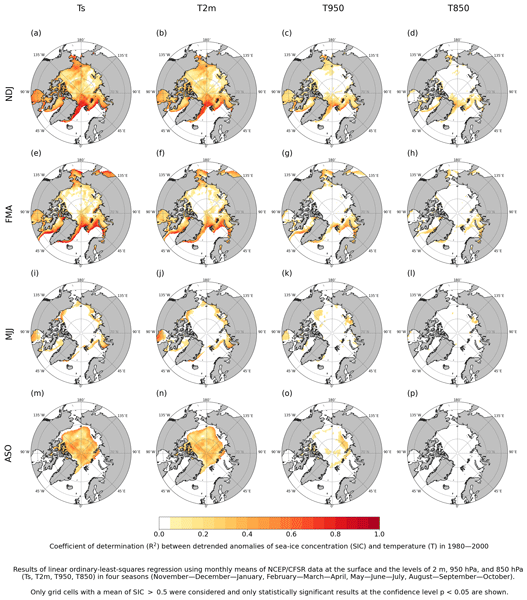
Abstract. Understanding of the local effects of sea-ice concentration (SIC) variations on the Arctic atmosphere is a prerequisite for assessing the role of Arctic sea-ice decline in the climate system, including its influence on mid-latitudes. In this study, we analysed the relationships between SIC and both temperature and specific humidity at the surface and 2-m level, as well as at 950, 850, 750, and 600 hPa across the circumpolar Arctic. We applied linear ordinary-least-squares-regression analysis to detrended anomalies of monthly means of data from the NCEP/CFSR atmospheric reanalysis for 1980–2021. The results show the strongest correlations between SIC and temperature, as well as between SIC and specific humidity, in the marginal ice zone during the cold seasons (November–April) with the coefficient of determination (R2) around 0.6 at the surface and near-surface levels and around 0.3 at 950 and 850 hPa. During these cold seasons, SIC affects air temperature and specific humidity, while the effects of air temperature variations on SIC are limited. SIC correlates somewhat better with specific humidity than with temperature, which can be attributed to the exponential dependence of saturation specific humidity on temperature. In the Central Arctic, physical conditions are favourable for high R2 values, but low variability in SIC reduces the correlations. In contrast, in regions such as the northern Barents Sea, increased November–April SIC variability from 1980–2000 to 2001–2021 strengthens the correlations, even though surface heat and moisture fluxes become less sensitive to SIC in a warming climate. This finding suggests that statistical effects can outweigh the physical sensitivity in shaping observed relationships. During the warm seasons (May–October), high enough air temperatures reduce SIC, while the effect of SIC is small due to the surface temperature of the ice being close to that of the open ocean. The relationships between SIC and both temperature and specific humidity are generally weaker during these warm seasons with R2 at the surface and near-surface levels around 0.4 over the marginal ice zone during May–July and across the entire sea-ice zone during August–October. The role of wind speed and direction in the relationships between SIC and both temperature and specific humidity is discussed.
-
Notice on discussion status
The requested preprint has a corresponding peer-reviewed final revised paper. You are encouraged to refer to the final revised version.
-
Preprint
(5418 KB)
-
Supplement
(5377 KB)
-
The requested preprint has a corresponding peer-reviewed final revised paper. You are encouraged to refer to the final revised version.
- Preprint
(5418 KB) - Metadata XML
-
Supplement
(5377 KB) - BibTeX
- EndNote
- Final revised paper


Journal article(s) based on this preprint
Interactive discussion
Status: closed
-
RC1: 'Comment on egusphere-2025-4633', Anonymous Referee #1, 12 Nov 2025
- AC1: 'Reply on RC1', Tereza Uhlíková, 16 Apr 2026
-
RC2: 'Comment on egusphere-2025-4633', Anonymous Referee #2, 17 Mar 2026
Summary
This paper uses NCEP/CFSR reanalysis data from 1980-2021 to examine the decadal trends and statistical relationships between SIC and atmospheric temperature and humidity across the Arctic. Uhlikova et al. found the strongest relationship between SIC and temperature and specific humidity in the marginal ice zone during the cold season (Nov-Apr). They found the strongest relationships at the surface and that they get weaker as you ascend in the atmosphere. Interestingly, they found that surface heat and moisture fluxes become less sensitive to SIC in a warming climate but that the statistical effects can outweigh the physical sensitivity in determining observed relationships. The paper is interesting with clear analysis methods and figures. I think it could be suitable for publication in Cryosphere after the consideration of my comments as follows:
Major Comments
- In my opinion, there is an overstatement of the novelty of this work and conclusions. The introduction and discussion would need to include more engagement with the literature of work on this topic (see the suggestions in the minor comments section).
- Methods, Lines 68-73: please can you give more details of the skill and bias assessments of NCEP CFSR and then CFSv2 compared to other reanalyses beyond just the in-line references.
- I would question the use of CFSR v1 over other widely used reanalysis datasets. Studies have shown larger biases in NCEP CFSR Arctic atmospheric temperature aloft (Jakobson et al. 2012) and lower tropospheric Arctic humidity structure (Serreze et al. 2012).
- Lindsay et al. (2014) support the performance of CFSR over the Arctic, but their work is not discussed in this paper.
- Graham et al. (2019) found a moist bias in CFSv2 throughout the troposphere and Kong et al. (2022) found that CFSR has a moist bias over the Pacific sector and that moisture is more sensitive to sea ice concentration changes.
- Adding more details from the literature will also enable a brief comment of how the results should be interpreted and could differ if different reanlyses were used.
- Methods, Lines 73-80: there needs to be a discussion of the differences in the two model versions (CFSR vs. CFSv2) and their changed physics and biases. There needs to be a discussion of how the use of two different model versions might affect the results from 1980-2000 and 2001-2021 which are being directly compared as apples to apples. This further leads me to question why this dataset was chosen compared to others that cover 1980-present with the same model version.
- The paper states causality results of SIC affecting the atmosphere or vice versa (e.g. Lines 179-199; Lines 350-352). Unless I missed a portion of the analysis, causality cannot be ascertained from the comparisons and statistics presented here. OLS regression identifies statistical associations and does not, by itself, imply causality. “Coefficient of determination” ( ) is the fraction of the variance in the dependent variable that can be explained by the regression model. However, the model x and y can be flipped to generate the same relationship. The R2 does not mean the model is correct or causal. The language therefore needs to be adjusted throughout the paper of what the results present in terms of variance and relationships, but directional mechanisms are only possible explanations and not results.
- In my opinion, the calculations and comparison of Q2 to T2 could be moved to supplemental as this section breaks up the flow of the discussion and paper. Some currently supplemental figures are referred to in the text and could be moved into the main manuscript instead.
- Section 4.1: this section explains why SIC variability changes. However, there is no discussion of why the R2 changes. What then is related to the variability in the temperature anomalies instead in the later decades? Or when both temperature and SIC variability increase, why does R2 increase in the later decades? This is somewhat addressed in section 4.2 but not always directly addressing the stated results in section 4.1.
- In general, I don’t feel that the compelling sentence of “surface heat and moisture fluxes become less sensitive to SIC in a warming climate” from the abstract is fully demonstrated or discussed within the body of the manuscript. If this is analyzed and discussed more deeply, it would be a valuable contribution to the literature.
- Overall, I would suggest reorganizing the paper so that the results are paired with the discussion and explanation. Without this restructuring, there is repetition throughout the manuscript, and the reader must move around sections to find and glean the discussion and explanations of the stated results. Furthermore, some results are never properly explained.
- For example, moving the discussion of temperature inversions and wind to the relevant discussion of the relationships would be very helpful for the reader’s understanding and change the feeling that this section was just added on.
- The conclusions can then be used to summarize the main findings.
- I can defer to the editor if this is not the suggested format of Cryosphere manuscripts. However, whatever the overall structure of the main sections, I do think some refining could still be done to improve the readability and understandability of the results and their discussion.
- The conclusions and value of this paper would greatly benefit from a discussion of what this paper brings to the current literature and understanding. Are there any takeaways that could inform our understanding of the future of the changing Arctic?
Minor Comments
- Line 19: this is an abrupt sentence to end the abstract. I suggest moving it to lines 3-4 when summarizing the study.
- Line 46: please include some other relevant references here. E.g. Rinke et al. 2006; Parker et al. 2022.
- Line 47-57: Please see and consider additional references that do examine some of these same relationships and discuss how they inform or supplement your work throughout the manuscript. E.g. Screen et al. 2013; Boisvert and Stroeve 2015; Boisvert et al. 2015; Taylor et al. 2018; Liang et al. 2021; Yu-Fang et al. 2022; Boisvert et al. 2023.
- Introduction overall: I find the flow to be quite awkward. The introduction starts with a strong emphasis and a lot of detail, on the relationship between leads and the atmosphere. Given the methods of examining SIC and the atmospheric variables at coarse resolution of 0.5 degrees from the NCEP/CFSR data, there should be a broader and deeper discussion of the interaction of general surface characteristics with the atmosphere (both top-down, bottom-up, and the feedbacks).
- Line 75: is the native resolution 0.5 degrees for CFSR?
- Table 1 and 2, please use a marker or formatting to denote which of the numbers are statistically significant.
- Table 1, consider including the standard deviation values so that we can assess the decadal trend against variability.
- Lines 122: please give a short reason why temperature is increasing without large changes in SIC.
- Figure 2: consider adding trend lines for the series that have a significant trend over time.
- Line 170: please rephrase grammatically.
- Section 3.2 and throughout: please include confirmations within text of when a relationship (R2 value) is statistically significant.
- Line 205: please include discussion of how the large-scale circulation and climate may have a stronger relationship with the atmosphere aloft.
- Lines 206-238: I think it is still valid to discuss the physical mechanisms of sea ice as a buffer between the ocean and the atmosphere and the possible effects of sea ice loss on latent heat fluxes, evaporation, and humidity. Not only the relationship to T2m.
- Lines 251-272: please include some brief discussion of what could be causing the changing relationships here.
- Figure 7: this figure requires a lot of comparison by eye from a) to b) and c) to d). You could consider summarizing the differences in a table for easier and quicker interpretations of the similarities and differences.
- Line 277: please rephrase (towards close to SIC 1) – this is hard to understand.
References Cited
- Boisvert, L. N., & Stroeve, J. C. (2015). The Arctic is becoming warmer and wetter as revealed by the Atmospheric Infrared Sounder. Geophysical Research Letters, 42(11), 4439-4446.
- Boisvert, L. N., Wu, D. L., & Shie, C. L. (2015). Increasing evaporation amounts seen in the Arctic between 2003 and 2013 from AIRS data. Journal of Geophysical Research: Atmospheres, 120(14), 6865-6881.
- Boisvert, L., Parker, C., & Valkonen, E. (2023). A warmer and wetter Arctic: insights from a 20‐years AIRS record. Journal of Geophysical Research: Atmospheres, 128(20), e2023JD038793.
- Graham, R. M., Hudson, S. R., & Maturilli, M. (2019). Improved performance of ERA5 in Arctic gateway relative to four global atmospheric reanalyses. Geophysical Research Letters, 46(11), 6138-6147.
- Kong, B., Liu, N., Fan, L., Lin, L., Yang, L., Chen, H., ... & Xu, Y. (2022). Evaluation of surface meteorology parameters and heat fluxes from CFSR and ERA5 over the Pacific Arctic Region. Quarterly Journal of the Royal Meteorological Society, 148(747), 2973-2990.
- Liang, Y. C., Frankignoul, C., Kwon, Y. O., Gastineau, G., Manzini, E., Danabasoglu, G., ... & Zhang, Y. (2021). Impacts of Arctic sea ice on cold season atmospheric variability and trends estimated from observations and a multimodel large ensemble. Journal of Climate, 34(20), 8419-8443.
- Lindsay, R., Wensnahan, M., Schweiger, A., & Zhang, J. (2014). Evaluation of seven different atmospheric reanalysis products in the Arctic. Journal of Climate, 27(7), 2588-2606.
- Parker, C. L., Mooney, P. A., Webster, M. A., & Boisvert, L. N. (2022). The influence of recent and future climate change on spring Arctic cyclones. Nature Communications, 13(1), 6514.
- Rinke, A., Maslowski, W., Dethloff, K., & Clement, J. (2006). Influence of sea ice on the atmosphere: A study with an Arctic atmospheric regional climate model. Journal of Geophysical Research: Atmospheres, 111(D16).
- Screen, J. A., Simmonds, I., Deser, C., & Tomas, R. (2013). The atmospheric response to three decades of observed Arctic sea ice loss. Journal of climate, 26(4), 1230-1248.
- Serreze, M. C., Barrett, A. P., & Stroeve, J. (2012). Recent changes in tropospheric water vapor over the Arctic as assessed from radiosondes and atmospheric reanalyses. Journal of Geophysical Research: Atmospheres, 117(D10).
- Taylor, P. C., Hegyi, B. M., Boeke, R. C., & Boisvert, L. N. (2018). On the increasing importance of air-sea exchanges in a thawing Arctic: A review. Atmosphere, 9(2), 41.
- Yu-Fang, Y. E., Shokr, M., Zhuo-Qi, C. H. E. N., & Cheng, X. (2022). Exploring the effect of Arctic perennial sea ice on modulation of local air temperature. Advances in Climate Change Research, 13(4), 473-488.
Citation: https://doi.org/10.5194/egusphere-2025-4633-RC2 - AC2: 'Reply on RC2', Tereza Uhlíková, 16 Apr 2026
Peer review completion


Interactive discussion
Status: closed
-
RC1: 'Comment on egusphere-2025-4633', Anonymous Referee #1, 12 Nov 2025
Summary: This study examines the leading relationships between sea ice concentration (SIC), temperature and specific humidity in the observational period, using NCEP reanalysis and statistical techniques. The authors find that there is a strong correlation between SIC with temperature and specific humidity, closest to the near surface in the marginal zones, where there is less multiyear ice and SIC is typically lower, with SIC driving the correlations. They find this relationship is less in the summer months, with the atmosphere having a small influence on SIC instead. They also find that there is less correlation in the central Arctic, as a result of statistical methodology.
Overall, the paper was well written with a good and clear experiment design. The science is of good quality, including statistical tests, and fits well within the scope of TC. Results would be of interest to anyone researching casual relationships between SIC and the atmosphere, and those seeking an understanding of the two way relationship between ice and atmosphere.
Suggestions: The physical mechanisms presented in this manuscript would seem obvious conclusions based on the physics, however, they represent a gap in the literature where these relationships have not been directly assessed. Sea ice is both a biproduct and barrier in ocean and atmosphere interaction in the poles. The difference in relationship between the seasons is a shift between the ocean and atmospheric interactions and forcings with sea ice. For this reason, it would be beneficial to include some additional analysis with SST.
The work seems to be a little limited by method, for example, the central Arctic correlations being impacted by variability. Is there a way this could be addressed or another method that could be used for this region?
There are some limitations with using reanalysis for statistical relationship work, in that reanalysis models are built on statistical relationships, leading to biases. This should be addressed within the text further.
An addition to this work, that would show these relationships clearer in a physical sense, rather than statistical, would be analysis of the turbulent heat flux, both sensible and latent, perhaps assessing the dominating flux in each season, further showing the direction of the relationship.
Citation: https://doi.org/10.5194/egusphere-2025-4633-RC1 - AC1: 'Reply on RC1', Tereza Uhlíková, 16 Apr 2026
-
RC2: 'Comment on egusphere-2025-4633', Anonymous Referee #2, 17 Mar 2026
Summary
This paper uses NCEP/CFSR reanalysis data from 1980-2021 to examine the decadal trends and statistical relationships between SIC and atmospheric temperature and humidity across the Arctic. Uhlikova et al. found the strongest relationship between SIC and temperature and specific humidity in the marginal ice zone during the cold season (Nov-Apr). They found the strongest relationships at the surface and that they get weaker as you ascend in the atmosphere. Interestingly, they found that surface heat and moisture fluxes become less sensitive to SIC in a warming climate but that the statistical effects can outweigh the physical sensitivity in determining observed relationships. The paper is interesting with clear analysis methods and figures. I think it could be suitable for publication in Cryosphere after the consideration of my comments as follows:
Major Comments
- In my opinion, there is an overstatement of the novelty of this work and conclusions. The introduction and discussion would need to include more engagement with the literature of work on this topic (see the suggestions in the minor comments section).
- Methods, Lines 68-73: please can you give more details of the skill and bias assessments of NCEP CFSR and then CFSv2 compared to other reanalyses beyond just the in-line references.
- I would question the use of CFSR v1 over other widely used reanalysis datasets. Studies have shown larger biases in NCEP CFSR Arctic atmospheric temperature aloft (Jakobson et al. 2012) and lower tropospheric Arctic humidity structure (Serreze et al. 2012).
- Lindsay et al. (2014) support the performance of CFSR over the Arctic, but their work is not discussed in this paper.
- Graham et al. (2019) found a moist bias in CFSv2 throughout the troposphere and Kong et al. (2022) found that CFSR has a moist bias over the Pacific sector and that moisture is more sensitive to sea ice concentration changes.
- Adding more details from the literature will also enable a brief comment of how the results should be interpreted and could differ if different reanlyses were used.
- Methods, Lines 73-80: there needs to be a discussion of the differences in the two model versions (CFSR vs. CFSv2) and their changed physics and biases. There needs to be a discussion of how the use of two different model versions might affect the results from 1980-2000 and 2001-2021 which are being directly compared as apples to apples. This further leads me to question why this dataset was chosen compared to others that cover 1980-present with the same model version.
- The paper states causality results of SIC affecting the atmosphere or vice versa (e.g. Lines 179-199; Lines 350-352). Unless I missed a portion of the analysis, causality cannot be ascertained from the comparisons and statistics presented here. OLS regression identifies statistical associations and does not, by itself, imply causality. “Coefficient of determination” ( ) is the fraction of the variance in the dependent variable that can be explained by the regression model. However, the model x and y can be flipped to generate the same relationship. The R2 does not mean the model is correct or causal. The language therefore needs to be adjusted throughout the paper of what the results present in terms of variance and relationships, but directional mechanisms are only possible explanations and not results.
- In my opinion, the calculations and comparison of Q2 to T2 could be moved to supplemental as this section breaks up the flow of the discussion and paper. Some currently supplemental figures are referred to in the text and could be moved into the main manuscript instead.
- Section 4.1: this section explains why SIC variability changes. However, there is no discussion of why the R2 changes. What then is related to the variability in the temperature anomalies instead in the later decades? Or when both temperature and SIC variability increase, why does R2 increase in the later decades? This is somewhat addressed in section 4.2 but not always directly addressing the stated results in section 4.1.
- In general, I don’t feel that the compelling sentence of “surface heat and moisture fluxes become less sensitive to SIC in a warming climate” from the abstract is fully demonstrated or discussed within the body of the manuscript. If this is analyzed and discussed more deeply, it would be a valuable contribution to the literature.
- Overall, I would suggest reorganizing the paper so that the results are paired with the discussion and explanation. Without this restructuring, there is repetition throughout the manuscript, and the reader must move around sections to find and glean the discussion and explanations of the stated results. Furthermore, some results are never properly explained.
- For example, moving the discussion of temperature inversions and wind to the relevant discussion of the relationships would be very helpful for the reader’s understanding and change the feeling that this section was just added on.
- The conclusions can then be used to summarize the main findings.
- I can defer to the editor if this is not the suggested format of Cryosphere manuscripts. However, whatever the overall structure of the main sections, I do think some refining could still be done to improve the readability and understandability of the results and their discussion.
- The conclusions and value of this paper would greatly benefit from a discussion of what this paper brings to the current literature and understanding. Are there any takeaways that could inform our understanding of the future of the changing Arctic?
Minor Comments
- Line 19: this is an abrupt sentence to end the abstract. I suggest moving it to lines 3-4 when summarizing the study.
- Line 46: please include some other relevant references here. E.g. Rinke et al. 2006; Parker et al. 2022.
- Line 47-57: Please see and consider additional references that do examine some of these same relationships and discuss how they inform or supplement your work throughout the manuscript. E.g. Screen et al. 2013; Boisvert and Stroeve 2015; Boisvert et al. 2015; Taylor et al. 2018; Liang et al. 2021; Yu-Fang et al. 2022; Boisvert et al. 2023.
- Introduction overall: I find the flow to be quite awkward. The introduction starts with a strong emphasis and a lot of detail, on the relationship between leads and the atmosphere. Given the methods of examining SIC and the atmospheric variables at coarse resolution of 0.5 degrees from the NCEP/CFSR data, there should be a broader and deeper discussion of the interaction of general surface characteristics with the atmosphere (both top-down, bottom-up, and the feedbacks).
- Line 75: is the native resolution 0.5 degrees for CFSR?
- Table 1 and 2, please use a marker or formatting to denote which of the numbers are statistically significant.
- Table 1, consider including the standard deviation values so that we can assess the decadal trend against variability.
- Lines 122: please give a short reason why temperature is increasing without large changes in SIC.
- Figure 2: consider adding trend lines for the series that have a significant trend over time.
- Line 170: please rephrase grammatically.
- Section 3.2 and throughout: please include confirmations within text of when a relationship (R2 value) is statistically significant.
- Line 205: please include discussion of how the large-scale circulation and climate may have a stronger relationship with the atmosphere aloft.
- Lines 206-238: I think it is still valid to discuss the physical mechanisms of sea ice as a buffer between the ocean and the atmosphere and the possible effects of sea ice loss on latent heat fluxes, evaporation, and humidity. Not only the relationship to T2m.
- Lines 251-272: please include some brief discussion of what could be causing the changing relationships here.
- Figure 7: this figure requires a lot of comparison by eye from a) to b) and c) to d). You could consider summarizing the differences in a table for easier and quicker interpretations of the similarities and differences.
- Line 277: please rephrase (towards close to SIC 1) – this is hard to understand.
References Cited
- Boisvert, L. N., & Stroeve, J. C. (2015). The Arctic is becoming warmer and wetter as revealed by the Atmospheric Infrared Sounder. Geophysical Research Letters, 42(11), 4439-4446.
- Boisvert, L. N., Wu, D. L., & Shie, C. L. (2015). Increasing evaporation amounts seen in the Arctic between 2003 and 2013 from AIRS data. Journal of Geophysical Research: Atmospheres, 120(14), 6865-6881.
- Boisvert, L., Parker, C., & Valkonen, E. (2023). A warmer and wetter Arctic: insights from a 20‐years AIRS record. Journal of Geophysical Research: Atmospheres, 128(20), e2023JD038793.
- Graham, R. M., Hudson, S. R., & Maturilli, M. (2019). Improved performance of ERA5 in Arctic gateway relative to four global atmospheric reanalyses. Geophysical Research Letters, 46(11), 6138-6147.
- Kong, B., Liu, N., Fan, L., Lin, L., Yang, L., Chen, H., ... & Xu, Y. (2022). Evaluation of surface meteorology parameters and heat fluxes from CFSR and ERA5 over the Pacific Arctic Region. Quarterly Journal of the Royal Meteorological Society, 148(747), 2973-2990.
- Liang, Y. C., Frankignoul, C., Kwon, Y. O., Gastineau, G., Manzini, E., Danabasoglu, G., ... & Zhang, Y. (2021). Impacts of Arctic sea ice on cold season atmospheric variability and trends estimated from observations and a multimodel large ensemble. Journal of Climate, 34(20), 8419-8443.
- Lindsay, R., Wensnahan, M., Schweiger, A., & Zhang, J. (2014). Evaluation of seven different atmospheric reanalysis products in the Arctic. Journal of Climate, 27(7), 2588-2606.
- Parker, C. L., Mooney, P. A., Webster, M. A., & Boisvert, L. N. (2022). The influence of recent and future climate change on spring Arctic cyclones. Nature Communications, 13(1), 6514.
- Rinke, A., Maslowski, W., Dethloff, K., & Clement, J. (2006). Influence of sea ice on the atmosphere: A study with an Arctic atmospheric regional climate model. Journal of Geophysical Research: Atmospheres, 111(D16).
- Screen, J. A., Simmonds, I., Deser, C., & Tomas, R. (2013). The atmospheric response to three decades of observed Arctic sea ice loss. Journal of climate, 26(4), 1230-1248.
- Serreze, M. C., Barrett, A. P., & Stroeve, J. (2012). Recent changes in tropospheric water vapor over the Arctic as assessed from radiosondes and atmospheric reanalyses. Journal of Geophysical Research: Atmospheres, 117(D10).
- Taylor, P. C., Hegyi, B. M., Boeke, R. C., & Boisvert, L. N. (2018). On the increasing importance of air-sea exchanges in a thawing Arctic: A review. Atmosphere, 9(2), 41.
- Yu-Fang, Y. E., Shokr, M., Zhuo-Qi, C. H. E. N., & Cheng, X. (2022). Exploring the effect of Arctic perennial sea ice on modulation of local air temperature. Advances in Climate Change Research, 13(4), 473-488.
Citation: https://doi.org/10.5194/egusphere-2025-4633-RC2 - AC2: 'Reply on RC2', Tereza Uhlíková, 16 Apr 2026
Peer review completion
Journal article(s) based on this preprint
Viewed
| HTML | XML | Total | Supplement | BibTeX | EndNote | |
|---|---|---|---|---|---|---|
| 1,427 | 1,070 | 207 | 2,704 | 332 | 154 | 186 |
- HTML: 1,427
- PDF: 1,070
- XML: 207
- Total: 2,704
- Supplement: 332
- BibTeX: 154
- EndNote: 186
Viewed (geographical distribution)
| Country | # | Views | % |
|---|
| Total: | 0 |
| HTML: | 0 |
| PDF: | 0 |
| XML: | 0 |
- 1
Tereza Uhlíková

Timo Vihma
Alexey Yu Karpechko
Petteri Uotila
The requested preprint has a corresponding peer-reviewed final revised paper. You are encouraged to refer to the final revised version.
- Preprint
(5418 KB) - Metadata XML
-
Supplement
(5377 KB) - BibTeX
- EndNote
- Final revised paper
Summary: This study examines the leading relationships between sea ice concentration (SIC), temperature and specific humidity in the observational period, using NCEP reanalysis and statistical techniques. The authors find that there is a strong correlation between SIC with temperature and specific humidity, closest to the near surface in the marginal zones, where there is less multiyear ice and SIC is typically lower, with SIC driving the correlations. They find this relationship is less in the summer months, with the atmosphere having a small influence on SIC instead. They also find that there is less correlation in the central Arctic, as a result of statistical methodology.
Overall, the paper was well written with a good and clear experiment design. The science is of good quality, including statistical tests, and fits well within the scope of TC. Results would be of interest to anyone researching casual relationships between SIC and the atmosphere, and those seeking an understanding of the two way relationship between ice and atmosphere.
Suggestions: The physical mechanisms presented in this manuscript would seem obvious conclusions based on the physics, however, they represent a gap in the literature where these relationships have not been directly assessed. Sea ice is both a biproduct and barrier in ocean and atmosphere interaction in the poles. The difference in relationship between the seasons is a shift between the ocean and atmospheric interactions and forcings with sea ice. For this reason, it would be beneficial to include some additional analysis with SST.
The work seems to be a little limited by method, for example, the central Arctic correlations being impacted by variability. Is there a way this could be addressed or another method that could be used for this region?
There are some limitations with using reanalysis for statistical relationship work, in that reanalysis models are built on statistical relationships, leading to biases. This should be addressed within the text further.
An addition to this work, that would show these relationships clearer in a physical sense, rather than statistical, would be analysis of the turbulent heat flux, both sensible and latent, perhaps assessing the dominating flux in each season, further showing the direction of the relationship.