
the Creative Commons Attribution 4.0 License.
the Creative Commons Attribution 4.0 License.
 | 04 Nov 2025
Wildfire-atmosphere interactions during the Santa Coloma de Queralt fire: the development of a fire-induced circulation
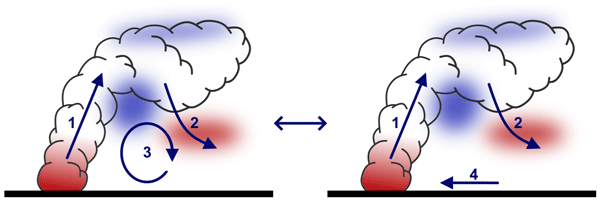
Abstract. High fireline intensities during extreme wildfire events can trigger pyro-convection, causing unpredictable fire spread behaviour, including faster-than-predicted fire spread and continued burning throughout the night. Earlier studies hypothesised that the main impact of pyro-convection on the fire behaviour is through the acceleration of the rear inflow. To assess this hypothesis, we used MicroHH to create a high-resolution (25 m) turbulence-resolving 3D large-eddy simulation (25.6 by 38.4 km2) of the Santa Coloma de Queralt fire. We validated the in-plume virtual potential temperature using sounding measurements, to our knowledge, a novel approach for validating large-eddy simulations of pyro-convection. In-depth analysis of the wind patterns revealed an increase in rear inflow due to pyro-convection, as well as a frontal inflow of comparable magnitude, as part of a fire-induced circulation ahead of the fire. The frontal inflow could counteract the accelerated rear inflow and is associated with fire-generated vortices and long-range spotting. Additionally, we found that the fire-induced circulation simultaneously deepens and lowers the boundary layer in the 4 km ahead, thereby disrupting the transition from the convective daytime to a stably stratified nighttime boundary layer. This disruption provides a plausible explanation for the sustained nighttime burning during the Santa Coloma de Queralt fire. Therefore, we argue that the primary impact of pyro-convection on wildfire behaviour depends on the balance between wind patterns at the rear and in front of the fire (revised hypothesis), rather than solely on the acceleration of the rear inflow (original hypothesis).
-
Notice on discussion status
The requested preprint has a corresponding peer-reviewed final revised paper. You are encouraged to refer to the final revised version.
-
Preprint
(11204 KB)
-
The requested preprint has a corresponding peer-reviewed final revised paper. You are encouraged to refer to the final revised version.
- Preprint
(11204 KB) - Metadata XML
- BibTeX
- EndNote
- Final revised paper


Journal article(s) based on this preprint
Interactive discussion
Status: closed
-
RC1: 'Comment on egusphere-2025-4620', Jean-Baptiste Filippi, 18 Nov 2025
-
AC1: 'Reply on RC1', Tristan Roelofs, 22 Dec 2025
Dear Jean-Baptiste Filippi, we want to thank you for taking the time and effort to review our paper. We attached a pdf in which we provide a detailed response on your comments and questions, including our approach to include your feedback to improve the paper.
-
AC1: 'Reply on RC1', Tristan Roelofs, 22 Dec 2025
-
RC2: 'Comment on egusphere-2025-4620', Anonymous Referee #1, 18 Nov 2025
- AC2: 'Reply on RC2', Tristan Roelofs, 22 Dec 2025
-
RC3: 'Comment on egusphere-2025-4620', Anonymous Referee #2, 19 Dec 2025
This paper attempts to deduce fire-atmosphere interactions using some observations in the fire environment and an LES model. The presentation is good, but the data and interpretation of the results are not publishable as is. I appreciate the effort, but before this study can be published, a thorough scaling analysis should be completed to ensure the model is accurate. The provided observations have bias because of their limitation and location of the soundings. Additionally, accurate updraft velocities need to be provided as has been used in most other model validation studies (10 years of these studies) which the authors neglect.
Additionally, the simplifications used in the MicroHH modeling system negates the whole concept of fire-atmosphere interaction. A stationary fire front is too simple and no studies use a stationary fire in the last 20 years because current operational models can do this at high resolution (WRF-SFIRE, WRF-FIRE, MesoNH-ForeFire). This is not acceptable for a fire modeling study or one that is teasing out fire-atmosphere coupling.
A major limitation is the use of rising speed of a radiosonde balloon that was launched close to the fire front. The observed updrafts from this technique are not adequate for model validation because the balloon sounding does not measure the true updraft velocity of a wildfire plume. These observations underestimate the true vertical velocity because of drag on the balloon even with the 2 m/s rise rate taken into account. Additionally, If the model is simulating a weak updraft throughout the plume depth less than 10 m/s, then the model physics are incorrect. It is not clear what the fuel load was at the fire front when measurements were measured. Even in small fires with low fuel loads, updrafts are 10 m/s, so the observations and simulations here are not natural and need to be further analyzed before the conclusions can be drawn.
For the model validation, Fig 5 shows observed vs simulation and in Fig. 5a, the model is not at all close to the observations. Again, the observations are suspect. For example, the capping inversion is almost 1 km higher than the observations, which are also missing in this region of the profile. There are no observations in the lowest 500 m, so the surface layer and lower boundary layer are not observed. The model does produce a very sharp superadiabatic surface layer, which would be correct on a hot day, but is higher likely due to the fire front heat flux. Again, this would be even higher than 318 K at the surface or near surface.
Lines 209-212: Authors do address the issues above in this section. But the authors state that this model validation would not impact this study. This is not true and ABL structure has shown to impact many aspects of fire behavior (Sun et al. 2006).
Line 246: Spot fires shouldn’t be discussed here unless the model can simulate these interactions. Why don’t the authors describe the downdrafts in Fig. 6b that are simulated to occur on the south flank and not on the north flank? These circulations are not realistic here. The flow around the fire front is and has been observed in many experimental fires and wildfires. Again, the updrafts shown in Fig. 6b are too weak to be realistic. These magnitudes are within the CBL updrafts/downdrafts scale, so it’s hard to imagine this is fire-induced.
Finally, I don’t believe the analysis supports the conclusions. Many of the conclusions have been observed previously in the literature, but here the authors do a poor job of addressing previous research results, so it’s hard to put these observations and modeling into context. For example, the rear inflow has been observed at many scales from small grass fires and under-canopy prescribed fires to active wildfires (Lareau et al. 2022). The description of the “frontal” inflow is not correct as this is downwind indrafts that have been observed previously in other studies. This terminology is misleading and hard to follow in the discussion. The proposal of Fig 13 is not novel and the statement in Fig. 13 caption “The question mark highlights the unknown factors that govern the development of fire-induced circulations as they do not appear in al previous studies.” True, but other studies have highlighted these and the Potter reference is now out dated. We have seen these same circulations in grass fires and canopy fires at the small scale. Figure 13b looks like previous published observations, so it does not provide new understanding.
Citation: https://doi.org/10.5194/egusphere-2025-4620-RC3 -
AC3: 'Reply on RC3', Tristan Roelofs, 09 Jan 2026
Publisher’s note: a supplement was added to this comment on 28 January 2026.
Dear reviewer, thanks for your effort and time in reviewing our paper. Your points have provided many good suggestions for improving our paper. We have attached our response in which we discuss your points in detail and provide the improvements that we have made to address your feedback, but also indicate where our viewpoint differs, or where improvements are hard to implement due to missing information in the review.
-
AC3: 'Reply on RC3', Tristan Roelofs, 09 Jan 2026
Peer review completion


Interactive discussion
Status: closed
-
RC1: 'Comment on egusphere-2025-4620', Jean-Baptiste Filippi, 18 Nov 2025
This manuscript presents a Large-Eddy Simulation (LES) study of the 2021 Santa Coloma de Queralt (SCQ) fire using MicroHH, with the novel inclusion of in-plume radiosonde data for validation. The objective is to examine how pyro-convection modifies near-fire wind patterns and boundary-layer structure, but also the evaluation of Micro-HH and using radio soundings.
The topic is scientifically significant, addressing the mechanisms behind sustained nighttime burning and extreme fire behaviour. The work demonstrates good numerical design and physical interpretation; in particular, the use of radiosonde profiles to validate the plume structure is original and valuable for the field, asn well as comparing it to NWP.
Scientific relevance can therfore be high. The study advances quantitative understanding of fire-induced circulations and provides evidence that frontal inflow, rather than rear-inflow enhancement alone, may governs plume–atmosphere coupling. The use of an LES code not originally developed for wildfire problems shows capability and will interest both fire and boundary-layer communities.
Major remarks:
Scope of “validation”. The paper repeatedly refers to validation, but it is not fully clear what is validated—MicroHH as a model, the fire setup, or the specific thermodynamic representation. Maybe just a "Comparison"or investigation. A clearer statement that this is a comparative test against a single radiosonde, not a formal model validation, would help.
Fire representation. The fire seems to be implemented as a dynamic heat-flux patch maybe with explicit combustion or spread, but it seems very vague or unclear in the current redaction, do you have any isochrones, fuel maps, orography, it appears not, as well as boundary condition, it is perfectly OK, but if it is a somehow idealized fire it should be clearly presented as such. Also this simplification should be justified earlier and clearly separated from coupled fire-atmosphere modelling claims. And if you have, it would be useful to provide basic the actual parameters of the assumed fuel type and flux intensity and to state whether topography was flat or taken from ERA5.
Boundary conditions. ERA5 forcing and the periodic lateral boundaries may influence inversion height and plume recirculation. A short sensitivity test or discussion (possibly moved from the Appendix) should quantify the expected impact.
Physical metrics. Beyond potential temperature, additional diagnostics (e.g., CAPE, wind profile, potential temperature) could strengthen the interpretation of the radiosonde comparison and the discussion of plume dynamics.
Figures. Some figures (e.g., Fig. 3–5) would benefit from clearer units and labels—particularly for “normalised flux”, velocities (m s⁻¹), and altitude scales.
Minor issues
– Define clearly “frontal inflow” and “rear inflow” on first use.
– Clarify whether “ERA5” or “ERA-5” is used consistently.
– Proofread for minor grammatical errors and duplicated references.
Overall the manuscript is scientifically sound and offers a significant contribution to the understanding of wildfire-atmosphere coupling. It would merit full review and likely publication after major revisions aimed at clarifying the methodological scope (validation vs. comparison), documenting the fire setup, and tightening figure presentation. Given these strengths and the importance of the dataset, I recommend accepting it for external reviewCitation: https://doi.org/10.5194/egusphere-2025-4620-RC1 -
AC1: 'Reply on RC1', Tristan Roelofs, 22 Dec 2025
Dear Jean-Baptiste Filippi, we want to thank you for taking the time and effort to review our paper. We attached a pdf in which we provide a detailed response on your comments and questions, including our approach to include your feedback to improve the paper.
-
AC1: 'Reply on RC1', Tristan Roelofs, 22 Dec 2025
-
RC2: 'Comment on egusphere-2025-4620', Anonymous Referee #1, 18 Nov 2025
- AC2: 'Reply on RC2', Tristan Roelofs, 22 Dec 2025
-
RC3: 'Comment on egusphere-2025-4620', Anonymous Referee #2, 19 Dec 2025
This paper attempts to deduce fire-atmosphere interactions using some observations in the fire environment and an LES model. The presentation is good, but the data and interpretation of the results are not publishable as is. I appreciate the effort, but before this study can be published, a thorough scaling analysis should be completed to ensure the model is accurate. The provided observations have bias because of their limitation and location of the soundings. Additionally, accurate updraft velocities need to be provided as has been used in most other model validation studies (10 years of these studies) which the authors neglect.
Additionally, the simplifications used in the MicroHH modeling system negates the whole concept of fire-atmosphere interaction. A stationary fire front is too simple and no studies use a stationary fire in the last 20 years because current operational models can do this at high resolution (WRF-SFIRE, WRF-FIRE, MesoNH-ForeFire). This is not acceptable for a fire modeling study or one that is teasing out fire-atmosphere coupling.
A major limitation is the use of rising speed of a radiosonde balloon that was launched close to the fire front. The observed updrafts from this technique are not adequate for model validation because the balloon sounding does not measure the true updraft velocity of a wildfire plume. These observations underestimate the true vertical velocity because of drag on the balloon even with the 2 m/s rise rate taken into account. Additionally, If the model is simulating a weak updraft throughout the plume depth less than 10 m/s, then the model physics are incorrect. It is not clear what the fuel load was at the fire front when measurements were measured. Even in small fires with low fuel loads, updrafts are 10 m/s, so the observations and simulations here are not natural and need to be further analyzed before the conclusions can be drawn.
For the model validation, Fig 5 shows observed vs simulation and in Fig. 5a, the model is not at all close to the observations. Again, the observations are suspect. For example, the capping inversion is almost 1 km higher than the observations, which are also missing in this region of the profile. There are no observations in the lowest 500 m, so the surface layer and lower boundary layer are not observed. The model does produce a very sharp superadiabatic surface layer, which would be correct on a hot day, but is higher likely due to the fire front heat flux. Again, this would be even higher than 318 K at the surface or near surface.
Lines 209-212: Authors do address the issues above in this section. But the authors state that this model validation would not impact this study. This is not true and ABL structure has shown to impact many aspects of fire behavior (Sun et al. 2006).
Line 246: Spot fires shouldn’t be discussed here unless the model can simulate these interactions. Why don’t the authors describe the downdrafts in Fig. 6b that are simulated to occur on the south flank and not on the north flank? These circulations are not realistic here. The flow around the fire front is and has been observed in many experimental fires and wildfires. Again, the updrafts shown in Fig. 6b are too weak to be realistic. These magnitudes are within the CBL updrafts/downdrafts scale, so it’s hard to imagine this is fire-induced.
Finally, I don’t believe the analysis supports the conclusions. Many of the conclusions have been observed previously in the literature, but here the authors do a poor job of addressing previous research results, so it’s hard to put these observations and modeling into context. For example, the rear inflow has been observed at many scales from small grass fires and under-canopy prescribed fires to active wildfires (Lareau et al. 2022). The description of the “frontal” inflow is not correct as this is downwind indrafts that have been observed previously in other studies. This terminology is misleading and hard to follow in the discussion. The proposal of Fig 13 is not novel and the statement in Fig. 13 caption “The question mark highlights the unknown factors that govern the development of fire-induced circulations as they do not appear in al previous studies.” True, but other studies have highlighted these and the Potter reference is now out dated. We have seen these same circulations in grass fires and canopy fires at the small scale. Figure 13b looks like previous published observations, so it does not provide new understanding.
Citation: https://doi.org/10.5194/egusphere-2025-4620-RC3 -
AC3: 'Reply on RC3', Tristan Roelofs, 09 Jan 2026
Publisher’s note: a supplement was added to this comment on 28 January 2026.
Dear reviewer, thanks for your effort and time in reviewing our paper. Your points have provided many good suggestions for improving our paper. We have attached our response in which we discuss your points in detail and provide the improvements that we have made to address your feedback, but also indicate where our viewpoint differs, or where improvements are hard to implement due to missing information in the review.
-
AC3: 'Reply on RC3', Tristan Roelofs, 09 Jan 2026
Peer review completion
Journal article(s) based on this preprint
Data sets
Wildfire-atmosphere interactions during the Santa Coloma de Queralt fire: the development of a fire-induced circulation Tristan Roelofs, Marc Castellnou, Jordi Vila, Martin Jannsens, Chiel van Heerwaarden https://doi.org/10.5281/zenodo.17159895
Viewed
| HTML | XML | Total | BibTeX | EndNote | |
|---|---|---|---|---|---|
| 2,574 | 1,326 | 257 | 4,157 | 173 | 189 |
- HTML: 2,574
- PDF: 1,326
- XML: 257
- Total: 4,157
- BibTeX: 173
- EndNote: 189
Viewed (geographical distribution)
| Country | # | Views | % |
|---|
| Total: | 0 |
| HTML: | 0 |
| PDF: | 0 |
| XML: | 0 |
- 1
Tristan Roelofs

Marc Castellnou
Jordi Vilà-Guerau de Arellano
Martin Janssens
Chiel van Heerwaarden
The requested preprint has a corresponding peer-reviewed final revised paper. You are encouraged to refer to the final revised version.
- Preprint
(11204 KB) - Metadata XML
This manuscript presents a Large-Eddy Simulation (LES) study of the 2021 Santa Coloma de Queralt (SCQ) fire using MicroHH, with the novel inclusion of in-plume radiosonde data for validation. The objective is to examine how pyro-convection modifies near-fire wind patterns and boundary-layer structure, but also the evaluation of Micro-HH and using radio soundings.
The topic is scientifically significant, addressing the mechanisms behind sustained nighttime burning and extreme fire behaviour. The work demonstrates good numerical design and physical interpretation; in particular, the use of radiosonde profiles to validate the plume structure is original and valuable for the field, asn well as comparing it to NWP.
Scientific relevance can therfore be high. The study advances quantitative understanding of fire-induced circulations and provides evidence that frontal inflow, rather than rear-inflow enhancement alone, may governs plume–atmosphere coupling. The use of an LES code not originally developed for wildfire problems shows capability and will interest both fire and boundary-layer communities.
Major remarks:
Scope of “validation”. The paper repeatedly refers to validation, but it is not fully clear what is validated—MicroHH as a model, the fire setup, or the specific thermodynamic representation. Maybe just a "Comparison"or investigation. A clearer statement that this is a comparative test against a single radiosonde, not a formal model validation, would help.
Fire representation. The fire seems to be implemented as a dynamic heat-flux patch maybe with explicit combustion or spread, but it seems very vague or unclear in the current redaction, do you have any isochrones, fuel maps, orography, it appears not, as well as boundary condition, it is perfectly OK, but if it is a somehow idealized fire it should be clearly presented as such. Also this simplification should be justified earlier and clearly separated from coupled fire-atmosphere modelling claims. And if you have, it would be useful to provide basic the actual parameters of the assumed fuel type and flux intensity and to state whether topography was flat or taken from ERA5.
Boundary conditions. ERA5 forcing and the periodic lateral boundaries may influence inversion height and plume recirculation. A short sensitivity test or discussion (possibly moved from the Appendix) should quantify the expected impact.
Physical metrics. Beyond potential temperature, additional diagnostics (e.g., CAPE, wind profile, potential temperature) could strengthen the interpretation of the radiosonde comparison and the discussion of plume dynamics.
Figures. Some figures (e.g., Fig. 3–5) would benefit from clearer units and labels—particularly for “normalised flux”, velocities (m s⁻¹), and altitude scales.
Minor issues
– Define clearly “frontal inflow” and “rear inflow” on first use.
– Clarify whether “ERA5” or “ERA-5” is used consistently.
– Proofread for minor grammatical errors and duplicated references.
Overall the manuscript is scientifically sound and offers a significant contribution to the understanding of wildfire-atmosphere coupling. It would merit full review and likely publication after major revisions aimed at clarifying the methodological scope (validation vs. comparison), documenting the fire setup, and tightening figure presentation. Given these strengths and the importance of the dataset, I recommend accepting it for external review