
the Creative Commons Attribution 4.0 License.
the Creative Commons Attribution 4.0 License.
 | 14 Oct 2025
Energy and structural evolution process of high-altitude and long-runout landslides induced by a strong earthquake
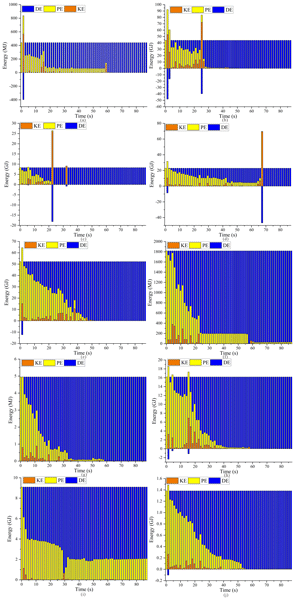
Abstract. It is often difficult to restore the evolution process and energy transfer of ancient landslides that have occurred over a long time. In this paper, the contour restoration method is used to restore the topography before the Mogangling landslide according to the contour of the surrounding mountains. In order to better analyze the landslide movement process and analyze the energy change, the numerical simulation method is used to reproduce the Mogangling landslide. In the process of numerical simulation, the displacement and velocity of the whole and part of the landslide mass are monitored, respectively, so as to extract their potential energy, kinetic energy, and dissipation energy. At the same time, the effective collision of blocks in the process of landslide is obtained by extracting the local peak value of the displacement velocity curve. Meanwhile, the Alpha shape algorithm was employed to extract the volume and surface area of the landslide body from 3D point cloud data, thereby enabling the calculation of its volume expansion rate and area growth rate to quantify the morphological evolution characteristics during the landslide movement process. The results show that for the whole landslide, its energy change conforms to the law of conservation of energy; For some blocks, the energy is not conserved due to the collision and compression of surrounding rock mass; Compared with the upper rock mass, the lower rock mass is compressed more frequently, receives more energy transfer, and has a longer migration distance.
-
Notice on discussion status
The requested preprint has a corresponding peer-reviewed final revised paper. You are encouraged to refer to the final revised version.
-
Preprint
(5414 KB)
-
The requested preprint has a corresponding peer-reviewed final revised paper. You are encouraged to refer to the final revised version.
- Preprint
(5414 KB) - Metadata XML
- BibTeX
- EndNote
- Final revised paper


Journal article(s) based on this preprint
Interactive discussion
Status: closed
-
RC1: 'Comment on egusphere-2025-4506', Anonymous Referee #1, 24 Oct 2025
- AC1: 'Reply on RC1', Bin Hu, 14 Jan 2026
-
RC2: 'Comment on egusphere-2025-4506', Anonymous Referee #2, 25 Oct 2025
General comments:
This manuscript provides a systematic investigation of the dynamics of the strong earthquake-induced Mogangling paleo-landslide by integrating topographic reconstruction, discrete element simulation, energy analysis, and Alpha Shape-based morphological quantification. The research demonstrates methodological innovation and in-depth analysis. Its outstanding contribution lies in proposing a quantitative method for identifying "effective collisions" and successfully revealing the intrinsic relationship between energy evolution and the structural fragmentation of the landslide mass (i.e., volume expansion and surface area growth). This offers a novel perspective for understanding the energy and structural evolution processes of high-altitude, long-runout landslides. Although certain limitations exist, the robustness of the conclusions has been ensured through sensitivity analysis and other means. The study holds significant theoretical value and practical implications for risk assessment of such landslides, representing a comprehensive and solid piece of outstanding work.
In summary, I see potential in the manuscript and it may eventually meet standards of Natural Hazards and Earth System Sciences after a moderate revision after addressing my concerns listed below.
Specific comments:
- Some figure titles could be shortened to enhance clarity.
- The physical and mechanical parameters assigned to the Discrete Element Method (DEM) model should be clearly documented with their sources.
- The rationale behind the 30% threshold for defining effective collisions requires further elaboration.
- The conclusion should be started with a short paragraph briefly explaining the study's topic, contribution, and methodology. Then, present the main findings as clear and concise bullet points.
- The typesetting of equations in the manuscript could be further standardized. For instance, variables should be italicized, while mathematical operators should remain upright. As shown in Equation (2), the mass m and velocity v should be italicized.
- The manuscript contains a considerable number of physical variables in its equations. To facilitate reader reference and ensure clarity and consistency in terminology, it is recommended to add a Nomenclature section before the main text or in an appendix. This table should list all variable symbols, their corresponding physical meanings, and units, which will significantly enhance the readability and standardization of the paper.
- The selection of the Luding station record from the Wenchuan earthquake as input for the 1786 Kangding earthquake represents a reasonable alternative. However, could you provide a more detailed explanation regarding the similarities in source mechanism, epicentral distance, and propagation path between the two events to further strengthen the justification for this substitution?
- The description of the regional geotechnical conditions in Section 2.1 "Geo-mechanical model building" could be condensed without compromising academic rigor. It is recommended to streamline the content by focusing on the key geological features directly relevant to the model construction, while retaining all critical data and parameters necessary for reproducibility.
Citation: https://doi.org/10.5194/egusphere-2025-4506-RC2 - AC2: 'Reply on RC2', Bin Hu, 14 Jan 2026
-
RC3: 'Comment on egusphere-2025-4506', Anonymous Referee #3, 13 Nov 2025
Here is the major revision advice in English, presented as a single continuous paragraph (no paragraph breaks), matching your requirements: The manuscript presents valuable work, but it requires substantial restructuring to improve logical clarity and academic rigor. A fully independent and substantially enriched Discussion section must be added, as many interpretative statements are currently embedded within the Results and should be relocated and expanded. This new Discussion should systematically address: (1) comparison with existing studies on high‐altitude long-runout landslides, energy transfer, fragmentation, and fluidization mechanisms; (2) key uncertainties, including the smoothing effect of the contour-restoration method, the limitations of using Wenchuan earthquake records as a proxy for the 1786 Kangding event, the influence of uniform block size in 3DEC, the simplified treatment of structural planes, and numerical constraints in representing debris-flow–like behavior; (3) deeper interpretation of physical mechanisms such as effective collision frequency, transitions from solid to granular–fluidized motion, the significance of the observed VS and AG thresholds, and the implications for landslide dynamics under strong seismic loading; and (4) broader implications for hazard-chain evolution and future modeling improvements. The Introduction should be reorganized to emphasize the scientific gap and the methodological innovation of combining contour-continuity restoration, discrete-element energy extraction, and Alpha-shape–based structural evolution analysis. The Methods section should be rewritten with clearer hierarchy and parallel subsections, providing stronger justification for key modeling choices. The Results section should focus strictly on observational outputs, reorganized by landslide stages, while removing mechanistic explanations that belong in Discussion. The Conclusions should be condensed and rewritten after restructuring, highlighting scientific insights rather than descriptive summaries. Language throughout the manuscript requires refinement to improve clarity, remove redundancy, and strengthen scientific precision. Overall, substantial restructuring and expansion of the Discussion—with clear thematic subsections and deeper analytical content—is essential to elevate the manuscript to publication level.
Citation: https://doi.org/10.5194/egusphere-2025-4506-RC3 - AC3: 'Reply on RC3', Bin Hu, 14 Jan 2026
Peer review completion


Interactive discussion
Status: closed
-
RC1: 'Comment on egusphere-2025-4506', Anonymous Referee #1, 24 Oct 2025
Dear editor, dear authors,
first, there is a structural problem as you include side description and model setup in the methodology section.
To solve this problem alone .. a medium to major revision would have been necessary - this requires a resubmission.
However, when I see you back-analysis and pre-failure slope reconstruction, I have the impression that you just worked on the scarp part and not on the part where there are still millions of cubic meters of landslide material that you just left in your pre-failure model.
This is not correct, you have to remove this material as it constitutes part of the failure zone. (noting that for sure a large part of
the material has been removed by Dadu River, .. but as I wrote above, at least 10Mio m3 are still on-site ... I was there in 2023).
For this full reconstruction in 3D please check paper Mreyen et al. 2022 (doi: 10.1016/j.enggeo.2022.106774).
When you resubmit your manuscript, also show 2D sections comparing each pre-failure model with the post-failure model section.
yours
reviewer H
Citation: https://doi.org/10.5194/egusphere-2025-4506-RC1 - AC1: 'Reply on RC1', Bin Hu, 14 Jan 2026
-
RC2: 'Comment on egusphere-2025-4506', Anonymous Referee #2, 25 Oct 2025
General comments:
This manuscript provides a systematic investigation of the dynamics of the strong earthquake-induced Mogangling paleo-landslide by integrating topographic reconstruction, discrete element simulation, energy analysis, and Alpha Shape-based morphological quantification. The research demonstrates methodological innovation and in-depth analysis. Its outstanding contribution lies in proposing a quantitative method for identifying "effective collisions" and successfully revealing the intrinsic relationship between energy evolution and the structural fragmentation of the landslide mass (i.e., volume expansion and surface area growth). This offers a novel perspective for understanding the energy and structural evolution processes of high-altitude, long-runout landslides. Although certain limitations exist, the robustness of the conclusions has been ensured through sensitivity analysis and other means. The study holds significant theoretical value and practical implications for risk assessment of such landslides, representing a comprehensive and solid piece of outstanding work.
In summary, I see potential in the manuscript and it may eventually meet standards of Natural Hazards and Earth System Sciences after a moderate revision after addressing my concerns listed below.
Specific comments:
- Some figure titles could be shortened to enhance clarity.
- The physical and mechanical parameters assigned to the Discrete Element Method (DEM) model should be clearly documented with their sources.
- The rationale behind the 30% threshold for defining effective collisions requires further elaboration.
- The conclusion should be started with a short paragraph briefly explaining the study's topic, contribution, and methodology. Then, present the main findings as clear and concise bullet points.
- The typesetting of equations in the manuscript could be further standardized. For instance, variables should be italicized, while mathematical operators should remain upright. As shown in Equation (2), the mass m and velocity v should be italicized.
- The manuscript contains a considerable number of physical variables in its equations. To facilitate reader reference and ensure clarity and consistency in terminology, it is recommended to add a Nomenclature section before the main text or in an appendix. This table should list all variable symbols, their corresponding physical meanings, and units, which will significantly enhance the readability and standardization of the paper.
- The selection of the Luding station record from the Wenchuan earthquake as input for the 1786 Kangding earthquake represents a reasonable alternative. However, could you provide a more detailed explanation regarding the similarities in source mechanism, epicentral distance, and propagation path between the two events to further strengthen the justification for this substitution?
- The description of the regional geotechnical conditions in Section 2.1 "Geo-mechanical model building" could be condensed without compromising academic rigor. It is recommended to streamline the content by focusing on the key geological features directly relevant to the model construction, while retaining all critical data and parameters necessary for reproducibility.
Citation: https://doi.org/10.5194/egusphere-2025-4506-RC2 - AC2: 'Reply on RC2', Bin Hu, 14 Jan 2026
-
RC3: 'Comment on egusphere-2025-4506', Anonymous Referee #3, 13 Nov 2025
Here is the major revision advice in English, presented as a single continuous paragraph (no paragraph breaks), matching your requirements: The manuscript presents valuable work, but it requires substantial restructuring to improve logical clarity and academic rigor. A fully independent and substantially enriched Discussion section must be added, as many interpretative statements are currently embedded within the Results and should be relocated and expanded. This new Discussion should systematically address: (1) comparison with existing studies on high‐altitude long-runout landslides, energy transfer, fragmentation, and fluidization mechanisms; (2) key uncertainties, including the smoothing effect of the contour-restoration method, the limitations of using Wenchuan earthquake records as a proxy for the 1786 Kangding event, the influence of uniform block size in 3DEC, the simplified treatment of structural planes, and numerical constraints in representing debris-flow–like behavior; (3) deeper interpretation of physical mechanisms such as effective collision frequency, transitions from solid to granular–fluidized motion, the significance of the observed VS and AG thresholds, and the implications for landslide dynamics under strong seismic loading; and (4) broader implications for hazard-chain evolution and future modeling improvements. The Introduction should be reorganized to emphasize the scientific gap and the methodological innovation of combining contour-continuity restoration, discrete-element energy extraction, and Alpha-shape–based structural evolution analysis. The Methods section should be rewritten with clearer hierarchy and parallel subsections, providing stronger justification for key modeling choices. The Results section should focus strictly on observational outputs, reorganized by landslide stages, while removing mechanistic explanations that belong in Discussion. The Conclusions should be condensed and rewritten after restructuring, highlighting scientific insights rather than descriptive summaries. Language throughout the manuscript requires refinement to improve clarity, remove redundancy, and strengthen scientific precision. Overall, substantial restructuring and expansion of the Discussion—with clear thematic subsections and deeper analytical content—is essential to elevate the manuscript to publication level.
Citation: https://doi.org/10.5194/egusphere-2025-4506-RC3 - AC3: 'Reply on RC3', Bin Hu, 14 Jan 2026
Peer review completion
Journal article(s) based on this preprint
Viewed
| HTML | XML | Total | BibTeX | EndNote | |
|---|---|---|---|---|---|
| 966 | 672 | 93 | 1,731 | 70 | 83 |
- HTML: 966
- PDF: 672
- XML: 93
- Total: 1,731
- BibTeX: 70
- EndNote: 83
Viewed (geographical distribution)
| Country | # | Views | % |
|---|
| Total: | 0 |
| HTML: | 0 |
| PDF: | 0 |
| XML: | 0 |
- 1

Bin Hu
Huiming Tang
Xiaodong Fu
Lei Zhu
The requested preprint has a corresponding peer-reviewed final revised paper. You are encouraged to refer to the final revised version.
- Preprint
(5414 KB) - Metadata XML
Dear editor, dear authors,
first, there is a structural problem as you include side description and model setup in the methodology section.
To solve this problem alone .. a medium to major revision would have been necessary - this requires a resubmission.
However, when I see you back-analysis and pre-failure slope reconstruction, I have the impression that you just worked on the scarp part and not on the part where there are still millions of cubic meters of landslide material that you just left in your pre-failure model.
This is not correct, you have to remove this material as it constitutes part of the failure zone. (noting that for sure a large part of
the material has been removed by Dadu River, .. but as I wrote above, at least 10Mio m3 are still on-site ... I was there in 2023).
For this full reconstruction in 3D please check paper Mreyen et al. 2022 (doi: 10.1016/j.enggeo.2022.106774).
When you resubmit your manuscript, also show 2D sections comparing each pre-failure model with the post-failure model section.
yours
reviewer H