
the Creative Commons Attribution 4.0 License.
the Creative Commons Attribution 4.0 License.
 | 08 Oct 2025
Exploring groundwater-surface water interactions and recharge in fractured mountain systems: an integrated approach
Abstract. This study presents an integrated approach to map groundwater-surface water (GW-SW) interactions in a scarcely anthropized Mediterranean mountain catchment (Ussita) characterized by fractured limestone rocks with complex spatial-temporal patterns of hydrological processes. Understanding GW contributions to streams like the Ussita is crucial for addressing environmental challenges, including water resources management and evaluating ecological flows to protect aquatic ecosystems. The use of traditional hydrological techniques, such as discharge measurements along various stream stretches, combined with hydrochemical-isotopic analyses and innovative thermal drone investigations, allowed us to quantify the specific contributions of different limestone aquifers in sustaining streamflow. Integrating satellite-based meteorological datasets with in-situ observations further helped to constrain the water budget and assess the extent of the recharge area. Hydrogeochemical data analyses also revealed that the contribution of snow melt to aquifer recharge is about 20%, which is an important issue to consider for GW availability in case of future spatial-temporal changes in snow patterns. These findings can support further studies in other catchments by guiding and optimizing field campaigns to identify site-specific conditions responsible for GW inflow, from the point source to the stream stretch. Moreover, the results can help optimize resource management, mitigate climate-related risks, and support the long-term sustainability of both upstream and downstream socio-ecological systems.
Competing interests: At least one of the (co-)authors is a member of the editorial board of Hydrology and Earth System Sciences. The peer-review process was guided by an independent editor, and the authors also have no other competing interests to declare.
Publisher's note: Copernicus Publications remains neutral with regard to jurisdictional claims made in the text, published maps, institutional affiliations, or any other geographical representation in this paper. While Copernicus Publications makes every effort to include appropriate place names, the final responsibility lies with the authors. Views expressed in the text are those of the authors and do not necessarily reflect the views of the publisher.-
Notice on discussion status
The requested preprint has a corresponding peer-reviewed final revised paper. You are encouraged to refer to the final revised version.
-
Preprint
(11228 KB)
-
Supplement
(286 KB)
-
The requested preprint has a corresponding peer-reviewed final revised paper. You are encouraged to refer to the final revised version.
- Preprint
(11228 KB) - Metadata XML
-
Supplement
(286 KB) - BibTeX
- EndNote
- Final revised paper


Journal article(s) based on this preprint
Interactive discussion
Status: closed
-
RC1: 'Comment on egusphere-2025-4368', Anonymous Referee #1, 25 Oct 2025
-
AC1: 'Reply on RC1', Lucio Di Matteo, 06 Nov 2025
Response to Reviewer#1
We appreciate the Reviewer's valuable feedback and insights, which will help improve some aspects of the manuscript in the revised version.
General comments: The work of Ortenzi et al. presents an interesting dataset for studying mountain catchments in the Mediterranean area. I personally found the introduction and methodology sections rather long, and some basic concepts could easily be moved to the Supporting Information for less experienced readers. Conversely, the description of the monitoring and measurement concepts should be expanded, focusing on important aspects such as the use of the data in the study and their associated uncertainty. In particular, it should be explained why discrete monitoring was performed on those specific dates, why only one thermal image was taken, and whether the temporal and spatial resolution are sufficient to derive robust conclusions. This should be a key point in explaining why other researchers should follow the proposed approach when conducting similar investigations in other catchments. The presentation of the results and the discussion could benefit from more detailed analyses and a more critical assessment of the authors’ conclusions. In my view, the data analysis is somewhat questionable: on one hand, I appreciate its simplicity, but on the other, it should not be oversimplified.
Answer: We agree with the Reviewer that some basic concepts should be moved to the Supporting Information. In the revised manuscript, we will follow up on the suggestion. Moreover, we will enhance the manuscript by incorporating considerations about measurement and estimation uncertainties. See also below our considerations in relation to the other points raised by the reviewer:
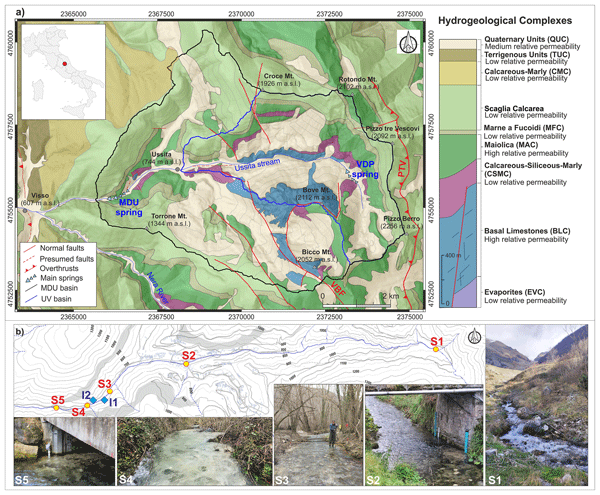
Discharge measurements: As reported in Section 2.2.1 (lines 149-150), we mainly used continuous discharge data collected from two stream sections with reliable rating curves. We have chosen the spot stream discharge measurements dates in periods mostly falling within the recession curve (cf., red dots in Fig. 5): it was possible by checking remotely the stream-level dataloggers (placed in stream sections S2 and S5 in Fig. 1). Spot measuremets by the OTT MF Pro also allowed us to assess the performance of the rating curves during the recession phase, where baseflow contribution is dominant. Combining continuous and discrete monitoring enabled us to develop robust conclusions, which help us understand stream segments primarily fed by groundwater moving from the stream headwaters toward section S5.
Drone flight: Regarding the use of a single thermal drone flight, it should not be seen as a lack of information, but rather as an optimization of the cost/benefit ratio to achieve the best possible result, given the multiple factors involved in a complex, mountainous region. We have a new drone flight conducted in summer 2025, the results of which will be included in the revised version of the manuscript. In any case, the thermal image we presented supported the findings of the discharge data analysis, enabling the identification of the main inflow on both the right and left banks of the stream. It should be noted that the drone flight was carried out in winter 2025, when vegetation effects were negligible. Since groundwater temperatures are often more stable than those of the surrounding land (including stream water), the absence of vegetation makes this contrast easier to see. The main groundwater inflow points into the stream were carefully identified using a drone survey and subsequently confirmed by visual inspections. In these conditions, stream discharge data, coupled with thermal drone imagery, enabled robust conclusions about the location of stretches characterized by groundwater inflow, thereby defining geochemical sampling points. In the discussion section, we will add new text to emphasize that, in the mountain region, the best practice is to acquire basic, insightful information to understand the hydrogeological system. Overall, we believe that the data analyses are not oversimplified and yield robust conclusions that can be easily incorporated into water management systems.
Comment 1: a critical uncertainty quantification and propagation to the derived quantities.
Answer: We thank the Reviewer for this valuable comment. We fully agree that an uncertainty quantification and its propagation to the derived quantities would provide a more robust assessment of the water balance components. In the revised version of the manuscript, we will better highlight and discuss this aspect, providing possible directions for how such analyses could be implemented in future studies.
However, a comprehensive uncertainty analysis is beyond the scope of the present work, which primarily aims to present an integrated and preliminary quantitative framework for investigating surface–groundwater interactions in complex basins. The manuscript focuses on demonstrating which instruments, methods, and datasets can support this type of analysis, and what kind of insights can be derived.
To provide at least a preliminary quantification of uncertainty, we will add one or more additional datasets in the revised version, which expand the ensemble of possible water balance estimates and yield a more robust characterization of the overall uncertainty. We emphasize that this represents a basic approach, while more sophisticated methods could further improve the quantification. Nonetheless, maintaining this level of simplicity is appropriate given the length and scope of the manuscript.
Comment 2: Although the authors’ conclusions may be correct, the fact that many data are collected at a relatively coarse spatial and temporal scale is an issue that should be discussed more critically and taken into consideration.
Answer: We thank the Reviewer for this constructive comment. We agree that the spatial and temporal resolution of some datasets represents a limitation that should be discussed more critically. In the revised version of the manuscript, we will explicitly address this aspect in the Discussion section.
Note that most of the datasets used in our analysis (e.g., MCM, IT-SNOW, and MOD16A2) have relatively fine spatial resolutions of about 1 km (MCM) and 500 m (IT-SNOW and MOD16A2), which are among the most accurate and detailed currently available for the study area. Only a few datasets, such as MERIDA, IMERG, ERA5, and EUMETSAT LSA SAF have coarser resolutions exceeding 5 km, which may introduce additional uncertainty and smoothing effects in the spatial variability of hydrological processes.
We will also verify, during the revision process, whether more recent or higher-resolution datasets have become available and could be incorporated or compared to improve the analysis.
Comment 3: It is somewhat disappointing to see a study focusing on groundwater–surface water interactions that does not actually include data (particularly high-resolution time series) from piezometers. It is also unclear how the spring water was sampled and how the springs were gauged. I do not see a dataset that truly captures the spatio-temporal dynamics of groundwater–surface water interactions; rather, it seems to describe the contribution of the springs to the river. But what about the contribution of the river to the groundwater system? Where is the interaction?.
Answer: We respectfully disagree with the Reviewer on this point. As clearly stated in the manuscript, the Ussita stream is primarily sustained by groundwater in specific stream stretches, as confirmed by the BFI computed from streamflow data recorded at stream sections S2 and S5 (BFI values of 80% and 90%, respectively). It is a key point because the analysis of stream discharge during no-recharge periods provides information on the groundwater system without the need for piezometric data, which, as stressed, are challenging to collect in mountainous areas since piezometers must be drilled at high depth to reach the piezometric surface. Since there are no piezometers in the area, this does not mean that groundwater cannot be studied. During the no-recharge period, the stream water is spring water; thus, monitoring the stream discharge effectively means monitoring groundwater (e.g., . Thanks to drone flight, we also identified some punctual springs between sections S3 and S5, the water of which has been sampled together with stream water during the measurement campaigns.
Thanks to the integrated approach, we captured the spatio-temporal dynamics of groundwater–surface water interactions. Gaining stream is one of the possible scenarios of the GW-SW interactions (Irvine et al., 2024), which are highly dependent on the spatial scale through which their interaction occurs. Using streamflow data and other techniques, we demonstrated where and how GW-SW interactions occur. We carefully located stream stretches where groundwater feeds the stream, and highlighted stretches where no interactions occur (e.g., the stream flow remains almost constant between sections S1 and S3). The Ussita stream is, especially in the headwaters (section S2) and at the catchment closure (between sections S3 and S5), a gaining stream, where the surface water body increases in volume through seepage, fracture flow, and macropore discharge (e.g., Irvine et al., 2024).Comment 4: The work would greatly benefit from a model-based interpretation of the results. Would a hydrological model support these conclusions?.
Answer: We thank the Reviewer for this important comment. We agree that a model-based interpretation could provide additional insight into the processes discussed in this study and how to build a model suitable for reproducing hydrological processes in the area (see, for example, Kavetski and Fenicia, 2011). However, including a full modeling experiment would substantially lengthen the manuscript and fall outside the current scope, which focuses on developing an integrated and preliminary framework based on the available data.
This study, nevertheless, represents a fundamental step toward any future modeling effort (see, for example, Anderson et al., 2015; Enemark et al., 2019). Our results already highlight the challenges of building and calibrating a hydrological model in such a complex basin, given the heterogeneity of data sources, scales, and hydrological conditions (see, for example, Azimi et al., 2022). In the revised version, we will include a discussion that emphasizes these aspects and the potential role of modeling as a natural extension of this work.
References
Anderson, M.P., Woessner, W.W., & Hunt, R.J.: Modeling Purpose and Conceptual Model, Applied Groundwater Modeling, Elsevier Inc, pp. 27-67, doi: 10.1016/B978-0-08-091638-5.00002-X, 2015.
Azimi, S., Massari, C., Formetta, G., Barbetta, S., Tazioli, A., Fronzi, D., Modanesi, S., Tarpanelli, A., and Rigon, R.: On understanding mountainous carbonate basins of the Mediterranean using parsimonious modeling solutions, HESS, 27(24), 4485-4503, doi:10.5194/hess-27-4485-2023, 2023.
Enemark, T., Peeters, L. J., Mallants, D., & Batelaan, O.: Hydrogeological conceptual model building and testing: A review. Journal of Hydrology, 569, 310-329, doi: 10.1016/j.jhydrol.2018.12.007,2019.
Irvine, D.J., Singha, K., Kurylyk, B.L., Briggs, M.A., Sebastian, Y., Tait, D.R., & Helton, A.M.: Groundwater-Surface water interactions research: Past trends and future directions. Journal of Hydrology, 644, 132061, doi: 10.1016/j.jhydrol.2024.132061, 2024.
Kavetski, D., & Fenicia, F.: Elements of a flexible approach for conceptual hydrological modeling: 2. Application and experimental insights. Water Resources Research, 47(11), doi: 10.1029/2010WR010174, 2011.Citation: https://doi.org/10.5194/egusphere-2025-4368-AC1
-
AC1: 'Reply on RC1', Lucio Di Matteo, 06 Nov 2025
-
CC1: 'Comment on egusphere-2025-4368', Massimiliano Schiavo, 16 Nov 2025
Publisher’s note: this comment is a copy of RC2 and its content was therefore removed on 18 November 2025.
Citation: https://doi.org/10.5194/egusphere-2025-4368-CC1 -
AC3: 'Reply on CC1', Lucio Di Matteo, 04 Dec 2025
The following are the responses to the interactive discussion.
General comments: The paper "Exploring groundwater-surface water interactions and recharge in fractured mountain systems: an integrated approach" examines the relationship between surface and groundwater in an Italian mountain headwater catchment using isotope-based analysis. Despite its aim to understand surface and groundwater patterns, there are significant conceptual and methodological weaknesses that affect its suitability for publication in HESS.
Response: We respectfully disagree with the Reviewer’s general comments about the “significant conceptual and methodological weaknesses” found in the manuscript.
Following the point-by-point answers to the comments.
1. The introduction (Lines 1-75) lacks adequate support for an integrated surface-groundwater analysis. The study doesn't employ a robust, quantitative, model-based approach, which is crucial for a comprehensive understanding of the complex interactions between surface and groundwater systems. It would be beneficial to consider relevant literature (e.g., Camporese et al., 2019; Betterle and Bellin, 2024) that provides quantitative assessments of surface and groundwater relationships at plot and hillslope scales. These studies demonstrate the importance of integrating observational data with numerical modeling to capture the full complexity of hydrological processes.
Response: We thank the reviewer for this comment and agree that numerical modeling can be a powerful tool in many hydrogeological and hydrological studies. However, our manuscript has a different, complementary objective: to provide an integrated experimental characterization of surface–groundwater interactions in a fractured, partially karst mountain basin in a severely data-scarce environment.
The study catchment is located in the Central Apennines, where many mountain systems are tectonically complex, highly heterogeneous, and characterized by limited or absent information for supporting hypotheses on the groundwater system due to difficulties in defining boundary conditions, in estimating groundwater interchanges with neighboring hydrogeological systems, in acquiring reliable hydrogeological properties of complex aquifer feeding the streams, etc. In this framework, the need for experimental data is fundamental before moving to the modelling. As extensively documented in the literature (e.g., Beven, 2007; Clark et al., 2017; Azimi et al., 2022), these conditions render the calibration and validation of numerical groundwater models extremely challenging, or even unfeasible, without a minimal level of monitoring data, which extends beyond plot and hillslope scales. According to Clark et al. (2017), one specific need for hydrological modelling is to obtain better data on hydrological processes by field campaigns and field experiments to advance understanding of the terrestrial component of the water cycle across scales and locations. This is a key point already highlighted by other reference papers, such as Silberstein (2006), who stated, “Modelling is an important accompaniment to measurement, but is no substitute for it; science requires observation, and without that we will cease to progress in understanding our environment, and therefore in managing it appropriately”.
Stressing the need for experimental data, various approaches can be used to simulate groundwater flow in fractured/karst systems, including Equivalent Porous Media (EPV) (e.g., Scanlon et al., 2003). This method is useful for medium to large-scale simulations where modeling individual fractures is computationally expensive, but it can oversimplify the system by ignoring details of fracture networks, potentially leading to inaccuracies in pressure distribution and groundwater flow path. For example, one of the papers suggested by the Reviewer (Betterle and Bellin, 2024) follows this approach (e.g., “In the present work ….we simulated both the superficial loose material and the fractured bedrock below as an equivalent porous media with the hydraulic conductivity that declines with depth”), making it challenging to capture the full complexity of hydrological processes of mountain aquifers characterized by strong tectonic influence, karst and the presence of compartmentalized aquifer systems. Moreover, the other suggested paper (Camporese et al., 2019), even if interesting, focuses on modelling hillslope runoff and, in particular, on simulating the internal transient subsurface stormflow dynamics, a minor issue in the case of the Ussita hydrogeological system, considering the high volume of groundwater flow towards some stream sections, documented through our integrated approach.
For this reason, experimental and field-based analyses represent an essential first step, and in many cases, the only scientifically defensible approach, to constrain hydrogeological functioning and avoid speculative numerical modeling not grounded in field evidence.
Anyway, we appreciate the reviewer’s suggestion to include quantitative modeling; such an approach is beyond the scope and objectives of the present paper and would not be methodologically defensible without the experimental baseline provided by this study. The methodology, data collection procedures, and experimental design represent a substantial field effort and form the essential foundation for any future modeling activity in such complex geological settings. As such, in the revised version of the manuscript, as suggested by the Reviewer, we will include some sentences with new literature about the potential support for an integrated surface-groundwater analysis through modeling, which, however, cannot be conducted without comprehensive monitoring from an integrated experimental approach, which is essential before any quantitative modeling can be meaningfully attempted.
2. The claim of catchment representativeness (Lines 91 and following) is debatable and potentially problematic. Generalizing findings from a single catchment to thousands of others may oversimplify the inherent variability in hydrological systems. The Instantaneous Unit Hydrograph (IUH) varies significantly between cases, as do geomorphological structures and recharge patterns. Rigon et al. (2015) provide valuable insights into this variability, emphasizing the need for caution when extrapolating results from a single catchment study.
Response: We thank the reviewer for raising this point. We would like to clarify that we do not extrapolate the hydrological behavior of our study catchment to other basins, nor do we claim that the results observed here are representative of thousands of other catchments. Our work does not aim to generalize catchment responses or to propose a common IUH or GIUH framework, nor does it attempt to model the catchment using these concepts.
On the contrary, the manuscript presents a transferable methodological approach, not transferable hydrological results. This point is clearly stated at the end of the introduction section “Although developed for the Ussita catchment, the methodology is designed to be adaptable to other Mediterranean mountain catchments and worldwide fractured systems with limited high-elevation monitoring” and at the end of the conclusions section, “In conclusion, the techniques and methods used for the Ussita stream can serve as a model for guiding field campaigns in other catchments, aiming to identify site-specific conditions responsible for GW inflow, from the point source to the stream stretch”. As clearly stated, we intend to show (i) how complex these fractured and partially karst mountain catchments can be, and (ii) how an integrated experimental strategy, combining multiple observational datasets and analytical methods, can be used to gain insight into their functioning. What is scalable or applicable to other basins is therefore the approach itself, not the specific hydrological response of this catchment. In fact, applying this methodology elsewhere would very likely reveal different hydrological behaviors, structures, and recharge patterns, fully consistent with the variability discussed by Rigon et al. (2015). In this regard, the work of Azimi et al. (2022), which also includes Prof. Rigon as co-author, clearly demonstrates that, in the Nera catchment, which includes the Ussita basin, numerical modeling would not have been feasible without prior experimental characterization (i.e., in that case the recharge area resulted higher than the catchment one as delineated by a full experimental approach based on the application of tracer tests). This reinforces our point that field-based data and integrated experimental analyses are indispensable prerequisites for any reliable modeling effort in such fractured and tectonically complex environments.
We will clarify this further to avoid any misunderstanding and explicitly state that our study does not attempt to generalize catchment behavior nor to invoke GIUH concepts.
3. The high climatic variability in Mediterranean catchments makes it challenging to prove the general validity of the findings. Recharge patterns can vary significantly across Mediterranean regions, and it's unclear how this specific catchment's hydrological patterns could be considered generally valid for such a diverse area. It would be advisable to examine multiple catchments with various geomorphological and climatic patterns to establish more robust, generalizable conclusions. Jiang et al. (2015) demonstrate the importance of analyzing a large number of catchments (108 in their case) to comprehensively understand climate change and human activity impacts on runoff and water resources. This approach allows for capturing regional variability and identifying common or divergent patterns among different catchments. Therefore, analyzing a single catchment and extending its findings may oversimplify hydrological complexities.
Response: We agree that Mediterranean basins exhibit high climatic and geomorphological variability, and that large-sample analyses such as Jiang et al. (2015) are valuable for identifying regional-scale patterns, particularly when based on modeled or readily available hydrological indicators. However, our study has a very different scope and purpose.
As discussed in our response to Comment 2, we do not aim to generalize hydrological responses. However, this can help advance science in these catchments and enable extrapolation of recharge patterns from our catchment to the entire Mediterranean region. What our manuscript proposes to scale is the methodology, not the results (see answer to comment 2). The integrated experimental approach we present, combining hydrological measurements, hydrochemistry, and isotope analysis, and thermal drone investigation, is unique in the literature and is intended to serve as a framework that can be replicated in other data-scarce mountainous basins, each of which would naturally exhibit distinct hydrological behavior.
Large-sample analysis of the type cited by the Reviewer is not directly comparable to the kind of field-intensive experimental characterization conducted here. Detailed field investigations in fractured and tectonically complex mountain environments require significant logistical effort, infrastructure, and long-term monitoring, which are the basis for developing a reliable numerical modelling approach.
For these reasons, and we trust the Reviewer is well aware of this, applying such a detailed experimental approach to dozens or even hundreds of catchments is not feasible and is rarely attempted in the hydrological literature.
4. The geological introduction (Lines 97-104) provides a classic overview but lacks specific information on how different formations contribute quantitatively to groundwater flow. To strengthen the groundwater investigation aspect, it would be beneficial to address questions about groundwater domain conceptualization, such as: How many layers are present? What is the vertical compartmentalization, or are there semi-confined horizons? What is the connectivity on the z-axis between these formations? How are fractures interpreted - as preferential pathways or double continua? Enemark et al. (2019) could provide useful insights into integrating geological information with hydrological modeling, offering a more comprehensive approach to understanding the physical reality of the system.
Response: Section 2.1, “The Ussita experimental catchment,” details the main hydrogeological complexes and structural features in the study area, and the discussion clearly states how different geological formations (better hydrogeological complexes) contribute quantitatively to groundwater flow. Only after an in-depth analysis of all the data was it possible to draw this information. It is clearly stated in section 4.1 as follows:
Lines 580-587: “In detail, the main advantage of the integrated approach is the investigation of the spatial distribution of GW inflow along the Ussita stream, revealing that most of the baseflow in the stream from S1 to S3 is sustained by the VDP spring (Q ≃ 220 L/s), with a huge baseflow increase between S3 and S5 sections (Q ≃ 650 L/s) delineating, two different sources of alimentation: i) the Maiolica Complex for the VDP spring (EC ≃ 210 μS/cm; SO4 ≃ 2.5 mg/l), and ii) the Base Limestone Complex for punctual and linear springs downstream of the S3 section and up to S5 (EC ≃ 310 μS/cm; SO4 ≃ 18.7 mg/l), with some mixing water with intermediate characteristics in the I1 sampling point related to the Maiolica Complex contribution (Ussita left bank, Fig. 1, EC ≃ 264 μS/cm; SO4 ≃ 6.9 mg/l)”.
We are aware of the suggested interesting paper by Enemark et al. (2019) as other pioneering papers, such as Anderson and Woessner (1992). As reported by Enemark et al. (2019), “The development of conceptual models is based on the available geological and hydrological information, which are observed data, such as water levels, borehole information, and tracer concentrations, but often also include a component of soft knowledge, such as geological insights or expert interpretation.” As stressed above, the objective of our work is not to define a conceptual model for numerical modeling (this term is not used in the manuscript), but to acquire information to support hypotheses about the groundwater system through an integrated approach, leaving to future studies the attempt to define a conceptual model for numerical modeling.
Our findings identify the main hydrogeological units, quantify their contribution to streamflow, and delineate where these contributions occur. Using the water budget, we also constrained the extent of the recharge area, which is essential for defining boundary conditions. We also evaluated the imbalance between groundwater inflow and outflow, a key challenge in complex hydrogeological systems. The questions raised by the Reviewer concern the practical implementation of the numerical modelling, which requires a 3-D schematization of the main aquifers (including their interconnections, if present) and the definition of their hydrogeological properties, which are very useful but outside the scope of our study. We want to point out that the set of questions raised by Reviewer clashes with the complexity of the study basin, which is located in a highly heterogeneous and tectonically deformed carbonate system, fractured, where simple hydrogeological assumptions, such as laterally continuous layers, well-defined confined or unconfined aquifers, or vertically structured flow domains, can oversimplify the nature of the problem. This problem has also been pointed out by Silberstein (2006), who reported, “Models are also useful for exploring scenarios that cannot be tested in the real world. However, while this last use is a rapidly expanding one, it is also the most dangerous, as high-level managers appreciate the nice graphics and, possibly, simplistic sets of options, it can be easy to lose sight of the limitations of the process that generated them”. For this reason, a quantitative definition of discrete layers or vertical compartments is beyond what can be supported by available field information and would risk introducing unwarranted assumptions.
We will revise the text, adding aspects reported in the literature, as suggested by the Reviewer and other reference papers, to explicitly explain that the experimental evidence from our integrated approach can support the definition of hypotheses about the groundwater system, which, in turn, can support future modelling approaches.
5. Figure 1 would benefit from including a map of Italy to frame the catchment's location. This addition would provide important context for readers unfamiliar with the study area and help situate the research within the broader geographical landscape of Italy.
Response: Figure 1 already includes a map of Italy to frame the catchment's location. Please check the preprint version carefully.
6. The use of different climate products (ERA5, GRISO, etc.) requires more explanation regarding their disparate input datasets, spatial resolutions, and interpretations of phenomena. These products have different underlying data sources, spatial resolutions, and focus on different aspects of climate. An analysis of biases and their impacts on basin recharge would be helpful to understand how these differences affect the study's results. Consider discussing the impact of time steps on bias correction and providing relevant plots. It would be beneficial to address questions such as: What are the differences in quantiles and extreme events between these products? Do these products undergo bias correction (except for reanalysis)? What is the impact of these products' heterogeneous nature on basin recharge at this scale? Canon et al. (2015) could provide valuable guidance on addressing these issues.
Response: We thank the Reviewer for this detailed observation. We agree that climate products differ in terms of input data, spatial resolution, and methodological assumptions, and that these aspects are important in climate-focused studies. However, the scope of our work differs substantially from that of Cannon et al. (2015) or other climatological investigations centered on high-resolution bias correction or extreme-event analysis.
Our analysis is conducted on a monthly timescale to capture broad seasonal climatic patterns rather than short-duration extremes. For this reason, differences in quantiles of sub-monthly extremes, which are highly relevant for climate-model evaluation, are not directly applicable to our experimental hydrogeological framework. We fully acknowledge that all climatic products carry uncertainties, but it is important to note that observational datasets also include errors, and reanalysis products similarly require careful interpretation due to scale mismatch and interpolation biases (e.g., Ebert et al., 2007; Massari et al., 2017; Maggioni et al., 2018). In our work, we used the monthly meteo-climatic data from satellite and reanalysis products to derive quantitative mean annual recharge estimates instead of performing climate impact assessments.
We fully agree that an uncertainty quantification and its propagation to the derived quantities would provide a more robust assessment of the water balance components. In the revised manuscript, we will more clearly highlight and discuss this aspect and provide possible directions for implementing such analyses in future studies.
However, a comprehensive uncertainty analysis is beyond the scope of the present work, which primarily aims to present an integrated and preliminary quantitative framework for investigating surface–groundwater interactions in complex basins. The manuscript focuses on demonstrating which instruments, methods, and datasets can support this type of analysis and what insights can be derived.
To provide at least a preliminary quantification of uncertainty, we will add one or more additional datasets in the revised version, which expand the ensemble of possible water balance estimates and yield a more robust characterization of the overall uncertainty. We emphasize that this represents a basic approach, while more sophisticated methods could further improve the quantification. Nonetheless, maintaining this level of simplicity is appropriate given the length and scope of the manuscript.
7. The baseflow quantification method could be more robust. Equation (4) is a top-down approach that may need validation before being employed. The use of simplified analytical equations to estimate baseflow and groundwater recharge from stream discharge records has significant limitations, particularly in complex hydrogeological systems. Such equations often fail to account for the heterogeneity of hydraulic properties, vertical stratification of aquifer layers, and intricate interactions between groundwater and surface water bodies, including leakage phenomena. Consider the limitations highlighted by Halford & Mayer (2000), Bresciani et al. (2016), Woessner (2000), and Betterle and Bellin (2024). These studies collectively underscore the inadequacy of simplified baseflow equations and advocate for the use of numerical groundwater flow models to accurately quantify baseflow and aquifer-stream exchanges. Betterle and Bellin (2024) even more underlined the role of groundwater fluxes in complex landscapes. Groundwater‐fed surface drainage networks under various morphological and geological settings show a complex behavior, following a Gamma distribution, whose parameters are modulated by recharge, hydraulic conductivity, and topography, to be carefully assessed and validated for each case study.
Response: We respectfully disagree. We think that simplified analytical approaches have limitations, particularly in hydrogeologically complex environments. (Note that 'simplified' does not mean 'inaccurate' here). Most of the papers suggested by the Reviewer analyzed hypothetical catchments in mountain areas or combined hypothetical and field sites (e.g., Halford & Mayer, 2000). Among the suggested papers, Halford & Mayer (2000) presented the results of baseflow separation by a modelling approach considering only one karst limestone and dolomite catchment having an extension of more than 20,000 km2, with a minimum estimated BF of 44 m3/s, the latter of two orders of magnitude higher than the mean BF of our case study. Moreover, as highlighted by Halford & Mayer (2000), in such systems, multiple processes (e.g., drainage from bank storage) can affect the recession curves. The approach we used to estimate the BF (LH method) is one of the possible techniques, but in our case, the problems highlighted by Halford & Mayer (2000) are absent. Anyway, Xie et al. (2020) reported that digital filter methods performed well across 1145 catchments in the USA, including those with high infiltration rates, such as the Ussita catchment. It is difficult to evaluate the accuracy of baseflow estimation using any baseflow separation methods or modelling approach because baseflow cannot be directly measured, except during periods of no recharging or prolonged dry spells (i.e., in these periods the stream discharge corresponds to BF). Thanks to the Master Recession Curves, we found that during no-recharge periods, stream discharge is described by the Maillet equation (i.e., linear reservoir depletion). Using the recession constant, we computed the k-filter, and we verified that the derived baseflows were appropriate during the available recession periods. In other words, the computed BF data were validated using streamflow during no-recharge periods, once again highlighting the importance of acquiring data. Therefore, even if the BF values are not exact estimators (e.g., during recharge periods), they are reliable for the analyses we have carried out.
Furthermore, note that in our case, the subsurface geometry, fault architecture, hydraulic compartmentalization, and boundary conditions are fundamentally unknown and cannot be meaningfully parameterized with the information currently available. Under these conditions, numerical groundwater models would introduce a high degree of structural uncertainty and risk, yielding results that are not physically constrained.
For this reason, our objective is not to provide a precise quantification of groundwater fluxes but rather to characterize the system's integrated hydrological response. Since we found a linear reservoir depletion, the information on baseflow dynamics we obtained, even if it is not an exact estimator, can be considered as a diagnostic tool to help interpret the system’s behavior in combination with hydrochemical and isotopic evidence.
In the revised version of the manuscript, we will introduce, when presenting the methods, a specific updated literature that used the LH method for BF separation, also in mountain regions.
8. Section 2.7: The water budget calculation should consider leakage for closure. Without accounting for leakage, the water budget may not be accurately represented, potentially leading to misinterpretation of the hydrological processes within the catchment.
Response: Indeed, this was already considered in the water budget calculation. As is well known in complex mountain hydrogeological systems, water budget closure is not determined solely by leakage (groundwater outflow to neighboring hydrogeological systems) but also by groundwater inflow into the catchment (it is well explained in the schematic representation of Fig. 4). In this way, we computed in sections 3.3.1 and 3.3.2 the difference of these two GW components as residuals, which has helped us understand that very few GW inflows come into the catchment.
9. Section 2.8: The estimation of water storage changes using stream recession analysis and the Maillet exponential relationship may be oversimplified. While this method provides a rough approximation, it fails to capture the inherent complexity and heterogeneity of groundwater systems. A more robust approach could involve developing a three-dimensional geological model of the aquifer system, accounting for the spatial variability of hydraulic properties. Recent groundwater modeling studies, such as Schorpp et al. (2025), have emphasized the importance of incorporating heterogeneity into numerical models to accurately represent the subsurface environment. By incorporating heterogeneity into the geological model and subsequently into the numerical groundwater model, researchers can more accurately simulate the spatial and temporal variations in water storage, accounting for the effects of local-scale variations in hydraulic properties and geological structures.
Response: As mentioned in most responses to previous points, developing a three-dimensional geological model of the hydrogeological system is beyond the scope of the manuscript, even though the collected data can support hypotheses about groundwater circulation that may aid further studies involving modeling. According to Kirchner (2009), any analysis is only as good as the data on which it is based. This is particularly important because, although the use of models is a quickly growing area, introducing a basic set of options can ignore the limitations of the processes that created them (e.g., Silberstein, 2006). Since the Maillet equation accurately describes stream discharge during no-recharge periods, the estimation of water storage changes by recession analysis, despite its oversimplification, can still offer valuable insights, especially when incorporated into the mean annual water budget (e.g., Tallaksen, 1995; Raeisi, 2008; Krakauer and Temimi, 2011). Recently, a study by Hameed et al. (2025) investigated the reliability of baseflow recession analysis for estimating long-term changes in groundwater storage in minimally disturbed watersheds in the USA (1144 gauged watersheds). Despite differences in magnitude, storage changes derived from baseflow recession analysis show remarkably similar spatial patterns to those derived from GRACE (for 75% of the catchment analyzed). As reported in Hameed et al. (2025), “that baseflow recession analysis is a reliable, high-resolution proxy for groundwater storage monitoring. It is especially useful in regions with sparse well-level observation networks or where satellite data are too coarse for small watersheds”. The hydrograph recession analysis was also used to estimate streamflow sensitivity to changes in water storage across Europe (725 catchments; Berghuijs et al., 2016). Thus, the method we used (Korkmaz, 1990) provides an estimate of changes in reservoir water storage for the Ussita catchment (e.g., no well-level observation network), which is to be considered satisfactory for computing the mean annual water budget. Although the Korkmaz method has been around for several decades, it is still in use, as shown by recent references (e.g., Abirifard et al., 2022). It addresses two main constraints: the validity of the extrapolated recession curves and the availability of annual recession periods (since, in some years, recharge did not completely stop for a certain period during the observed recession). These issues do not exist for Ussita because the recession curves are clearly defined for each year and well-fitted by the Maillet equation.
Overall, it should be pointed out that the average annual change in water storage we estimated is two orders of magnitude smaller than the water surplus.
In the revised manuscript, we will include references supporting the method used to estimate mean changes in water storage.
Formal issues:
1. Lines 78-81 present direct, open questions in the Introduction. While these questions effectively highlight the study's objectives, they might be more impactful if presented as Highlights. This would allow readers to quickly grasp the key focus areas of the research without disrupting the flow of the introduction.
Response: We will try to modify them accordingly.
2. Equation 2 would benefit from formatting in a Math editor to improve clarity and professional presentation.
Response: It will be modified accordingly.
3. The sub-paragraph structure (e.g., 2.2.2.2) could be simplified for better readability. While detailed organization can be helpful, excessive subdivision can make the paper structure cumbersome, confusing, and annoying for readers.
Response: We will consider the suggestions, including those from Reviewer #1.
The number of authors (13) seems high, given that only 9 actively participated in the work. Consider acknowledging those involved solely in data collection rather than including them as co-authors. This approach would more accurately reflect the contributions to the research and writing process.
Response: Authorship decisions follow the journal guidelines and the standard practices of our research institutions. All authors listed made substantial contributions to the study, either through field design, data collection, data analysis, methodological development, interpretation of results, or manuscript preparation and revision.
In highly field-intensive experimental studies such as ours, conducted in challenging mountainous terrain and involving long-term monitoring, tracer experiments, and coordinated multidisciplinary work, data collection is a core scientific activity. It requires rigorous planning, specialized technical expertise, continuous field presence, and responsibility for the integrity and interpretation of the resulting dataset. In the hydrological community, such contributions are universally recognized as legitimate intellectual input and are standard criteria for authorship in experimental research.
For this reason, excluding colleagues who played essential roles in the design, execution, and scientific interpretation of the field campaign would misrepresent the true nature of the work. The reviewer’s comment appears to overlook the scientific weight and complexity of experimental hydrology, where generating reliable data is itself a substantial research contribution. We trust that this clarification makes it evident why all listed co-authors fully meet authorship criteria.
For these reasons, we will maintain the current author list.
Conclusions of the Reviewer: In conclusion, while the study relies on valuable data, it appears as a preliminary investigation, focusing primarily on isotope data collection and interpretation. The work would benefit from addressing issues of novelty, methodological clarity, conceptual solidity, and case-study representativeness. To strengthen the paper, consider incorporating more robust modeling approaches, expanding the analysis to multiple catchments, and providing more detailed explanations of the methodologies used.
Response: Although the Reviewer highlighted that the manuscript is based on valuable data, the concluding remarks suggest that he did not fully consider the manuscript's overall assessment, overlooking the significant effort involved in monitoring groundwater processes (not only isotope data collection and interpretation) in a data-scarce, structurally complex mountain setting. High-quality field observations of this kind are extremely rare in the Central Apennines and represent precisely the type of foundational knowledge that modelling studies depend on. In regions where the subsurface architecture, hydraulic properties, and boundary conditions are unknown, such experimental datasets are indispensable, and their scientific value goes well beyond a “preliminary investigation.” It is important to emphasize that our study provides new, hard-to-obtain empirical evidence on groundwater–surface water interactions in a basin where modelling alone cannot advance understanding without prior field-based constraints. We trust that this clarification highlights the significance of our contribution for both observational and modelling communities.
Suggested readings:
Abirifard, M., Birk, S., Raeisi, E., Sauter, M. (2022). Dynamic volume in karst aquifers: Parameters affecting the accuracy of estimates from recession analysis. Journal of Hydrology, 612, 128286.
Anderson, M.P., Woessner, W.W., & Hunt, R.J. (2015). Applied groundwater modeling: simulation of flow and advective transport. Academic Press. 535 pp.
Betterle, A., & Bellin, A. (2024). Morphological and Hydrogeological Controls of Groundwater Flows and Water Age Distribution in Mountain Aquifers and Streams. Water Resources Research, 60(11), e2024WR037407. https://doi.org/10.1029/2024WR037407
Beven, K. (2007). Towards integrated environmental models of everywhere: uncertainty, data and modelling as a learning process. Hydrology and Earth System Sciences, 11(1), 460-467.
Bresciani, E., Goderniaux, P., & Batelaan, O. (2016). Hydrogeological characterization of groundwater-dominated lowland catchments. Journal of Hydrology, 542, 813-835.
Camporese, M., Paniconi, C., Putti, M., & McDonnell, J. J. (2019). Fill and Spill Hillslope Runoff Representation With a Richards Equation-Based Model. Water Resources Research, 55(11), 8445-8462. https://doi.org/10.1029/2019WR025726
Cannon, A. J., Sobie, S. R., & Murdock, T. Q. (2015). Bias Correction of GCM Precipitation by Quantile Mapping: How Well Do Methods Preserve Changes in Quantiles and Extremes?. Journal of Climate, 28(16), 6938-6959. https://doi.org/10.1175/JCLI-D-14-00754.1
Clark, M.P., Bierkens, M.F., Samaniego, L., Woods, R.A., Uijlenhoet, R., Bennett, K.E., Pauwels, V.N.R, Cai, X., Wood, A.W., Peters-Lidard, C.D. (2017). The evolution of process-based hydrologic models: historical challenges and the collective quest for physical realism. Hydrology and Earth System Sciences, 21(7), 3427-3440.
Ebert, E.E., Janowiak, J.E., & Kidd, C. (2007). Comparison of near-real-time precipitation estimates from satellite observations and numerical models. Bulletin of the American Meteorological Society, 88(1), 47-64.
Enemark, T., Peeters, L. J., Mallants, D., & Batelaan, O. (2019). Hydrogeological conceptual model building and testing: A review. Journal of Hydrology, 569, 310-329. https://doi.org/10.1016/j.jhydrol.2018.12.007
Halford, K. J., & Mayer, G. C. (2000). Problems associated with estimating ground water discharge and recharge from stream-discharge records. Groundwater, 38(2), 331-342.
Hameed, M., Nayak, M.A., Ahangar, M.A. (2025). Groundwater storage changes in the United States using baseflow recession method: Comparison with GRACE and well observations. Journal of Hydrology: Regional Studies, 62, 102946.
Kirchner, J.W. (2009). Catchments as simple dynamical systems: Catchment characterization, rainfall‐runoff modeling, and doing hydrology backward. Water Resources Research, 45(2), 1-34.
Krakauer, N.Y., Temimi, M. (2011). Stream recession curves and storage variability in small watersheds. Hydrology and Earth System Sciences, 15(7), 2377-2389.
Jiang, C., Xiong, L., Wang, D., Liu, P., Guo, S., & Xu, C. Y. (2015). Separating the impacts of climate change and human activities on runoff using the Budyko-type equations with time-varying parameters. Journal of Hydrology, 522, 326-338. https://doi.org/10.1016/j.jhydrol.2014.12.060
Massari, C., Crow, W., Brocca, L. (2017). An assessment of the performance of global rainfall estimates without ground-based observations. Hydrology and Earth System Sciences, 21(9), 4347-4361.
Maggioni, V., Massari, C. (2018). On the performance of satellite precipitation products in riverine flood modeling: A review. Journal of Hydrology, 558, 214-224.
Raeisi, E. (2008). Ground-water storage calculation in karst aquifers with alluvium or no-flow boundaries. Journal of Cave and Karst Studies, 70(1), 62–70.
Rigon, R., Bancheri, M., & Formetta, G. (2015). The geomorphological unit hydrograph from a historical-critical perspective. Earth Surface Processes and Landforms, 41(1), 27-37. https://doi.org/10.1002/esp.3855
Scanlon, B.R., Mace, R.E., Barrett, M.E., Smith, B. (2003). Can we simulate regional groundwater flow in a karst system using equivalent porous media models? Case study, Barton Springs Edwards aquifer, USA. Journal of Hydrology, 276(1-4), 137-158.
Schorpp, L., Egli, N., Straubhaar, J., & Renard, P. ArchPy and MODFLOW: Toward a General Integration of Heterogeneity into Groundwater Models. Groundwater. https://doi.org/10.1111/gwat.70028
Silberstein, R.P. (2006). Hydrological models are so good, do we still need data? Environmental Modelling & Software, 21(9), 1340-1352.
Tallaksen, L. M. (1995). A review of baseflow recession analysis. Journal of Hydrology, 165(1-4), 349-370.
Citation: https://doi.org/10.5194/egusphere-2025-4368-AC3
-
AC3: 'Reply on CC1', Lucio Di Matteo, 04 Dec 2025
-
RC2: 'Comment on egusphere-2025-4368', Massimiliano Schiavo, 17 Nov 2025
The paper "Exploring groundwater-surface water interactions and recharge in fractured mountain systems: an integrated approach" examines the relationship between surface and groundwater in an Italian mountain headwater catchment using isotope-based analysis. Despite its aim to understand surface and groundwater patterns, there are significant conceptual and methodological weaknesses that affect its suitability for publication in HESS:
- The introduction (Lines 1-75) lacks adequate support for an integrated surface-groundwater analysis. The study doesn't employ a robust, quantitative, model-based approach, which is crucial for a comprehensive understanding of the complex interactions between surface and groundwater systems. It would be beneficial to consider relevant literature (e.g., Camporese et al., 2019; Betterle and Bellin, 2024) that provides quantitative assessments of surface and groundwater relationships at plot and hillslope scales. These studies demonstrate the importance of integrating observational data with numerical modeling to capture the full complexity of hydrological processes.
- The claim of catchment representativeness (Lines 91 and following) is debatable and potentially problematic. Generalizing findings from a single catchment to thousands of others may oversimplify the inherent variability in hydrological systems. The Instantaneous Unit Hydrograph (IUH) varies significantly between cases, as do geomorphological structures and recharge patterns. Rigon et al. (2015) provide valuable insights into this variability, emphasizing the need for caution when extrapolating results from a single catchment study.
- The high climatic variability in Mediterranean catchments makes it challenging to prove the general validity of the findings. Recharge patterns can vary significantly across Mediterranean regions, and it's unclear how this specific catchment's hydrological patterns could be considered generally valid for such a diverse area. It would be advisable to examine multiple catchments with various geomorphological and climatic patterns to establish more robust, generalizable conclusions. Jiang et al. (2015) demonstrate the importance of analyzing a large number of catchments (108 in their case) to comprehensively understand climate change and human activity impacts on runoff and water resources. This approach allows for capturing regional variability and identifying common or divergent patterns among different catchments. Therefore, analyzing a single catchment and extending its findings may oversimplify hydrological complexities.
- The geological introduction (Lines 97-104) provides a classic overview but lacks specific information on how different formations contribute quantitatively to groundwater flow. To strengthen the groundwater investigation aspect, it would be beneficial to address questions about groundwater domain conceptualization, such as: How many layers are present? What is the vertical compartmentalization, or are there semi-confined horizons? What is the connectivity on the z-axis between these formations? How are fractures interpreted - as preferential pathways or double continua? Enemark et al. (2019) could provide useful insights into integrating geological information with hydrological modeling, offering a more comprehensive approach to understanding the physical reality of the system.
- Figure 1 would benefit from including a map of Italy to frame the catchment's location. This addition would provide important context for readers unfamiliar with the study area and help situate the research within the broader geographical landscape of Italy.
- The use of different climate products (ERA5, GRISO, etc.) requires more explanation regarding their disparate input datasets, spatial resolutions, and interpretations of phenomena. These products have different underlying data sources, spatial resolutions, and focus on different aspects of climate. An analysis of biases and their impacts on basin recharge would be helpful to understand how these differences affect the study's results. Consider discussing the impact of time steps on bias correction and providing relevant plots. It would be beneficial to address questions such as: What are the differences in quantiles and extreme events between these products? Do these products undergo bias correction (except for reanalysis)? What is the impact of these products' heterogeneous nature on basin recharge at this scale? Canon et al. (2015) could provide valuable guidance on addressing these issues.
- The baseflow quantification method could be more robust. Equation (4) is a top-down approach that may need validation before being employed. The use of simplified analytical equations to estimate baseflow and groundwater recharge from stream discharge records has significant limitations, particularly in complex hydrogeological systems. Such equations often fail to account for the heterogeneity of hydraulic properties, vertical stratification of aquifer layers, and intricate interactions between groundwater and surface water bodies, including leakage phenomena. Consider the limitations highlighted by Halford & Mayer (2000), Bresciani et al. (2016), Woessner (2000), and Betterle and Bellin (2024). These studies collectively underscore the inadequacy of simplified baseflow equations and advocate for the use of numerical groundwater flow models to accurately quantify baseflow and aquifer-stream exchanges. Betterle and Bellin (2024) even more underlined the role of groundwater fluxes in complex landscapes. Groundwater‐fed surface drainage networks under various morphological and geological settings show a complex behavior, following a Gamma distribution, whose parameters are modulated by recharge, hydraulic conductivity, and topography, to be carefully assessed and validated for each case study.
- Section 2.7: The water budget calculation should consider leakage for closure. Without accounting for leakage, the water budget may not be accurately represented, potentially leading to misinterpretation of the hydrological processes within the catchment.
- Section 2.8: The estimation of water storage changes using stream recession analysis and the Maillet exponential relationship may be oversimplified. While this method provides a rough approximation, it fails to capture the inherent complexity and heterogeneity of groundwater systems. A more robust approach could involve developing a three-dimensional geological model of the aquifer system, accounting for the spatial variability of hydraulic properties. Recent groundwater modeling studies, such as Schorpp et al. (2025), have emphasized the importance of incorporating heterogeneity into numerical models to accurately represent the subsurface environment. By incorporating heterogeneity into the geological model and subsequently into the numerical groundwater model, researchers can more accurately simulate the spatial and temporal variations in water storage, accounting for the effects of local-scale variations in hydraulic properties and geological structures.
Formal issues:
- Lines 78-81 present direct, open questions in the Introduction. While these questions effectively highlight the study's objectives, they might be more impactful if presented as Highlights. This would allow readers to quickly grasp the key focus areas of the research without disrupting the flow of the introduction.
- Equation 2 would benefit from formatting in a Math editor to improve clarity and professional presentation.
- The sub-paragraph structure (e.g., 2.2.2.2) could be simplified for better readability. While detailed organization can be helpful, excessive subdivision can make the paper structure cumbersome, confusing, and annoying for readers.
- The number of authors (13) seems high, given that only 9 actively participated in the work. Consider acknowledging those involved solely in data collection rather than including them as co-authors. This approach would more accurately reflect the contributions to the research and writing process.
In conclusion, while the study relies on valuable data, it appears as a preliminary investigation, focusing primarily on isotope data collection and interpretation. The work would benefit from addressing issues of novelty, methodological clarity, conceptual solidity, and case-study representativeness. To strengthen the paper, consider incorporating more robust modeling approaches, expanding the analysis to multiple catchments, and providing more detailed explanations of the methodologies used.
Suggested readings:
Betterle, A., & Bellin, A. (2024). Morphological and Hydrogeological Controls of Groundwater Flows and Water Age Distribution in Mountain Aquifers and Streams. Water Resources Research, 60(11), e2024WR037407. https://doi.org/10.1029/2024WR037407
Bresciani, E., Goderniaux, P., & Batelaan, O. (2016). Hydrogeological characterization of groundwater-dominated lowland catchments. Journal of Hydrology, 542, 813-835.
Cannon, A. J., Sobie, S. R., & Murdock, T. Q. (2015). Bias Correction of GCM Precipitation by Quantile Mapping: How Well Do Methods Preserve Changes in Quantiles and Extremes?. Journal of Climate, 28(16), 6938-6959. https://doi.org/10.1175/JCLI-D-14-00754.1
Camporese, M., Paniconi, C., Putti, M., & McDonnell, J. J. (2019). Fill and Spill Hillslope Runoff Representation With a Richards Equation-Based Model. Water Resources Research, 55(11), 8445-8462. https://doi.org/10.1029/2019WR025726
Enemark, T., Peeters, L. J., Mallants, D., & Batelaan, O. (2019). Hydrogeological conceptual model building and testing: A review. Journal of Hydrology, 569, 310-329. https://doi.org/10.1016/j.jhydrol.2018.12.007
Jiang, C., Xiong, L., Wang, D., Liu, P., Guo, S., & Xu, C. Y. (2015). Separating the impacts of climate change and human activities on runoff using the Budyko-type equations with time-varying parameters. Journal of Hydrology, 522, 326-338. https://doi.org/10.1016/j.jhydrol.2014.12.060
Halford, K. J., & Mayer, G. C. (2000). Problems associated with estimating ground water discharge and recharge from stream-discharge records. Groundwater, 38(2), 331-342.
Schorpp, L., Egli, N., Straubhaar, J., & Renard, P. ArchPy and MODFLOW: Toward a General Integration of Heterogeneity into Groundwater Models. Groundwater. https://doi.org/10.1111/gwat.70028
Rigon, R., Bancheri, M., & Formetta, G. (2015). The geomorphological unit hydrograph from a historical-critical perspective. Earth Surface Processes and Landforms, 41(1), 27-37. https://doi.org/10.1002/esp.3855
Woessner, W. W. (2000). Stream and fluvial plain ground water interactions: Rescaling hydrogeologic thought. Groundwater, 38(3), 423-429.
Citation: https://doi.org/10.5194/egusphere-2025-4368-RC2 -
AC2: 'Reply on RC2', Lucio Di Matteo, 04 Dec 2025
Reply to Reviewer#2
The authors would like to thank the Reviewer for their time in reviewing the manuscript.
General comments: The paper "Exploring groundwater-surface water interactions and recharge in fractured mountain systems: an integrated approach" examines the relationship between surface and groundwater in an Italian mountain headwater catchment using isotope-based analysis. Despite its aim to understand surface and groundwater patterns, there are significant conceptual and methodological weaknesses that affect its suitability for publication in HESS.
Response: We respectfully disagree with the Reviewer’s general comments about the “significant conceptual and methodological weaknesses” found in the manuscript.
Following the point-by-point answers to the comments.
1. The introduction (Lines 1-75) lacks adequate support for an integrated surface-groundwater analysis. The study doesn't employ a robust, quantitative, model-based approach, which is crucial for a comprehensive understanding of the complex interactions between surface and groundwater systems. It would be beneficial to consider relevant literature (e.g., Camporese et al., 2019; Betterle and Bellin, 2024) that provides quantitative assessments of surface and groundwater relationships at plot and hillslope scales. These studies demonstrate the importance of integrating observational data with numerical modeling to capture the full complexity of hydrological processes.
Response: We thank the reviewer for this comment and agree that numerical modeling can be a powerful tool in many hydrogeological and hydrological studies. However, our manuscript has a different, complementary objective: to provide an integrated experimental characterization of surface–groundwater interactions in a fractured, partially karst mountain basin in a severely data-scarce environment.
The study catchment is located in the Central Apennines, where many mountain systems are tectonically complex, highly heterogeneous, and characterized by limited or absent information for supporting hypotheses on the groundwater system due to difficulties in defining boundary conditions, in estimating groundwater interchanges with neighboring hydrogeological systems, in acquiring reliable hydrogeological properties of complex aquifer feeding the streams, etc. In this framework, the need for experimental data is fundamental before moving to the modelling. As extensively documented in the literature (e.g., Beven, 2007; Clark et al., 2017; Azimi et al., 2022), these conditions render the calibration and validation of numerical groundwater models extremely challenging, or even unfeasible, without a minimal level of monitoring data, which extends beyond plot and hillslope scales. According to Clark et al. (2017), one specific need for hydrological modelling is to obtain better data on hydrological processes by field campaigns and field experiments to advance understanding of the terrestrial component of the water cycle across scales and locations. This is a key point already highlighted by other reference papers, such as Silberstein (2006), who stated, “Modelling is an important accompaniment to measurement, but is no substitute for it; science requires observation, and without that we will cease to progress in understanding our environment, and therefore in managing it appropriately”.
Stressing the need for experimental data, various approaches can be used to simulate groundwater flow in fractured/karst systems, including Equivalent Porous Media (EPV) (e.g., Scanlon et al., 2003). This method is useful for medium to large-scale simulations where modeling individual fractures is computationally expensive, but it can oversimplify the system by ignoring details of fracture networks, potentially leading to inaccuracies in pressure distribution and groundwater flow path. For example, one of the papers suggested by the Reviewer (Betterle and Bellin, 2024) follows this approach (e.g., “In the present work ….we simulated both the superficial loose material and the fractured bedrock below as an equivalent porous media with the hydraulic conductivity that declines with depth”), making it challenging to capture the full complexity of hydrological processes of mountain aquifers characterized by strong tectonic influence, karst and the presence of compartmentalized aquifer systems. Moreover, the other suggested paper (Camporese et al., 2019), even if interesting, focuses on modelling hillslope runoff and, in particular, on simulating the internal transient subsurface stormflow dynamics, a minor issue in the case of the Ussita hydrogeological system, considering the high volume of groundwater flow towards some stream sections, documented through our integrated approach.
For this reason, experimental and field-based analyses represent an essential first step, and in many cases, the only scientifically defensible approach, to constrain hydrogeological functioning and avoid speculative numerical modeling not grounded in field evidence.
Anyway, we appreciate the reviewer’s suggestion to include quantitative modeling; such an approach is beyond the scope and objectives of the present paper and would not be methodologically defensible without the experimental baseline provided by this study. The methodology, data collection procedures, and experimental design represent a substantial field effort and form the essential foundation for any future modeling activity in such complex geological settings. As such, in the revised version of the manuscript, as suggested by the Reviewer, we will include some sentences with new literature about the potential support for an integrated surface-groundwater analysis through modeling, which, however, cannot be conducted without comprehensive monitoring from an integrated experimental approach, which is essential before any quantitative modeling can be meaningfully attempted.
2. The claim of catchment representativeness (Lines 91 and following) is debatable and potentially problematic. Generalizing findings from a single catchment to thousands of others may oversimplify the inherent variability in hydrological systems. The Instantaneous Unit Hydrograph (IUH) varies significantly between cases, as do geomorphological structures and recharge patterns. Rigon et al. (2015) provide valuable insights into this variability, emphasizing the need for caution when extrapolating results from a single catchment study.
Response: We thank the reviewer for raising this point. We would like to clarify that we do not extrapolate the hydrological behavior of our study catchment to other basins, nor do we claim that the results observed here are representative of thousands of other catchments. Our work does not aim to generalize catchment responses or to propose a common IUH or GIUH framework, nor does it attempt to model the catchment using these concepts.
On the contrary, the manuscript presents a transferable methodological approach, not transferable hydrological results. This point is clearly stated at the end of the introduction section “Although developed for the Ussita catchment, the methodology is designed to be adaptable to other Mediterranean mountain catchments and worldwide fractured systems with limited high-elevation monitoring” and at the end of the conclusions section, “In conclusion, the techniques and methods used for the Ussita stream can serve as a model for guiding field campaigns in other catchments, aiming to identify site-specific conditions responsible for GW inflow, from the point source to the stream stretch”. As clearly stated, we intend to show (i) how complex these fractured and partially karst mountain catchments can be, and (ii) how an integrated experimental strategy, combining multiple observational datasets and analytical methods, can be used to gain insight into their functioning. What is scalable or applicable to other basins is therefore the approach itself, not the specific hydrological response of this catchment. In fact, applying this methodology elsewhere would very likely reveal different hydrological behaviors, structures, and recharge patterns, fully consistent with the variability discussed by Rigon et al. (2015). In this regard, the work of Azimi et al. (2022), which also includes Prof. Rigon as co-author, clearly demonstrates that, in the Nera catchment, which includes the Ussita basin, numerical modeling would not have been feasible without prior experimental characterization (i.e., in that case the recharge area resulted higher than the catchment one as delineated by a full experimental approach based on the application of tracer tests). This reinforces our point that field-based data and integrated experimental analyses are indispensable prerequisites for any reliable modeling effort in such fractured and tectonically complex environments.
We will clarify this further to avoid any misunderstanding and explicitly state that our study does not attempt to generalize catchment behavior nor to invoke GIUH concepts.
3. The high climatic variability in Mediterranean catchments makes it challenging to prove the general validity of the findings. Recharge patterns can vary significantly across Mediterranean regions, and it's unclear how this specific catchment's hydrological patterns could be considered generally valid for such a diverse area. It would be advisable to examine multiple catchments with various geomorphological and climatic patterns to establish more robust, generalizable conclusions. Jiang et al. (2015) demonstrate the importance of analyzing a large number of catchments (108 in their case) to comprehensively understand climate change and human activity impacts on runoff and water resources. This approach allows for capturing regional variability and identifying common or divergent patterns among different catchments. Therefore, analyzing a single catchment and extending its findings may oversimplify hydrological complexities.
Response: We agree that Mediterranean basins exhibit high climatic and geomorphological variability, and that large-sample analyses such as Jiang et al. (2015) are valuable for identifying regional-scale patterns, particularly when based on modeled or readily available hydrological indicators. However, our study has a very different scope and purpose.
As discussed in our response to Comment 2, we do not aim to generalize hydrological responses. However, this can help advance science in these catchments and enable extrapolation of recharge patterns from our catchment to the entire Mediterranean region. What our manuscript proposes to scale is the methodology, not the results (see answer to comment 2). The integrated experimental approach we present, combining hydrological measurements, hydrochemistry, and isotope analysis, and thermal drone investigation, is unique in the literature and is intended to serve as a framework that can be replicated in other data-scarce mountainous basins, each of which would naturally exhibit distinct hydrological behavior.
Large-sample analysis of the type cited by the Reviewer is not directly comparable to the kind of field-intensive experimental characterization conducted here. Detailed field investigations in fractured and tectonically complex mountain environments require significant logistical effort, infrastructure, and long-term monitoring, which are the basis for developing a reliable numerical modelling approach.
For these reasons, and we trust the Reviewer is well aware of this, applying such a detailed experimental approach to dozens or even hundreds of catchments is not feasible and is rarely attempted in the hydrological literature.
4. The geological introduction (Lines 97-104) provides a classic overview but lacks specific information on how different formations contribute quantitatively to groundwater flow. To strengthen the groundwater investigation aspect, it would be beneficial to address questions about groundwater domain conceptualization, such as: How many layers are present? What is the vertical compartmentalization, or are there semi-confined horizons? What is the connectivity on the z-axis between these formations? How are fractures interpreted - as preferential pathways or double continua? Enemark et al. (2019) could provide useful insights into integrating geological information with hydrological modeling, offering a more comprehensive approach to understanding the physical reality of the system.
Response: Section 2.1, “The Ussita experimental catchment,” details the main hydrogeological complexes and structural features in the study area, and the discussion clearly states how different geological formations (better hydrogeological complexes) contribute quantitatively to groundwater flow. Only after an in-depth analysis of all the data was it possible to draw this information. It is clearly stated in section 4.1 as follows:
Lines 580-587: “In detail, the main advantage of the integrated approach is the investigation of the spatial distribution of GW inflow along the Ussita stream, revealing that most of the baseflow in the stream from S1 to S3 is sustained by the VDP spring (Q ≃ 220 L/s), with a huge baseflow increase between S3 and S5 sections (Q ≃ 650 L/s) delineating, two different sources of alimentation: i) the Maiolica Complex for the VDP spring (EC ≃ 210 μS/cm; SO4 ≃ 2.5 mg/l), and ii) the Base Limestone Complex for punctual and linear springs downstream of the S3 section and up to S5 (EC ≃ 310 μS/cm; SO4 ≃ 18.7 mg/l), with some mixing water with intermediate characteristics in the I1 sampling point related to the Maiolica Complex contribution (Ussita left bank, Fig. 1, EC ≃ 264 μS/cm; SO4 ≃ 6.9 mg/l)”.
We are aware of the suggested interesting paper by Enemark et al. (2019) as other pioneering papers, such as Anderson and Woessner (1992). As reported by Enemark et al. (2019), “The development of conceptual models is based on the available geological and hydrological information, which are observed data, such as water levels, borehole information, and tracer concentrations, but often also include a component of soft knowledge, such as geological insights or expert interpretation.” As stressed above, the objective of our work is not to define a conceptual model for numerical modeling (this term is not used in the manuscript), but to acquire information to support hypotheses about the groundwater system through an integrated approach, leaving to future studies the attempt to define a conceptual model for numerical modeling.
Our findings identify the main hydrogeological units, quantify their contribution to streamflow, and delineate where these contributions occur. Using the water budget, we also constrained the extent of the recharge area, which is essential for defining boundary conditions. We also evaluated the imbalance between groundwater inflow and outflow, a key challenge in complex hydrogeological systems. The questions raised by the Reviewer concern the practical implementation of the numerical modelling, which requires a 3-D schematization of the main aquifers (including their interconnections, if present) and the definition of their hydrogeological properties, which are very useful but outside the scope of our study. We want to point out that the set of questions raised by Reviewer clashes with the complexity of the study basin, which is located in a highly heterogeneous and tectonically deformed carbonate system, fractured, where simple hydrogeological assumptions, such as laterally continuous layers, well-defined confined or unconfined aquifers, or vertically structured flow domains, can oversimplify the nature of the problem. This problem has also been pointed out by Silberstein (2006), who reported, “Models are also useful for exploring scenarios that cannot be tested in the real world. However, while this last use is a rapidly expanding one, it is also the most dangerous, as high-level managers appreciate the nice graphics and, possibly, simplistic sets of options, it can be easy to lose sight of the limitations of the process that generated them”. For this reason, a quantitative definition of discrete layers or vertical compartments is beyond what can be supported by available field information and would risk introducing unwarranted assumptions.
We will revise the text, adding aspects reported in the literature, as suggested by the Reviewer and other reference papers, to explicitly explain that the experimental evidence from our integrated approach can support the definition of hypotheses about the groundwater system, which, in turn, can support future modelling approaches.
5. Figure 1 would benefit from including a map of Italy to frame the catchment's location. This addition would provide important context for readers unfamiliar with the study area and help situate the research within the broader geographical landscape of Italy.
Response: Figure 1 already includes a map of Italy to frame the catchment's location. Please check the preprint version carefully.
6. The use of different climate products (ERA5, GRISO, etc.) requires more explanation regarding their disparate input datasets, spatial resolutions, and interpretations of phenomena. These products have different underlying data sources, spatial resolutions, and focus on different aspects of climate. An analysis of biases and their impacts on basin recharge would be helpful to understand how these differences affect the study's results. Consider discussing the impact of time steps on bias correction and providing relevant plots. It would be beneficial to address questions such as: What are the differences in quantiles and extreme events between these products? Do these products undergo bias correction (except for reanalysis)? What is the impact of these products' heterogeneous nature on basin recharge at this scale? Canon et al. (2015) could provide valuable guidance on addressing these issues.
Response: We thank the Reviewer for this detailed observation. We agree that climate products differ in terms of input data, spatial resolution, and methodological assumptions, and that these aspects are important in climate-focused studies. However, the scope of our work differs substantially from that of Cannon et al. (2015) or other climatological investigations centered on high-resolution bias correction or extreme-event analysis.
Our analysis is conducted on a monthly timescale to capture broad seasonal climatic patterns rather than short-duration extremes. For this reason, differences in quantiles of sub-monthly extremes, which are highly relevant for climate-model evaluation, are not directly applicable to our experimental hydrogeological framework. We fully acknowledge that all climatic products carry uncertainties, but it is important to note that observational datasets also include errors, and reanalysis products similarly require careful interpretation due to scale mismatch and interpolation biases (e.g., Ebert et al., 2007; Massari et al., 2017; Maggioni et al., 2018). In our work, we used the monthly meteo-climatic data from satellite and reanalysis products to derive quantitative mean annual recharge estimates instead of performing climate impact assessments.
We fully agree that an uncertainty quantification and its propagation to the derived quantities would provide a more robust assessment of the water balance components. In the revised manuscript, we will more clearly highlight and discuss this aspect and provide possible directions for implementing such analyses in future studies.
However, a comprehensive uncertainty analysis is beyond the scope of the present work, which primarily aims to present an integrated and preliminary quantitative framework for investigating surface–groundwater interactions in complex basins. The manuscript focuses on demonstrating which instruments, methods, and datasets can support this type of analysis and what insights can be derived.
To provide at least a preliminary quantification of uncertainty, we will add one or more additional datasets in the revised version, which expand the ensemble of possible water balance estimates and yield a more robust characterization of the overall uncertainty. We emphasize that this represents a basic approach, while more sophisticated methods could further improve the quantification. Nonetheless, maintaining this level of simplicity is appropriate given the length and scope of the manuscript.
7. The baseflow quantification method could be more robust. Equation (4) is a top-down approach that may need validation before being employed. The use of simplified analytical equations to estimate baseflow and groundwater recharge from stream discharge records has significant limitations, particularly in complex hydrogeological systems. Such equations often fail to account for the heterogeneity of hydraulic properties, vertical stratification of aquifer layers, and intricate interactions between groundwater and surface water bodies, including leakage phenomena. Consider the limitations highlighted by Halford & Mayer (2000), Bresciani et al. (2016), Woessner (2000), and Betterle and Bellin (2024). These studies collectively underscore the inadequacy of simplified baseflow equations and advocate for the use of numerical groundwater flow models to accurately quantify baseflow and aquifer-stream exchanges. Betterle and Bellin (2024) even more underlined the role of groundwater fluxes in complex landscapes. Groundwater‐fed surface drainage networks under various morphological and geological settings show a complex behavior, following a Gamma distribution, whose parameters are modulated by recharge, hydraulic conductivity, and topography, to be carefully assessed and validated for each case study.
Response: We respectfully disagree. We think that simplified analytical approaches have limitations, particularly in hydrogeologically complex environments. (Note that 'simplified' does not mean 'inaccurate' here). Most of the papers suggested by the Reviewer analyzed hypothetical catchments in mountain areas or combined hypothetical and field sites (e.g., Halford & Mayer, 2000). Among the suggested papers, Halford & Mayer (2000) presented the results of baseflow separation by a modelling approach considering only one karst limestone and dolomite catchment having an extension of more than 20,000 km2, with a minimum estimated BF of 44 m3/s, the latter of two orders of magnitude higher than the mean BF of our case study. Moreover, as highlighted by Halford & Mayer (2000), in such systems, multiple processes (e.g., drainage from bank storage) can affect the recession curves. The approach we used to estimate the BF (LH method) is one of the possible techniques, but in our case, the problems highlighted by Halford & Mayer (2000) are absent. Anyway, Xie et al. (2020) reported that digital filter methods performed well across 1145 catchments in the USA, including those with high infiltration rates, such as the Ussita catchment. It is difficult to evaluate the accuracy of baseflow estimation using any baseflow separation methods or modelling approach because baseflow cannot be directly measured, except during periods of no recharging or prolonged dry spells (i.e., in these periods the stream discharge corresponds to BF). Thanks to the Master Recession Curves, we found that during no-recharge periods, stream discharge is described by the Maillet equation (i.e., linear reservoir depletion). Using the recession constant, we computed the k-filter, and we verified that the derived baseflows were appropriate during the available recession periods. In other words, the computed BF data were validated using streamflow during no-recharge periods, once again highlighting the importance of acquiring data. Therefore, even if the BF values are not exact estimators (e.g., during recharge periods), they are reliable for the analyses we have carried out.
Furthermore, note that in our case, the subsurface geometry, fault architecture, hydraulic compartmentalization, and boundary conditions are fundamentally unknown and cannot be meaningfully parameterized with the information currently available. Under these conditions, numerical groundwater models would introduce a high degree of structural uncertainty and risk, yielding results that are not physically constrained.
For this reason, our objective is not to provide a precise quantification of groundwater fluxes but rather to characterize the system's integrated hydrological response. Since we found a linear reservoir depletion, the information on baseflow dynamics we obtained, even if it is not an exact estimator, can be considered as a diagnostic tool to help interpret the system’s behavior in combination with hydrochemical and isotopic evidence.
In the revised version of the manuscript, we will introduce, when presenting the methods, a specific updated literature that used the LH method for BF separation, also in mountain regions.
8. Section 2.7: The water budget calculation should consider leakage for closure. Without accounting for leakage, the water budget may not be accurately represented, potentially leading to misinterpretation of the hydrological processes within the catchment.
Response: Indeed, this was already considered in the water budget calculation. As is well known in complex mountain hydrogeological systems, water budget closure is not determined solely by leakage (groundwater outflow to neighboring hydrogeological systems) but also by groundwater inflow into the catchment (it is well explained in the schematic representation of Fig. 4). In this way, we computed in sections 3.3.1 and 3.3.2 the difference of these two GW components as residuals, which has helped us understand that very few GW inflows come into the catchment.
9. Section 2.8: The estimation of water storage changes using stream recession analysis and the Maillet exponential relationship may be oversimplified. While this method provides a rough approximation, it fails to capture the inherent complexity and heterogeneity of groundwater systems. A more robust approach could involve developing a three-dimensional geological model of the aquifer system, accounting for the spatial variability of hydraulic properties. Recent groundwater modeling studies, such as Schorpp et al. (2025), have emphasized the importance of incorporating heterogeneity into numerical models to accurately represent the subsurface environment. By incorporating heterogeneity into the geological model and subsequently into the numerical groundwater model, researchers can more accurately simulate the spatial and temporal variations in water storage, accounting for the effects of local-scale variations in hydraulic properties and geological structures.
Response: As mentioned in most responses to previous points, developing a three-dimensional geological model of the hydrogeological system is beyond the scope of the manuscript, even though the collected data can support hypotheses about groundwater circulation that may aid further studies involving modeling. According to Kirchner (2009), any analysis is only as good as the data on which it is based. This is particularly important because, although the use of models is a quickly growing area, introducing a basic set of options can ignore the limitations of the processes that created them (e.g., Silberstein, 2006). Since the Maillet equation accurately describes stream discharge during no-recharge periods, the estimation of water storage changes by recession analysis, despite its oversimplification, can still offer valuable insights, especially when incorporated into the mean annual water budget (e.g., Tallaksen, 1995; Raeisi, 2008; Krakauer and Temimi, 2011). Recently, a study by Hameed et al. (2025) investigated the reliability of baseflow recession analysis for estimating long-term changes in groundwater storage in minimally disturbed watersheds in the USA (1144 gauged watersheds). Despite differences in magnitude, storage changes derived from baseflow recession analysis show remarkably similar spatial patterns to those derived from GRACE (for 75% of the catchment analyzed). As reported in Hameed et al. (2025), “that baseflow recession analysis is a reliable, high-resolution proxy for groundwater storage monitoring. It is especially useful in regions with sparse well-level observation networks or where satellite data are too coarse for small watersheds”. The hydrograph recession analysis was also used to estimate streamflow sensitivity to changes in water storage across Europe (725 catchments; Berghuijs et al., 2016). Thus, the method we used (Korkmaz, 1990) provides an estimate of changes in reservoir water storage for the Ussita catchment (e.g., no well-level observation network), which is to be considered satisfactory for computing the mean annual water budget. Although the Korkmaz method has been around for several decades, it is still in use, as shown by recent references (e.g., Abirifard et al., 2022). It addresses two main constraints: the validity of the extrapolated recession curves and the availability of annual recession periods (since, in some years, recharge did not completely stop for a certain period during the observed recession). These issues do not exist for Ussita because the recession curves are clearly defined for each year and well-fitted by the Maillet equation.
Overall, it should be pointed out that the average annual change in water storage we estimated is two orders of magnitude smaller than the water surplus.
In the revised manuscript, we will include references supporting the method used to estimate mean changes in water storage.
Formal issues:
1. Lines 78-81 present direct, open questions in the Introduction. While these questions effectively highlight the study's objectives, they might be more impactful if presented as Highlights. This would allow readers to quickly grasp the key focus areas of the research without disrupting the flow of the introduction.
Response: We will try to modify them accordingly.
2. Equation 2 would benefit from formatting in a Math editor to improve clarity and professional presentation.
Response: It will be modified accordingly.
3. The sub-paragraph structure (e.g., 2.2.2.2) could be simplified for better readability. While detailed organization can be helpful, excessive subdivision can make the paper structure cumbersome, confusing, and annoying for readers.
Response: We will consider the suggestions, including those from Reviewer #1.
The number of authors (13) seems high, given that only 9 actively participated in the work. Consider acknowledging those involved solely in data collection rather than including them as co-authors. This approach would more accurately reflect the contributions to the research and writing process.
Response: Authorship decisions follow the journal guidelines and the standard practices of our research institutions. All authors listed made substantial contributions to the study, either through field design, data collection, data analysis, methodological development, interpretation of results, or manuscript preparation and revision.
In highly field-intensive experimental studies such as ours, conducted in challenging mountainous terrain and involving long-term monitoring, tracer experiments, and coordinated multidisciplinary work, data collection is a core scientific activity. It requires rigorous planning, specialized technical expertise, continuous field presence, and responsibility for the integrity and interpretation of the resulting dataset. In the hydrological community, such contributions are universally recognized as legitimate intellectual input and are standard criteria for authorship in experimental research.
For this reason, excluding colleagues who played essential roles in the design, execution, and scientific interpretation of the field campaign would misrepresent the true nature of the work. The reviewer’s comment appears to overlook the scientific weight and complexity of experimental hydrology, where generating reliable data is itself a substantial research contribution. We trust that this clarification makes it evident why all listed co-authors fully meet authorship criteria.
For these reasons, we will maintain the current author list.
Conclusions of the Reviewer: In conclusion, while the study relies on valuable data, it appears as a preliminary investigation, focusing primarily on isotope data collection and interpretation. The work would benefit from addressing issues of novelty, methodological clarity, conceptual solidity, and case-study representativeness. To strengthen the paper, consider incorporating more robust modeling approaches, expanding the analysis to multiple catchments, and providing more detailed explanations of the methodologies used.
Response: Although the Reviewer highlighted that the manuscript is based on valuable data, the concluding remarks suggest that he did not fully consider the manuscript's overall assessment, overlooking the significant effort involved in monitoring groundwater processes (not only isotope data collection and interpretation) in a data-scarce, structurally complex mountain setting. High-quality field observations of this kind are extremely rare in the Central Apennines and represent precisely the type of foundational knowledge that modelling studies depend on. In regions where the subsurface architecture, hydraulic properties, and boundary conditions are unknown, such experimental datasets are indispensable, and their scientific value goes well beyond a “preliminary investigation.” It is important to emphasize that our study provides new, hard-to-obtain empirical evidence on groundwater–surface water interactions in a basin where modelling alone cannot advance understanding without prior field-based constraints. We trust that this clarification highlights the significance of our contribution for both observational and modelling communities.
Suggested readings:
Abirifard, M., Birk, S., Raeisi, E., Sauter, M. (2022). Dynamic volume in karst aquifers: Parameters affecting the accuracy of estimates from recession analysis. Journal of Hydrology, 612, 128286.
Anderson, M.P., Woessner, W.W., & Hunt, R.J. (2015). Applied groundwater modeling: simulation of flow and advective transport. Academic Press. 535 pp.
Betterle, A., & Bellin, A. (2024). Morphological and Hydrogeological Controls of Groundwater Flows and Water Age Distribution in Mountain Aquifers and Streams. Water Resources Research, 60(11), e2024WR037407. https://doi.org/10.1029/2024WR037407
Beven, K. (2007). Towards integrated environmental models of everywhere: uncertainty, data and modelling as a learning process. Hydrology and Earth System Sciences, 11(1), 460-467.
Bresciani, E., Goderniaux, P., & Batelaan, O. (2016). Hydrogeological characterization of groundwater-dominated lowland catchments. Journal of Hydrology, 542, 813-835.
Camporese, M., Paniconi, C., Putti, M., & McDonnell, J. J. (2019). Fill and Spill Hillslope Runoff Representation With a Richards Equation-Based Model. Water Resources Research, 55(11), 8445-8462. https://doi.org/10.1029/2019WR025726
Cannon, A. J., Sobie, S. R., & Murdock, T. Q. (2015). Bias Correction of GCM Precipitation by Quantile Mapping: How Well Do Methods Preserve Changes in Quantiles and Extremes?. Journal of Climate, 28(16), 6938-6959. https://doi.org/10.1175/JCLI-D-14-00754.1
Clark, M.P., Bierkens, M.F., Samaniego, L., Woods, R.A., Uijlenhoet, R., Bennett, K.E., Pauwels, V.N.R, Cai, X., Wood, A.W., Peters-Lidard, C.D. (2017). The evolution of process-based hydrologic models: historical challenges and the collective quest for physical realism. Hydrology and Earth System Sciences, 21(7), 3427-3440.
Ebert, E.E., Janowiak, J.E., & Kidd, C. (2007). Comparison of near-real-time precipitation estimates from satellite observations and numerical models. Bulletin of the American Meteorological Society, 88(1), 47-64.
Enemark, T., Peeters, L. J., Mallants, D., & Batelaan, O. (2019). Hydrogeological conceptual model building and testing: A review. Journal of Hydrology, 569, 310-329. https://doi.org/10.1016/j.jhydrol.2018.12.007
Halford, K. J., & Mayer, G. C. (2000). Problems associated with estimating ground water discharge and recharge from stream-discharge records. Groundwater, 38(2), 331-342.
Hameed, M., Nayak, M.A., Ahangar, M.A. (2025). Groundwater storage changes in the United States using baseflow recession method: Comparison with GRACE and well observations. Journal of Hydrology: Regional Studies, 62, 102946.
Kirchner, J.W. (2009). Catchments as simple dynamical systems: Catchment characterization, rainfall‐runoff modeling, and doing hydrology backward. Water Resources Research, 45(2), 1-34.
Krakauer, N.Y., Temimi, M. (2011). Stream recession curves and storage variability in small watersheds. Hydrology and Earth System Sciences, 15(7), 2377-2389.
Jiang, C., Xiong, L., Wang, D., Liu, P., Guo, S., & Xu, C. Y. (2015). Separating the impacts of climate change and human activities on runoff using the Budyko-type equations with time-varying parameters. Journal of Hydrology, 522, 326-338. https://doi.org/10.1016/j.jhydrol.2014.12.060
Massari, C., Crow, W., Brocca, L. (2017). An assessment of the performance of global rainfall estimates without ground-based observations. Hydrology and Earth System Sciences, 21(9), 4347-4361.
Maggioni, V., Massari, C. (2018). On the performance of satellite precipitation products in riverine flood modeling: A review. Journal of Hydrology, 558, 214-224.
Raeisi, E. (2008). Ground-water storage calculation in karst aquifers with alluvium or no-flow boundaries. Journal of Cave and Karst Studies, 70(1), 62–70.
Rigon, R., Bancheri, M., & Formetta, G. (2015). The geomorphological unit hydrograph from a historical-critical perspective. Earth Surface Processes and Landforms, 41(1), 27-37. https://doi.org/10.1002/esp.3855
Scanlon, B.R., Mace, R.E., Barrett, M.E., Smith, B. (2003). Can we simulate regional groundwater flow in a karst system using equivalent porous media models? Case study, Barton Springs Edwards aquifer, USA. Journal of Hydrology, 276(1-4), 137-158.
Schorpp, L., Egli, N., Straubhaar, J., & Renard, P. ArchPy and MODFLOW: Toward a General Integration of Heterogeneity into Groundwater Models. Groundwater. https://doi.org/10.1111/gwat.70028
Silberstein, R.P. (2006). Hydrological models are so good, do we still need data? Environmental Modelling & Software, 21(9), 1340-1352.
Tallaksen, L. M. (1995). A review of baseflow recession analysis. Journal of Hydrology, 165(1-4), 349-370.
Citation: https://doi.org/10.5194/egusphere-2025-4368-AC2
Peer review completion


Interactive discussion
Status: closed
-
RC1: 'Comment on egusphere-2025-4368', Anonymous Referee #1, 25 Oct 2025
The work of Ortenzi et al. presents an interesting dataset for studying mountain catchments in the Mediterranean area. I personally found the introduction and methodology sections rather long, and some basic concepts could easily be moved to the Supporting Information for less experienced readers.
Conversely, the description of the monitoring and measurement concepts should be expanded, focusing on important aspects such as the use of the data in the study and their associated uncertainty. In particular, it should be explained why discrete monitoring was performed on those specific dates, why only one thermal image was taken, and whether the temporal and spatial resolution are sufficient to derive robust conclusions. This should be a key point in explaining why other researchers should follow the proposed approach when conducting similar investigations in other catchments.The presentation of the results and the discussion could benefit from more detailed analyses and a more critical assessment of the authors’ conclusions. In my view, the data analysis is somewhat questionable: on one hand, I appreciate its simplicity, but on the other, it should not be oversimplified. The study could and should be improved by considering the following points:
-
A critical uncertainty quantification and propagation to the derived quantities.
-
Although the authors’ conclusions may be correct, the fact that many data are collected at a relatively coarse spatial and temporal scale is an issue that should be discussed more critically and taken into consideration.
-
It is somewhat disappointing to see a study focusing on groundwater–surface water interactions that does not actually include data (particularly high-resolution time series) from piezometers. It is also unclear how the spring water was sampled and how the springs were gauged. I do not see a dataset that truly captures the spatio-temporal dynamics of groundwater–surface water interactions; rather, it seems to describe the contribution of the springs to the river. But what about the contribution of the river to the groundwater system? Where is the interaction?
-
The work would greatly benefit from a model-based interpretation of the results. Would a hydrological model support these conclusions?
Citation: https://doi.org/10.5194/egusphere-2025-4368-RC1 -
AC1: 'Reply on RC1', Lucio Di Matteo, 06 Nov 2025
Response to Reviewer#1
We appreciate the Reviewer's valuable feedback and insights, which will help improve some aspects of the manuscript in the revised version.
General comments: The work of Ortenzi et al. presents an interesting dataset for studying mountain catchments in the Mediterranean area. I personally found the introduction and methodology sections rather long, and some basic concepts could easily be moved to the Supporting Information for less experienced readers. Conversely, the description of the monitoring and measurement concepts should be expanded, focusing on important aspects such as the use of the data in the study and their associated uncertainty. In particular, it should be explained why discrete monitoring was performed on those specific dates, why only one thermal image was taken, and whether the temporal and spatial resolution are sufficient to derive robust conclusions. This should be a key point in explaining why other researchers should follow the proposed approach when conducting similar investigations in other catchments. The presentation of the results and the discussion could benefit from more detailed analyses and a more critical assessment of the authors’ conclusions. In my view, the data analysis is somewhat questionable: on one hand, I appreciate its simplicity, but on the other, it should not be oversimplified.
Answer: We agree with the Reviewer that some basic concepts should be moved to the Supporting Information. In the revised manuscript, we will follow up on the suggestion. Moreover, we will enhance the manuscript by incorporating considerations about measurement and estimation uncertainties. See also below our considerations in relation to the other points raised by the reviewer:
Discharge measurements: As reported in Section 2.2.1 (lines 149-150), we mainly used continuous discharge data collected from two stream sections with reliable rating curves. We have chosen the spot stream discharge measurements dates in periods mostly falling within the recession curve (cf., red dots in Fig. 5): it was possible by checking remotely the stream-level dataloggers (placed in stream sections S2 and S5 in Fig. 1). Spot measuremets by the OTT MF Pro also allowed us to assess the performance of the rating curves during the recession phase, where baseflow contribution is dominant. Combining continuous and discrete monitoring enabled us to develop robust conclusions, which help us understand stream segments primarily fed by groundwater moving from the stream headwaters toward section S5.
Drone flight: Regarding the use of a single thermal drone flight, it should not be seen as a lack of information, but rather as an optimization of the cost/benefit ratio to achieve the best possible result, given the multiple factors involved in a complex, mountainous region. We have a new drone flight conducted in summer 2025, the results of which will be included in the revised version of the manuscript. In any case, the thermal image we presented supported the findings of the discharge data analysis, enabling the identification of the main inflow on both the right and left banks of the stream. It should be noted that the drone flight was carried out in winter 2025, when vegetation effects were negligible. Since groundwater temperatures are often more stable than those of the surrounding land (including stream water), the absence of vegetation makes this contrast easier to see. The main groundwater inflow points into the stream were carefully identified using a drone survey and subsequently confirmed by visual inspections. In these conditions, stream discharge data, coupled with thermal drone imagery, enabled robust conclusions about the location of stretches characterized by groundwater inflow, thereby defining geochemical sampling points. In the discussion section, we will add new text to emphasize that, in the mountain region, the best practice is to acquire basic, insightful information to understand the hydrogeological system. Overall, we believe that the data analyses are not oversimplified and yield robust conclusions that can be easily incorporated into water management systems.
Comment 1: a critical uncertainty quantification and propagation to the derived quantities.
Answer: We thank the Reviewer for this valuable comment. We fully agree that an uncertainty quantification and its propagation to the derived quantities would provide a more robust assessment of the water balance components. In the revised version of the manuscript, we will better highlight and discuss this aspect, providing possible directions for how such analyses could be implemented in future studies.
However, a comprehensive uncertainty analysis is beyond the scope of the present work, which primarily aims to present an integrated and preliminary quantitative framework for investigating surface–groundwater interactions in complex basins. The manuscript focuses on demonstrating which instruments, methods, and datasets can support this type of analysis, and what kind of insights can be derived.
To provide at least a preliminary quantification of uncertainty, we will add one or more additional datasets in the revised version, which expand the ensemble of possible water balance estimates and yield a more robust characterization of the overall uncertainty. We emphasize that this represents a basic approach, while more sophisticated methods could further improve the quantification. Nonetheless, maintaining this level of simplicity is appropriate given the length and scope of the manuscript.
Comment 2: Although the authors’ conclusions may be correct, the fact that many data are collected at a relatively coarse spatial and temporal scale is an issue that should be discussed more critically and taken into consideration.
Answer: We thank the Reviewer for this constructive comment. We agree that the spatial and temporal resolution of some datasets represents a limitation that should be discussed more critically. In the revised version of the manuscript, we will explicitly address this aspect in the Discussion section.
Note that most of the datasets used in our analysis (e.g., MCM, IT-SNOW, and MOD16A2) have relatively fine spatial resolutions of about 1 km (MCM) and 500 m (IT-SNOW and MOD16A2), which are among the most accurate and detailed currently available for the study area. Only a few datasets, such as MERIDA, IMERG, ERA5, and EUMETSAT LSA SAF have coarser resolutions exceeding 5 km, which may introduce additional uncertainty and smoothing effects in the spatial variability of hydrological processes.
We will also verify, during the revision process, whether more recent or higher-resolution datasets have become available and could be incorporated or compared to improve the analysis.
Comment 3: It is somewhat disappointing to see a study focusing on groundwater–surface water interactions that does not actually include data (particularly high-resolution time series) from piezometers. It is also unclear how the spring water was sampled and how the springs were gauged. I do not see a dataset that truly captures the spatio-temporal dynamics of groundwater–surface water interactions; rather, it seems to describe the contribution of the springs to the river. But what about the contribution of the river to the groundwater system? Where is the interaction?.
Answer: We respectfully disagree with the Reviewer on this point. As clearly stated in the manuscript, the Ussita stream is primarily sustained by groundwater in specific stream stretches, as confirmed by the BFI computed from streamflow data recorded at stream sections S2 and S5 (BFI values of 80% and 90%, respectively). It is a key point because the analysis of stream discharge during no-recharge periods provides information on the groundwater system without the need for piezometric data, which, as stressed, are challenging to collect in mountainous areas since piezometers must be drilled at high depth to reach the piezometric surface. Since there are no piezometers in the area, this does not mean that groundwater cannot be studied. During the no-recharge period, the stream water is spring water; thus, monitoring the stream discharge effectively means monitoring groundwater (e.g., . Thanks to drone flight, we also identified some punctual springs between sections S3 and S5, the water of which has been sampled together with stream water during the measurement campaigns.
Thanks to the integrated approach, we captured the spatio-temporal dynamics of groundwater–surface water interactions. Gaining stream is one of the possible scenarios of the GW-SW interactions (Irvine et al., 2024), which are highly dependent on the spatial scale through which their interaction occurs. Using streamflow data and other techniques, we demonstrated where and how GW-SW interactions occur. We carefully located stream stretches where groundwater feeds the stream, and highlighted stretches where no interactions occur (e.g., the stream flow remains almost constant between sections S1 and S3). The Ussita stream is, especially in the headwaters (section S2) and at the catchment closure (between sections S3 and S5), a gaining stream, where the surface water body increases in volume through seepage, fracture flow, and macropore discharge (e.g., Irvine et al., 2024).Comment 4: The work would greatly benefit from a model-based interpretation of the results. Would a hydrological model support these conclusions?.
Answer: We thank the Reviewer for this important comment. We agree that a model-based interpretation could provide additional insight into the processes discussed in this study and how to build a model suitable for reproducing hydrological processes in the area (see, for example, Kavetski and Fenicia, 2011). However, including a full modeling experiment would substantially lengthen the manuscript and fall outside the current scope, which focuses on developing an integrated and preliminary framework based on the available data.
This study, nevertheless, represents a fundamental step toward any future modeling effort (see, for example, Anderson et al., 2015; Enemark et al., 2019). Our results already highlight the challenges of building and calibrating a hydrological model in such a complex basin, given the heterogeneity of data sources, scales, and hydrological conditions (see, for example, Azimi et al., 2022). In the revised version, we will include a discussion that emphasizes these aspects and the potential role of modeling as a natural extension of this work.
References
Anderson, M.P., Woessner, W.W., & Hunt, R.J.: Modeling Purpose and Conceptual Model, Applied Groundwater Modeling, Elsevier Inc, pp. 27-67, doi: 10.1016/B978-0-08-091638-5.00002-X, 2015.
Azimi, S., Massari, C., Formetta, G., Barbetta, S., Tazioli, A., Fronzi, D., Modanesi, S., Tarpanelli, A., and Rigon, R.: On understanding mountainous carbonate basins of the Mediterranean using parsimonious modeling solutions, HESS, 27(24), 4485-4503, doi:10.5194/hess-27-4485-2023, 2023.
Enemark, T., Peeters, L. J., Mallants, D., & Batelaan, O.: Hydrogeological conceptual model building and testing: A review. Journal of Hydrology, 569, 310-329, doi: 10.1016/j.jhydrol.2018.12.007,2019.
Irvine, D.J., Singha, K., Kurylyk, B.L., Briggs, M.A., Sebastian, Y., Tait, D.R., & Helton, A.M.: Groundwater-Surface water interactions research: Past trends and future directions. Journal of Hydrology, 644, 132061, doi: 10.1016/j.jhydrol.2024.132061, 2024.
Kavetski, D., & Fenicia, F.: Elements of a flexible approach for conceptual hydrological modeling: 2. Application and experimental insights. Water Resources Research, 47(11), doi: 10.1029/2010WR010174, 2011.Citation: https://doi.org/10.5194/egusphere-2025-4368-AC1
-
-
CC1: 'Comment on egusphere-2025-4368', Massimiliano Schiavo, 16 Nov 2025
Publisher’s note: this comment is a copy of RC2 and its content was therefore removed on 18 November 2025.
Citation: https://doi.org/10.5194/egusphere-2025-4368-CC1 -
AC3: 'Reply on CC1', Lucio Di Matteo, 04 Dec 2025
The following are the responses to the interactive discussion.
General comments: The paper "Exploring groundwater-surface water interactions and recharge in fractured mountain systems: an integrated approach" examines the relationship between surface and groundwater in an Italian mountain headwater catchment using isotope-based analysis. Despite its aim to understand surface and groundwater patterns, there are significant conceptual and methodological weaknesses that affect its suitability for publication in HESS.
Response: We respectfully disagree with the Reviewer’s general comments about the “significant conceptual and methodological weaknesses” found in the manuscript.
Following the point-by-point answers to the comments.
1. The introduction (Lines 1-75) lacks adequate support for an integrated surface-groundwater analysis. The study doesn't employ a robust, quantitative, model-based approach, which is crucial for a comprehensive understanding of the complex interactions between surface and groundwater systems. It would be beneficial to consider relevant literature (e.g., Camporese et al., 2019; Betterle and Bellin, 2024) that provides quantitative assessments of surface and groundwater relationships at plot and hillslope scales. These studies demonstrate the importance of integrating observational data with numerical modeling to capture the full complexity of hydrological processes.
Response: We thank the reviewer for this comment and agree that numerical modeling can be a powerful tool in many hydrogeological and hydrological studies. However, our manuscript has a different, complementary objective: to provide an integrated experimental characterization of surface–groundwater interactions in a fractured, partially karst mountain basin in a severely data-scarce environment.
The study catchment is located in the Central Apennines, where many mountain systems are tectonically complex, highly heterogeneous, and characterized by limited or absent information for supporting hypotheses on the groundwater system due to difficulties in defining boundary conditions, in estimating groundwater interchanges with neighboring hydrogeological systems, in acquiring reliable hydrogeological properties of complex aquifer feeding the streams, etc. In this framework, the need for experimental data is fundamental before moving to the modelling. As extensively documented in the literature (e.g., Beven, 2007; Clark et al., 2017; Azimi et al., 2022), these conditions render the calibration and validation of numerical groundwater models extremely challenging, or even unfeasible, without a minimal level of monitoring data, which extends beyond plot and hillslope scales. According to Clark et al. (2017), one specific need for hydrological modelling is to obtain better data on hydrological processes by field campaigns and field experiments to advance understanding of the terrestrial component of the water cycle across scales and locations. This is a key point already highlighted by other reference papers, such as Silberstein (2006), who stated, “Modelling is an important accompaniment to measurement, but is no substitute for it; science requires observation, and without that we will cease to progress in understanding our environment, and therefore in managing it appropriately”.
Stressing the need for experimental data, various approaches can be used to simulate groundwater flow in fractured/karst systems, including Equivalent Porous Media (EPV) (e.g., Scanlon et al., 2003). This method is useful for medium to large-scale simulations where modeling individual fractures is computationally expensive, but it can oversimplify the system by ignoring details of fracture networks, potentially leading to inaccuracies in pressure distribution and groundwater flow path. For example, one of the papers suggested by the Reviewer (Betterle and Bellin, 2024) follows this approach (e.g., “In the present work ….we simulated both the superficial loose material and the fractured bedrock below as an equivalent porous media with the hydraulic conductivity that declines with depth”), making it challenging to capture the full complexity of hydrological processes of mountain aquifers characterized by strong tectonic influence, karst and the presence of compartmentalized aquifer systems. Moreover, the other suggested paper (Camporese et al., 2019), even if interesting, focuses on modelling hillslope runoff and, in particular, on simulating the internal transient subsurface stormflow dynamics, a minor issue in the case of the Ussita hydrogeological system, considering the high volume of groundwater flow towards some stream sections, documented through our integrated approach.
For this reason, experimental and field-based analyses represent an essential first step, and in many cases, the only scientifically defensible approach, to constrain hydrogeological functioning and avoid speculative numerical modeling not grounded in field evidence.
Anyway, we appreciate the reviewer’s suggestion to include quantitative modeling; such an approach is beyond the scope and objectives of the present paper and would not be methodologically defensible without the experimental baseline provided by this study. The methodology, data collection procedures, and experimental design represent a substantial field effort and form the essential foundation for any future modeling activity in such complex geological settings. As such, in the revised version of the manuscript, as suggested by the Reviewer, we will include some sentences with new literature about the potential support for an integrated surface-groundwater analysis through modeling, which, however, cannot be conducted without comprehensive monitoring from an integrated experimental approach, which is essential before any quantitative modeling can be meaningfully attempted.
2. The claim of catchment representativeness (Lines 91 and following) is debatable and potentially problematic. Generalizing findings from a single catchment to thousands of others may oversimplify the inherent variability in hydrological systems. The Instantaneous Unit Hydrograph (IUH) varies significantly between cases, as do geomorphological structures and recharge patterns. Rigon et al. (2015) provide valuable insights into this variability, emphasizing the need for caution when extrapolating results from a single catchment study.
Response: We thank the reviewer for raising this point. We would like to clarify that we do not extrapolate the hydrological behavior of our study catchment to other basins, nor do we claim that the results observed here are representative of thousands of other catchments. Our work does not aim to generalize catchment responses or to propose a common IUH or GIUH framework, nor does it attempt to model the catchment using these concepts.
On the contrary, the manuscript presents a transferable methodological approach, not transferable hydrological results. This point is clearly stated at the end of the introduction section “Although developed for the Ussita catchment, the methodology is designed to be adaptable to other Mediterranean mountain catchments and worldwide fractured systems with limited high-elevation monitoring” and at the end of the conclusions section, “In conclusion, the techniques and methods used for the Ussita stream can serve as a model for guiding field campaigns in other catchments, aiming to identify site-specific conditions responsible for GW inflow, from the point source to the stream stretch”. As clearly stated, we intend to show (i) how complex these fractured and partially karst mountain catchments can be, and (ii) how an integrated experimental strategy, combining multiple observational datasets and analytical methods, can be used to gain insight into their functioning. What is scalable or applicable to other basins is therefore the approach itself, not the specific hydrological response of this catchment. In fact, applying this methodology elsewhere would very likely reveal different hydrological behaviors, structures, and recharge patterns, fully consistent with the variability discussed by Rigon et al. (2015). In this regard, the work of Azimi et al. (2022), which also includes Prof. Rigon as co-author, clearly demonstrates that, in the Nera catchment, which includes the Ussita basin, numerical modeling would not have been feasible without prior experimental characterization (i.e., in that case the recharge area resulted higher than the catchment one as delineated by a full experimental approach based on the application of tracer tests). This reinforces our point that field-based data and integrated experimental analyses are indispensable prerequisites for any reliable modeling effort in such fractured and tectonically complex environments.
We will clarify this further to avoid any misunderstanding and explicitly state that our study does not attempt to generalize catchment behavior nor to invoke GIUH concepts.
3. The high climatic variability in Mediterranean catchments makes it challenging to prove the general validity of the findings. Recharge patterns can vary significantly across Mediterranean regions, and it's unclear how this specific catchment's hydrological patterns could be considered generally valid for such a diverse area. It would be advisable to examine multiple catchments with various geomorphological and climatic patterns to establish more robust, generalizable conclusions. Jiang et al. (2015) demonstrate the importance of analyzing a large number of catchments (108 in their case) to comprehensively understand climate change and human activity impacts on runoff and water resources. This approach allows for capturing regional variability and identifying common or divergent patterns among different catchments. Therefore, analyzing a single catchment and extending its findings may oversimplify hydrological complexities.
Response: We agree that Mediterranean basins exhibit high climatic and geomorphological variability, and that large-sample analyses such as Jiang et al. (2015) are valuable for identifying regional-scale patterns, particularly when based on modeled or readily available hydrological indicators. However, our study has a very different scope and purpose.
As discussed in our response to Comment 2, we do not aim to generalize hydrological responses. However, this can help advance science in these catchments and enable extrapolation of recharge patterns from our catchment to the entire Mediterranean region. What our manuscript proposes to scale is the methodology, not the results (see answer to comment 2). The integrated experimental approach we present, combining hydrological measurements, hydrochemistry, and isotope analysis, and thermal drone investigation, is unique in the literature and is intended to serve as a framework that can be replicated in other data-scarce mountainous basins, each of which would naturally exhibit distinct hydrological behavior.
Large-sample analysis of the type cited by the Reviewer is not directly comparable to the kind of field-intensive experimental characterization conducted here. Detailed field investigations in fractured and tectonically complex mountain environments require significant logistical effort, infrastructure, and long-term monitoring, which are the basis for developing a reliable numerical modelling approach.
For these reasons, and we trust the Reviewer is well aware of this, applying such a detailed experimental approach to dozens or even hundreds of catchments is not feasible and is rarely attempted in the hydrological literature.
4. The geological introduction (Lines 97-104) provides a classic overview but lacks specific information on how different formations contribute quantitatively to groundwater flow. To strengthen the groundwater investigation aspect, it would be beneficial to address questions about groundwater domain conceptualization, such as: How many layers are present? What is the vertical compartmentalization, or are there semi-confined horizons? What is the connectivity on the z-axis between these formations? How are fractures interpreted - as preferential pathways or double continua? Enemark et al. (2019) could provide useful insights into integrating geological information with hydrological modeling, offering a more comprehensive approach to understanding the physical reality of the system.
Response: Section 2.1, “The Ussita experimental catchment,” details the main hydrogeological complexes and structural features in the study area, and the discussion clearly states how different geological formations (better hydrogeological complexes) contribute quantitatively to groundwater flow. Only after an in-depth analysis of all the data was it possible to draw this information. It is clearly stated in section 4.1 as follows:
Lines 580-587: “In detail, the main advantage of the integrated approach is the investigation of the spatial distribution of GW inflow along the Ussita stream, revealing that most of the baseflow in the stream from S1 to S3 is sustained by the VDP spring (Q ≃ 220 L/s), with a huge baseflow increase between S3 and S5 sections (Q ≃ 650 L/s) delineating, two different sources of alimentation: i) the Maiolica Complex for the VDP spring (EC ≃ 210 μS/cm; SO4 ≃ 2.5 mg/l), and ii) the Base Limestone Complex for punctual and linear springs downstream of the S3 section and up to S5 (EC ≃ 310 μS/cm; SO4 ≃ 18.7 mg/l), with some mixing water with intermediate characteristics in the I1 sampling point related to the Maiolica Complex contribution (Ussita left bank, Fig. 1, EC ≃ 264 μS/cm; SO4 ≃ 6.9 mg/l)”.
We are aware of the suggested interesting paper by Enemark et al. (2019) as other pioneering papers, such as Anderson and Woessner (1992). As reported by Enemark et al. (2019), “The development of conceptual models is based on the available geological and hydrological information, which are observed data, such as water levels, borehole information, and tracer concentrations, but often also include a component of soft knowledge, such as geological insights or expert interpretation.” As stressed above, the objective of our work is not to define a conceptual model for numerical modeling (this term is not used in the manuscript), but to acquire information to support hypotheses about the groundwater system through an integrated approach, leaving to future studies the attempt to define a conceptual model for numerical modeling.
Our findings identify the main hydrogeological units, quantify their contribution to streamflow, and delineate where these contributions occur. Using the water budget, we also constrained the extent of the recharge area, which is essential for defining boundary conditions. We also evaluated the imbalance between groundwater inflow and outflow, a key challenge in complex hydrogeological systems. The questions raised by the Reviewer concern the practical implementation of the numerical modelling, which requires a 3-D schematization of the main aquifers (including their interconnections, if present) and the definition of their hydrogeological properties, which are very useful but outside the scope of our study. We want to point out that the set of questions raised by Reviewer clashes with the complexity of the study basin, which is located in a highly heterogeneous and tectonically deformed carbonate system, fractured, where simple hydrogeological assumptions, such as laterally continuous layers, well-defined confined or unconfined aquifers, or vertically structured flow domains, can oversimplify the nature of the problem. This problem has also been pointed out by Silberstein (2006), who reported, “Models are also useful for exploring scenarios that cannot be tested in the real world. However, while this last use is a rapidly expanding one, it is also the most dangerous, as high-level managers appreciate the nice graphics and, possibly, simplistic sets of options, it can be easy to lose sight of the limitations of the process that generated them”. For this reason, a quantitative definition of discrete layers or vertical compartments is beyond what can be supported by available field information and would risk introducing unwarranted assumptions.
We will revise the text, adding aspects reported in the literature, as suggested by the Reviewer and other reference papers, to explicitly explain that the experimental evidence from our integrated approach can support the definition of hypotheses about the groundwater system, which, in turn, can support future modelling approaches.
5. Figure 1 would benefit from including a map of Italy to frame the catchment's location. This addition would provide important context for readers unfamiliar with the study area and help situate the research within the broader geographical landscape of Italy.
Response: Figure 1 already includes a map of Italy to frame the catchment's location. Please check the preprint version carefully.
6. The use of different climate products (ERA5, GRISO, etc.) requires more explanation regarding their disparate input datasets, spatial resolutions, and interpretations of phenomena. These products have different underlying data sources, spatial resolutions, and focus on different aspects of climate. An analysis of biases and their impacts on basin recharge would be helpful to understand how these differences affect the study's results. Consider discussing the impact of time steps on bias correction and providing relevant plots. It would be beneficial to address questions such as: What are the differences in quantiles and extreme events between these products? Do these products undergo bias correction (except for reanalysis)? What is the impact of these products' heterogeneous nature on basin recharge at this scale? Canon et al. (2015) could provide valuable guidance on addressing these issues.
Response: We thank the Reviewer for this detailed observation. We agree that climate products differ in terms of input data, spatial resolution, and methodological assumptions, and that these aspects are important in climate-focused studies. However, the scope of our work differs substantially from that of Cannon et al. (2015) or other climatological investigations centered on high-resolution bias correction or extreme-event analysis.
Our analysis is conducted on a monthly timescale to capture broad seasonal climatic patterns rather than short-duration extremes. For this reason, differences in quantiles of sub-monthly extremes, which are highly relevant for climate-model evaluation, are not directly applicable to our experimental hydrogeological framework. We fully acknowledge that all climatic products carry uncertainties, but it is important to note that observational datasets also include errors, and reanalysis products similarly require careful interpretation due to scale mismatch and interpolation biases (e.g., Ebert et al., 2007; Massari et al., 2017; Maggioni et al., 2018). In our work, we used the monthly meteo-climatic data from satellite and reanalysis products to derive quantitative mean annual recharge estimates instead of performing climate impact assessments.
We fully agree that an uncertainty quantification and its propagation to the derived quantities would provide a more robust assessment of the water balance components. In the revised manuscript, we will more clearly highlight and discuss this aspect and provide possible directions for implementing such analyses in future studies.
However, a comprehensive uncertainty analysis is beyond the scope of the present work, which primarily aims to present an integrated and preliminary quantitative framework for investigating surface–groundwater interactions in complex basins. The manuscript focuses on demonstrating which instruments, methods, and datasets can support this type of analysis and what insights can be derived.
To provide at least a preliminary quantification of uncertainty, we will add one or more additional datasets in the revised version, which expand the ensemble of possible water balance estimates and yield a more robust characterization of the overall uncertainty. We emphasize that this represents a basic approach, while more sophisticated methods could further improve the quantification. Nonetheless, maintaining this level of simplicity is appropriate given the length and scope of the manuscript.
7. The baseflow quantification method could be more robust. Equation (4) is a top-down approach that may need validation before being employed. The use of simplified analytical equations to estimate baseflow and groundwater recharge from stream discharge records has significant limitations, particularly in complex hydrogeological systems. Such equations often fail to account for the heterogeneity of hydraulic properties, vertical stratification of aquifer layers, and intricate interactions between groundwater and surface water bodies, including leakage phenomena. Consider the limitations highlighted by Halford & Mayer (2000), Bresciani et al. (2016), Woessner (2000), and Betterle and Bellin (2024). These studies collectively underscore the inadequacy of simplified baseflow equations and advocate for the use of numerical groundwater flow models to accurately quantify baseflow and aquifer-stream exchanges. Betterle and Bellin (2024) even more underlined the role of groundwater fluxes in complex landscapes. Groundwater‐fed surface drainage networks under various morphological and geological settings show a complex behavior, following a Gamma distribution, whose parameters are modulated by recharge, hydraulic conductivity, and topography, to be carefully assessed and validated for each case study.
Response: We respectfully disagree. We think that simplified analytical approaches have limitations, particularly in hydrogeologically complex environments. (Note that 'simplified' does not mean 'inaccurate' here). Most of the papers suggested by the Reviewer analyzed hypothetical catchments in mountain areas or combined hypothetical and field sites (e.g., Halford & Mayer, 2000). Among the suggested papers, Halford & Mayer (2000) presented the results of baseflow separation by a modelling approach considering only one karst limestone and dolomite catchment having an extension of more than 20,000 km2, with a minimum estimated BF of 44 m3/s, the latter of two orders of magnitude higher than the mean BF of our case study. Moreover, as highlighted by Halford & Mayer (2000), in such systems, multiple processes (e.g., drainage from bank storage) can affect the recession curves. The approach we used to estimate the BF (LH method) is one of the possible techniques, but in our case, the problems highlighted by Halford & Mayer (2000) are absent. Anyway, Xie et al. (2020) reported that digital filter methods performed well across 1145 catchments in the USA, including those with high infiltration rates, such as the Ussita catchment. It is difficult to evaluate the accuracy of baseflow estimation using any baseflow separation methods or modelling approach because baseflow cannot be directly measured, except during periods of no recharging or prolonged dry spells (i.e., in these periods the stream discharge corresponds to BF). Thanks to the Master Recession Curves, we found that during no-recharge periods, stream discharge is described by the Maillet equation (i.e., linear reservoir depletion). Using the recession constant, we computed the k-filter, and we verified that the derived baseflows were appropriate during the available recession periods. In other words, the computed BF data were validated using streamflow during no-recharge periods, once again highlighting the importance of acquiring data. Therefore, even if the BF values are not exact estimators (e.g., during recharge periods), they are reliable for the analyses we have carried out.
Furthermore, note that in our case, the subsurface geometry, fault architecture, hydraulic compartmentalization, and boundary conditions are fundamentally unknown and cannot be meaningfully parameterized with the information currently available. Under these conditions, numerical groundwater models would introduce a high degree of structural uncertainty and risk, yielding results that are not physically constrained.
For this reason, our objective is not to provide a precise quantification of groundwater fluxes but rather to characterize the system's integrated hydrological response. Since we found a linear reservoir depletion, the information on baseflow dynamics we obtained, even if it is not an exact estimator, can be considered as a diagnostic tool to help interpret the system’s behavior in combination with hydrochemical and isotopic evidence.
In the revised version of the manuscript, we will introduce, when presenting the methods, a specific updated literature that used the LH method for BF separation, also in mountain regions.
8. Section 2.7: The water budget calculation should consider leakage for closure. Without accounting for leakage, the water budget may not be accurately represented, potentially leading to misinterpretation of the hydrological processes within the catchment.
Response: Indeed, this was already considered in the water budget calculation. As is well known in complex mountain hydrogeological systems, water budget closure is not determined solely by leakage (groundwater outflow to neighboring hydrogeological systems) but also by groundwater inflow into the catchment (it is well explained in the schematic representation of Fig. 4). In this way, we computed in sections 3.3.1 and 3.3.2 the difference of these two GW components as residuals, which has helped us understand that very few GW inflows come into the catchment.
9. Section 2.8: The estimation of water storage changes using stream recession analysis and the Maillet exponential relationship may be oversimplified. While this method provides a rough approximation, it fails to capture the inherent complexity and heterogeneity of groundwater systems. A more robust approach could involve developing a three-dimensional geological model of the aquifer system, accounting for the spatial variability of hydraulic properties. Recent groundwater modeling studies, such as Schorpp et al. (2025), have emphasized the importance of incorporating heterogeneity into numerical models to accurately represent the subsurface environment. By incorporating heterogeneity into the geological model and subsequently into the numerical groundwater model, researchers can more accurately simulate the spatial and temporal variations in water storage, accounting for the effects of local-scale variations in hydraulic properties and geological structures.
Response: As mentioned in most responses to previous points, developing a three-dimensional geological model of the hydrogeological system is beyond the scope of the manuscript, even though the collected data can support hypotheses about groundwater circulation that may aid further studies involving modeling. According to Kirchner (2009), any analysis is only as good as the data on which it is based. This is particularly important because, although the use of models is a quickly growing area, introducing a basic set of options can ignore the limitations of the processes that created them (e.g., Silberstein, 2006). Since the Maillet equation accurately describes stream discharge during no-recharge periods, the estimation of water storage changes by recession analysis, despite its oversimplification, can still offer valuable insights, especially when incorporated into the mean annual water budget (e.g., Tallaksen, 1995; Raeisi, 2008; Krakauer and Temimi, 2011). Recently, a study by Hameed et al. (2025) investigated the reliability of baseflow recession analysis for estimating long-term changes in groundwater storage in minimally disturbed watersheds in the USA (1144 gauged watersheds). Despite differences in magnitude, storage changes derived from baseflow recession analysis show remarkably similar spatial patterns to those derived from GRACE (for 75% of the catchment analyzed). As reported in Hameed et al. (2025), “that baseflow recession analysis is a reliable, high-resolution proxy for groundwater storage monitoring. It is especially useful in regions with sparse well-level observation networks or where satellite data are too coarse for small watersheds”. The hydrograph recession analysis was also used to estimate streamflow sensitivity to changes in water storage across Europe (725 catchments; Berghuijs et al., 2016). Thus, the method we used (Korkmaz, 1990) provides an estimate of changes in reservoir water storage for the Ussita catchment (e.g., no well-level observation network), which is to be considered satisfactory for computing the mean annual water budget. Although the Korkmaz method has been around for several decades, it is still in use, as shown by recent references (e.g., Abirifard et al., 2022). It addresses two main constraints: the validity of the extrapolated recession curves and the availability of annual recession periods (since, in some years, recharge did not completely stop for a certain period during the observed recession). These issues do not exist for Ussita because the recession curves are clearly defined for each year and well-fitted by the Maillet equation.
Overall, it should be pointed out that the average annual change in water storage we estimated is two orders of magnitude smaller than the water surplus.
In the revised manuscript, we will include references supporting the method used to estimate mean changes in water storage.
Formal issues:
1. Lines 78-81 present direct, open questions in the Introduction. While these questions effectively highlight the study's objectives, they might be more impactful if presented as Highlights. This would allow readers to quickly grasp the key focus areas of the research without disrupting the flow of the introduction.
Response: We will try to modify them accordingly.
2. Equation 2 would benefit from formatting in a Math editor to improve clarity and professional presentation.
Response: It will be modified accordingly.
3. The sub-paragraph structure (e.g., 2.2.2.2) could be simplified for better readability. While detailed organization can be helpful, excessive subdivision can make the paper structure cumbersome, confusing, and annoying for readers.
Response: We will consider the suggestions, including those from Reviewer #1.
The number of authors (13) seems high, given that only 9 actively participated in the work. Consider acknowledging those involved solely in data collection rather than including them as co-authors. This approach would more accurately reflect the contributions to the research and writing process.
Response: Authorship decisions follow the journal guidelines and the standard practices of our research institutions. All authors listed made substantial contributions to the study, either through field design, data collection, data analysis, methodological development, interpretation of results, or manuscript preparation and revision.
In highly field-intensive experimental studies such as ours, conducted in challenging mountainous terrain and involving long-term monitoring, tracer experiments, and coordinated multidisciplinary work, data collection is a core scientific activity. It requires rigorous planning, specialized technical expertise, continuous field presence, and responsibility for the integrity and interpretation of the resulting dataset. In the hydrological community, such contributions are universally recognized as legitimate intellectual input and are standard criteria for authorship in experimental research.
For this reason, excluding colleagues who played essential roles in the design, execution, and scientific interpretation of the field campaign would misrepresent the true nature of the work. The reviewer’s comment appears to overlook the scientific weight and complexity of experimental hydrology, where generating reliable data is itself a substantial research contribution. We trust that this clarification makes it evident why all listed co-authors fully meet authorship criteria.
For these reasons, we will maintain the current author list.
Conclusions of the Reviewer: In conclusion, while the study relies on valuable data, it appears as a preliminary investigation, focusing primarily on isotope data collection and interpretation. The work would benefit from addressing issues of novelty, methodological clarity, conceptual solidity, and case-study representativeness. To strengthen the paper, consider incorporating more robust modeling approaches, expanding the analysis to multiple catchments, and providing more detailed explanations of the methodologies used.
Response: Although the Reviewer highlighted that the manuscript is based on valuable data, the concluding remarks suggest that he did not fully consider the manuscript's overall assessment, overlooking the significant effort involved in monitoring groundwater processes (not only isotope data collection and interpretation) in a data-scarce, structurally complex mountain setting. High-quality field observations of this kind are extremely rare in the Central Apennines and represent precisely the type of foundational knowledge that modelling studies depend on. In regions where the subsurface architecture, hydraulic properties, and boundary conditions are unknown, such experimental datasets are indispensable, and their scientific value goes well beyond a “preliminary investigation.” It is important to emphasize that our study provides new, hard-to-obtain empirical evidence on groundwater–surface water interactions in a basin where modelling alone cannot advance understanding without prior field-based constraints. We trust that this clarification highlights the significance of our contribution for both observational and modelling communities.
Suggested readings:
Abirifard, M., Birk, S., Raeisi, E., Sauter, M. (2022). Dynamic volume in karst aquifers: Parameters affecting the accuracy of estimates from recession analysis. Journal of Hydrology, 612, 128286.
Anderson, M.P., Woessner, W.W., & Hunt, R.J. (2015). Applied groundwater modeling: simulation of flow and advective transport. Academic Press. 535 pp.
Betterle, A., & Bellin, A. (2024). Morphological and Hydrogeological Controls of Groundwater Flows and Water Age Distribution in Mountain Aquifers and Streams. Water Resources Research, 60(11), e2024WR037407. https://doi.org/10.1029/2024WR037407
Beven, K. (2007). Towards integrated environmental models of everywhere: uncertainty, data and modelling as a learning process. Hydrology and Earth System Sciences, 11(1), 460-467.
Bresciani, E., Goderniaux, P., & Batelaan, O. (2016). Hydrogeological characterization of groundwater-dominated lowland catchments. Journal of Hydrology, 542, 813-835.
Camporese, M., Paniconi, C., Putti, M., & McDonnell, J. J. (2019). Fill and Spill Hillslope Runoff Representation With a Richards Equation-Based Model. Water Resources Research, 55(11), 8445-8462. https://doi.org/10.1029/2019WR025726
Cannon, A. J., Sobie, S. R., & Murdock, T. Q. (2015). Bias Correction of GCM Precipitation by Quantile Mapping: How Well Do Methods Preserve Changes in Quantiles and Extremes?. Journal of Climate, 28(16), 6938-6959. https://doi.org/10.1175/JCLI-D-14-00754.1
Clark, M.P., Bierkens, M.F., Samaniego, L., Woods, R.A., Uijlenhoet, R., Bennett, K.E., Pauwels, V.N.R, Cai, X., Wood, A.W., Peters-Lidard, C.D. (2017). The evolution of process-based hydrologic models: historical challenges and the collective quest for physical realism. Hydrology and Earth System Sciences, 21(7), 3427-3440.
Ebert, E.E., Janowiak, J.E., & Kidd, C. (2007). Comparison of near-real-time precipitation estimates from satellite observations and numerical models. Bulletin of the American Meteorological Society, 88(1), 47-64.
Enemark, T., Peeters, L. J., Mallants, D., & Batelaan, O. (2019). Hydrogeological conceptual model building and testing: A review. Journal of Hydrology, 569, 310-329. https://doi.org/10.1016/j.jhydrol.2018.12.007
Halford, K. J., & Mayer, G. C. (2000). Problems associated with estimating ground water discharge and recharge from stream-discharge records. Groundwater, 38(2), 331-342.
Hameed, M., Nayak, M.A., Ahangar, M.A. (2025). Groundwater storage changes in the United States using baseflow recession method: Comparison with GRACE and well observations. Journal of Hydrology: Regional Studies, 62, 102946.
Kirchner, J.W. (2009). Catchments as simple dynamical systems: Catchment characterization, rainfall‐runoff modeling, and doing hydrology backward. Water Resources Research, 45(2), 1-34.
Krakauer, N.Y., Temimi, M. (2011). Stream recession curves and storage variability in small watersheds. Hydrology and Earth System Sciences, 15(7), 2377-2389.
Jiang, C., Xiong, L., Wang, D., Liu, P., Guo, S., & Xu, C. Y. (2015). Separating the impacts of climate change and human activities on runoff using the Budyko-type equations with time-varying parameters. Journal of Hydrology, 522, 326-338. https://doi.org/10.1016/j.jhydrol.2014.12.060
Massari, C., Crow, W., Brocca, L. (2017). An assessment of the performance of global rainfall estimates without ground-based observations. Hydrology and Earth System Sciences, 21(9), 4347-4361.
Maggioni, V., Massari, C. (2018). On the performance of satellite precipitation products in riverine flood modeling: A review. Journal of Hydrology, 558, 214-224.
Raeisi, E. (2008). Ground-water storage calculation in karst aquifers with alluvium or no-flow boundaries. Journal of Cave and Karst Studies, 70(1), 62–70.
Rigon, R., Bancheri, M., & Formetta, G. (2015). The geomorphological unit hydrograph from a historical-critical perspective. Earth Surface Processes and Landforms, 41(1), 27-37. https://doi.org/10.1002/esp.3855
Scanlon, B.R., Mace, R.E., Barrett, M.E., Smith, B. (2003). Can we simulate regional groundwater flow in a karst system using equivalent porous media models? Case study, Barton Springs Edwards aquifer, USA. Journal of Hydrology, 276(1-4), 137-158.
Schorpp, L., Egli, N., Straubhaar, J., & Renard, P. ArchPy and MODFLOW: Toward a General Integration of Heterogeneity into Groundwater Models. Groundwater. https://doi.org/10.1111/gwat.70028
Silberstein, R.P. (2006). Hydrological models are so good, do we still need data? Environmental Modelling & Software, 21(9), 1340-1352.
Tallaksen, L. M. (1995). A review of baseflow recession analysis. Journal of Hydrology, 165(1-4), 349-370.
Citation: https://doi.org/10.5194/egusphere-2025-4368-AC3
-
AC3: 'Reply on CC1', Lucio Di Matteo, 04 Dec 2025
-
RC2: 'Comment on egusphere-2025-4368', Massimiliano Schiavo, 17 Nov 2025
The paper "Exploring groundwater-surface water interactions and recharge in fractured mountain systems: an integrated approach" examines the relationship between surface and groundwater in an Italian mountain headwater catchment using isotope-based analysis. Despite its aim to understand surface and groundwater patterns, there are significant conceptual and methodological weaknesses that affect its suitability for publication in HESS:
- The introduction (Lines 1-75) lacks adequate support for an integrated surface-groundwater analysis. The study doesn't employ a robust, quantitative, model-based approach, which is crucial for a comprehensive understanding of the complex interactions between surface and groundwater systems. It would be beneficial to consider relevant literature (e.g., Camporese et al., 2019; Betterle and Bellin, 2024) that provides quantitative assessments of surface and groundwater relationships at plot and hillslope scales. These studies demonstrate the importance of integrating observational data with numerical modeling to capture the full complexity of hydrological processes.
- The claim of catchment representativeness (Lines 91 and following) is debatable and potentially problematic. Generalizing findings from a single catchment to thousands of others may oversimplify the inherent variability in hydrological systems. The Instantaneous Unit Hydrograph (IUH) varies significantly between cases, as do geomorphological structures and recharge patterns. Rigon et al. (2015) provide valuable insights into this variability, emphasizing the need for caution when extrapolating results from a single catchment study.
- The high climatic variability in Mediterranean catchments makes it challenging to prove the general validity of the findings. Recharge patterns can vary significantly across Mediterranean regions, and it's unclear how this specific catchment's hydrological patterns could be considered generally valid for such a diverse area. It would be advisable to examine multiple catchments with various geomorphological and climatic patterns to establish more robust, generalizable conclusions. Jiang et al. (2015) demonstrate the importance of analyzing a large number of catchments (108 in their case) to comprehensively understand climate change and human activity impacts on runoff and water resources. This approach allows for capturing regional variability and identifying common or divergent patterns among different catchments. Therefore, analyzing a single catchment and extending its findings may oversimplify hydrological complexities.
- The geological introduction (Lines 97-104) provides a classic overview but lacks specific information on how different formations contribute quantitatively to groundwater flow. To strengthen the groundwater investigation aspect, it would be beneficial to address questions about groundwater domain conceptualization, such as: How many layers are present? What is the vertical compartmentalization, or are there semi-confined horizons? What is the connectivity on the z-axis between these formations? How are fractures interpreted - as preferential pathways or double continua? Enemark et al. (2019) could provide useful insights into integrating geological information with hydrological modeling, offering a more comprehensive approach to understanding the physical reality of the system.
- Figure 1 would benefit from including a map of Italy to frame the catchment's location. This addition would provide important context for readers unfamiliar with the study area and help situate the research within the broader geographical landscape of Italy.
- The use of different climate products (ERA5, GRISO, etc.) requires more explanation regarding their disparate input datasets, spatial resolutions, and interpretations of phenomena. These products have different underlying data sources, spatial resolutions, and focus on different aspects of climate. An analysis of biases and their impacts on basin recharge would be helpful to understand how these differences affect the study's results. Consider discussing the impact of time steps on bias correction and providing relevant plots. It would be beneficial to address questions such as: What are the differences in quantiles and extreme events between these products? Do these products undergo bias correction (except for reanalysis)? What is the impact of these products' heterogeneous nature on basin recharge at this scale? Canon et al. (2015) could provide valuable guidance on addressing these issues.
- The baseflow quantification method could be more robust. Equation (4) is a top-down approach that may need validation before being employed. The use of simplified analytical equations to estimate baseflow and groundwater recharge from stream discharge records has significant limitations, particularly in complex hydrogeological systems. Such equations often fail to account for the heterogeneity of hydraulic properties, vertical stratification of aquifer layers, and intricate interactions between groundwater and surface water bodies, including leakage phenomena. Consider the limitations highlighted by Halford & Mayer (2000), Bresciani et al. (2016), Woessner (2000), and Betterle and Bellin (2024). These studies collectively underscore the inadequacy of simplified baseflow equations and advocate for the use of numerical groundwater flow models to accurately quantify baseflow and aquifer-stream exchanges. Betterle and Bellin (2024) even more underlined the role of groundwater fluxes in complex landscapes. Groundwater‐fed surface drainage networks under various morphological and geological settings show a complex behavior, following a Gamma distribution, whose parameters are modulated by recharge, hydraulic conductivity, and topography, to be carefully assessed and validated for each case study.
- Section 2.7: The water budget calculation should consider leakage for closure. Without accounting for leakage, the water budget may not be accurately represented, potentially leading to misinterpretation of the hydrological processes within the catchment.
- Section 2.8: The estimation of water storage changes using stream recession analysis and the Maillet exponential relationship may be oversimplified. While this method provides a rough approximation, it fails to capture the inherent complexity and heterogeneity of groundwater systems. A more robust approach could involve developing a three-dimensional geological model of the aquifer system, accounting for the spatial variability of hydraulic properties. Recent groundwater modeling studies, such as Schorpp et al. (2025), have emphasized the importance of incorporating heterogeneity into numerical models to accurately represent the subsurface environment. By incorporating heterogeneity into the geological model and subsequently into the numerical groundwater model, researchers can more accurately simulate the spatial and temporal variations in water storage, accounting for the effects of local-scale variations in hydraulic properties and geological structures.
Formal issues:
- Lines 78-81 present direct, open questions in the Introduction. While these questions effectively highlight the study's objectives, they might be more impactful if presented as Highlights. This would allow readers to quickly grasp the key focus areas of the research without disrupting the flow of the introduction.
- Equation 2 would benefit from formatting in a Math editor to improve clarity and professional presentation.
- The sub-paragraph structure (e.g., 2.2.2.2) could be simplified for better readability. While detailed organization can be helpful, excessive subdivision can make the paper structure cumbersome, confusing, and annoying for readers.
- The number of authors (13) seems high, given that only 9 actively participated in the work. Consider acknowledging those involved solely in data collection rather than including them as co-authors. This approach would more accurately reflect the contributions to the research and writing process.
In conclusion, while the study relies on valuable data, it appears as a preliminary investigation, focusing primarily on isotope data collection and interpretation. The work would benefit from addressing issues of novelty, methodological clarity, conceptual solidity, and case-study representativeness. To strengthen the paper, consider incorporating more robust modeling approaches, expanding the analysis to multiple catchments, and providing more detailed explanations of the methodologies used.
Suggested readings:
Betterle, A., & Bellin, A. (2024). Morphological and Hydrogeological Controls of Groundwater Flows and Water Age Distribution in Mountain Aquifers and Streams. Water Resources Research, 60(11), e2024WR037407. https://doi.org/10.1029/2024WR037407
Bresciani, E., Goderniaux, P., & Batelaan, O. (2016). Hydrogeological characterization of groundwater-dominated lowland catchments. Journal of Hydrology, 542, 813-835.
Cannon, A. J., Sobie, S. R., & Murdock, T. Q. (2015). Bias Correction of GCM Precipitation by Quantile Mapping: How Well Do Methods Preserve Changes in Quantiles and Extremes?. Journal of Climate, 28(16), 6938-6959. https://doi.org/10.1175/JCLI-D-14-00754.1
Camporese, M., Paniconi, C., Putti, M., & McDonnell, J. J. (2019). Fill and Spill Hillslope Runoff Representation With a Richards Equation-Based Model. Water Resources Research, 55(11), 8445-8462. https://doi.org/10.1029/2019WR025726
Enemark, T., Peeters, L. J., Mallants, D., & Batelaan, O. (2019). Hydrogeological conceptual model building and testing: A review. Journal of Hydrology, 569, 310-329. https://doi.org/10.1016/j.jhydrol.2018.12.007
Jiang, C., Xiong, L., Wang, D., Liu, P., Guo, S., & Xu, C. Y. (2015). Separating the impacts of climate change and human activities on runoff using the Budyko-type equations with time-varying parameters. Journal of Hydrology, 522, 326-338. https://doi.org/10.1016/j.jhydrol.2014.12.060
Halford, K. J., & Mayer, G. C. (2000). Problems associated with estimating ground water discharge and recharge from stream-discharge records. Groundwater, 38(2), 331-342.
Schorpp, L., Egli, N., Straubhaar, J., & Renard, P. ArchPy and MODFLOW: Toward a General Integration of Heterogeneity into Groundwater Models. Groundwater. https://doi.org/10.1111/gwat.70028
Rigon, R., Bancheri, M., & Formetta, G. (2015). The geomorphological unit hydrograph from a historical-critical perspective. Earth Surface Processes and Landforms, 41(1), 27-37. https://doi.org/10.1002/esp.3855
Woessner, W. W. (2000). Stream and fluvial plain ground water interactions: Rescaling hydrogeologic thought. Groundwater, 38(3), 423-429.
Citation: https://doi.org/10.5194/egusphere-2025-4368-RC2 -
AC2: 'Reply on RC2', Lucio Di Matteo, 04 Dec 2025
Reply to Reviewer#2
The authors would like to thank the Reviewer for their time in reviewing the manuscript.
General comments: The paper "Exploring groundwater-surface water interactions and recharge in fractured mountain systems: an integrated approach" examines the relationship between surface and groundwater in an Italian mountain headwater catchment using isotope-based analysis. Despite its aim to understand surface and groundwater patterns, there are significant conceptual and methodological weaknesses that affect its suitability for publication in HESS.
Response: We respectfully disagree with the Reviewer’s general comments about the “significant conceptual and methodological weaknesses” found in the manuscript.
Following the point-by-point answers to the comments.
1. The introduction (Lines 1-75) lacks adequate support for an integrated surface-groundwater analysis. The study doesn't employ a robust, quantitative, model-based approach, which is crucial for a comprehensive understanding of the complex interactions between surface and groundwater systems. It would be beneficial to consider relevant literature (e.g., Camporese et al., 2019; Betterle and Bellin, 2024) that provides quantitative assessments of surface and groundwater relationships at plot and hillslope scales. These studies demonstrate the importance of integrating observational data with numerical modeling to capture the full complexity of hydrological processes.
Response: We thank the reviewer for this comment and agree that numerical modeling can be a powerful tool in many hydrogeological and hydrological studies. However, our manuscript has a different, complementary objective: to provide an integrated experimental characterization of surface–groundwater interactions in a fractured, partially karst mountain basin in a severely data-scarce environment.
The study catchment is located in the Central Apennines, where many mountain systems are tectonically complex, highly heterogeneous, and characterized by limited or absent information for supporting hypotheses on the groundwater system due to difficulties in defining boundary conditions, in estimating groundwater interchanges with neighboring hydrogeological systems, in acquiring reliable hydrogeological properties of complex aquifer feeding the streams, etc. In this framework, the need for experimental data is fundamental before moving to the modelling. As extensively documented in the literature (e.g., Beven, 2007; Clark et al., 2017; Azimi et al., 2022), these conditions render the calibration and validation of numerical groundwater models extremely challenging, or even unfeasible, without a minimal level of monitoring data, which extends beyond plot and hillslope scales. According to Clark et al. (2017), one specific need for hydrological modelling is to obtain better data on hydrological processes by field campaigns and field experiments to advance understanding of the terrestrial component of the water cycle across scales and locations. This is a key point already highlighted by other reference papers, such as Silberstein (2006), who stated, “Modelling is an important accompaniment to measurement, but is no substitute for it; science requires observation, and without that we will cease to progress in understanding our environment, and therefore in managing it appropriately”.
Stressing the need for experimental data, various approaches can be used to simulate groundwater flow in fractured/karst systems, including Equivalent Porous Media (EPV) (e.g., Scanlon et al., 2003). This method is useful for medium to large-scale simulations where modeling individual fractures is computationally expensive, but it can oversimplify the system by ignoring details of fracture networks, potentially leading to inaccuracies in pressure distribution and groundwater flow path. For example, one of the papers suggested by the Reviewer (Betterle and Bellin, 2024) follows this approach (e.g., “In the present work ….we simulated both the superficial loose material and the fractured bedrock below as an equivalent porous media with the hydraulic conductivity that declines with depth”), making it challenging to capture the full complexity of hydrological processes of mountain aquifers characterized by strong tectonic influence, karst and the presence of compartmentalized aquifer systems. Moreover, the other suggested paper (Camporese et al., 2019), even if interesting, focuses on modelling hillslope runoff and, in particular, on simulating the internal transient subsurface stormflow dynamics, a minor issue in the case of the Ussita hydrogeological system, considering the high volume of groundwater flow towards some stream sections, documented through our integrated approach.
For this reason, experimental and field-based analyses represent an essential first step, and in many cases, the only scientifically defensible approach, to constrain hydrogeological functioning and avoid speculative numerical modeling not grounded in field evidence.
Anyway, we appreciate the reviewer’s suggestion to include quantitative modeling; such an approach is beyond the scope and objectives of the present paper and would not be methodologically defensible without the experimental baseline provided by this study. The methodology, data collection procedures, and experimental design represent a substantial field effort and form the essential foundation for any future modeling activity in such complex geological settings. As such, in the revised version of the manuscript, as suggested by the Reviewer, we will include some sentences with new literature about the potential support for an integrated surface-groundwater analysis through modeling, which, however, cannot be conducted without comprehensive monitoring from an integrated experimental approach, which is essential before any quantitative modeling can be meaningfully attempted.
2. The claim of catchment representativeness (Lines 91 and following) is debatable and potentially problematic. Generalizing findings from a single catchment to thousands of others may oversimplify the inherent variability in hydrological systems. The Instantaneous Unit Hydrograph (IUH) varies significantly between cases, as do geomorphological structures and recharge patterns. Rigon et al. (2015) provide valuable insights into this variability, emphasizing the need for caution when extrapolating results from a single catchment study.
Response: We thank the reviewer for raising this point. We would like to clarify that we do not extrapolate the hydrological behavior of our study catchment to other basins, nor do we claim that the results observed here are representative of thousands of other catchments. Our work does not aim to generalize catchment responses or to propose a common IUH or GIUH framework, nor does it attempt to model the catchment using these concepts.
On the contrary, the manuscript presents a transferable methodological approach, not transferable hydrological results. This point is clearly stated at the end of the introduction section “Although developed for the Ussita catchment, the methodology is designed to be adaptable to other Mediterranean mountain catchments and worldwide fractured systems with limited high-elevation monitoring” and at the end of the conclusions section, “In conclusion, the techniques and methods used for the Ussita stream can serve as a model for guiding field campaigns in other catchments, aiming to identify site-specific conditions responsible for GW inflow, from the point source to the stream stretch”. As clearly stated, we intend to show (i) how complex these fractured and partially karst mountain catchments can be, and (ii) how an integrated experimental strategy, combining multiple observational datasets and analytical methods, can be used to gain insight into their functioning. What is scalable or applicable to other basins is therefore the approach itself, not the specific hydrological response of this catchment. In fact, applying this methodology elsewhere would very likely reveal different hydrological behaviors, structures, and recharge patterns, fully consistent with the variability discussed by Rigon et al. (2015). In this regard, the work of Azimi et al. (2022), which also includes Prof. Rigon as co-author, clearly demonstrates that, in the Nera catchment, which includes the Ussita basin, numerical modeling would not have been feasible without prior experimental characterization (i.e., in that case the recharge area resulted higher than the catchment one as delineated by a full experimental approach based on the application of tracer tests). This reinforces our point that field-based data and integrated experimental analyses are indispensable prerequisites for any reliable modeling effort in such fractured and tectonically complex environments.
We will clarify this further to avoid any misunderstanding and explicitly state that our study does not attempt to generalize catchment behavior nor to invoke GIUH concepts.
3. The high climatic variability in Mediterranean catchments makes it challenging to prove the general validity of the findings. Recharge patterns can vary significantly across Mediterranean regions, and it's unclear how this specific catchment's hydrological patterns could be considered generally valid for such a diverse area. It would be advisable to examine multiple catchments with various geomorphological and climatic patterns to establish more robust, generalizable conclusions. Jiang et al. (2015) demonstrate the importance of analyzing a large number of catchments (108 in their case) to comprehensively understand climate change and human activity impacts on runoff and water resources. This approach allows for capturing regional variability and identifying common or divergent patterns among different catchments. Therefore, analyzing a single catchment and extending its findings may oversimplify hydrological complexities.
Response: We agree that Mediterranean basins exhibit high climatic and geomorphological variability, and that large-sample analyses such as Jiang et al. (2015) are valuable for identifying regional-scale patterns, particularly when based on modeled or readily available hydrological indicators. However, our study has a very different scope and purpose.
As discussed in our response to Comment 2, we do not aim to generalize hydrological responses. However, this can help advance science in these catchments and enable extrapolation of recharge patterns from our catchment to the entire Mediterranean region. What our manuscript proposes to scale is the methodology, not the results (see answer to comment 2). The integrated experimental approach we present, combining hydrological measurements, hydrochemistry, and isotope analysis, and thermal drone investigation, is unique in the literature and is intended to serve as a framework that can be replicated in other data-scarce mountainous basins, each of which would naturally exhibit distinct hydrological behavior.
Large-sample analysis of the type cited by the Reviewer is not directly comparable to the kind of field-intensive experimental characterization conducted here. Detailed field investigations in fractured and tectonically complex mountain environments require significant logistical effort, infrastructure, and long-term monitoring, which are the basis for developing a reliable numerical modelling approach.
For these reasons, and we trust the Reviewer is well aware of this, applying such a detailed experimental approach to dozens or even hundreds of catchments is not feasible and is rarely attempted in the hydrological literature.
4. The geological introduction (Lines 97-104) provides a classic overview but lacks specific information on how different formations contribute quantitatively to groundwater flow. To strengthen the groundwater investigation aspect, it would be beneficial to address questions about groundwater domain conceptualization, such as: How many layers are present? What is the vertical compartmentalization, or are there semi-confined horizons? What is the connectivity on the z-axis between these formations? How are fractures interpreted - as preferential pathways or double continua? Enemark et al. (2019) could provide useful insights into integrating geological information with hydrological modeling, offering a more comprehensive approach to understanding the physical reality of the system.
Response: Section 2.1, “The Ussita experimental catchment,” details the main hydrogeological complexes and structural features in the study area, and the discussion clearly states how different geological formations (better hydrogeological complexes) contribute quantitatively to groundwater flow. Only after an in-depth analysis of all the data was it possible to draw this information. It is clearly stated in section 4.1 as follows:
Lines 580-587: “In detail, the main advantage of the integrated approach is the investigation of the spatial distribution of GW inflow along the Ussita stream, revealing that most of the baseflow in the stream from S1 to S3 is sustained by the VDP spring (Q ≃ 220 L/s), with a huge baseflow increase between S3 and S5 sections (Q ≃ 650 L/s) delineating, two different sources of alimentation: i) the Maiolica Complex for the VDP spring (EC ≃ 210 μS/cm; SO4 ≃ 2.5 mg/l), and ii) the Base Limestone Complex for punctual and linear springs downstream of the S3 section and up to S5 (EC ≃ 310 μS/cm; SO4 ≃ 18.7 mg/l), with some mixing water with intermediate characteristics in the I1 sampling point related to the Maiolica Complex contribution (Ussita left bank, Fig. 1, EC ≃ 264 μS/cm; SO4 ≃ 6.9 mg/l)”.
We are aware of the suggested interesting paper by Enemark et al. (2019) as other pioneering papers, such as Anderson and Woessner (1992). As reported by Enemark et al. (2019), “The development of conceptual models is based on the available geological and hydrological information, which are observed data, such as water levels, borehole information, and tracer concentrations, but often also include a component of soft knowledge, such as geological insights or expert interpretation.” As stressed above, the objective of our work is not to define a conceptual model for numerical modeling (this term is not used in the manuscript), but to acquire information to support hypotheses about the groundwater system through an integrated approach, leaving to future studies the attempt to define a conceptual model for numerical modeling.
Our findings identify the main hydrogeological units, quantify their contribution to streamflow, and delineate where these contributions occur. Using the water budget, we also constrained the extent of the recharge area, which is essential for defining boundary conditions. We also evaluated the imbalance between groundwater inflow and outflow, a key challenge in complex hydrogeological systems. The questions raised by the Reviewer concern the practical implementation of the numerical modelling, which requires a 3-D schematization of the main aquifers (including their interconnections, if present) and the definition of their hydrogeological properties, which are very useful but outside the scope of our study. We want to point out that the set of questions raised by Reviewer clashes with the complexity of the study basin, which is located in a highly heterogeneous and tectonically deformed carbonate system, fractured, where simple hydrogeological assumptions, such as laterally continuous layers, well-defined confined or unconfined aquifers, or vertically structured flow domains, can oversimplify the nature of the problem. This problem has also been pointed out by Silberstein (2006), who reported, “Models are also useful for exploring scenarios that cannot be tested in the real world. However, while this last use is a rapidly expanding one, it is also the most dangerous, as high-level managers appreciate the nice graphics and, possibly, simplistic sets of options, it can be easy to lose sight of the limitations of the process that generated them”. For this reason, a quantitative definition of discrete layers or vertical compartments is beyond what can be supported by available field information and would risk introducing unwarranted assumptions.
We will revise the text, adding aspects reported in the literature, as suggested by the Reviewer and other reference papers, to explicitly explain that the experimental evidence from our integrated approach can support the definition of hypotheses about the groundwater system, which, in turn, can support future modelling approaches.
5. Figure 1 would benefit from including a map of Italy to frame the catchment's location. This addition would provide important context for readers unfamiliar with the study area and help situate the research within the broader geographical landscape of Italy.
Response: Figure 1 already includes a map of Italy to frame the catchment's location. Please check the preprint version carefully.
6. The use of different climate products (ERA5, GRISO, etc.) requires more explanation regarding their disparate input datasets, spatial resolutions, and interpretations of phenomena. These products have different underlying data sources, spatial resolutions, and focus on different aspects of climate. An analysis of biases and their impacts on basin recharge would be helpful to understand how these differences affect the study's results. Consider discussing the impact of time steps on bias correction and providing relevant plots. It would be beneficial to address questions such as: What are the differences in quantiles and extreme events between these products? Do these products undergo bias correction (except for reanalysis)? What is the impact of these products' heterogeneous nature on basin recharge at this scale? Canon et al. (2015) could provide valuable guidance on addressing these issues.
Response: We thank the Reviewer for this detailed observation. We agree that climate products differ in terms of input data, spatial resolution, and methodological assumptions, and that these aspects are important in climate-focused studies. However, the scope of our work differs substantially from that of Cannon et al. (2015) or other climatological investigations centered on high-resolution bias correction or extreme-event analysis.
Our analysis is conducted on a monthly timescale to capture broad seasonal climatic patterns rather than short-duration extremes. For this reason, differences in quantiles of sub-monthly extremes, which are highly relevant for climate-model evaluation, are not directly applicable to our experimental hydrogeological framework. We fully acknowledge that all climatic products carry uncertainties, but it is important to note that observational datasets also include errors, and reanalysis products similarly require careful interpretation due to scale mismatch and interpolation biases (e.g., Ebert et al., 2007; Massari et al., 2017; Maggioni et al., 2018). In our work, we used the monthly meteo-climatic data from satellite and reanalysis products to derive quantitative mean annual recharge estimates instead of performing climate impact assessments.
We fully agree that an uncertainty quantification and its propagation to the derived quantities would provide a more robust assessment of the water balance components. In the revised manuscript, we will more clearly highlight and discuss this aspect and provide possible directions for implementing such analyses in future studies.
However, a comprehensive uncertainty analysis is beyond the scope of the present work, which primarily aims to present an integrated and preliminary quantitative framework for investigating surface–groundwater interactions in complex basins. The manuscript focuses on demonstrating which instruments, methods, and datasets can support this type of analysis and what insights can be derived.
To provide at least a preliminary quantification of uncertainty, we will add one or more additional datasets in the revised version, which expand the ensemble of possible water balance estimates and yield a more robust characterization of the overall uncertainty. We emphasize that this represents a basic approach, while more sophisticated methods could further improve the quantification. Nonetheless, maintaining this level of simplicity is appropriate given the length and scope of the manuscript.
7. The baseflow quantification method could be more robust. Equation (4) is a top-down approach that may need validation before being employed. The use of simplified analytical equations to estimate baseflow and groundwater recharge from stream discharge records has significant limitations, particularly in complex hydrogeological systems. Such equations often fail to account for the heterogeneity of hydraulic properties, vertical stratification of aquifer layers, and intricate interactions between groundwater and surface water bodies, including leakage phenomena. Consider the limitations highlighted by Halford & Mayer (2000), Bresciani et al. (2016), Woessner (2000), and Betterle and Bellin (2024). These studies collectively underscore the inadequacy of simplified baseflow equations and advocate for the use of numerical groundwater flow models to accurately quantify baseflow and aquifer-stream exchanges. Betterle and Bellin (2024) even more underlined the role of groundwater fluxes in complex landscapes. Groundwater‐fed surface drainage networks under various morphological and geological settings show a complex behavior, following a Gamma distribution, whose parameters are modulated by recharge, hydraulic conductivity, and topography, to be carefully assessed and validated for each case study.
Response: We respectfully disagree. We think that simplified analytical approaches have limitations, particularly in hydrogeologically complex environments. (Note that 'simplified' does not mean 'inaccurate' here). Most of the papers suggested by the Reviewer analyzed hypothetical catchments in mountain areas or combined hypothetical and field sites (e.g., Halford & Mayer, 2000). Among the suggested papers, Halford & Mayer (2000) presented the results of baseflow separation by a modelling approach considering only one karst limestone and dolomite catchment having an extension of more than 20,000 km2, with a minimum estimated BF of 44 m3/s, the latter of two orders of magnitude higher than the mean BF of our case study. Moreover, as highlighted by Halford & Mayer (2000), in such systems, multiple processes (e.g., drainage from bank storage) can affect the recession curves. The approach we used to estimate the BF (LH method) is one of the possible techniques, but in our case, the problems highlighted by Halford & Mayer (2000) are absent. Anyway, Xie et al. (2020) reported that digital filter methods performed well across 1145 catchments in the USA, including those with high infiltration rates, such as the Ussita catchment. It is difficult to evaluate the accuracy of baseflow estimation using any baseflow separation methods or modelling approach because baseflow cannot be directly measured, except during periods of no recharging or prolonged dry spells (i.e., in these periods the stream discharge corresponds to BF). Thanks to the Master Recession Curves, we found that during no-recharge periods, stream discharge is described by the Maillet equation (i.e., linear reservoir depletion). Using the recession constant, we computed the k-filter, and we verified that the derived baseflows were appropriate during the available recession periods. In other words, the computed BF data were validated using streamflow during no-recharge periods, once again highlighting the importance of acquiring data. Therefore, even if the BF values are not exact estimators (e.g., during recharge periods), they are reliable for the analyses we have carried out.
Furthermore, note that in our case, the subsurface geometry, fault architecture, hydraulic compartmentalization, and boundary conditions are fundamentally unknown and cannot be meaningfully parameterized with the information currently available. Under these conditions, numerical groundwater models would introduce a high degree of structural uncertainty and risk, yielding results that are not physically constrained.
For this reason, our objective is not to provide a precise quantification of groundwater fluxes but rather to characterize the system's integrated hydrological response. Since we found a linear reservoir depletion, the information on baseflow dynamics we obtained, even if it is not an exact estimator, can be considered as a diagnostic tool to help interpret the system’s behavior in combination with hydrochemical and isotopic evidence.
In the revised version of the manuscript, we will introduce, when presenting the methods, a specific updated literature that used the LH method for BF separation, also in mountain regions.
8. Section 2.7: The water budget calculation should consider leakage for closure. Without accounting for leakage, the water budget may not be accurately represented, potentially leading to misinterpretation of the hydrological processes within the catchment.
Response: Indeed, this was already considered in the water budget calculation. As is well known in complex mountain hydrogeological systems, water budget closure is not determined solely by leakage (groundwater outflow to neighboring hydrogeological systems) but also by groundwater inflow into the catchment (it is well explained in the schematic representation of Fig. 4). In this way, we computed in sections 3.3.1 and 3.3.2 the difference of these two GW components as residuals, which has helped us understand that very few GW inflows come into the catchment.
9. Section 2.8: The estimation of water storage changes using stream recession analysis and the Maillet exponential relationship may be oversimplified. While this method provides a rough approximation, it fails to capture the inherent complexity and heterogeneity of groundwater systems. A more robust approach could involve developing a three-dimensional geological model of the aquifer system, accounting for the spatial variability of hydraulic properties. Recent groundwater modeling studies, such as Schorpp et al. (2025), have emphasized the importance of incorporating heterogeneity into numerical models to accurately represent the subsurface environment. By incorporating heterogeneity into the geological model and subsequently into the numerical groundwater model, researchers can more accurately simulate the spatial and temporal variations in water storage, accounting for the effects of local-scale variations in hydraulic properties and geological structures.
Response: As mentioned in most responses to previous points, developing a three-dimensional geological model of the hydrogeological system is beyond the scope of the manuscript, even though the collected data can support hypotheses about groundwater circulation that may aid further studies involving modeling. According to Kirchner (2009), any analysis is only as good as the data on which it is based. This is particularly important because, although the use of models is a quickly growing area, introducing a basic set of options can ignore the limitations of the processes that created them (e.g., Silberstein, 2006). Since the Maillet equation accurately describes stream discharge during no-recharge periods, the estimation of water storage changes by recession analysis, despite its oversimplification, can still offer valuable insights, especially when incorporated into the mean annual water budget (e.g., Tallaksen, 1995; Raeisi, 2008; Krakauer and Temimi, 2011). Recently, a study by Hameed et al. (2025) investigated the reliability of baseflow recession analysis for estimating long-term changes in groundwater storage in minimally disturbed watersheds in the USA (1144 gauged watersheds). Despite differences in magnitude, storage changes derived from baseflow recession analysis show remarkably similar spatial patterns to those derived from GRACE (for 75% of the catchment analyzed). As reported in Hameed et al. (2025), “that baseflow recession analysis is a reliable, high-resolution proxy for groundwater storage monitoring. It is especially useful in regions with sparse well-level observation networks or where satellite data are too coarse for small watersheds”. The hydrograph recession analysis was also used to estimate streamflow sensitivity to changes in water storage across Europe (725 catchments; Berghuijs et al., 2016). Thus, the method we used (Korkmaz, 1990) provides an estimate of changes in reservoir water storage for the Ussita catchment (e.g., no well-level observation network), which is to be considered satisfactory for computing the mean annual water budget. Although the Korkmaz method has been around for several decades, it is still in use, as shown by recent references (e.g., Abirifard et al., 2022). It addresses two main constraints: the validity of the extrapolated recession curves and the availability of annual recession periods (since, in some years, recharge did not completely stop for a certain period during the observed recession). These issues do not exist for Ussita because the recession curves are clearly defined for each year and well-fitted by the Maillet equation.
Overall, it should be pointed out that the average annual change in water storage we estimated is two orders of magnitude smaller than the water surplus.
In the revised manuscript, we will include references supporting the method used to estimate mean changes in water storage.
Formal issues:
1. Lines 78-81 present direct, open questions in the Introduction. While these questions effectively highlight the study's objectives, they might be more impactful if presented as Highlights. This would allow readers to quickly grasp the key focus areas of the research without disrupting the flow of the introduction.
Response: We will try to modify them accordingly.
2. Equation 2 would benefit from formatting in a Math editor to improve clarity and professional presentation.
Response: It will be modified accordingly.
3. The sub-paragraph structure (e.g., 2.2.2.2) could be simplified for better readability. While detailed organization can be helpful, excessive subdivision can make the paper structure cumbersome, confusing, and annoying for readers.
Response: We will consider the suggestions, including those from Reviewer #1.
The number of authors (13) seems high, given that only 9 actively participated in the work. Consider acknowledging those involved solely in data collection rather than including them as co-authors. This approach would more accurately reflect the contributions to the research and writing process.
Response: Authorship decisions follow the journal guidelines and the standard practices of our research institutions. All authors listed made substantial contributions to the study, either through field design, data collection, data analysis, methodological development, interpretation of results, or manuscript preparation and revision.
In highly field-intensive experimental studies such as ours, conducted in challenging mountainous terrain and involving long-term monitoring, tracer experiments, and coordinated multidisciplinary work, data collection is a core scientific activity. It requires rigorous planning, specialized technical expertise, continuous field presence, and responsibility for the integrity and interpretation of the resulting dataset. In the hydrological community, such contributions are universally recognized as legitimate intellectual input and are standard criteria for authorship in experimental research.
For this reason, excluding colleagues who played essential roles in the design, execution, and scientific interpretation of the field campaign would misrepresent the true nature of the work. The reviewer’s comment appears to overlook the scientific weight and complexity of experimental hydrology, where generating reliable data is itself a substantial research contribution. We trust that this clarification makes it evident why all listed co-authors fully meet authorship criteria.
For these reasons, we will maintain the current author list.
Conclusions of the Reviewer: In conclusion, while the study relies on valuable data, it appears as a preliminary investigation, focusing primarily on isotope data collection and interpretation. The work would benefit from addressing issues of novelty, methodological clarity, conceptual solidity, and case-study representativeness. To strengthen the paper, consider incorporating more robust modeling approaches, expanding the analysis to multiple catchments, and providing more detailed explanations of the methodologies used.
Response: Although the Reviewer highlighted that the manuscript is based on valuable data, the concluding remarks suggest that he did not fully consider the manuscript's overall assessment, overlooking the significant effort involved in monitoring groundwater processes (not only isotope data collection and interpretation) in a data-scarce, structurally complex mountain setting. High-quality field observations of this kind are extremely rare in the Central Apennines and represent precisely the type of foundational knowledge that modelling studies depend on. In regions where the subsurface architecture, hydraulic properties, and boundary conditions are unknown, such experimental datasets are indispensable, and their scientific value goes well beyond a “preliminary investigation.” It is important to emphasize that our study provides new, hard-to-obtain empirical evidence on groundwater–surface water interactions in a basin where modelling alone cannot advance understanding without prior field-based constraints. We trust that this clarification highlights the significance of our contribution for both observational and modelling communities.
Suggested readings:
Abirifard, M., Birk, S., Raeisi, E., Sauter, M. (2022). Dynamic volume in karst aquifers: Parameters affecting the accuracy of estimates from recession analysis. Journal of Hydrology, 612, 128286.
Anderson, M.P., Woessner, W.W., & Hunt, R.J. (2015). Applied groundwater modeling: simulation of flow and advective transport. Academic Press. 535 pp.
Betterle, A., & Bellin, A. (2024). Morphological and Hydrogeological Controls of Groundwater Flows and Water Age Distribution in Mountain Aquifers and Streams. Water Resources Research, 60(11), e2024WR037407. https://doi.org/10.1029/2024WR037407
Beven, K. (2007). Towards integrated environmental models of everywhere: uncertainty, data and modelling as a learning process. Hydrology and Earth System Sciences, 11(1), 460-467.
Bresciani, E., Goderniaux, P., & Batelaan, O. (2016). Hydrogeological characterization of groundwater-dominated lowland catchments. Journal of Hydrology, 542, 813-835.
Camporese, M., Paniconi, C., Putti, M., & McDonnell, J. J. (2019). Fill and Spill Hillslope Runoff Representation With a Richards Equation-Based Model. Water Resources Research, 55(11), 8445-8462. https://doi.org/10.1029/2019WR025726
Cannon, A. J., Sobie, S. R., & Murdock, T. Q. (2015). Bias Correction of GCM Precipitation by Quantile Mapping: How Well Do Methods Preserve Changes in Quantiles and Extremes?. Journal of Climate, 28(16), 6938-6959. https://doi.org/10.1175/JCLI-D-14-00754.1
Clark, M.P., Bierkens, M.F., Samaniego, L., Woods, R.A., Uijlenhoet, R., Bennett, K.E., Pauwels, V.N.R, Cai, X., Wood, A.W., Peters-Lidard, C.D. (2017). The evolution of process-based hydrologic models: historical challenges and the collective quest for physical realism. Hydrology and Earth System Sciences, 21(7), 3427-3440.
Ebert, E.E., Janowiak, J.E., & Kidd, C. (2007). Comparison of near-real-time precipitation estimates from satellite observations and numerical models. Bulletin of the American Meteorological Society, 88(1), 47-64.
Enemark, T., Peeters, L. J., Mallants, D., & Batelaan, O. (2019). Hydrogeological conceptual model building and testing: A review. Journal of Hydrology, 569, 310-329. https://doi.org/10.1016/j.jhydrol.2018.12.007
Halford, K. J., & Mayer, G. C. (2000). Problems associated with estimating ground water discharge and recharge from stream-discharge records. Groundwater, 38(2), 331-342.
Hameed, M., Nayak, M.A., Ahangar, M.A. (2025). Groundwater storage changes in the United States using baseflow recession method: Comparison with GRACE and well observations. Journal of Hydrology: Regional Studies, 62, 102946.
Kirchner, J.W. (2009). Catchments as simple dynamical systems: Catchment characterization, rainfall‐runoff modeling, and doing hydrology backward. Water Resources Research, 45(2), 1-34.
Krakauer, N.Y., Temimi, M. (2011). Stream recession curves and storage variability in small watersheds. Hydrology and Earth System Sciences, 15(7), 2377-2389.
Jiang, C., Xiong, L., Wang, D., Liu, P., Guo, S., & Xu, C. Y. (2015). Separating the impacts of climate change and human activities on runoff using the Budyko-type equations with time-varying parameters. Journal of Hydrology, 522, 326-338. https://doi.org/10.1016/j.jhydrol.2014.12.060
Massari, C., Crow, W., Brocca, L. (2017). An assessment of the performance of global rainfall estimates without ground-based observations. Hydrology and Earth System Sciences, 21(9), 4347-4361.
Maggioni, V., Massari, C. (2018). On the performance of satellite precipitation products in riverine flood modeling: A review. Journal of Hydrology, 558, 214-224.
Raeisi, E. (2008). Ground-water storage calculation in karst aquifers with alluvium or no-flow boundaries. Journal of Cave and Karst Studies, 70(1), 62–70.
Rigon, R., Bancheri, M., & Formetta, G. (2015). The geomorphological unit hydrograph from a historical-critical perspective. Earth Surface Processes and Landforms, 41(1), 27-37. https://doi.org/10.1002/esp.3855
Scanlon, B.R., Mace, R.E., Barrett, M.E., Smith, B. (2003). Can we simulate regional groundwater flow in a karst system using equivalent porous media models? Case study, Barton Springs Edwards aquifer, USA. Journal of Hydrology, 276(1-4), 137-158.
Schorpp, L., Egli, N., Straubhaar, J., & Renard, P. ArchPy and MODFLOW: Toward a General Integration of Heterogeneity into Groundwater Models. Groundwater. https://doi.org/10.1111/gwat.70028
Silberstein, R.P. (2006). Hydrological models are so good, do we still need data? Environmental Modelling & Software, 21(9), 1340-1352.
Tallaksen, L. M. (1995). A review of baseflow recession analysis. Journal of Hydrology, 165(1-4), 349-370.
Citation: https://doi.org/10.5194/egusphere-2025-4368-AC2
Peer review completion
Journal article(s) based on this preprint
Viewed
| HTML | XML | Total | Supplement | BibTeX | EndNote | |
|---|---|---|---|---|---|---|
| 2,002 | 826 | 109 | 2,937 | 213 | 81 | 79 |
- HTML: 2,002
- PDF: 826
- XML: 109
- Total: 2,937
- Supplement: 213
- BibTeX: 81
- EndNote: 79
Viewed (geographical distribution)
| Country | # | Views | % |
|---|
| Total: | 0 |
| HTML: | 0 |
| PDF: | 0 |
| XML: | 0 |
- 1
Sofia Ortenzi

Daniela Valigi
Marco Donnini
Marco Dionigi
Davide Fronzi
Josie Geris
Fabio Guadagnano
Ivan Marchesini
Paolo Filippucci
Francesco Avanzi
Daniele Penna
Christian Massari
The requested preprint has a corresponding peer-reviewed final revised paper. You are encouraged to refer to the final revised version.
- Preprint
(11228 KB) - Metadata XML
-
Supplement
(286 KB) - BibTeX
- EndNote
- Final revised paper
The work of Ortenzi et al. presents an interesting dataset for studying mountain catchments in the Mediterranean area. I personally found the introduction and methodology sections rather long, and some basic concepts could easily be moved to the Supporting Information for less experienced readers.
Conversely, the description of the monitoring and measurement concepts should be expanded, focusing on important aspects such as the use of the data in the study and their associated uncertainty. In particular, it should be explained why discrete monitoring was performed on those specific dates, why only one thermal image was taken, and whether the temporal and spatial resolution are sufficient to derive robust conclusions. This should be a key point in explaining why other researchers should follow the proposed approach when conducting similar investigations in other catchments.
The presentation of the results and the discussion could benefit from more detailed analyses and a more critical assessment of the authors’ conclusions. In my view, the data analysis is somewhat questionable: on one hand, I appreciate its simplicity, but on the other, it should not be oversimplified. The study could and should be improved by considering the following points:
A critical uncertainty quantification and propagation to the derived quantities.
Although the authors’ conclusions may be correct, the fact that many data are collected at a relatively coarse spatial and temporal scale is an issue that should be discussed more critically and taken into consideration.
It is somewhat disappointing to see a study focusing on groundwater–surface water interactions that does not actually include data (particularly high-resolution time series) from piezometers. It is also unclear how the spring water was sampled and how the springs were gauged. I do not see a dataset that truly captures the spatio-temporal dynamics of groundwater–surface water interactions; rather, it seems to describe the contribution of the springs to the river. But what about the contribution of the river to the groundwater system? Where is the interaction?
The work would greatly benefit from a model-based interpretation of the results. Would a hydrological model support these conclusions?