
the Creative Commons Attribution 4.0 License.
the Creative Commons Attribution 4.0 License.
 | 23 Sep 2025
Nonlinear hydro-climatic controls on an arid-region lake: Evidence from 40 years of remote sensing
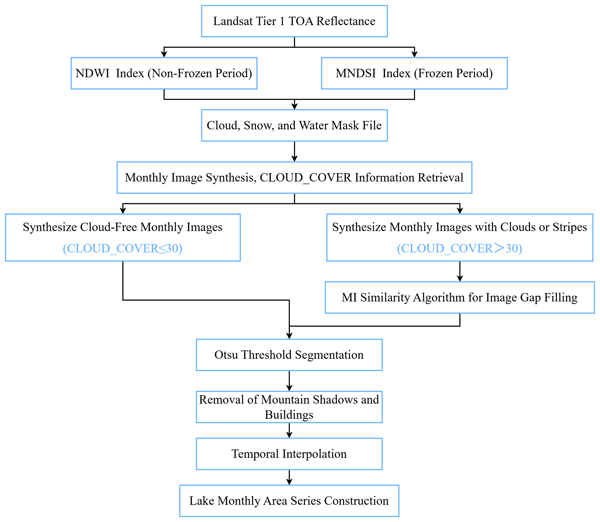
Abstract. Accurate measurement of lake surface area is essential for understanding eco-hydrological processes in arid regions, yet long-term records are often limited by cloud contamination, seasonal ice cover, and data gaps. In this study, we developed an optimized extraction framework that integrates seasonal index selection, adaptive thresholding, maximum connectivity analysis, and mutual information – based gap filling to construct a continuous monthly lake area series for Bahannao Lake from 1984 to 2024. This method effectively addressed common challenges in remote sensing water extraction and provided reliable long-term lake dynamics in a data-scarce desert region. Based on the reconstructed time series, we examined the multi-factor drivers of lake evolution using an XGBoost model combined with climatic and energy-balance variables. Results reveal pronounced interannual and seasonal variability: precipitation dominates lake expansion in spring and summer, while shortwave radiation is the main driver of evaporation in autumn and winter, even under cold conditions. Long-term trends indicate a shift in controlling mechanisms – from humidity and precipitation decline (1984–1999), to increased radiation and humidity variability (2000–2014), and finally to intensified sensible heat flux and potential evapotranspiration (2015–2024).Our findings highlight the nonlinear and evolving interactions between hydro-climatic factors regulating arid-region lakes. The proposed framework provides a robust approach for generating long-term lake records, advancing understanding of eco-hydrological responses to climate change, and offering scientific support for water resources management and adaptation in arid regions.
-
Notice on discussion status
The requested preprint has a corresponding peer-reviewed final revised paper. You are encouraged to refer to the final revised version.
-
Preprint
(2350 KB)
-
The requested preprint has a corresponding peer-reviewed final revised paper. You are encouraged to refer to the final revised version.
- Preprint
(2350 KB) - Metadata XML
- BibTeX
- EndNote
- Final revised paper


Journal article(s) based on this preprint
Interactive discussion
Status: closed
-
RC1: 'Comment on egusphere-2025-4356', Anonymous Referee #1, 19 Oct 2025
-
AC2: 'Reply on RC1', Rui Zou, 02 Dec 2025
Lakes in arid and semi-arid regions are good indicators for the regional environmental changes. The manuscript develops a series of technologies to construct a continuous monthly record of Bahannao Lake based on remote sensing data, further reveals the temporal shifts and nonlinear controls of hydro-climatic drivers on lake dynamics with the help of multi-factor analysis using the XGBoost model. A large number of data analysis have been carried out; the methods are sound and the results are reliable. However, there are shortcomings in the presentation and interpretation of the results, which prohibit the publication of this manuscript in the current version.
Overall, the manuscript offers significant value and is suitable for publication in HESS. The topic is of interest and fits the journal scope, but I have several suggestions and comments before publication in HESS.
We would like to sincerely thank the reviewer for taking the time to review the manuscript and for their positive assessment.
Major comments:
- In the introduction part, it is necessary to address why you carry out the present work and the innovation of your work. But in the current form, it seems to be unclear in this part.
Response:
We sincerely appreciate the reviewer’s insightful comment regarding the need to more clearly articulate the motivation and innovation of this study. In line with this suggestion, we will substantially revise the Introduction to better present the global background, scientific necessity, and methodological novelty of our work.
First, we will place our study in the broader context of global lake change. Recent large-scale assessments have revealed global surface-water datasets and lake-water-storage analyses show that many natural lakes — especially in arid and semi-arid regions — have experienced pronounced declines in surface water extent or storage over recent decades (Pekel et al., 2016; Yao et al., 2023). This trend is particularly pronounced in arid and semi-arid regions, where hydrological systems are extremely sensitive to warming-induced increases in evaporation, reduced precipitation, and intensified drought conditions (Woolway et al., 2022; Zhao et al., 2022). As natural integrators of hydro-climatic variability, closed-basin lakes in these regions often serve as early indicators of regional water-balance shifts, ecological degradation, and climate stress. Against this global backdrop, improving long-term monitoring of small and medium-sized closed-basin lakes—such as Bahannao Lake—is both scientifically necessary and urgent.
Second, we will emphasize the need for higher-temporal-resolution lake monitoring in arid and semi-arid regions. Although many existing long-term lake studies rely on annual or seasonal lake-area estimates, such approaches may overlook important intra-annual fluctuations, abrupt changes, and nonlinear responses to hydro-climatic drivers. To help address this gap, our study develops a continuous 40-year monthly lake-area record for Bahannao Lake using multi-source Landsat imagery. This long-term, higher-temporal-resolution dataset enables a more detailed examination of intra-annual lake dynamics and provides a finer temporal basis for evaluating hydro-climatic responses.
Third, we will elaborate on the methodological innovation of our work. Traditional approaches to analyzing lake–climate relationships—such as correlation analysis, linear regression, and trend detection—have been widely used, but they are limited in their ability to capture nonlinear interactions and to quantify the relative contributions of multiple climatic factors. To complement these methods, we integrate traditional hydro-climatic indicators with a nonlinear machine-learning framework. This framework allows us to detect potential nonlinear responses, assess variable importance, and explore the temporal behavior of key climatic drivers, thereby providing deeper insight into the mechanisms governing lake variability than linear techniques alone.
Following these enhancements, the revised Introduction will more clearly explain why this study is needed, what scientific gaps it addresses, and what methodological contributions it makes, thereby directly addressing the reviewer’s concern about the motivation and innovation of our work.
- The authors need to further specify the main findings of the paper and make comparison with related research. The results need to be compared with the former research.
Response:
We sincerely appreciate the reviewer’s valuable comment regarding the need to better specify the main findings and strengthen the comparison with related research. Following the reviewer’s suggestion, we will substantially improve the clarity and contextualization of our results in the revision. The enhanced manuscript will address this issue from the following perspectives:
First, we will provide a more explicit summary of the key findings, highlighting how the 40-year monthly lake-area dataset and hydro-climatic analysis jointly reveal the temporal variability, abrupt changes, and dominant drivers of Bahannao Lake dynamics. These results will be presented more clearly to ensure that the central outcomes are easy for readers to identify and understand.
Second, we will expand our comparison with previous research. Although existing studies on lake changes in arid regions have primarily relied on annual measurements, in situ observations, or coarse-resolution trend analyses, such approaches may not fully capture the rapid fluctuations and nonlinear hydro-climatic responses that are increasingly common under accelerated climate change. By contrast, our method—based on multi-source Landsat imagery and automated processing—provides higher temporal resolution, more stable long-term continuity, and improved detection of short-term variability. We will emphasize these methodological differences and demonstrate how our findings align with or differ from previous studies on precipitation, evaporation, and drought responses in arid-region lakes.
Third, we will explicitly discuss the advantages of our approach over traditional observation-based methods. Traditional lake monitoring often depends on sparse hydrological stations or manually delineated remote-sensing results, which are limited in spatial coverage, temporal frequency, and consistency. In comparison, our automated workflow improves efficiency, reduces subjectivity, and enhances accuracy in delineating lake boundaries across multi-decadal timeframes. These advantages enable more reliable detection of long-term trends and climate-driven fluctuations. This comparative analysis will be added to highlight why the improved method is necessary under the current context of rapidly changing lake systems.
Accordingly, we will revise the Results and Discussion sections to:
(1) more clearly articulate the key findings;
(2) explicitly compare the results with previous lake studies;
(3) clarify the methodological advantages and the added value of the proposed approach.
We believe these additions will directly address the reviewer’s concern and further strengthen the scientific contribution and contextual relevance of the study.
- Relationship between climate change elements and the lake area need to be further investigated, e.g., using correlation analysis or wavelet coherence analysis.
Response:
Thank you for this valuable suggestion. We agree that the relationship between climate change elements and lake area needs to be further clarified. In the revised manuscript, we will strengthen this part by adding dedicated analyses—specifically, correlation analysis and wavelet coherence analysis—to quantitatively assess the linkages between hydro-climatic variables and lake-area fluctuations. These analyses will allow us to better describe both the overall associations and the time-scale-dependent interactions between climate variability and lake dynamics, thereby providing a more robust and comprehensive interpretation of the climate–lake relationships.
- What are the advantages of the XGOOST method, why is it suitable for the analysis in this study?
Response:
Thank you for this insightful comment. We agree that the advantages of the XGBoost method and its suitability for this study should be more clearly explained. In the revised manuscript, we will clarify that XGBoost is particularly appropriate for this analysis because it can effectively capture nonlinear relationships, handle multicollinearity among hydro-climatic variables, and provide robust measures of variable importance. These characteristics make it well suited for evaluating the complex and potentially nonlinear responses of lake area to multiple climatic factors. We will supplement the Methods and Discussion sections accordingly to clearly articulate the rationale for selecting XGBoost in this study.
Minor comments:
- The equations should be listed in numbers. And a map of the study area should be given.
Response:
Thank you for the helpful comment. We have numbered all equations in the revised manuscript and added a map of the study area to improve clarity and completeness.
- The first key words should be “remote sensing”, instead of “R mote sensing”. Response:
Thank you for pointing this out. We have corrected the typographical error in the keywords, and “remote sensing” is now written correctly in the revised manuscript.
- The expression of “Bahanao Lake” should be consistent all through the manuscript.
Response:
Thank you for the comment. We have carefully checked the entire manuscript and ensured that the expression “Bahanao Lake” is used consistently throughout the revised version.
- Section 3.1 has too many subtitles and need to be merged into 4-5 subtitles. Subtitle (3) should be (2). Subtitle (4) Monthly Image Download need to be deleted.
Response:
Thank you for this helpful suggestion. In the revised manuscript, we have reorganized Section 3.1 by merging the excessive subtitles into 4–5 concise subsections. We have also corrected the numbering of subtitle (3) to (2) and deleted the subtitle “Monthly Image Download” as recommended.
- In Figure 9, 14, 15, 16, 17, 18, 19, 20, 21 fitting lines and P values need to be given.
Response:
Thank you for this comment. In the revised manuscript, we have added fitting lines and the corresponding P-values to Figures 9, 14, 15, 16, 17, 18, 19, 20, and 21 to improve the clarity and statistical interpretation of the results.
- Some of the figures need to be merged. It is suggested to merge figures 23 and 24. Fig 11 and Fig 13 should be integrated into one figure; figures 14-16 should be merged into one figure.
Response:
Thank you for the helpful suggestion. Following the reviewer’s recommendation, we have merged Figures 23 and 24, combined Figures 11 and 13 into a single figure, and integrated Figures 14–16 into one composite figure in the revised manuscript. These adjustments help reduce redundancy and improve the clarity of visual presentation.
- Section 3.3 can be divided into 3.3.1 Changes of hydro-climate series and 3.3.2 Impacts of hydro-climate elements on lake area. The second part may be from line 646 to line 758.
Response:
Thank you for the constructive suggestion. In the revised manuscript, we have reorganized Section 3.3 into two subsections: (1) “3.3.1 Changes of hydro-climate series” and (2) “3.3.2 Impacts of hydro-climate elements on lake area.”
- Line 156, “Recently, Pekel et al. (Pekel et al., 2014) utilized---“, should be “Recently, Pekel et al. (2014) utilized---”
Response:
Thank you for pointing out this issue. We have corrected the citation in Line 156, and it now reads “Recently, Pekel et al. (2014) utilized—” as suggested.
- It is suggested to give more description of Factor analysis in the method section of the manuscript. And XGBOOST model need to be mentioned in the result section.
Response:
Thank you for this helpful suggestion. We agree that the description of the factor analysis in the Methods section should be expanded and that the XGBoost model needs to be more clearly reflected in the Results section. In the revised manuscript, we will provide a more detailed explanation of the factor analysis procedure, including its purpose, variables involved, and analytical steps. In addition, we will explicitly incorporate the XGBoost results into the Results section to ensure a clearer link between the methodological framework and the findings. These revisions will improve transparency and strengthen the coherence of the manuscript.
- The title of figure 12 is better to be “--- during the period of 1984-2024”. And the four seasons need to be written as Spring, Summer, Autumn and Winter.
Response:
Thank you for the helpful comment. We will revise the title of Figure 12 to “—during the period of 1984–2024” as suggested, and we will also standardize the seasonal labels by writing them as Spring, Summer, Autumn, and Winter in the revised manuscript.
- In section 3.3 Impact of Climate Chang, (1) Temperature Variation, “1) Temperature” and “2) 2m Dew Point Temperature” need to be merged. So do “(3) Radiation and Energy Exchang” and “ (4) Humidity and Evapotranspiration”.
Response:
Thank you for the constructive comment. In the revised manuscript, we have merged “1) Temperature” with “2) 2m Dew Point Temperature,” and combined “(3) Radiation and Energy Exchange” with “(4) Humidity and Evapotranspiration” in Section 3.3 as suggested. These adjustments help streamline the structure and improve readability.
- Line 655, “---as shown in the figure 23---”, “the” should be deleted.
Response:
Thank you for pointing this out. We have corrected the grammatical issue in Line 655 by removing the word “the,” and it now reads “as shown in figure 23.”
References
Pekel, J.-F., Cottam, A., Gorelick, N., & Belward, A. S. (2016). High-resolution mapping of global surface water and its long-term changes. Nature, 540, 418–422. https://doi.org/10.1038/nature20584
Woolway, R. I., Sharma, S., Smol, J. P., et al. (2022). Lakes in hot water: The impacts of a changing climate on aquatic ecosystems. BioScience, 72(11), 1050–1061. https://doi.org/10.1093/biosci/biac078
Yao, F., Luo, B., Rajasekaran, B., et al. (2023). Satellites reveal widespread decline in global lake water storage. Science, 380, 743–749. https://doi.org/10.1126/ science.abo 1327
Zhao, G., Li, Y., Zhou, L., Gao, H., et al. (2022). Evaporative water loss of 1.42 million global lakes. Nature Communications, 13, 3686. https://doi.org/10.1038/s41467-022-31267-2
Citation: https://doi.org/10.5194/egusphere-2025-4356-AC2 -
AC4: 'Reply on RC1', Rui Zou, 02 Dec 2025
Lakes in arid and semi-arid regions are good indicators for the regional environmental changes. The manuscript develops a series of technologies to construct a continuous monthly record of Bahannao Lake based on remote sensing data, further reveals the temporal shifts and nonlinear controls of hydro-climatic drivers on lake dynamics with the help of multi-factor analysis using the XGBoost model. A large number of data analysis have been carried out; the methods are sound and the results are reliable. However, there are shortcomings in the presentation and interpretation of the results, which prohibit the publication of this manuscript in the current version.
Overall, the manuscript offers significant value and is suitable for publication in HESS. The topic is of interest and fits the journal scope, but I have several suggestions and comments before publication in HESS.
We would like to sincerely thank the reviewer for taking the time to review the manuscript and for their positive assessment.
Major comments:
1.In the introduction part, it is necessary to address why you carry out the present work and the innovation of your work. But in the current form, it seems to be unclear in this part.
Response:
We sincerely appreciate the reviewer’s insightful comment regarding the need to more clearly articulate the motivation and innovation of this study. In line with this suggestion, we will substantially revise the Introduction to better present the global background, scientific necessity, and methodological novelty of our work.
First, we will place our study in the broader context of global lake change. Recent large-scale assessments have revealed global surface-water datasets and lake-water-storage analyses show that many natural lakes — especially in arid and semi-arid regions — have experienced pronounced declines in surface water extent or storage over recent decades (Pekel et al., 2016; Yao et al., 2023). This trend is particularly pronounced in arid and semi-arid regions, where hydrological systems are extremely sensitive to warming-induced increases in evaporation, reduced precipitation, and intensified drought conditions (Woolway et al., 2022; Zhao et al., 2022). As natural integrators of hydro-climatic variability, closed-basin lakes in these regions often serve as early indicators of regional water-balance shifts, ecological degradation, and climate stress. Against this global backdrop, improving long-term monitoring of small and medium-sized closed-basin lakes—such as Bahannao Lake—is both scientifically necessary and urgent.
Second, we will emphasize the need for higher-temporal-resolution lake monitoring in arid and semi-arid regions. Although many existing long-term lake studies rely on annual or seasonal lake-area estimates, such approaches may overlook important intra-annual fluctuations, abrupt changes, and nonlinear responses to hydro-climatic drivers. To help address this gap, our study develops a continuous 40-year monthly lake-area record for Bahannao Lake using multi-source Landsat imagery. This long-term, higher-temporal-resolution dataset enables a more detailed examination of intra-annual lake dynamics and provides a finer temporal basis for evaluating hydro-climatic responses.
Third, we will elaborate on the methodological innovation of our work. Traditional approaches to analyzing lake–climate relationships—such as correlation analysis, linear regression, and trend detection—have been widely used, but they are limited in their ability to capture nonlinear interactions and to quantify the relative contributions of multiple climatic factors. To complement these methods, we integrate traditional hydro-climatic indicators with a nonlinear machine-learning framework. This framework allows us to detect potential nonlinear responses, assess variable importance, and explore the temporal behavior of key climatic drivers, thereby providing deeper insight into the mechanisms governing lake variability than linear techniques alone.
Following these enhancements, the revised Introduction will more clearly explain why this study is needed, what scientific gaps it addresses, and what methodological contributions it makes, thereby directly addressing the reviewer’s concern about the motivation and innovation of our work.
2.The authors need to further specify the main findings of the paper and make comparison with related research. The results need to be compared with the former research.
Response:
We sincerely appreciate the reviewer’s valuable comment regarding the need to better specify the main findings and strengthen the comparison with related research. Following the reviewer’s suggestion, we will substantially improve the clarity and contextualization of our results in the revision. The enhanced manuscript will address this issue from the following perspectives:
First, we will provide a more explicit summary of the key findings, highlighting how the 40-year monthly lake-area dataset and hydro-climatic analysis jointly reveal the temporal variability, abrupt changes, and dominant drivers of Bahannao Lake dynamics. These results will be presented more clearly to ensure that the central outcomes are easy for readers to identify and understand.
Second, we will expand our comparison with previous research. Although existing studies on lake changes in arid regions have primarily relied on annual measurements, in situ observations, or coarse-resolution trend analyses, such approaches may not fully capture the rapid fluctuations and nonlinear hydro-climatic responses that are increasingly common under accelerated climate change. By contrast, our method—based on multi-source Landsat imagery and automated processing—provides higher temporal resolution, more stable long-term continuity, and improved detection of short-term variability. We will emphasize these methodological differences and demonstrate how our findings align with or differ from previous studies on precipitation, evaporation, and drought responses in arid-region lakes.
Third, we will explicitly discuss the advantages of our approach over traditional observation-based methods. Traditional lake monitoring often depends on sparse hydrological stations or manually delineated remote-sensing results, which are limited in spatial coverage, temporal frequency, and consistency. In comparison, our automated workflow improves efficiency, reduces subjectivity, and enhances accuracy in delineating lake boundaries across multi-decadal timeframes. These advantages enable more reliable detection of long-term trends and climate-driven fluctuations. This comparative analysis will be added to highlight why the improved method is necessary under the current context of rapidly changing lake systems.
Accordingly, we will revise the Results and Discussion sections to:
(1) more clearly articulate the key findings;
(2) explicitly compare the results with previous lake studies;
(3) clarify the methodological advantages and the added value of the proposed approach.
We believe these additions will directly address the reviewer’s concern and further strengthen the scientific contribution and contextual relevance of the study.
3.Relationship between climate change elements and the lake area need to be further investigated, e.g., using correlation analysis or wavelet coherence analysis.
Response:
Thank you for this valuable suggestion. We agree that the relationship between climate change elements and lake area needs to be further clarified. In the revised manuscript, we will strengthen this part by adding dedicated analyses—specifically, correlation analysis and wavelet coherence analysis—to quantitatively assess the linkages between hydro-climatic variables and lake-area fluctuations. These analyses will allow us to better describe both the overall associations and the time-scale-dependent interactions between climate variability and lake dynamics, thereby providing a more robust and comprehensive interpretation of the climate–lake relationships.
4.What are the advantages of the XGOOST method, why is it suitable for the analysis in this study?
Response:
Thank you for this insightful comment. We agree that the advantages of the XGBoost method and its suitability for this study should be more clearly explained. In the revised manuscript, we will clarify that XGBoost is particularly appropriate for this analysis because it can effectively capture nonlinear relationships, handle multicollinearity among hydro-climatic variables, and provide robust measures of variable importance. These characteristics make it well suited for evaluating the complex and potentially nonlinear responses of lake area to multiple climatic factors. We will supplement the Methods and Discussion sections accordingly to clearly articulate the rationale for selecting XGBoost in this study.
Minor comments:
1.The equations should be listed in numbers. And a map of the study area should be given.
Response:
Thank you for the helpful comment. We have numbered all equations in the revised manuscript and added a map of the study area to improve clarity and completeness.
2.The first key words should be “remote sensing”, instead of “R mote sensing”. Response:
Thank you for pointing this out. We have corrected the typographical error in the keywords, and “remote sensing” is now written correctly in the revised manuscript.
3.The expression of “Bahanao Lake” should be consistent all through the manuscript.
Response:
Thank you for the comment. We have carefully checked the entire manuscript and ensured that the expression “Bahanao Lake” is used consistently throughout the revised version.
4.Section 3.1 has too many subtitles and need to be merged into 4-5 subtitles. Subtitle (3) should be (2). Subtitle (4) Monthly Image Download need to be deleted.
Response:
Thank you for this helpful suggestion. In the revised manuscript, we have reorganized Section 3.1 by merging the excessive subtitles into 4–5 concise subsections. We have also corrected the numbering of subtitle (3) to (2) and deleted the subtitle “Monthly Image Download” as recommended.
5.In Figure 9, 14, 15, 16, 17, 18, 19, 20, 21 fitting lines and P values need to be given.
Response:
Thank you for this comment. In the revised manuscript, we have added fitting lines and the corresponding P-values to Figures 9, 14, 15, 16, 17, 18, 19, 20, and 21 to improve the clarity and statistical interpretation of the results.
6.Some of the figures need to be merged. It is suggested to merge figures 23 and 24. Fig 11 and Fig 13 should be integrated into one figure; figures 14-16 should be merged into one figure.
Response:
Thank you for the helpful suggestion. Following the reviewer’s recommendation, we have merged Figures 23 and 24, combined Figures 11 and 13 into a single figure, and integrated Figures 14–16 into one composite figure in the revised manuscript. These adjustments help reduce redundancy and improve the clarity of visual presentation.
7.Section 3.3 can be divided into 3.3.1 Changes of hydro-climate series and 3.3.2 Impacts of hydro-climate elements on lake area. The second part may be from line 646 to line 758.
Response:
Thank you for the constructive suggestion. In the revised manuscript, we have reorganized Section 3.3 into two subsections: (1) “3.3.1 Changes of hydro-climate series” and (2) “3.3.2 Impacts of hydro-climate elements on lake area.”
8.Line 156, “Recently, Pekel et al. (Pekel et al., 2014) utilized---“, should be “Recently, Pekel et al. (2014) utilized---”
Response:
Thank you for pointing out this issue. We have corrected the citation in Line 156, and it now reads “Recently, Pekel et al. (2014) utilized—” as suggested.
9.It is suggested to give more description of Factor analysis in the method section of the manuscript. And XGBOOST model need to be mentioned in the result section.
Response:
Thank you for this helpful suggestion. We agree that the description of the factor analysis in the Methods section should be expanded and that the XGBoost model needs to be more clearly reflected in the Results section. In the revised manuscript, we will provide a more detailed explanation of the factor analysis procedure, including its purpose, variables involved, and analytical steps. In addition, we will explicitly incorporate the XGBoost results into the Results section to ensure a clearer link between the methodological framework and the findings. These revisions will improve transparency and strengthen the coherence of the manuscript.
10.The title of figure 12 is better to be “--- during the period of 1984-2024”. And the four seasons need to be written as Spring, Summer, Autumn and Winter.
Response:
Thank you for the helpful comment. We will revise the title of Figure 12 to “—during the period of 1984–2024” as suggested, and we will also standardize the seasonal labels by writing them as Spring, Summer, Autumn, and Winter in the revised manuscript.
11.In section 3.3 Impact of Climate Chang, (1) Temperature Variation, “1) Temperature” and “2) 2m Dew Point Temperature” need to be merged. So do “(3) Radiation and Energy Exchang” and “ (4) Humidity and Evapotranspiration”.
Response:
Thank you for the constructive comment. In the revised manuscript, we have merged “1) Temperature” with “2) 2m Dew Point Temperature,” and combined “(3) Radiation and Energy Exchange” with “(4) Humidity and Evapotranspiration” in Section 3.3 as suggested. These adjustments help streamline the structure and improve readability.
12.Line 655, “---as shown in the figure 23---”, “the” should be deleted.
Response:
Thank you for pointing this out. We have corrected the grammatical issue in Line 655 by removing the word “the,” and it now reads “as shown in figure 23.”
References
Pekel, J.-F., Cottam, A., Gorelick, N., & Belward, A. S. (2016). High-resolution mapping of global surface water and its long-term changes. Nature, 540, 418–422. https://doi.org/10.1038/nature20584
Woolway, R. I., Sharma, S., Smol, J. P., et al. (2022). Lakes in hot water: The impacts of a changing climate on aquatic ecosystems. BioScience, 72(11), 1050–1061. https://doi.org/10.1093/biosci/biac078
Yao, F., Luo, B., Rajasekaran, B., et al. (2023). Satellites reveal widespread decline in global lake water storage. Science, 380, 743–749. https://doi.org/10.1126/ science.abo 1327
Zhao, G., Li, Y., Zhou, L., Gao, H., et al. (2022). Evaporative water loss of 1.42 million global lakes. Nature Communications, 13, 3686. https://doi.org/10.1038/s41467-022-31267-2
Citation: https://doi.org/10.5194/egusphere-2025-4356-AC4
-
AC2: 'Reply on RC1', Rui Zou, 02 Dec 2025
-
RC2: 'Comment on egusphere-2025-4356', Anonymous Referee #2, 05 Nov 2025
Lakes are barometers of climate change. Changes in the area of lakes have significant indicative significance for regional climate. This paper adopts a new approach, using remote sensing data to study the changes of lakes in arid areas and their relationship with climatic factors, which has certain value. However, the current state is not suitable for publication and still requires major revisions.
- Where exactly is Bahannao Lake? What kind of climate environment does it belong to? What kind of representativeness does it have? It is strongly recommended that the author explain clearly.
- There are too many figures in the entire manuscript. It is recommended to compress them. Each figure contains too little information, especially Figures 2 to 8. It is suggested to integrate them.
- In the process of analyzing the driving factors of lake changes, energy flux is mainly affected by meteorological factors and land use, and it is a passive changing quantity. It is not appropriate to use it to explain the changes in lake area. From the perspective of water balance, precipitation, evaporation, runoff and groundwater are the direct influencing factors. In terms of mechanism analysis, the influence of other factors is all exerted through these factors.
- How is the drought index calculated? What does the size of a numerical value represent? It needs to be explained clearly in the method section.
- What variables do the abbreviations in Figures 18 and 23 represent? It needs to be explained in the figure captions.
- Remote sensing monitoring of lake area changes has become relatively mature. What are the innovative aspects of the methods and data used in this paper? A clearer explanation needs to be given through comparison.
- For such study, merely focusing on a single lake, especially an unknown small one, is not of much significance and also reduces the universality of the method and the representativeness of the conclusion. It is suggested to increase the number of lakes in this study or include similar lakes in this area.
Citation: https://doi.org/10.5194/egusphere-2025-4356-RC2 -
AC1: 'Reply on RC2', Rui Zou, 02 Dec 2025
Lakes are barometers of climate change. Changes in the area of lakes have significant indicative significance for regional climate. This paper adopts a new approach, using remote sensing data to study the changes of lakes in arid areas and their relationship with climatic factors, which has certain value. However, the current state is not suitable for publication and still requires major revisions.
We would like to sincerely thank the reviewer for taking the time to review the manuscript and for their positive assessment.
- Where exactly is Bahannao Lake? What kind of climate environment does it belong to? What kind of representativeness does it have? It is strongly recommended that the author explain clearly.
Response:
Thank you for this important comment. We agree that the geographical location, climatic setting, and representativeness of Bahannao Lake should be described more clearly. In the revised manuscript, we will provide a detailed explanation of where Bahannao Lake is located, the semi-arid climate environment it belongs to, and why it is representative of small- to medium-sized lakes in northern China that are sensitive to hydro-climatic variability. These additions will help readers better understand the study context and the relevance of selecting this lake as the research site.
- There are too many figures in the entire manuscript. It is recommended to compress them. Each figure contains too little information, especially Figures 2 to 8. It is suggested to integrate them.
Response:
Thank you for your helpful suggestion. We agree that the number of figures in the manuscript is relatively high and that some figures contain limited information when presented separately. In the revised manuscript, we will compress and integrate the relevant figures to improve readability and reduce redundancy. In addition to merging Figures 2–8 as recommended, we will also combine several other figures (such as merging Figures 23 and 24, integrating Figures 11 and 13, and consolidating Figures 14–16 into a single composite figure). These adjustments will make the visual presentation throughout the manuscript more concise, consistent, and coherent.
- In the process of analyzing the driving factors of lake changes, energy flux is mainly affected by meteorological factors and land use, and it is a passive changing quantity. It is not appropriate to use it to explain the changes in lake area. From the perspective of water balance, precipitation, evaporation, runoff and groundwater are the direct influencing factors. In terms of mechanism analysis, the influence of other factors is all exerted through these factors.
Response:
Thank you for this insightful comment. We agree with the reviewer that energy flux is a passive variable influenced primarily by meteorological conditions and land-surface characteristics, and therefore should not be treated as a direct driving factor of lake-area changes. In the revised manuscript, we will improve this part in the following ways:
(1) Clarifying the conceptual framework:
We will revise the mechanism discussion to explicitly state that, from a water-balance perspective, precipitation, evaporation, runoff, and groundwater are the fundamental direct drivers of lake-area variability. These components determine the net water input and loss and therefore directly control lake dynamics.
(2) Adjusting the interpretation of energy flux:
We will clarify that energy flux variables (e.g., net radiation, latent heat flux) reflect atmospheric and land-surface energy conditions and respond passively to meteorological forcing. Therefore, they will no longer be interpreted as direct causal factors but instead described as supplementary indicators that may help contextualize surface–atmosphere processes.
(3) Re-focusing mechanism analysis on hydrological variables:
We will restructure this section to emphasize direct hydrological drivers (precipitation, evaporation, drought index, and groundwater conditions when available). The influence of other variables will be described as indirect, operating through these water-balance components.
(4) Revising figures and descriptions where applicable:
Where energy-flux variables were previously interpreted alongside direct hydrologic drivers, we will adjust the narrative to ensure a clear distinction between direct and indirect factors. This will make the mechanism analysis more accurate and consistent with hydrological theory.
These revisions will ensure that the explanation of driving mechanisms is scientifically sound, consistent with water-balance principles, and aligned with the reviewer’s suggestions.
- How is the drought index calculated? What does the size of a numerical value represent? It needs to be explained clearly in the method section.
Response:
Thank you for this important comment. We will clarify the drought index in the revised manuscript as follows:
(1) How the drought index is calculated:
This study uses the Standardized Precipitation Evapotranspiration Index (SPEI), which is computed from the climatic water balance (precipitation minus potential evapotranspiration). The resulting series is fitted to a probability distribution and then standardized to obtain the SPEI values.
(2) What the numerical values represent:
Positive SPEI values indicate wetter-than-normal conditions, values around zero represent near-normal moisture conditions, and negative values correspond to varying degrees of drought (mild, moderate, severe, or extreme).
We will clearly explain these points in the Methods section to ensure full transparency and clarity.
- What variables do the abbreviations in Figures 18 and 23 represent? It needs to be explained in the figure captions.
Response:
Thank you for pointing this out. In the revised manuscript, we will clearly define all abbreviations used in Figures 18 and 23 by adding explicit explanations of each variable in the figure captions. This will ensure that the figures are fully understandable without referring back to the main text.
- Remote sensing monitoring of lake area changes has become relatively mature. What are the innovative aspects of the methods and data used in this paper? A clearer explanation needs to be given through comparison.
Response:
Thank you for this important comment. We agree that remote sensing monitoring of lake-area changes is relatively mature, and therefore the data- and method-related innovations of this study should be explained more clearly. In the revised manuscript, we will clarify the novelty in two complementary aspects.
(1) Data-related contribution:
Although extracting lake extent from Landsat imagery is well established, long-term, continuous monthly lake-area datasets for small lakes in semi-arid regions have been less frequently reported. In this study, we produce a 40-year monthly lake-area record by integrating multi-source Landsat TM/ETM+/OLI imagery and applying preprocessing steps tailored to local conditions (e.g., separate indices for freezing and non-freezing periods, cloud/snow filtering, monthly composite generation, and DEM-based terrain screening). This contributes additional temporal resolution and monitoring continuity compared with the more common annual or seasonal datasets used in many previous studies.
(2) Method-related contribution:
To address challenges specific to small lakes and long-term Landsat archives (e.g., cloud contamination and striping), we implement an optimized workflow that includes the use of Mutual Information (MI) matching to identify the most similar historical cloud-free images, enabling reconstruction of cloudy or striped pixels. While MI-based reconstruction has been used in other image-processing applications, it has been less commonly applied in long-term lake monitoring. We present this as a complementary enhancement to standard lake-extraction approaches rather than a replacement of existing methods.
(3) Clarification through comparison:
In the revised Introduction and Discussion sections, we will explicitly compare our workflow with representative remote-sensing lake studies to more clearly illustrate how our data processing and reconstruction steps extend, refine, or supplement established techniques, in line with the reviewer’s suggestion.
- For such study, merely focusing on a single lake, especially an unknown small one, is not of much significance and also reduces the universality of the method and the representativeness of the conclusion. It is suggested to increase the number of lakes in this study or include similar lakes in this area.
Response:
We sincerely appreciate the reviewer’s important comment. We fully understand and agree with the concern that restricting the analysis to a single small lake may limit the generalizability of the method and the representativeness of the conclusions.
To respond more effectively, we will revise the manuscript by situating the study within the broader scientific context of hydro-climatic processes shared by arid-region closed-basin lakes, rather than treating Bahannao Lake as an isolated case. Closed-basin lakes in arid and semi-arid climates commonly:
- act as natural integrators of regional water balance,
- respond very rapidly to variations in precipitation, evaporation, and drought,
- exhibit strong nonlinear fluctuations due to limited hydrological buffering capacity.
These shared characteristics mean that the scientific mechanisms investigated—i.e., hydro-climatic drivers of lake variability—are broadly representative of lakes in similar arid environments.
In addition, to further enhance the robustness and universality of the methodology, we will incorporate two representative arid-region lakes—Hongjiannao Lake and Wuliangsuhai Lake—into the revised manuscript for comparative validation. These lakes differ substantially in size, hydrological setting, and climatic sensitivity, thereby enabling us to evaluate the consistency and transferability of the proposed remote-sensing workflow across diverse lake types.
The comparative analysis will include:
(1) deriving long-term lake-area series for both lakes using our workflow;
(2) comparing these records against published lake-area datasets at annual or multi-year scales;
(3) evaluating the consistency and accuracy of the results to confirm the broader applicability of the method and strengthen the representativeness of the conclusions. We believe these revisions will comprehensively address the reviewer’s concern and substantially improve the scientific rigor, regional relevance, and methodological robustness of the study.
Citation: https://doi.org/10.5194/egusphere-2025-4356-AC1 -
AC3: 'Reply on RC2', Rui Zou, 02 Dec 2025
Lakes are barometers of climate change. Changes in the area of lakes have significant indicative significance for regional climate. This paper adopts a new approach, using remote sensing data to study the changes of lakes in arid areas and their relationship with climatic factors, which has certain value. However, the current state is not suitable for publication and still requires major revisions.
We would like to sincerely thank the reviewer for taking the time to review the manuscript and for their positive assessment.
1.Where exactly is Bahannao Lake? What kind of climate environment does it belong to? What kind of representativeness does it have? It is strongly recommended that the author explain clearly.
Response:
Thank you for this important comment. We agree that the geographical location, climatic setting, and representativeness of Bahannao Lake should be described more clearly. In the revised manuscript, we will provide a detailed explanation of where Bahannao Lake is located, the semi-arid climate environment it belongs to, and why it is representative of small- to medium-sized lakes in northern China that are sensitive to hydro-climatic variability. These additions will help readers better understand the study context and the relevance of selecting this lake as the research site.
2.There are too many figures in the entire manuscript. It is recommended to compress them. Each figure contains too little information, especially Figures 2 to 8. It is suggested to integrate them.
Response:
Thank you for your helpful suggestion. We agree that the number of figures in the manuscript is relatively high and that some figures contain limited information when presented separately. In the revised manuscript, we will compress and integrate the relevant figures to improve readability and reduce redundancy. In addition to merging Figures 2–8 as recommended, we will also combine several other figures (such as merging Figures 23 and 24, integrating Figures 11 and 13, and consolidating Figures 14–16 into a single composite figure). These adjustments will make the visual presentation throughout the manuscript more concise, consistent, and coherent.
3.In the process of analyzing the driving factors of lake changes, energy flux is mainly affected by meteorological factors and land use, and it is a passive changing quantity. It is not appropriate to use it to explain the changes in lake area. From the perspective of water balance, precipitation, evaporation, runoff and groundwater are the direct influencing factors. In terms of mechanism analysis, the influence of other factors is all exerted through these factors.
Response:
Thank you for this insightful comment. We agree with the reviewer that energy flux is a passive variable influenced primarily by meteorological conditions and land-surface characteristics, and therefore should not be treated as a direct driving factor of lake-area changes. In the revised manuscript, we will improve this part in the following ways:
(1) Clarifying the conceptual framework:
We will revise the mechanism discussion to explicitly state that, from a water-balance perspective, precipitation, evaporation, runoff, and groundwater are the fundamental direct drivers of lake-area variability. These components determine the net water input and loss and therefore directly control lake dynamics.
(2) Adjusting the interpretation of energy flux:
We will clarify that energy flux variables (e.g., net radiation, latent heat flux) reflect atmospheric and land-surface energy conditions and respond passively to meteorological forcing. Therefore, they will no longer be interpreted as direct causal factors but instead described as supplementary indicators that may help contextualize surface–atmosphere processes.
(3) Re-focusing mechanism analysis on hydrological variables:
We will restructure this section to emphasize direct hydrological drivers (precipitation, evaporation, drought index, and groundwater conditions when available). The influence of other variables will be described as indirect, operating through these water-balance components.
(4) Revising figures and descriptions where applicable:
Where energy-flux variables were previously interpreted alongside direct hydrologic drivers, we will adjust the narrative to ensure a clear distinction between direct and indirect factors. This will make the mechanism analysis more accurate and consistent with hydrological theory.
These revisions will ensure that the explanation of driving mechanisms is scientifically sound, consistent with water-balance principles, and aligned with the reviewer’s suggestions.
4.How is the drought index calculated? What does the size of a numerical value represent? It needs to be explained clearly in the method section.
Response:
Thank you for this important comment. We will clarify the drought index in the revised manuscript as follows:
(1) How the drought index is calculated:
This study uses the Standardized Precipitation Evapotranspiration Index (SPEI), which is computed from the climatic water balance (precipitation minus potential evapotranspiration). The resulting series is fitted to a probability distribution and then standardized to obtain the SPEI values.
(2) What the numerical values represent:
Positive SPEI values indicate wetter-than-normal conditions, values around zero represent near-normal moisture conditions, and negative values correspond to varying degrees of drought (mild, moderate, severe, or extreme).
We will clearly explain these points in the Methods section to ensure full transparency and clarity.
5.What variables do the abbreviations in Figures 18 and 23 represent? It needs to be explained in the figure captions.
Response:
Thank you for pointing this out. In the revised manuscript, we will clearly define all abbreviations used in Figures 18 and 23 by adding explicit explanations of each variable in the figure captions. This will ensure that the figures are fully understandable without referring back to the main text.
6.Remote sensing monitoring of lake area changes has become relatively mature. What are the innovative aspects of the methods and data used in this paper? A clearer explanation needs to be given through comparison.
Response:
Thank you for this important comment. We agree that remote sensing monitoring of lake-area changes is relatively mature, and therefore the data- and method-related innovations of this study should be explained more clearly. In the revised manuscript, we will clarify the novelty in two complementary aspects.
(1) Data-related contribution:
Although extracting lake extent from Landsat imagery is well established, long-term, continuous monthly lake-area datasets for small lakes in semi-arid regions have been less frequently reported. In this study, we produce a 40-year monthly lake-area record by integrating multi-source Landsat TM/ETM+/OLI imagery and applying preprocessing steps tailored to local conditions (e.g., separate indices for freezing and non-freezing periods, cloud/snow filtering, monthly composite generation, and DEM-based terrain screening). This contributes additional temporal resolution and monitoring continuity compared with the more common annual or seasonal datasets used in many previous studies.
(2) Method-related contribution:
To address challenges specific to small lakes and long-term Landsat archives (e.g., cloud contamination and striping), we implement an optimized workflow that includes the use of Mutual Information (MI) matching to identify the most similar historical cloud-free images, enabling reconstruction of cloudy or striped pixels. While MI-based reconstruction has been used in other image-processing applications, it has been less commonly applied in long-term lake monitoring. We present this as a complementary enhancement to standard lake-extraction approaches rather than a replacement of existing methods.
(3) Clarification through comparison:
In the revised Introduction and Discussion sections, we will explicitly compare our workflow with representative remote-sensing lake studies to more clearly illustrate how our data processing and reconstruction steps extend, refine, or supplement established techniques, in line with the reviewer’s suggestion.
7.For such study, merely focusing on a single lake, especially an unknown small one, is not of much significance and also reduces the universality of the method and the representativeness of the conclusion. It is suggested to increase the number of lakes in this study or include similar lakes in this area.
Response:
We sincerely appreciate the reviewer’s important comment. We fully understand and agree with the concern that restricting the analysis to a single small lake may limit the generalizability of the method and the representativeness of the conclusions.
To respond more effectively, we will revise the manuscript by situating the study within the broader scientific context of hydro-climatic processes shared by arid-region closed-basin lakes, rather than treating Bahannao Lake as an isolated case. Closed-basin lakes in arid and semi-arid climates commonly:
- act as natural integrators of regional water balance,
- respond very rapidly to variations in precipitation, evaporation, and drought,
- exhibit strong nonlinear fluctuations due to limited hydrological buffering capacity.
These shared characteristics mean that the scientific mechanisms investigated—i.e., hydro-climatic drivers of lake variability—are broadly representative of lakes in similar arid environments.
In addition, to further enhance the robustness and universality of the methodology, we will incorporate two representative arid-region lakes—Hongjiannao Lake and Wuliangsuhai Lake—into the revised manuscript for comparative validation. These lakes differ substantially in size, hydrological setting, and climatic sensitivity, thereby enabling us to evaluate the consistency and transferability of the proposed remote-sensing workflow across diverse lake types.
The comparative analysis will include:
(1) deriving long-term lake-area series for both lakes using our workflow;
(2) comparing these records against published lake-area datasets at annual or multi-year scales;
(3) evaluating the consistency and accuracy of the results to confirm the broader applicability of the method and strengthen the representativeness of the conclusions. We believe these revisions will comprehensively address the reviewer’s concern and substantially improve the scientific rigor, regional relevance, and methodological robustness of the study.
Citation: https://doi.org/10.5194/egusphere-2025-4356-AC3
Peer review completion


Interactive discussion
Status: closed
-
RC1: 'Comment on egusphere-2025-4356', Anonymous Referee #1, 19 Oct 2025
Lakes in arid and semi-arid regions are good indicators for the regional environmental changes. The manuscript develops a series of technologies to construct a continuous monthly record of Bahannao Lake based on remote sensing data, further reveals the temporal shifts and nonlinear controls of hydro-climatic drivers on lake dynamics with the help of multi-factor analysis using the XGBoost model. A large number of data analysis have been carried out; the methods are sound and the results are reliable. However, there are shortcomings in the presentation and interpretation of the results, which prohibit the publication of this manuscript in the current version.
Overall, the manuscript offers significant value and is suitable for publication in HESS. The topic is of interest and fits the journal scope, but I have several suggestions and comments before publication in HESS.
Major comments:
- In the introduction part, it is necessary to address why you carry out the present work and the innovation of your work. But in the current form, it seems to be unclear in this part.
- The authors need to further specify the main findings of the paper and make comparison with related research. The results need to be compared with the former research.
- Relationship between climate change elements and the lake area need to be further investigated, e.g., using correlation analysis or wavelet coherence analysis.
- What are the advantages of the XGOOST method, why is it suitable for the analysis in this study?
Minor comments:
- The equations should be listed in numbers. And a map of the study area should be given.
- The first key words should be “remote sensing”, instead of “R mote sensing”.
- The expression of “Bahanao Lake” should be consistent all through the manuscript.
- Section 3.1 has too many subtitles and need to be merged into 4-5 subtitles. Subtitle (3) should be (2). Subtitle (4) Monthly Image Download need to be deleted.
- In Figure 9, 14, 15, 16, 17, 18, 19, 20, 21 fitting lines and P values need to be given.
- Some of the figures need to be merged. It is suggested to merge figures 23 and 24. Fig 11 and Fig 13 should be integrated into one figure; figures 14-16 should be merged into one figure.
- Section 3.3 can be divided into 3.3.1 Changes of hydro-climate series and 3.3.2 Impacts of hydro-climate elements on lake area. The second part may be from line 646 to line 758.
- Line 156, “Recently, Pekel et al. (Pekel et al., 2014) utilized---“, should be “Recently, Pekel et al. (2014) utilized---”
- It is suggested to give more description of Factor analysis in the method section of the manuscript. And XGBOOST model need to be mentioned in the result section.
- The title of figure 12 is better to be “--- during the period of 1984-2024”. And the four seasons need to be written as Spring, Summer, Autumn and Winter.
- In section 3.3 Impact of Climate Chang, (1) Temperature Variation, “1) Temperature” and “2) 2m Dew Point Temperature” need to be merged. So do “(3) Radiation and Energy Exchang” and “ (4) Humidity and Evapotranspiration”.
- Line 655, “---as shown in the figure 23---”, “the” should be deleted.
Citation: https://doi.org/10.5194/egusphere-2025-4356-RC1 -
AC2: 'Reply on RC1', Rui Zou, 02 Dec 2025
Lakes in arid and semi-arid regions are good indicators for the regional environmental changes. The manuscript develops a series of technologies to construct a continuous monthly record of Bahannao Lake based on remote sensing data, further reveals the temporal shifts and nonlinear controls of hydro-climatic drivers on lake dynamics with the help of multi-factor analysis using the XGBoost model. A large number of data analysis have been carried out; the methods are sound and the results are reliable. However, there are shortcomings in the presentation and interpretation of the results, which prohibit the publication of this manuscript in the current version.
Overall, the manuscript offers significant value and is suitable for publication in HESS. The topic is of interest and fits the journal scope, but I have several suggestions and comments before publication in HESS.
We would like to sincerely thank the reviewer for taking the time to review the manuscript and for their positive assessment.
Major comments:
- In the introduction part, it is necessary to address why you carry out the present work and the innovation of your work. But in the current form, it seems to be unclear in this part.
Response:
We sincerely appreciate the reviewer’s insightful comment regarding the need to more clearly articulate the motivation and innovation of this study. In line with this suggestion, we will substantially revise the Introduction to better present the global background, scientific necessity, and methodological novelty of our work.
First, we will place our study in the broader context of global lake change. Recent large-scale assessments have revealed global surface-water datasets and lake-water-storage analyses show that many natural lakes — especially in arid and semi-arid regions — have experienced pronounced declines in surface water extent or storage over recent decades (Pekel et al., 2016; Yao et al., 2023). This trend is particularly pronounced in arid and semi-arid regions, where hydrological systems are extremely sensitive to warming-induced increases in evaporation, reduced precipitation, and intensified drought conditions (Woolway et al., 2022; Zhao et al., 2022). As natural integrators of hydro-climatic variability, closed-basin lakes in these regions often serve as early indicators of regional water-balance shifts, ecological degradation, and climate stress. Against this global backdrop, improving long-term monitoring of small and medium-sized closed-basin lakes—such as Bahannao Lake—is both scientifically necessary and urgent.
Second, we will emphasize the need for higher-temporal-resolution lake monitoring in arid and semi-arid regions. Although many existing long-term lake studies rely on annual or seasonal lake-area estimates, such approaches may overlook important intra-annual fluctuations, abrupt changes, and nonlinear responses to hydro-climatic drivers. To help address this gap, our study develops a continuous 40-year monthly lake-area record for Bahannao Lake using multi-source Landsat imagery. This long-term, higher-temporal-resolution dataset enables a more detailed examination of intra-annual lake dynamics and provides a finer temporal basis for evaluating hydro-climatic responses.
Third, we will elaborate on the methodological innovation of our work. Traditional approaches to analyzing lake–climate relationships—such as correlation analysis, linear regression, and trend detection—have been widely used, but they are limited in their ability to capture nonlinear interactions and to quantify the relative contributions of multiple climatic factors. To complement these methods, we integrate traditional hydro-climatic indicators with a nonlinear machine-learning framework. This framework allows us to detect potential nonlinear responses, assess variable importance, and explore the temporal behavior of key climatic drivers, thereby providing deeper insight into the mechanisms governing lake variability than linear techniques alone.
Following these enhancements, the revised Introduction will more clearly explain why this study is needed, what scientific gaps it addresses, and what methodological contributions it makes, thereby directly addressing the reviewer’s concern about the motivation and innovation of our work.
- The authors need to further specify the main findings of the paper and make comparison with related research. The results need to be compared with the former research.
Response:
We sincerely appreciate the reviewer’s valuable comment regarding the need to better specify the main findings and strengthen the comparison with related research. Following the reviewer’s suggestion, we will substantially improve the clarity and contextualization of our results in the revision. The enhanced manuscript will address this issue from the following perspectives:
First, we will provide a more explicit summary of the key findings, highlighting how the 40-year monthly lake-area dataset and hydro-climatic analysis jointly reveal the temporal variability, abrupt changes, and dominant drivers of Bahannao Lake dynamics. These results will be presented more clearly to ensure that the central outcomes are easy for readers to identify and understand.
Second, we will expand our comparison with previous research. Although existing studies on lake changes in arid regions have primarily relied on annual measurements, in situ observations, or coarse-resolution trend analyses, such approaches may not fully capture the rapid fluctuations and nonlinear hydro-climatic responses that are increasingly common under accelerated climate change. By contrast, our method—based on multi-source Landsat imagery and automated processing—provides higher temporal resolution, more stable long-term continuity, and improved detection of short-term variability. We will emphasize these methodological differences and demonstrate how our findings align with or differ from previous studies on precipitation, evaporation, and drought responses in arid-region lakes.
Third, we will explicitly discuss the advantages of our approach over traditional observation-based methods. Traditional lake monitoring often depends on sparse hydrological stations or manually delineated remote-sensing results, which are limited in spatial coverage, temporal frequency, and consistency. In comparison, our automated workflow improves efficiency, reduces subjectivity, and enhances accuracy in delineating lake boundaries across multi-decadal timeframes. These advantages enable more reliable detection of long-term trends and climate-driven fluctuations. This comparative analysis will be added to highlight why the improved method is necessary under the current context of rapidly changing lake systems.
Accordingly, we will revise the Results and Discussion sections to:
(1) more clearly articulate the key findings;
(2) explicitly compare the results with previous lake studies;
(3) clarify the methodological advantages and the added value of the proposed approach.
We believe these additions will directly address the reviewer’s concern and further strengthen the scientific contribution and contextual relevance of the study.
- Relationship between climate change elements and the lake area need to be further investigated, e.g., using correlation analysis or wavelet coherence analysis.
Response:
Thank you for this valuable suggestion. We agree that the relationship between climate change elements and lake area needs to be further clarified. In the revised manuscript, we will strengthen this part by adding dedicated analyses—specifically, correlation analysis and wavelet coherence analysis—to quantitatively assess the linkages between hydro-climatic variables and lake-area fluctuations. These analyses will allow us to better describe both the overall associations and the time-scale-dependent interactions between climate variability and lake dynamics, thereby providing a more robust and comprehensive interpretation of the climate–lake relationships.
- What are the advantages of the XGOOST method, why is it suitable for the analysis in this study?
Response:
Thank you for this insightful comment. We agree that the advantages of the XGBoost method and its suitability for this study should be more clearly explained. In the revised manuscript, we will clarify that XGBoost is particularly appropriate for this analysis because it can effectively capture nonlinear relationships, handle multicollinearity among hydro-climatic variables, and provide robust measures of variable importance. These characteristics make it well suited for evaluating the complex and potentially nonlinear responses of lake area to multiple climatic factors. We will supplement the Methods and Discussion sections accordingly to clearly articulate the rationale for selecting XGBoost in this study.
Minor comments:
- The equations should be listed in numbers. And a map of the study area should be given.
Response:
Thank you for the helpful comment. We have numbered all equations in the revised manuscript and added a map of the study area to improve clarity and completeness.
- The first key words should be “remote sensing”, instead of “R mote sensing”. Response:
Thank you for pointing this out. We have corrected the typographical error in the keywords, and “remote sensing” is now written correctly in the revised manuscript.
- The expression of “Bahanao Lake” should be consistent all through the manuscript.
Response:
Thank you for the comment. We have carefully checked the entire manuscript and ensured that the expression “Bahanao Lake” is used consistently throughout the revised version.
- Section 3.1 has too many subtitles and need to be merged into 4-5 subtitles. Subtitle (3) should be (2). Subtitle (4) Monthly Image Download need to be deleted.
Response:
Thank you for this helpful suggestion. In the revised manuscript, we have reorganized Section 3.1 by merging the excessive subtitles into 4–5 concise subsections. We have also corrected the numbering of subtitle (3) to (2) and deleted the subtitle “Monthly Image Download” as recommended.
- In Figure 9, 14, 15, 16, 17, 18, 19, 20, 21 fitting lines and P values need to be given.
Response:
Thank you for this comment. In the revised manuscript, we have added fitting lines and the corresponding P-values to Figures 9, 14, 15, 16, 17, 18, 19, 20, and 21 to improve the clarity and statistical interpretation of the results.
- Some of the figures need to be merged. It is suggested to merge figures 23 and 24. Fig 11 and Fig 13 should be integrated into one figure; figures 14-16 should be merged into one figure.
Response:
Thank you for the helpful suggestion. Following the reviewer’s recommendation, we have merged Figures 23 and 24, combined Figures 11 and 13 into a single figure, and integrated Figures 14–16 into one composite figure in the revised manuscript. These adjustments help reduce redundancy and improve the clarity of visual presentation.
- Section 3.3 can be divided into 3.3.1 Changes of hydro-climate series and 3.3.2 Impacts of hydro-climate elements on lake area. The second part may be from line 646 to line 758.
Response:
Thank you for the constructive suggestion. In the revised manuscript, we have reorganized Section 3.3 into two subsections: (1) “3.3.1 Changes of hydro-climate series” and (2) “3.3.2 Impacts of hydro-climate elements on lake area.”
- Line 156, “Recently, Pekel et al. (Pekel et al., 2014) utilized---“, should be “Recently, Pekel et al. (2014) utilized---”
Response:
Thank you for pointing out this issue. We have corrected the citation in Line 156, and it now reads “Recently, Pekel et al. (2014) utilized—” as suggested.
- It is suggested to give more description of Factor analysis in the method section of the manuscript. And XGBOOST model need to be mentioned in the result section.
Response:
Thank you for this helpful suggestion. We agree that the description of the factor analysis in the Methods section should be expanded and that the XGBoost model needs to be more clearly reflected in the Results section. In the revised manuscript, we will provide a more detailed explanation of the factor analysis procedure, including its purpose, variables involved, and analytical steps. In addition, we will explicitly incorporate the XGBoost results into the Results section to ensure a clearer link between the methodological framework and the findings. These revisions will improve transparency and strengthen the coherence of the manuscript.
- The title of figure 12 is better to be “--- during the period of 1984-2024”. And the four seasons need to be written as Spring, Summer, Autumn and Winter.
Response:
Thank you for the helpful comment. We will revise the title of Figure 12 to “—during the period of 1984–2024” as suggested, and we will also standardize the seasonal labels by writing them as Spring, Summer, Autumn, and Winter in the revised manuscript.
- In section 3.3 Impact of Climate Chang, (1) Temperature Variation, “1) Temperature” and “2) 2m Dew Point Temperature” need to be merged. So do “(3) Radiation and Energy Exchang” and “ (4) Humidity and Evapotranspiration”.
Response:
Thank you for the constructive comment. In the revised manuscript, we have merged “1) Temperature” with “2) 2m Dew Point Temperature,” and combined “(3) Radiation and Energy Exchange” with “(4) Humidity and Evapotranspiration” in Section 3.3 as suggested. These adjustments help streamline the structure and improve readability.
- Line 655, “---as shown in the figure 23---”, “the” should be deleted.
Response:
Thank you for pointing this out. We have corrected the grammatical issue in Line 655 by removing the word “the,” and it now reads “as shown in figure 23.”
References
Pekel, J.-F., Cottam, A., Gorelick, N., & Belward, A. S. (2016). High-resolution mapping of global surface water and its long-term changes. Nature, 540, 418–422. https://doi.org/10.1038/nature20584
Woolway, R. I., Sharma, S., Smol, J. P., et al. (2022). Lakes in hot water: The impacts of a changing climate on aquatic ecosystems. BioScience, 72(11), 1050–1061. https://doi.org/10.1093/biosci/biac078
Yao, F., Luo, B., Rajasekaran, B., et al. (2023). Satellites reveal widespread decline in global lake water storage. Science, 380, 743–749. https://doi.org/10.1126/ science.abo 1327
Zhao, G., Li, Y., Zhou, L., Gao, H., et al. (2022). Evaporative water loss of 1.42 million global lakes. Nature Communications, 13, 3686. https://doi.org/10.1038/s41467-022-31267-2
Citation: https://doi.org/10.5194/egusphere-2025-4356-AC2 -
AC4: 'Reply on RC1', Rui Zou, 02 Dec 2025
Lakes in arid and semi-arid regions are good indicators for the regional environmental changes. The manuscript develops a series of technologies to construct a continuous monthly record of Bahannao Lake based on remote sensing data, further reveals the temporal shifts and nonlinear controls of hydro-climatic drivers on lake dynamics with the help of multi-factor analysis using the XGBoost model. A large number of data analysis have been carried out; the methods are sound and the results are reliable. However, there are shortcomings in the presentation and interpretation of the results, which prohibit the publication of this manuscript in the current version.
Overall, the manuscript offers significant value and is suitable for publication in HESS. The topic is of interest and fits the journal scope, but I have several suggestions and comments before publication in HESS.
We would like to sincerely thank the reviewer for taking the time to review the manuscript and for their positive assessment.
Major comments:
1.In the introduction part, it is necessary to address why you carry out the present work and the innovation of your work. But in the current form, it seems to be unclear in this part.
Response:
We sincerely appreciate the reviewer’s insightful comment regarding the need to more clearly articulate the motivation and innovation of this study. In line with this suggestion, we will substantially revise the Introduction to better present the global background, scientific necessity, and methodological novelty of our work.
First, we will place our study in the broader context of global lake change. Recent large-scale assessments have revealed global surface-water datasets and lake-water-storage analyses show that many natural lakes — especially in arid and semi-arid regions — have experienced pronounced declines in surface water extent or storage over recent decades (Pekel et al., 2016; Yao et al., 2023). This trend is particularly pronounced in arid and semi-arid regions, where hydrological systems are extremely sensitive to warming-induced increases in evaporation, reduced precipitation, and intensified drought conditions (Woolway et al., 2022; Zhao et al., 2022). As natural integrators of hydro-climatic variability, closed-basin lakes in these regions often serve as early indicators of regional water-balance shifts, ecological degradation, and climate stress. Against this global backdrop, improving long-term monitoring of small and medium-sized closed-basin lakes—such as Bahannao Lake—is both scientifically necessary and urgent.
Second, we will emphasize the need for higher-temporal-resolution lake monitoring in arid and semi-arid regions. Although many existing long-term lake studies rely on annual or seasonal lake-area estimates, such approaches may overlook important intra-annual fluctuations, abrupt changes, and nonlinear responses to hydro-climatic drivers. To help address this gap, our study develops a continuous 40-year monthly lake-area record for Bahannao Lake using multi-source Landsat imagery. This long-term, higher-temporal-resolution dataset enables a more detailed examination of intra-annual lake dynamics and provides a finer temporal basis for evaluating hydro-climatic responses.
Third, we will elaborate on the methodological innovation of our work. Traditional approaches to analyzing lake–climate relationships—such as correlation analysis, linear regression, and trend detection—have been widely used, but they are limited in their ability to capture nonlinear interactions and to quantify the relative contributions of multiple climatic factors. To complement these methods, we integrate traditional hydro-climatic indicators with a nonlinear machine-learning framework. This framework allows us to detect potential nonlinear responses, assess variable importance, and explore the temporal behavior of key climatic drivers, thereby providing deeper insight into the mechanisms governing lake variability than linear techniques alone.
Following these enhancements, the revised Introduction will more clearly explain why this study is needed, what scientific gaps it addresses, and what methodological contributions it makes, thereby directly addressing the reviewer’s concern about the motivation and innovation of our work.
2.The authors need to further specify the main findings of the paper and make comparison with related research. The results need to be compared with the former research.
Response:
We sincerely appreciate the reviewer’s valuable comment regarding the need to better specify the main findings and strengthen the comparison with related research. Following the reviewer’s suggestion, we will substantially improve the clarity and contextualization of our results in the revision. The enhanced manuscript will address this issue from the following perspectives:
First, we will provide a more explicit summary of the key findings, highlighting how the 40-year monthly lake-area dataset and hydro-climatic analysis jointly reveal the temporal variability, abrupt changes, and dominant drivers of Bahannao Lake dynamics. These results will be presented more clearly to ensure that the central outcomes are easy for readers to identify and understand.
Second, we will expand our comparison with previous research. Although existing studies on lake changes in arid regions have primarily relied on annual measurements, in situ observations, or coarse-resolution trend analyses, such approaches may not fully capture the rapid fluctuations and nonlinear hydro-climatic responses that are increasingly common under accelerated climate change. By contrast, our method—based on multi-source Landsat imagery and automated processing—provides higher temporal resolution, more stable long-term continuity, and improved detection of short-term variability. We will emphasize these methodological differences and demonstrate how our findings align with or differ from previous studies on precipitation, evaporation, and drought responses in arid-region lakes.
Third, we will explicitly discuss the advantages of our approach over traditional observation-based methods. Traditional lake monitoring often depends on sparse hydrological stations or manually delineated remote-sensing results, which are limited in spatial coverage, temporal frequency, and consistency. In comparison, our automated workflow improves efficiency, reduces subjectivity, and enhances accuracy in delineating lake boundaries across multi-decadal timeframes. These advantages enable more reliable detection of long-term trends and climate-driven fluctuations. This comparative analysis will be added to highlight why the improved method is necessary under the current context of rapidly changing lake systems.
Accordingly, we will revise the Results and Discussion sections to:
(1) more clearly articulate the key findings;
(2) explicitly compare the results with previous lake studies;
(3) clarify the methodological advantages and the added value of the proposed approach.
We believe these additions will directly address the reviewer’s concern and further strengthen the scientific contribution and contextual relevance of the study.
3.Relationship between climate change elements and the lake area need to be further investigated, e.g., using correlation analysis or wavelet coherence analysis.
Response:
Thank you for this valuable suggestion. We agree that the relationship between climate change elements and lake area needs to be further clarified. In the revised manuscript, we will strengthen this part by adding dedicated analyses—specifically, correlation analysis and wavelet coherence analysis—to quantitatively assess the linkages between hydro-climatic variables and lake-area fluctuations. These analyses will allow us to better describe both the overall associations and the time-scale-dependent interactions between climate variability and lake dynamics, thereby providing a more robust and comprehensive interpretation of the climate–lake relationships.
4.What are the advantages of the XGOOST method, why is it suitable for the analysis in this study?
Response:
Thank you for this insightful comment. We agree that the advantages of the XGBoost method and its suitability for this study should be more clearly explained. In the revised manuscript, we will clarify that XGBoost is particularly appropriate for this analysis because it can effectively capture nonlinear relationships, handle multicollinearity among hydro-climatic variables, and provide robust measures of variable importance. These characteristics make it well suited for evaluating the complex and potentially nonlinear responses of lake area to multiple climatic factors. We will supplement the Methods and Discussion sections accordingly to clearly articulate the rationale for selecting XGBoost in this study.
Minor comments:
1.The equations should be listed in numbers. And a map of the study area should be given.
Response:
Thank you for the helpful comment. We have numbered all equations in the revised manuscript and added a map of the study area to improve clarity and completeness.
2.The first key words should be “remote sensing”, instead of “R mote sensing”. Response:
Thank you for pointing this out. We have corrected the typographical error in the keywords, and “remote sensing” is now written correctly in the revised manuscript.
3.The expression of “Bahanao Lake” should be consistent all through the manuscript.
Response:
Thank you for the comment. We have carefully checked the entire manuscript and ensured that the expression “Bahanao Lake” is used consistently throughout the revised version.
4.Section 3.1 has too many subtitles and need to be merged into 4-5 subtitles. Subtitle (3) should be (2). Subtitle (4) Monthly Image Download need to be deleted.
Response:
Thank you for this helpful suggestion. In the revised manuscript, we have reorganized Section 3.1 by merging the excessive subtitles into 4–5 concise subsections. We have also corrected the numbering of subtitle (3) to (2) and deleted the subtitle “Monthly Image Download” as recommended.
5.In Figure 9, 14, 15, 16, 17, 18, 19, 20, 21 fitting lines and P values need to be given.
Response:
Thank you for this comment. In the revised manuscript, we have added fitting lines and the corresponding P-values to Figures 9, 14, 15, 16, 17, 18, 19, 20, and 21 to improve the clarity and statistical interpretation of the results.
6.Some of the figures need to be merged. It is suggested to merge figures 23 and 24. Fig 11 and Fig 13 should be integrated into one figure; figures 14-16 should be merged into one figure.
Response:
Thank you for the helpful suggestion. Following the reviewer’s recommendation, we have merged Figures 23 and 24, combined Figures 11 and 13 into a single figure, and integrated Figures 14–16 into one composite figure in the revised manuscript. These adjustments help reduce redundancy and improve the clarity of visual presentation.
7.Section 3.3 can be divided into 3.3.1 Changes of hydro-climate series and 3.3.2 Impacts of hydro-climate elements on lake area. The second part may be from line 646 to line 758.
Response:
Thank you for the constructive suggestion. In the revised manuscript, we have reorganized Section 3.3 into two subsections: (1) “3.3.1 Changes of hydro-climate series” and (2) “3.3.2 Impacts of hydro-climate elements on lake area.”
8.Line 156, “Recently, Pekel et al. (Pekel et al., 2014) utilized---“, should be “Recently, Pekel et al. (2014) utilized---”
Response:
Thank you for pointing out this issue. We have corrected the citation in Line 156, and it now reads “Recently, Pekel et al. (2014) utilized—” as suggested.
9.It is suggested to give more description of Factor analysis in the method section of the manuscript. And XGBOOST model need to be mentioned in the result section.
Response:
Thank you for this helpful suggestion. We agree that the description of the factor analysis in the Methods section should be expanded and that the XGBoost model needs to be more clearly reflected in the Results section. In the revised manuscript, we will provide a more detailed explanation of the factor analysis procedure, including its purpose, variables involved, and analytical steps. In addition, we will explicitly incorporate the XGBoost results into the Results section to ensure a clearer link between the methodological framework and the findings. These revisions will improve transparency and strengthen the coherence of the manuscript.
10.The title of figure 12 is better to be “--- during the period of 1984-2024”. And the four seasons need to be written as Spring, Summer, Autumn and Winter.
Response:
Thank you for the helpful comment. We will revise the title of Figure 12 to “—during the period of 1984–2024” as suggested, and we will also standardize the seasonal labels by writing them as Spring, Summer, Autumn, and Winter in the revised manuscript.
11.In section 3.3 Impact of Climate Chang, (1) Temperature Variation, “1) Temperature” and “2) 2m Dew Point Temperature” need to be merged. So do “(3) Radiation and Energy Exchang” and “ (4) Humidity and Evapotranspiration”.
Response:
Thank you for the constructive comment. In the revised manuscript, we have merged “1) Temperature” with “2) 2m Dew Point Temperature,” and combined “(3) Radiation and Energy Exchange” with “(4) Humidity and Evapotranspiration” in Section 3.3 as suggested. These adjustments help streamline the structure and improve readability.
12.Line 655, “---as shown in the figure 23---”, “the” should be deleted.
Response:
Thank you for pointing this out. We have corrected the grammatical issue in Line 655 by removing the word “the,” and it now reads “as shown in figure 23.”
References
Pekel, J.-F., Cottam, A., Gorelick, N., & Belward, A. S. (2016). High-resolution mapping of global surface water and its long-term changes. Nature, 540, 418–422. https://doi.org/10.1038/nature20584
Woolway, R. I., Sharma, S., Smol, J. P., et al. (2022). Lakes in hot water: The impacts of a changing climate on aquatic ecosystems. BioScience, 72(11), 1050–1061. https://doi.org/10.1093/biosci/biac078
Yao, F., Luo, B., Rajasekaran, B., et al. (2023). Satellites reveal widespread decline in global lake water storage. Science, 380, 743–749. https://doi.org/10.1126/ science.abo 1327
Zhao, G., Li, Y., Zhou, L., Gao, H., et al. (2022). Evaporative water loss of 1.42 million global lakes. Nature Communications, 13, 3686. https://doi.org/10.1038/s41467-022-31267-2
Citation: https://doi.org/10.5194/egusphere-2025-4356-AC4
-
RC2: 'Comment on egusphere-2025-4356', Anonymous Referee #2, 05 Nov 2025
Lakes are barometers of climate change. Changes in the area of lakes have significant indicative significance for regional climate. This paper adopts a new approach, using remote sensing data to study the changes of lakes in arid areas and their relationship with climatic factors, which has certain value. However, the current state is not suitable for publication and still requires major revisions.
- Where exactly is Bahannao Lake? What kind of climate environment does it belong to? What kind of representativeness does it have? It is strongly recommended that the author explain clearly.
- There are too many figures in the entire manuscript. It is recommended to compress them. Each figure contains too little information, especially Figures 2 to 8. It is suggested to integrate them.
- In the process of analyzing the driving factors of lake changes, energy flux is mainly affected by meteorological factors and land use, and it is a passive changing quantity. It is not appropriate to use it to explain the changes in lake area. From the perspective of water balance, precipitation, evaporation, runoff and groundwater are the direct influencing factors. In terms of mechanism analysis, the influence of other factors is all exerted through these factors.
- How is the drought index calculated? What does the size of a numerical value represent? It needs to be explained clearly in the method section.
- What variables do the abbreviations in Figures 18 and 23 represent? It needs to be explained in the figure captions.
- Remote sensing monitoring of lake area changes has become relatively mature. What are the innovative aspects of the methods and data used in this paper? A clearer explanation needs to be given through comparison.
- For such study, merely focusing on a single lake, especially an unknown small one, is not of much significance and also reduces the universality of the method and the representativeness of the conclusion. It is suggested to increase the number of lakes in this study or include similar lakes in this area.
Citation: https://doi.org/10.5194/egusphere-2025-4356-RC2 -
AC1: 'Reply on RC2', Rui Zou, 02 Dec 2025
Lakes are barometers of climate change. Changes in the area of lakes have significant indicative significance for regional climate. This paper adopts a new approach, using remote sensing data to study the changes of lakes in arid areas and their relationship with climatic factors, which has certain value. However, the current state is not suitable for publication and still requires major revisions.
We would like to sincerely thank the reviewer for taking the time to review the manuscript and for their positive assessment.
- Where exactly is Bahannao Lake? What kind of climate environment does it belong to? What kind of representativeness does it have? It is strongly recommended that the author explain clearly.
Response:
Thank you for this important comment. We agree that the geographical location, climatic setting, and representativeness of Bahannao Lake should be described more clearly. In the revised manuscript, we will provide a detailed explanation of where Bahannao Lake is located, the semi-arid climate environment it belongs to, and why it is representative of small- to medium-sized lakes in northern China that are sensitive to hydro-climatic variability. These additions will help readers better understand the study context and the relevance of selecting this lake as the research site.
- There are too many figures in the entire manuscript. It is recommended to compress them. Each figure contains too little information, especially Figures 2 to 8. It is suggested to integrate them.
Response:
Thank you for your helpful suggestion. We agree that the number of figures in the manuscript is relatively high and that some figures contain limited information when presented separately. In the revised manuscript, we will compress and integrate the relevant figures to improve readability and reduce redundancy. In addition to merging Figures 2–8 as recommended, we will also combine several other figures (such as merging Figures 23 and 24, integrating Figures 11 and 13, and consolidating Figures 14–16 into a single composite figure). These adjustments will make the visual presentation throughout the manuscript more concise, consistent, and coherent.
- In the process of analyzing the driving factors of lake changes, energy flux is mainly affected by meteorological factors and land use, and it is a passive changing quantity. It is not appropriate to use it to explain the changes in lake area. From the perspective of water balance, precipitation, evaporation, runoff and groundwater are the direct influencing factors. In terms of mechanism analysis, the influence of other factors is all exerted through these factors.
Response:
Thank you for this insightful comment. We agree with the reviewer that energy flux is a passive variable influenced primarily by meteorological conditions and land-surface characteristics, and therefore should not be treated as a direct driving factor of lake-area changes. In the revised manuscript, we will improve this part in the following ways:
(1) Clarifying the conceptual framework:
We will revise the mechanism discussion to explicitly state that, from a water-balance perspective, precipitation, evaporation, runoff, and groundwater are the fundamental direct drivers of lake-area variability. These components determine the net water input and loss and therefore directly control lake dynamics.
(2) Adjusting the interpretation of energy flux:
We will clarify that energy flux variables (e.g., net radiation, latent heat flux) reflect atmospheric and land-surface energy conditions and respond passively to meteorological forcing. Therefore, they will no longer be interpreted as direct causal factors but instead described as supplementary indicators that may help contextualize surface–atmosphere processes.
(3) Re-focusing mechanism analysis on hydrological variables:
We will restructure this section to emphasize direct hydrological drivers (precipitation, evaporation, drought index, and groundwater conditions when available). The influence of other variables will be described as indirect, operating through these water-balance components.
(4) Revising figures and descriptions where applicable:
Where energy-flux variables were previously interpreted alongside direct hydrologic drivers, we will adjust the narrative to ensure a clear distinction between direct and indirect factors. This will make the mechanism analysis more accurate and consistent with hydrological theory.
These revisions will ensure that the explanation of driving mechanisms is scientifically sound, consistent with water-balance principles, and aligned with the reviewer’s suggestions.
- How is the drought index calculated? What does the size of a numerical value represent? It needs to be explained clearly in the method section.
Response:
Thank you for this important comment. We will clarify the drought index in the revised manuscript as follows:
(1) How the drought index is calculated:
This study uses the Standardized Precipitation Evapotranspiration Index (SPEI), which is computed from the climatic water balance (precipitation minus potential evapotranspiration). The resulting series is fitted to a probability distribution and then standardized to obtain the SPEI values.
(2) What the numerical values represent:
Positive SPEI values indicate wetter-than-normal conditions, values around zero represent near-normal moisture conditions, and negative values correspond to varying degrees of drought (mild, moderate, severe, or extreme).
We will clearly explain these points in the Methods section to ensure full transparency and clarity.
- What variables do the abbreviations in Figures 18 and 23 represent? It needs to be explained in the figure captions.
Response:
Thank you for pointing this out. In the revised manuscript, we will clearly define all abbreviations used in Figures 18 and 23 by adding explicit explanations of each variable in the figure captions. This will ensure that the figures are fully understandable without referring back to the main text.
- Remote sensing monitoring of lake area changes has become relatively mature. What are the innovative aspects of the methods and data used in this paper? A clearer explanation needs to be given through comparison.
Response:
Thank you for this important comment. We agree that remote sensing monitoring of lake-area changes is relatively mature, and therefore the data- and method-related innovations of this study should be explained more clearly. In the revised manuscript, we will clarify the novelty in two complementary aspects.
(1) Data-related contribution:
Although extracting lake extent from Landsat imagery is well established, long-term, continuous monthly lake-area datasets for small lakes in semi-arid regions have been less frequently reported. In this study, we produce a 40-year monthly lake-area record by integrating multi-source Landsat TM/ETM+/OLI imagery and applying preprocessing steps tailored to local conditions (e.g., separate indices for freezing and non-freezing periods, cloud/snow filtering, monthly composite generation, and DEM-based terrain screening). This contributes additional temporal resolution and monitoring continuity compared with the more common annual or seasonal datasets used in many previous studies.
(2) Method-related contribution:
To address challenges specific to small lakes and long-term Landsat archives (e.g., cloud contamination and striping), we implement an optimized workflow that includes the use of Mutual Information (MI) matching to identify the most similar historical cloud-free images, enabling reconstruction of cloudy or striped pixels. While MI-based reconstruction has been used in other image-processing applications, it has been less commonly applied in long-term lake monitoring. We present this as a complementary enhancement to standard lake-extraction approaches rather than a replacement of existing methods.
(3) Clarification through comparison:
In the revised Introduction and Discussion sections, we will explicitly compare our workflow with representative remote-sensing lake studies to more clearly illustrate how our data processing and reconstruction steps extend, refine, or supplement established techniques, in line with the reviewer’s suggestion.
- For such study, merely focusing on a single lake, especially an unknown small one, is not of much significance and also reduces the universality of the method and the representativeness of the conclusion. It is suggested to increase the number of lakes in this study or include similar lakes in this area.
Response:
We sincerely appreciate the reviewer’s important comment. We fully understand and agree with the concern that restricting the analysis to a single small lake may limit the generalizability of the method and the representativeness of the conclusions.
To respond more effectively, we will revise the manuscript by situating the study within the broader scientific context of hydro-climatic processes shared by arid-region closed-basin lakes, rather than treating Bahannao Lake as an isolated case. Closed-basin lakes in arid and semi-arid climates commonly:
- act as natural integrators of regional water balance,
- respond very rapidly to variations in precipitation, evaporation, and drought,
- exhibit strong nonlinear fluctuations due to limited hydrological buffering capacity.
These shared characteristics mean that the scientific mechanisms investigated—i.e., hydro-climatic drivers of lake variability—are broadly representative of lakes in similar arid environments.
In addition, to further enhance the robustness and universality of the methodology, we will incorporate two representative arid-region lakes—Hongjiannao Lake and Wuliangsuhai Lake—into the revised manuscript for comparative validation. These lakes differ substantially in size, hydrological setting, and climatic sensitivity, thereby enabling us to evaluate the consistency and transferability of the proposed remote-sensing workflow across diverse lake types.
The comparative analysis will include:
(1) deriving long-term lake-area series for both lakes using our workflow;
(2) comparing these records against published lake-area datasets at annual or multi-year scales;
(3) evaluating the consistency and accuracy of the results to confirm the broader applicability of the method and strengthen the representativeness of the conclusions. We believe these revisions will comprehensively address the reviewer’s concern and substantially improve the scientific rigor, regional relevance, and methodological robustness of the study.
Citation: https://doi.org/10.5194/egusphere-2025-4356-AC1 -
AC3: 'Reply on RC2', Rui Zou, 02 Dec 2025
Lakes are barometers of climate change. Changes in the area of lakes have significant indicative significance for regional climate. This paper adopts a new approach, using remote sensing data to study the changes of lakes in arid areas and their relationship with climatic factors, which has certain value. However, the current state is not suitable for publication and still requires major revisions.
We would like to sincerely thank the reviewer for taking the time to review the manuscript and for their positive assessment.
1.Where exactly is Bahannao Lake? What kind of climate environment does it belong to? What kind of representativeness does it have? It is strongly recommended that the author explain clearly.
Response:
Thank you for this important comment. We agree that the geographical location, climatic setting, and representativeness of Bahannao Lake should be described more clearly. In the revised manuscript, we will provide a detailed explanation of where Bahannao Lake is located, the semi-arid climate environment it belongs to, and why it is representative of small- to medium-sized lakes in northern China that are sensitive to hydro-climatic variability. These additions will help readers better understand the study context and the relevance of selecting this lake as the research site.
2.There are too many figures in the entire manuscript. It is recommended to compress them. Each figure contains too little information, especially Figures 2 to 8. It is suggested to integrate them.
Response:
Thank you for your helpful suggestion. We agree that the number of figures in the manuscript is relatively high and that some figures contain limited information when presented separately. In the revised manuscript, we will compress and integrate the relevant figures to improve readability and reduce redundancy. In addition to merging Figures 2–8 as recommended, we will also combine several other figures (such as merging Figures 23 and 24, integrating Figures 11 and 13, and consolidating Figures 14–16 into a single composite figure). These adjustments will make the visual presentation throughout the manuscript more concise, consistent, and coherent.
3.In the process of analyzing the driving factors of lake changes, energy flux is mainly affected by meteorological factors and land use, and it is a passive changing quantity. It is not appropriate to use it to explain the changes in lake area. From the perspective of water balance, precipitation, evaporation, runoff and groundwater are the direct influencing factors. In terms of mechanism analysis, the influence of other factors is all exerted through these factors.
Response:
Thank you for this insightful comment. We agree with the reviewer that energy flux is a passive variable influenced primarily by meteorological conditions and land-surface characteristics, and therefore should not be treated as a direct driving factor of lake-area changes. In the revised manuscript, we will improve this part in the following ways:
(1) Clarifying the conceptual framework:
We will revise the mechanism discussion to explicitly state that, from a water-balance perspective, precipitation, evaporation, runoff, and groundwater are the fundamental direct drivers of lake-area variability. These components determine the net water input and loss and therefore directly control lake dynamics.
(2) Adjusting the interpretation of energy flux:
We will clarify that energy flux variables (e.g., net radiation, latent heat flux) reflect atmospheric and land-surface energy conditions and respond passively to meteorological forcing. Therefore, they will no longer be interpreted as direct causal factors but instead described as supplementary indicators that may help contextualize surface–atmosphere processes.
(3) Re-focusing mechanism analysis on hydrological variables:
We will restructure this section to emphasize direct hydrological drivers (precipitation, evaporation, drought index, and groundwater conditions when available). The influence of other variables will be described as indirect, operating through these water-balance components.
(4) Revising figures and descriptions where applicable:
Where energy-flux variables were previously interpreted alongside direct hydrologic drivers, we will adjust the narrative to ensure a clear distinction between direct and indirect factors. This will make the mechanism analysis more accurate and consistent with hydrological theory.
These revisions will ensure that the explanation of driving mechanisms is scientifically sound, consistent with water-balance principles, and aligned with the reviewer’s suggestions.
4.How is the drought index calculated? What does the size of a numerical value represent? It needs to be explained clearly in the method section.
Response:
Thank you for this important comment. We will clarify the drought index in the revised manuscript as follows:
(1) How the drought index is calculated:
This study uses the Standardized Precipitation Evapotranspiration Index (SPEI), which is computed from the climatic water balance (precipitation minus potential evapotranspiration). The resulting series is fitted to a probability distribution and then standardized to obtain the SPEI values.
(2) What the numerical values represent:
Positive SPEI values indicate wetter-than-normal conditions, values around zero represent near-normal moisture conditions, and negative values correspond to varying degrees of drought (mild, moderate, severe, or extreme).
We will clearly explain these points in the Methods section to ensure full transparency and clarity.
5.What variables do the abbreviations in Figures 18 and 23 represent? It needs to be explained in the figure captions.
Response:
Thank you for pointing this out. In the revised manuscript, we will clearly define all abbreviations used in Figures 18 and 23 by adding explicit explanations of each variable in the figure captions. This will ensure that the figures are fully understandable without referring back to the main text.
6.Remote sensing monitoring of lake area changes has become relatively mature. What are the innovative aspects of the methods and data used in this paper? A clearer explanation needs to be given through comparison.
Response:
Thank you for this important comment. We agree that remote sensing monitoring of lake-area changes is relatively mature, and therefore the data- and method-related innovations of this study should be explained more clearly. In the revised manuscript, we will clarify the novelty in two complementary aspects.
(1) Data-related contribution:
Although extracting lake extent from Landsat imagery is well established, long-term, continuous monthly lake-area datasets for small lakes in semi-arid regions have been less frequently reported. In this study, we produce a 40-year monthly lake-area record by integrating multi-source Landsat TM/ETM+/OLI imagery and applying preprocessing steps tailored to local conditions (e.g., separate indices for freezing and non-freezing periods, cloud/snow filtering, monthly composite generation, and DEM-based terrain screening). This contributes additional temporal resolution and monitoring continuity compared with the more common annual or seasonal datasets used in many previous studies.
(2) Method-related contribution:
To address challenges specific to small lakes and long-term Landsat archives (e.g., cloud contamination and striping), we implement an optimized workflow that includes the use of Mutual Information (MI) matching to identify the most similar historical cloud-free images, enabling reconstruction of cloudy or striped pixels. While MI-based reconstruction has been used in other image-processing applications, it has been less commonly applied in long-term lake monitoring. We present this as a complementary enhancement to standard lake-extraction approaches rather than a replacement of existing methods.
(3) Clarification through comparison:
In the revised Introduction and Discussion sections, we will explicitly compare our workflow with representative remote-sensing lake studies to more clearly illustrate how our data processing and reconstruction steps extend, refine, or supplement established techniques, in line with the reviewer’s suggestion.
7.For such study, merely focusing on a single lake, especially an unknown small one, is not of much significance and also reduces the universality of the method and the representativeness of the conclusion. It is suggested to increase the number of lakes in this study or include similar lakes in this area.
Response:
We sincerely appreciate the reviewer’s important comment. We fully understand and agree with the concern that restricting the analysis to a single small lake may limit the generalizability of the method and the representativeness of the conclusions.
To respond more effectively, we will revise the manuscript by situating the study within the broader scientific context of hydro-climatic processes shared by arid-region closed-basin lakes, rather than treating Bahannao Lake as an isolated case. Closed-basin lakes in arid and semi-arid climates commonly:
- act as natural integrators of regional water balance,
- respond very rapidly to variations in precipitation, evaporation, and drought,
- exhibit strong nonlinear fluctuations due to limited hydrological buffering capacity.
These shared characteristics mean that the scientific mechanisms investigated—i.e., hydro-climatic drivers of lake variability—are broadly representative of lakes in similar arid environments.
In addition, to further enhance the robustness and universality of the methodology, we will incorporate two representative arid-region lakes—Hongjiannao Lake and Wuliangsuhai Lake—into the revised manuscript for comparative validation. These lakes differ substantially in size, hydrological setting, and climatic sensitivity, thereby enabling us to evaluate the consistency and transferability of the proposed remote-sensing workflow across diverse lake types.
The comparative analysis will include:
(1) deriving long-term lake-area series for both lakes using our workflow;
(2) comparing these records against published lake-area datasets at annual or multi-year scales;
(3) evaluating the consistency and accuracy of the results to confirm the broader applicability of the method and strengthen the representativeness of the conclusions. We believe these revisions will comprehensively address the reviewer’s concern and substantially improve the scientific rigor, regional relevance, and methodological robustness of the study.
Citation: https://doi.org/10.5194/egusphere-2025-4356-AC3
Peer review completion
Journal article(s) based on this preprint
Viewed
| HTML | XML | Total | BibTeX | EndNote | |
|---|---|---|---|---|---|
| 2,330 | 409 | 94 | 2,833 | 61 | 110 |
- HTML: 2,330
- PDF: 409
- XML: 94
- Total: 2,833
- BibTeX: 61
- EndNote: 110
Viewed (geographical distribution)
| Country | # | Views | % |
|---|
| Total: | 0 |
| HTML: | 0 |
| PDF: | 0 |
| XML: | 0 |
- 1
Rui Zou
Xiaojun Wang

Jianyun Zhang
Wentai Pang
Jianfeng Liu
The requested preprint has a corresponding peer-reviewed final revised paper. You are encouraged to refer to the final revised version.
- Preprint
(2350 KB) - Metadata XML
Lakes in arid and semi-arid regions are good indicators for the regional environmental changes. The manuscript develops a series of technologies to construct a continuous monthly record of Bahannao Lake based on remote sensing data, further reveals the temporal shifts and nonlinear controls of hydro-climatic drivers on lake dynamics with the help of multi-factor analysis using the XGBoost model. A large number of data analysis have been carried out; the methods are sound and the results are reliable. However, there are shortcomings in the presentation and interpretation of the results, which prohibit the publication of this manuscript in the current version.
Overall, the manuscript offers significant value and is suitable for publication in HESS. The topic is of interest and fits the journal scope, but I have several suggestions and comments before publication in HESS.
Major comments:
Minor comments: