
the Creative Commons Attribution 4.0 License.
the Creative Commons Attribution 4.0 License.
 | 22 Oct 2025
Distributed right-lateral strain at the northern boundary of the Quito-Latacunga microblock
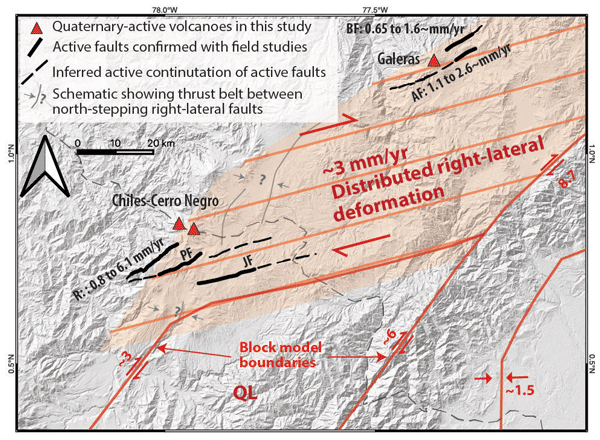
Abstract. Remote sensing and field data suggest distributed right-lateral faulting at the northern edge of the Quito-Latacunga microblock in northern Ecuador and southern Colombia. Off the west coast of Ecuador and Colombia, oblique subduction of the Nazca Plate beneath the South America plate induces northeastward motion of the Northern Andean Sliver relative to stable South America. Recent geodetic studies show this sliver comprises several independent microblocks, with strain accommodated at each of their boundaries. The Quito-Latacunga microblock, located in the densely populated Interandean valley, shows approximately 3 mm/yr of right-lateral strain at its northern boundary. However, which structures accommodate this deformation is unclear. Using available digital terrain models (DTMs), local DTMs derived from Pleiades satellite stereo-imagery, InSAR, Google Earth imagery, and field surveys, we demonstrate deformation at the northern boundary is distributed across several northeast-striking right-lateral faults in Ecuador and Colombia. InSAR shows that a recent 2022 M 5.7 earthquake resulted in line-of-sight displacement of 5 cm to 13 cm along one of the east-northeast striking, right-lateral faults. Offset sediments and glacial features indicate recent earthquakes on two other faults (the Reservoir and Polylepis faults) north of and subparallel with this rupture. Displaced glacial landforms along the Reservoir fault show slip rates between 0.8 and 6.1 mm/yr, suggesting geologic slip rates that could be higher than geodetic ones. Exposures of the Reservoir fault also show evidence for at least three surface rupturing earthquakes with magnitudes between M 6.3 and M 7.0. Inflation at the nearby Chile-Cerro Negro volcano may influence earthquakes on these faults, enhancing slip and earthquake rates. The Polylepis, Reservoir, and July 25th earthquake faults all overlap with the proposed area for the August 15, 1868, M 6.4-6.8 El Angel earthquake, indicating they could be associated with this damaging event.
-
Notice on discussion status
The requested preprint has a corresponding peer-reviewed final revised paper. You are encouraged to refer to the final revised version.
-
Preprint
(21553 KB)
-
The requested preprint has a corresponding peer-reviewed final revised paper. You are encouraged to refer to the final revised version.
- Preprint
(21553 KB) - Metadata XML
- BibTeX
- EndNote
- Final revised paper


Journal article(s) based on this preprint
Interactive discussion
Status: closed
-
RC1: 'Comment on egusphere-2025-4329', Sam Wimpenny, 06 Nov 2025
- AC1: 'Reply on RC1', Nicolas Harrichhausen, 14 Jan 2026
-
RC2: 'Comment on egusphere-2025-4329', Anonymous Referee #2, 26 Nov 2025
The comment was uploaded in the form of a supplement: https://egusphere.copernicus.org/preprints/2025/egusphere-2025-4329/egusphere-2025-4329-RC2-supplement.pdf
- AC2: 'Reply on RC2', Nicolas Harrichhausen, 14 Jan 2026
Peer review completion


Post-review adjustments


Interactive discussion
Status: closed
-
RC1: 'Comment on egusphere-2025-4329', Sam Wimpenny, 06 Nov 2025
- AC1: 'Reply on RC1', Nicolas Harrichhausen, 14 Jan 2026
-
RC2: 'Comment on egusphere-2025-4329', Anonymous Referee #2, 26 Nov 2025
The comment was uploaded in the form of a supplement: https://egusphere.copernicus.org/preprints/2025/egusphere-2025-4329/egusphere-2025-4329-RC2-supplement.pdf
- AC2: 'Reply on RC2', Nicolas Harrichhausen, 14 Jan 2026
Peer review completion
Post-review adjustments
Journal article(s) based on this preprint
Viewed
| HTML | XML | Total | BibTeX | EndNote | |
|---|---|---|---|---|---|
| 2,094 | 1,102 | 214 | 3,410 | 125 | 133 |
- HTML: 2,094
- PDF: 1,102
- XML: 214
- Total: 3,410
- BibTeX: 125
- EndNote: 133
Viewed (geographical distribution)
| Country | # | Views | % |
|---|
| Total: | 0 |
| HTML: | 0 |
| PDF: | 0 |
| XML: | 0 |
- 1
Nicolas Harrichhausen

Léo Marconato
Laurence Audin
Pierre Lacan
Stéphane Baize
Hervé Jomard
Alexandra Alvarado
James Hollingsworth
Pierre-Henri Blard
Patricia Ann Mothes
Frédérique Rolandoné
Iván Dario Ortiz Martin
The requested preprint has a corresponding peer-reviewed final revised paper. You are encouraged to refer to the final revised version.
- Preprint
(21553 KB) - Metadata XML
Find review file attached.