
the Creative Commons Attribution 4.0 License.
the Creative Commons Attribution 4.0 License.
 | 24 Sep 2025
The impact of aerosol mixing state on immersion freezing: Insights from classical nucleation theory and particle-resolved simulations
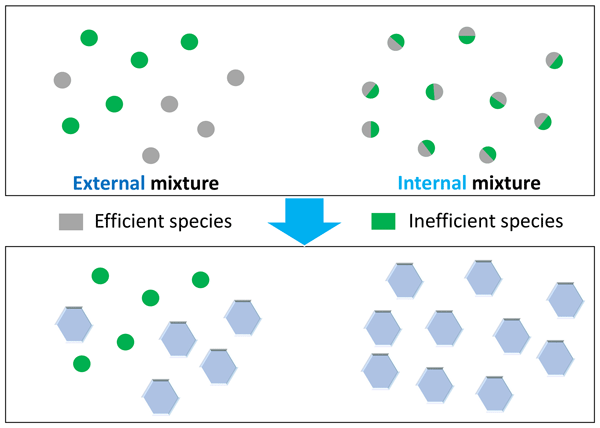
Abstract. Immersion freezing, initiated by ice-nucleating particles (INPs) in supercooled aqueous droplets, plays an important role in the formation of ice crystals within clouds. The efficiency of immersion freezing depends strongly on INP composition and, crucially, on the mixing state—how chemical species are distributed across the particle population. Here, we quantify the impact of aerosol mixing state on immersion freezing using a combined theoretical and particle-resolved modeling approach. We derive analytical expressions for the frozen fraction of internally and externally mixed INP populations based on classical nucleation theory, showing that the frozen fraction is sensitive to whether ice-active species are present in all particles or only in a subset of the population. We introduce a multi-species immersion freezing scheme into the particle-resolved model PartMC, using the water activity-based immersion freezing model (ABIFM) to compute freezing probabilities for mixed-composition particles. To improve computational efficiency, we implement a Binned Tau-Leaping algorithm and demonstrate an order-of-magnitude speedup with minimal accuracy loss. Simulations confirm the theoretical prediction that internally mixed populations yield higher frozen fractions than externally mixed ones under otherwise identical conditions. Sensitivity analyses across particle size, species type, and cooling condition reveal that the mixing state effect is most pronounced when small amounts of highly efficient INPs are mixed with less efficient materials. These findings underscore the need to represent aerosol mixing state explicitly in models of heterogeneous ice nucleation to reduce uncertainty in cloud-phase partitioning.
Competing interests: At least one of the (co-)authors is a member of the editorial board of Atmospheric Chemistry and Physics.
Publisher's note: Copernicus Publications remains neutral with regard to jurisdictional claims made in the text, published maps, institutional affiliations, or any other geographical representation in this paper. While Copernicus Publications makes every effort to include appropriate place names, the final responsibility lies with the authors. Views expressed in the text are those of the authors and do not necessarily reflect the views of the publisher.-
Notice on discussion status
The requested preprint has a corresponding peer-reviewed final revised paper. You are encouraged to refer to the final revised version.
-
Preprint
(4257 KB)
-
The requested preprint has a corresponding peer-reviewed final revised paper. You are encouraged to refer to the final revised version.
- Preprint
(4257 KB) - Metadata XML
- BibTeX
- EndNote
- Final revised paper


Journal article(s) based on this preprint
Interactive discussion
Status: closed
-
RC1: 'Comment on egusphere-2025-4326', Anonymous Referee #1, 15 Oct 2025
- AC1: 'Reply on RC1', Wenhan Tang, 19 Apr 2026
-
RC2: 'Comment on egusphere-2025-4326', Anonymous Referee #2, 20 Feb 2026
The comment was uploaded in the form of a supplement: https://egusphere.copernicus.org/preprints/2025/egusphere-2025-4326/egusphere-2025-4326-RC2-supplement.pdf
- AC2: 'Reply on RC2', Wenhan Tang, 19 Apr 2026
Peer review completion


Interactive discussion
Status: closed
-
RC1: 'Comment on egusphere-2025-4326', Anonymous Referee #1, 15 Oct 2025
Ice nucleation is an important process to form ice particles in clouds. Gaps still exist in understanding how the mixing state alters the INP efficiency. The study quantifies the impact of INP mixing state on immersion freezing using a combined theoretical and particle-resolved modeling approach. The authors first derive analytical expressions of the frozen fraction of internally and externally mixed INP populations. Results from a multi-species immersion freezing scheme into the particle-resolved model with a Binned Tau-Leaping algorithm to speed up the simulation confirm the theoretical prediction that internally mixed INPs yield higher frozen fractions than externally mixed INPs under otherwise identical conditions. The model framework (PartMC+ABIFM) can be a useful tool to study ice nucleation under complex mixing state conditions. In general, I think the paper is well written and I have some minor comments listed below.
- Overall, I find results from this study interesting. However, I am concerned about a key assumption—that the volume ratio of the species equals their surface area ratio. This assumption is unlikely to be held under realistic atmospheric conditions (e.g., I am thinking about aging or coating). My main concern is the representativeness of this assumption for real atmospheric INPs and how it affects the applicability of findings in this study to other research. I think it is worth including a discussion of this assumption, along with its potential limitations.
- Line 20: I suggest adding “extreme” before “external mixture” and “internal mixture” when first mentioning them in the paper, because there are many situations of “external” and “internal” mixture. “Each particle consists of a single chemical species” and “all particles share the same composition” are extreme conditions.
- Line 140: From the measurement point of view, people usually measure INP efficiency (INP spectrum) without knowing the chemical composition or mixing state of aerosols. Theorem 1 is not surprising from this point of view because internal mixture basically increases the number concentration of efficient INPs compared with external mixture. Therefore, I think it is equivalent to say the mixing state can change the INP spectrum. I wonder whether the authors can have one figure to show the change of INP spectrum by changing the mixing state.
- Line 186: Provide parameterization equation of Jhet and values of parameters of Fe2O3 and other species (e.g., those used in Figure 3) in the appendix, instead of just referring to Knopf and Alpert (2013).
- Figure 3. Mention the simulation condition in the caption, e.g., a constant temperature of -33 C and a duration of 10 minutes.
- Figure 7 caption. Specify “2, 5, and 9 minutes” in the caption, insteady of saying "at specific times".
- Line 388, “the \chi index” is not defined before. Consider changing it to “the mixing state”.
Citation: https://doi.org/10.5194/egusphere-2025-4326-RC1 - AC1: 'Reply on RC1', Wenhan Tang, 19 Apr 2026
-
RC2: 'Comment on egusphere-2025-4326', Anonymous Referee #2, 20 Feb 2026
The comment was uploaded in the form of a supplement: https://egusphere.copernicus.org/preprints/2025/egusphere-2025-4326/egusphere-2025-4326-RC2-supplement.pdf
- AC2: 'Reply on RC2', Wenhan Tang, 19 Apr 2026
Peer review completion
Journal article(s) based on this preprint
Data sets
Data for: The impact of aerosol mixing state on immersion freezing: Insights from classical nucleation theory and particle-resolved simulations W. Tang et al. https://doi.org/10.13012/B2IDB-6849781_V1
Model code and software
PartMC: Particle-resolved Monte Carlo code for atmospheric aerosol simulation (Version 2.8.0) M. West et al. https://github.com/tangwhiap/partmc/tree/imf
Interactive computing environment
Jupyter notebook for: The impact of aerosol mixing state on immersion freezing: Insights from classical nucleation theory and particle-resolved simulations W. Tang et al. https://github.com/open-atmos/PyPartMC/blob/main/examples/immersion_freezing.ipynb
Viewed
| HTML | XML | Total | BibTeX | EndNote | |
|---|---|---|---|---|---|
| 8,355 | 958 | 215 | 9,528 | 203 | 254 |
- HTML: 8,355
- PDF: 958
- XML: 215
- Total: 9,528
- BibTeX: 203
- EndNote: 254
Viewed (geographical distribution)
| Country | # | Views | % |
|---|
| Total: | 0 |
| HTML: | 0 |
| PDF: | 0 |
| XML: | 0 |
- 1
Wenhan Tang

Sylwester Arabas
Jeffrey H. Curtis
Daniel A. Knopf
Matthew West
The requested preprint has a corresponding peer-reviewed final revised paper. You are encouraged to refer to the final revised version.
- Preprint
(4257 KB) - Metadata XML
Ice nucleation is an important process to form ice particles in clouds. Gaps still exist in understanding how the mixing state alters the INP efficiency. The study quantifies the impact of INP mixing state on immersion freezing using a combined theoretical and particle-resolved modeling approach. The authors first derive analytical expressions of the frozen fraction of internally and externally mixed INP populations. Results from a multi-species immersion freezing scheme into the particle-resolved model with a Binned Tau-Leaping algorithm to speed up the simulation confirm the theoretical prediction that internally mixed INPs yield higher frozen fractions than externally mixed INPs under otherwise identical conditions. The model framework (PartMC+ABIFM) can be a useful tool to study ice nucleation under complex mixing state conditions. In general, I think the paper is well written and I have some minor comments listed below.