
the Creative Commons Attribution 4.0 License.
the Creative Commons Attribution 4.0 License.
 | 16 Sep 2025
Elucidation of the myrcene ozonolysis mechanism from a Criegee Chemistry perspective
Abstract. Criegee intermediates (CIs) are highly reactive species generated during the alkene ozonolysis, which play a critical role in atmospheric chemistry. Myrcene is a typical monoterpene, and its linear structure is significantly different from other cyclic monoterpenes such as α-pinene. This structural distinction consequently leads to different reactions mechanisms. This study employs a combined approach of matrix isolation Fourier transform infrared spectroscopy (MI-FTIR) and smog chamber experiments to elucidate the mechanisms of myrcene ozonolysis from the Criegee chemistry perspective. Two CIs with different molecular sizes, C3-CIs and C7-CIs, are captured at 880 and 905 cm-1 by using MI-FTIR. Ordered oligomers with C3-CIs serving as chain units, formed via RO2 + n C3-CIs + HO2/RO2 mechanisms, are detected as significant components in secondary organic aerosol (SOA). C7-CIs are more prone to unimolecular degradation to form C7-RO2 radical, which act as initiators for oligomerization reactions. The mechanisms may also exist in other monoterpenes ozonolysis, which offering new insights into the contribution of CIs to SOA formation. Furthermore, the mechanisms of the synergistic interaction between SCIs oligomerization and RO2 autoxidation are illustrated. The mechanisms facilitate the rapid formation of highly oxygenated species, playing a critical role in particle nucleation. The increase in relative humidity can effectively reduce the formation of higher-order oligomers, thereby suppressing the SOA yields. This study provides a systematic elucidation of myrcene ozonolysis mechanisms, thereby significantly enhancing the understanding of oxidation processes in acyclic monoterpenes.
-
Notice on discussion status
The requested preprint has a corresponding peer-reviewed final revised paper. You are encouraged to refer to the final revised version.
-
Preprint
(1462 KB)
-
Supplement
(553 KB)
-
The requested preprint has a corresponding peer-reviewed final revised paper. You are encouraged to refer to the final revised version.
- Preprint
(1462 KB) - Metadata XML
-
Supplement
(553 KB) - BibTeX
- EndNote
- Final revised paper


Journal article(s) based on this preprint
Interactive discussion
Status: closed
-
RC1: 'Comment on egusphere-2025-4310', Anonymous Referee #1, 08 Nov 2025
-
AC1: 'Reply on RC1', Shengrui Tong, 02 Dec 2025
The comment was uploaded in the form of a supplement: https://egusphere.copernicus.org/preprints/2025/egusphere-2025-4310/egusphere-2025-4310-AC1-supplement.pdf
-
AC1: 'Reply on RC1', Shengrui Tong, 02 Dec 2025
-
RC2: 'Comment on egusphere-2025-4310', Anonymous Referee #2, 15 Nov 2025
This manuscript presents a comprehensive investigation of myrcene ozonolysis from the perspective of Criegee intermediate (CI) chemistry. Using a combination of MI-FTIR, smog-chamber experiments, UHPLC-Orbitrap MS, and quantum chemical calculations, the authors identify both C3-CIs and C7-CIs, and evaluate their distinct contributions to secondary organic aerosol (SOA) formation. The work proposes a potentially important synergistic mechanism between SCIs oligomerization and RO₂ autoxidation, offering new insights into particle nucleation in monoterpene systems.
Major issues:
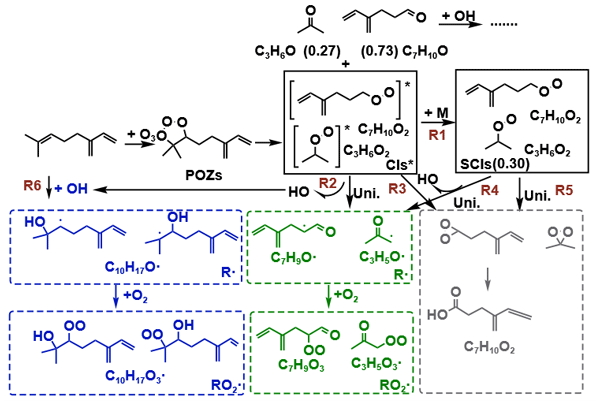
- Criegee intermediates are produced in the ozonolysis of myrcene as proposed in Figure 1. It is noted that the formed Criegee intermediates contain C=C group and COO group, which could lead to the C=C group reaction with COO group similar to the previous investigation in the literature (Nat. Commun. 2019, 10, 2003.).
- Although I think that the calculated results can be used to help explain the experimental measurements, it is better to explain the error bars due to the computational methods. This is very helpful for potential readers to understand the challenges in the calculations.
Minor issues
Figure 1: Make the font of this figure consistent with those of the other figures in the entire text.
Figure 2: How to confirm that the 907 cm⁻¹ peak is the characteristic IR peak for C7-CIs, given the overlap with the parent peak and the presence of other products with conjugated double bonds, such as POZ.
Regarding the matrix isolation experiment, what are the scientific considerations governing the choice of the specific temperature window, namely 35-55 K?
Section 3.2, How to confirm that SCIs first react with RO2 and then with HO2, rather than RO2 first reacting with HO2 to form ROOH, which then reacts with SCIs.
The authors characterized the particulate phase composition and detected oligomers within it. How can it be demonstrated that these oligomers were formed in the gas phase rather than in the particle phase? For instance, oligomers can also be formed by hemiacetal reactions within the particle phase. How is this particle-phase pathway accounted for?
Equation R8 contains an error in its chemical formula.
Citation: https://doi.org/10.5194/egusphere-2025-4310-RC2 -
AC2: 'Reply on RC2', Shengrui Tong, 02 Dec 2025
The comment was uploaded in the form of a supplement: https://egusphere.copernicus.org/preprints/2025/egusphere-2025-4310/egusphere-2025-4310-AC2-supplement.pdf
-
RC3: 'Comment on egusphere-2025-4310', Matti Rissanen, 10 Dec 2025
The comment was uploaded in the form of a supplement: https://egusphere.copernicus.org/preprints/2025/egusphere-2025-4310/egusphere-2025-4310-RC3-supplement.pdf
-
AC3: 'Reply on RC3', Shengrui Tong, 18 Dec 2025
The comment was uploaded in the form of a supplement: https://egusphere.copernicus.org/preprints/2025/egusphere-2025-4310/egusphere-2025-4310-AC3-supplement.pdf
-
AC3: 'Reply on RC3', Shengrui Tong, 18 Dec 2025
Peer review completion


Interactive discussion
Status: closed
-
RC1: 'Comment on egusphere-2025-4310', Anonymous Referee #1, 08 Nov 2025
General comments:
This study employs a combined approach of matrix isolation Fourier transform infrared spectroscopy (MI-FTIR) and smog chamber experiments to elucidate the mechanisms of myrcene ozonolysis from the perspective of Criegee chemistry, thus significantly enhancing our understanding of oxidation processes in acyclic monoterpenes.
The manuscript presents research of high quality, with sound methodology and clearly described experimental processes. The findings are of considerable significance and are generally well-articulated and convincing. The methods applied are appropriate, and the reaction mechanisms are described in a detailed and clear manner. This work merits publication in Atmospheric Chemistry and Physics after the authors address the minor revisions outlined below.
Specific comments:
- It is recommended to provide additional clarification on the calculation method of SOA yield in Table 2, such as whether corrections were made for particle wall loss.
- In the MI-FTIR experiment, the characteristic peak of C7-CIs (905 cm⁻¹) overlaps with that of myrcene itself. How was interference from the parent compound ruled out in this case?
- In this study, the conclusion regarding the role of C7-CIs in SOA formation primarily relies on their degradation product C7-RO2. Could this potentially underestimate the direct involvement of C7-CIs themselves in other bimolecular reactions, such as those with organic acids?
- In the Results and Discussion section, it is mentioned that for C10-CIs produced by cyclic monoterpenes such as α-pinene and limonene, they may more closely resemble C7-CIs in being incorporated into the particle phase through monomeric reactions rather than oligomerization. This inference tends to rely more on molecular size analogy. Are there any literature sources that provide direct experimental observations or quantum chemical calculations to support this view?
- This study mentions that "the contribution of C7-CIs oligomerization is negligible." Is this due to their low reactivity or the high volatility of the reaction products? It is recommended to briefly explain this in the discussion.
- Some sentences in the text are quite lengthy; it is suggested to appropriately break them down to enhance the readability of the article.
- Is the synergistic mechanism discovered in this study universal in other monoterpene or alkene systems beyond the myrcene system?
Citation: https://doi.org/10.5194/egusphere-2025-4310-RC1 -
AC1: 'Reply on RC1', Shengrui Tong, 02 Dec 2025
The comment was uploaded in the form of a supplement: https://egusphere.copernicus.org/preprints/2025/egusphere-2025-4310/egusphere-2025-4310-AC1-supplement.pdf
-
RC2: 'Comment on egusphere-2025-4310', Anonymous Referee #2, 15 Nov 2025
This manuscript presents a comprehensive investigation of myrcene ozonolysis from the perspective of Criegee intermediate (CI) chemistry. Using a combination of MI-FTIR, smog-chamber experiments, UHPLC-Orbitrap MS, and quantum chemical calculations, the authors identify both C3-CIs and C7-CIs, and evaluate their distinct contributions to secondary organic aerosol (SOA) formation. The work proposes a potentially important synergistic mechanism between SCIs oligomerization and RO₂ autoxidation, offering new insights into particle nucleation in monoterpene systems.
Major issues:
- Criegee intermediates are produced in the ozonolysis of myrcene as proposed in Figure 1. It is noted that the formed Criegee intermediates contain C=C group and COO group, which could lead to the C=C group reaction with COO group similar to the previous investigation in the literature (Nat. Commun. 2019, 10, 2003.).
- Although I think that the calculated results can be used to help explain the experimental measurements, it is better to explain the error bars due to the computational methods. This is very helpful for potential readers to understand the challenges in the calculations.
Minor issues
Figure 1: Make the font of this figure consistent with those of the other figures in the entire text.
Figure 2: How to confirm that the 907 cm⁻¹ peak is the characteristic IR peak for C7-CIs, given the overlap with the parent peak and the presence of other products with conjugated double bonds, such as POZ.
Regarding the matrix isolation experiment, what are the scientific considerations governing the choice of the specific temperature window, namely 35-55 K?
Section 3.2, How to confirm that SCIs first react with RO2 and then with HO2, rather than RO2 first reacting with HO2 to form ROOH, which then reacts with SCIs.
The authors characterized the particulate phase composition and detected oligomers within it. How can it be demonstrated that these oligomers were formed in the gas phase rather than in the particle phase? For instance, oligomers can also be formed by hemiacetal reactions within the particle phase. How is this particle-phase pathway accounted for?
Equation R8 contains an error in its chemical formula.
Citation: https://doi.org/10.5194/egusphere-2025-4310-RC2 -
AC2: 'Reply on RC2', Shengrui Tong, 02 Dec 2025
The comment was uploaded in the form of a supplement: https://egusphere.copernicus.org/preprints/2025/egusphere-2025-4310/egusphere-2025-4310-AC2-supplement.pdf
-
RC3: 'Comment on egusphere-2025-4310', Matti Rissanen, 10 Dec 2025
The comment was uploaded in the form of a supplement: https://egusphere.copernicus.org/preprints/2025/egusphere-2025-4310/egusphere-2025-4310-RC3-supplement.pdf
-
AC3: 'Reply on RC3', Shengrui Tong, 18 Dec 2025
The comment was uploaded in the form of a supplement: https://egusphere.copernicus.org/preprints/2025/egusphere-2025-4310/egusphere-2025-4310-AC3-supplement.pdf
-
AC3: 'Reply on RC3', Shengrui Tong, 18 Dec 2025
Peer review completion
Journal article(s) based on this preprint
Viewed
| HTML | XML | Total | Supplement | BibTeX | EndNote | |
|---|---|---|---|---|---|---|
| 4,844 | 426 | 132 | 5,402 | 192 | 105 | 106 |
- HTML: 4,844
- PDF: 426
- XML: 132
- Total: 5,402
- Supplement: 192
- BibTeX: 105
- EndNote: 106
Viewed (geographical distribution)
| Country | # | Views | % |
|---|
| Total: | 0 |
| HTML: | 0 |
| PDF: | 0 |
| XML: | 0 |
- 1
Meifang Chen
Shengrui Tong

Shanshan Yu
Xiaofan Lv
Yanyong Xu
Hailiang Zhang
The requested preprint has a corresponding peer-reviewed final revised paper. You are encouraged to refer to the final revised version.
- Preprint
(1462 KB) - Metadata XML
-
Supplement
(553 KB) - BibTeX
- EndNote
- Final revised paper
General comments:
This study employs a combined approach of matrix isolation Fourier transform infrared spectroscopy (MI-FTIR) and smog chamber experiments to elucidate the mechanisms of myrcene ozonolysis from the perspective of Criegee chemistry, thus significantly enhancing our understanding of oxidation processes in acyclic monoterpenes.
The manuscript presents research of high quality, with sound methodology and clearly described experimental processes. The findings are of considerable significance and are generally well-articulated and convincing. The methods applied are appropriate, and the reaction mechanisms are described in a detailed and clear manner. This work merits publication in Atmospheric Chemistry and Physics after the authors address the minor revisions outlined below.
Specific comments: