
the Creative Commons Attribution 4.0 License.
the Creative Commons Attribution 4.0 License.
 | 06 Oct 2025
Heterogeneous future Arctic Ocean primary productivity changes projected in CMIP6
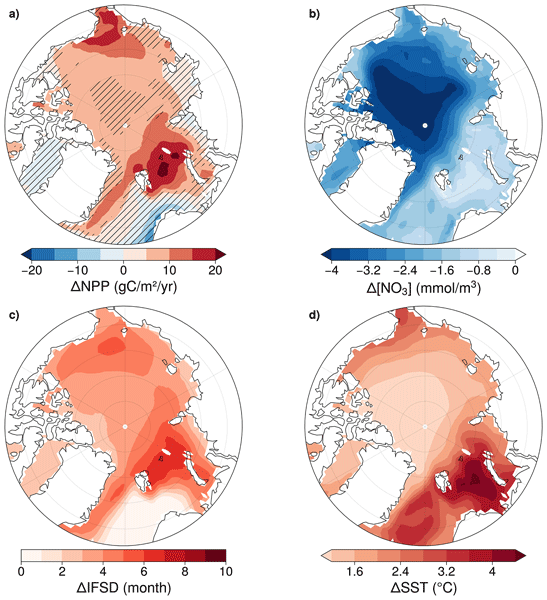
Abstract. The Arctic Ocean is experiencing profound environmental changes due to climate change, with Net Primary Production (NPP) broadly projected to increase this century. This study analyzes NPP trends and their drivers across pan-Arctic and sub-regional scales throughout the 21st century, comparing Coupled Model Intercomparison Project Phase 6 (CMIP6) and Phase 5 (CMIP5) projections to assess how model generations differ. Using a multi-model approach, we assess projections for different Phytoplankton Functional Types (PFTs), diatoms and nanophytoplankton, and examine the role of physical and biogeochemical constraints including light, nutrient, and temperature limitations. Our results reveal that Arctic Ocean NPP increases are primarily driven by reduced sea ice cover, leading to longer ice-free seasons in the expanding seasonal ice zone. However, NPP changes exhibit pronounced spatial heterogeneity, with strong increases in Arctic inflow shelf regions, tempered by decreases in Baffin Bay and Nordic Seas. These differences are due to the varying balance between physical and biogeochemical NPP constraints across the Arctic Ocean. The multi-model mean Arctic Ocean NPP increase is four times larger in CMIP6 than in CMIP5, under comparable radiative forcing, with a three times higher uncertainty at the end of the century. This difference is attributed to higher baseline nutrient levels in CMIP6, combined with more pronounced sea ice loss and greater warming than in CMIP5. Key aspects to better simulate future Arctic Ocean NPP remain the representation of present-day nutrient levels, light transmission through sea ice and reduced model uncertainty in climate sensitivity.
-
Notice on discussion status
The requested preprint has a corresponding peer-reviewed final revised paper. You are encouraged to refer to the final revised version.
-
Preprint
(7141 KB)
-
The requested preprint has a corresponding peer-reviewed final revised paper. You are encouraged to refer to the final revised version.
- Preprint
(7141 KB) - Metadata XML
- BibTeX
- EndNote
- Final revised paper


Journal article(s) based on this preprint
Interactive discussion
Status: closed
-
RC1: 'Comment on egusphere-2025-4296', Stephen Kelly, 12 Nov 2025
-
AC1: 'Reply on RC1', Léna Champiot-Bayard, 02 Feb 2026
The comment was uploaded in the form of a supplement: https://egusphere.copernicus.org/preprints/2025/egusphere-2025-4296/egusphere-2025-4296-AC1-supplement.pdf
-
AC1: 'Reply on RC1', Léna Champiot-Bayard, 02 Feb 2026
-
RC2: 'Comment on egusphere-2025-4296', Nadja Steiner, 20 Dec 2025
Content comments
The paper discusses changes in Arctic ocean primary production and its drivers in CMIP6 models with comparison to CMIP5, with some focus on subregional scales.
- Despite initial indication of subregional analysis there is great emphasis and description of panarctic averages. Given the high variability and large differences among Arctic regions for both drivers and PP, I don’t think a panarctic view is very meaningful. It may be a good benchmark to add, but only becomes scientifically useful if the regional drivers are discussed/understood. While there is regional discussion later on in the paper (mostly spatial maps) and one figure with multi-model mean subregional trends, I think the value of the science would be much higher if the subregional trends were shown/discussed for all models and in context with the initial panarctic mean discussions. This would allow to highlight the differences among models with information on where the models show different PP, if the drivers are consistent among models and regions or if there are certain regions/models that drive the panarctic mean. It would also allow insights into how the model uncertainty varies across region and time for both PP and limitation functions.
- The mixed use of relative and absolute values leads to inaccurate statements and misleading impressions of PP increase/decrease. Please ensure comparisons are accurate and actually comparable and I highly recommend the use of absolute values to adequately highlight/represent what is going on in the CAO versus the shelf and subarctic seas.
- Please refrain from making blunt and potentially inaccurate statements about Impacts on Inuit (see detailed note below).
In summary, I think the paper has really good potential to provide a valuable science contribution. A detailed, subregional evaluation of CMIP6/CMIP5 models is overdue! However, at this stage I recommend major changes to improve the discussion/value of the subregional analysis, ensure accurate comparisons and highlighting, and remove potentially harmful commenting on Inuit impacts.
Detailed content comments:
Figure 1 and text P8L7-15: I assume this is pan-Arctic. I find a pan-Arctic average evaluation not very meaningful as the Arctic is quite diverse, both in drivers and responses (see e.g. Steiner and Reader 2024, https://doi.org/10.1029/2024JC020970). a panarctic average can represent great correspondence all around or bad correspondence with some areas over and some underestimated. Given that the authors indicated 10 regions, I suggest add/discuss the evaluation for all regions in addition to the pan-Arctic already here. That way it is possible to see which regions may be contributing more or less to model-obs biases (see introductory note).
Also P10L1-10 I think adding the subregional evaluation here would allow to be more quantitative on regional biases and strengthen this section.
Figure 3: Indicate in caption what region is averaged over. Again I suggest doing these plots for all subregions at least in the supplementary material (if available for this journal), it is really the regional changes that are interesting and useful.
P11 L1-5 This would be really interesting to see for the sub regions
Figure 7 Indicate region average, I assume this is pan-Arctic.
Again, I see even less value in pan-Arctic limitation functions, I think this discussion would be more valuable if subdivided or when the panarctic mean is supported by the subregional analysis right from the start
P16: “Remarkably, the regions of greatest relative NPP uncertainty (central Arctic Ocean) differ from those exhibiting the largest absolute NPP increases (shelf regions, Fig. 4a), “
As these are relative differences, I assume the very low PP values in the CAO lead to the very high relative differences and the pattern may not be very meaningful. Absolute anomalies would be more meaningful here. Also, given the use of relative differences, which overemphasize the CAO in this context this is not “remarkable” at all. This statement is in fact misleading. I suggest to clarify this in this section and either remove or revise to " Given the very low PP values in the CAO it is not surprising that....”
L11 “highlighting that uncertainty patterns do not necessarily coincide with the magnitude of projected changes.”
Given that the authors are comparing relative with absolute, this statement is not accurate. To compare accurately either compare relative with relative or absolute with absolute, otherwise remove the statement.
P17 L10/11 “Relative increases in total NPP are greatest in the central Arctic basin, with >200 % enhancement compared to 1995-2014 values.”
Again, note that with the very low PP this may not be very meaningful, and actually misleading, especially given the color coding which gives an impression of a massive greening of the Arctic as well as giving the impression that the 40% decline in southerly regions is minor, which it definitely is not. I strongly recommend using the absolute values here.
P18 L5 “Nlim is lower”
For Nlim it is important to highlight that some Nlim is because there is a lot of productivity which quickly consumes available nutrients, others are because there are not a lot of N in the first place, so a more useful estimate would be the ratio of limitation to productivity, or alternatively present the Nlim at the begin of the productive season (which is more difficult as this varies by latitude).
L8/9 “40 %, indicating that diatoms face strongest nutrient constraints there.”
Inaccurate phrasing, largest change does not mean largest constraint, largest constraints are where values are lowest (again, ideally referring to the begin of the growing season)
L11/12 “2014). “Light limitation is highest” - This is light limitation, i.e the higher the factor, the lower is the limitation, i.e light limitation is lowest in the Nordic and Barents
P21 L7 “these ecosystem changes pose serious threats to local Inuit communities, …”
careful with the phrasing here, Inuit don't like to hear this, especially if it is neither clear nor accurate:
- these are projections and not proven changes, 2. threats have not been evaluated in this study, 3. only phytoplankton productivity has been evaluated, this is not the full ecosystem, 4. primary productivity is projected to increase, why should this negatively impact Inuit?
Please rephrase or even better, remove this sentence. If there is a need or strong wish to keep it, I suggest using something like "the projected changes on PP are expected to impact the local ecosystems with unclear impacts on Inuit subsistence species and harvesting".
L9 “factors” : maybe also indicate remaining differences in biogeochemical parameterizations, e.g. community structure? I suggest the authors also add a note on the lack/limited inclusion of sea ice algae in CMIP models which impacts timing of productivity, vertical distribution and carbon export. (could refer to ice algal model papers, e.g sea ice book Castellani et al 2025)
Technical comments
P2 l26 rm space after scape
P3 L18 one bracket only – Eyring
2.2 Model diagnostics ( rm s)
P4 l5 for light and nutrients
L22 provide actual equation for Eppley function
P7 line 2 - I wonder if there is a newer publication as you are referring to WOA18, several years after the referenced publication
Figure 1: suggest to not use black as a color for individual models (even with circles and triangles) to better highlight the model mean, maybe also make the mean line thicker also indicate averaging area in caption
P8 L8 394 Tg… : add by *** as for obs
P10L19-21 greater => larger anomalies , greater => higher radiative forcing, smaller model ensemble
P10L11 larger lower????
Fig 4 caption in 2081 => for 2081
P12 L10 losing up to more – losing more
L11 The Barents
L12 rm: in these zones
P13 L0 ensemble, however
L11: “The area-specific Arctic Ocean ΔNPP is relatively low compared to other regions,” unclear what is meant here. what does area-specific mean and what are the other regions ?
P14 L 5 suggest rem “This region” at the beginning – start with Baffin Bay differs
also “the multi-model”
L7 anomaly remains – I think "change" works better here
L9 basins: maybe ocean regions? there are many regions in the Arctic, but only very few basins
P15 L11-12 “relaxed light limitation which is augmented by the influence of warming on phytoplankton temperature functions and slightly offset by enhanced nutrient limitation “ - awkward phrasing, suggest improved light condition or "a reduction in the light limitation", then start a new sentence
L13 However, the deltaLim
Fig 10 caption – correct bracket SSP8
P18 L10: “maximum Nlim decrease of less than 20 % “ - suggest "with Nlim decreases below 20%
L15 The light
L16 The temperature
P19 L14 are contributing, suggest use “amay contribute”
L20 exhibit a different
P20 L3 check citation format Lewis et al
L4 than the scenario
L5 suggest start new sentence after NPP projections
L6 among ( 2 =between, >2 among)
L9 no comma after bracket, - a higher
L18 mean state concentrations of what ?
L20 “ Regions experiencing NPP decline, such as Baffin Bay and the Nordic Seas,”
duplication , suggest just "These regions ...
L24 The Nordic
L32 This production => This increase is
L33 the Nordic
L36 suggest removing the word fundamental, maybe a bit too strong here
L37 remove thus
P21 L3 “implications” suggest "impacts": ....
also the authors indicate diverse implications, but then don't identify what is diverse. Maybe use "with a variety of impacts:" in lieu
L3-5 suggest splitting into 2 sentences
L9 “ varying sea ice thickness and optical properties,”
awkward phrasing, suggest: through sea ice of varying thickness and optical properties
L17 suggest remove “incidentally”
L19 suggest "unclear impacts"
L20 suggest “potential implications”
Citation: https://doi.org/10.5194/egusphere-2025-4296-RC2 -
AC2: 'Reply on RC2', Léna Champiot-Bayard, 02 Feb 2026
We thank Reviewer 2 for taking the time to comment on our manuscript, which helped improve the clarity, robustness, and regional relevance of our manuscript. We have carefully and constructively addressed all comments by revising the manuscript accordingly in our detailed responses attached.
-
AC3: 'Reply on RC2', Léna Champiot-Bayard, 02 Feb 2026
Publisher’s note: this comment is a copy of AC2 and its content was therefore removed on 3 February 2026.
Citation: https://doi.org/10.5194/egusphere-2025-4296-AC3
Peer review completion


Post-review adjustments


Interactive discussion
Status: closed
-
RC1: 'Comment on egusphere-2025-4296', Stephen Kelly, 12 Nov 2025
Please do not be disheartened by my recommendation of major revisions: this is a promising manuscript that will represent a significant contribution to scientific progress when it is ready for publication. I have selected major revisions because I feel that some of the explanation is currently incomplete and I have suggested some additional analysis that may take longer than would be appropriate for minor revisions. I enjoyed reading this manuscript and I look forward to seeing a revised version. Please see attached PDF for my reviewer comments.
-
AC1: 'Reply on RC1', Léna Champiot-Bayard, 02 Feb 2026
The comment was uploaded in the form of a supplement: https://egusphere.copernicus.org/preprints/2025/egusphere-2025-4296/egusphere-2025-4296-AC1-supplement.pdf
-
AC1: 'Reply on RC1', Léna Champiot-Bayard, 02 Feb 2026
-
RC2: 'Comment on egusphere-2025-4296', Nadja Steiner, 20 Dec 2025
Content comments
The paper discusses changes in Arctic ocean primary production and its drivers in CMIP6 models with comparison to CMIP5, with some focus on subregional scales.
- Despite initial indication of subregional analysis there is great emphasis and description of panarctic averages. Given the high variability and large differences among Arctic regions for both drivers and PP, I don’t think a panarctic view is very meaningful. It may be a good benchmark to add, but only becomes scientifically useful if the regional drivers are discussed/understood. While there is regional discussion later on in the paper (mostly spatial maps) and one figure with multi-model mean subregional trends, I think the value of the science would be much higher if the subregional trends were shown/discussed for all models and in context with the initial panarctic mean discussions. This would allow to highlight the differences among models with information on where the models show different PP, if the drivers are consistent among models and regions or if there are certain regions/models that drive the panarctic mean. It would also allow insights into how the model uncertainty varies across region and time for both PP and limitation functions.
- The mixed use of relative and absolute values leads to inaccurate statements and misleading impressions of PP increase/decrease. Please ensure comparisons are accurate and actually comparable and I highly recommend the use of absolute values to adequately highlight/represent what is going on in the CAO versus the shelf and subarctic seas.
- Please refrain from making blunt and potentially inaccurate statements about Impacts on Inuit (see detailed note below).
In summary, I think the paper has really good potential to provide a valuable science contribution. A detailed, subregional evaluation of CMIP6/CMIP5 models is overdue! However, at this stage I recommend major changes to improve the discussion/value of the subregional analysis, ensure accurate comparisons and highlighting, and remove potentially harmful commenting on Inuit impacts.
Detailed content comments:
Figure 1 and text P8L7-15: I assume this is pan-Arctic. I find a pan-Arctic average evaluation not very meaningful as the Arctic is quite diverse, both in drivers and responses (see e.g. Steiner and Reader 2024, https://doi.org/10.1029/2024JC020970). a panarctic average can represent great correspondence all around or bad correspondence with some areas over and some underestimated. Given that the authors indicated 10 regions, I suggest add/discuss the evaluation for all regions in addition to the pan-Arctic already here. That way it is possible to see which regions may be contributing more or less to model-obs biases (see introductory note).
Also P10L1-10 I think adding the subregional evaluation here would allow to be more quantitative on regional biases and strengthen this section.
Figure 3: Indicate in caption what region is averaged over. Again I suggest doing these plots for all subregions at least in the supplementary material (if available for this journal), it is really the regional changes that are interesting and useful.
P11 L1-5 This would be really interesting to see for the sub regions
Figure 7 Indicate region average, I assume this is pan-Arctic.
Again, I see even less value in pan-Arctic limitation functions, I think this discussion would be more valuable if subdivided or when the panarctic mean is supported by the subregional analysis right from the start
P16: “Remarkably, the regions of greatest relative NPP uncertainty (central Arctic Ocean) differ from those exhibiting the largest absolute NPP increases (shelf regions, Fig. 4a), “
As these are relative differences, I assume the very low PP values in the CAO lead to the very high relative differences and the pattern may not be very meaningful. Absolute anomalies would be more meaningful here. Also, given the use of relative differences, which overemphasize the CAO in this context this is not “remarkable” at all. This statement is in fact misleading. I suggest to clarify this in this section and either remove or revise to " Given the very low PP values in the CAO it is not surprising that....”
L11 “highlighting that uncertainty patterns do not necessarily coincide with the magnitude of projected changes.”
Given that the authors are comparing relative with absolute, this statement is not accurate. To compare accurately either compare relative with relative or absolute with absolute, otherwise remove the statement.
P17 L10/11 “Relative increases in total NPP are greatest in the central Arctic basin, with >200 % enhancement compared to 1995-2014 values.”
Again, note that with the very low PP this may not be very meaningful, and actually misleading, especially given the color coding which gives an impression of a massive greening of the Arctic as well as giving the impression that the 40% decline in southerly regions is minor, which it definitely is not. I strongly recommend using the absolute values here.
P18 L5 “Nlim is lower”
For Nlim it is important to highlight that some Nlim is because there is a lot of productivity which quickly consumes available nutrients, others are because there are not a lot of N in the first place, so a more useful estimate would be the ratio of limitation to productivity, or alternatively present the Nlim at the begin of the productive season (which is more difficult as this varies by latitude).
L8/9 “40 %, indicating that diatoms face strongest nutrient constraints there.”
Inaccurate phrasing, largest change does not mean largest constraint, largest constraints are where values are lowest (again, ideally referring to the begin of the growing season)
L11/12 “2014). “Light limitation is highest” - This is light limitation, i.e the higher the factor, the lower is the limitation, i.e light limitation is lowest in the Nordic and Barents
P21 L7 “these ecosystem changes pose serious threats to local Inuit communities, …”
careful with the phrasing here, Inuit don't like to hear this, especially if it is neither clear nor accurate:
- these are projections and not proven changes, 2. threats have not been evaluated in this study, 3. only phytoplankton productivity has been evaluated, this is not the full ecosystem, 4. primary productivity is projected to increase, why should this negatively impact Inuit?
Please rephrase or even better, remove this sentence. If there is a need or strong wish to keep it, I suggest using something like "the projected changes on PP are expected to impact the local ecosystems with unclear impacts on Inuit subsistence species and harvesting".
L9 “factors” : maybe also indicate remaining differences in biogeochemical parameterizations, e.g. community structure? I suggest the authors also add a note on the lack/limited inclusion of sea ice algae in CMIP models which impacts timing of productivity, vertical distribution and carbon export. (could refer to ice algal model papers, e.g sea ice book Castellani et al 2025)
Technical comments
P2 l26 rm space after scape
P3 L18 one bracket only – Eyring
2.2 Model diagnostics ( rm s)
P4 l5 for light and nutrients
L22 provide actual equation for Eppley function
P7 line 2 - I wonder if there is a newer publication as you are referring to WOA18, several years after the referenced publication
Figure 1: suggest to not use black as a color for individual models (even with circles and triangles) to better highlight the model mean, maybe also make the mean line thicker also indicate averaging area in caption
P8 L8 394 Tg… : add by *** as for obs
P10L19-21 greater => larger anomalies , greater => higher radiative forcing, smaller model ensemble
P10L11 larger lower????
Fig 4 caption in 2081 => for 2081
P12 L10 losing up to more – losing more
L11 The Barents
L12 rm: in these zones
P13 L0 ensemble, however
L11: “The area-specific Arctic Ocean ΔNPP is relatively low compared to other regions,” unclear what is meant here. what does area-specific mean and what are the other regions ?
P14 L 5 suggest rem “This region” at the beginning – start with Baffin Bay differs
also “the multi-model”
L7 anomaly remains – I think "change" works better here
L9 basins: maybe ocean regions? there are many regions in the Arctic, but only very few basins
P15 L11-12 “relaxed light limitation which is augmented by the influence of warming on phytoplankton temperature functions and slightly offset by enhanced nutrient limitation “ - awkward phrasing, suggest improved light condition or "a reduction in the light limitation", then start a new sentence
L13 However, the deltaLim
Fig 10 caption – correct bracket SSP8
P18 L10: “maximum Nlim decrease of less than 20 % “ - suggest "with Nlim decreases below 20%
L15 The light
L16 The temperature
P19 L14 are contributing, suggest use “amay contribute”
L20 exhibit a different
P20 L3 check citation format Lewis et al
L4 than the scenario
L5 suggest start new sentence after NPP projections
L6 among ( 2 =between, >2 among)
L9 no comma after bracket, - a higher
L18 mean state concentrations of what ?
L20 “ Regions experiencing NPP decline, such as Baffin Bay and the Nordic Seas,”
duplication , suggest just "These regions ...
L24 The Nordic
L32 This production => This increase is
L33 the Nordic
L36 suggest removing the word fundamental, maybe a bit too strong here
L37 remove thus
P21 L3 “implications” suggest "impacts": ....
also the authors indicate diverse implications, but then don't identify what is diverse. Maybe use "with a variety of impacts:" in lieu
L3-5 suggest splitting into 2 sentences
L9 “ varying sea ice thickness and optical properties,”
awkward phrasing, suggest: through sea ice of varying thickness and optical properties
L17 suggest remove “incidentally”
L19 suggest "unclear impacts"
L20 suggest “potential implications”
Citation: https://doi.org/10.5194/egusphere-2025-4296-RC2 -
AC2: 'Reply on RC2', Léna Champiot-Bayard, 02 Feb 2026
We thank Reviewer 2 for taking the time to comment on our manuscript, which helped improve the clarity, robustness, and regional relevance of our manuscript. We have carefully and constructively addressed all comments by revising the manuscript accordingly in our detailed responses attached.
-
AC3: 'Reply on RC2', Léna Champiot-Bayard, 02 Feb 2026
Publisher’s note: this comment is a copy of AC2 and its content was therefore removed on 3 February 2026.
Citation: https://doi.org/10.5194/egusphere-2025-4296-AC3
Peer review completion
Post-review adjustments
Journal article(s) based on this preprint
Viewed
| HTML | XML | Total | BibTeX | EndNote | |
|---|---|---|---|---|---|
| 2,625 | 1,805 | 203 | 4,633 | 194 | 172 |
- HTML: 2,625
- PDF: 1,805
- XML: 203
- Total: 4,633
- BibTeX: 194
- EndNote: 172
Viewed (geographical distribution)
| Country | # | Views | % |
|---|
| Total: | 0 |
| HTML: | 0 |
| PDF: | 0 |
| XML: | 0 |
- 1
Cited


Léna L. Champiot-Bayard

Lester L. Kwiatkowski
Martin M. Vancoppenolle
The requested preprint has a corresponding peer-reviewed final revised paper. You are encouraged to refer to the final revised version.
- Preprint
(7141 KB) - Metadata XML
Please do not be disheartened by my recommendation of major revisions: this is a promising manuscript that will represent a significant contribution to scientific progress when it is ready for publication. I have selected major revisions because I feel that some of the explanation is currently incomplete and I have suggested some additional analysis that may take longer than would be appropriate for minor revisions. I enjoyed reading this manuscript and I look forward to seeing a revised version. Please see attached PDF for my reviewer comments.