
the Creative Commons Attribution 4.0 License.
the Creative Commons Attribution 4.0 License.
 | 02 Sep 2025
Spatially contrasted response of Devonian anoxia to astronomical forcing
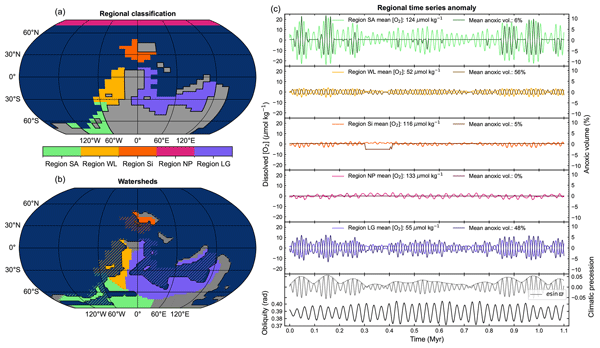
Abstract. The Devonian period, spanning from 419 to 359 million years ago, was marked by a warmer-than-present climate and recurring ocean anoxic events, with evidence increasingly suggesting a link between these events and astronomical forcing. Here, we explore how astronomical forcing influences ocean oxygenation by modulating the continental weathering flux of phosphate within a Late Devonian climate framework. To investigate this, we performed transient simulations spanning 1.1 Myr, crossing a 2.4 Myr eccentricity node using the cGENIE Earth system model. These simulations were driven by spatially resolved fluxes of reactive phosphorus from continents, computed using the emulator developed by Sablon et al. (2025), trained on GEOCLIM and HadSM3 outputs. Our results provide new evidence supporting eccentricity maxima as a driver of Late Devonian anoxic events. Additionally, global analysis reveals that obliquity variations can imprint a distinct signal on global ocean oxygen levels via their influence on biological productivity, offering a plausible mechanism for obliquity-driven anoxia under greenhouse conditions. Regional analysis revealed pronounced spatial heterogeneity in the biogeochemical response to astronomical forcing. Local ocean circulation emerged as a critical factor in shaping these patterns. The simulations indicate that astronomical forcing can, through its impact on continental weathering fluxes, exert a dominant influence on ocean oxygenation, with regional oxygen concentrations varying by up to 35 % and driving changes in regional anoxic volume of up to 19 %. Finally, these findings help explain why proxy records from different locations may show divergent expressions of astronomical signals, potentially leading to contrasting interpretations of their role in driving ocean anoxia.
-
Notice on discussion status
The requested preprint has a corresponding peer-reviewed final revised paper. You are encouraged to refer to the final revised version.
-
Preprint
(1487 KB)
-
Supplement
(3734 KB)
-
The requested preprint has a corresponding peer-reviewed final revised paper. You are encouraged to refer to the final revised version.
- Preprint
(1487 KB) - Metadata XML
-
Supplement
(3734 KB) - BibTeX
- EndNote
- Final revised paper


Journal article(s) based on this preprint
Interactive discussion
Status: closed
-
RC1: 'Comment on egusphere-2025-4238', Anonymous Referee #1, 05 Nov 2025
- AC1: 'Reply on RC1', Justin Gérard, 11 Dec 2025
-
RC2: 'Comment on egusphere-2025-4238', Alexander Farnsworth, 01 Dec 2025
Review: Gérard et al. Spatially contrasted response of Devonian anoxia to astronomical forcing.
Summary:
Gérard et al. investigate how orbital forcing may have modulated ocean oxygenation during the Late Devonian by altering continental phosphorus (PO₄) weathering fluxes and, in turn, marine productivity and redox state. Specifically, trying to assess the impact of a 2.4 Myr eccentricity cycle is implicated to drive the pacing of anoxic events using cGENIE, an Earth system intermediate complexity model in conjunction with HadCM3Bl temperature and hydrology, GEOCLIM7 and an emulator approach to produce more accurate fluxes containing orbital variation. This allows spatially explicit phosphorus (PO4) values instead of a single global value, theoretically allowing greater accuracy (both globally and regionally).
Transient and sensitivity simulations show that eccentricity drives a 40 ppm change in CO2 showing that PO4 is anti-correlated leading to smaller changes in dissolved oxygen on a global level, but much larger regional changes.
This work suggests that orbital forcing alone is not responsible for the Devonian anoxic events (if we believe they were truly global events), but could lead to anoxic states in some regions if the background state was nearer its tipping point.
There is good novelty throughout this manuscript, it is well written and generally well argued. I applaud the authors limitations section, and while there are limitations, it does show what the current state of the art is and ways forward for future modelling of deep-time orbital biogeochemical studies. More can be done (see below) but this open discussion on the matter in the ms is very welcome.
Major comments:
Given that the hydrological signal determines a large part of the amount of weathering occuing, can anything be said as to how well the model (HadCM3BL) is representing the hydrological cycle? I suspect there isn’t much proxy-data to do this. Likewise, can we constrain the rate of weathering from ROKGEM somehow? Presumably a higher or lower rate of weathering could substantially change these results? Or if another weathering model were used? Some further discussion about the implications of this (as well as the type of rock type being eroded – can we constrain this too?) might be warranted.
Likewise, can we constrain at all the predicted background state of the Late Devonian O2? Whether the model becomes anoxic/how sensitivity it might be to any change in CO2/PO4 will have an impact on whether it becomes anoxic. I.e. if the background state was already near the threshold, then even small changes might be important.
Was an ice sheet prescribed from the paleogeography (Famennian) in cGENIE? It is suggested that the Late Devonian may have had one present. Scotese and Wright do not explicitly have one, however one was artificially added into the Valdes et al. simulations (change in orography and albedo). Is there a potential disconnect here? If so, what impact could this have on fluxes and ocean circulation in cGENIE and in turn anoxia on a global and regional level?
How well does cGENIE represent modern climate and ocean biogeochemistry? How sensitive is the model to changes in nutrient fluxes and/or CO2. I may have missed it, but some references or discussion to justify that cGENIE and GEOCLIM adequately produces
How appropriate is the emulator at representing Deep time periods?
- Was the emulator trained on Quaternary time periods?
- Is the La11a-based orbital solution (123.3–122.2 Ma in the original chronology) applicable to your time frame?
- Granted the Devonian-specific solution (e.g. Zeebe & Lantink 2024) came out while your study was already running, but do you think your results would be different if it were used?
Further questions relating to some of the studies limitations:
- Flat bottom bathymetry in the palaeogeography – what role could this play on ocean anoxia? Or indirectly through unrealistic ocean circulation?
- How appropriate is cGENIE in resolving the large scale ocean circulation, especially at orbital timescales? E.g. AMOC collapse on LGM timescales?
- Have any specific assumptions on nutrient and other co-varying fluxes been made?
- How much can we trust available proxy-date? Good enough and well constrained age model? Are there different interpretations for these Devonian deposits? Can we truly determine whether this was a global event from them alone?
If HadCM3 circulation was used to initialised this work, how much memory of it persists through the orbital cycle? I suspect (not much once the orbital starts to change significantly) not much, which is good because you want ocean circulation to respond. However, does this then rely on cGENIE ocean circulation being appropriate? And if so, is it?
Minor comments:
The introduction was nicely written highlighting why orbital variability is worthy to look at. However, I wonder if a sentence of two explaining how orbital forcing imprints itself onto changes in ocean biogeochemistry, e.g. through changes to ocean circulation, hydrological changes leading to change in nutrient input, etc…
It might be worth a small paragraph discussing the proxy-evidence for this time period? How reliable was it? Are they globally distributed? Etc…
When the PO4 flux was routed to coastal tiles, was the total amount for each watershed basin averaged between each coastal grid cell? Or where higher concentrations routed through large river systems (river exit node)? I suspect it’s the later unless paleo-rivers were determined?
HadSM3? Do you mean HadCM3? The ‘S’ implied a slab ocean model was used. However, I suspect the outputs from Valdes, 2021 was used as initialised this work, then it’s the full AOGCM version (HadCM3BL).
What value of CO2 did the HadCM3BL late Devonian use?
Line 44 – Change GEOCLIM to GEOCLIM7
Line 188 – “This inverse relationship occurs because intensified weathering”, would this not be dependent on the type of rock that is being eroded?
Line 194:195 – “This outcome arises from the physical processes encoded in the emulator developed by Sablon et al. (2025), where the same feature was previously identified.” Presumably driven by the hydrology? Can you say whether it was simply an enhancement of the hydrological cycle globally? Or was it changes in the location of precipitation maxima (e.g. changes in storm tracks) moving poleward/equatorward over regions with more erodible material (i.e. mountains vs flat regions?) leading to a greater PO4 flux? Is the model complex enough to shed any light on this?
Line 220 – How well does the model represent shallow marine settings?
Line 229:237 – Why does the Si region have such a high O2 background state? Any idea why?
Line 327:329 – Assuming that the model is adequately capturing the background state correctly?
Line 329:330 – “Our results also suggest that anoxic events could manifest as a succession of smaller, transient episodes”. How does this tally with the earlier suggestion that there isn’t much memory in the system?
Will the simulations be made available to the community?
Just to reiterate, this is a nice study and worthy of being published in Climate of the Past, excellent stuff!
Alex Farnsworth
Citation: https://doi.org/10.5194/egusphere-2025-4238-RC2 -
AC2: 'Reply on RC2', Justin Gérard, 11 Dec 2025
We thank the Reviewer for the constructive and encouraging feedback. We are pleased that the manuscript’s novelty, clarity, and discussion of model limitations were appreciated.
We have uploaded the response as a supplement (single document, common to both reviewers).
Peer review completion


Interactive discussion
Status: closed
-
RC1: 'Comment on egusphere-2025-4238', Anonymous Referee #1, 05 Nov 2025
In this manuscript, Gérard et al. explore the impact of astronomical parameters on marine oxygen levels in a Devonian context using cGENIE model experiments with an updated, emulator-based, weathering scheme. The 1.1 Myr transient cGENIE simulations are forced with prescribed surface albedo and wind stress from a specific HadCM3 simulation of Valdes et al. (2021) and variable continental phosphorus inputs that evolve following a 1.1 Myr synthetic Devonian astronomical forcing that includes transitions between 405-kyr-modulated 100-kyr cycles and a 2.4-Myr eccentricity node without 100-kyr cycles. Following the methods described in Sablon et al. (2025), the phosphorus inputs to the ocean are emulated based on GEOCLIM simulations forced with climate conditions obtained from HadSM3 simulations with various combinations of orbital parameters and CO2. 3 simulations are evaluated with either the full orbital parameters evolving together or either obliquity or eccentricity/precession fixed to their mean values across the 1.1 Myr astronomical solution. The main result is that astronomy weakly influence the global mean concentration in O2 and PO4 but may have a greater impact on regional water mass characteristics, via inputs of weathered PO4 to the proximal ocean. The results support the hypothesis that Late Devonian anoxic events occurred close to eccentricity maxima as the latter forcing yields the largest anoxic volume in the simulations discussed in this manuscript.
I think this manuscript is worthy of publication after revisions. I have particularly liked the key message that the astronomical signal may have different regional expression on oceanic PO4 and O2. The links between the astronomical forcing and the simulated PO4 and O2 ocean concentrations are adequately illustrated, even if they are somehow expected from the start given the simplicity of the nutrient cycle – marine productivity is function of the concentration of PO4 – and that the astronomically-varying input of PO4 to the ocean is the only transient forcing across the simulations. The regional analysis is interesting but the impact of astronomy on O2 variability is in my opinion a bit oversold in some of the regions discussed.
My major concern is about the absence of astronomically-varying climate change in the simulations. If I understand correctly, the surface albedo and wind stress field are prescribed using outputs from a Devonian HadCM3 simulation with the same CO2 as Valdes et al. (2021) – which is what exactly? because Valdes et al. present 370 Ma simulations with 2 different pCO2 of 926 and 811 ppmv – and orbital values of 0 and 23° for eccentricity and obliquity and a longitude of perihelion of 0°. Now with very different orbital parameters, e.g. high eccentricity and/or obliquity, albedo and wind stress will change, perhaps significantly, and I suspect that it would drive ocean circulation changes leading to changes in marine O2 concentrations of at least similar, if not much larger, amplitude.
Given the numerous HadCM3 simulations with different orbital parameters that I suppose available to the authors from what is written in this manuscript and in Sablon et al. (2025), I suggest to perform at least one cGENIE simulation with prescribed wind stress and albedo from a simulation with an ‘extreme’ orbital configuration among those available in the HadCM3 ensemble to evaluate how dynamical changes in ocean circulation affect PO4 and O2 in the regions defined in Fig. 4, as well as globally.
A related question is how does the transient astronomical changes affect the ocean circulation via local insolation and freshwater fluxes, as I guess the cGENIE atmospheric EMB still operates across the model runs? With the wind stress field prescribed, do these heat and freshwater fluxes lead to changes in ocean convection zones? If yes, does this play a role in the O2 variability in the SA region? More generally, I think some ocean diagnostics could be useful to get a basic idea about the ocean circulation of this Devonian simulation.
Other comments.
1. Methods section.
The climate-weathering emulator construction is not very clear. The authors refer to Sablon et al. 2025 for the detailed description, which is fine, but the information laid out in this manuscript are ambiguous and/or not sufficiently detailed. Was HadSM3 or HadCM3, or both, used to construct the surface climate? If the methodology follows Sablon then it is probably the two of them but this should explicitly appear in the manuscript. If not, then how the procedure differs from Sablon must be clarified.
If the same HadCM3-HadSM3 methodology as Sablon was applied, then I find a bit problematic that HadCM3 is only run for 250 years before completing the simulations with HadSM3 (Sablon et al. 2025). How can the response of the ocean circulation to different orbital parameters and CO2 be adequately captured? I agree that 250 years is probably sufficient for near surface equilibrium but what about the deeper ocean? This can probably be alleviated, at least partly, if the simulations start from previous fully equilibrated HadCM3 simulations but this information is nowhere to be found, and even in this case, the longer-term equilibrium of the HadCM3 simulations should ideally be checked. If the simulations are initialized with idealized conditions, I have a hard time buying that surface ocean is in near-equilibrium without additional diagnostics.
Btw, it should be mentioned somewhere in the text that HadSM3 is the slab-ocean version of the HadCM3 GCM and therefore not a GCM as generally understood.
2. As it stands, Figure 2 is rather useless, unless I missed something.
3. Figure 3.
In Gérard et al. (2025) in Clim. Past, the global mean O2 concentration at 370 Ma with preindustrial pCO2 and pO2 and mean ocean PO4 is about 210 mmol/m3 (Fig. 3 of Gérard et al. 2025). In this manuscript, at ~ 2x preindustrial pCO2 (550 ppmv), 0.8x preindustrial pO2 and preindustrial mean ocean PO4, the global mean O2 concentration is 55 mmol/m3 (Fig. 3). Is it simply the effect of decreased atmospheric O2 concentration? I find this surprising.
4. Looking at the bathymetric differences between the 370 Ma configuration of Scotese and Verard in Gérard et al. (2025) makes me wonder if a similar sensitivity of O2 variability would be found with the Verard paleogeography? There are indeed a lot fewer shallow seas in Verard. It could be nice to add some lines about this in the discussion.
5. l. 237.
I don’t get what is remarkable in that the NP region shows no anoxia. It is instead rather expected if this a deep-water formation area (l. 223). It is more remarkable to me that region SA exhibits anoxia if it is indeed a deep-water formation zone, though I guess that the convection area must be quite localized, at the highest latitudes.
6. Figure 4 and l. 249 and on.
To me, the very weak astronomical effect on O2 and anoxia in regions NP, Si and WL is a bit overemphasized. At any rate, the purported insolation-driven changes invoked to explain the small variations in regions NP and Si should be shown in a figure, which could replace Fig. 2 for instance.
7. l. 256-268.
What is the reason for the different lag values in regions SA, WL, LG?
8. l. 269-281.
What explains the [PO4] lead in the time series then?
It is written that the regional [PO4] signature is strongly influenced by NH weathering outside of the Si region but there are not a lot more land masses in the NH.
Also, region Si is located right poleward of significant deep upwellings (see the MOC on Fig. 8 of Gérard et al. 2025). Perhaps worth checking whether these upwellings may mask continental PO4 inputs from weathering.
9. There is no map of the prescribed topography, even though I suppose that steep slopes strongly affect the simulated weathering fluxes. This could be easily added to Fig. 1.
I would appreciate some comments on this.
10. l. 374.
I am not convinced that the results presented in this manuscript support this. Obliquity-driven changes of a few mmol/m3 around of mean of more than 100 mmol/m3 in regions NP and Si would probably barely affect the sedimentary record.
Citation: https://doi.org/10.5194/egusphere-2025-4238-RC1 - AC1: 'Reply on RC1', Justin Gérard, 11 Dec 2025
-
RC2: 'Comment on egusphere-2025-4238', Alexander Farnsworth, 01 Dec 2025
Review: Gérard et al. Spatially contrasted response of Devonian anoxia to astronomical forcing.
Summary:
Gérard et al. investigate how orbital forcing may have modulated ocean oxygenation during the Late Devonian by altering continental phosphorus (PO₄) weathering fluxes and, in turn, marine productivity and redox state. Specifically, trying to assess the impact of a 2.4 Myr eccentricity cycle is implicated to drive the pacing of anoxic events using cGENIE, an Earth system intermediate complexity model in conjunction with HadCM3Bl temperature and hydrology, GEOCLIM7 and an emulator approach to produce more accurate fluxes containing orbital variation. This allows spatially explicit phosphorus (PO4) values instead of a single global value, theoretically allowing greater accuracy (both globally and regionally).
Transient and sensitivity simulations show that eccentricity drives a 40 ppm change in CO2 showing that PO4 is anti-correlated leading to smaller changes in dissolved oxygen on a global level, but much larger regional changes.
This work suggests that orbital forcing alone is not responsible for the Devonian anoxic events (if we believe they were truly global events), but could lead to anoxic states in some regions if the background state was nearer its tipping point.
There is good novelty throughout this manuscript, it is well written and generally well argued. I applaud the authors limitations section, and while there are limitations, it does show what the current state of the art is and ways forward for future modelling of deep-time orbital biogeochemical studies. More can be done (see below) but this open discussion on the matter in the ms is very welcome.
Major comments:
Given that the hydrological signal determines a large part of the amount of weathering occuing, can anything be said as to how well the model (HadCM3BL) is representing the hydrological cycle? I suspect there isn’t much proxy-data to do this. Likewise, can we constrain the rate of weathering from ROKGEM somehow? Presumably a higher or lower rate of weathering could substantially change these results? Or if another weathering model were used? Some further discussion about the implications of this (as well as the type of rock type being eroded – can we constrain this too?) might be warranted.
Likewise, can we constrain at all the predicted background state of the Late Devonian O2? Whether the model becomes anoxic/how sensitivity it might be to any change in CO2/PO4 will have an impact on whether it becomes anoxic. I.e. if the background state was already near the threshold, then even small changes might be important.
Was an ice sheet prescribed from the paleogeography (Famennian) in cGENIE? It is suggested that the Late Devonian may have had one present. Scotese and Wright do not explicitly have one, however one was artificially added into the Valdes et al. simulations (change in orography and albedo). Is there a potential disconnect here? If so, what impact could this have on fluxes and ocean circulation in cGENIE and in turn anoxia on a global and regional level?
How well does cGENIE represent modern climate and ocean biogeochemistry? How sensitive is the model to changes in nutrient fluxes and/or CO2. I may have missed it, but some references or discussion to justify that cGENIE and GEOCLIM adequately produces
How appropriate is the emulator at representing Deep time periods?
- Was the emulator trained on Quaternary time periods?
- Is the La11a-based orbital solution (123.3–122.2 Ma in the original chronology) applicable to your time frame?
- Granted the Devonian-specific solution (e.g. Zeebe & Lantink 2024) came out while your study was already running, but do you think your results would be different if it were used?
Further questions relating to some of the studies limitations:
- Flat bottom bathymetry in the palaeogeography – what role could this play on ocean anoxia? Or indirectly through unrealistic ocean circulation?
- How appropriate is cGENIE in resolving the large scale ocean circulation, especially at orbital timescales? E.g. AMOC collapse on LGM timescales?
- Have any specific assumptions on nutrient and other co-varying fluxes been made?
- How much can we trust available proxy-date? Good enough and well constrained age model? Are there different interpretations for these Devonian deposits? Can we truly determine whether this was a global event from them alone?
If HadCM3 circulation was used to initialised this work, how much memory of it persists through the orbital cycle? I suspect (not much once the orbital starts to change significantly) not much, which is good because you want ocean circulation to respond. However, does this then rely on cGENIE ocean circulation being appropriate? And if so, is it?
Minor comments:
The introduction was nicely written highlighting why orbital variability is worthy to look at. However, I wonder if a sentence of two explaining how orbital forcing imprints itself onto changes in ocean biogeochemistry, e.g. through changes to ocean circulation, hydrological changes leading to change in nutrient input, etc…
It might be worth a small paragraph discussing the proxy-evidence for this time period? How reliable was it? Are they globally distributed? Etc…
When the PO4 flux was routed to coastal tiles, was the total amount for each watershed basin averaged between each coastal grid cell? Or where higher concentrations routed through large river systems (river exit node)? I suspect it’s the later unless paleo-rivers were determined?
HadSM3? Do you mean HadCM3? The ‘S’ implied a slab ocean model was used. However, I suspect the outputs from Valdes, 2021 was used as initialised this work, then it’s the full AOGCM version (HadCM3BL).
What value of CO2 did the HadCM3BL late Devonian use?
Line 44 – Change GEOCLIM to GEOCLIM7
Line 188 – “This inverse relationship occurs because intensified weathering”, would this not be dependent on the type of rock that is being eroded?
Line 194:195 – “This outcome arises from the physical processes encoded in the emulator developed by Sablon et al. (2025), where the same feature was previously identified.” Presumably driven by the hydrology? Can you say whether it was simply an enhancement of the hydrological cycle globally? Or was it changes in the location of precipitation maxima (e.g. changes in storm tracks) moving poleward/equatorward over regions with more erodible material (i.e. mountains vs flat regions?) leading to a greater PO4 flux? Is the model complex enough to shed any light on this?
Line 220 – How well does the model represent shallow marine settings?
Line 229:237 – Why does the Si region have such a high O2 background state? Any idea why?
Line 327:329 – Assuming that the model is adequately capturing the background state correctly?
Line 329:330 – “Our results also suggest that anoxic events could manifest as a succession of smaller, transient episodes”. How does this tally with the earlier suggestion that there isn’t much memory in the system?
Will the simulations be made available to the community?
Just to reiterate, this is a nice study and worthy of being published in Climate of the Past, excellent stuff!
Alex Farnsworth
Citation: https://doi.org/10.5194/egusphere-2025-4238-RC2 -
AC2: 'Reply on RC2', Justin Gérard, 11 Dec 2025
We thank the Reviewer for the constructive and encouraging feedback. We are pleased that the manuscript’s novelty, clarity, and discussion of model limitations were appreciated.
We have uploaded the response as a supplement (single document, common to both reviewers).
Peer review completion
Journal article(s) based on this preprint
Viewed
| HTML | XML | Total | Supplement | BibTeX | EndNote | |
|---|---|---|---|---|---|---|
| 10,779 | 1,337 | 231 | 12,347 | 205 | 283 | 298 |
- HTML: 10,779
- PDF: 1,337
- XML: 231
- Total: 12,347
- Supplement: 205
- BibTeX: 283
- EndNote: 298
Viewed (geographical distribution)
| Country | # | Views | % |
|---|
| Total: | 0 |
| HTML: | 0 |
| PDF: | 0 |
| XML: | 0 |
- 1

Alexandre Pohl
Loïc Sablon
Jarno Huygh
Anne-Christine Da Silva
Michel Crucifix
The requested preprint has a corresponding peer-reviewed final revised paper. You are encouraged to refer to the final revised version.
- Preprint
(1487 KB) - Metadata XML
-
Supplement
(3734 KB) - BibTeX
- EndNote
- Final revised paper
In this manuscript, Gérard et al. explore the impact of astronomical parameters on marine oxygen levels in a Devonian context using cGENIE model experiments with an updated, emulator-based, weathering scheme. The 1.1 Myr transient cGENIE simulations are forced with prescribed surface albedo and wind stress from a specific HadCM3 simulation of Valdes et al. (2021) and variable continental phosphorus inputs that evolve following a 1.1 Myr synthetic Devonian astronomical forcing that includes transitions between 405-kyr-modulated 100-kyr cycles and a 2.4-Myr eccentricity node without 100-kyr cycles. Following the methods described in Sablon et al. (2025), the phosphorus inputs to the ocean are emulated based on GEOCLIM simulations forced with climate conditions obtained from HadSM3 simulations with various combinations of orbital parameters and CO2. 3 simulations are evaluated with either the full orbital parameters evolving together or either obliquity or eccentricity/precession fixed to their mean values across the 1.1 Myr astronomical solution. The main result is that astronomy weakly influence the global mean concentration in O2 and PO4 but may have a greater impact on regional water mass characteristics, via inputs of weathered PO4 to the proximal ocean. The results support the hypothesis that Late Devonian anoxic events occurred close to eccentricity maxima as the latter forcing yields the largest anoxic volume in the simulations discussed in this manuscript.
I think this manuscript is worthy of publication after revisions. I have particularly liked the key message that the astronomical signal may have different regional expression on oceanic PO4 and O2. The links between the astronomical forcing and the simulated PO4 and O2 ocean concentrations are adequately illustrated, even if they are somehow expected from the start given the simplicity of the nutrient cycle – marine productivity is function of the concentration of PO4 – and that the astronomically-varying input of PO4 to the ocean is the only transient forcing across the simulations. The regional analysis is interesting but the impact of astronomy on O2 variability is in my opinion a bit oversold in some of the regions discussed.
My major concern is about the absence of astronomically-varying climate change in the simulations. If I understand correctly, the surface albedo and wind stress field are prescribed using outputs from a Devonian HadCM3 simulation with the same CO2 as Valdes et al. (2021) – which is what exactly? because Valdes et al. present 370 Ma simulations with 2 different pCO2 of 926 and 811 ppmv – and orbital values of 0 and 23° for eccentricity and obliquity and a longitude of perihelion of 0°. Now with very different orbital parameters, e.g. high eccentricity and/or obliquity, albedo and wind stress will change, perhaps significantly, and I suspect that it would drive ocean circulation changes leading to changes in marine O2 concentrations of at least similar, if not much larger, amplitude.
Given the numerous HadCM3 simulations with different orbital parameters that I suppose available to the authors from what is written in this manuscript and in Sablon et al. (2025), I suggest to perform at least one cGENIE simulation with prescribed wind stress and albedo from a simulation with an ‘extreme’ orbital configuration among those available in the HadCM3 ensemble to evaluate how dynamical changes in ocean circulation affect PO4 and O2 in the regions defined in Fig. 4, as well as globally.
A related question is how does the transient astronomical changes affect the ocean circulation via local insolation and freshwater fluxes, as I guess the cGENIE atmospheric EMB still operates across the model runs? With the wind stress field prescribed, do these heat and freshwater fluxes lead to changes in ocean convection zones? If yes, does this play a role in the O2 variability in the SA region? More generally, I think some ocean diagnostics could be useful to get a basic idea about the ocean circulation of this Devonian simulation.
Other comments.
1. Methods section.
The climate-weathering emulator construction is not very clear. The authors refer to Sablon et al. 2025 for the detailed description, which is fine, but the information laid out in this manuscript are ambiguous and/or not sufficiently detailed. Was HadSM3 or HadCM3, or both, used to construct the surface climate? If the methodology follows Sablon then it is probably the two of them but this should explicitly appear in the manuscript. If not, then how the procedure differs from Sablon must be clarified.
If the same HadCM3-HadSM3 methodology as Sablon was applied, then I find a bit problematic that HadCM3 is only run for 250 years before completing the simulations with HadSM3 (Sablon et al. 2025). How can the response of the ocean circulation to different orbital parameters and CO2 be adequately captured? I agree that 250 years is probably sufficient for near surface equilibrium but what about the deeper ocean? This can probably be alleviated, at least partly, if the simulations start from previous fully equilibrated HadCM3 simulations but this information is nowhere to be found, and even in this case, the longer-term equilibrium of the HadCM3 simulations should ideally be checked. If the simulations are initialized with idealized conditions, I have a hard time buying that surface ocean is in near-equilibrium without additional diagnostics.
Btw, it should be mentioned somewhere in the text that HadSM3 is the slab-ocean version of the HadCM3 GCM and therefore not a GCM as generally understood.
2. As it stands, Figure 2 is rather useless, unless I missed something.
3. Figure 3.
In Gérard et al. (2025) in Clim. Past, the global mean O2 concentration at 370 Ma with preindustrial pCO2 and pO2 and mean ocean PO4 is about 210 mmol/m3 (Fig. 3 of Gérard et al. 2025). In this manuscript, at ~ 2x preindustrial pCO2 (550 ppmv), 0.8x preindustrial pO2 and preindustrial mean ocean PO4, the global mean O2 concentration is 55 mmol/m3 (Fig. 3). Is it simply the effect of decreased atmospheric O2 concentration? I find this surprising.
4. Looking at the bathymetric differences between the 370 Ma configuration of Scotese and Verard in Gérard et al. (2025) makes me wonder if a similar sensitivity of O2 variability would be found with the Verard paleogeography? There are indeed a lot fewer shallow seas in Verard. It could be nice to add some lines about this in the discussion.
5. l. 237.
I don’t get what is remarkable in that the NP region shows no anoxia. It is instead rather expected if this a deep-water formation area (l. 223). It is more remarkable to me that region SA exhibits anoxia if it is indeed a deep-water formation zone, though I guess that the convection area must be quite localized, at the highest latitudes.
6. Figure 4 and l. 249 and on.
To me, the very weak astronomical effect on O2 and anoxia in regions NP, Si and WL is a bit overemphasized. At any rate, the purported insolation-driven changes invoked to explain the small variations in regions NP and Si should be shown in a figure, which could replace Fig. 2 for instance.
7. l. 256-268.
What is the reason for the different lag values in regions SA, WL, LG?
8. l. 269-281.
What explains the [PO4] lead in the time series then?
It is written that the regional [PO4] signature is strongly influenced by NH weathering outside of the Si region but there are not a lot more land masses in the NH.
Also, region Si is located right poleward of significant deep upwellings (see the MOC on Fig. 8 of Gérard et al. 2025). Perhaps worth checking whether these upwellings may mask continental PO4 inputs from weathering.
9. There is no map of the prescribed topography, even though I suppose that steep slopes strongly affect the simulated weathering fluxes. This could be easily added to Fig. 1.
I would appreciate some comments on this.
10. l. 374.
I am not convinced that the results presented in this manuscript support this. Obliquity-driven changes of a few mmol/m3 around of mean of more than 100 mmol/m3 in regions NP and Si would probably barely affect the sedimentary record.