
the Creative Commons Attribution 4.0 License.
the Creative Commons Attribution 4.0 License.
 | 23 Sep 2025
On the non-linear response of Antarctic ice shelf surface melt to warming
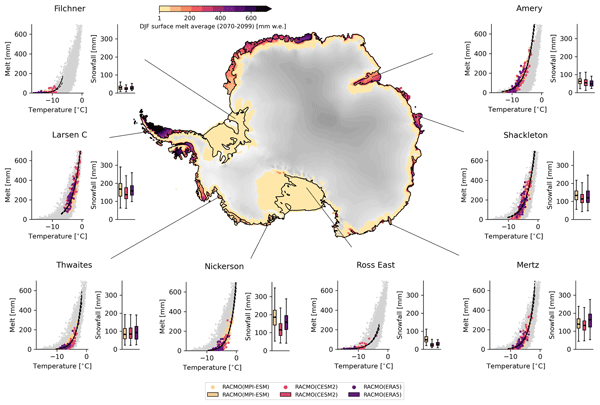
Abstract. Surface meltwater can saturate firn, form melt ponds, and trigger hydrofracturing of Antarctic ice shelves, ultimately accelerating grounded ice flow and contributing to sea level rise. Although the response of surface melt to atmospheric warming (expressed by near-surface air temperature) is known to be non-linear, the mechanisms driving this non-linearity remain poorly understood. In this study we explain the non-linear temperature-melt relationship from an energy balance perspective and assess its spatial variability across Antarctic ice shelves. We use the regional climate model RACMO2.4p1, forced by ERA5 re-analysis and two global earth system models under the SSP3-7.0 high emission scenario, to simulate contemporary and future Antarctic climate and surface mass balance until 2100. We find that the temperature dependence of net shortwave radiation is the primary driver of the non-linearity. On relatively cold ice shelves, warming increases cloud cover and snowfall, raising albedo, reducing net shortwave radiation. In contrast, on warmer ice shelves the snowmelt-albedo feedback dominates the response: warming leads to melt that reduces albedo, enhancing shortwave radiation absorption. The temperature–melt relationship also varies spatially: ice shelves in drier regions experience more melt at the same average summer temperatures than those in wetter regions, highlighting the role of snowfall in suppressing the albedo feedback. When mean summer air temperatures reach or exceed the melting point (0 °C), ice shelves becomes even more sensitive to warming. Surface temperatures can not rise above 0 °C while the atmosphere can, allowing the sensible heat and net longwave radiation to increase. At the same time, snowfall transitions to rain, amplifying the albedo feedback. Our results suggest that currently colder, drier and stable ice shelves could experience rapid increases in melt under future warming, with implications for their long-term stability.
Competing interests: At least one of the (co-)authors is a member of the editorial board of The Cryosphere. The peer-review process was guided by an independent editor, and the authors also have no other competing interests to declare.
Publisher's note: Copernicus Publications remains neutral with regard to jurisdictional claims made in the text, published maps, institutional affiliations, or any other geographical representation in this paper. While Copernicus Publications makes every effort to include appropriate place names, the final responsibility lies with the authors. Views expressed in the text are those of the authors and do not necessarily reflect the views of the publisher.-
Notice on discussion status
The requested preprint has a corresponding peer-reviewed final revised paper. You are encouraged to refer to the final revised version.
-
Preprint
(9389 KB)
-
The requested preprint has a corresponding peer-reviewed final revised paper. You are encouraged to refer to the final revised version.
- Preprint
(9389 KB) - Metadata XML
- BibTeX
- EndNote
- Final revised paper


Journal article(s) based on this preprint
Interactive discussion
Status: closed
-
RC1: 'Comment on egusphere-2025-4176', Anonymous Referee #1, 21 Oct 2025
- AC1: 'Reply on RC1', Marte Hofsteenge, 21 Jan 2026
-
RC2: 'Comment on egusphere-2025-4176', Anonymous Referee #2, 17 Nov 2025
Review of “On the non-linear response of Antarctic ice shelf surface melt to Warming”
This study investigates non-linearity in the temperature-melt relationship over Antarctic ice shelves using a modeling approach. The goals of the study are twofold, first to investigate spatial variability in the temperature-melt relationship and, second, to identify the dominant components driving non-linearity in the temperature-melt relationship. The authors pursue both goals by analyzing outputs from a regional climate model forced over the historical period (1979-2023) using ERA5 and two future climate scenarios (SSP3-7.0) using CESM2 and MPI-ESM (2015-2099). I think the study addresses an important research topic that is certainly within the scope of The Cryosphere and it is generally presented in clear, concise way. However, I do have some concerns about the scientific rigor and significance which I think would require some fairly substantiative changes to address. My recommendation is that the manuscript is considered after major revisions.
General comments
- It’s not clear how Section 3.1 and 3.2 contribute to the goals of the study. I understand that the authors need some temperature variation to investigate its relationship with melt. But it looks like there is plenty of variation in the historical forcings (e.g. Fig. 5a and 6a). The authors should consider removing these sections or strengthening the links between ESM forcing/trends and the goals of the study.
- On a related note, it’s not clear why two different ESMs are used to force RACMO. The current use of two ESMs makes the figures cluttered (e.g. Figures 5 and 6) and distracts from the main message. The authors acknowledge that the relationship between temperature and melt is consistent across the ERA5 and ESM model forcings (L201-202). I recommend that the authors provide better motivation for using two models or consider streamlining the analysis by not using any (see previous comment) or just one.
- The authors categorize ice shelves in several ways. In Figure 3 the ice shelves are categorized regionally. In Figures 7 and 8, ice shelves are categorized by annual precipitation. In the text, the authors state that the ice shelves are categorized by summer air temperatures as well. The central message of the manuscript would be strengthened if the analysis categorized ice shelves in just one way.
- The motivation for categorizing ice shelves by annual precipitation is not clear. As written, it feels like the authors tuned an annual precipitation threshold until the data were split according to their narrative. I recommend that the authors better explain their decision to use a 500 mm threshold in both introduction and the methods sections. Better would be to provide a sensitivity analysis on this threshold.
- The authors claim that there is large spatial variability in the temperature-melt relationship on ice shelves but the current analysis is not very convincing. I acknowledge that there is some qualitative support for this finding in Figure 4. But the analysis would be improved by demonstrating this variability quantitatively or statistically.
- Too much of the main text and figures are focused on SEB components at very low temperatures when there is little or no melt. There is therefore a mismatch between the goals of the study and the findings. The manuscript would be improved by expanding Section 3.3. and focusing Sections 3.4. and 3.5 (and Figures 5-8) on air temperatures that are associated with melt. Alternatively, given that some of the most interesting findings occur at low air temperatures, perhaps the goal of the study could be modified (e.g. impact of air temperature on SEB).
Specific comments
L24-25: It would be useful to add a brief statement here to explain why the relationship between temperature and melt is highly non-linear.
L47-49: The problem statement should be expanded by reviewing the findings of Jakobs et al. (2019) in a bit more detail and clarifying how this study differs from van Wessem et al. (2023). One way the authors could do this is by briefly reviewing how SEB components (e.g. albedo, clouds) are thought to respond to temperature in Antarctica.
L65-66: Recommend placing the “van Dalum” reference before “are” and after “RACMO2.3p2”
L73: “part of” is redundant here if “grid cells can be partially glaciated…”
L74: “…and therefore better representing areas…” is a little awkward, consider revising.
L82: Should it not be “SEB of skin layer is defined as:”?
L92: energy “available” for melt since some will be used for warming
Section 2.2: It’s not clear to me why SMB is defined here since it is not required to complete the goals of the study. Given the importance of melt in the study, it would be more useful to describe the relationship between QM and melt, instead of SMB.
L107-108: “have been done” is a little awkward, consider revising.
L129-134: Recommend moving this text to the Methods
L143: How was the anomaly computed? Recommend that this is described in the Methods
L151-152: Recommend moving this text to the Methods
L158-159: Not sure that Table 1 supports this statement.
L180: “trends of” near-surface air temperature?
L181: Recommend that “inter-annual variability” is quantified to support this statement.
Fig. 3: “COLD” ice shelf category has not been defined yet, recommend doing so in the Methods
L207: Not clear how drier and wetter climates are defined. Recommend describing in the Methods. Also see general comment.
L209-214: Reasoning is unclear – does Nickerson Ice Shelf also have a mean summer air temperature of -4C? It would be better is the study could quantitatively demonstrate this point instead of cherry-picking examples. I think Figure C1 could serve this purpose, consider adding it to the main text.
L211-212: Awkward phrasing, consider revising.
L212-213: Not clear what this sentence is getting at.
L223: Recommend moving to Methods
L226: How were these hypothetical clear-sky conditions derived? Was this a separate model run or something that is produced implicitly by RACMO. The methods could be improved by outlining the key metrics that are used for the analysis.
L248-255: Recommend moving to Methods
L258: Should “SWnet” actually b “the correlation between SWnet and air temperature”?
L267: "peaking" seems to imply that the strength of the snowmelt-albedo feedback reduces at temperatures higher than -8 but Fig. 7 does not show that. Please consider clarifying.
Citation: https://doi.org/10.5194/egusphere-2025-4176-RC2 - AC2: 'Reply on RC2', Marte Hofsteenge, 21 Jan 2026
Peer review completion


Interactive discussion
Status: closed
-
RC1: 'Comment on egusphere-2025-4176', Anonymous Referee #1, 21 Oct 2025
This manuscript provided a spatially informed comparison of the mechanisms which dictate differences in the relationship between rising air temperature and meltwater production over the ice shelves of Antarctica. The results represent a novel and potentially important contribution to the literature pending suitable revisions. I have included some general feedback followed by a list of specific recommendations below.
General comments
The authors briefly state that RACMO may struggle to accurately represent longwave radiation and turbulent heat fluxes in the opening paragraph of section 3.1. This deserves more discussion. How does RACMO struggle to represent these variables? Are the biases in these variables uniform across antarctica or regionally dependent? How does RACMO accurately resolve surface air temperature and SMB if these important surface energy balance components are not resolved accurately in the model? What implications, if any, do these shortcomings have for the results of the study?
One of the strengths of this study is the detailed consideration in climate-driven spatial differences in SMB response between the various ice shelves. Some of the results presented in section 3.1 worked counter to this strength. For example, spatial averages in Table 1 could obscure biases that are locally relevant to a specific ice shelf. Furthermore, I did not see how this examination of biases was considered in the interpretation of rest of the results. Do these biases have any implications for the conclusions of the study? Here again, spatial averaging makes it difficult to answer this question.
I often found it difficult to see from where the authors were basing their claims. I believe the manuscript would benefit from more detailed explanations of how the figures support their claims. This is particularly true for the discussion of figures 4-6.
Specific comments
L13: delete the s from “becomes”
L74: I would suggest rewriting as “…and therefore provide a better representation of areas such as…”
L79: delete “in” from “penetrate in the snowpack”
L103: It can be assumed from the description that ER>0 for erosion and ER<0 for deposition, but it would not hurt to state this explicitly.
L109: A citation is needed for the ERA5 reanalysis dataset
L111: “Future projection simulations” is a bit redundant. I would suggest “Projections spanning 2015 to 2099 were forced using…”
L114: A short rationale for why SSP3-7.0 was chosen could be included here.
L117-120: This information would fit better in the previous paragraph, which is where you first introduce the future period simulations.
L124: Is this calculation of sea ice temperature performed within RACMO? Also, a citation is needed for this slab model.
L130: Can you clarify what is meant by “average climate in the historical simulation…”? As written, I would assume that RACMO(ERA5) is the historical simulation, since it is forced by an observationally constrained dataset. From what is written in the remainder of the paragraph, it seems the comparison referenced here is between RACMO(ERA5) and RACMO forced by the ESM’s representation of historical conditions. It is also not clear what the “average climate” is here. Perhaps long-term mean would be more accurate?
L132: Is this statement summarizing your own attempts at validating RACMO against in situ data? If so, where is this data presented? If not, a citation is needed.
L138: The word “significant” is usually reserved for instances of statistical significance. Was a statistical analysis performed here? If so, what method was used and where are these results presented?
Figure 1: It is somewhat unusual in my experience to use hatching to highlight areas of small differences relative to internal variability. This is also a bit confusing in the context of the discussion, where significant differences are emphasized (L138). This is related to my previous comment, but if a statistical significance test was conducted, I think it would make more sense to highlight areas of statistical significance.
Table 1: If the focus of this paper is on the Antarctic ice shelves, how relevant is a spatial average of model biases across the whole of the Antarctic Ice Sheet? It seems that spatially informed biases are of critical importance to the question at hand, and the information in Table 1 may mask some of these locally relevant biases by averaging biases of opposing sign in different regions (e.g., the strong negative precipitation bias over east Antarctica versus the strong positive bias over Dronning Maud Land in RACMO(MPI-ESM)).
Figure 2: Panels are referred to by letter in the figure caption, but there is no lettering on the figure.
L185: “consistently stronger” is a bit unclear. Perhaps something like “…21st century; however, output from RACMO(CESM2) consistently shows a greater rate of warming than RACMO(MPI-ESM).
Figure 3: The error bars in each panel can be hard to read. Would it be possible to spread them out more so as to avoid overlap?
L221: What are the authors relying on to make this claim about increased snowfall over cold ice shelves? This explanation makes sense from a physical standpoint, but did the authors verify an increasing trend in snowfall over these ice shelves in their RACMO simulations?
L224: Why is “near” in parentheses?
Figure 5 caption: Caption refers to figure panels by letter, but letter labels are missing from the figure.
Figure 5: Points and lines are color coded according to average snowfall rate. I do not see where mean snowfall rate is discussed in the context of the albedo-temperature relationship.
Figure 5: it is difficult to read these plots. As noted by the author in the previous paragraph, one of the more interesting pieces of information conveyed here is the slope of the albedo-temperature relationship is different among ice shelves. This is evident in the fit lines, but it is hard to distinguish the fit lines from the points. Perhaps using different color scales for the fit lines and points could help? Also, while it is not practical to label all fit lines, perhaps annotating a few lines to highlight the difference between the relatively cold and warm ice shelves could clarify things.
Figure 7 caption: delete “is” from last line.
L324: should be spelled “satellites”
L341: Might read better as “Not only does the sensible heat flux become more important … at 0 °C, but atmospheric temperatures and moisture content can also continue to rise.”
Citation: https://doi.org/10.5194/egusphere-2025-4176-RC1 - AC1: 'Reply on RC1', Marte Hofsteenge, 21 Jan 2026
-
RC2: 'Comment on egusphere-2025-4176', Anonymous Referee #2, 17 Nov 2025
Review of “On the non-linear response of Antarctic ice shelf surface melt to Warming”
This study investigates non-linearity in the temperature-melt relationship over Antarctic ice shelves using a modeling approach. The goals of the study are twofold, first to investigate spatial variability in the temperature-melt relationship and, second, to identify the dominant components driving non-linearity in the temperature-melt relationship. The authors pursue both goals by analyzing outputs from a regional climate model forced over the historical period (1979-2023) using ERA5 and two future climate scenarios (SSP3-7.0) using CESM2 and MPI-ESM (2015-2099). I think the study addresses an important research topic that is certainly within the scope of The Cryosphere and it is generally presented in clear, concise way. However, I do have some concerns about the scientific rigor and significance which I think would require some fairly substantiative changes to address. My recommendation is that the manuscript is considered after major revisions.
General comments
- It’s not clear how Section 3.1 and 3.2 contribute to the goals of the study. I understand that the authors need some temperature variation to investigate its relationship with melt. But it looks like there is plenty of variation in the historical forcings (e.g. Fig. 5a and 6a). The authors should consider removing these sections or strengthening the links between ESM forcing/trends and the goals of the study.
- On a related note, it’s not clear why two different ESMs are used to force RACMO. The current use of two ESMs makes the figures cluttered (e.g. Figures 5 and 6) and distracts from the main message. The authors acknowledge that the relationship between temperature and melt is consistent across the ERA5 and ESM model forcings (L201-202). I recommend that the authors provide better motivation for using two models or consider streamlining the analysis by not using any (see previous comment) or just one.
- The authors categorize ice shelves in several ways. In Figure 3 the ice shelves are categorized regionally. In Figures 7 and 8, ice shelves are categorized by annual precipitation. In the text, the authors state that the ice shelves are categorized by summer air temperatures as well. The central message of the manuscript would be strengthened if the analysis categorized ice shelves in just one way.
- The motivation for categorizing ice shelves by annual precipitation is not clear. As written, it feels like the authors tuned an annual precipitation threshold until the data were split according to their narrative. I recommend that the authors better explain their decision to use a 500 mm threshold in both introduction and the methods sections. Better would be to provide a sensitivity analysis on this threshold.
- The authors claim that there is large spatial variability in the temperature-melt relationship on ice shelves but the current analysis is not very convincing. I acknowledge that there is some qualitative support for this finding in Figure 4. But the analysis would be improved by demonstrating this variability quantitatively or statistically.
- Too much of the main text and figures are focused on SEB components at very low temperatures when there is little or no melt. There is therefore a mismatch between the goals of the study and the findings. The manuscript would be improved by expanding Section 3.3. and focusing Sections 3.4. and 3.5 (and Figures 5-8) on air temperatures that are associated with melt. Alternatively, given that some of the most interesting findings occur at low air temperatures, perhaps the goal of the study could be modified (e.g. impact of air temperature on SEB).
Specific comments
L24-25: It would be useful to add a brief statement here to explain why the relationship between temperature and melt is highly non-linear.
L47-49: The problem statement should be expanded by reviewing the findings of Jakobs et al. (2019) in a bit more detail and clarifying how this study differs from van Wessem et al. (2023). One way the authors could do this is by briefly reviewing how SEB components (e.g. albedo, clouds) are thought to respond to temperature in Antarctica.
L65-66: Recommend placing the “van Dalum” reference before “are” and after “RACMO2.3p2”
L73: “part of” is redundant here if “grid cells can be partially glaciated…”
L74: “…and therefore better representing areas…” is a little awkward, consider revising.
L82: Should it not be “SEB of skin layer is defined as:”?
L92: energy “available” for melt since some will be used for warming
Section 2.2: It’s not clear to me why SMB is defined here since it is not required to complete the goals of the study. Given the importance of melt in the study, it would be more useful to describe the relationship between QM and melt, instead of SMB.
L107-108: “have been done” is a little awkward, consider revising.
L129-134: Recommend moving this text to the Methods
L143: How was the anomaly computed? Recommend that this is described in the Methods
L151-152: Recommend moving this text to the Methods
L158-159: Not sure that Table 1 supports this statement.
L180: “trends of” near-surface air temperature?
L181: Recommend that “inter-annual variability” is quantified to support this statement.
Fig. 3: “COLD” ice shelf category has not been defined yet, recommend doing so in the Methods
L207: Not clear how drier and wetter climates are defined. Recommend describing in the Methods. Also see general comment.
L209-214: Reasoning is unclear – does Nickerson Ice Shelf also have a mean summer air temperature of -4C? It would be better is the study could quantitatively demonstrate this point instead of cherry-picking examples. I think Figure C1 could serve this purpose, consider adding it to the main text.
L211-212: Awkward phrasing, consider revising.
L212-213: Not clear what this sentence is getting at.
L223: Recommend moving to Methods
L226: How were these hypothetical clear-sky conditions derived? Was this a separate model run or something that is produced implicitly by RACMO. The methods could be improved by outlining the key metrics that are used for the analysis.
L248-255: Recommend moving to Methods
L258: Should “SWnet” actually b “the correlation between SWnet and air temperature”?
L267: "peaking" seems to imply that the strength of the snowmelt-albedo feedback reduces at temperatures higher than -8 but Fig. 7 does not show that. Please consider clarifying.
Citation: https://doi.org/10.5194/egusphere-2025-4176-RC2 - AC2: 'Reply on RC2', Marte Hofsteenge, 21 Jan 2026
Peer review completion
Journal article(s) based on this preprint
Data sets
Monthly RACMO2.4p1 data for Antarctica (11 km) forced with ERA5 (1979-2023), CESM2 (1985-2100) and MPI-ESM (1985-2100) Marte Ge Hofsteenge, Willem Jan van de Berg, Christiaan van Dalum, Kristiina Verro, Maurice van Tiggelen, Michiel van den Broeke https://doi.org/10.5281/zenodo.16902106
Viewed
| HTML | XML | Total | BibTeX | EndNote | |
|---|---|---|---|---|---|
| 5,875 | 2,428 | 239 | 8,542 | 230 | 244 |
- HTML: 5,875
- PDF: 2,428
- XML: 239
- Total: 8,542
- BibTeX: 230
- EndNote: 244
Viewed (geographical distribution)
| Country | # | Views | % |
|---|
| Total: | 0 |
| HTML: | 0 |
| PDF: | 0 |
| XML: | 0 |
- 1
Cited


1 citations as recorded by crossref.

Willem Jan van de Berg
Christiaan van Dalum
Kristiina Verro
Maurice van Tiggelen
Michiel van den Broeke
The requested preprint has a corresponding peer-reviewed final revised paper. You are encouraged to refer to the final revised version.
- Preprint
(9389 KB) - Metadata XML
This manuscript provided a spatially informed comparison of the mechanisms which dictate differences in the relationship between rising air temperature and meltwater production over the ice shelves of Antarctica. The results represent a novel and potentially important contribution to the literature pending suitable revisions. I have included some general feedback followed by a list of specific recommendations below.
General comments
The authors briefly state that RACMO may struggle to accurately represent longwave radiation and turbulent heat fluxes in the opening paragraph of section 3.1. This deserves more discussion. How does RACMO struggle to represent these variables? Are the biases in these variables uniform across antarctica or regionally dependent? How does RACMO accurately resolve surface air temperature and SMB if these important surface energy balance components are not resolved accurately in the model? What implications, if any, do these shortcomings have for the results of the study?
One of the strengths of this study is the detailed consideration in climate-driven spatial differences in SMB response between the various ice shelves. Some of the results presented in section 3.1 worked counter to this strength. For example, spatial averages in Table 1 could obscure biases that are locally relevant to a specific ice shelf. Furthermore, I did not see how this examination of biases was considered in the interpretation of rest of the results. Do these biases have any implications for the conclusions of the study? Here again, spatial averaging makes it difficult to answer this question.
I often found it difficult to see from where the authors were basing their claims. I believe the manuscript would benefit from more detailed explanations of how the figures support their claims. This is particularly true for the discussion of figures 4-6.
Specific comments
L13: delete the s from “becomes”
L74: I would suggest rewriting as “…and therefore provide a better representation of areas such as…”
L79: delete “in” from “penetrate in the snowpack”
L103: It can be assumed from the description that ER>0 for erosion and ER<0 for deposition, but it would not hurt to state this explicitly.
L109: A citation is needed for the ERA5 reanalysis dataset
L111: “Future projection simulations” is a bit redundant. I would suggest “Projections spanning 2015 to 2099 were forced using…”
L114: A short rationale for why SSP3-7.0 was chosen could be included here.
L117-120: This information would fit better in the previous paragraph, which is where you first introduce the future period simulations.
L124: Is this calculation of sea ice temperature performed within RACMO? Also, a citation is needed for this slab model.
L130: Can you clarify what is meant by “average climate in the historical simulation…”? As written, I would assume that RACMO(ERA5) is the historical simulation, since it is forced by an observationally constrained dataset. From what is written in the remainder of the paragraph, it seems the comparison referenced here is between RACMO(ERA5) and RACMO forced by the ESM’s representation of historical conditions. It is also not clear what the “average climate” is here. Perhaps long-term mean would be more accurate?
L132: Is this statement summarizing your own attempts at validating RACMO against in situ data? If so, where is this data presented? If not, a citation is needed.
L138: The word “significant” is usually reserved for instances of statistical significance. Was a statistical analysis performed here? If so, what method was used and where are these results presented?
Figure 1: It is somewhat unusual in my experience to use hatching to highlight areas of small differences relative to internal variability. This is also a bit confusing in the context of the discussion, where significant differences are emphasized (L138). This is related to my previous comment, but if a statistical significance test was conducted, I think it would make more sense to highlight areas of statistical significance.
Table 1: If the focus of this paper is on the Antarctic ice shelves, how relevant is a spatial average of model biases across the whole of the Antarctic Ice Sheet? It seems that spatially informed biases are of critical importance to the question at hand, and the information in Table 1 may mask some of these locally relevant biases by averaging biases of opposing sign in different regions (e.g., the strong negative precipitation bias over east Antarctica versus the strong positive bias over Dronning Maud Land in RACMO(MPI-ESM)).
Figure 2: Panels are referred to by letter in the figure caption, but there is no lettering on the figure.
L185: “consistently stronger” is a bit unclear. Perhaps something like “…21st century; however, output from RACMO(CESM2) consistently shows a greater rate of warming than RACMO(MPI-ESM).
Figure 3: The error bars in each panel can be hard to read. Would it be possible to spread them out more so as to avoid overlap?
L221: What are the authors relying on to make this claim about increased snowfall over cold ice shelves? This explanation makes sense from a physical standpoint, but did the authors verify an increasing trend in snowfall over these ice shelves in their RACMO simulations?
L224: Why is “near” in parentheses?
Figure 5 caption: Caption refers to figure panels by letter, but letter labels are missing from the figure.
Figure 5: Points and lines are color coded according to average snowfall rate. I do not see where mean snowfall rate is discussed in the context of the albedo-temperature relationship.
Figure 5: it is difficult to read these plots. As noted by the author in the previous paragraph, one of the more interesting pieces of information conveyed here is the slope of the albedo-temperature relationship is different among ice shelves. This is evident in the fit lines, but it is hard to distinguish the fit lines from the points. Perhaps using different color scales for the fit lines and points could help? Also, while it is not practical to label all fit lines, perhaps annotating a few lines to highlight the difference between the relatively cold and warm ice shelves could clarify things.
Figure 7 caption: delete “is” from last line.
L324: should be spelled “satellites”
L341: Might read better as “Not only does the sensible heat flux become more important … at 0 °C, but atmospheric temperatures and moisture content can also continue to rise.”