
the Creative Commons Attribution 4.0 License.
the Creative Commons Attribution 4.0 License.
 | 25 Sep 2025
Adjusting Diurnal Error in In-Situ Soil Moisture Measurements via Fourier Time-Filtering Using Land Surface Model Datasets
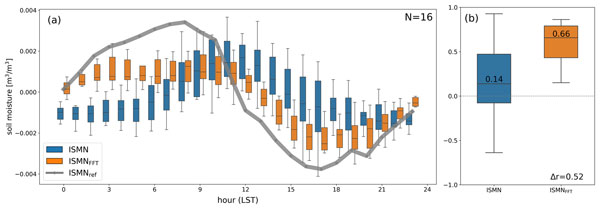
Abstract. Soil moisture (SM) measurements obtained via dielectric-based sensors are widely used in hydrological and climate studies. However, these measurements exhibit significant temperature sensitivity due to the Maxwell–Wagner polarization effect, causing an unrealistic diurnal cycle having spurious daytime peaks. This study introduces a Fourier transform-based method to correct such temperature-induced errors using physically consistent diurnal patterns from land surface model (LSM) reanalysis datasets (ERA5-Land and MERRA-2). The proposed approach adjusts the spectral power of the SM diurnal cycle to align with model-derived patterns constrained by conservation of mass, resulting in physically realistic SM behavior—peaking in the morning and decreasing during the daytime due to evapotranspiration. Validation against non-dielectric reference sensors indicates that the adjusted SM measurements are significantly improved. The diurnal correlation between SM and soil temperature shifts from predominantly positive to negative, particularly evident in regions with large diurnal temperature ranges and dry climates. Furthermore, applying this method to flux tower observations improves the characterization of land–atmosphere interactions by depicting the energy-limited process at sub-daily timescales, where increased incoming radiation during the daytime drives enhanced latent heat flux and subsequently reduces SM. Overall, this Fourier transform-based adjustment enhances the verity of in-situ soil moisture observations, promoting accurate sub-daily analyses of soil moisture dynamics and enabling improved understanding of land–atmosphere coupling processes.
-
Notice on discussion status
The requested preprint has a corresponding peer-reviewed final revised paper. You are encouraged to refer to the final revised version.
-
Preprint
(3317 KB)
-
Supplement
(785 KB)
-
The requested preprint has a corresponding peer-reviewed final revised paper. You are encouraged to refer to the final revised version.
- Preprint
(3317 KB) - Metadata XML
-
Supplement
(785 KB) - BibTeX
- EndNote
- Final revised paper


Journal article(s) based on this preprint
Interactive discussion
Status: closed
-
RC1: 'Comment on egusphere-2025-4163', Anonymous Referee #1, 29 Dec 2025
-
AC1: 'Reply on RC1', Eunkyo Seo, 06 Mar 2026
The comment was uploaded in the form of a supplement: https://egusphere.copernicus.org/preprints/2025/egusphere-2025-4163/egusphere-2025-4163-AC1-supplement.pdf
-
AC1: 'Reply on RC1', Eunkyo Seo, 06 Mar 2026
-
RC2: 'Comment on egusphere-2025-4163', Anonymous Referee #2, 20 Jan 2026
The comment was uploaded in the form of a supplement: https://egusphere.copernicus.org/preprints/2025/egusphere-2025-4163/egusphere-2025-4163-RC2-supplement.pdf
-
AC2: 'Reply on RC2', Eunkyo Seo, 06 Mar 2026
The comment was uploaded in the form of a supplement: https://egusphere.copernicus.org/preprints/2025/egusphere-2025-4163/egusphere-2025-4163-AC2-supplement.pdf
-
AC2: 'Reply on RC2', Eunkyo Seo, 06 Mar 2026
Peer review completion


Post-review adjustments


Interactive discussion
Status: closed
-
RC1: 'Comment on egusphere-2025-4163', Anonymous Referee #1, 29 Dec 2025
Review: Adjusting Diurnal Error in In-Situ Soil Moisture Measurements via Fourier Time-Filtering Using Land Surface Model Datasets
This manuscript focuses on addressing the temperature-sensitivity issues inherent in dielectric-based soil moisture (SM) sensors, which often lead to spurious daytime peaks in diurnal cycles. The authors propose an empirical correction method based on Fast Fourier Transform (FFT) by leveraging the physically consistent diurnal patterns from land surface model (LSM) reanalysis datasets. The performance of the adjusted SM data was validated against reference sensors and further evaluated through land-atmosphere coupling analysis. Overall, the study provides a practical and innovative solution to a long-standing problem in the hydrological community. The topic fits well within the scope of the journal. However, considering there are some critical methodological issues and data inconsistencies that need to be clarified, I recommend a major revision.
Major Comments:
- The proposed method introduces a potential risk of circular reasoning. By aligning the diurnal power of in-situ observations with LSM reanalysis (ERA5-Land/MERRA-2), the independence of the observation data is significantly compromised. This raises a critical question: Can the adjusted ISMNadjdata still be used as an independent reference to evaluate the same or similar land surface models? The authors should explicitly discuss the limitations of using model-informed observations for model validation or data assimilation.
- A critical physical inconsistency arises in cold regions (e.g., the Tibetan Plateau mentioned in L309). Dielectric-based in-situ sensors primarily measure the liquid soil water content because the dielectric constant of ice (~3.2) is much lower than that of liquid water (~80). However, the ERA5-Land soil moisture variable (swvl) represents the total water content (liquid + ice). During freeze-thaw cycles, the liquid water content exhibited a strong diurnal signal driven by phase changes, while the total water content remained relatively stable. Using the diurnal power of the model’s total water to adjust the liquid water observations would be physically erroneous. Could the authors clarify: (1) whether they used only the liquid water component from the LSMs (if available), or (2) whether they excluded periods when the soil temperature was below 0°C to avoid this mismatch?
- Regarding the precipitation filtering (Section 3.1), I have concerns about the consistency and physical basis of the thresholds used. The authors used a +1.5 standard deviation (SD) threshold for in-situ data but a 0.1 mm/day threshold for LSMs. (1) Since SM response to rain is highly dependent on soil texture and antecedent moisture, can a universal +1.5 SD threshold reliably identify rainy days across all global ISMN sites? (2) Why was the 'previous day' (L206) excluded along with the rainy day, rather than the following day, which is typically affected by post-rainfall drainage? (3) The use of different filtering methods for models and observations may lead to mismatched samples in the FFT adjustment. The authors should justify these choices.
- The authors used sensor pairs within a 200 km radius for validation. Given that soil moisture is known for its extreme spatial heterogeneity, 200 km is a very large distance. How can the authors ensure that the SM diurnal cycle at a site 200 km away is representative enough to validate the local sensor's correction? I suggest the authors provide a sensitivity analysis or at least discuss how the correlation changes as the distance threshold decreases.
- There is a clear discrepancy between the measurement depths of the LSMs (0–7 cm for ERA5-Land, 0–5 cm for MERRA-2) and the in-situ sensors (top 10 cm). Soil moisture and temperature in the top few centimeters are often Using the diurnal power of a 0–5 cm layer to correct a 10 cm layer might introduce vertical representativeness errors. This point needs more rigorous justification.
- The correction relies on the assumption that sensors are insensitive to temperature during 20:00–06:00 LST. However, in many regions, soil temperature can remain high or continue to fluctuate significantly during the early night. Does this "baseline" assumption hold across all climate zones?
- The study shows that ERA5-Land and MERRA-2 exhibit different SM-temperature coupling behaviors due to inconsistencies in latent heat (LH) flux. Since these models serve as the“ground truth” for the diurnal pattern, how does the discrepancy between the two models affect the reliability of the adjusted ISMNadj product?
- The application of standard normal deviate scaling (SNDS) to avoid negative values is an additional empirical step. I wonder if this scaling process significantly alters the original variance or the physical meaning of the diurnal amplitude.
Minor Comments:
- L205-207: The +1.5 standard deviation threshold for excluding rainy days seems somewhat arbitrary. Is this value robust for both humid and arid regions?
- L222-223: Please ensure that all cited works in the text are properly listed in the Reference section.
- I suggest adding a brief comment on whether this Fourier-based method could be adapted for real-time data streams or if it is strictly a post-processing tool for historical datasets.
Citation: https://doi.org/10.5194/egusphere-2025-4163-RC1 -
AC1: 'Reply on RC1', Eunkyo Seo, 06 Mar 2026
The comment was uploaded in the form of a supplement: https://egusphere.copernicus.org/preprints/2025/egusphere-2025-4163/egusphere-2025-4163-AC1-supplement.pdf
-
RC2: 'Comment on egusphere-2025-4163', Anonymous Referee #2, 20 Jan 2026
The comment was uploaded in the form of a supplement: https://egusphere.copernicus.org/preprints/2025/egusphere-2025-4163/egusphere-2025-4163-RC2-supplement.pdf
-
AC2: 'Reply on RC2', Eunkyo Seo, 06 Mar 2026
The comment was uploaded in the form of a supplement: https://egusphere.copernicus.org/preprints/2025/egusphere-2025-4163/egusphere-2025-4163-AC2-supplement.pdf
-
AC2: 'Reply on RC2', Eunkyo Seo, 06 Mar 2026
Peer review completion
Post-review adjustments
Journal article(s) based on this preprint
Viewed
| HTML | XML | Total | Supplement | BibTeX | EndNote | |
|---|---|---|---|---|---|---|
| 1,985 | 442 | 89 | 2,516 | 178 | 76 | 86 |
- HTML: 1,985
- PDF: 442
- XML: 89
- Total: 2,516
- Supplement: 178
- BibTeX: 76
- EndNote: 86
Viewed (geographical distribution)
| Country | # | Views | % |
|---|
| Total: | 0 |
| HTML: | 0 |
| PDF: | 0 |
| XML: | 0 |
- 1
Junnyeong Han

Paul A. Dirmeyer
The requested preprint has a corresponding peer-reviewed final revised paper. You are encouraged to refer to the final revised version.
- Preprint
(3317 KB) - Metadata XML
-
Supplement
(785 KB) - BibTeX
- EndNote
- Final revised paper
Review: Adjusting Diurnal Error in In-Situ Soil Moisture Measurements via Fourier Time-Filtering Using Land Surface Model Datasets
This manuscript focuses on addressing the temperature-sensitivity issues inherent in dielectric-based soil moisture (SM) sensors, which often lead to spurious daytime peaks in diurnal cycles. The authors propose an empirical correction method based on Fast Fourier Transform (FFT) by leveraging the physically consistent diurnal patterns from land surface model (LSM) reanalysis datasets. The performance of the adjusted SM data was validated against reference sensors and further evaluated through land-atmosphere coupling analysis. Overall, the study provides a practical and innovative solution to a long-standing problem in the hydrological community. The topic fits well within the scope of the journal. However, considering there are some critical methodological issues and data inconsistencies that need to be clarified, I recommend a major revision.
Major Comments:
Minor Comments: