
the Creative Commons Attribution 4.0 License.
the Creative Commons Attribution 4.0 License.
 | 22 Sep 2025
Pb and Fe flow through the mire-lake complex of Skogaryd catchment – a system under anthropogenic influence
Abstract. Sphagnum dominated peatlands store not only vast amounts of carbon (C) but also metals derived from bedrock and anthropogenic sources. Some metals are involved in peat C stability, and some are toxic to living organisms. However, the pools of such metals and their export in relation to export of C in the form of dissolved organic C (DOC) in mire-lake complexes have received little attention. We characterized a hemiboreal mire in Sweden previously exposed to heavy metal pollution in terms of physiochemistry, age, total C pool, lead (Pb) and iron (Fe) content. We investigated export of Fe and Pb in relation to DOC in the mire-lake complex.
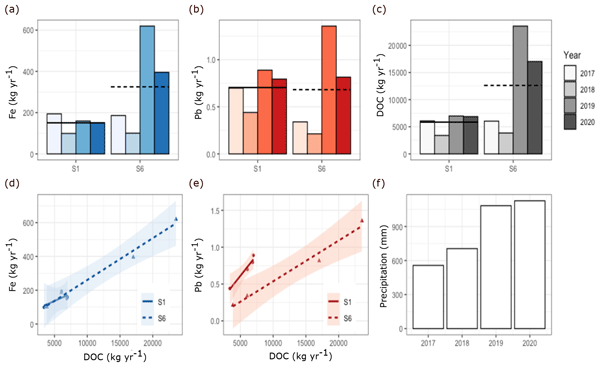
We found strong and linear correlations of Fe and DOC export in streams and the export occurred in similar ratios from both the lake and mire. The export of Fe and DOC seemed to be controlled by hydrological connectivity, while the production of DOC and Fe most likely was highest at low water table depth leading to oxic conditions. We found the Pb content exceeded threshold values for toxicity in the top layer of the peat and in stream water leaving the mire. Stream water concentrations of Pb were as for Fe and DOC, highest after drought periods. Pb isotope analysis revealed that Pb leaving the mire accumulated through anthropogenic contamination (most likely gasoline), while the Pb leaving the lake had a Pb isotopic composition from the geological background. In addition, the lake appeared to be a sink for the anthropogenic Pb leaving the mire through sedimentation. This study suggests that peat decomposition in peatlands affected by climate change may pose a risk to not only losing stored C, but also through release of heavy metals to the local environment.
-
Notice on discussion status
The requested preprint has a corresponding peer-reviewed final revised paper. You are encouraged to refer to the final revised version.
-
Preprint
(1296 KB)
-
Supplement
(691 KB)
-
The requested preprint has a corresponding peer-reviewed final revised paper. You are encouraged to refer to the final revised version.
- Preprint
(1296 KB) - Metadata XML
-
Supplement
(691 KB) - BibTeX
- EndNote
- Final revised paper


Journal article(s) based on this preprint
Interactive discussion
Status: closed
-
RC1: 'Comment on egusphere-2025-4108', Anonymous Referee #1, 24 Oct 2025
- AC2: 'Reply on RC1', Jonas Thomsen, 15 Dec 2025
-
RC2: 'Comment on egusphere-2025-4108', Anonymous Referee #2, 25 Oct 2025
This study presents a well-designed and careful investigation of Fe-Pb-DOC dynamics in a boreal mire-lake system affected by historical anthropogenic Pb pollution. The authors integrate peat-core geochemistry, radiocarbon dating, long-term DOC-metal flux monitoring, and Pb isotopic tracing to quantify the coupling between carbon and metal export under variable hydrological regimes. The dataset is of high analytical quality, and the topic is of clear environmental significance. The main conclusions-namely, that hydrological fluctuations promote the co-export of Fe and DOC, and that anthropogenic Pb is remobilized but largely retained within the lake-are well supported by the data.
However, I have several comments that the authors may wish to consider:
First, the reported Fe-DOC correlation (R2 = 0.96) is striking but insufficiently explained. The term “hydrological connectivity” alone does not capture the underlying chemical mechanisms. Please discuss whether the observed Fe-DOC co-variation results primarily from colloidal co-transport, redox-driven Fe-organic complexation, or other processes. In addition, the asynchronous timing of Fe (2018) and DOC (2019) peaks requires clarification. Does this temporal offset reflect delayed microbial production, hydrological hysteresis, or differences in source zones within the peat profile?
Second, the Pb isotope work is technically robust, and the evidence for anthropogenic Pb contamination derived from gasoline combustion is convincing. Nevertheless, I recommend that the authors provide propagated uncertainties for the isotope ratios and isotope-mixing model outputs, and compare their measured isotope values with established European reference baselines (these appear to be missing from the manuscript). Moreover, please include confidence intervals for the estimated ~33% Pb retention in the lake to substantiate this quantitative conclusion.
Third, the finding that surface peat Pb concentrations exceed ecotoxic thresholds (>90 mg kg-1) is both important and policy-relevant. However, the manuscript does not adequately discuss Pb speciation or its geochemical associations, which are critical for assessing Pb mobility and ecological risk.
Given that the studied mire is strongly Sphagnum-dominated, the biochemical characteristics of Sphagnum mosses likely play a central role in the observed Fe-DOC-Pb interactions. Sphagnum tissues contain abundant polyphenolic compounds and organic acids, all of which can influence Fe and Pb cycle and modulate DOC chemistry. Could the authors elaborate on how these unique Sphagnum traits might govern the tight Fe–DOC correlation and the substantial Pb retention observed in this system? For example, does the acidity and high ligand density of Sphagnum-derived organic matter affects the stability of Fe-DOC-Pb complexes? A brief discussion along these lines would substantially enhance the ecological and mechanistic relevance of the study.
Citation: https://doi.org/10.5194/egusphere-2025-4108-RC2 - AC3: 'Reply on RC2', Jonas Thomsen, 15 Dec 2025
-
RC3: 'Comment on egusphere-2025-4108', Anonymous Referee #3, 31 Oct 2025
General Comments
The manuscript investigates the mobilization of Pb, Fe, and DOC from a mire–lake system in southern Sweden, as well as the system’s carbon storage, over a four-year period marked by drought events that affected ecosystem dynamics.
The topic is relevant for understanding ecosystem responses to climate change and for the preservation of peatland–lake systems in Europe. However, the scientific conclusions are not entirely novel. As the authors acknowledge, the role of drought–rewetting cycles and hydrological connectivity in controlling DOC, Fe, and Pb export is already well established (e.g., Broder & Biester 2015, 2017; Rezanezhad et al., 2016).
The study presents a comprehensive and valuable dataset, supported by an extended four-year sampling period, which surpass typical studies based on shorter (1–2 year) campaigns. The comparison between the mire and lake compartments provides a broader perspective on the functioning of these common northern European ecosystems.
Overall, the topic is suitable for publication, but several revisions are recommended to improve the presentation and contextualization of the results. The discussion, in particular, needs a deeper and more critical analysis of the controlling processes and factors. Emphasis should also be placed on highlighting the novel aspects of this work and implications.
Specific Comments
The introduction would benefit from a clearer and more concise presentation of the current state of knowledge regarding Fe, DOC, and Pb export from peatlands—particularly the roles of hydrological connectivity, drought, and precipitation events (see Broder et al.). This section could be shortened by summarizing previously established processes collectively, allowing the focus to shift toward how these factors specifically affect the studied system and its long-term dynamics.
The statement that “how the export of DOC and hydrology affect the transport of metals is unknown for most peatlands” is somewhat overstated. While some mechanistic details remain uncertain, several key processes are already considered common to peatlands (see previous comment). If previous research cannot be considered indicative for this system, it becomes difficult to reconcile this with the claim in Line 366 that the study site represents northern European mires in the temperate–boreal transition zone. Please clarified.
Several trace metals (Pb, Hg, As, Cd) were analyzed in peat cores as part of previous work (Tchounwou et al., 2012). Since only Pb is discussed in the current manuscript, I recommend omitting mention of the other trace metals in both the methods and the introduction to maintain focus and clarity. If not, I recommend explain in more detail the implication for other trace metals analyzed. For example considering the Pb behaviour.
The Pb isotope dataset is valuable, covering mire, lake, and forest samples. However, its interpretation is limited. The isotope data suggest a mixing line between European gasoline, coal, and natural geogenic sources, with the lake outflow positioned between the mire and forest endmembers. This pattern likely reflects contributions from both local (forest) and upstream (mire) sources, implying that the lake catchment exerts additional influence (indicated by the forest).
In this regard, please consider:
- Topographic map illustrating the mire and lake catchments (sizes are already provided in the text) and flow directions.
- Exploring implications for DOC origin: how does catchment size and type (forest, agriculture) affect lake outflow composition compared with mire outflow? Do sites S1 and S6 directly receive water from other catchment areas? Relevant literature includes Kaal et al. (2017, 2020), which highlights the contribution of forest organic matter to DOM in similar mire systems and could strengthen this interpretation.
- Clarifying the processes of Pb and in lake outflow. Does it primarily derive from the mire (directly). Estimating or discussing the lake’s water residence time could help address this. What are the implications for the lake being a “sink” for Pb from the peatland?
- Based on isotopes and Pb. Can any kind of extrapolation be made about the role played by the mire-lake system depending on the flow (precipitation, drought period, etc.)?
Although CN ratios are presented, their implications for organic matter degradation are not discussed in sufficient depth. Given the importance of decomposition in DOM formation in peatlands, I recommend expanding on the observed CN trends and discussing how they reflect mass loss or varying degradation intensities within the cores. (See Biester et al., 2014 and Zeh eta l., 2020 for comparison between proxies for OM decomposition.
The results for δ¹³C and δ¹⁵N show clear variations, yet their interpretation remains superficial. The authors should elaborate on how these isotopic shifts relate to organic matter degradation, plant sources, and CN ratios, and what they reveal about peat formation and transformation processes. See Zeh et al., 2020; Gandois et al., 2019.
The differentiation among hollows, hummocks, and intermediate positions yields interesting insights into trace metal accumulation and peatland heterogeneity. The discussion could be strengthened by integrating findings from Pérez-Rodríguez et al. (2025), who examined degradation dynamics under aerobic versus anaerobic conditions in similar microtopographies. Additionally, it would be helpful to clarify whether the hollow–hummock pattern is assumed to have remained consistent throughout the peatland’s development. And what are the possible implications. See Nungesser (2003).
The suggestion that Pb toxicity may inhibit microbial degradation of organic matter deserves further consideration. Where is the Pb located in the moss and moss-derived organic matter, and is this Pb likely to be bioavailable to microorganisms?
While the cited literature on peatlands as trace metal sinks is appropriate, the authors should also consider referencing the extensive work conducted by Bindler’s and Kylander’s groups on Swedish peatlands, which would provide useful regional context.
The citation (González & Pokrovsky, 2014) in line 64 is not appropriate. Although the authors developed an excellent model to understand trace metal accumulation in mosses, their results are not specifically related to the peatland context.
References:
Biester, H., Knorr, K. H., Schellekens, J., Basler, A., & Hermanns, Y. M. (2014). Comparison of different methods to determine the degree of peat decomposition in peat bogs. Biogeosciences, 11(10), 2691-2707.
Gandois, L., Hoyt, A. M., Hatté, C., Jeanneau, L., Teisserenc, R., Liotaud, M., & Tananaev, N. (2019). Contribution of peatland permafrost to dissolved organic matter along a thaw gradient in North Siberia. Environmental Science & Technology, 53(24), 14165-14174.
Kaal, J., Cortizas, A. M., & Biester, H. (2017). Downstream changes in molecular composition of DOM along a headwater stream in the Harz mountains (Central Germany) as determined by FTIR, Pyrolysis-GC–MS and THM-GC–MS. Journal of Analytical and Applied Pyrolysis, 126, 50-61.
Kaal, J., Plaza, C., Nierop, K. G., Pérez-Rodríguez, M., & Biester, H. (2020). Origin of dissolved organic matter in the Harz Mountains (Germany): A thermally assisted hydrolysis and methylation (THM-GC–MS) study. Geoderma, 378, 114635.
Nungesser, M. K. (2003). Modelling microtopography in boreal peatlands: hummocks and hollows. Ecological Modelling, 165(2-3), 175-207.
Pérez-Rodríguez, M., Alten, A., Miler, M., & Kaal, J. (2025). Explicit microrelief-controlled decoupling of initial aerobic decay and leaching (in hummocks) and anaerobic decay (in hollows) in surface layers of a Sphagnum-dominated peatland. Journal of Analytical and Applied Pyrolysis, 192, 107295. https://doi.org/10.1016/j.jaap.2025.107295
Rezanezhad, F., Price, J. S., Quinton, W. L., Lennartz, B., Milojevic, T., & Van Cappellen, P. (2016). Structure of peat soils and implications for water storage, flow and solute transport: A review update for geochemists. Chemical Geology, 429, 75-84.
Zeh, L., Igel, M. T., Schellekens, J., Limpens, J., Bragazza, L., & Kalbitz, K. (2020). Vascular plants affect properties and decomposition of moss-dominated peat, particularly at elevated temperatures. Biogeosciences, 17(19), 4797-4813.
Citation: https://doi.org/10.5194/egusphere-2025-4108-RC3 - AC1: 'Reply on RC3', Jonas Thomsen, 15 Dec 2025
Peer review completion


Interactive discussion
Status: closed
-
RC1: 'Comment on egusphere-2025-4108', Anonymous Referee #1, 24 Oct 2025
General comments
This manuscript, which investigates the pools and export of C, Fe, and Pb in a hemiboreal mire, is generally well written, fits well within the scope of the journal, and will likely be of interest to the audience of Biogeosciences. The findings showing increased DOC and Fe mobilization following drought periods, as well as the role of hydrological connectivity in regulating DOC and Fe export from peatlands, are consistent with previous research. Placing these results within a broader climate change context is valuable. Moreover, the inclusion of the heavy metal perspective is intriguing, and the observation that peat decomposition in peatlands affected by climate change may pose a risk not only through the loss of stored C but also via mobilization of toxic heavy metals to the surrounding environment adds an important and novel dimension to the study.
Specific comments
- The study objectives are not entirely clear upon reading the manuscript. The research questions are introduced without a clear structure, and the final paragraph of the introduction provides only a very general statement of the aim of the study. I recommend that the authors present the study objectives more explicitly, and potentially include specific hypotheses/predictions in the introduction to better guide the reader.
- The manuscript lacks clear definitions of the topography types and information regarding their spatial scale. It is specified that the topography types were sampled 1-2 m apart, but the typical size or extent of these structures is not described. I furthermore lack a discussion of the observed differences in the physical and chemical characteristics among different topography types.
- The depth resolution of the measured variables, especially for the metals, is coarse. Consequently, statements such as that on line 292; “Peat Fe concentrations at the top of the mire were between 606 and 1237 mg/kg and barely changed until below 120” are problematic, as no data are available for the interval between 50 and 120 cm depth. This limitation should be acknowledged in the manuscript.
- The introduction currently lacks a clear motivation for including the lake measurements. The objectives stated at the end of the introduction are rather general and focus solely on the mire. Interestingly, the substantially higher export of C and Fe from the lake compared to the inflow to the lake points to other sources than the mire. This observation could be explored further in the manuscript, and the relative contribution of the mire to the overall hydrological inflow to the lake could be clarified if this data is available.
Technical corrections
Line 54: Replace “binds” with “bind”.
Line 57: Replace “peatland” with “peatlands”.
Line 68: Remove “and” before “can be traced…”.
Line 270: I cannot see that the change in N with depth was more extreme for hummock compared to intermediate and hollow. This is not obvious looking at Fig. 3. Should it be the other way around?
Line 286: Intermediate generally had the highest Pb content, although the largest concentration was found in hummock at 25-50 cm (Table S1).
Line 288 – 290: Make sure that the correct numbers are presented here. According to Table S1, intermediate has the Pb content of 64.25 mg/kg, and hollow that of 32.21 mg/kg, and not the other way around. Pb contents of 4.41 and 0.05 mg/kg in the 25-50 cm interval do not match with the data in Table S1, nor with Fig. 4.
Line 319: It is not clear why data points for Fe and Pb were removed when discharge was low? It would have been informative to include this data.
Line 337: Remove “at” before “from Mycklemossen”.
Line 390: Please elaborate on what type of interaction with Fe that stabilizes peat. Also in the same sentence, that most Fe in Mycklemossen is placed in deep anoxic peat layers does not rule out that this stabilizing effect of Fe on C is important.
Line 392: What is the “C destabilizing mechanism of Fe”. Please clarify.
Line 402: Incomplete sentence starting with “The strong correlation…”
Line 407: I suggest adding “The year of” or something similar before 2017 to avoid beginning the sentence with a number.
Line 420: Could this be assessed if there are CO2 flux measurements from the site?
Citation: https://doi.org/10.5194/egusphere-2025-4108-RC1 - AC2: 'Reply on RC1', Jonas Thomsen, 15 Dec 2025
-
RC2: 'Comment on egusphere-2025-4108', Anonymous Referee #2, 25 Oct 2025
This study presents a well-designed and careful investigation of Fe-Pb-DOC dynamics in a boreal mire-lake system affected by historical anthropogenic Pb pollution. The authors integrate peat-core geochemistry, radiocarbon dating, long-term DOC-metal flux monitoring, and Pb isotopic tracing to quantify the coupling between carbon and metal export under variable hydrological regimes. The dataset is of high analytical quality, and the topic is of clear environmental significance. The main conclusions-namely, that hydrological fluctuations promote the co-export of Fe and DOC, and that anthropogenic Pb is remobilized but largely retained within the lake-are well supported by the data.
However, I have several comments that the authors may wish to consider:
First, the reported Fe-DOC correlation (R2 = 0.96) is striking but insufficiently explained. The term “hydrological connectivity” alone does not capture the underlying chemical mechanisms. Please discuss whether the observed Fe-DOC co-variation results primarily from colloidal co-transport, redox-driven Fe-organic complexation, or other processes. In addition, the asynchronous timing of Fe (2018) and DOC (2019) peaks requires clarification. Does this temporal offset reflect delayed microbial production, hydrological hysteresis, or differences in source zones within the peat profile?
Second, the Pb isotope work is technically robust, and the evidence for anthropogenic Pb contamination derived from gasoline combustion is convincing. Nevertheless, I recommend that the authors provide propagated uncertainties for the isotope ratios and isotope-mixing model outputs, and compare their measured isotope values with established European reference baselines (these appear to be missing from the manuscript). Moreover, please include confidence intervals for the estimated ~33% Pb retention in the lake to substantiate this quantitative conclusion.
Third, the finding that surface peat Pb concentrations exceed ecotoxic thresholds (>90 mg kg-1) is both important and policy-relevant. However, the manuscript does not adequately discuss Pb speciation or its geochemical associations, which are critical for assessing Pb mobility and ecological risk.
Given that the studied mire is strongly Sphagnum-dominated, the biochemical characteristics of Sphagnum mosses likely play a central role in the observed Fe-DOC-Pb interactions. Sphagnum tissues contain abundant polyphenolic compounds and organic acids, all of which can influence Fe and Pb cycle and modulate DOC chemistry. Could the authors elaborate on how these unique Sphagnum traits might govern the tight Fe–DOC correlation and the substantial Pb retention observed in this system? For example, does the acidity and high ligand density of Sphagnum-derived organic matter affects the stability of Fe-DOC-Pb complexes? A brief discussion along these lines would substantially enhance the ecological and mechanistic relevance of the study.
Citation: https://doi.org/10.5194/egusphere-2025-4108-RC2 - AC3: 'Reply on RC2', Jonas Thomsen, 15 Dec 2025
-
RC3: 'Comment on egusphere-2025-4108', Anonymous Referee #3, 31 Oct 2025
General Comments
The manuscript investigates the mobilization of Pb, Fe, and DOC from a mire–lake system in southern Sweden, as well as the system’s carbon storage, over a four-year period marked by drought events that affected ecosystem dynamics.
The topic is relevant for understanding ecosystem responses to climate change and for the preservation of peatland–lake systems in Europe. However, the scientific conclusions are not entirely novel. As the authors acknowledge, the role of drought–rewetting cycles and hydrological connectivity in controlling DOC, Fe, and Pb export is already well established (e.g., Broder & Biester 2015, 2017; Rezanezhad et al., 2016).
The study presents a comprehensive and valuable dataset, supported by an extended four-year sampling period, which surpass typical studies based on shorter (1–2 year) campaigns. The comparison between the mire and lake compartments provides a broader perspective on the functioning of these common northern European ecosystems.
Overall, the topic is suitable for publication, but several revisions are recommended to improve the presentation and contextualization of the results. The discussion, in particular, needs a deeper and more critical analysis of the controlling processes and factors. Emphasis should also be placed on highlighting the novel aspects of this work and implications.
Specific Comments
The introduction would benefit from a clearer and more concise presentation of the current state of knowledge regarding Fe, DOC, and Pb export from peatlands—particularly the roles of hydrological connectivity, drought, and precipitation events (see Broder et al.). This section could be shortened by summarizing previously established processes collectively, allowing the focus to shift toward how these factors specifically affect the studied system and its long-term dynamics.
The statement that “how the export of DOC and hydrology affect the transport of metals is unknown for most peatlands” is somewhat overstated. While some mechanistic details remain uncertain, several key processes are already considered common to peatlands (see previous comment). If previous research cannot be considered indicative for this system, it becomes difficult to reconcile this with the claim in Line 366 that the study site represents northern European mires in the temperate–boreal transition zone. Please clarified.
Several trace metals (Pb, Hg, As, Cd) were analyzed in peat cores as part of previous work (Tchounwou et al., 2012). Since only Pb is discussed in the current manuscript, I recommend omitting mention of the other trace metals in both the methods and the introduction to maintain focus and clarity. If not, I recommend explain in more detail the implication for other trace metals analyzed. For example considering the Pb behaviour.
The Pb isotope dataset is valuable, covering mire, lake, and forest samples. However, its interpretation is limited. The isotope data suggest a mixing line between European gasoline, coal, and natural geogenic sources, with the lake outflow positioned between the mire and forest endmembers. This pattern likely reflects contributions from both local (forest) and upstream (mire) sources, implying that the lake catchment exerts additional influence (indicated by the forest).
In this regard, please consider:
- Topographic map illustrating the mire and lake catchments (sizes are already provided in the text) and flow directions.
- Exploring implications for DOC origin: how does catchment size and type (forest, agriculture) affect lake outflow composition compared with mire outflow? Do sites S1 and S6 directly receive water from other catchment areas? Relevant literature includes Kaal et al. (2017, 2020), which highlights the contribution of forest organic matter to DOM in similar mire systems and could strengthen this interpretation.
- Clarifying the processes of Pb and in lake outflow. Does it primarily derive from the mire (directly). Estimating or discussing the lake’s water residence time could help address this. What are the implications for the lake being a “sink” for Pb from the peatland?
- Based on isotopes and Pb. Can any kind of extrapolation be made about the role played by the mire-lake system depending on the flow (precipitation, drought period, etc.)?
Although CN ratios are presented, their implications for organic matter degradation are not discussed in sufficient depth. Given the importance of decomposition in DOM formation in peatlands, I recommend expanding on the observed CN trends and discussing how they reflect mass loss or varying degradation intensities within the cores. (See Biester et al., 2014 and Zeh eta l., 2020 for comparison between proxies for OM decomposition.
The results for δ¹³C and δ¹⁵N show clear variations, yet their interpretation remains superficial. The authors should elaborate on how these isotopic shifts relate to organic matter degradation, plant sources, and CN ratios, and what they reveal about peat formation and transformation processes. See Zeh et al., 2020; Gandois et al., 2019.
The differentiation among hollows, hummocks, and intermediate positions yields interesting insights into trace metal accumulation and peatland heterogeneity. The discussion could be strengthened by integrating findings from Pérez-Rodríguez et al. (2025), who examined degradation dynamics under aerobic versus anaerobic conditions in similar microtopographies. Additionally, it would be helpful to clarify whether the hollow–hummock pattern is assumed to have remained consistent throughout the peatland’s development. And what are the possible implications. See Nungesser (2003).
The suggestion that Pb toxicity may inhibit microbial degradation of organic matter deserves further consideration. Where is the Pb located in the moss and moss-derived organic matter, and is this Pb likely to be bioavailable to microorganisms?
While the cited literature on peatlands as trace metal sinks is appropriate, the authors should also consider referencing the extensive work conducted by Bindler’s and Kylander’s groups on Swedish peatlands, which would provide useful regional context.
The citation (González & Pokrovsky, 2014) in line 64 is not appropriate. Although the authors developed an excellent model to understand trace metal accumulation in mosses, their results are not specifically related to the peatland context.
References:
Biester, H., Knorr, K. H., Schellekens, J., Basler, A., & Hermanns, Y. M. (2014). Comparison of different methods to determine the degree of peat decomposition in peat bogs. Biogeosciences, 11(10), 2691-2707.
Gandois, L., Hoyt, A. M., Hatté, C., Jeanneau, L., Teisserenc, R., Liotaud, M., & Tananaev, N. (2019). Contribution of peatland permafrost to dissolved organic matter along a thaw gradient in North Siberia. Environmental Science & Technology, 53(24), 14165-14174.
Kaal, J., Cortizas, A. M., & Biester, H. (2017). Downstream changes in molecular composition of DOM along a headwater stream in the Harz mountains (Central Germany) as determined by FTIR, Pyrolysis-GC–MS and THM-GC–MS. Journal of Analytical and Applied Pyrolysis, 126, 50-61.
Kaal, J., Plaza, C., Nierop, K. G., Pérez-Rodríguez, M., & Biester, H. (2020). Origin of dissolved organic matter in the Harz Mountains (Germany): A thermally assisted hydrolysis and methylation (THM-GC–MS) study. Geoderma, 378, 114635.
Nungesser, M. K. (2003). Modelling microtopography in boreal peatlands: hummocks and hollows. Ecological Modelling, 165(2-3), 175-207.
Pérez-Rodríguez, M., Alten, A., Miler, M., & Kaal, J. (2025). Explicit microrelief-controlled decoupling of initial aerobic decay and leaching (in hummocks) and anaerobic decay (in hollows) in surface layers of a Sphagnum-dominated peatland. Journal of Analytical and Applied Pyrolysis, 192, 107295. https://doi.org/10.1016/j.jaap.2025.107295
Rezanezhad, F., Price, J. S., Quinton, W. L., Lennartz, B., Milojevic, T., & Van Cappellen, P. (2016). Structure of peat soils and implications for water storage, flow and solute transport: A review update for geochemists. Chemical Geology, 429, 75-84.
Zeh, L., Igel, M. T., Schellekens, J., Limpens, J., Bragazza, L., & Kalbitz, K. (2020). Vascular plants affect properties and decomposition of moss-dominated peat, particularly at elevated temperatures. Biogeosciences, 17(19), 4797-4813.
Citation: https://doi.org/10.5194/egusphere-2025-4108-RC3 - AC1: 'Reply on RC3', Jonas Thomsen, 15 Dec 2025
Peer review completion
Journal article(s) based on this preprint
Viewed
| HTML | XML | Total | Supplement | BibTeX | EndNote | |
|---|---|---|---|---|---|---|
| 2,126 | 363 | 134 | 2,623 | 215 | 80 | 86 |
- HTML: 2,126
- PDF: 363
- XML: 134
- Total: 2,623
- Supplement: 215
- BibTeX: 80
- EndNote: 86
Viewed (geographical distribution)
| Country | # | Views | % |
|---|
| Total: | 0 |
| HTML: | 0 |
| PDF: | 0 |
| XML: | 0 |
- 1

Signe Lett
Leif Klemedtsson
Delia Rösel
Louise Rütting
Katja Salomon Johansen
Tobias Rütting
The requested preprint has a corresponding peer-reviewed final revised paper. You are encouraged to refer to the final revised version.
- Preprint
(1296 KB) - Metadata XML
-
Supplement
(691 KB) - BibTeX
- EndNote
- Final revised paper
General comments
This manuscript, which investigates the pools and export of C, Fe, and Pb in a hemiboreal mire, is generally well written, fits well within the scope of the journal, and will likely be of interest to the audience of Biogeosciences. The findings showing increased DOC and Fe mobilization following drought periods, as well as the role of hydrological connectivity in regulating DOC and Fe export from peatlands, are consistent with previous research. Placing these results within a broader climate change context is valuable. Moreover, the inclusion of the heavy metal perspective is intriguing, and the observation that peat decomposition in peatlands affected by climate change may pose a risk not only through the loss of stored C but also via mobilization of toxic heavy metals to the surrounding environment adds an important and novel dimension to the study.
Specific comments
Technical corrections
Line 54: Replace “binds” with “bind”.
Line 57: Replace “peatland” with “peatlands”.
Line 68: Remove “and” before “can be traced…”.
Line 270: I cannot see that the change in N with depth was more extreme for hummock compared to intermediate and hollow. This is not obvious looking at Fig. 3. Should it be the other way around?
Line 286: Intermediate generally had the highest Pb content, although the largest concentration was found in hummock at 25-50 cm (Table S1).
Line 288 – 290: Make sure that the correct numbers are presented here. According to Table S1, intermediate has the Pb content of 64.25 mg/kg, and hollow that of 32.21 mg/kg, and not the other way around. Pb contents of 4.41 and 0.05 mg/kg in the 25-50 cm interval do not match with the data in Table S1, nor with Fig. 4.
Line 319: It is not clear why data points for Fe and Pb were removed when discharge was low? It would have been informative to include this data.
Line 337: Remove “at” before “from Mycklemossen”.
Line 390: Please elaborate on what type of interaction with Fe that stabilizes peat. Also in the same sentence, that most Fe in Mycklemossen is placed in deep anoxic peat layers does not rule out that this stabilizing effect of Fe on C is important.
Line 392: What is the “C destabilizing mechanism of Fe”. Please clarify.
Line 402: Incomplete sentence starting with “The strong correlation…”
Line 407: I suggest adding “The year of” or something similar before 2017 to avoid beginning the sentence with a number.
Line 420: Could this be assessed if there are CO2 flux measurements from the site?