
the Creative Commons Attribution 4.0 License.
the Creative Commons Attribution 4.0 License.
 | 28 Oct 2025
Coastal-Cosmo-Model (CCMv1): a cosmogenic nuclide model for rocky coastlines
Abstract. Understanding the long-term evolution of rocky coasts requires models that can account for complex interactions between exposure, erosion and sea level, constrained by empirical observations. This paper introduces Coastal-Cosmo-Model version 1 (CCMv1), a modular forward modelling framework designed to reconstruct coastal histories from in situ cosmogenic nuclide concentrations. CCMv1 integrates community-standard production rate calculations and allows flexible inversion of platform histories using discrete erosion and exposure parameters. The model includes four sub-models—inheritance, zero erosion, down-wearing only, and cliff retreat with down-wearing—enabling users to test hypotheses of increasing complexity. Crucially, CCMv1 can be applied to both eroding and non-eroding coastlines, offering a means to investigate the dominant controls on rocky shore histories for different settings. A demonstration using a published dataset from shore platform shows that CCMv1 effectively reproduces measured nuclide concentrations and supports a history of Holocene cliff retreat. CCMv1 provides an adaptable and hypothesis-driven framework for exploring rocky shore histories, with potential for future development to incorporate probabilistic optimisation and additional nuclide systems, and implementation for testing complex (multi-stage) erosion histories or relative sea-level histories.
-
Notice on discussion status
The requested preprint has a corresponding peer-reviewed final revised paper. You are encouraged to refer to the final revised version.
-
Preprint
(1538 KB)
-
The requested preprint has a corresponding peer-reviewed final revised paper. You are encouraged to refer to the final revised version.
- Preprint
(1538 KB) - Metadata XML
- BibTeX
- EndNote
- Final revised paper


Journal article(s) based on this preprint
Interactive discussion
Status: closed
-
RC1: 'Comment on egusphere-2025-4086', Mark Dickson, 02 Dec 2025
-
AC1: 'Reply on RC1', Richard Jones, 08 Jan 2026
My responses are in bold at relevant parts of the review.
This manuscript provides a welcome new addition to efforts to model shore platform evolution (and coastal cliff retreat rates) using in situ produced cosmogenic radionuclides (CRN). It contributes to a growing body of literature on the topic. I suggest adding an additional paragraph within the introduction to more fully summarise the relatively small number of contributions in the field to date.
>> Thank you for this suggestion. I agree that it is helpful to more explicitly situate CCMv1 within the existing literature. I will add a short paragraph to the Introduction that summarises the limited number of numerical models that directly link cosmogenic nuclide concentrations to rocky coast evolution, highlighting their primary focus and methodological approaches, and clarifying how CCMv1 complements and extends this body of work by providing a flexible, hypothesis-driven framework applicable across a broader range of coastal morphologies and erosion regimes.
The model formulation appears to be grounded in established cosmogenic nuclide theory. A key novel contribution of this new model (CCM) is that it provides a clear hypothesis testing framework. Rather than seeking a single solution between morphological development and observed CRN concentrations, it allows users to systematically step through multiple hypotheses that increase in complexity. I think this will be a valuable addition to existing tools to model rock coast evolution.
Four sub-models are provided: inheritance, zero erosion, down-wearing only, and cliff retreat with down-wearing. Similar to previous work (e.g. Hurst et al., 2016), the inheritance sub-model calculates cosmogenic inheritance based on a sample taken from a site that represents how much inherited 10Be is in the rock prior to exposure. If a feasible value is found for the site, that value is then used to correct platform nuclide concentrations prior to modelling the erosion history. The zero erosion sub model represents a null hypothesis in which the test is whether CRN observations can be explained solely by sea-level change. In this model there is no cliff retreat (backwear) or vertical shore platform erosion (downwear). The downwear model then tests vertical erosion without cliff retreat, and the final model is the most complex (and the most likely in nature!) in that it involves both backwear (cliff retreat) and downwear (vertical platform erosion). It would be interesting to understand a little more about whether there would be any value in a backwear only model. Downwear only makes sense, because it makes it possible to rule out a no-backwear scenario. Perhaps backwear only doesn't make sense, because downwear would be expected if backwear is also occurring, but is there value in isolating what a backwear only signal would look like? Perhaps it is possible to set the downwear rate to zero in the combined backwear/downwear model?
>> I agree that clarifying the rationale behind the model hierarchy is important. I will revise the manuscript to more explicitly explain that down-wearing is treated as a more fundamental and ubiquitous erosional process on rocky coasts, including settings where long-term cliff retreat may be negligible. The ‘down-wearing only’ model therefore serves as a key intermediate hypothesis, allowing sensitivity to vertical erosion and sea-level history to be tested independently of backwear. A standalone ‘backwear-only’ sub-model was not implemented because cliff retreat would generally be expected to coincide with some degree of platform lowering; however, as the reviewer notes, such a scenario can be readily explored within CCMv1 by setting the down-wearing rate to zero in the combined ‘cliff retreat and down-wearing’ model. This clarification will be added to the model description (section 2).
The CCM model usefully integrates with CRONUScalc and a global calibration dataset. It also includes an optimisation framework, and while it doesn't go as far as previous work (Shadrick et al., 2021) in respect to techniques such as multi-objective and Bayesian optimisation, the overall model framework means that the optimisation function (multidimensional unconstrained nonlinear minimization using Nelder-Mead within MATLAB) can help to solve for variable backwear and downwear erosion rates through time.
Similar to previous work, three downwear scenarios are considered: constant, increasing or decreasing (relative to some specified present-day erosion rate). Three backwear scenarios are also considered: accelerating, decelerating or constant. In theory, if cliff retreat is wave-driven then widening platforms through time should result in a non-linear decline in erosion rates, although this is complicated by Holocene sea level variability (eg see Trenhaile 2010). In future work, in addition to the decelerating scenario, it would be interesting also to allow testing of a non-linear deceleration.
>> I agree with this suggestion. CCMv1 was intentionally designed as a foundational and usable framework that represents temporal changes in erosion rates using simple linear multipliers relative to present-day values. In section 6, I will clarify that the model structure readily permits more complex parameterisations, including non-linear or user-defined rate histories, which may be appropriate for specific sites or hypotheses and represent a natural direction for future development.
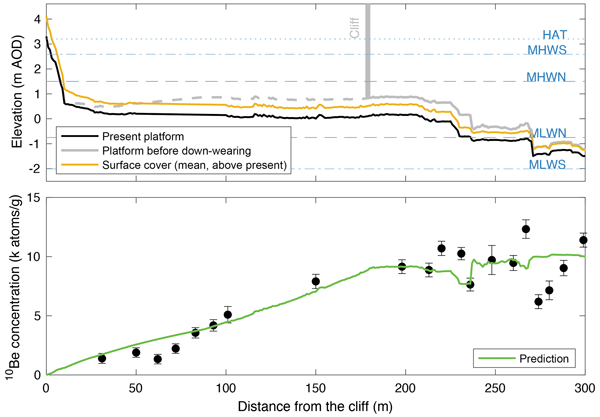
The overall value of the new modelling approach is demonstrated with a useful real-world comparison using the dataset of Swirad et al. (2020) from North Yorkshire. Ultimately the lower panel of Figure 6 appears to be a compelling demonstration that the combined effects of backwear and downwear have driven the evolution of this rock coast environment. The discussion section notes that the model does not actually simulate the physical drivers of erosion, but in helping to untangle the relative contribution of backwear and downwear, the model does present a new tool that should help in broader efforts to understand process controls on rock coast evolution.
>> I thank the reviewer for their support of the approach and demonstration of CCM, and for the suggestions to improve the manuscript and consider future developments.
Citation: https://doi.org/10.5194/egusphere-2025-4086-AC1
-
AC1: 'Reply on RC1', Richard Jones, 08 Jan 2026
-
RC2: 'Comment on egusphere-2025-4086', Luca C Malatesta, 21 Dec 2025
Dear Editor, dear author,
caveat: I am evaluating this manuscript with a limited capacity. I am not an expert in cosmogenic nuclide measurements and I do not have access to MATLAB. My comments focus solely on the text of the manuscript which I have read with attention from the perspective of a potential user.
Richard Jones introduces a new optimization model to resolve rates of cliff retreat and platform downwearing on coastal platforms sampled with cosmogenic nuclides. The model uses simple equations to capture the first-order evolution of eroding coasts (platform and cliff). These equations are process-agnostic and assume spatially uniform rates of of cliff retreat and downwearing that can nevertheless change linearly through time from an initial rate to the present one. The effect of topographic change on the sample locations is calculated directly, side-stepping the actual topographic evolution. The framework optimizes a range of parameters to best fit the cosmogenic nuclide data used as an input.
The author convincingly guides the reader through a step-by-step demonstration of the framework with a well-known dataset from Yorkshire (UK). The framework seems like a welcome new tool for the community.
The text is didactic and well written. I have a few minor comments that would need to be addressed before publication, and a suggestion that the author may want to reserve for a future version of the framework. For simplicity, I will address the author directly in the rest of this short review.
Modularity of the equations.
This question betrays the fact that I could not run the model. Given the main text, I was not able to assess whether the equations you presented here can be modified and swapped with alternatives. For example, if I wanted to test a rate of weathering that changes with elevation above sea-level, could I change epsilon_pres in Eq. 6 and make it a function of elevation z? Similarly, if I wanted to test the effect of cliff erosion continuing after the cliff base exceeds HAT+RSL, could I change Eq. 7 and still run the optimization scheme? Or does the optimization require a specific type of equation (e.g. downwearing needs to be spatially uniform)? It would be useful to know what can be modified while keeping the optimization function.
For readability, since the text is comfortably not cramped, I would suggest to not use the acronyms MHWN, MHWS, MLWS, HAT, etc. or maybe remind the reader of their meaning at the start of each section. I had to repeatedly go back and forth through the manuscript to not mix them up.
There are a few pieces of information that, in my opinion could be brought up earlier in the text for clarity.
On l. 42 and following, I would have like to directly have an explanation of the inheritance sample. The sentence on l. 73–74 would be handy here.
In Table 1 and in paragraph l. 47: “past rate”, until later in the text I did not understand if it was another rate at some point in the past, or if that could be any arbitrary rate changing through time. On l. 203–204, you explain clearly what that entails. An initial rate and an present rate linked by a linear increase or decrease. These two lines would be most welcome in paragraph starting l. 47 to explain all the “past” values.
In section 5, it would be useful to indicate the few kyr timescale of the exercise. Maybe by mentioning that Swirad estimated a 6.5 kyr evolution. It is written later in the text and shown in Figure 2. But an earlier mention would be welcome.
Maybe less important, but on line 414–415, you write that the model does not explicitly simulate the physical drivers of erosion. This was clear when you introduced the various equations. Would it however be possible to spend a few sentences in the introduction to let us know that while different processes such as salt weathering or wave erosion drive the evolution the platform the framework presented here does not make a call about which process to simulate and simply captures the first-order result of the various processes.
I would appreciate a first cartoon figure to set the scene for all the different dimensions, rates, and parameters of the model. To be filed in the nice-to-have category. That would right away clarify what is the inheritance sample, the cliff-top erosion rate (I was confused whether it maybe was a retreat rate), etc.
Ideally, all subscripts that are not variable should be in upright font to help with readability. E.g. N_{k,\textup{pred}}
Line by line comments
l. 31 the CCM acronym is only explained in the abstract beforehand.
l. 61: well maybe true for a model that helps analyze data, but there’s a wide range of models out there, some that don’t use data to explore system behaviour. Probably worth rephrasing to not offend anyone.
l. 64: designed
l. 78 to instead of and
l. 79 (and any place where a distance “from cliff” is mentioned): It is from cliff base, right? or from cliff top. Depending on the site, the two can be tens of m apart.
l. 89 First time I read “m AOD” could you add the meaning of the acronym for this datum?
l. 108: What is tidal duration in %age?
l. 166–167: I don’t understand how we go from the tidal parameters of section 3.5 to this single tidal height value.
l. 247 sensitivity
Figure 2, A, B, C, D panels would be helpful
Figure 2 caption: here 1, 3, 5, and 7 thousand years are a duration not an age —> kyr.
l. 368: fitted to the dataset (?)
l. 424: optimization of initial values.
Tool for sampling strategy (suggestion).
You walk the reader through the model in a pleasantly didactic way. I think it elevates the manuscript beyond a strict user manual and makes it an interesting resource to understand the ins and outs for cosmogenic surveys for platform evolution. In that sense, I would think that the model presented here would also find a use as a tool to define sampling strategies ahead of field missions or proposal writing.
As I understand the framework cannot be currently used to only output ages as a function of erosion rates and other parameters without comparison and optimization against measured concentrations (I might well be wrong not having run the model myself). This is most likely beyond the scope of this review, but you might want to consider a future version where predicted nuclide concentrations can be the sole result. This would help design sampling strategies as mentioned above and to help the user think about confounding factors (e.g. downwearing versus shielding). This could be particularity useful to approach equifinality and identify whether samples in one location or another could be diagnostic.
Good luck for the revision,
Luca Malatesta
Citation: https://doi.org/10.5194/egusphere-2025-4086-RC2 -
AC2: 'Reply on RC2', Richard Jones, 08 Jan 2026
My responses are in bold at relevant parts of the review.
Richard Jones introduces a new optimization model to resolve rates of cliff retreat and platform downwearing on coastal platforms sampled with cosmogenic nuclides. The model uses simple equations to capture the first-order evolution of eroding coasts (platform and cliff). These equations are process-agnostic and assume spatially uniform rates of cliff retreat and downwearing that can nevertheless change linearly through time from an initial rate to the present one. The effect of topographic change on the sample locations is calculated directly, side-stepping the actual topographic evolution. The framework optimizes a range of parameters to best fit the cosmogenic nuclide data used as an input.
The author convincingly guides the reader through a step-by-step demonstration of the framework with a well-known dataset from Yorkshire (UK). The framework seems like a welcome new tool for the community.
The text is didactic and well written. I have a few minor comments that would need to be addressed before publication, and a suggestion that the author may want to reserve for a future version of the framework. For simplicity, I will address the author directly in the rest of this short review.
>> I thank the reviewer for their positive and a very constructive review.
Modularity of the equations.
This question betrays the fact that I could not run the model. Given the main text, I was not able to assess whether the equations you presented here can be modified and swapped with alternatives. For example, if I wanted to test a rate of weathering that changes with elevation above sea-level, could I change epsilon_pres in Eq. 6 and make it a function of elevation z? Similarly, if I wanted to test the effect of cliff erosion continuing after the cliff base exceeds HAT+RSL, could I change Eq. 7 and still run the optimization scheme? Or does the optimization require a specific type of equation (e.g. downwearing needs to be spatially uniform)? It would be useful to know what can be modified while keeping the optimization function.
>> A decision was made to make CCM as modular as possible to allow for modification, while still keeping a simple user interface that allows the user to run each model with control over data and model inputs.
It might be easiest to think of CCM as a series of levels:
- Level 1: the overarching script to run the models (Coastal_cosmo_model.m), where the user can specify the input data, select the CCM model, and choice the starting parameters values to initialise the optimisation.
- Level 2: functions to run each model (e.g. run_ErosionCRDW.m), which pre-processes the inputs and parameters, sets up and executes the model optimization, and exports the result; this level also includes get_data.m to initially import the measured data before running the models.
- Level 3: functions to perform the model calculations and assess the misfit with measured data (e.g. fit_ErosionCRDW.m), which is specific to each CCM erosion model and called for each iteration of the optimization; this level also includes get_pars.m to pre-process nuclide parameters for modelling.
- Level 4: suite of generic functions that perform model variable and nuclide concentration calculations (e.g. shielding_water.m, calc_conc.m), which are not specific to any CCM erosion model
- Level 5: a few functions to carry out specific calculations for the level 4 functions (e.g. get_cov_shield.m, PR_Z.m).
Plotting functions also exist within levels 1, 3 and 4 (e.g. plot_platform_concs.m, plot_variables.m), and there are various pre-existing functions used by CCM in different levels that come from CronusCalc or that are built within Matlab (e.g. prodz1026.m, fminsearch.m).
All levels are modifiable to some degree. Level 5 should not need changing as it provides the underlying calculations. Level 4 functions are very modular and can be easily modified or replaced, particularly if the user preferred a different approach for calculating topographic shielding (Eq. 3), water shielding (Eq. 4) and cover shielding (Eq. 5). Level 3 can be modified if the user prefers an alternative calculation of erosion (Eqs. 6-9), similar to what the reviewer suggests. However, if any modifications require a new type of model input or different free parameters, the corresponding level 4 erosion model function would need to be heavily modified. In this case, I advise creating a new model version (easiest if adapted from a current CCM model).
CCMv1 is intended to provide the foundation for further development, particularly for more complex scenarios and study-specific applications. For example, I have a version of the ‘Cliff retreat and down-wearing’ model that uses spatially-variable down-wearing rates measured at a site; this bespoke model version would be published at a later date as part of an application study, highlighting how CCMv1 can be modified for specific cases.
To better outline the modularity and highlight what could be modified, I can add a paragraph (small subsection) to section 4.
For readability, since the text is comfortably not cramped, I would suggest to not use the acronyms MHWN, MHWS, MLWS, HAT, etc. or maybe remind the reader of their meaning at the start of each section. I had to repeatedly go back and forth through the manuscript to not mix them up.
>> I appreciate this concern. As these are common terms and acronyms associated with sea level and coastal geomorphology, I chose to define them once initially and later use only the acronyms thereafter. It would not be suitable to redefine in each subsection, but I could for each main section. This, however, may conflict with journal requirements, so I will make revisions following editor guidance.
There are a few pieces of information that, in my opinion could be brought up earlier in the text for clarity.
On l. 42 and following, I would have like to directly have an explanation of the inheritance sample. The sentence on l. 73–74 would be handy here.
>> Agreed. The purpose and importance of an inheritance sample should be explained here. I will move the sentence on l.74-75 to this paragraph (l.42).
In Table 1 and in paragraph l. 47: “past rate”, until later in the text I did not understand if it was another rate at some point in the past, or if that could be any arbitrary rate changing through time. On l. 203–204, you explain clearly what that entails. An initial rate and an present rate linked by a linear increase or decrease. These two lines would be most welcome in paragraph starting l. 47 to explain all the “past” values.
>> Agreed, reference to “past rate” could be clearer. My preference is to remove “past” in this paragraph (l.55) instead of introducing the method of defining rate change here. The main point in this section is to highlight that the rate can change over time (e.g. accelerating, decelerating or constant). In Table 1, “past rate” will be changed to more clearly describe what the parameter presents, concisely capturing the description on l.203-204.
In section 5, it would be useful to indicate the few kyr timescale of the exercise. Maybe by mentioning that Swirad estimated a 6.5 kyr evolution. It is written later in the text and shown in Figure 2. But an earlier mention would be welcome.
>> While the exact timescale is dependent on the model (how it captures processes and sample uncertainty), I agree that some temporal context would help in the introductory paragraph of Section 5. I will add text to highlight the timescale predicted by Swirad et al.
Maybe less important, but on line 414–415, you write that the model does not explicitly simulate the physical drivers of erosion. This was clear when you introduced the various equations. Would it however be possible to spend a few sentences in the introduction to let us know that while different processes such as salt weathering or wave erosion drive the evolution the platform the framework presented here does not make a call about which process to simulate and simply captures the first-order result of the various processes.
>> That is a good point, and I will add a sentence to the Introduction as suggested.
I would appreciate a first cartoon figure to set the scene for all the different dimensions, rates, and parameters of the model. To be filed in the nice-to-have category. That would right away clarify what is the inheritance sample, the cliff-top erosion rate (I was confused whether it maybe was a retreat rate), etc.
>> Thank you for the suggestion. I considered a cartoon, but opted for a table and text descriptions to outline the components and parameters of the model. While such a cartoon may provide some additional clarification for some parameters, not all would work on the same cartoon (e.g. some are varying spatially, others temporally). I have therefore decided not to include a cartoon; but, I will follow the other recommendations to clarify the descriptions of model components and parameters.
Ideally, all subscripts that are not variable should be in upright font to help with readability. E.g. N_{k,\textup{pred}}
Line by line comments
- 31 the CCM acronym is only explained in the abstract beforehand.
>> I will write the model name in full here.
- 61: well maybe true for a model that helps analyze data, but there’s a wide range of models out there, some that don’t use data to explore system behaviour. Probably worth rephrasing to not offend anyone.
>> Data is a broad term, and all models need some form of input data to simulate system behaviour. But I don’t intend to offend, so I will happily modify this sentence.
- 64: designed
>> Will correct this typo.
- 78 to instead of and
>> Unsure what text this refers to, and no sentences near this line would make sense with the suggested wording change.
- 79 (and any place where a distance “from cliff” is mentioned): It is from cliff base, right? or from cliff top. Depending on the site, the two can be tens of m apart.
>> Will change all references to “from cliff”.
- 89 First time I read “m AOD” could you add the meaning of the acronym for this datum?
>> Will define AOD here.
- 108: What is tidal duration in %age?
>> Tidal duration (%) is the percentage of the time that the tide is in that elevation band, with a value provided for each elevation band. I will add a sentence here to explain what this value represents in relation to tidal elevation.
- 166–167: I don’t understand how we go from the tidal parameters of section 3.5 to this single tidal height value.
>> This is a good point, which has made me realise that Eq. 4 does not accurately represent the calculation. Water shielding is averaged over the tidal cycle using the discrete tidal elevation bins and their fractional durations (i.e. the model integrates attenuation across the full tide-level distribution rather than using a single tidal height).
I will correct this equation and the accompanying text description, replacing tidal height with the tidal parameters of duration and elevation.
- 247 sensitivity
>> Will correct this typo.
Figure 2, A, B, C, D panels would be helpful
>> Will add letters to panels, and adjust the figure caption accordingly.
Figure 2 caption: here 1, 3, 5, and 7 thousand years are a duration not an age —> kyr.
>> These values are effectively the duration and the age. Technically, they are the total model time (thousands of years before present) when the model was started for the scenario, and therefore ‘ka’ should be the correct unit.
- 368: fitted to the dataset (?)
>> Will correct this typo.
- 424: optimization of initial values.
>> Will correct this typo.
Tool for sampling strategy (suggestion).
You walk the reader through the model in a pleasantly didactic way. I think it elevates the manuscript beyond a strict user manual and makes it an interesting resource to understand the ins and outs for cosmogenic surveys for platform evolution. In that sense, I would think that the model presented here would also find a use as a tool to define sampling strategies ahead of field missions or proposal writing.
As I understand the framework cannot be currently used to only output ages as a function of erosion rates and other parameters without comparison and optimization against measured concentrations (I might well be wrong not having run the model myself). This is most likely beyond the scope of this review, but you might want to consider a future version where predicted nuclide concentrations can be the sole result. This would help design sampling strategies as mentioned above and to help the user think about confounding factors (e.g. downwearing versus shielding). This could be particularity useful to approach equifinality and identify whether samples in one location or another could be diagnostic.
>> Thank you for raising this interesting point and suggestion. It is currently possible to achieve this goal of informing sampling strategies with the existing model framework. In addition to the suite of models, there is a section of code (in the overarching model script Coastal_cosmo_model.m) that calculates nuclide concentrations based on any specified scenario. Measured concentrations are required as an input, but only for plotting purposes; instead, an input with zero values could be used in cases where samples are yet to be collected. A user could explore different scenarios using this code for their intended study site to determine where best to collect samples, as well as what the nuclide concentrations would be for a particular erosion rate or exposure time.
I will add a paragraph to Section 5 to explain this additional benefit of the model code, including a description of how to apply it and what it could achieve.
Citation: https://doi.org/10.5194/egusphere-2025-4086-AC2
-
AC2: 'Reply on RC2', Richard Jones, 08 Jan 2026


Interactive discussion
Status: closed
-
RC1: 'Comment on egusphere-2025-4086', Mark Dickson, 02 Dec 2025
This manuscript provides a welcome new addition to efforts to model shore platform evolution (and coastal cliff retreat rates) using in situ produced cosmogenic radionuclides (CRN). It contributes to a growing body of literature on the topic. I suggest adding an additional paragraph within the introduction to more fully summarise the relatively small number of contributions in the field to date.
The model formulation appears to be grounded in established cosmogenic nuclide theory. A key novel contribution of this new model (CCM) is that it provides a clear hypothesis testing framework. Rather than seeking a single solution between morphological development and observed CRN concentrations, it allows users to systematically step through multiple hypotheses that increase in complexity. I think this will be a valuable addition to existing tools to model rock coast evolution.
Four sub-models are provided: inheritance, zero erosion, down-wearing only, and cliff retreat with down-wearing. Similar to previous work (e.g. Hurst et al., 2016), the inheritance sub-model calculates cosmogenic inheritance based on a sample taken from a site that represents how much inherited 10Be is in the rock prior to exposure. If a feasible value is found for the site, that value is then used to correct platform nuclide concentrations prior to modelling the erosion history. The zero erosion sub model represents a null hypothesis in which the test is whether CRN observations can be explained solely by sea-level change. In this model there is no cliff retreat (backwear) or vertical shore platform erosion (downwear). The downwear model then tests vertical erosion without cliff retreat, and the final model is the most complex (and the most likely in nature!) in that it involves both backwear (cliff retreat) and downwear (vertical platform erosion). It would be interesting to understand a little more about whether there would be any value in a backwear only model. Downwear only makes sense, because it makes it possible to rule out a no-backwear scenario. Perhaps backwear only doesn't make sense, because downwear would be expected if backwear is also occurring, but is there value in isolating what a backwear only signal would look like? Perhaps it is possible to set the downwear rate to zero in the combined backwear/downwear model?
The CCM model usefully integrates with CRONUScalc and a global calibration dataset. It also includes an optimisation framework, and while it doesn't go as far as previous work (Shadrick et al., 2021) in respect to techniques such as multi-objective and Bayesian optimisation, the overall model framework means that the optimisation function (multidimensional unconstrained nonlinear minimization using Nelder-Mead within MATLAB) can help to solve for variable backwear and downwear erosion rates through time.
Similar to previous work, three downwear scenarios are considered: constant, increasing or decreasing (relative to some specified present-day erosion rate). Three backwear scenarios are also considered: accelerating, decelerating or constant. In theory, if cliff retreat is wave-driven then widening platforms through time should result in a non-linear decline in erosion rates, although this is complicated by Holocene sea level variability (eg see Trenhaile 2010). In future work, in addition to the decelerating scenario, it would be interesting also to allow testing of a non-linear deceleration.
The overall value of the new modelling approach is demonstrated with a useful real-world comparison using the dataset of Swirad et al. (2020) from North Yorkshire. Ultimately the lower panel of Figure 6 appears to be a compelling demonstration that the combined effects of backwear and downwear have driven the evolution of this rock coast environment. The discussion section notes that the model does not actually simulate the physical drivers of erosion, but in helping to untangle the relative contribution of backwear and downwear, the model does present a new tool that should help in broader efforts to understand process controls on rock coast evolution.
Additional references cited:
Trenhaile, A. S. (2010). The effect of Holocene changes in relative sea level on the morphology of rocky coasts. Geomorphology, 114(1-2), 30-41.Citation: https://doi.org/10.5194/egusphere-2025-4086-RC1 -
AC1: 'Reply on RC1', Richard Jones, 08 Jan 2026
My responses are in bold at relevant parts of the review.
This manuscript provides a welcome new addition to efforts to model shore platform evolution (and coastal cliff retreat rates) using in situ produced cosmogenic radionuclides (CRN). It contributes to a growing body of literature on the topic. I suggest adding an additional paragraph within the introduction to more fully summarise the relatively small number of contributions in the field to date.
>> Thank you for this suggestion. I agree that it is helpful to more explicitly situate CCMv1 within the existing literature. I will add a short paragraph to the Introduction that summarises the limited number of numerical models that directly link cosmogenic nuclide concentrations to rocky coast evolution, highlighting their primary focus and methodological approaches, and clarifying how CCMv1 complements and extends this body of work by providing a flexible, hypothesis-driven framework applicable across a broader range of coastal morphologies and erosion regimes.
The model formulation appears to be grounded in established cosmogenic nuclide theory. A key novel contribution of this new model (CCM) is that it provides a clear hypothesis testing framework. Rather than seeking a single solution between morphological development and observed CRN concentrations, it allows users to systematically step through multiple hypotheses that increase in complexity. I think this will be a valuable addition to existing tools to model rock coast evolution.
Four sub-models are provided: inheritance, zero erosion, down-wearing only, and cliff retreat with down-wearing. Similar to previous work (e.g. Hurst et al., 2016), the inheritance sub-model calculates cosmogenic inheritance based on a sample taken from a site that represents how much inherited 10Be is in the rock prior to exposure. If a feasible value is found for the site, that value is then used to correct platform nuclide concentrations prior to modelling the erosion history. The zero erosion sub model represents a null hypothesis in which the test is whether CRN observations can be explained solely by sea-level change. In this model there is no cliff retreat (backwear) or vertical shore platform erosion (downwear). The downwear model then tests vertical erosion without cliff retreat, and the final model is the most complex (and the most likely in nature!) in that it involves both backwear (cliff retreat) and downwear (vertical platform erosion). It would be interesting to understand a little more about whether there would be any value in a backwear only model. Downwear only makes sense, because it makes it possible to rule out a no-backwear scenario. Perhaps backwear only doesn't make sense, because downwear would be expected if backwear is also occurring, but is there value in isolating what a backwear only signal would look like? Perhaps it is possible to set the downwear rate to zero in the combined backwear/downwear model?
>> I agree that clarifying the rationale behind the model hierarchy is important. I will revise the manuscript to more explicitly explain that down-wearing is treated as a more fundamental and ubiquitous erosional process on rocky coasts, including settings where long-term cliff retreat may be negligible. The ‘down-wearing only’ model therefore serves as a key intermediate hypothesis, allowing sensitivity to vertical erosion and sea-level history to be tested independently of backwear. A standalone ‘backwear-only’ sub-model was not implemented because cliff retreat would generally be expected to coincide with some degree of platform lowering; however, as the reviewer notes, such a scenario can be readily explored within CCMv1 by setting the down-wearing rate to zero in the combined ‘cliff retreat and down-wearing’ model. This clarification will be added to the model description (section 2).
The CCM model usefully integrates with CRONUScalc and a global calibration dataset. It also includes an optimisation framework, and while it doesn't go as far as previous work (Shadrick et al., 2021) in respect to techniques such as multi-objective and Bayesian optimisation, the overall model framework means that the optimisation function (multidimensional unconstrained nonlinear minimization using Nelder-Mead within MATLAB) can help to solve for variable backwear and downwear erosion rates through time.
Similar to previous work, three downwear scenarios are considered: constant, increasing or decreasing (relative to some specified present-day erosion rate). Three backwear scenarios are also considered: accelerating, decelerating or constant. In theory, if cliff retreat is wave-driven then widening platforms through time should result in a non-linear decline in erosion rates, although this is complicated by Holocene sea level variability (eg see Trenhaile 2010). In future work, in addition to the decelerating scenario, it would be interesting also to allow testing of a non-linear deceleration.
>> I agree with this suggestion. CCMv1 was intentionally designed as a foundational and usable framework that represents temporal changes in erosion rates using simple linear multipliers relative to present-day values. In section 6, I will clarify that the model structure readily permits more complex parameterisations, including non-linear or user-defined rate histories, which may be appropriate for specific sites or hypotheses and represent a natural direction for future development.
The overall value of the new modelling approach is demonstrated with a useful real-world comparison using the dataset of Swirad et al. (2020) from North Yorkshire. Ultimately the lower panel of Figure 6 appears to be a compelling demonstration that the combined effects of backwear and downwear have driven the evolution of this rock coast environment. The discussion section notes that the model does not actually simulate the physical drivers of erosion, but in helping to untangle the relative contribution of backwear and downwear, the model does present a new tool that should help in broader efforts to understand process controls on rock coast evolution.
>> I thank the reviewer for their support of the approach and demonstration of CCM, and for the suggestions to improve the manuscript and consider future developments.
Citation: https://doi.org/10.5194/egusphere-2025-4086-AC1
-
AC1: 'Reply on RC1', Richard Jones, 08 Jan 2026
-
RC2: 'Comment on egusphere-2025-4086', Luca C Malatesta, 21 Dec 2025
Dear Editor, dear author,
caveat: I am evaluating this manuscript with a limited capacity. I am not an expert in cosmogenic nuclide measurements and I do not have access to MATLAB. My comments focus solely on the text of the manuscript which I have read with attention from the perspective of a potential user.
Richard Jones introduces a new optimization model to resolve rates of cliff retreat and platform downwearing on coastal platforms sampled with cosmogenic nuclides. The model uses simple equations to capture the first-order evolution of eroding coasts (platform and cliff). These equations are process-agnostic and assume spatially uniform rates of of cliff retreat and downwearing that can nevertheless change linearly through time from an initial rate to the present one. The effect of topographic change on the sample locations is calculated directly, side-stepping the actual topographic evolution. The framework optimizes a range of parameters to best fit the cosmogenic nuclide data used as an input.
The author convincingly guides the reader through a step-by-step demonstration of the framework with a well-known dataset from Yorkshire (UK). The framework seems like a welcome new tool for the community.
The text is didactic and well written. I have a few minor comments that would need to be addressed before publication, and a suggestion that the author may want to reserve for a future version of the framework. For simplicity, I will address the author directly in the rest of this short review.
Modularity of the equations.
This question betrays the fact that I could not run the model. Given the main text, I was not able to assess whether the equations you presented here can be modified and swapped with alternatives. For example, if I wanted to test a rate of weathering that changes with elevation above sea-level, could I change epsilon_pres in Eq. 6 and make it a function of elevation z? Similarly, if I wanted to test the effect of cliff erosion continuing after the cliff base exceeds HAT+RSL, could I change Eq. 7 and still run the optimization scheme? Or does the optimization require a specific type of equation (e.g. downwearing needs to be spatially uniform)? It would be useful to know what can be modified while keeping the optimization function.
For readability, since the text is comfortably not cramped, I would suggest to not use the acronyms MHWN, MHWS, MLWS, HAT, etc. or maybe remind the reader of their meaning at the start of each section. I had to repeatedly go back and forth through the manuscript to not mix them up.
There are a few pieces of information that, in my opinion could be brought up earlier in the text for clarity.
On l. 42 and following, I would have like to directly have an explanation of the inheritance sample. The sentence on l. 73–74 would be handy here.
In Table 1 and in paragraph l. 47: “past rate”, until later in the text I did not understand if it was another rate at some point in the past, or if that could be any arbitrary rate changing through time. On l. 203–204, you explain clearly what that entails. An initial rate and an present rate linked by a linear increase or decrease. These two lines would be most welcome in paragraph starting l. 47 to explain all the “past” values.
In section 5, it would be useful to indicate the few kyr timescale of the exercise. Maybe by mentioning that Swirad estimated a 6.5 kyr evolution. It is written later in the text and shown in Figure 2. But an earlier mention would be welcome.
Maybe less important, but on line 414–415, you write that the model does not explicitly simulate the physical drivers of erosion. This was clear when you introduced the various equations. Would it however be possible to spend a few sentences in the introduction to let us know that while different processes such as salt weathering or wave erosion drive the evolution the platform the framework presented here does not make a call about which process to simulate and simply captures the first-order result of the various processes.
I would appreciate a first cartoon figure to set the scene for all the different dimensions, rates, and parameters of the model. To be filed in the nice-to-have category. That would right away clarify what is the inheritance sample, the cliff-top erosion rate (I was confused whether it maybe was a retreat rate), etc.
Ideally, all subscripts that are not variable should be in upright font to help with readability. E.g. N_{k,\textup{pred}}
Line by line comments
l. 31 the CCM acronym is only explained in the abstract beforehand.
l. 61: well maybe true for a model that helps analyze data, but there’s a wide range of models out there, some that don’t use data to explore system behaviour. Probably worth rephrasing to not offend anyone.
l. 64: designed
l. 78 to instead of and
l. 79 (and any place where a distance “from cliff” is mentioned): It is from cliff base, right? or from cliff top. Depending on the site, the two can be tens of m apart.
l. 89 First time I read “m AOD” could you add the meaning of the acronym for this datum?
l. 108: What is tidal duration in %age?
l. 166–167: I don’t understand how we go from the tidal parameters of section 3.5 to this single tidal height value.
l. 247 sensitivity
Figure 2, A, B, C, D panels would be helpful
Figure 2 caption: here 1, 3, 5, and 7 thousand years are a duration not an age —> kyr.
l. 368: fitted to the dataset (?)
l. 424: optimization of initial values.
Tool for sampling strategy (suggestion).
You walk the reader through the model in a pleasantly didactic way. I think it elevates the manuscript beyond a strict user manual and makes it an interesting resource to understand the ins and outs for cosmogenic surveys for platform evolution. In that sense, I would think that the model presented here would also find a use as a tool to define sampling strategies ahead of field missions or proposal writing.
As I understand the framework cannot be currently used to only output ages as a function of erosion rates and other parameters without comparison and optimization against measured concentrations (I might well be wrong not having run the model myself). This is most likely beyond the scope of this review, but you might want to consider a future version where predicted nuclide concentrations can be the sole result. This would help design sampling strategies as mentioned above and to help the user think about confounding factors (e.g. downwearing versus shielding). This could be particularity useful to approach equifinality and identify whether samples in one location or another could be diagnostic.
Good luck for the revision,
Luca Malatesta
Citation: https://doi.org/10.5194/egusphere-2025-4086-RC2 -
AC2: 'Reply on RC2', Richard Jones, 08 Jan 2026
My responses are in bold at relevant parts of the review.
Richard Jones introduces a new optimization model to resolve rates of cliff retreat and platform downwearing on coastal platforms sampled with cosmogenic nuclides. The model uses simple equations to capture the first-order evolution of eroding coasts (platform and cliff). These equations are process-agnostic and assume spatially uniform rates of cliff retreat and downwearing that can nevertheless change linearly through time from an initial rate to the present one. The effect of topographic change on the sample locations is calculated directly, side-stepping the actual topographic evolution. The framework optimizes a range of parameters to best fit the cosmogenic nuclide data used as an input.
The author convincingly guides the reader through a step-by-step demonstration of the framework with a well-known dataset from Yorkshire (UK). The framework seems like a welcome new tool for the community.
The text is didactic and well written. I have a few minor comments that would need to be addressed before publication, and a suggestion that the author may want to reserve for a future version of the framework. For simplicity, I will address the author directly in the rest of this short review.
>> I thank the reviewer for their positive and a very constructive review.
Modularity of the equations.
This question betrays the fact that I could not run the model. Given the main text, I was not able to assess whether the equations you presented here can be modified and swapped with alternatives. For example, if I wanted to test a rate of weathering that changes with elevation above sea-level, could I change epsilon_pres in Eq. 6 and make it a function of elevation z? Similarly, if I wanted to test the effect of cliff erosion continuing after the cliff base exceeds HAT+RSL, could I change Eq. 7 and still run the optimization scheme? Or does the optimization require a specific type of equation (e.g. downwearing needs to be spatially uniform)? It would be useful to know what can be modified while keeping the optimization function.
>> A decision was made to make CCM as modular as possible to allow for modification, while still keeping a simple user interface that allows the user to run each model with control over data and model inputs.
It might be easiest to think of CCM as a series of levels:
- Level 1: the overarching script to run the models (Coastal_cosmo_model.m), where the user can specify the input data, select the CCM model, and choice the starting parameters values to initialise the optimisation.
- Level 2: functions to run each model (e.g. run_ErosionCRDW.m), which pre-processes the inputs and parameters, sets up and executes the model optimization, and exports the result; this level also includes get_data.m to initially import the measured data before running the models.
- Level 3: functions to perform the model calculations and assess the misfit with measured data (e.g. fit_ErosionCRDW.m), which is specific to each CCM erosion model and called for each iteration of the optimization; this level also includes get_pars.m to pre-process nuclide parameters for modelling.
- Level 4: suite of generic functions that perform model variable and nuclide concentration calculations (e.g. shielding_water.m, calc_conc.m), which are not specific to any CCM erosion model
- Level 5: a few functions to carry out specific calculations for the level 4 functions (e.g. get_cov_shield.m, PR_Z.m).
Plotting functions also exist within levels 1, 3 and 4 (e.g. plot_platform_concs.m, plot_variables.m), and there are various pre-existing functions used by CCM in different levels that come from CronusCalc or that are built within Matlab (e.g. prodz1026.m, fminsearch.m).
All levels are modifiable to some degree. Level 5 should not need changing as it provides the underlying calculations. Level 4 functions are very modular and can be easily modified or replaced, particularly if the user preferred a different approach for calculating topographic shielding (Eq. 3), water shielding (Eq. 4) and cover shielding (Eq. 5). Level 3 can be modified if the user prefers an alternative calculation of erosion (Eqs. 6-9), similar to what the reviewer suggests. However, if any modifications require a new type of model input or different free parameters, the corresponding level 4 erosion model function would need to be heavily modified. In this case, I advise creating a new model version (easiest if adapted from a current CCM model).
CCMv1 is intended to provide the foundation for further development, particularly for more complex scenarios and study-specific applications. For example, I have a version of the ‘Cliff retreat and down-wearing’ model that uses spatially-variable down-wearing rates measured at a site; this bespoke model version would be published at a later date as part of an application study, highlighting how CCMv1 can be modified for specific cases.
To better outline the modularity and highlight what could be modified, I can add a paragraph (small subsection) to section 4.
For readability, since the text is comfortably not cramped, I would suggest to not use the acronyms MHWN, MHWS, MLWS, HAT, etc. or maybe remind the reader of their meaning at the start of each section. I had to repeatedly go back and forth through the manuscript to not mix them up.
>> I appreciate this concern. As these are common terms and acronyms associated with sea level and coastal geomorphology, I chose to define them once initially and later use only the acronyms thereafter. It would not be suitable to redefine in each subsection, but I could for each main section. This, however, may conflict with journal requirements, so I will make revisions following editor guidance.
There are a few pieces of information that, in my opinion could be brought up earlier in the text for clarity.
On l. 42 and following, I would have like to directly have an explanation of the inheritance sample. The sentence on l. 73–74 would be handy here.
>> Agreed. The purpose and importance of an inheritance sample should be explained here. I will move the sentence on l.74-75 to this paragraph (l.42).
In Table 1 and in paragraph l. 47: “past rate”, until later in the text I did not understand if it was another rate at some point in the past, or if that could be any arbitrary rate changing through time. On l. 203–204, you explain clearly what that entails. An initial rate and an present rate linked by a linear increase or decrease. These two lines would be most welcome in paragraph starting l. 47 to explain all the “past” values.
>> Agreed, reference to “past rate” could be clearer. My preference is to remove “past” in this paragraph (l.55) instead of introducing the method of defining rate change here. The main point in this section is to highlight that the rate can change over time (e.g. accelerating, decelerating or constant). In Table 1, “past rate” will be changed to more clearly describe what the parameter presents, concisely capturing the description on l.203-204.
In section 5, it would be useful to indicate the few kyr timescale of the exercise. Maybe by mentioning that Swirad estimated a 6.5 kyr evolution. It is written later in the text and shown in Figure 2. But an earlier mention would be welcome.
>> While the exact timescale is dependent on the model (how it captures processes and sample uncertainty), I agree that some temporal context would help in the introductory paragraph of Section 5. I will add text to highlight the timescale predicted by Swirad et al.
Maybe less important, but on line 414–415, you write that the model does not explicitly simulate the physical drivers of erosion. This was clear when you introduced the various equations. Would it however be possible to spend a few sentences in the introduction to let us know that while different processes such as salt weathering or wave erosion drive the evolution the platform the framework presented here does not make a call about which process to simulate and simply captures the first-order result of the various processes.
>> That is a good point, and I will add a sentence to the Introduction as suggested.
I would appreciate a first cartoon figure to set the scene for all the different dimensions, rates, and parameters of the model. To be filed in the nice-to-have category. That would right away clarify what is the inheritance sample, the cliff-top erosion rate (I was confused whether it maybe was a retreat rate), etc.
>> Thank you for the suggestion. I considered a cartoon, but opted for a table and text descriptions to outline the components and parameters of the model. While such a cartoon may provide some additional clarification for some parameters, not all would work on the same cartoon (e.g. some are varying spatially, others temporally). I have therefore decided not to include a cartoon; but, I will follow the other recommendations to clarify the descriptions of model components and parameters.
Ideally, all subscripts that are not variable should be in upright font to help with readability. E.g. N_{k,\textup{pred}}
Line by line comments
- 31 the CCM acronym is only explained in the abstract beforehand.
>> I will write the model name in full here.
- 61: well maybe true for a model that helps analyze data, but there’s a wide range of models out there, some that don’t use data to explore system behaviour. Probably worth rephrasing to not offend anyone.
>> Data is a broad term, and all models need some form of input data to simulate system behaviour. But I don’t intend to offend, so I will happily modify this sentence.
- 64: designed
>> Will correct this typo.
- 78 to instead of and
>> Unsure what text this refers to, and no sentences near this line would make sense with the suggested wording change.
- 79 (and any place where a distance “from cliff” is mentioned): It is from cliff base, right? or from cliff top. Depending on the site, the two can be tens of m apart.
>> Will change all references to “from cliff”.
- 89 First time I read “m AOD” could you add the meaning of the acronym for this datum?
>> Will define AOD here.
- 108: What is tidal duration in %age?
>> Tidal duration (%) is the percentage of the time that the tide is in that elevation band, with a value provided for each elevation band. I will add a sentence here to explain what this value represents in relation to tidal elevation.
- 166–167: I don’t understand how we go from the tidal parameters of section 3.5 to this single tidal height value.
>> This is a good point, which has made me realise that Eq. 4 does not accurately represent the calculation. Water shielding is averaged over the tidal cycle using the discrete tidal elevation bins and their fractional durations (i.e. the model integrates attenuation across the full tide-level distribution rather than using a single tidal height).
I will correct this equation and the accompanying text description, replacing tidal height with the tidal parameters of duration and elevation.
- 247 sensitivity
>> Will correct this typo.
Figure 2, A, B, C, D panels would be helpful
>> Will add letters to panels, and adjust the figure caption accordingly.
Figure 2 caption: here 1, 3, 5, and 7 thousand years are a duration not an age —> kyr.
>> These values are effectively the duration and the age. Technically, they are the total model time (thousands of years before present) when the model was started for the scenario, and therefore ‘ka’ should be the correct unit.
- 368: fitted to the dataset (?)
>> Will correct this typo.
- 424: optimization of initial values.
>> Will correct this typo.
Tool for sampling strategy (suggestion).
You walk the reader through the model in a pleasantly didactic way. I think it elevates the manuscript beyond a strict user manual and makes it an interesting resource to understand the ins and outs for cosmogenic surveys for platform evolution. In that sense, I would think that the model presented here would also find a use as a tool to define sampling strategies ahead of field missions or proposal writing.
As I understand the framework cannot be currently used to only output ages as a function of erosion rates and other parameters without comparison and optimization against measured concentrations (I might well be wrong not having run the model myself). This is most likely beyond the scope of this review, but you might want to consider a future version where predicted nuclide concentrations can be the sole result. This would help design sampling strategies as mentioned above and to help the user think about confounding factors (e.g. downwearing versus shielding). This could be particularity useful to approach equifinality and identify whether samples in one location or another could be diagnostic.
>> Thank you for raising this interesting point and suggestion. It is currently possible to achieve this goal of informing sampling strategies with the existing model framework. In addition to the suite of models, there is a section of code (in the overarching model script Coastal_cosmo_model.m) that calculates nuclide concentrations based on any specified scenario. Measured concentrations are required as an input, but only for plotting purposes; instead, an input with zero values could be used in cases where samples are yet to be collected. A user could explore different scenarios using this code for their intended study site to determine where best to collect samples, as well as what the nuclide concentrations would be for a particular erosion rate or exposure time.
I will add a paragraph to Section 5 to explain this additional benefit of the model code, including a description of how to apply it and what it could achieve.
Citation: https://doi.org/10.5194/egusphere-2025-4086-AC2
-
AC2: 'Reply on RC2', Richard Jones, 08 Jan 2026
Peer review completion
Journal article(s) based on this preprint
Viewed
| HTML | XML | Total | BibTeX | EndNote | |
|---|---|---|---|---|---|
| 212 | 80 | 30 | 322 | 20 | 22 |
- HTML: 212
- PDF: 80
- XML: 30
- Total: 322
- BibTeX: 20
- EndNote: 22
Viewed (geographical distribution)
| Country | # | Views | % |
|---|
| Total: | 0 |
| HTML: | 0 |
| PDF: | 0 |
| XML: | 0 |
- 1
Richard S. Jones
The requested preprint has a corresponding peer-reviewed final revised paper. You are encouraged to refer to the final revised version.
- Preprint
(1538 KB) - Metadata XML
This manuscript provides a welcome new addition to efforts to model shore platform evolution (and coastal cliff retreat rates) using in situ produced cosmogenic radionuclides (CRN). It contributes to a growing body of literature on the topic. I suggest adding an additional paragraph within the introduction to more fully summarise the relatively small number of contributions in the field to date.
The model formulation appears to be grounded in established cosmogenic nuclide theory. A key novel contribution of this new model (CCM) is that it provides a clear hypothesis testing framework. Rather than seeking a single solution between morphological development and observed CRN concentrations, it allows users to systematically step through multiple hypotheses that increase in complexity. I think this will be a valuable addition to existing tools to model rock coast evolution.
Four sub-models are provided: inheritance, zero erosion, down-wearing only, and cliff retreat with down-wearing. Similar to previous work (e.g. Hurst et al., 2016), the inheritance sub-model calculates cosmogenic inheritance based on a sample taken from a site that represents how much inherited 10Be is in the rock prior to exposure. If a feasible value is found for the site, that value is then used to correct platform nuclide concentrations prior to modelling the erosion history. The zero erosion sub model represents a null hypothesis in which the test is whether CRN observations can be explained solely by sea-level change. In this model there is no cliff retreat (backwear) or vertical shore platform erosion (downwear). The downwear model then tests vertical erosion without cliff retreat, and the final model is the most complex (and the most likely in nature!) in that it involves both backwear (cliff retreat) and downwear (vertical platform erosion). It would be interesting to understand a little more about whether there would be any value in a backwear only model. Downwear only makes sense, because it makes it possible to rule out a no-backwear scenario. Perhaps backwear only doesn't make sense, because downwear would be expected if backwear is also occurring, but is there value in isolating what a backwear only signal would look like? Perhaps it is possible to set the downwear rate to zero in the combined backwear/downwear model?
The CCM model usefully integrates with CRONUScalc and a global calibration dataset. It also includes an optimisation framework, and while it doesn't go as far as previous work (Shadrick et al., 2021) in respect to techniques such as multi-objective and Bayesian optimisation, the overall model framework means that the optimisation function (multidimensional unconstrained nonlinear minimization using Nelder-Mead within MATLAB) can help to solve for variable backwear and downwear erosion rates through time.
Similar to previous work, three downwear scenarios are considered: constant, increasing or decreasing (relative to some specified present-day erosion rate). Three backwear scenarios are also considered: accelerating, decelerating or constant. In theory, if cliff retreat is wave-driven then widening platforms through time should result in a non-linear decline in erosion rates, although this is complicated by Holocene sea level variability (eg see Trenhaile 2010). In future work, in addition to the decelerating scenario, it would be interesting also to allow testing of a non-linear deceleration.
The overall value of the new modelling approach is demonstrated with a useful real-world comparison using the dataset of Swirad et al. (2020) from North Yorkshire. Ultimately the lower panel of Figure 6 appears to be a compelling demonstration that the combined effects of backwear and downwear have driven the evolution of this rock coast environment. The discussion section notes that the model does not actually simulate the physical drivers of erosion, but in helping to untangle the relative contribution of backwear and downwear, the model does present a new tool that should help in broader efforts to understand process controls on rock coast evolution.
Additional references cited:
Trenhaile, A. S. (2010). The effect of Holocene changes in relative sea level on the morphology of rocky coasts. Geomorphology, 114(1-2), 30-41.