
the Creative Commons Attribution 4.0 License.
the Creative Commons Attribution 4.0 License.
 | 04 Sep 2025
Simulation of wind and solar energy generation over California with E3SM SCREAM regionally refined models at 3.25 km and 800 m resolutions
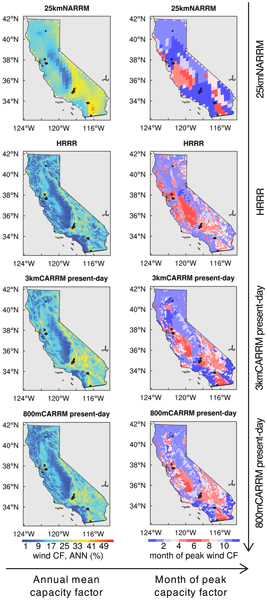
Abstract. This study produces wind and solar power generation estimates derived from the US Department of Energy’s Simple Cloud-Resolving Energy Exascale Earth System Model (E3SM) Atmosphere Model (SCREAM) by leveraging regional mesh refinement over California (CARRM) simulations at 3.25 km and 800 m horizontal resolutions, using the Python wrapper of System Advisor Model (PySAM). The resulting wind and solar energy generation estimates are compared to monthly capacity factors from the Energy Information Administration (EIA), the High-Resolution Rapid Refresh (HRRR; 3 km resolution) forecast model, and the E3SM North American Regionally Refined Model (NARRM; 25 km resolution). We systematically assess the impacts of generation modeling assumptions, meteorological models, and horizontal resolution. Results show that resolution plays a dominant role for wind energy: increasing from 25 km to 3.25 km brings qualitative and quantitative improvements, most notably by resolving the phase error in the seasonal cycle found in coarser simulations. However, further refinement to 800 m offers minimal gains. SCREAM’s performance for solar generation surpasses HRRR, likely due to more accurate surface radiation. The sensitivity of PySAM to system configuration, particularly for axis-tracking modeling in photovoltaics, is also highlighted. Overall, SCREAM-RRM shows strong potential for high-resolution energy assessments, with future progress depending on more in situ observations and clearer quantification of generation modeling uncertainties.
Competing interests: At least one of the (co-)authors is a member of the editorial board of Geoscientific Model Development. The authors declare that they have no other competing interests.
Publisher's note: Copernicus Publications remains neutral with regard to jurisdictional claims made in the text, published maps, institutional affiliations, or any other geographical representation in this paper. While Copernicus Publications makes every effort to include appropriate place names, the final responsibility lies with the authors. Views expressed in the text are those of the authors and do not necessarily reflect the views of the publisher.-
Notice on discussion status
The requested preprint has a corresponding peer-reviewed final revised paper. You are encouraged to refer to the final revised version.
-
Preprint
(31981 KB)
-
The requested preprint has a corresponding peer-reviewed final revised paper. You are encouraged to refer to the final revised version.
- Preprint
(31981 KB) - Metadata XML
- BibTeX
- EndNote
- Final revised paper


Journal article(s) based on this preprint
Interactive discussion
Status: closed
-
RC1: 'Comment on egusphere-2025-3947', Anonymous Referee #1, 20 Oct 2025
- AC1: 'Reply on RC1', Jishi Zhang, 22 Mar 2026
-
RC2: 'Comment on egusphere-2025-3947', Anonymous Referee #2, 08 Feb 2026
Please see the attached file for comments on egusphere-2025-3947.
- AC2: 'Reply on RC2', Jishi Zhang, 22 Mar 2026
Peer review completion


Interactive discussion
Status: closed
-
RC1: 'Comment on egusphere-2025-3947', Anonymous Referee #1, 20 Oct 2025
This is a well-written and structured manuscript, easy to read and follow meanwhile without losing the rigour of scientific work. It deals with the evaluation of atmospheric models for simulating solar and wind power in California, with multiple layers of investigation, i.e., evaluating the impact of using different atmospheric models, spatial resolutions, and solar and wind power generation models. Answering these questions would help users to understand the impact of different factors on solar and wind power calculations, and to decide on the best solution given the available resources. This is particularly important in the context of the current global transition toward a carbon-neutral energy system. I believe this manuscript could be further improved by addressing the points listed below:
- The necessity or irreplaceability of the work needs to be sharpened. What makes it so important to evaluate solar and wind power generation derived from the atmospheric models (or meteorological data sets) you mentioned in California? What are their special things compared with other alternatives, or can they represent the others?
- Adding information about the status quo of renewable energy installation in California and how much they cover the local electricity demand may help readers further understand the importance of your work.
- The limitations of this study should be uncovered and discussed in the manuscript.
- The conclusions you have made based on the results in the work, are they applicable to other regions? Or, are they applicable to other models?
- Are monthly CF observations really able to identify the difference of the high- and coarse-resolution atmospheric modeling outputs by evaluating their derived power results? The fluctuations in renewables, especially in wind, have been largely filtered out at the monthly scale, for which high-resolution models are good at solving while coarse-resolution models are not. Would not evaluating the direct solar and wind output variables from atmospheric models against observations from, e.g., synoptic stations and weather masts, make more sense for this purpose? Since hourly or finer time scale CF are not reachable as mentioned in the manuscript.
- Please justify in this manuscript why this work chose to use grid-cell (figure 3, 4, 5, 8; 11, 12) based evaluation, instead of evaluating over every plant (figure 9; 15) all the time?
- The study indicated in line 99 that the only difference between SCREAM-3kmCARRM and SCREAM-800mCARRM is the horizontal resolution, and in line 100-101 it also indicated that the physical parameterization is sensitive to horizontal resolution. Then, why do you think using the same suit of physical parameterization in these two experiments is fair and reasonable?
- Since this work recognized the effect of using different loss schemes in the generation estimate models, it should disclose the details of the wake scheme used in the PySAM/SAM, even though it is the default one. A brief intro as you did to PLUSWIND in lines 263-264 would do the job for PySAM/SAM. A great solution would also be adding words justifying why a certain wake scheme is chosen to be used in the workflow.
Now follows some technical comments:
- Make sure every acronym mentioned in the abstract has its full name explained there (e.g., SCREAM-RRM is a bit surprised to me)
- To be precise with the used language, solar and wind power are not renewable technologies, wind turbines and solar PV systems are. Solar and wind power are renewable energy sources. Please reformulate line 23 accordingly, and check throughout the manuscript to get rid of similar errors.
- In line 97 the study used “water years”, which is a field-specific terminology. It is suggested to explain its meaning at its first occurrence (line 97, while its first explanation now is in line 172) or use a more common term like weather years.
- The headline index might be wrong in section 2.1 and 2.2. Now it appears nothing presented under the headline 2.1, which should not be the case.
- Please check the entire Methods section, many acronyms mentioned without introducing its full name at the 1st occurrence, such as SVD, MPAS, HICCUP
- Line 216, repetitive to line 114-115, please reformulate and avoid using the exact same sentence
- Line 274, repetitive word used “preprocessing”
- Please add references to underpin your perspectives in line 315-316
- Figure 3: suggest to rearrange the legend into multiple columns (like 3) to save space, and to add index for subplots like a), b), c), which applies to other figures as well in this manuscript
- Figure 4: suggest to keep legend only one time for one row since they are the same, the same applies to Figure 5 and other figures from solar
- Line 423: I don’t see an underestimation in SoCal from HRRR, at least not from the bold line. Also it seems to me that NorCal has the least discrepancy present instead of SoCal.
- Figure 6: to save space, suggest to use a shared colorbar, put repetitive names as row name and column name, and show latitudes and longitudes only at the first column and the last row, the same applies to other figures from solar, otherwise some numbers are hard to read at the moment in these figures
- Figure 7: texts are hard to recognize, save space by reducing repetitive information as suggested before, try to use a landscape layout or split them into two panels to improve the visualization
- Figure 14: why not showing the “difference” subplots you have in Figure 7?
- Figure 9 and 15: try to adjust the legend so that it would not overlap the plot
Citation: https://doi.org/10.5194/egusphere-2025-3947-RC1 - AC1: 'Reply on RC1', Jishi Zhang, 22 Mar 2026
-
RC2: 'Comment on egusphere-2025-3947', Anonymous Referee #2, 08 Feb 2026
Please see the attached file for comments on egusphere-2025-3947.
- AC2: 'Reply on RC2', Jishi Zhang, 22 Mar 2026
Peer review completion
Journal article(s) based on this preprint
Data sets
Code, model, and analysis data for simulation of wind and solar energy generation over California with E3SM SCREAM regionally refined models at 3.25 km and 800 m resolutions Jishi Zhang https://zenodo.org/records/16809290
Model code and software
Code, model, and analysis data for simulation of wind and solar energy generation over California with E3SM SCREAM regionally refined models at 3.25 km and 800 m resolutions Jishi Zhang https://zenodo.org/records/16809290
Viewed
| HTML | XML | Total | BibTeX | EndNote | |
|---|---|---|---|---|---|
| 11,065 | 2,694 | 225 | 13,984 | 223 | 201 |
- HTML: 11,065
- PDF: 2,694
- XML: 225
- Total: 13,984
- BibTeX: 223
- EndNote: 201
Viewed (geographical distribution)
| Country | # | Views | % |
|---|
| Total: | 0 |
| HTML: | 0 |
| PDF: | 0 |
| XML: | 0 |
- 1

Jean–Christophe Golaz
Matthew Vincent Signorotti
Hsiang–He Lee
Peter Bogenschutz
Minda Monteagudo
Paul Aaron Ullrich
Robert S. Arthur
Stephen Po–Chedley
Philip Cameron–smith
Jean–Paul Watson
The requested preprint has a corresponding peer-reviewed final revised paper. You are encouraged to refer to the final revised version.
- Preprint
(31981 KB) - Metadata XML
This is a well-written and structured manuscript, easy to read and follow meanwhile without losing the rigour of scientific work. It deals with the evaluation of atmospheric models for simulating solar and wind power in California, with multiple layers of investigation, i.e., evaluating the impact of using different atmospheric models, spatial resolutions, and solar and wind power generation models. Answering these questions would help users to understand the impact of different factors on solar and wind power calculations, and to decide on the best solution given the available resources. This is particularly important in the context of the current global transition toward a carbon-neutral energy system. I believe this manuscript could be further improved by addressing the points listed below:
Now follows some technical comments: