
the Creative Commons Attribution 4.0 License.
the Creative Commons Attribution 4.0 License.
 | 20 Aug 2025
Comparing Secondary Organic Aerosols Schemes Implemented in Current Chemical Transport Models and the Policy Implications of Uncertainties
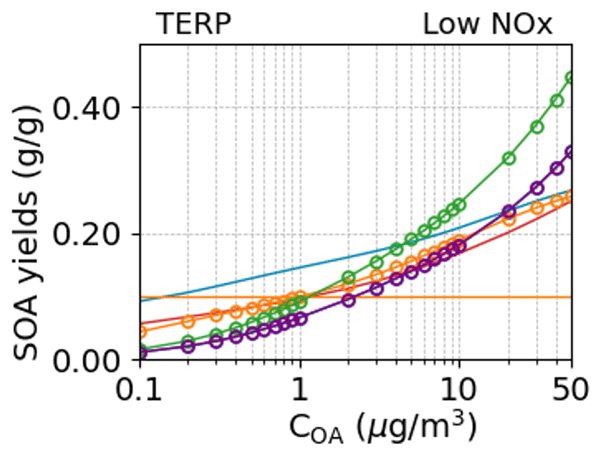
Abstract. Secondary organic aerosol (SOA) constitutes a major component of fine particulate matter (PM2.5) that models must account for to assess how human activities influence air quality, climate, and public health. We characterize the current state of SOA modeling by analyzing eight SOA schemes implemented in five widely used air quality models: CAMx, CMAQ, GEOS-Chem, WRF-Chem and CHIMERE. We performed offline calculations to compare initial SOA yields, the effects of SOA aging processes, and the influence of NOx conditions on yields. Our objective is to understand variation rather than to identify a superior scheme. We find significant discrepancies in initial SOA yields leading to different precursor rankings of SOA-forming potential. The ratio of maximum to minimum initial yield spans from 1.8 to over 1000, depending upon precursor, with the median of 4.2 underscoring large uncertainties. The impact of NOx conditions on SOA yields is also highly variable among schemes. While some schemes include SOA aging, their treatments differ substantially, with some schemes showing large increases in SOA mass, while others exhibit minimal changes. The substantial differences among current SOA schemes highlight a lack of consensus within the air quality modelling community. Evaluating model simulation results using ambient measurements is unlikely to resolve these discrepancies because uncertainties in SOA formation and precursor emissions are deeply intertwined. The limitations of current SOA schemes should be recognized and acknowledged because model choice can greatly influence predicted SOA concentrations and their evolution, ultimately impacting air quality forecasts, assessments, and regulatory decisions.
-
Notice on discussion status
The requested preprint has a corresponding peer-reviewed final revised paper. You are encouraged to refer to the final revised version.
-
Preprint
(2104 KB)
-
Supplement
(513 KB)
-
The requested preprint has a corresponding peer-reviewed final revised paper. You are encouraged to refer to the final revised version.
- Preprint
(2104 KB) - Metadata XML
-
Supplement
(513 KB) - BibTeX
- EndNote
- Final revised paper


Journal article(s) based on this preprint
Interactive discussion
Status: closed
- RC1: 'Comment on egusphere-2025-3921', Anonymous Referee #1, 14 Nov 2025
-
RC2: 'Comment on egusphere-2025-3921', Anonymous Referee #2, 03 Feb 2026
The comment was uploaded in the form of a supplement: https://egusphere.copernicus.org/preprints/2025/egusphere-2025-3921/egusphere-2025-3921-RC2-supplement.pdf
-
AC1: 'Response to comments on egusphere-2025-3921', Gregory Yarwood, 17 Mar 2026
The comment was uploaded in the form of a supplement: https://egusphere.copernicus.org/preprints/2025/egusphere-2025-3921/egusphere-2025-3921-AC1-supplement.pdf
Peer review completion


Interactive discussion
Status: closed
-
RC1: 'Comment on egusphere-2025-3921', Anonymous Referee #1, 14 Nov 2025
Huang et al. presents a comparison of 8 different air quality models/mechanisms in how these models produce secondary organic aerosol (SOA). They run these models offline, e.g., using a box model, so that same initial conditions are used and initial results can be compared. They find that each model/mechanism lead to very different yields of the similarly tracked species (aromatics, biogenics). Though this could be a good reference paper for modeling community and insight into how to compare and/or improve models, the paper currently as presented is not ready to be published in ACP, for the following reasons:
1) The first 16 pages of the manuscript currently reads more as a review of SOA modeling schemes than a research article. Though this compilation of models is useful for an easily digestable reference, I recommend that the authors and/or editor determine if this paper should be a review, a research article, or a measurement report, as I will discuss next.2) The results and discussion, currently as written, read more as a measurement report, meaning that the values on the figures are directly discussed without really place the results from these figures into bigger context. This bigger context includes directly comparing the results from one model to another, which is sometimes done but gets lost. Also, placing the results into the context of prior research is currently not done, leading the the results/discussion reading as a measurement report. To move the science beyond measurement report, if the authors want this to be a research article, I would recommend more in depth analysis (e.g., plotting the SOA yields as ratios to a model to demonstrate how much more SOA is being produced or plotting the average and spread of SOA yields across the models and what does that mean for total SOA produced for a typical urban environment and typical biogenic environment for uncertainty). Another demonstration of this is that figures are rarely referenced, esp. Fig 6, and again generally reads more as a review in that this is how model A performs, this is model B performs, etc. How much in how the model performs is surprising? E.g., if the authors compiled results of model comparisons or different model performances in a review type method, are the differences in yields and aging surprising?
3) Authors state that they do not want to say use model X after this evaluation; however, from the results, it would feel like at least two models need to be used in order to better demonstrate all possible answers and uncertainty, which would be resource heavy. Could any evaluation against published chamber studies be done to provide better guidance of at least potential biases of one model vs another?
4) The largest concern is the title does not reflect what is in the paper. After reading this, there was no evident discussion about the policy implications of these 8 different models/mechanisms. If this is important aspect the authors want to address, which I would support, more in-depth analysis, as suggested in comment 2), should be done. E.g., if a typical urban area starting with a mixture of aromatics, biogenics, IVOCs, etc., is modeled, how much total SOA is produced with the different metrics the authors discuss? How do these differences imply differences in policy strategy, such as explicit emission control (assuming most of the precursors are coming from heating or transportation or another source) vs more widespread emission control (transportation plus solvents plus . . .). What could the economic and/or public health impact be using one model that has lower total SOA vs another that has too high SOA? E.g., if the lowest performing model underpredicts the SOA for an urban area, what does that mean for the policy implications that were pursued due to using that model? If the model overpredicted, is that an economical concern?
Citation: https://doi.org/10.5194/egusphere-2025-3921-RC1 -
RC2: 'Comment on egusphere-2025-3921', Anonymous Referee #2, 03 Feb 2026
The comment was uploaded in the form of a supplement: https://egusphere.copernicus.org/preprints/2025/egusphere-2025-3921/egusphere-2025-3921-RC2-supplement.pdf
-
AC1: 'Response to comments on egusphere-2025-3921', Gregory Yarwood, 17 Mar 2026
The comment was uploaded in the form of a supplement: https://egusphere.copernicus.org/preprints/2025/egusphere-2025-3921/egusphere-2025-3921-AC1-supplement.pdf
Peer review completion
Journal article(s) based on this preprint
Viewed
| HTML | XML | Total | Supplement | BibTeX | EndNote | |
|---|---|---|---|---|---|---|
| 13,724 | 1,332 | 202 | 15,258 | 486 | 292 | 288 |
- HTML: 13,724
- PDF: 1,332
- XML: 202
- Total: 15,258
- Supplement: 486
- BibTeX: 292
- EndNote: 288
Viewed (geographical distribution)
| Country | # | Views | % |
|---|
| Total: | 0 |
| HTML: | 0 |
| PDF: | 0 |
| XML: | 0 |
- 1
Ling Huang
Benjie Chen
Zi'ang Wu
Katie Tuite
Pradeepa Vennam

The requested preprint has a corresponding peer-reviewed final revised paper. You are encouraged to refer to the final revised version.
- Preprint
(2104 KB) - Metadata XML
-
Supplement
(513 KB) - BibTeX
- EndNote
- Final revised paper
Huang et al. presents a comparison of 8 different air quality models/mechanisms in how these models produce secondary organic aerosol (SOA). They run these models offline, e.g., using a box model, so that same initial conditions are used and initial results can be compared. They find that each model/mechanism lead to very different yields of the similarly tracked species (aromatics, biogenics). Though this could be a good reference paper for modeling community and insight into how to compare and/or improve models, the paper currently as presented is not ready to be published in ACP, for the following reasons:
1) The first 16 pages of the manuscript currently reads more as a review of SOA modeling schemes than a research article. Though this compilation of models is useful for an easily digestable reference, I recommend that the authors and/or editor determine if this paper should be a review, a research article, or a measurement report, as I will discuss next.
2) The results and discussion, currently as written, read more as a measurement report, meaning that the values on the figures are directly discussed without really place the results from these figures into bigger context. This bigger context includes directly comparing the results from one model to another, which is sometimes done but gets lost. Also, placing the results into the context of prior research is currently not done, leading the the results/discussion reading as a measurement report. To move the science beyond measurement report, if the authors want this to be a research article, I would recommend more in depth analysis (e.g., plotting the SOA yields as ratios to a model to demonstrate how much more SOA is being produced or plotting the average and spread of SOA yields across the models and what does that mean for total SOA produced for a typical urban environment and typical biogenic environment for uncertainty). Another demonstration of this is that figures are rarely referenced, esp. Fig 6, and again generally reads more as a review in that this is how model A performs, this is model B performs, etc. How much in how the model performs is surprising? E.g., if the authors compiled results of model comparisons or different model performances in a review type method, are the differences in yields and aging surprising?
3) Authors state that they do not want to say use model X after this evaluation; however, from the results, it would feel like at least two models need to be used in order to better demonstrate all possible answers and uncertainty, which would be resource heavy. Could any evaluation against published chamber studies be done to provide better guidance of at least potential biases of one model vs another?
4) The largest concern is the title does not reflect what is in the paper. After reading this, there was no evident discussion about the policy implications of these 8 different models/mechanisms. If this is important aspect the authors want to address, which I would support, more in-depth analysis, as suggested in comment 2), should be done. E.g., if a typical urban area starting with a mixture of aromatics, biogenics, IVOCs, etc., is modeled, how much total SOA is produced with the different metrics the authors discuss? How do these differences imply differences in policy strategy, such as explicit emission control (assuming most of the precursors are coming from heating or transportation or another source) vs more widespread emission control (transportation plus solvents plus . . .). What could the economic and/or public health impact be using one model that has lower total SOA vs another that has too high SOA? E.g., if the lowest performing model underpredicts the SOA for an urban area, what does that mean for the policy implications that were pursued due to using that model? If the model overpredicted, is that an economical concern?