
the Creative Commons Attribution 4.0 License.
the Creative Commons Attribution 4.0 License.
 | 22 Sep 2025
A Fast and Physically Grounded Ocean Model for GCMs: The Dynamical Slab Ocean Model of the Generic-PCM (rev. 3423)
Abstract. We present the new dynamical slab ocean model implemented in a 3-D General Circulation Model (GCM) called the Generic Planetary Climate Model (Generic-PCM; formerly the LMD-Generic GCM). Our two-layer slab ocean model features emergent ocean heat transport (OHT) arising from wind-driven Ekman transport, horizontal diffusion, convective adjustment, and a newly implemented Gent–McWilliams (GM) parameterisation for mesoscale eddies. Sea ice evolution is spectrally-dependent and varies with ice thickness. We first validate the model in an idealised aquaplanet setting under various OHT configurations. We show that enabling OHT transforms not only surface features – such as cooler tropical sea surface temperatures (SSTs) and reduced sea ice coverage – but also atmospheric structures, notably producing a double-banded precipitation pattern across the equator driven by Ekman-induced upwelling. Our modelled meridional OHT profiles are in agreement with fully coupled atmosphere-ocean GCMs, with Ekman transport dominating in the tropics and GM advection and diffusion peaking near the ice edge. When applied to modern Earth, the OHT-enabled configuration yields an annual global average surface temperature of 13 °C, within 1 °C of reanalysis estimates, and improves extrapolar SSTs and sea ice coverage relative to the OHT-disabled baseline. Seasonal SST and sea ice biases relative to observations are also significantly reduced to within 0.6 °C and 3 million km2, respectively. We obtain a planetary bond albedo of around 0.32, in close agreement with observations. We additionally find that GM-induced mixing mimics vertical convection, while the inclusion of OHT reduces hemispheric asymmetries and improves the overall GCM numerical stability. Notably, these improvements are achieved at almost no additional computational cost compared to OHT-disabled simulations run over the same number of model years. This balance of computational efficiency and physical realism makes the model particularly well-suited for sensitivity studies and large parameter sweeps – crucial in exoplanet and paleoclimate applications where observational constraints are limited.
-
Notice on discussion status
The requested preprint has a corresponding peer-reviewed final revised paper. You are encouraged to refer to the final revised version.
-
Preprint
(1982 KB)
-
The requested preprint has a corresponding peer-reviewed final revised paper. You are encouraged to refer to the final revised version.
- Preprint
(1982 KB) - Metadata XML
- BibTeX
- EndNote
- Final revised paper


Journal article(s) based on this preprint
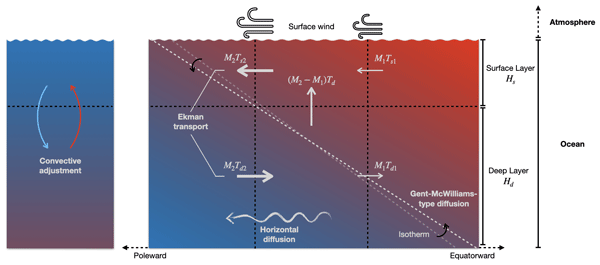
We present an efficient ocean model coupled to a 3-D climate model (the Generic-PCM) that captures key features of ocean heat transport, matching well the global heat flows of more complex models. It closely reproduces Earth’s sea surface temperatures and sea ice, while influencing atmospheric circulation consistently. Balancing speed and accuracy, the model is ideal for exoplanet and paleoclimate studies, where observations are limited and broad parameter exploration is necessary.
Interactive discussion
Status: closed
-
RC1: 'Comment on egusphere-2025-3786', Anonymous Referee #1, 27 Oct 2025
-
AC1: 'Reply on RC1', Siddharth Bhatnagar, 18 Feb 2026
The comment was uploaded in the form of a supplement: https://egusphere.copernicus.org/preprints/2025/egusphere-2025-3786/egusphere-2025-3786-AC1-supplement.pdf
-
AC1: 'Reply on RC1', Siddharth Bhatnagar, 18 Feb 2026
-
RC2: 'Comment on egusphere-2025-3786', Ashley Barnes, 09 Feb 2026
This manuscript showcases and benchmarks an improved 2-layer slab ocean model intended for use in long-running coupled atmosphere-ocean applications. The authors note that the flexibility of the model makes it suitable for studies of paleo-earth, or exoplanets with even more exotic characteristics compared to the modern Earth. The new model combines the computational efficiency of a slab model, with the added realism of ocean heat transport parametrisation schemes. The study is well motivated, argued and written, and all figures and schematics are clear and easy to understand. Some small improvements could be made to improve clarity for the reader, but I overall find the breadth of the study, thorough literature review and depth of the analysis of the model performance and biases to be satisfactory.
I therefore suggest to the editor that this manuscript is ready for publication with minor revisions, which i outline below:Line 1: Authors refer to this a a 'new' model, but also that it is building on a previous work. It is unclear to what extent this is an improvement on an existing model vs a novel model. This should be clarified / explained
Line 43-44: Salinity is mentioned here as important, but not included in the model. While the lack of salinity is returned to in the discussion, I think it would be good to discuss the omission of salinity somewhere in the introduction, perhaps here, or somewhere in lines 65-75 when the authors describe models of increasing complexity. I would suggest explaining here briefly why including salinity adds a disproportionately high computational cost for the improved accuracy.Line 406: Please refer specifically to what the reader should look at in figure 6c, and expand upon how this residual should be interpreted. I'm unsure from the text whether it is attributed to a physical phenomenon, or a model artefact
line 524: space after bracket
Discussion:
It would be good to provide an estimate for how this model compares in computational cost to the ocean GCMs typical for exoplanet study. This would provide a better sense of the cost-benefit of choosing this model over a more complex one.
General comment:
No explicit comparisons are made to the Codron 2012 model, even though this is referenced as something on which this model improves. Is this because turning off the OHT parameterisations in this model result in very similar performance to Codron 2012? If so, this should be stated or argued explicitly. If not, then some comparison with Codron 2012 would strengthen the manuscript.
Citation: https://doi.org/10.5194/egusphere-2025-3786-RC2 -
AC2: 'Reply on RC2', Siddharth Bhatnagar, 18 Feb 2026
The comment was uploaded in the form of a supplement: https://egusphere.copernicus.org/preprints/2025/egusphere-2025-3786/egusphere-2025-3786-AC2-supplement.pdf
-
AC2: 'Reply on RC2', Siddharth Bhatnagar, 18 Feb 2026


Interactive discussion
Status: closed
-
RC1: 'Comment on egusphere-2025-3786', Anonymous Referee #1, 27 Oct 2025
GENERAL COMMENTS
This study presents a computationally efficient ocean model for use in planetary climate simulations, with proposed relevance to the exoplanet modeling community. The manuscript presents a two-layer slab ocean model integrated into the Generic Planetary Climate Model (Generic-PCM). The model aims to balance physical realism with computational speed, making it suitable for long-term simulations and parameter sweeps that are often of interest in the context of exoplanet studies. The work appears to be mainly a follow-up on Codron (2012) and Charnay et al. (2013), who laid important groundwork in representing ocean heat transport in slab models. The dynamical slab ocean model of the Generic-PCM presented here builds on that legacy by improving sea ice representation and including a Gent-McWilliams parameterisation. The model is validated against both an idealized aquaplanet and an Earth scenario, as already done in Codron (2012) and Charnay et al. (2013), with a somewhat more detailed comparison with these two benchmark cases.
Overall, this is an interesting study that can propose an improved modelisation of ocean heat transport mechanisms for applications where computational efficiency and flexibility are paramount. There are several areas that require improvement before publication. These include primarily a more direct comparisons with Codron (2012) and Charnay et al. (2013), with clearer comments regarding the improvements of this new version of the dynamical slab ocean model with respect to previous 2-layer ocean models, and further discussion about the model validation against other scenarios with respect to the ones already considered in previous works. A more detailed analysis of the model validation is presented here compared to Codron (2012) and Charnay et al. (2013), with specific evaluations of seasonal climate and sea ice, which were previously only superficially addressed. However, further validation would have constituted a significant advancement, and an opportunity to test the model capabilities against AOGCM results in different scenarios. Examples include a “ridgeworld” continental configuration, that significantly impacts ocean dynamics, or non-solar host star spectra, given the newly implemented spectrally dependent parameterisation of sea ice and snow albedo. I therefore recommend a major revision.
SPECIFIC COMMENTS
- Ln 33: In listing applications of dynamic oceans for planetary climate studies, it would be more complete to also include works about Mars (e.g. Schmidt et al. 2022), in addition to Venus.
- Ln 37: Distinguishing between tidal locking and synchronous rotation would be more accurate. As mentioned later in the manuscript, at Ln 566, “tidally locked in a 1:1 spin-orbit resonance” refers to a synchronous rotation case, while “tidally locked” could refer to higher order spin-orbit resonances. In general, this terminology is often improperly used by the community, with “synchronously rotating” and “tidally locked” being adopted interchangeably. However, it would be more consistent and clearer to choose one descriptor within the text.
- Ln 38: The spin state of Proxima-b is still debated, with several studies suggesting a 3:2 spin-orbit resonance capture even for small orbital eccentricities (e.g. Ribas et al. 2016).
- Ln 73-79: This work appears to be a follow-up of Codron (2012) and Charnay et al (2013). This should be made clearer in the introduction when these works are mentioned. While the manuscript presents a well-implemented and computationally efficient “dynamical slab ocean model”, its core architecture and conceptual framework appear to be largely derivative of Codron (2012). Improvements to this model are presented later in the manuscript (in “Model description”), but these enhancements build upon an existing foundation rather than represent a fundamentally new modeling paradigm. I recommend the authors clarify the degree of novelty in the introduction, as the current framing may give the impression that the model is entirely new (Ln 73, as well as in the abstract). The model is more accurately described as a refined and extended implementation of a previously published concept: improvements to the previous model are specified in Ln 77-79, while Ln 74-76 seem to be describing previous work.
- Ln 176: More context for the chosen value of A_ice,max would be helpful. Specifically, the choice of A_ice,max for the VIS needs further explanation. The chosen value is 0.65, consistent to the spectrally-independent value chosen by Charnay et al. (2013), and inconsistent to the higher value of 0.75 chosen by Pedersen et al. (2009) - that was referenced here.
- Ln 177: Additional explanation could be added to justify the choice of h_ice,0=0.3 m, which is different from the previously adopted value by Charnay et al. (2013).
- Ln 183: The choice to adopt the mixed snow profile can be clarified. Here, it is motivated by the fact that it is representative of the albedo of snow-covered sea ice. Is another value chosen for snow on land? Or is the mixed snow profile used for all cases?
- Ln 215-222: The transition to a Sverdrup balance seems to be the authors’ refinement to the wind-driven Ekman transport implemented in the model already detailed in Codron (2012). However, an assessment regarding how this new development improves the simulation(s) results is missing from the manuscript. The sensitivity of the upwelling structure to the value of epsilon has been discussed in Codron (2012), with repercussions on tropical SST and precipitation. Ln 396-397 specify that lower values of epsilon extend the equatorial cold tongue, but don’t specify how the newly implemented Sverdrup balance may improve the results.
- Ln 292: Comments about the discrepancy in spin up times between this work and Codron (2012) would be useful. An upper limit of 40 years, instead of 20 years in Codron (2012) seems non-negligible. The reader would benefit from this comparison, that would highlight which model is more suited to the reader’s needs.
- Figure 3: In this plot, only Case 1 and Case 7 can be compared. A comparison with the aquaplanet results by Codron (2012), without the model improvements detailed in this work, would help clarify why these improvements are significant. When including OHT, Codron (2012) seems to reproduce a flatter SST compared to the one shown in Figure 3a. At the same time in Codron (2012), including OHT moves the mid-latitude storm tracks poleward, while it does not affect their position in Figure 3b. For instance, this comparison could be done through a direct overlay on the plot.
- Figure 5: Again, for this plot a more direct comparison with Codron (2012) would be useful, especially given the evident differences for the Ekman transport in the mid latitudes. For instance, this comparison could be done through a direct overlay on the plot.
- Ln 354: The general amplitude of the total ocean heat transport in Marshall et al. (2007) does not seem to match what is observed here. In Figure 7 of Marshall et al. (2007), the peak value for OHT exceeds ~4PW, basically double the peak value in this work. This is somewhat similar to the OHT peak values shown in Wu et al (2021), while Brunetti et al. (2019) exhibits lower values.
- Ln 365: As stated previously, comments about the discrepancy in spin up times between this work - 70 years - and Codron (2012) - 10-30 years - would be useful.
- Figure 6: A few comments regarding the similarities/differences between this work and previous ones are included. Once again, more cohesive direct comparisons – such as with difference map plots - would highlight what this new version of the model can achieve. For instance, the position of the Pacific cold tongue is more central in Codron (2012) and shifted eastward in this work. An explanation for the shift in the position of the ITCZ is provided in the text.
- Ln 418: The Southern hemisphere OHT is more severely underestimated than suggested, as “similarly” would imply an equivalent misrepresentation.
- Ln 449: These estimates of planetary bond albedo represent an improvement with respect to the 0.36 value in Charnay et al. (2013), and this could be highlighted, especially since the importance of accurately modelling albedo and OLR for exoplanetary studies is mentioned in Ln 468.
- Ln 464: The discrepancy between the global annually averaged surface temperature in this work (13°C, NCEP/NCAR reanalysis 14.0°C) and Charnay et al. (2013) (14.9°C, NCEP reanalysis 15.0°C) can be potentially discussed.
- Ln 480 (but this is a more general comment regarding the impact of GM on all analysed quantities): Comparing the cases Hdiff+Ekman+GM(+conv.) and an additional case Hdiff+Ekman+conv. would be especially interesting in order to clarify the importance of including GM. When excluding GM (like in Codron (2012)), does convective adjustment dominate? In other words, if including all other processes, does including/discarding GM have a significant impact on the state of the climate? Moreover, regarding the need for a detailed comparison with previous versions of the model, Hdiff(8000m2s-1)+Ekman+GM+conv. should be compared to Hdiff(25000m2s-1)+Ekman+conv.. Assessing whether convection and horizontal diffusion can effectively substitute GM is required to have a clearer understanding of why distinguishing different processes might be necessary. Given that the parameterization of GM in this model is one of the main proposed improvements, this question needs to be addressed.
- Ln 529-531: A q-flux, although certainly not ideal, can be prescribed for already well-studied cases. Analogously, the model presented here can currently only be somewhat accurately applied to cases characterized by well-known parameter values, valid for Earth-like spin states. This is specified throughout the manuscript: the current Sverdrup transport would be unrealistically large for slowly rotating planets (Ln 223-224), the values for GM diffusion coefficient and maximum slope are tuned to fit AGCM results for aquaplanet with Earth rotation rate (Ln 239-240), the horizontal diffusion coefficient is specific to Earth’s rotation (Ln 226-227).
- Ln 558-560: Given the stated intention of using the model to simulate exoplanetary climates, I once again recommend implementing a discussion regarding the differences between this work and results previously presented in Codron (2012) and Charnay et al. (2013). In the context of exoplanetary studies, in which observational constraints are mostly uncertain – as stated in the manuscript – does this new refined model present significant improvements in simulating planetary climate with respect to Codron (2012) and Charnay et al. (2013)? While the potential of applying these models is evident, and introducing spectrally dependent refinements for ice and albedo is certainly important, the manuscript does not highlight major advantages regarding this improved version of the model. For instance, Ln 600-603 justify the choice of disregarding the role of salinity, and therefore thermohaline circulation, in shaping climate. This appears to have major impacts on climate in terms of ocean transport and heat storage (Cullum et al. (2014)) compared to what seems to be a minor implication of including a GM parameterisation in this model.
- Ln 565: Additionally to geothermal heat fluxes, internal tidal heating (Driscoll & Barnes 2015, Dobos et al 2018) can also be modelled and included. Moreover, in the context of aquaplanets orbiting low-mass stars, ocean tides shape ocean circulation and have significant impact on climate (Di Paolo et al. 2025, Si et al. 2022). Including tidal effects might further improve the model and offer a more realistic depiction of climate in exotic contexts.
- Ln 669: Some additional comparison with AOGCM computation time would be useful. For instance, computation time for the favoured AOGCM ROCKE-3D 2.0 appears to be significantly shorter (Figure 15 of Tsigaridis et al. (2025)), even though timestep frequency is not comparable to this case.
TECHNICAL CORRECTIONS:
- Ln 54: ANDES@ELT is included here, while PCS@ELT is only mentioned in Ln 655.
- Ln 342: typo (“Trade”).
- Ln 633: Type (“upto”).
Citation: https://doi.org/10.5194/egusphere-2025-3786-RC1 -
AC1: 'Reply on RC1', Siddharth Bhatnagar, 18 Feb 2026
The comment was uploaded in the form of a supplement: https://egusphere.copernicus.org/preprints/2025/egusphere-2025-3786/egusphere-2025-3786-AC1-supplement.pdf
-
RC2: 'Comment on egusphere-2025-3786', Ashley Barnes, 09 Feb 2026
This manuscript showcases and benchmarks an improved 2-layer slab ocean model intended for use in long-running coupled atmosphere-ocean applications. The authors note that the flexibility of the model makes it suitable for studies of paleo-earth, or exoplanets with even more exotic characteristics compared to the modern Earth. The new model combines the computational efficiency of a slab model, with the added realism of ocean heat transport parametrisation schemes. The study is well motivated, argued and written, and all figures and schematics are clear and easy to understand. Some small improvements could be made to improve clarity for the reader, but I overall find the breadth of the study, thorough literature review and depth of the analysis of the model performance and biases to be satisfactory.
I therefore suggest to the editor that this manuscript is ready for publication with minor revisions, which i outline below:Line 1: Authors refer to this a a 'new' model, but also that it is building on a previous work. It is unclear to what extent this is an improvement on an existing model vs a novel model. This should be clarified / explained
Line 43-44: Salinity is mentioned here as important, but not included in the model. While the lack of salinity is returned to in the discussion, I think it would be good to discuss the omission of salinity somewhere in the introduction, perhaps here, or somewhere in lines 65-75 when the authors describe models of increasing complexity. I would suggest explaining here briefly why including salinity adds a disproportionately high computational cost for the improved accuracy.Line 406: Please refer specifically to what the reader should look at in figure 6c, and expand upon how this residual should be interpreted. I'm unsure from the text whether it is attributed to a physical phenomenon, or a model artefact
line 524: space after bracket
Discussion:
It would be good to provide an estimate for how this model compares in computational cost to the ocean GCMs typical for exoplanet study. This would provide a better sense of the cost-benefit of choosing this model over a more complex one.
General comment:
No explicit comparisons are made to the Codron 2012 model, even though this is referenced as something on which this model improves. Is this because turning off the OHT parameterisations in this model result in very similar performance to Codron 2012? If so, this should be stated or argued explicitly. If not, then some comparison with Codron 2012 would strengthen the manuscript.
Citation: https://doi.org/10.5194/egusphere-2025-3786-RC2 -
AC2: 'Reply on RC2', Siddharth Bhatnagar, 18 Feb 2026
The comment was uploaded in the form of a supplement: https://egusphere.copernicus.org/preprints/2025/egusphere-2025-3786/egusphere-2025-3786-AC2-supplement.pdf
-
AC2: 'Reply on RC2', Siddharth Bhatnagar, 18 Feb 2026
Peer review completion


Journal article(s) based on this preprint
We present an efficient ocean model coupled to a 3-D climate model (the Generic-PCM) that captures key features of ocean heat transport, matching well the global heat flows of more complex models. It closely reproduces Earth’s sea surface temperatures and sea ice, while influencing atmospheric circulation consistently. Balancing speed and accuracy, the model is ideal for exoplanet and paleoclimate studies, where observations are limited and broad parameter exploration is necessary.
Viewed
| HTML | XML | Total | BibTeX | EndNote | |
|---|---|---|---|---|---|
| 2,555 | 701 | 66 | 3,322 | 61 | 84 |
- HTML: 2,555
- PDF: 701
- XML: 66
- Total: 3,322
- BibTeX: 61
- EndNote: 84
Viewed (geographical distribution)
| Country | # | Views | % |
|---|
| Total: | 0 |
| HTML: | 0 |
| PDF: | 0 |
| XML: | 0 |
- 1
Siddharth Bhatnagar
Francis Codron
Ehouarn Millour
Emeline Bolmont
Maura Brunetti
Jérôme Kasparian
Martin Turbet
Guillaume Chaverot
The requested preprint has a corresponding peer-reviewed final revised paper. You are encouraged to refer to the final revised version.
- Preprint
(1982 KB) - Metadata XML
GENERAL COMMENTS
This study presents a computationally efficient ocean model for use in planetary climate simulations, with proposed relevance to the exoplanet modeling community. The manuscript presents a two-layer slab ocean model integrated into the Generic Planetary Climate Model (Generic-PCM). The model aims to balance physical realism with computational speed, making it suitable for long-term simulations and parameter sweeps that are often of interest in the context of exoplanet studies. The work appears to be mainly a follow-up on Codron (2012) and Charnay et al. (2013), who laid important groundwork in representing ocean heat transport in slab models. The dynamical slab ocean model of the Generic-PCM presented here builds on that legacy by improving sea ice representation and including a Gent-McWilliams parameterisation. The model is validated against both an idealized aquaplanet and an Earth scenario, as already done in Codron (2012) and Charnay et al. (2013), with a somewhat more detailed comparison with these two benchmark cases.
Overall, this is an interesting study that can propose an improved modelisation of ocean heat transport mechanisms for applications where computational efficiency and flexibility are paramount. There are several areas that require improvement before publication. These include primarily a more direct comparisons with Codron (2012) and Charnay et al. (2013), with clearer comments regarding the improvements of this new version of the dynamical slab ocean model with respect to previous 2-layer ocean models, and further discussion about the model validation against other scenarios with respect to the ones already considered in previous works. A more detailed analysis of the model validation is presented here compared to Codron (2012) and Charnay et al. (2013), with specific evaluations of seasonal climate and sea ice, which were previously only superficially addressed. However, further validation would have constituted a significant advancement, and an opportunity to test the model capabilities against AOGCM results in different scenarios. Examples include a “ridgeworld” continental configuration, that significantly impacts ocean dynamics, or non-solar host star spectra, given the newly implemented spectrally dependent parameterisation of sea ice and snow albedo. I therefore recommend a major revision.
SPECIFIC COMMENTS
TECHNICAL CORRECTIONS: