
the Creative Commons Attribution 4.0 License.
the Creative Commons Attribution 4.0 License.
 | 15 Sep 2025
A new method for estimating cloud optical depth from photovoltaic power measurements
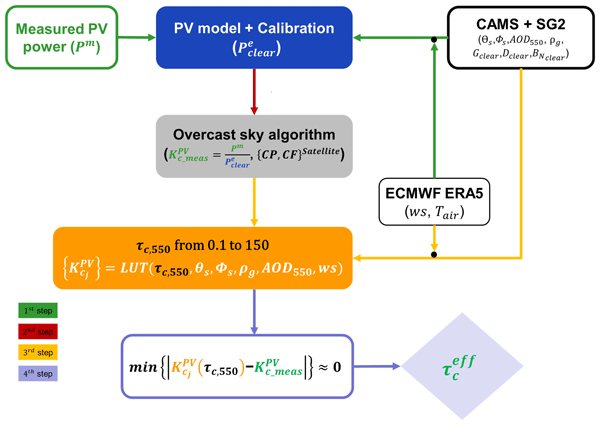
Abstract. A new method was developed to estimate the cloud optical depth (τc) from photovoltaic (PV) power measurements under overcast sky conditions. It is the first fully physical and universally applicable method utilizing directly PV power measurements. It exploits the recent advances and real-time availability at global scale of aerosol properties, downwelling shortwave irradiance and its direct and diffuse components received at ground level under clear-sky conditions, ground albedo and extraterrestrial irradiance, altogether provided by the Copernicus Atmosphere Monitoring Service (CAMS) radiation service. In addition to CAMS data, wind speed and air temperature from European Centre for Medium-Range Weather Forecasts (ECMWF) twentieth century reanalysis ERA5 products are also used as inputs. An algorithm for selecting overcast sky conditions has been designed too. The estimates have been compared to different data sources of retrievals at four experimental PV sites located in various climates. When compared to retrieved from ground–based pyranometer measurements serving as reference, the correlation coefficient is greater than 0.97. The bias ranges between –3 and 4, i.e., −8 % and 12 % in relative value. The root mean square error (RMSE) lies in the interval [3, 8] ([9, 21] % in relative value). When compared to satellite–based retrievals from Meteosat Second Generation (MSG) and Moderate Resolution Imaging Spectroradiometer (MODIS), both relative errors become comprehensively greater. Nevertheless, our method remarkably reduces the relative bias and RMSE, by up to 10 % and 20 % respectively, compared to the existing state-of-the-art approach. This work demonstrates the accuracy of the method and clearly shows its great potential use whenever PV power measurements are available.
-
Notice on discussion status
The requested preprint has a corresponding peer-reviewed final revised paper. You are encouraged to refer to the final revised version.
-
Preprint
(2030 KB)
-
The requested preprint has a corresponding peer-reviewed final revised paper. You are encouraged to refer to the final revised version.
- Preprint
(2030 KB) - Metadata XML
- BibTeX
- EndNote
- Final revised paper


Journal article(s) based on this preprint
Interactive discussion
Status: closed
-
CC1: 'Comment on egusphere-2025-3743', Simone Lolli, 29 Sep 2025
-
AC2: 'Reply on CC1', William Wandji Nyamsi, 02 Jan 2026
ANSWERS TO REFEREE Simone Lolli
First of all, we thank Simone Lolli for these positive and constructive remarks and comments on this topic. The comments have been addressed below and have been taken into account for revising a part of the text following recommendations of the referee. The responses to the referee points are below after the reviewer points that are in italics.
The manuscript presents a rigorous approach to retrieve cloud optical depth (τc) directly from photovoltaic power measurements.
The abstract describes it as “the first fully physical and universally applicable method … to estimate τc from PV measurements”.
It may be noted that the broader concept of exploiting PV-panel electrical output in synergy with a radiative-transfer model to infer an atmospheric optical-depth parameter was introduced earlier in Lolli (2021), Sensors 21, 6342; https://doi.org/10.3390/s21196342, which retrieved aerosol optical depth (AOD) at 550 nm from PV power.
Although the methodology in Lolli (2021) differs, i.e. using the Fu–Liou–Gu model and an iterative inversion, the two studies share the same fundamental synergy of radiative-transfer modelling coupled with PV-power measurements. Including Lolli (2021) as a reference could be useful for readers interested in the historical development of PV-based atmospheric-retrieval techniques.
Thanks for this remark. We agree with you. The first part of the comment for the abstract has been updated accordingly. We have added a sentence with reference to Lolli to the introduction:
Lolli, S.: Is the air too polluted for outdoor activities? Check by using your photovoltaic system as an air-quality monitoring device, Sensors, 21, 6342, https://doi.org/10.3390/s21196342, 2021.
Citation: https://doi.org/10.5194/egusphere-2025-3743-AC2
-
AC2: 'Reply on CC1', William Wandji Nyamsi, 02 Jan 2026
-
RC1: 'Comment on egusphere-2025-3743', Anonymous Referee #1, 05 Oct 2025
This manuscript proposed a new method to estimate the cloud optical depth from PV power measurements. It provided a detailed description of the algorithm mechanism, development, and application. Evaluations at four PV sites all demonstrated good performance of this method. The manuscript is well-organized, clearly written, and easy to follow. The topic is within the scope of Atmospheric Measurement Techniques. My comments are therefore largely focused on a few specific points that require clarification or further discussion.
From the algorithm description, the new method proposed by the authors seems to require building corresponding K-LUT for each experimental PV site. Given this, would it be more appropriate in practical application to consider atmospheric profiles (e.g., from ERA5) that are more aligned with the local conditions rather than using standard atmospheric profiles? Besides, what are the main reasons or impact factors for the generally poorer performance of the method at Cabauw-ID023 site compared to the other three sites (see Figs. 7~10)? Authors should include relevant discussion on this matter.
While this work primarily focuses on cloudy conditions (CF larger than 0.95), I am also concerned about, how the new method perform under partly cloudy conditions compares with satellite retrievals.
The method still relies on other auxiliary data, such as cloud phase, cloud fraction, etc. provided by CAMS/MODIS. Is there potential for achieving algorithmic independence in the future by relying solely on PV observations?
Citation: https://doi.org/10.5194/egusphere-2025-3743-RC1 -
AC1: 'Reply on RC1', William Wandji Nyamsi, 02 Jan 2026
ANSWERS TO REFEREE #1
First of all, we thank Referee #1 for these positive remarks and comments on this topic. The comments have been addressed below and have been taken into account for revising a part of the text following recommendations of the referee. The responses to the referee points are below after the reviewer points that are in italics
This manuscript proposed a new method to estimate the cloud optical depth from PV power measurements. It provided a detailed description of the algorithm mechanism, development, and application. Evaluations at four PV sites all demonstrated good performance of this method. The manuscript is well-organized, clearly written, and easy to follow. The topic is within the scope of Atmospheric Measurement Techniques. My comments are therefore largely focused on a few specific points that require clarification or further discussion.
We thank you for your positive comments on the manuscript.
- From the algorithm description, the new method proposed by the authors seems to require building corresponding K-LUT for each experimental PV site. Given this, would it be more appropriate in practical application to consider atmospheric profiles (e.g., from ERA5) that are more aligned with the local conditions rather than using standard atmospheric profiles? Besides, what are the main reasons or impact factors for the generally poorer performance of the method at Cabauw-ID023 site compared to the other three sites (see Figs. 7~10)? Authors should include relevant discussion on this matter.
Thanks for this remark, which relates strongly to Section 4.3 where we present a sensitivity analysis on the K-LUT-based approach for estimating cloud optical depth. Although the sensitivity analysis includes few column quantities (such as total ozone column and total column content in water vapor), it appears that we through this sensivity analysis can remove some dimensions from the LUT, that might otherwise have been seen as necessary. It is true that adding more specific, locally representative, profile information to the radiative transfer simulations could plausibly improve the accuracy. However, it would also complicate the approach by adding new dimensions to the LUT. Therefore, we have chosen not to include local profile information in our approach. We have, however, added profile information as an explicitly mentioned factor causing uncertainty (see new text in Conclusions).
Thanks also for the observation about the poor performance at Cabauw-ID023. We have more carefully double-checked our results. The site under scrutiny was very slightly offset by latitude. This has now been corrected (slightly changed statistic results; improved situation for Cabauw), and the manuscript has been updated accordingly. Nevertheless, we have added a paragraph in the relevant part of manuscript as follows: “In general, the comparisons reveal that somewhat lower performance of the method is observed at Cabauw–ID023, compared to the three other sites. Only for this site with power measurements of rooftop mounted residential PV system and unfortunately, historic metadata information is not available due to privacy concerns (Visser et al., 2022). Such information is certainly considered to be the most efficient way to track down issues that might occur like inverter malfunctions, electrical issues and so on. When unavailable as is the case for Cabauw–ID023, it remains quite challenging to carry out further investigations to understand discrepancies. This emphasizes the need to obtain as much a priori metadata about the PV systems as possible when performing such retrievals.”
- While this work primarily focuses on cloudy conditions (CF larger than 0.95), I am also concerned about, how the new method perform under partly cloudy conditions compares with satellite retrievals.
Thanks for this remark. While this study focuses on overcast sky conditions, performing studies under broken cloud conditions is currently being explored in the context of future work. Therefore, we have added a paragraph on perspectives as follows: “Further improvements are needed. A major improvement would be the extension of the method to be applied to partly cloudy conditions, i.e., under broken cloud conditions typically characterized by between 0.05 and 0.95 (Wandji Nyamsi et al., 2023b; 2024b). Considering that cloud parametrizations used in this study are originally in 3D cloud effects, a good starting point is to utilize the methodology described in this work. In this way, at least two tasks are required priorly to carry out such method development in a dedicated future work: (1) the selection of a more sophisticated RTM setup that can appropriately handle atmospheres comprising broken clouds and (2) a suitable design of large number of realistic configurations of broken clouds and simulations.”
- The method still relies on other auxiliary data, such as cloud phase, cloud fraction, etc. provided by CAMS/MODIS. Is there potential for achieving algorithmic independence in the future by relying solely on PV observations?
Thanks for this remark. This is also seen as future work aiming to improve the method. Therefore, we have added a paragraph in the Conclusion section as follows: “Another improvement aiming to achieve an algorithmic independence in the future consists in making the method to be auxiliary data-free related to satellite-based cloud parameters. This could be partially resolved with cloud fraction by utilizing additional power records from multiple fixed-tilt orientation PV systems in the immediate vicinity of the PV site under scrutiny. As consequence, the sky will be seen from various FOVs by PV sensors thus allowing to build a more complete picture of the sky and therefore accurately discriminating against various cloudy sky conditions.”
Citation: https://doi.org/10.5194/egusphere-2025-3743-AC1
-
AC1: 'Reply on RC1', William Wandji Nyamsi, 02 Jan 2026
-
RC2: 'Comment on egusphere-2025-3743', Anonymous Referee #3, 07 Dec 2025
The manuscript by Wandji Nyamsi et al. presented a numerical method to estimate cloud optical depth (COD) from PV measurements. COD is an important factor scientifically for weather and climate studies, and also a key factor influencing solar energy reaching the Earth surface. Thus, great efforts have been devoted to measure or retrieve COP from both ground and space. This study presented a numerical estimation of the COD from PV power measurement under overcast sky conditions. The authors claim the method to be physically and universally applicable, and correlation coefficients over 0.97 are achieved by comparing with ground-based pyranometer measurements. However, as expected, the results between the ground-based retrievals and satellite retrievals agree less well. Overall, the method is clearly presented, and the paper is well organized. The following lists my detailed comments on the paper.
1. The method is solid and well designed, while claiming the method to be the “first fully physical and universally applicable method” is less unsubstantiated. Such statements should be carefully considered.
2. The ice cloud properties could be quite different from model to model, and the model by Fu (1996) is relatively outdated. Would it possible considered a more advanced one that better represented ice cloud radiative effects? For example, Yang et al. (2013,https://doi.org/10.1175/JAS-D-12-039.1) or Liu et al. (2014, doi:10.5194/acp-14-13719-2014) give much improved models. Maybe, the ice cloud model itself will not affect the model results, and it is also worth mention.
3. It is always challenging to compared retrieval results of different kinds, i.e., the ground-based one from this study and the MDOSI one. Thus, the less agreed results in Figures 9 and 10 are expected due to multiple factors that may influence the comparison. Are there results really needed to demonstrate the effectiveness of the current methods?
4. The necessity of wind speed on the method is also not that straightforward, and maybe more physical explanation should be given.
5. The paper is overall long and in significant details. Maybe more materials can be moved to appendix.
6. The last paragraph of the conclusion gives the implementation of the COD retrieval algorithm, which, in my opinion, is less convincing. This may be improved as well.
Citation: https://doi.org/10.5194/egusphere-2025-3743-RC2 -
AC3: 'Reply on RC2', William Wandji Nyamsi, 02 Jan 2026
ANSWERS TO REFEREE #3
First of all, we thank Referee #3 for these constructive remarks and comments on this topic. The comments have been addressed below and have been taken into account for revising a part of the text following recommendations of the referee. The responses to the referee points are below after the reviewer points that are in italics.
General comments
The manuscript by Wandji Nyamsi et al. presented a numerical method to estimate cloud optical depth (COD) from PV measurements. COD is an important factor scientifically for weather and climate studies, and also a key factor influencing solar energy reaching the Earth surface. Thus, great efforts have been devoted to measure or retrieve COP from both ground and space. This study presented a numerical estimation of the COD from PV power measurement under overcast sky conditions. The authors claim the method to be physically and universally applicable, and correlation coefficients over 0.97 are achieved by comparing with ground-based pyranometer measurements. However, as expected, the results between the ground-based retrievals and satellite retrievals agree less well. Overall, the method is clearly presented, and the paper is well organized. The following lists my detailed comments on the paper.
We thank you for your positive overview of our work.
- The method is solid and well designed, while claiming the method to be the “first fully physical and universally applicable method” is less unsubstantiated. Such statements should be carefully considered.
Thank you for this observation. The last part of the comment is also a comment from the community. In response to these comments, we have rephrased all relevant parts of the text.
- The ice cloud properties could be quite different from model to model, and the model by Fu (1996) is relatively outdated. Would it possible considered a more advanced one that better represented ice cloud radiative effects? For example, Yang et al. (2013,https://doi.org/10.1175/JAS-D-12-039.1) or Liu et al. (2014, doi:10.5194/acp-14-13719-2014) give much improved models. Maybe, the ice cloud model itself will not affect the model results, and it is also worth mention.
Thanks for this remark. Ice optical properties vary widely from one model to the next depending on, for instance, a wide range of size and habit assumptions and other characteristics of ice particles. Even though the Fu (1996) model was one of the earliest of the schemes, it is still widely used in rapid radiative transfer models, global climate models and numerical weather prediction models (Emde et al., 2016; Hogan and Bozzo, 2018; Sepulveda Araya et al., 2025). That is why we have selected Fu (1996) model for our study. The investigation of the effect of using different ice cloud optical schemes on the results could be performed in future dedicated work. We have rewritten relevant parts of the text accordingly.
Emde, C., Buras-Schnell, R., Kylling, A., Mayer, B., Gasteiger, J., Hamann, U., Kylling, J., Richter, B., Pause, C., Dowling, T., and Bugliaro, L.: The libRadtran software package for radiative transfer calculations (version 2.0.1), Geosci. Model Dev., 9, 1647–1672, https://doi.org/10.5194/gmd-9-1647-2016, 2016.
Hogan, R. J. and Bozzo, A.: A Flexible and Efficient Radiation Scheme for the ECMWF Model, J. Adv. Model. Earth Sy., 10, 1990–2008, https://doi.org/10.1029/2018MS001364, 2018.
Sepulveda Araya, E. I., Sullivan, S. C., and Voigt, A.: Ice crystal complexity leads to weaker ice cloud radiative heating in idealized single-column simulations, Atmos. Chem. Phys., 25, 8943–8958, https://doi.org/10.5194/acp-25-8943-2025, 2025.
- It is always challenging to compared retrieval results of different kinds, i.e., the ground-based one from this study and the MDOSI one. Thus, the less agreed results in Figures 9 and 10 are expected due to multiple factors that may influence the comparison. Are there results really needed to demonstrate the effectiveness of the current methods?
Thanks for this remark. Adding satellite-based COD comparison gives a more independent comparison. Satellite COD is fundamentally different from PV-COD and also from pyranometer-COD, which we also use. Pyranometer-COD and PV-COD, on the other hand, are naturally somewhat similar to each other in the way COD is determined. Such comparisons are still demanded, carried out and well appreciated by the scientific community. Numerous research papers in the literature and cited in our study when dealing with COD retrievals from either ground-based measurements or satellited-based data, generally performed such comparisons between various data sources despite multiple factors that may influence the results (Barker et al., 1998; Barnard et al., 2008; Dong et al., 2008; Chiu et al., 2010; Yan et al., 2015; Sporre et al., 2016; Lai et al., 2019; Li et al., 2019; Aebi et al., 2020).
- The necessity of wind speed on the method is also not that straightforward, and maybe more physical explanation should be given.
Thanks for this remark. We have rewritten a relevant part of the text accordingly.
- The paper is overall long and in significant details. Maybe more materials can be moved to appendix.
Following the journal policies, a research paper must guarantee integrity, transparency, reuse, and reproducibility of scientific findings. As far that the paper is clearly presented, well organized, easy to follow and provides necessary detailed information for ensuring its applicability as observed and well appreciated by other reviewers, we have kept it as is.
- The last paragraph of the conclusion gives the implementation of the COD retrieval algorithm, which, in my opinion, is less convincing. This may be improved as well.
Thanks. The conclusion section aims to summarize and synthetize main points developed in the study. To align ourselves with this goal, we have removed a relevant part of the last paragraph.
Citation: https://doi.org/10.5194/egusphere-2025-3743-AC3
-
AC3: 'Reply on RC2', William Wandji Nyamsi, 02 Jan 2026
Peer review completion


Interactive discussion
Status: closed
-
CC1: 'Comment on egusphere-2025-3743', Simone Lolli, 29 Sep 2025
The manuscript presents a rigorous approach to retrieve cloud optical depth (τc) directly from photovoltaic power measurements.
The abstract describes it as “the first fully physical and universally applicable method … to estimate τc from PV measurements”.
It may be noted that the broader concept of exploiting PV-panel electrical output in synergy with a radiative-transfer model to infer an atmospheric optical-depth parameter was introduced earlier in Lolli (2021), Sensors 21, 6342; https://doi.org/10.3390/s21196342, which retrieved aerosol optical depth (AOD) at 550 nm from PV power.
Although the methodology in Lolli (2021) differs, i.e. using the Fu–Liou–Gu model and an iterative inversion, the two studies share the same fundamental synergy of radiative-transfer modelling coupled with PV-power measurements. Including Lolli (2021) as a reference could be useful for readers interested in the historical development of PV-based atmospheric-retrieval techniques.Citation: https://doi.org/10.5194/egusphere-2025-3743-CC1 -
AC2: 'Reply on CC1', William Wandji Nyamsi, 02 Jan 2026
ANSWERS TO REFEREE Simone Lolli
First of all, we thank Simone Lolli for these positive and constructive remarks and comments on this topic. The comments have been addressed below and have been taken into account for revising a part of the text following recommendations of the referee. The responses to the referee points are below after the reviewer points that are in italics.
The manuscript presents a rigorous approach to retrieve cloud optical depth (τc) directly from photovoltaic power measurements.
The abstract describes it as “the first fully physical and universally applicable method … to estimate τc from PV measurements”.
It may be noted that the broader concept of exploiting PV-panel electrical output in synergy with a radiative-transfer model to infer an atmospheric optical-depth parameter was introduced earlier in Lolli (2021), Sensors 21, 6342; https://doi.org/10.3390/s21196342, which retrieved aerosol optical depth (AOD) at 550 nm from PV power.
Although the methodology in Lolli (2021) differs, i.e. using the Fu–Liou–Gu model and an iterative inversion, the two studies share the same fundamental synergy of radiative-transfer modelling coupled with PV-power measurements. Including Lolli (2021) as a reference could be useful for readers interested in the historical development of PV-based atmospheric-retrieval techniques.
Thanks for this remark. We agree with you. The first part of the comment for the abstract has been updated accordingly. We have added a sentence with reference to Lolli to the introduction:
Lolli, S.: Is the air too polluted for outdoor activities? Check by using your photovoltaic system as an air-quality monitoring device, Sensors, 21, 6342, https://doi.org/10.3390/s21196342, 2021.
Citation: https://doi.org/10.5194/egusphere-2025-3743-AC2
-
AC2: 'Reply on CC1', William Wandji Nyamsi, 02 Jan 2026
-
RC1: 'Comment on egusphere-2025-3743', Anonymous Referee #1, 05 Oct 2025
This manuscript proposed a new method to estimate the cloud optical depth from PV power measurements. It provided a detailed description of the algorithm mechanism, development, and application. Evaluations at four PV sites all demonstrated good performance of this method. The manuscript is well-organized, clearly written, and easy to follow. The topic is within the scope of Atmospheric Measurement Techniques. My comments are therefore largely focused on a few specific points that require clarification or further discussion.
From the algorithm description, the new method proposed by the authors seems to require building corresponding K-LUT for each experimental PV site. Given this, would it be more appropriate in practical application to consider atmospheric profiles (e.g., from ERA5) that are more aligned with the local conditions rather than using standard atmospheric profiles? Besides, what are the main reasons or impact factors for the generally poorer performance of the method at Cabauw-ID023 site compared to the other three sites (see Figs. 7~10)? Authors should include relevant discussion on this matter.
While this work primarily focuses on cloudy conditions (CF larger than 0.95), I am also concerned about, how the new method perform under partly cloudy conditions compares with satellite retrievals.
The method still relies on other auxiliary data, such as cloud phase, cloud fraction, etc. provided by CAMS/MODIS. Is there potential for achieving algorithmic independence in the future by relying solely on PV observations?
Citation: https://doi.org/10.5194/egusphere-2025-3743-RC1 -
AC1: 'Reply on RC1', William Wandji Nyamsi, 02 Jan 2026
ANSWERS TO REFEREE #1
First of all, we thank Referee #1 for these positive remarks and comments on this topic. The comments have been addressed below and have been taken into account for revising a part of the text following recommendations of the referee. The responses to the referee points are below after the reviewer points that are in italics
This manuscript proposed a new method to estimate the cloud optical depth from PV power measurements. It provided a detailed description of the algorithm mechanism, development, and application. Evaluations at four PV sites all demonstrated good performance of this method. The manuscript is well-organized, clearly written, and easy to follow. The topic is within the scope of Atmospheric Measurement Techniques. My comments are therefore largely focused on a few specific points that require clarification or further discussion.
We thank you for your positive comments on the manuscript.
- From the algorithm description, the new method proposed by the authors seems to require building corresponding K-LUT for each experimental PV site. Given this, would it be more appropriate in practical application to consider atmospheric profiles (e.g., from ERA5) that are more aligned with the local conditions rather than using standard atmospheric profiles? Besides, what are the main reasons or impact factors for the generally poorer performance of the method at Cabauw-ID023 site compared to the other three sites (see Figs. 7~10)? Authors should include relevant discussion on this matter.
Thanks for this remark, which relates strongly to Section 4.3 where we present a sensitivity analysis on the K-LUT-based approach for estimating cloud optical depth. Although the sensitivity analysis includes few column quantities (such as total ozone column and total column content in water vapor), it appears that we through this sensivity analysis can remove some dimensions from the LUT, that might otherwise have been seen as necessary. It is true that adding more specific, locally representative, profile information to the radiative transfer simulations could plausibly improve the accuracy. However, it would also complicate the approach by adding new dimensions to the LUT. Therefore, we have chosen not to include local profile information in our approach. We have, however, added profile information as an explicitly mentioned factor causing uncertainty (see new text in Conclusions).
Thanks also for the observation about the poor performance at Cabauw-ID023. We have more carefully double-checked our results. The site under scrutiny was very slightly offset by latitude. This has now been corrected (slightly changed statistic results; improved situation for Cabauw), and the manuscript has been updated accordingly. Nevertheless, we have added a paragraph in the relevant part of manuscript as follows: “In general, the comparisons reveal that somewhat lower performance of the method is observed at Cabauw–ID023, compared to the three other sites. Only for this site with power measurements of rooftop mounted residential PV system and unfortunately, historic metadata information is not available due to privacy concerns (Visser et al., 2022). Such information is certainly considered to be the most efficient way to track down issues that might occur like inverter malfunctions, electrical issues and so on. When unavailable as is the case for Cabauw–ID023, it remains quite challenging to carry out further investigations to understand discrepancies. This emphasizes the need to obtain as much a priori metadata about the PV systems as possible when performing such retrievals.”
- While this work primarily focuses on cloudy conditions (CF larger than 0.95), I am also concerned about, how the new method perform under partly cloudy conditions compares with satellite retrievals.
Thanks for this remark. While this study focuses on overcast sky conditions, performing studies under broken cloud conditions is currently being explored in the context of future work. Therefore, we have added a paragraph on perspectives as follows: “Further improvements are needed. A major improvement would be the extension of the method to be applied to partly cloudy conditions, i.e., under broken cloud conditions typically characterized by between 0.05 and 0.95 (Wandji Nyamsi et al., 2023b; 2024b). Considering that cloud parametrizations used in this study are originally in 3D cloud effects, a good starting point is to utilize the methodology described in this work. In this way, at least two tasks are required priorly to carry out such method development in a dedicated future work: (1) the selection of a more sophisticated RTM setup that can appropriately handle atmospheres comprising broken clouds and (2) a suitable design of large number of realistic configurations of broken clouds and simulations.”
- The method still relies on other auxiliary data, such as cloud phase, cloud fraction, etc. provided by CAMS/MODIS. Is there potential for achieving algorithmic independence in the future by relying solely on PV observations?
Thanks for this remark. This is also seen as future work aiming to improve the method. Therefore, we have added a paragraph in the Conclusion section as follows: “Another improvement aiming to achieve an algorithmic independence in the future consists in making the method to be auxiliary data-free related to satellite-based cloud parameters. This could be partially resolved with cloud fraction by utilizing additional power records from multiple fixed-tilt orientation PV systems in the immediate vicinity of the PV site under scrutiny. As consequence, the sky will be seen from various FOVs by PV sensors thus allowing to build a more complete picture of the sky and therefore accurately discriminating against various cloudy sky conditions.”
Citation: https://doi.org/10.5194/egusphere-2025-3743-AC1
-
AC1: 'Reply on RC1', William Wandji Nyamsi, 02 Jan 2026
-
RC2: 'Comment on egusphere-2025-3743', Anonymous Referee #3, 07 Dec 2025
The manuscript by Wandji Nyamsi et al. presented a numerical method to estimate cloud optical depth (COD) from PV measurements. COD is an important factor scientifically for weather and climate studies, and also a key factor influencing solar energy reaching the Earth surface. Thus, great efforts have been devoted to measure or retrieve COP from both ground and space. This study presented a numerical estimation of the COD from PV power measurement under overcast sky conditions. The authors claim the method to be physically and universally applicable, and correlation coefficients over 0.97 are achieved by comparing with ground-based pyranometer measurements. However, as expected, the results between the ground-based retrievals and satellite retrievals agree less well. Overall, the method is clearly presented, and the paper is well organized. The following lists my detailed comments on the paper.
1. The method is solid and well designed, while claiming the method to be the “first fully physical and universally applicable method” is less unsubstantiated. Such statements should be carefully considered.
2. The ice cloud properties could be quite different from model to model, and the model by Fu (1996) is relatively outdated. Would it possible considered a more advanced one that better represented ice cloud radiative effects? For example, Yang et al. (2013,https://doi.org/10.1175/JAS-D-12-039.1) or Liu et al. (2014, doi:10.5194/acp-14-13719-2014) give much improved models. Maybe, the ice cloud model itself will not affect the model results, and it is also worth mention.
3. It is always challenging to compared retrieval results of different kinds, i.e., the ground-based one from this study and the MDOSI one. Thus, the less agreed results in Figures 9 and 10 are expected due to multiple factors that may influence the comparison. Are there results really needed to demonstrate the effectiveness of the current methods?
4. The necessity of wind speed on the method is also not that straightforward, and maybe more physical explanation should be given.
5. The paper is overall long and in significant details. Maybe more materials can be moved to appendix.
6. The last paragraph of the conclusion gives the implementation of the COD retrieval algorithm, which, in my opinion, is less convincing. This may be improved as well.
Citation: https://doi.org/10.5194/egusphere-2025-3743-RC2 -
AC3: 'Reply on RC2', William Wandji Nyamsi, 02 Jan 2026
ANSWERS TO REFEREE #3
First of all, we thank Referee #3 for these constructive remarks and comments on this topic. The comments have been addressed below and have been taken into account for revising a part of the text following recommendations of the referee. The responses to the referee points are below after the reviewer points that are in italics.
General comments
The manuscript by Wandji Nyamsi et al. presented a numerical method to estimate cloud optical depth (COD) from PV measurements. COD is an important factor scientifically for weather and climate studies, and also a key factor influencing solar energy reaching the Earth surface. Thus, great efforts have been devoted to measure or retrieve COP from both ground and space. This study presented a numerical estimation of the COD from PV power measurement under overcast sky conditions. The authors claim the method to be physically and universally applicable, and correlation coefficients over 0.97 are achieved by comparing with ground-based pyranometer measurements. However, as expected, the results between the ground-based retrievals and satellite retrievals agree less well. Overall, the method is clearly presented, and the paper is well organized. The following lists my detailed comments on the paper.
We thank you for your positive overview of our work.
- The method is solid and well designed, while claiming the method to be the “first fully physical and universally applicable method” is less unsubstantiated. Such statements should be carefully considered.
Thank you for this observation. The last part of the comment is also a comment from the community. In response to these comments, we have rephrased all relevant parts of the text.
- The ice cloud properties could be quite different from model to model, and the model by Fu (1996) is relatively outdated. Would it possible considered a more advanced one that better represented ice cloud radiative effects? For example, Yang et al. (2013,https://doi.org/10.1175/JAS-D-12-039.1) or Liu et al. (2014, doi:10.5194/acp-14-13719-2014) give much improved models. Maybe, the ice cloud model itself will not affect the model results, and it is also worth mention.
Thanks for this remark. Ice optical properties vary widely from one model to the next depending on, for instance, a wide range of size and habit assumptions and other characteristics of ice particles. Even though the Fu (1996) model was one of the earliest of the schemes, it is still widely used in rapid radiative transfer models, global climate models and numerical weather prediction models (Emde et al., 2016; Hogan and Bozzo, 2018; Sepulveda Araya et al., 2025). That is why we have selected Fu (1996) model for our study. The investigation of the effect of using different ice cloud optical schemes on the results could be performed in future dedicated work. We have rewritten relevant parts of the text accordingly.
Emde, C., Buras-Schnell, R., Kylling, A., Mayer, B., Gasteiger, J., Hamann, U., Kylling, J., Richter, B., Pause, C., Dowling, T., and Bugliaro, L.: The libRadtran software package for radiative transfer calculations (version 2.0.1), Geosci. Model Dev., 9, 1647–1672, https://doi.org/10.5194/gmd-9-1647-2016, 2016.
Hogan, R. J. and Bozzo, A.: A Flexible and Efficient Radiation Scheme for the ECMWF Model, J. Adv. Model. Earth Sy., 10, 1990–2008, https://doi.org/10.1029/2018MS001364, 2018.
Sepulveda Araya, E. I., Sullivan, S. C., and Voigt, A.: Ice crystal complexity leads to weaker ice cloud radiative heating in idealized single-column simulations, Atmos. Chem. Phys., 25, 8943–8958, https://doi.org/10.5194/acp-25-8943-2025, 2025.
- It is always challenging to compared retrieval results of different kinds, i.e., the ground-based one from this study and the MDOSI one. Thus, the less agreed results in Figures 9 and 10 are expected due to multiple factors that may influence the comparison. Are there results really needed to demonstrate the effectiveness of the current methods?
Thanks for this remark. Adding satellite-based COD comparison gives a more independent comparison. Satellite COD is fundamentally different from PV-COD and also from pyranometer-COD, which we also use. Pyranometer-COD and PV-COD, on the other hand, are naturally somewhat similar to each other in the way COD is determined. Such comparisons are still demanded, carried out and well appreciated by the scientific community. Numerous research papers in the literature and cited in our study when dealing with COD retrievals from either ground-based measurements or satellited-based data, generally performed such comparisons between various data sources despite multiple factors that may influence the results (Barker et al., 1998; Barnard et al., 2008; Dong et al., 2008; Chiu et al., 2010; Yan et al., 2015; Sporre et al., 2016; Lai et al., 2019; Li et al., 2019; Aebi et al., 2020).
- The necessity of wind speed on the method is also not that straightforward, and maybe more physical explanation should be given.
Thanks for this remark. We have rewritten a relevant part of the text accordingly.
- The paper is overall long and in significant details. Maybe more materials can be moved to appendix.
Following the journal policies, a research paper must guarantee integrity, transparency, reuse, and reproducibility of scientific findings. As far that the paper is clearly presented, well organized, easy to follow and provides necessary detailed information for ensuring its applicability as observed and well appreciated by other reviewers, we have kept it as is.
- The last paragraph of the conclusion gives the implementation of the COD retrieval algorithm, which, in my opinion, is less convincing. This may be improved as well.
Thanks. The conclusion section aims to summarize and synthetize main points developed in the study. To align ourselves with this goal, we have removed a relevant part of the last paragraph.
Citation: https://doi.org/10.5194/egusphere-2025-3743-AC3
-
AC3: 'Reply on RC2', William Wandji Nyamsi, 02 Jan 2026
Peer review completion
Journal article(s) based on this preprint
Viewed
| HTML | XML | Total | BibTeX | EndNote | |
|---|---|---|---|---|---|
| 3,918 | 693 | 114 | 4,725 | 122 | 94 |
- HTML: 3,918
- PDF: 693
- XML: 114
- Total: 4,725
- BibTeX: 122
- EndNote: 94
Viewed (geographical distribution)
| Country | # | Views | % |
|---|
| Total: | 0 |
| HTML: | 0 |
| PDF: | 0 |
| XML: | 0 |
- 1
William Wandji Nyamsi

Anders V. Lindfors
Angela Meyer
Antti Lipponen
Antti Arola
The requested preprint has a corresponding peer-reviewed final revised paper. You are encouraged to refer to the final revised version.
- Preprint
(2030 KB) - Metadata XML
The manuscript presents a rigorous approach to retrieve cloud optical depth (τc) directly from photovoltaic power measurements.
The abstract describes it as “the first fully physical and universally applicable method … to estimate τc from PV measurements”.
It may be noted that the broader concept of exploiting PV-panel electrical output in synergy with a radiative-transfer model to infer an atmospheric optical-depth parameter was introduced earlier in Lolli (2021), Sensors 21, 6342; https://doi.org/10.3390/s21196342, which retrieved aerosol optical depth (AOD) at 550 nm from PV power.
Although the methodology in Lolli (2021) differs, i.e. using the Fu–Liou–Gu model and an iterative inversion, the two studies share the same fundamental synergy of radiative-transfer modelling coupled with PV-power measurements. Including Lolli (2021) as a reference could be useful for readers interested in the historical development of PV-based atmospheric-retrieval techniques.