
the Creative Commons Attribution 4.0 License.
the Creative Commons Attribution 4.0 License.
 | 20 Aug 2025
Sedimentary insights into organic matter alteration in Arctic Alaska’s saline permafrost
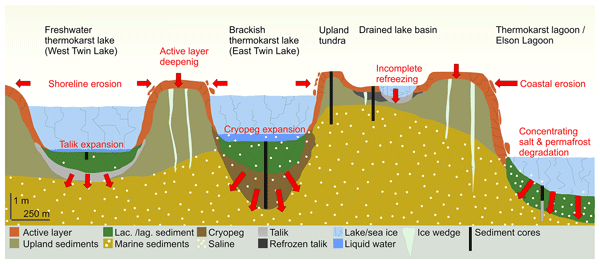
Abstract. In Arctic coastal lowland regions such as northernmost Alaska, thermokarst landscapes are often underlain by saline marine deposits, a factor frequently overlooked when assessing permafrost thaw risks. To evaluate the influence of thaw and salinity on organic matter degradation and landscape dynamics, we analyzed six sediment cores from representative landforms near Utqiaġvik (Barrow Peninsula, Alaska) using a multiproxy, carbon-focused approach, with emphasis on n-alkane biomarkers. Undisturbed tundra uplands contained well-preserved, organic-rich Holocene sediments (~140 cm thick) overlying brackish Lateglacial deposits, indicating the presence of saline permafrost. Thermokarst lake subsidence into these substrates led to enhanced carbon degradation, as reflected by lower n-alkane carbon preference index (CPI) values. While West Twin Lake talik sediments exhibited brackish porewater, East Twin Lake sediments were characterized by predominantly saline porewater, indicating the presence of a cryopeg driven by salt-induced thaw-point depression. Lagoonal environments, receiving both terrestrial and lacustrine inputs, accumulate sediments under unfrozen hypersaline conditions, presenting a high potential for organic carbon degradation. Carbon proxy signatures statistically distinguish perennially frozen uplands, unfrozen lakes, refrozen drained lake basins, and lagoonal settings. Our results demonstrate that salt-bearing deposits, as found in all investigated sites, are vulnerable to active layer deepening, talik and cryopeg formation, and shoreline erosion. These processes accelerate organic matter degradation and alter landscape trajectories. Our study underscores the need to better understand the role of saline permafrost in Arctic coastal lowlands and its broader implications under ongoing climate change.
Competing interests: At least one of the (co-)authors is a member of the editorial board of Biogeosciences. The peer-review process was guided by an independent editor, and the authors also have no other competing interests to declare.
Publisher's note: Copernicus Publications remains neutral with regard to jurisdictional claims made in the text, published maps, institutional affiliations, or any other geographical representation in this paper. While Copernicus Publications makes every effort to include appropriate place names, the final responsibility lies with the authors. Views expressed in the text are those of the authors and do not necessarily reflect the views of the publisher.-
Notice on discussion status
The requested preprint has a corresponding peer-reviewed final revised paper. You are encouraged to refer to the final revised version.
-
Preprint
(1549 KB)
-
Supplement
(443 KB)
-
The requested preprint has a corresponding peer-reviewed final revised paper. You are encouraged to refer to the final revised version.
- Preprint
(1549 KB) - Metadata XML
-
Supplement
(443 KB) - BibTeX
- EndNote
- Final revised paper


Journal article(s) based on this preprint
Interactive discussion
Status: closed
-
RC1: 'Comment on egusphere-2025-3727', Anonymous Referee #1, 12 Dec 2025
- AC1: 'Reply on RC1', Fabian Seemann, 08 Jan 2026
-
RC2: 'Comment on egusphere-2025-3727', Anonymous Referee #2, 16 Dec 2025
The comment was uploaded in the form of a supplement: https://egusphere.copernicus.org/preprints/2025/egusphere-2025-3727/egusphere-2025-3727-RC2-supplement.pdf
- AC2: 'Reply on RC2', Fabian Seemann, 08 Jan 2026
Peer review completion


Interactive discussion
Status: closed
-
RC1: 'Comment on egusphere-2025-3727', Anonymous Referee #1, 12 Dec 2025
This study provides valuable insights into how organic matter is altered within saline permafrost sediments in Arctic Alaska—an important contribution to understanding carbon cycling and permafrost–climate feedbacks. While the dataset is strong, the manuscript would benefit from clearer explanations of the sampling design, the rationale for data grouping (Table 3), and the broader significance of saline permafrost thaw in a warming Arctic. Improved figure presentation (Figure 1) and an expanded discussion of methane and carbon dynamics in the broader climate context would further enhance the clarity and impact of the study.
- AC1: 'Reply on RC1', Fabian Seemann, 08 Jan 2026
-
RC2: 'Comment on egusphere-2025-3727', Anonymous Referee #2, 16 Dec 2025
The comment was uploaded in the form of a supplement: https://egusphere.copernicus.org/preprints/2025/egusphere-2025-3727/egusphere-2025-3727-RC2-supplement.pdf
- AC2: 'Reply on RC2', Fabian Seemann, 08 Jan 2026
Peer review completion
Journal article(s) based on this preprint
Data sets
Sediment and pore water investigations in thermokarst terrain near Utqiagvik, Alaska Fabian Seemann et al. https://doi.pangaea.de/10.1594/PANGAEA.983965
n-Alkane biomarker, carbon, nitrogen and d13C data from the Barrow Peninsula (northern Alaska) before and after a one-year long incubation experiment Fabian Seemann et al. https://doi.pangaea.de/10.1594/PANGAEA.983966
Viewed
| HTML | XML | Total | Supplement | BibTeX | EndNote | |
|---|---|---|---|---|---|---|
| 12,447 | 1,327 | 269 | 14,043 | 435 | 327 | 294 |
- HTML: 12,447
- PDF: 1,327
- XML: 269
- Total: 14,043
- Supplement: 435
- BibTeX: 327
- EndNote: 294
Viewed (geographical distribution)
| Country | # | Views | % |
|---|
| Total: | 0 |
| HTML: | 0 |
| PDF: | 0 |
| XML: | 0 |
- 1

Michael Zech
Maren Jenrich
Guido Grosse
Benjamin M. Jones
Claire Treat
Lutz Schirrmeister
Susanne Liebner
Jens Strauss
The requested preprint has a corresponding peer-reviewed final revised paper. You are encouraged to refer to the final revised version.
- Preprint
(1549 KB) - Metadata XML
-
Supplement
(443 KB) - BibTeX
- EndNote
- Final revised paper
This study provides valuable insights into how organic matter is altered within saline permafrost sediments in Arctic Alaska—an important contribution to understanding carbon cycling and permafrost–climate feedbacks. While the dataset is strong, the manuscript would benefit from clearer explanations of the sampling design, the rationale for data grouping (Table 3), and the broader significance of saline permafrost thaw in a warming Arctic. Improved figure presentation (Figure 1) and an expanded discussion of methane and carbon dynamics in the broader climate context would further enhance the clarity and impact of the study.