
the Creative Commons Attribution 4.0 License.
the Creative Commons Attribution 4.0 License.
 | 06 Oct 2025
Bias-corrected UKCP18 Convection-Permitting Model Projections for England
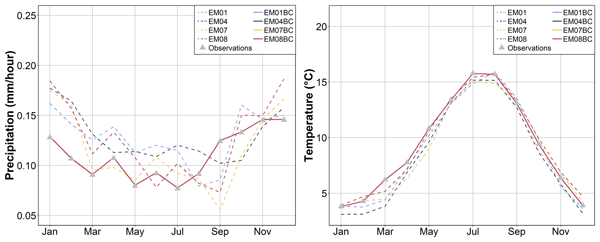
Abstract. The UKCP18 Convection-Permitting Model (CPM) provides the latest high-resolution climate projections for the UK. Compared with regional climate model projections, the CPM projections are more capable of simulating small-scale atmospheric convection particularly during extreme weather events such as intense rainfall and localized storms. However, systematic biases still exist in these projections. To improve the reliability of these projections, bias correction is crucial. In this study, we applied a quantile mapping (QM) method to correct hourly precipitation and daily temperature for four selected ensemble members (EM01, EM04, EM07, EM08) of the UKCP18-CPM for England. The raw UKCP18-CPM simulations exhibit wet precipitation biases, particularly in northern England, with annual mean biases ranging from 4.6 % to 18.3 %, and cool temperature biases, with annual mean biases from −0.87 °C to 0.02 °C. Bias correction substantially improved agreement with observational datasets, increasing R² values for the 95th percentile of hourly precipitation from 0.80–0.88 to 0.98 and achieving near-perfect alignment (R² = 1) for temperature extremes. Future projections for the 2070s indicate notable increases in annual maximum precipitation by 25.1–39.1 % and mean daily temperature by 3.1 °C to 4.5 °C, highlighting the potential for more intense climate-related events. These results emphasize the effectiveness of bias correction in reducing model biases and improving the reliability of the CPM climate projections, thereby supporting more reliable future high-resolution climate and hydrological impact assessments in England.
Competing interests: At least one of the (co-)authors is a member of the editorial board of Hydrology and Earth System Sciences. The peer-review process was guided by an independent editor, and the authors also have no other competing interests to declare.
Publisher's note: Copernicus Publications remains neutral with regard to jurisdictional claims made in the text, published maps, institutional affiliations, or any other geographical representation in this paper. While Copernicus Publications makes every effort to include appropriate place names, the final responsibility lies with the authors. Views expressed in the text are those of the authors and do not necessarily reflect the views of the publisher.-
Notice on discussion status
The requested preprint has a corresponding peer-reviewed final revised paper. You are encouraged to refer to the final revised version.
-
Preprint
(4411 KB)
-
The requested preprint has a corresponding peer-reviewed final revised paper. You are encouraged to refer to the final revised version.
- Preprint
(4411 KB) - Metadata XML
- BibTeX
- EndNote
- Final revised paper


Journal article(s) based on this preprint
Interactive discussion
Status: closed
-
RC1: 'Comment on egusphere-2025-3717', Anonymous Referee #1, 08 Dec 2025
- AC1: 'Reply on RC1', Yi He, 12 Mar 2026
-
RC2: 'Comment on egusphere-2025-3717', Anonymous Referee #2, 31 Jan 2026
The paper proposes the bias correction (BC) of precipitation and temperature for 4 members from the convection-permitting simulations over UK (UKCP18-CPM), based on gridded observation products. Quantification of biases are presented for average and “extreme” magnitudes, at annual and seasonal scale, before and after correction, evidencing over- or underestimation depending on the members, the variable considered, the region in uk. The future change in precipitation and temperature is then presented, based on the bias corrected simulations, finding a general increase extreme precipitation (Annual Maxima) but moderate change on annual totals, and increase in temperatures.
The paper is generally well written with clear figures, presenting a topic (bias correction of climate models for precipitation and temperature) which is of interest for the hydrological community. Anyway, I think there are some major weakness that need to be addressed before publication, particularly on the novelty, the analyzed domain, the future change from raw and corrected simulations, the discussion section.
I list below my major concerns, and then bullet points on more specific/minor comments.
1) the novelty of this work should be better highlighted, in the introduction and discussion. Considering that methodology is based on already existing approaches, author should state more clearly why this study is relevant.
2) I find not clear motivation for limiting the analysis based on catchments (any hydrological modelling is applied here) instead of whole UK, which I believe could be more relevant. I strongly suggest to expand the study domain, and completely change section 2.1 and figure 1 (why flow gauges are shown?)
3) I suggest to compare also future changes based on raw simulations with those from bias corrected ones, to show/discuss the impact of bias correction on projected changes
4) No clear why bias on extremes is shown on P95, and changes are shown for Annual Maxima. I suggest to also show biases on AM (at least in supplementary).
4) Discussion is more a summary of results (all lines from 407 to 434!), with no explanation/interpretation of your findings (bias and change) and very poor comparison with other works (just a few sentences based on studies using the same models). And on the choice/impact of the specific BC method with respect of others. Some example references for biases: https://doi.org/10.1016/j.jhydrol.2025.133324; https://doi.org/10.1007/s00382-021-05708-w; https://doi.org/10.1007/s00382-022-06593-7; for future changes: https://doi.org/10.1029/2024EF005185; https://doi.org/10.1007/s00382-021-05657-4; ….
- line 39-45: maybe better after line 32, where the different models (GCM – RCM) are presented
- line 90: no diurnal cycle for temperature if you sue daily values!
- from line 161: In this section I find some repetitions of information contained in 2.2.1. Consider a careful re-reading for optimizing
- lines 169-174. No useful to have all these details on computational cost.
- Line 230-233: redundant sentences.
- Line 237: no clear to me why a 3h moving window; precipitation is intermittent and variable in time, not with “continuous variations” as for temperature
- Line 237: 24 unique correction factors … per month?
- Line 246; “precipitation biases” … on which prec. amount? Seasonal total?
- Line 262: already said at line 259-260
- Figure 2b: maybe better %bias also for event number; add mean as done for panel b. I suggest to add also a metric for the ranges in the domain (e.g. st.dev or iqr) for all panels. I suggest to use different colors than red/blue for the color bar, because it is confounding to have then red/blue in figure 3 for opposite biases
- Line 278-279: why to put EM08 separated? Just mention in the sentence before that the range is -0.87 +0.02, with 3 out of 4 models with negative mean bias.
- Line 282: “more pronounced” …based on mean values, this is no true for 3 models …
- Lin 291-294: merge sentences, expressing same concepts
- Lin 324: “unrealistic fluctuations” … precipitation is intermittent !
- Figure 5: average hourly precipitation?
- From line 332: I suggest to also report the %bias for the 95th percentiles as made in the previous section
- Figure 6 second row: Logical order of violin plot is like the legend: obs-raw-corrected
- Line 350-354: I suggest to shorten
- Figure 8: consider to add as 3rd row in figure 7, as figure 6 (considering also the very short description of this figure)
- Figure 9-10-11: add mean change and a metric of range, in each panel; color bar for temperature doesn’t allow to distinguish different changes
- Line 453-439: already said previously in the paper.
- Useless table A! with information of catchments of any interest in this study.
Citation: https://doi.org/10.5194/egusphere-2025-3717-RC2 - AC2: 'Reply on RC2', Yi He, 12 Mar 2026
Peer review completion


Interactive discussion
Status: closed
-
RC1: 'Comment on egusphere-2025-3717', Anonymous Referee #1, 08 Dec 2025
General Comments:
- The paper describes the method used to empirically quantile map hourly rainfall and daily temperature from the UKCP18 CPM model using observed datasets. The article is well presented and very clearly described, enabling readers to understand the underlying methods and reasoning with relative ease.
- Some additional content would improve the justification of the method – specifically the impact of using the bias controlled dataset relative to the original. This update should be relatively simple and not significantly add to the length of the paper. The paper also alludes to river catchments – it should be stated why this is as it is otherwise out of context.
- The purpose of the paper should also be stated more clearly from the abstract and introduction. Is the paper there to develop a method, to build a dataset for others to use, to demonstrate the inadequacy of the data in its raw form, or to demonstrate the importance of quantile mapping. Whichever the motivation, some additional content is required – either clearly stating that this approach is new and how others can use it, stating within the article where the data can be found and how it can be used, clearly stating that the raw data should not be used for the authors purpose, or by demonstrating more directly the impact of the BC on the future datasets.
There are several additional comments/queries/suggestions, but all are minor edits and do not require any amount of additional work. While not ground breaking (or intending to be), this is a good clear paper of direct interest to those in this field and looking to use bias correction.
Specific Comments
- Abstract – is the purpose of this paper to simply present a dataset? Or to present a method? Or to present findings on the biases? Unclear. Also worth stating around line 91. The paper needs a very minor reframing of its purpose (maybe only a sentence or two) and a bit of additional material to complete that purpose. See general comment.
- Line 48 – ‘…the ensemble generally underestimates values across the mean, cold, and hot tails of the distribution’ – is that correct? This sounds like it just underestimates everything. (Though I suppose it is possible that it over estimates the shoulders and underestimates the middle/ends).
- Line 76 – what distributions? Perhaps a timescale or few extra words would help. E.g. ‘distribution of rainfall within the period’.
- Line 87 – What is the temporal resolution of the ‘1 km HadUK-Grid dataset’?
- Section 2.1 is the first mention of catchments and hydrology – until this point I thought that this was a climate paper, but maybe it will become a hydrology paper. Introduce the use of this data being for hydrological purposes earlier in the paper (and abstract?) so that this is not out of place. Looking forward there does not seem to be future mention of hydrology/rivers – why was this process only done for some river catchments – would it not have been simpler, and more useful to others, to have conducted the processing nationally rather than for such vocation specific areas? Justify/explain this or consider presenting data for whole of England. If the purpose of this paper is to provide a dataset then it would probably be more useful to process all of England and to present it alongside a table of which catchments have missing data.
- Section 2.1 – Please also explain why only England (if there is a reason). Consider whether to say England and Wales as you have ‘English’ catchments that cover much of Wales.
- Line 107 – CAMELS-GB is mentioned? Are you taking other parameters from this other than catchment outlines? If not then NRFA is perhaps a more appropriate reference for these, or consider stating ‘… catchment boundaries taken from the CAMELS-GB dataset…’).
- Figure 1 - Would be interesting to also see which catchments were removed due to issues with either human or rainfall data or temperature data, but perhaps surplus.
- Line 127 – what strand are the CPMs? Or is this a different release/dataset?
- Line 224 – ‘As Reiter et al. (2018) pointed out, QM can correct the distribution’… Is this just for a certain period? I.e. ‘…annual QM can correct…’. Or ‘QM, taking the period as a whole, can correct…’
- Section 2.3.2 – Presumably you calculate the two CDFs using the baseline period for 1990-2000 and then apply the mapping function to the whole period of the modelled data? So that the baseline periods have the same relative and absolute distributions and the 2000+ period has the same relative values (i.e. distribution). If so, state that the CDFs are made using only the 1990-2000 period and that mapping is applied to the whole period.
- Does using DQM have a significant effect?
- Line 255 – not sure I agree with ‘…although the spatial differentiation between north and south is relatively moderate on an annual basis.’ There seems to be a clear difference in north and south biases. Is relatively moderate high or low?
- Line 278 – Unsure whether treating EM08 as a separate, instead of part of the same continuous range is odd…
- Figure 5 – Where are the thin yellow lines on the plot? These are presumably buried beneath the thicker yellow line. Would it be simpler to remove these and explain that a single line represents all EMs? If not then please state whether the thin yellows are beneath the red of the thick yellow.
- Line 323 – You say that the 3hr window is used to remove unrealisable observations – is this due to a data accuracy/ error? If so, does the large number of values used in each hourly calculation (10 years x 30 days?) not drown out the impact of these naturally?
- Figure 6 - What causes banding in Observations? Limit of resolution in recording measurements?
- Line 358 – This ‘almost perfect’ match should be treated as a mathematical function as a result of the method of mapping the modelled to the observed, rather than a success or proof that it is working well. Similar comment for line 361 – need to be careful using the word ‘correct’ – it should be used to mean ‘adjust’ rather than ‘right’.
- Figures 10 and 11 – Colour scale is difficult to use – figures are interpreted as ‘red’ – consider adding another colour into the colour bar to differentiate between the temperature increases. Or consider cropping colours to 0-10 degrees if there is no cooling.
- Line 469 – If there was a seasonal pattern in temperature bias then please include that or state otherwise earlier in the text.
- Conclusion point 2 – as mentioned earlier – the bias corrected data may be ‘better’ and more fit for purpose than the original, however you are treading the line of making it sounds as if the alignment of BC data to the observations is proof that this is the case, when this is simply a direct result of remapping the UKCP18 data. I.e. Doubling a UKCP18 temperature 5°C and matching the observation of 10°C does not prove that the bias controlled data is better, only that the process is working as it should. Consider rephrasing and the appropriateness of words/phrases like ‘marked improvement’ and ‘corrected’ rather than ‘bias corrected’. Perhaps ‘After bias correction, both precipitation and temperature simulations aligned well with observational data. Monthly precipitation and temperature biases were substantially reduced, with bias corrected outputs closely following observed monthly patterns. The diurnal cycle of bias corrected precipitation captured the variability and magnitude of observed precipitation across most hours of the day. The 95th percentile (P95) of hourly precipitation and temperature extremes (T95) matched observational datasets after bias correction demonstrating that the method had been correctly applied across the dataset, including the tails.’
- Discussion – If possible, I would like to see a little more detail on how this compares with other bias corrections, even if these are the RCMs rather than CPMs. The content on comparison is limited other than saying that there is general agreement with Robinson (2023) and Kendon (2019b). It would be interesting to hear whether the similarities are in the patterns, or the values themselves and if there are any differences and why this may be. That said, it is difficult to compare between datasets and so this may be difficult to do in depth or in a fully quantitative manner.
- Discussion – The paper ticks off all of the expected content apart from a comparison with unbiased corrected futures. In my view this would demonstrate the need / impact of the bias correction and demonstrate to others that they need to employ (or at least consider) methods such as this before using the raw data. This would also make the paper more applicable/relevant and increase its impact. The difference in raw/BC data is discussed with regard to the reference period, however this is the simple part as, simply due to the method, we expect the BC data to align with the observations. I would like to see a few plots of future rainfall/temperature with and without BC. Perhaps an annual timeseries for the 2035 or 2075 showing the difference, or a seasonal plot of the impact as this has clear consequences for the hydrological/agricultureal uses mentioned in the paper. Seasonal differences were discussed in the text in relation to biases in the reference period, but a direct future example would be more impactful. The referenced Robinson et al. (2023) shows seasonal breakdowns, clearly demonstrating the seasonality of the impact of bias control. Another approach could be to add a column to the mapped figures with EMean Raw, showing the un-bias corrected data.
- Discussion on the limitations of BC in general would be benificial if possible. I.e. does bias correction detract from the point of using a climate model in the first place?
Technical Corrections:
- Line 33 – ‘…provide the…’
- Line 42 – What has been widely applied? CMPs (presumably not UKCP18-CPM)
- Line 54 – ‘while in summer it shows spatial variability, being too wet in the north and too dry in the south’. Would delete ‘shows spatial variability’, as that is good, being too wet/dry is the issue.
- Line 75 – ‘applies’ -> ‘applied’ … ‘cannot’ -> ‘could not’
- Line 78 – Comma before ‘which’.
- Line 83 – Incorrect ‘.’ before integrates.
- Line 88 – Faghih reference seems slightly out of place – perhaps better with mention of diurnal cycle in paragraph above.
- Line 96 – is the driest member EM01 or EM04? Unclear from list arrangement.
- Line 108 – Confusingly long bracketed sentence, consider making it its own sentence.
- Line 109 – Typo in ‘datasetshereafter’.
- Line 112 – Unsure of purpose of giving mean annual rainfall/temp.
- Figure 1 – Reference data sources and resolution for elevation and catchment outlines. Consider rounding Elevation upper bound to 1000m.
- Line 122 - Duplicated? ‘Strand 3 is a new perturbed parameter ensemble (PPE) of regional climate model (RCM) projections. It introduces a new ensemble consisting of 12 RCM simulations, which form a PPE of RCM variants derived from 12 out of the 15 GC3.05-PPE simulations (Murphy et al., 2018).’ à Strand 3 is a new perturbed parameter ensemble (PPE) of 12 regional climate model (RCM) projections derived from 12 of the 15 GC3.05-PPE simulations (Murphy et al., 2018).
- Line 163 – Sect. should presumably be ‘Section’ as in the text, not brackets.
- Line 174 – are the sizes correct? 576 GB of inputs to only 57 GB of outputs seems unlikely…
- Line 246 – Should say Figure 2, not 2a. Should say ‘…and the change in the number of events exceeding in the UKCP18 data relative to the CEH-GEAR data’.
- Figure 2 may benefit from actual figure titles rather than equations. I.e. Percentage change in precipitation bias (%).
- Figure 2b – The duration over which the sum is calculated should be emphasised – you do state that this is for the reference period, but I missed this on first reading and it could be taken as annual values in this period by a reader flicking through. Consider stating ‘…GEAR1hr over the 10-year reference period…’.
- Figure 2 – A thin GB outline would make the figure geography clearer, if it does not make the maps to cluttered.
- Figure 3 – Same comments as for figure 2.
- I do not think there should be a space between a temperature and the degrees symbol.
- Line 321 – Should ‘darker’ be ‘thicker’? They look to be the same colour, but different thicknesses.
- Figure 6 – Backwards order of data – I would present chronologically (black, light blue, dark blue from left to right). Minor point. Would also mean that order in figure matches order in caption. And order in Fig 8.
- Line 350 – Does 5th percentile use all values beneath this threshold, or just those on it? I was presuming that 95th percentile used all values on and above that threshold…
- Figure 7/8 – ‘bias-corrected UKCP18-CPM BC’ does not need ‘BC’ to match other figures.
- Figure 9 – would be clearer to mention Annual Total and Annual Maximum in caption so that it is clear what abbreviations mean in plot.
- Line 378 – ‘mostly positive’ sounds like a good thing, when it is meant as an increase.
- Line 397 – ‘minimum,by’ has missing space.
- Line 454 – Future research… does not read correctly. Remove ‘that’ from ‘that would’?
- Line 477 – ‘increasesin’ has missing space.
- Does the paper address relevant scientific questions within the scope of HESS?
Yes - Does the paper present novel concepts, ideas, tools, or data?
Somewhat - the paper uses existing methods but applies them to data that has not yet been publically bias controlled, and which will be useful for the community (both in terms of the example method and the dataset). - Are substantial conclusions reached?
Conclusions are in line with existing papers, but demonstrate that they also apply here. - Are the scientific methods and assumptions valid and clearly outlined?
Yes. - Are the results sufficient to support the interpretations and conclusions?
Yes. - Is the description of experiments and calculations sufficiently complete and precise to allow their reproduction by fellow scientists (traceability of results)?
Yes - Do the authors give proper credit to related work and clearly indicate their own new/original contribution?
Yes - Does the title clearly reflect the contents of the paper?
Yes - Does the abstract provide a concise and complete summary?
Yes - Is the overall presentation well-structured and clear?
Yes - Is the language fluent and precise?
Yes - Are mathematical formulae, symbols, abbreviations, and units correctly defined and used?
Yes - Should any parts of the paper (text, formulae, figures, tables) be clarified, reduced, combined, or eliminated?
Yes - largely minor comments above. - Are the number and quality of references appropriate?
Yes, though some additional discussion on other work has been requested. - Is the amount and quality of supplementary material appropriate?
Yes
Citation: https://doi.org/10.5194/egusphere-2025-3717-RC1 - AC1: 'Reply on RC1', Yi He, 12 Mar 2026
-
RC2: 'Comment on egusphere-2025-3717', Anonymous Referee #2, 31 Jan 2026
The paper proposes the bias correction (BC) of precipitation and temperature for 4 members from the convection-permitting simulations over UK (UKCP18-CPM), based on gridded observation products. Quantification of biases are presented for average and “extreme” magnitudes, at annual and seasonal scale, before and after correction, evidencing over- or underestimation depending on the members, the variable considered, the region in uk. The future change in precipitation and temperature is then presented, based on the bias corrected simulations, finding a general increase extreme precipitation (Annual Maxima) but moderate change on annual totals, and increase in temperatures.
The paper is generally well written with clear figures, presenting a topic (bias correction of climate models for precipitation and temperature) which is of interest for the hydrological community. Anyway, I think there are some major weakness that need to be addressed before publication, particularly on the novelty, the analyzed domain, the future change from raw and corrected simulations, the discussion section.
I list below my major concerns, and then bullet points on more specific/minor comments.
1) the novelty of this work should be better highlighted, in the introduction and discussion. Considering that methodology is based on already existing approaches, author should state more clearly why this study is relevant.
2) I find not clear motivation for limiting the analysis based on catchments (any hydrological modelling is applied here) instead of whole UK, which I believe could be more relevant. I strongly suggest to expand the study domain, and completely change section 2.1 and figure 1 (why flow gauges are shown?)
3) I suggest to compare also future changes based on raw simulations with those from bias corrected ones, to show/discuss the impact of bias correction on projected changes
4) No clear why bias on extremes is shown on P95, and changes are shown for Annual Maxima. I suggest to also show biases on AM (at least in supplementary).
4) Discussion is more a summary of results (all lines from 407 to 434!), with no explanation/interpretation of your findings (bias and change) and very poor comparison with other works (just a few sentences based on studies using the same models). And on the choice/impact of the specific BC method with respect of others. Some example references for biases: https://doi.org/10.1016/j.jhydrol.2025.133324; https://doi.org/10.1007/s00382-021-05708-w; https://doi.org/10.1007/s00382-022-06593-7; for future changes: https://doi.org/10.1029/2024EF005185; https://doi.org/10.1007/s00382-021-05657-4; ….
- line 39-45: maybe better after line 32, where the different models (GCM – RCM) are presented
- line 90: no diurnal cycle for temperature if you sue daily values!
- from line 161: In this section I find some repetitions of information contained in 2.2.1. Consider a careful re-reading for optimizing
- lines 169-174. No useful to have all these details on computational cost.
- Line 230-233: redundant sentences.
- Line 237: no clear to me why a 3h moving window; precipitation is intermittent and variable in time, not with “continuous variations” as for temperature
- Line 237: 24 unique correction factors … per month?
- Line 246; “precipitation biases” … on which prec. amount? Seasonal total?
- Line 262: already said at line 259-260
- Figure 2b: maybe better %bias also for event number; add mean as done for panel b. I suggest to add also a metric for the ranges in the domain (e.g. st.dev or iqr) for all panels. I suggest to use different colors than red/blue for the color bar, because it is confounding to have then red/blue in figure 3 for opposite biases
- Line 278-279: why to put EM08 separated? Just mention in the sentence before that the range is -0.87 +0.02, with 3 out of 4 models with negative mean bias.
- Line 282: “more pronounced” …based on mean values, this is no true for 3 models …
- Lin 291-294: merge sentences, expressing same concepts
- Lin 324: “unrealistic fluctuations” … precipitation is intermittent !
- Figure 5: average hourly precipitation?
- From line 332: I suggest to also report the %bias for the 95th percentiles as made in the previous section
- Figure 6 second row: Logical order of violin plot is like the legend: obs-raw-corrected
- Line 350-354: I suggest to shorten
- Figure 8: consider to add as 3rd row in figure 7, as figure 6 (considering also the very short description of this figure)
- Figure 9-10-11: add mean change and a metric of range, in each panel; color bar for temperature doesn’t allow to distinguish different changes
- Line 453-439: already said previously in the paper.
- Useless table A! with information of catchments of any interest in this study.
Citation: https://doi.org/10.5194/egusphere-2025-3717-RC2 - AC2: 'Reply on RC2', Yi He, 12 Mar 2026
Peer review completion
Journal article(s) based on this preprint
Data sets
Bias-Corrected UKCP18 Convection-Permitting Model (CPM) Projections of Precipitation and Temperature Using Non-Parametric Quantile Mapping Qianyu Zha et al. https://zenodo.org/records/16213003
Viewed
| HTML | XML | Total | BibTeX | EndNote | |
|---|---|---|---|---|---|
| 1,010 | 788 | 96 | 1,894 | 83 | 80 |
- HTML: 1,010
- PDF: 788
- XML: 96
- Total: 1,894
- BibTeX: 83
- EndNote: 80
Viewed (geographical distribution)
| Country | # | Views | % |
|---|
| Total: | 0 |
| HTML: | 0 |
| PDF: | 0 |
| XML: | 0 |
- 1
Qianyu Zha

Timothy J. Osborn
Nicole Forstenhäusler
The requested preprint has a corresponding peer-reviewed final revised paper. You are encouraged to refer to the final revised version.
- Preprint
(4411 KB) - Metadata XML
General Comments:
There are several additional comments/queries/suggestions, but all are minor edits and do not require any amount of additional work. While not ground breaking (or intending to be), this is a good clear paper of direct interest to those in this field and looking to use bias correction.
Specific Comments
Technical Corrections:
Yes
Somewhat - the paper uses existing methods but applies them to data that has not yet been publically bias controlled, and which will be useful for the community (both in terms of the example method and the dataset).
Conclusions are in line with existing papers, but demonstrate that they also apply here.
Yes.
Yes.
Yes
Yes
Yes
Yes
Yes
Yes
Yes
Yes - largely minor comments above.
Yes, though some additional discussion on other work has been requested.
Yes