
the Creative Commons Attribution 4.0 License.
the Creative Commons Attribution 4.0 License.
 | 08 Oct 2025
The 2022–2023 snow drought in the Italian Alps doubled glacier contribution to summer streamflow
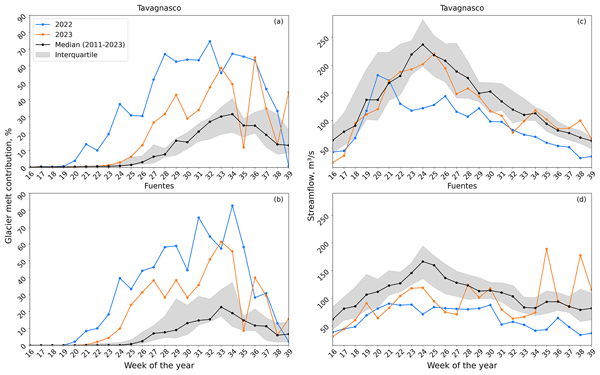
Abstract. We quantified the role of glaciers in mitigating snow-drought impacts on downstream streamflow during the severe 2022- 2023 event in the Italian Alps. In order to do so, we compared glacier-melt contribution to streamflow during these years with the 2011-2023 historical period in two catchments, Dora Baltea (Aosta Valley) and Adda (Lombardy). We employed spatially distributed estimates of glacier melt, Snow Water Equivalent (SWE), air temperature and total precipitation over glaciers from an operational cryospheric model (S3M Italy), and compared these estimates with downstream observations of streamflow at the closure sections of both catchments. Results showed a severe snow water equivalent deficit over glaciers across both catchments and both years (between ∼ -45 % at 4000 m in 2022 and ∼ -75 % at 2000 m a.s.l. during both years), which was largely driven by anomalous air temperatures and seasonal-precipitation patterns (up to +2–3 °C and -73 %, respectively). Air-temperature anomalies displayed a clear signature of orographic-dependent warming, with anomalies at 4000 m a.s.l. that were 1 to 1,5 °C higher than at 2000 m a.s.l.. Glacier contribution to streamflow doubled to tripled during these snow droughts in both catchments, a process that manifested itself through four mechanisms: an earlier-than-usual onset of the glacier melt season, an intensification of glacier melt contribution to streamflow, an earlier-than-usual seasonal peak in glacier melt contribution, and an extension of the glacier melt season. Still, glacier melt contribution to streamflow remained highly sensitive to short-term meteorological events, such as a sudden drop of temperatures, as well as early/late snowfalls. These results highlight the critical role of glacier melt in maintaining streamflow during severe droughts and emphasize the need to integrate glacier dynamics into water management strategies for alpine areas facing increasingly frequent and intense drought events.
-
Notice on discussion status
The requested preprint has a corresponding peer-reviewed final revised paper. You are encouraged to refer to the final revised version.
-
Preprint
(26713 KB)
-
The requested preprint has a corresponding peer-reviewed final revised paper. You are encouraged to refer to the final revised version.
- Preprint
(26713 KB) - Metadata XML
- BibTeX
- EndNote
- Final revised paper


Journal article(s) based on this preprint
Interactive discussion
Status: closed
-
RC1: 'Comment on egusphere-2025-3705', Anonymous Referee #1, 04 Nov 2025
- AC1: 'Reply on RC1', Martina Leone, 26 Jan 2026
-
RC2: 'Comment on egusphere-2025-3705', Anonymous Referee #2, 09 Dec 2025
- AC2: 'Reply on RC2', Martina Leone, 26 Jan 2026
Peer review completion


Interactive discussion
Status: closed
-
RC1: 'Comment on egusphere-2025-3705', Anonymous Referee #1, 04 Nov 2025
This manuscript provides a timely and well-structured analysis of how extreme snow droughts influenced glacier melt and streamflow in two Alpine catchments. Using outputs from the S3M Italy model and observational data, the authors quantify glacier contributions during the 2022–2023 events and identify four mechanisms driving their enhancement. The study is clearly written, methodologically sound, and supported by robust data, offering valuable insights into the compensatory role of glacier melt during concurrent heat and snow deficits. Nonetheless, several aspects require clarification and further improvement before publication.
- Although S3M Italy has been validated for snow processes, the glacier-melt component has not undergone a rigorous uncertainty assessment. The authors are suggested to quantify model uncertainty by: Providing a sensitivity analysis for key parameters (e.g., degree-day factor, radiation coefficients), Discussing potential errors due to spatial resolution mismatch between model pixels and stake measurements.
- The use of static glacier outlines (RGI v6.0) likely overestimates current glacierized area, especially during 2022–2023. The manuscript qualitatively acknowledges this, but a quantitative sensitivity test should be added to estimate its impact on meltwater contribution and streamflow ratios.
- Both study basins are affected by hydropower operations. Although the authors argue that regulation effects are minor, this statement would benefit from more evidence. A short discussion on how reservoir storage timing may alter glacier-melt signals at weekly scales would strengthen the argument.
- The four mechanisms (earlier onset, intensified contribution, earlier peak, prolonged season) are clearly described, but their physical interconnections remain underexplored. I recommend including a conceptual schematic illustrating the causal chain between snow drought, temperature anomalies, snow cover loss, and glacier melt timing.
- To highlight the novelty of the results, the authors should discuss how these findings compare to similar studies in other Alpine or mountain regions. This would clarify whether the doubling/tripling of glacier contribution is typical or exceptional in a broader context.
- The Discussion section would benefit from slight condensation to avoid repetition of results.
- Please specify the spatial resolution and vertical accuracy of the DEM used for S3M Italy, and discuss its implications for high-elevation modeling accuracy.
Citation: https://doi.org/10.5194/egusphere-2025-3705-RC1 - AC1: 'Reply on RC1', Martina Leone, 26 Jan 2026
-
RC2: 'Comment on egusphere-2025-3705', Anonymous Referee #2, 09 Dec 2025
- AC2: 'Reply on RC2', Martina Leone, 26 Jan 2026
Peer review completion
Journal article(s) based on this preprint
Viewed
| HTML | XML | Total | BibTeX | EndNote | |
|---|---|---|---|---|---|
| 3,782 | 4,284 | 294 | 8,360 | 191 | 250 |
- HTML: 3,782
- PDF: 4,284
- XML: 294
- Total: 8,360
- BibTeX: 191
- EndNote: 250
Viewed (geographical distribution)
| Country | # | Views | % |
|---|
| Total: | 0 |
| HTML: | 0 |
| PDF: | 0 |
| XML: | 0 |
- 1
Martina Leone

Francesco Avanzi
Umberto Morra Di Cella
Simone Gabellani
Edoardo Cremonese
Michel Isabellon
Paolo Pogliotti
Riccardo Scotti
Andrea Monti
Luca Ferraris
Roberto Colombo
The requested preprint has a corresponding peer-reviewed final revised paper. You are encouraged to refer to the final revised version.
- Preprint
(26713 KB) - Metadata XML
This manuscript provides a timely and well-structured analysis of how extreme snow droughts influenced glacier melt and streamflow in two Alpine catchments. Using outputs from the S3M Italy model and observational data, the authors quantify glacier contributions during the 2022–2023 events and identify four mechanisms driving their enhancement. The study is clearly written, methodologically sound, and supported by robust data, offering valuable insights into the compensatory role of glacier melt during concurrent heat and snow deficits. Nonetheless, several aspects require clarification and further improvement before publication.