
the Creative Commons Attribution 4.0 License.
the Creative Commons Attribution 4.0 License.
 | 28 Aug 2025
Sustainable risk management of trouble spots caused by heavy rainfall events: Citizen Science app and data analytics for residents and authorities
Abstract. To address the increasing threat of heavy rainfall events the FloReST (Urban Flood Resilience – Smart Tools) project focuses on the identification and prediction of emergency flow paths in urban areas and enhancing risk management and communication. The project developed a Citizen Science app to document and report pluvial flood risks in urban areas due to the fact that conventional flood protection has so far focused mainly on fluvial hazards. The population is involved in sustainable risk minimisation through the active use of the app and local risk awareness. Additionally, the app includes educational functions through a user guidance on categorizing pluvial hazards and taking preventive measures. The app is complemented by a Geo Data Warehouse, which enables authorities to analyse and visualise the data transmitted by users via customisable dashboards. Although there are still some technical limitations, such as limited offline functionality and inaccuracies in the use of Global Navigation Satellite Systems, these may be addressed in future research. Thanks to its open-source design, the system remains scalable and can be adapted to other regions worldwide. Overall, the Citizen Science app and Geo Data Warehouse form an innovative, participatory tool that improves the resilience of cities to climate change through inclusive, data-driven risk management.
-
Notice on discussion status
The requested preprint has a corresponding peer-reviewed final revised paper. You are encouraged to refer to the final revised version.
-
Preprint
(3917 KB)
-
The requested preprint has a corresponding peer-reviewed final revised paper. You are encouraged to refer to the final revised version.
- Preprint
(3917 KB) - Metadata XML
- BibTeX
- EndNote
- Final revised paper


Journal article(s) based on this preprint
Interactive discussion
Status: closed
-
RC1: 'Comment on egusphere-2025-3702', Jonathan Paul, 05 Sep 2025
-
AC1: 'Reply on RC1', Jaqueline Hoffmann, 22 Sep 2025
We sincerely thank the reviewer for the careful reading of our manuscript and for the constructive comments, which have helped us to improve the clarity and balance of our paper. Below we provide a structured response to the main points raised.
1. Scope and project namingReviewer comment“I feel the manuscript would work better if it was agnostic to the specific research project i.e. omit all mention of FloReST except for the acknowledgements, and couch the content instead on risk management of heavy rainfall events. At the moment it reads like an introduction to FloReST (e.g. Lines 212–4; 485–6)”
Response: We will reframe the manuscript as a contribution to risk management of heavy rainfall events and reduce references to “FloReST” to the Methods and Acknowledgements sections.
Reviewer comment: “The overall concept is sound but it must be made clearer that the proposal is purely a proof-of-concept.”
Response: The manuscript will be clearly designated as a proof-of-concept study.
2. Literature breadth and global context
Reviewer comment: “The literature cited and Section 1 has a heavy German bias. I would suggest either noting down the regional focus in the title, or amending the Introduction to make it more general/global.”
Response: We will broaden the literature to an international scope and give a short introduction to the local phenomena of the Ahr flood in 2021 to to clarify the current German focus.Reviewer comment: “Several sections in the manuscript need more (or better) citations to back up statements made.”
“Citizen science needs a far more careful treatment. For instance, Bonn et al. (2002) is not an appropriate reference to back up the introductory statement of Section 2.2; you might want to have a look at Cohn (2008) or Irwin (1995) instead (full details below).”
“Two additions would greatly strengthen the citizen science discussion: (a) some mention of the need for apps to be “useful, useable, and used”, and steps that were / could be taken to ensure this; (b) more detail on the mechanics of citizen science projects, even down to potentially replacing “citizen” with “community” […]”Response: We agree and will explicitly differentiate between Citizen Science and Community Science. This distinction will be integrated into Section 2.2 to better reflect the engagement model of our app. We will broaden the literature to include international and critical contributions to Citizen/Community Science (Irwin 1995; Cohn 2008; Ballard et al. 2024).
Reviewer comment: “Section 2.3 – missing some important watery citizen science programs and initiatives, e.g. CrowdWater […]”
Response: We will also explicitly distinguish our approach from other hydrological citizen science projects such as CrowdWater, highlighting that our app serves as a municipal risk management tool focused on the identification of trouble spots.
Reviewer comment: “There is no recognition of the various negative externalities that can result from CS projects, such as lost community trust if results are not immediately forthcoming, or inaccurate / imprecise data, or zero data production altogether."
“The final paragraph of Section 2 (“… opens the possibility for various municipalities to use the project …”) is very (over?)-optimistic and elides the significant technical, political, and regulatory challenges that might stand in the way of this level of operationalisation.”
Response: Barriers of a technical, political, and regulatory nature are already described in Section 5.2.2. To provide better context, we will also incorporate general challenges and critical perspectives on Citizen and Community Science into the literature review.
3. Language and target audienceReviewer comment: “This is contradicted by having the app solely in the German language: either it must be made clear that the app is of sole relevance to Germany, or some form of language flexibility could be introduced.”
Response: We will clarify that the current prototype only supports German and emphasize the local pilot focus (including the technical implications). In addition, we will outline a planned internationalisation (English UI/language files; language toggle) for future development stages.
4. Structure and figuresReviewer comment: “I suggest that Sections 1 and 2 be merged, as the narrative (as it stands) jumps around significantly, with citizen science being introduced briefly in the Introduction, before a more detailed consideration in Section 2.”
Response: We will revise the structure of Sections 2.1 and 2.2, strengthening Section 2.2 towards Community Science.
Reviewer comment: “3–5 are just screenshots of the app? Might it not be preferable to include an additional schematic diagram of its intended operation and use?”
Response: The screenshot figures will be supplemented with two functional and use-case diagrams of the app as a municipal risk management tool:
- Current application area: identification of trouble spots (e.g. recurrent water accumulation or vulnerable infrastructure) as a preventive measure for long-term adaptation.
- Potential extended function: real-time risk communication and decision support during heavy rainfall events.
5. Minor remarksWe will incorporate all suggested corrections and revise the corresponding passages accordingly.
Conclusion
We are grateful for the reviewer’s constructive feedback. With the planned revisions, we believe the manuscript will present a clearer, more balanced, and more internationally contextualized contribution, while explicitly acknowledging both the potential and the limitations of our proof-of-concept.Citation: https://doi.org/10.5194/egusphere-2025-3702-AC1
-
AC1: 'Reply on RC1', Jaqueline Hoffmann, 22 Sep 2025
-
RC2: 'Comment on egusphere-2025-3702', Christine Yiqing Liang, 25 Sep 2025
General comments
The research describes the development of a Citizen Science app for the FloReST project and how this tool can aid residents and authorities in risk management for heavy rainfall events and associated pluvial hazards. The authors focus on the technological development of the app in the methodology and the results further elaborate on the user interface and what participants (either the residents who submit the data or the authorities that may use it) would see. The authorities see the data through the Geo Data Warehouse, which has data visualisation features and can be customised. The manuscript fits well within the scope of NHESS since the central topic is natural hazards and the journal welcomes the design, development, and validation of new tools such as the Citizen Science app. I particularly liked the connection the authors made that small-scale events like heavy rainfall connect more to personal emotions. It is essentially a psychological bridge to make climate change (which can feel overwhelming and abstract) feel real and relevant to people. Highlighting how these smaller, more personal events affect individuals is a crucial step in getting people to understand and engage with such a massive global issue. Recent flooding events in the world (like in Valencia and Texas) are a stark reminder of why this kind of research is so crucial.
Given the timeliness and significance of the research, it would be great to see the research published in NHESS. However, there are major shortcomings that will need to be addressed before publication. Mainly, it is unclear from the introduction or methodology sections which stage of implementation the FloReST project is in, and how long the Citizen Science app has been used for. It seems from the results that the Citizen Science app has been developed but not yet tested in the community yet – however, this is unclear and thus the discussion section seems to have many assertions of how the app is beneficial but no data or tangible results to back them up. When I was reading the results section, it seemed like the “results” are what the app looks like and how it can be used instead of actual data gained through thorough user testing with multiple stakeholder groups. I was not expecting this, which means that the scope of the paper could be set up better to prepare readers for what exactly is being presented from the research. The shortfalls of the manuscript could perhaps be remedied by reframing the current research as still in the prototype stage and further emphasising the scope/results as the app development/capabilities and not the citizen-collected data. In addition, the writing style is disjointed and overall writing could be improved.
Specific comments
100 I’ve explained more in the technical comments below about disjointed writing with very short paragraphs that could be merged. However, in some cases, the 1-sentence paragraphs should not be merged, but rather developed. For example, 100 is missing topic and closing sentences and there should be more examples added of how CS has been used in monitoring, especially for natural hazards since that is the focus of the research. Overall, your literature review is missing key references.
121 “In CS projects, data should be collected by participants and sent for example to authorities or researchers.” – not necessarily, there are different levels of citizen science and participation.
123 Is mD a common abbreviation for mobile devices? Is it necessary to abbreviate “mobile devices”?
138 Is this redundant information? The authors already mentioned questionnaires in an earlier paragraph.
139 The authors could refer to the specific term “gamification” here i.e. the application of game design elements.
144 The authors could also cite data quality issues here.
169 “When developing mobile apps, a distinction is made between web, native and hybrid apps.” As someone without a computer science background, these terms are quite foreign – a lot of jargon in this whole section.
237 The methods section is missing the evaluation and use of the app by citizen scientists or authorities. For example, how did the authors administer the app and the evaluation survey?
265 Good attention to privacy of personal data (but does the paper refer back to all tenets the authors presented at first in methods?)
273 Is there an option for “other” if the given types do not apply?
291 disy Cadenza introduced is explained in section 4.2 but mentioned much earlier (for example in line 235)
325 Can citizens also access this data? What happens after they submit? How do the benefits come back to them?
339 There needs to be a methodology section that links to these results.
348 Data? Evidence? Results of survey? This last section is like a methods section not a results section.
353 Discussion starts with methods and results that weren’t presented before?
371 Did the methods/results show this?
379 Where is the evidence from the data that links to this?
404 Many instances throughout the Discussion section where statements are made but not backed up by the data or the literature, for example in this paragraph.
412 The authors mention a few times that the app was used by younger age individuals but did not explain how this was implemented – i.e. was a school partner involved?
420 Where are these results in the results section?
459 Could it more likely be a data quality issue than deliberate? This is a common problem in CS.
474 It is great that the app was developed to be open source, but are there any concrete plans for sustainability of the app/program?
501 Was this mentioned in limitations or results?
Technical corrections
25 The paragraphs throughout the introduction and literature review are quite short – sometimes one sentence has its own paragraph. This makes the writing look disjointed and interrupts flow.
25-28, 44, 47, 62 The introduction and literature review sections seem to be missing references.
67, 80 Example of 1-sentence paragraphs that should be merged with the above paragraph as a closing sentence. Especially with 80, the authors write “therefore” so it should be linked with the above paragraph.
124 Missing reference.
148 The writing is awkward at times and sounds clunky and confusing. For example, check this sentence. Have someone check writing throughout.
150 The authors use inconsistent US or UK spelling, for example here sometimes words are spelled with s and sometimes z. Here “organise” is spelled the UK way with an “s”. The authors spell other words with “z” i.e. the US way. Be consistent.
185 Figure 1 in the green box says “map displan” – is this a typo?
221 Is there a reason for the switch to footnotes here versus in-text citations?
309 As in comment 150. “The color-coded dots each represent a single report, coloured according to the categorization of problem area.” – this sentence mixes both US and UK spellings of “color/colour”. Pick one style of English and be consistent.
375 Delete paragraph break after open bracket.
Citation: https://doi.org/10.5194/egusphere-2025-3702-RC2 -
AC2: 'Reply on RC2', Jaqueline Hoffmann, 07 Oct 2025
We thank the reviewer for the thorough reading of our manuscript and the constructive comments. We appreciate the positive feedback on the timeliness of our research, the relevance to NHESS, and especially the emphasis on the psychological dimension of local heavy rainfall events as a bridge to broader climate change awareness. Below, we provide our responses to the main points raised.
1. Stage of implementation and scope of resultsReviewer Comment:When I was reading the results section, it seemed like the “results” are what the app looks like and how it can be used instead of actual data gained through thorough user testing with multiple stakeholder groups. I was not expecting this, which means that the scope of the paper could be set up better to prepare readers for what exactly is being presented from the research. The shortfalls of the manuscript could perhaps be remedied by reframing the current research as still in the prototype stage and further emphasising the scope/results as the app development/capabilities and not the citizen-collected data.”
Response: We agree that the scope was not sufficiently clear. The manuscript will be explicitly framed as a proof-of-concept paper, with the results section describing the app’s functionalities and potential applications, not outcomes of large-scale user testing. We will make this distinction clear in the introduction and methodology sections and formulate the statements in the discussion more clearly.
2. Literature review and referencesReviewer Comment: „Overall, your literature review is missing key references.“
“100 I’ve explained more in the technical comments below about disjointed writing with very short paragraphs that could be merged. However, in some cases, the 1-sentence paragraphs should not be merged, but rather developed.”
Response: We will restructure the introduction and literature review into longer, more coherent paragraphs, with clear topic and closing sentences. We will add examples of CS in natural hazard monitoring (e.g. hydrology, landslides, earthquakes) and incorporate references such as Irwin (1995), Cohn (2008), Ballard et al. (2024) and relevant hydrological initiatives (CrowdWater). This will provide a stronger theoretical and international context.
3. Terminology and clarityReviewer Comment: “123 Is mD a common abbreviation for mobile devices? Is it necessary to abbreviate “mobile devices”?”
„169 „When developing mobile apps, a distinction is made between web, native and hybrid apps.” As someone without a computer science background, these terms are quite foreign – a lot of jargon in this whole section.“
“139 The authors could refer to the specific term “gamification” here i.e. the application of game design elements.”
Response: We are revising these sections linguistically and reducing technical terms. Where technical distinctions are important, we explain them in more detail. We avoid non-standard abbreviations such as ‘mD’; the meaning of ‘gamification’ in the CS context will be explained in the literature review.
4. Methodology vs. resultsReviewer Comment: „237 The methods section is missing the evaluation and use of the app by citizen scientists or authorities. For example, how did the authors administer the app and the evaluation survey?“
“348 Data? Evidence? Results of survey? This last section is like a methods section not a results section.”
“353 Discussion starts with methods and results that weren’t presented before?”
“404 Many instances throughout the Discussion section where statements are made but not backed up by the data or the literature, for example in this paragraph.”
“412 The authors mention a few times that the app was used by younger age individuals but did not explain how this was implemented – i.e. was a school partner involved?”
“420 Where are these results in the results section?”
Response: We will describe the conditions of the test procedures carried out so far in the methods section and list the evaluation in the results under 4.4.
Reviewer Comment: “325 Can citizens also access this data? What happens after they submit? How do the benefits come back to them?”
Response: Currently, citizens only receive feedback in the form of confirmation when they submit their report. We will highlight this more clearly in Section 4.1.1. In Sections 5.1 and 5.2.1, we will discuss both the political and technical challenges of direct user feedback in this context.
5. Writing style and consistencyReviewer Comment: “148 The writing is awkward at times and sounds clunky and confusing. For example, check this sentence. Have someone check writing throughout.”
“150 The authors use inconsistent US or UK spelling, for example here sometimes words are spelled with s and sometimes z. Here “organise” is spelled the UK way with an “s”. The authors spell other words with “z” i.e. the US way. Be consistent.”
Response: We completely revise the manuscript linguistically. Short paragraphs are merged or expanded with examples. We consistently use British English (in accordance with NHESS standards) and correct spelling mistakes and stylistic inaccuracies.
6. Technical and structural detailsReviewer Comment: „273 Is there an option for “other” if the given types do not apply?“
Response: Now there is no option for “other”, but you can describe the problematic area via text field, if necessary.
Reviewer Comment: „291 disy Cadenza introduced is explained in section 4.2 but mentioned much earlier (for example in line 235)“
Response: The description of disy Cadenza will be moved to the appropriate section (3.2).
Reviewer Comment: “474 It is great that the app was developed to be open source, but are there any concrete plans for sustainability of the app/program?”
Response: We explain the current status of the app and how it can be transferred to other (including international) regions/projects.
7. Minor and technical correctionsWe insert missing references, improve unclear sentences and make all minor corrections.
Conclusion
We would like to thank the reviewer for their detailed comments. In the revised version, the manuscript will be explicitly positioned as a proof-of-concept paper, with linguistic and structural improvements, expanded literature, and improved methodology and presentation of results. These changes clarify the scope and significantly strengthen the contribution.Citation: https://doi.org/10.5194/egusphere-2025-3702-AC2
-
AC2: 'Reply on RC2', Jaqueline Hoffmann, 07 Oct 2025


Interactive discussion
Status: closed
-
RC1: 'Comment on egusphere-2025-3702', Jonathan Paul, 05 Sep 2025
REVIEW OF egusphere-2025-3702 (NHESS)
“SUSTAINABLE RISK MANAGEMENT OF TROUBLE SPOTS CAUSED BY HEAVY RAINFALL EVENTS: CITIZEN SCIENCE APP AND DATA ANALYTICS FOR RESIDENTS AND AUTHORITIES” BY HOFFMANN ET AL.
This manuscript details the development of a novel app in the realm of risk management of pluvial floods. While the topic is interesting and the paper generally very well written, I have several major concerns about the narrative: this is a proof-of-concept descriptive paper that employs citizen science (CS) almost as an add-on. I would suggest either greatly enhancing the CS aspect through actual user testing, in the field, with a variety of different stakeholders (including local government and risk managers, who seem to be the intended target audience) or excising the CS part and focusing solely on the computational side of app development. Three of the five figures are simply screenshots of various aspects of the app. In general, the literature review misses several key papers on CS and the development of apps / new tech to that end, and instead features a strong regional focus. Citizen (or community) science must not be seen as a universal panacea; likewise the development of apps has a long documented history of failure, which must be acknowledged. Several recent studies (extensive reference list provided below) have noted a movement away from ad hoc apps, which may not continue to be used successfully by local stakeholders, instead piggybacking on existing social media and platforms like WhatsApp and OpenStreetMap. Finally, it is correctly stated that CS can play a role in democratising science, and that the app will be tailored to local communities. This is contradicted by having the app solely in the German language: either it must be made clear that the app is of sole relevance to Germany, or some form of language flexibility could be introduced.
MAJOR COMMENTS
- I feel the manuscript would work better if it was agnostic to the specific research project i.e. omit all mention of FloReST except for the acknowledgements, and couch the content instead on risk management of heavy rainfall events. At the moment it reads like an introduction to FloReST (e.g. Lines 212–4; 485–6)
- The literature cited and Section 1 has a heavy German bias. I would suggest either noting down the regional focus in the title, or amending the Introduction to make it more general/global e.g. on Line 26, there is a big jump in the narrative from a general statement on climate change exacerbating pluvial flood events (on which note, the second sentence would benefit from additional citations and/or quantification) to the Ahr Valley floods, which will not immediately be familiar to the broad NHESS readership. I also suggest citing Rhein and Kreibich (2025) at this point - https://nhess.copernicus.org/articles/25/581/2025/
- Several sections in the manuscript need more (or better) citations to back up statements made. For instance:
- Lines 27–28: “… continuous research is being conducted …”
- Paragraph starting on Line 34 (“Risk management includes …”) – particularly statements asserting that “valuable knowledge often resides with residents …” about local/indigenous knowledge
- Line 63: “fluvial events, which are usually easy to predict …” – really? Relative to pluvial or groundwater flooding?
- Line 80: “Risk management therefore has both an educational task …”
- Line 82: Assertations about the poor predictability of pluvial events
- Line 92: “Currently there is often a gap …”
- Line 129: “The most common method of CS is the questionnaire” – not sure that this is actually true.
- Section 2.3 – missing some important watery citizen science programs and initiatives, e.g. CrowdWater – see their website https://crowdwater.ch/en/start/ - they have also published plenty of articles.
- Line 143 – on specific tailoring of apps to local communities. There is an entire literature on this, and knowledge co-production using apps, the Internet of Things etc (see Turner 2021 for one example - https://www.tandfonline.com/doi/full/10.1080/02615479.2020.1762858)
- I suggest that Sections 1 and 2 be merged, as the narrative (as it stands) jumps around significantly, with citizen science being introduced briefly in the Introduction, before a more detailed consideration in Section 2.
- Citizen science needs a far more careful treatment. For instance, Bonn et al. (2002) is not an appropriate reference to back up the introductory statement of Section 2.2; you might want to have a look at Cohn (2008) or Irwin (1995) instead (full details below). Also – I am really not a fan of reviewers who ask authors to include a load of self-citations, but I would suggest at least glancing through Paul et al. (2018), which gives a flavour of many challenges and tradeoffs when utilising a citizen science framework in geohazard risk reduction / resilience building. There are also several papers that consider the utility of apps that might be consulted – look at the references within Paul et al. (2021) for starters.
- Two additions would greatly strengthen the citizen science discussion: (a) some mention of the need for apps to be “useful, useable, and used”, and steps that were / could be taken to ensure this; (b) more detail on the mechanics of citizen science projects, even down to potentially replacing “citizen” with “community” (see Ballard et al. 2024 - https://www.tandfonline.com/doi/full/10.1080/13504622.2024.2348702) – but also how participant motivation was dealt with, what incentives might have been needed, and steps that were taken to enhance project sustainability/legacy
- Line 103 – needs some acknowledgement that citizen science data are often criticised by the scientific community for its lack of accuracy and simplicity. This is another part of the manuscript that would benefit from blending with the corresponding part of Section 1. On a related note: on Line 102 (“The CS approach is a win-win situation …”) – no! There is no recognition of the various negative externalities that can result from CS projects, such as lost community trust if results are not immediately forthcoming, or inaccurate / imprecise data, or zero data production altogether.
- Line 108 – this is in Germany? Are there any comparable global statistics?
- Can you strengthen the end of Section 2.2? Rather than including a saying or anecdote, why not instead discuss the importance of the polycentric governance of risk, starting from Elinor Ostrom’s suggestions (summarised here - https://onlinelibrary.wiley.com/doi/full/10.1111/psj.12518)
- The overall concept is sound but it must be made clearer that the proposal is purely a proof-of-concept. The final paragraph of Section 2 (“… opens the possibility for various municipalities to use the project …”) is very (over?)-optimistic and elides the significant technical, political, and regulatory challenges that might stand in the way of this level of operationalisation.
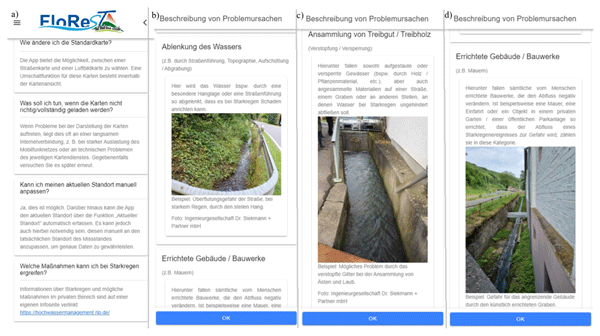
- 3–5 are just screenshots of the app? Might it not be preferable to include an additional schematic diagram of its intended operation and use?
MINOR COMMENTS
- Line 14 – remove “a” before “user guidance”
- Line 36 – remove “a” before “runoff”
- Line 78: The level of education … is (not are)
- Line 85: be developed (not are)
- Line 86: be improved (not is)
- Line 148: “a new software will be programmed as CS project” – this is unclear
- 1: Map display (not displan)
- Line 239: “sustainable risk management in heavy rain prevention” – this is a little unclear; rain can’t be prevented
REFERENCES
Cohn JP. Citizen science: can volunteers do real research? Bioscience 2008, 58: 192.
Irwin A. Citizen Science: A Study of People, Expertise and Sustainable Development. Abingdon, UK: Psychology Press; 1995.
Paul J.D., W. Buytaert, S. Allen, J.A. Ballesteros-Canovas, J. Bhusal, K. Cieslik, J. Clark, S. Dugar, D.M. Hannah, M. Stoffel, A. Dewulf. M.R. Dhital, W. Liu, J.L. Nayaval, B. Neupane, A. Schiller, P.J. Smith and R. Supper, 2018. Citizen science for hydrological risk reduction and resilience building. Wiley Interdisciplinary Reviews: Water, 5, e1262
Paul J.D., E. Bee, and M. Budimir, 2021. Mobile phone technologies for disaster risk reduction. Climate Risk Management, 32, 100296
--
Jonathan Paul
Royal Holloway, University of London
5 September 2025
Citation: https://doi.org/10.5194/egusphere-2025-3702-RC1 -
AC1: 'Reply on RC1', Jaqueline Hoffmann, 22 Sep 2025
We sincerely thank the reviewer for the careful reading of our manuscript and for the constructive comments, which have helped us to improve the clarity and balance of our paper. Below we provide a structured response to the main points raised.
1. Scope and project namingReviewer comment“I feel the manuscript would work better if it was agnostic to the specific research project i.e. omit all mention of FloReST except for the acknowledgements, and couch the content instead on risk management of heavy rainfall events. At the moment it reads like an introduction to FloReST (e.g. Lines 212–4; 485–6)”
Response: We will reframe the manuscript as a contribution to risk management of heavy rainfall events and reduce references to “FloReST” to the Methods and Acknowledgements sections.
Reviewer comment: “The overall concept is sound but it must be made clearer that the proposal is purely a proof-of-concept.”
Response: The manuscript will be clearly designated as a proof-of-concept study.
2. Literature breadth and global context
Reviewer comment: “The literature cited and Section 1 has a heavy German bias. I would suggest either noting down the regional focus in the title, or amending the Introduction to make it more general/global.”
Response: We will broaden the literature to an international scope and give a short introduction to the local phenomena of the Ahr flood in 2021 to to clarify the current German focus.Reviewer comment: “Several sections in the manuscript need more (or better) citations to back up statements made.”
“Citizen science needs a far more careful treatment. For instance, Bonn et al. (2002) is not an appropriate reference to back up the introductory statement of Section 2.2; you might want to have a look at Cohn (2008) or Irwin (1995) instead (full details below).”
“Two additions would greatly strengthen the citizen science discussion: (a) some mention of the need for apps to be “useful, useable, and used”, and steps that were / could be taken to ensure this; (b) more detail on the mechanics of citizen science projects, even down to potentially replacing “citizen” with “community” […]”Response: We agree and will explicitly differentiate between Citizen Science and Community Science. This distinction will be integrated into Section 2.2 to better reflect the engagement model of our app. We will broaden the literature to include international and critical contributions to Citizen/Community Science (Irwin 1995; Cohn 2008; Ballard et al. 2024).
Reviewer comment: “Section 2.3 – missing some important watery citizen science programs and initiatives, e.g. CrowdWater […]”
Response: We will also explicitly distinguish our approach from other hydrological citizen science projects such as CrowdWater, highlighting that our app serves as a municipal risk management tool focused on the identification of trouble spots.
Reviewer comment: “There is no recognition of the various negative externalities that can result from CS projects, such as lost community trust if results are not immediately forthcoming, or inaccurate / imprecise data, or zero data production altogether."
“The final paragraph of Section 2 (“… opens the possibility for various municipalities to use the project …”) is very (over?)-optimistic and elides the significant technical, political, and regulatory challenges that might stand in the way of this level of operationalisation.”
Response: Barriers of a technical, political, and regulatory nature are already described in Section 5.2.2. To provide better context, we will also incorporate general challenges and critical perspectives on Citizen and Community Science into the literature review.
3. Language and target audienceReviewer comment: “This is contradicted by having the app solely in the German language: either it must be made clear that the app is of sole relevance to Germany, or some form of language flexibility could be introduced.”
Response: We will clarify that the current prototype only supports German and emphasize the local pilot focus (including the technical implications). In addition, we will outline a planned internationalisation (English UI/language files; language toggle) for future development stages.
4. Structure and figuresReviewer comment: “I suggest that Sections 1 and 2 be merged, as the narrative (as it stands) jumps around significantly, with citizen science being introduced briefly in the Introduction, before a more detailed consideration in Section 2.”
Response: We will revise the structure of Sections 2.1 and 2.2, strengthening Section 2.2 towards Community Science.
Reviewer comment: “3–5 are just screenshots of the app? Might it not be preferable to include an additional schematic diagram of its intended operation and use?”
Response: The screenshot figures will be supplemented with two functional and use-case diagrams of the app as a municipal risk management tool:
- Current application area: identification of trouble spots (e.g. recurrent water accumulation or vulnerable infrastructure) as a preventive measure for long-term adaptation.
- Potential extended function: real-time risk communication and decision support during heavy rainfall events.
5. Minor remarksWe will incorporate all suggested corrections and revise the corresponding passages accordingly.
Conclusion
We are grateful for the reviewer’s constructive feedback. With the planned revisions, we believe the manuscript will present a clearer, more balanced, and more internationally contextualized contribution, while explicitly acknowledging both the potential and the limitations of our proof-of-concept.Citation: https://doi.org/10.5194/egusphere-2025-3702-AC1
-
RC2: 'Comment on egusphere-2025-3702', Christine Yiqing Liang, 25 Sep 2025
General comments
The research describes the development of a Citizen Science app for the FloReST project and how this tool can aid residents and authorities in risk management for heavy rainfall events and associated pluvial hazards. The authors focus on the technological development of the app in the methodology and the results further elaborate on the user interface and what participants (either the residents who submit the data or the authorities that may use it) would see. The authorities see the data through the Geo Data Warehouse, which has data visualisation features and can be customised. The manuscript fits well within the scope of NHESS since the central topic is natural hazards and the journal welcomes the design, development, and validation of new tools such as the Citizen Science app. I particularly liked the connection the authors made that small-scale events like heavy rainfall connect more to personal emotions. It is essentially a psychological bridge to make climate change (which can feel overwhelming and abstract) feel real and relevant to people. Highlighting how these smaller, more personal events affect individuals is a crucial step in getting people to understand and engage with such a massive global issue. Recent flooding events in the world (like in Valencia and Texas) are a stark reminder of why this kind of research is so crucial.
Given the timeliness and significance of the research, it would be great to see the research published in NHESS. However, there are major shortcomings that will need to be addressed before publication. Mainly, it is unclear from the introduction or methodology sections which stage of implementation the FloReST project is in, and how long the Citizen Science app has been used for. It seems from the results that the Citizen Science app has been developed but not yet tested in the community yet – however, this is unclear and thus the discussion section seems to have many assertions of how the app is beneficial but no data or tangible results to back them up. When I was reading the results section, it seemed like the “results” are what the app looks like and how it can be used instead of actual data gained through thorough user testing with multiple stakeholder groups. I was not expecting this, which means that the scope of the paper could be set up better to prepare readers for what exactly is being presented from the research. The shortfalls of the manuscript could perhaps be remedied by reframing the current research as still in the prototype stage and further emphasising the scope/results as the app development/capabilities and not the citizen-collected data. In addition, the writing style is disjointed and overall writing could be improved.
Specific comments
100 I’ve explained more in the technical comments below about disjointed writing with very short paragraphs that could be merged. However, in some cases, the 1-sentence paragraphs should not be merged, but rather developed. For example, 100 is missing topic and closing sentences and there should be more examples added of how CS has been used in monitoring, especially for natural hazards since that is the focus of the research. Overall, your literature review is missing key references.
121 “In CS projects, data should be collected by participants and sent for example to authorities or researchers.” – not necessarily, there are different levels of citizen science and participation.
123 Is mD a common abbreviation for mobile devices? Is it necessary to abbreviate “mobile devices”?
138 Is this redundant information? The authors already mentioned questionnaires in an earlier paragraph.
139 The authors could refer to the specific term “gamification” here i.e. the application of game design elements.
144 The authors could also cite data quality issues here.
169 “When developing mobile apps, a distinction is made between web, native and hybrid apps.” As someone without a computer science background, these terms are quite foreign – a lot of jargon in this whole section.
237 The methods section is missing the evaluation and use of the app by citizen scientists or authorities. For example, how did the authors administer the app and the evaluation survey?
265 Good attention to privacy of personal data (but does the paper refer back to all tenets the authors presented at first in methods?)
273 Is there an option for “other” if the given types do not apply?
291 disy Cadenza introduced is explained in section 4.2 but mentioned much earlier (for example in line 235)
325 Can citizens also access this data? What happens after they submit? How do the benefits come back to them?
339 There needs to be a methodology section that links to these results.
348 Data? Evidence? Results of survey? This last section is like a methods section not a results section.
353 Discussion starts with methods and results that weren’t presented before?
371 Did the methods/results show this?
379 Where is the evidence from the data that links to this?
404 Many instances throughout the Discussion section where statements are made but not backed up by the data or the literature, for example in this paragraph.
412 The authors mention a few times that the app was used by younger age individuals but did not explain how this was implemented – i.e. was a school partner involved?
420 Where are these results in the results section?
459 Could it more likely be a data quality issue than deliberate? This is a common problem in CS.
474 It is great that the app was developed to be open source, but are there any concrete plans for sustainability of the app/program?
501 Was this mentioned in limitations or results?
Technical corrections
25 The paragraphs throughout the introduction and literature review are quite short – sometimes one sentence has its own paragraph. This makes the writing look disjointed and interrupts flow.
25-28, 44, 47, 62 The introduction and literature review sections seem to be missing references.
67, 80 Example of 1-sentence paragraphs that should be merged with the above paragraph as a closing sentence. Especially with 80, the authors write “therefore” so it should be linked with the above paragraph.
124 Missing reference.
148 The writing is awkward at times and sounds clunky and confusing. For example, check this sentence. Have someone check writing throughout.
150 The authors use inconsistent US or UK spelling, for example here sometimes words are spelled with s and sometimes z. Here “organise” is spelled the UK way with an “s”. The authors spell other words with “z” i.e. the US way. Be consistent.
185 Figure 1 in the green box says “map displan” – is this a typo?
221 Is there a reason for the switch to footnotes here versus in-text citations?
309 As in comment 150. “The color-coded dots each represent a single report, coloured according to the categorization of problem area.” – this sentence mixes both US and UK spellings of “color/colour”. Pick one style of English and be consistent.
375 Delete paragraph break after open bracket.
Citation: https://doi.org/10.5194/egusphere-2025-3702-RC2 -
AC2: 'Reply on RC2', Jaqueline Hoffmann, 07 Oct 2025
We thank the reviewer for the thorough reading of our manuscript and the constructive comments. We appreciate the positive feedback on the timeliness of our research, the relevance to NHESS, and especially the emphasis on the psychological dimension of local heavy rainfall events as a bridge to broader climate change awareness. Below, we provide our responses to the main points raised.
1. Stage of implementation and scope of resultsReviewer Comment:When I was reading the results section, it seemed like the “results” are what the app looks like and how it can be used instead of actual data gained through thorough user testing with multiple stakeholder groups. I was not expecting this, which means that the scope of the paper could be set up better to prepare readers for what exactly is being presented from the research. The shortfalls of the manuscript could perhaps be remedied by reframing the current research as still in the prototype stage and further emphasising the scope/results as the app development/capabilities and not the citizen-collected data.”
Response: We agree that the scope was not sufficiently clear. The manuscript will be explicitly framed as a proof-of-concept paper, with the results section describing the app’s functionalities and potential applications, not outcomes of large-scale user testing. We will make this distinction clear in the introduction and methodology sections and formulate the statements in the discussion more clearly.
2. Literature review and referencesReviewer Comment: „Overall, your literature review is missing key references.“
“100 I’ve explained more in the technical comments below about disjointed writing with very short paragraphs that could be merged. However, in some cases, the 1-sentence paragraphs should not be merged, but rather developed.”
Response: We will restructure the introduction and literature review into longer, more coherent paragraphs, with clear topic and closing sentences. We will add examples of CS in natural hazard monitoring (e.g. hydrology, landslides, earthquakes) and incorporate references such as Irwin (1995), Cohn (2008), Ballard et al. (2024) and relevant hydrological initiatives (CrowdWater). This will provide a stronger theoretical and international context.
3. Terminology and clarityReviewer Comment: “123 Is mD a common abbreviation for mobile devices? Is it necessary to abbreviate “mobile devices”?”
„169 „When developing mobile apps, a distinction is made between web, native and hybrid apps.” As someone without a computer science background, these terms are quite foreign – a lot of jargon in this whole section.“
“139 The authors could refer to the specific term “gamification” here i.e. the application of game design elements.”
Response: We are revising these sections linguistically and reducing technical terms. Where technical distinctions are important, we explain them in more detail. We avoid non-standard abbreviations such as ‘mD’; the meaning of ‘gamification’ in the CS context will be explained in the literature review.
4. Methodology vs. resultsReviewer Comment: „237 The methods section is missing the evaluation and use of the app by citizen scientists or authorities. For example, how did the authors administer the app and the evaluation survey?“
“348 Data? Evidence? Results of survey? This last section is like a methods section not a results section.”
“353 Discussion starts with methods and results that weren’t presented before?”
“404 Many instances throughout the Discussion section where statements are made but not backed up by the data or the literature, for example in this paragraph.”
“412 The authors mention a few times that the app was used by younger age individuals but did not explain how this was implemented – i.e. was a school partner involved?”
“420 Where are these results in the results section?”
Response: We will describe the conditions of the test procedures carried out so far in the methods section and list the evaluation in the results under 4.4.
Reviewer Comment: “325 Can citizens also access this data? What happens after they submit? How do the benefits come back to them?”
Response: Currently, citizens only receive feedback in the form of confirmation when they submit their report. We will highlight this more clearly in Section 4.1.1. In Sections 5.1 and 5.2.1, we will discuss both the political and technical challenges of direct user feedback in this context.
5. Writing style and consistencyReviewer Comment: “148 The writing is awkward at times and sounds clunky and confusing. For example, check this sentence. Have someone check writing throughout.”
“150 The authors use inconsistent US or UK spelling, for example here sometimes words are spelled with s and sometimes z. Here “organise” is spelled the UK way with an “s”. The authors spell other words with “z” i.e. the US way. Be consistent.”
Response: We completely revise the manuscript linguistically. Short paragraphs are merged or expanded with examples. We consistently use British English (in accordance with NHESS standards) and correct spelling mistakes and stylistic inaccuracies.
6. Technical and structural detailsReviewer Comment: „273 Is there an option for “other” if the given types do not apply?“
Response: Now there is no option for “other”, but you can describe the problematic area via text field, if necessary.
Reviewer Comment: „291 disy Cadenza introduced is explained in section 4.2 but mentioned much earlier (for example in line 235)“
Response: The description of disy Cadenza will be moved to the appropriate section (3.2).
Reviewer Comment: “474 It is great that the app was developed to be open source, but are there any concrete plans for sustainability of the app/program?”
Response: We explain the current status of the app and how it can be transferred to other (including international) regions/projects.
7. Minor and technical correctionsWe insert missing references, improve unclear sentences and make all minor corrections.
Conclusion
We would like to thank the reviewer for their detailed comments. In the revised version, the manuscript will be explicitly positioned as a proof-of-concept paper, with linguistic and structural improvements, expanded literature, and improved methodology and presentation of results. These changes clarify the scope and significantly strengthen the contribution.Citation: https://doi.org/10.5194/egusphere-2025-3702-AC2
-
AC2: 'Reply on RC2', Jaqueline Hoffmann, 07 Oct 2025
Peer review completion


Journal article(s) based on this preprint
Viewed
| HTML | XML | Total | BibTeX | EndNote | |
|---|---|---|---|---|---|
| 5,309 | 725 | 79 | 6,113 | 118 | 116 |
- HTML: 5,309
- PDF: 725
- XML: 79
- Total: 6,113
- BibTeX: 118
- EndNote: 116
Viewed (geographical distribution)
| Country | # | Views | % |
|---|
| Total: | 0 |
| HTML: | 0 |
| PDF: | 0 |
| XML: | 0 |
- 1
Jaqueline Hoffmann
Sascha Nau
Sabrina Abler
Vincent Theis
Peter Fischer-Stabel
Julian Janßen
Andreas Abecker
The requested preprint has a corresponding peer-reviewed final revised paper. You are encouraged to refer to the final revised version.
- Preprint
(3917 KB) - Metadata XML
REVIEW OF egusphere-2025-3702 (NHESS)
“SUSTAINABLE RISK MANAGEMENT OF TROUBLE SPOTS CAUSED BY HEAVY RAINFALL EVENTS: CITIZEN SCIENCE APP AND DATA ANALYTICS FOR RESIDENTS AND AUTHORITIES” BY HOFFMANN ET AL.
This manuscript details the development of a novel app in the realm of risk management of pluvial floods. While the topic is interesting and the paper generally very well written, I have several major concerns about the narrative: this is a proof-of-concept descriptive paper that employs citizen science (CS) almost as an add-on. I would suggest either greatly enhancing the CS aspect through actual user testing, in the field, with a variety of different stakeholders (including local government and risk managers, who seem to be the intended target audience) or excising the CS part and focusing solely on the computational side of app development. Three of the five figures are simply screenshots of various aspects of the app. In general, the literature review misses several key papers on CS and the development of apps / new tech to that end, and instead features a strong regional focus. Citizen (or community) science must not be seen as a universal panacea; likewise the development of apps has a long documented history of failure, which must be acknowledged. Several recent studies (extensive reference list provided below) have noted a movement away from ad hoc apps, which may not continue to be used successfully by local stakeholders, instead piggybacking on existing social media and platforms like WhatsApp and OpenStreetMap. Finally, it is correctly stated that CS can play a role in democratising science, and that the app will be tailored to local communities. This is contradicted by having the app solely in the German language: either it must be made clear that the app is of sole relevance to Germany, or some form of language flexibility could be introduced.
MAJOR COMMENTS
MINOR COMMENTS
REFERENCES
Cohn JP. Citizen science: can volunteers do real research? Bioscience 2008, 58: 192.
Irwin A. Citizen Science: A Study of People, Expertise and Sustainable Development. Abingdon, UK: Psychology Press; 1995.
Paul J.D., W. Buytaert, S. Allen, J.A. Ballesteros-Canovas, J. Bhusal, K. Cieslik, J. Clark, S. Dugar, D.M. Hannah, M. Stoffel, A. Dewulf. M.R. Dhital, W. Liu, J.L. Nayaval, B. Neupane, A. Schiller, P.J. Smith and R. Supper, 2018. Citizen science for hydrological risk reduction and resilience building. Wiley Interdisciplinary Reviews: Water, 5, e1262
Paul J.D., E. Bee, and M. Budimir, 2021. Mobile phone technologies for disaster risk reduction. Climate Risk Management, 32, 100296
--
Jonathan Paul
Royal Holloway, University of London
5 September 2025