
the Creative Commons Attribution 4.0 License.
the Creative Commons Attribution 4.0 License.
 | 14 Aug 2025
Sea-effect snowfall in the Baltic Sea area in 1998–2018 derived from convection-permitting climate model data
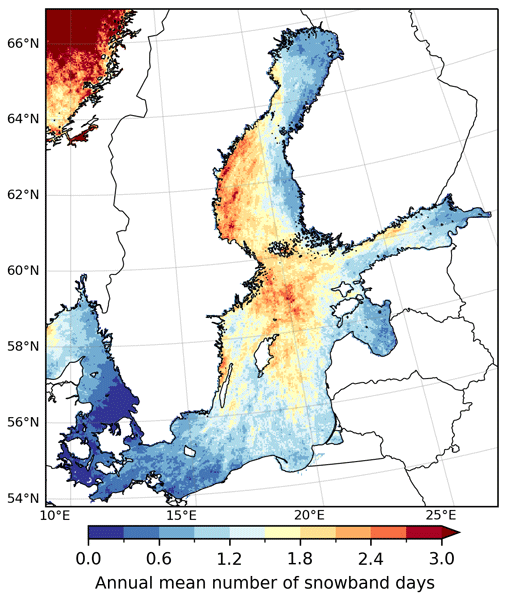
Abstract. Sea-effect snowfall forms frequently over the Baltic Sea in northern Europe. In its bordering countries, large snow accumulations and poor visibility associated with these, often intense, convective snowbands have had considerable impacts on society. This study presents, for the first time, the occurrence of snowband days over the full Baltic Sea area on climatological time scales. The climatology is investigated using a 21-year simulation made with the HARMONIE-Climate convection-permitting regional climate model applied at 3 km resolution. Snowband days occur most frequently (up to a few days per year in a 3 km x 3 km area) over specific regions of the Baltic Sea: near the eastern coast of Sweden, over the Gulf of Finland and the Northern Baltic Proper. Over majority of the northern Baltic Sea, snowbands occur typically between November–February. Winds with an easterly component favour the occurrence of snowbands along the eastern coast of Sweden and southern coast of Finland, whereas few cases in those regions occur with westerly winds. In addition, snowband days occur over the southern Baltic Sea, where the formation of snowbands is favoured by low-level winds having a northerly component and typically between December–March. This study supports operational forecasting of snowbands events and forms the basis for future research on how the occurrence of these events may change in a changing climate.
-
Notice on discussion status
The requested preprint has a corresponding peer-reviewed final revised paper. You are encouraged to refer to the final revised version.
-
Preprint
(6541 KB)
-
The requested preprint has a corresponding peer-reviewed final revised paper. You are encouraged to refer to the final revised version.
- Preprint
(6541 KB) - Metadata XML
- BibTeX
- EndNote
- Final revised paper


Journal article(s) based on this preprint
Interactive discussion
Status: closed
- RC1: 'Comment on egusphere-2025-3663', Anonymous Referee #1, 29 Oct 2025
- RC2: 'Comment on egusphere-2025-3663', Anonymous Referee #2, 19 Dec 2025
-
AC1: 'Comment on egusphere-2025-3663', Meri Virman, 21 Jan 2026
We thank both referees for their insightful comments and constructive feedback. We have carefully considered all comments made by the referees and revised the manuscript accordingly. Please find a response to each comment in the attached document.
-
EC1: 'Comment on egusphere-2025-3663', Johannes Dahl, 22 Jan 2026
I thank the reviewers for their comments, and the authors for their responses. I look forward to the revised manuscript.
Citation: https://doi.org/10.5194/egusphere-2025-3663-EC1
Peer review completion


Interactive discussion
Status: closed
-
RC1: 'Comment on egusphere-2025-3663', Anonymous Referee #1, 29 Oct 2025
Summary:
The authors present a 21 year climatology of sea-effect snowfall events over the Baltic Sea using the HCLIM model. I think the paper is clearly written, the method is tested and shown to work well for the intended purpose, and limitations are discussed. I only have two minor substantive comments and spotted a couple of typos/grammar errors. I recommend publication after minor revisions.
Substantive comments:
1. Could you add some discussion about different potential methods to detect snowbands (e.g., using model reflectivity or satellite data), and why you chose your more indirect method. Are direct methods too complex and hence error-prone (maybe involving pattern recognition etc.)?
2. I didn't understand why Fig. 9 was divided into subregions--what is the purpose of introducing these regions?
Typos/grammar:
Line 7: Add "the" before majority
Line 67: The previously made studies --> Previous studies
Line 124: "... criteria of OLS2022 were adopted from OLS2022" sounds a little redundant.Line 136 (and elsewhere): From hereon --> Hereafter
Line 276: into --> of
Line 188: Could add a short one-sentence subsection summary?
Line 200: Doesn't Fig. 1 include southern Finland?
Line 245: Is the most snowfall related to the orientation of the coast relative to the winds, or to the fetch?
Line 264: Detected *snowband* days?
Line 304: Add "the" before majority
Line 306: Above mentioned
Line 334, 371: use --> utility of HCLIM
Line 375: seek for --> seek to identify?
Line 381: Maybe use the plural (uncertainties)? Also, I wasn't sure what you were trying to say. Do you mean temporal variability with period on the order of 20 years? Natural variability by itself does not render climatologies inaccurate (no?).
Line 389: I'm not sure if the last paragraph/advertisement is needed (but will leave it up to you).
Citation: https://doi.org/10.5194/egusphere-2025-3663-RC1 - RC2: 'Comment on egusphere-2025-3663', Anonymous Referee #2, 19 Dec 2025
-
AC1: 'Comment on egusphere-2025-3663', Meri Virman, 21 Jan 2026
We thank both referees for their insightful comments and constructive feedback. We have carefully considered all comments made by the referees and revised the manuscript accordingly. Please find a response to each comment in the attached document.
-
EC1: 'Comment on egusphere-2025-3663', Johannes Dahl, 22 Jan 2026
I thank the reviewers for their comments, and the authors for their responses. I look forward to the revised manuscript.
Citation: https://doi.org/10.5194/egusphere-2025-3663-EC1
Peer review completion
Journal article(s) based on this preprint
Viewed
| HTML | XML | Total | BibTeX | EndNote | |
|---|---|---|---|---|---|
| 2,838 | 367 | 105 | 3,310 | 151 | 150 |
- HTML: 2,838
- PDF: 367
- XML: 105
- Total: 3,310
- BibTeX: 151
- EndNote: 150
Viewed (geographical distribution)
| Country | # | Views | % |
|---|
| Total: | 0 |
| HTML: | 0 |
| PDF: | 0 |
| XML: | 0 |
- 1

Taru Olsson
Petter Lind
Kirsti Jylhä
The requested preprint has a corresponding peer-reviewed final revised paper. You are encouraged to refer to the final revised version.
- Preprint
(6541 KB) - Metadata XML
Summary:
The authors present a 21 year climatology of sea-effect snowfall events over the Baltic Sea using the HCLIM model. I think the paper is clearly written, the method is tested and shown to work well for the intended purpose, and limitations are discussed. I only have two minor substantive comments and spotted a couple of typos/grammar errors. I recommend publication after minor revisions.
Substantive comments:
1. Could you add some discussion about different potential methods to detect snowbands (e.g., using model reflectivity or satellite data), and why you chose your more indirect method. Are direct methods too complex and hence error-prone (maybe involving pattern recognition etc.)?
2. I didn't understand why Fig. 9 was divided into subregions--what is the purpose of introducing these regions?
Typos/grammar:
Line 7: Add "the" before majority
Line 67: The previously made studies --> Previous studies
Line 124: "... criteria of OLS2022 were adopted from OLS2022" sounds a little redundant.
Line 136 (and elsewhere): From hereon --> Hereafter
Line 276: into --> of
Line 188: Could add a short one-sentence subsection summary?
Line 200: Doesn't Fig. 1 include southern Finland?
Line 245: Is the most snowfall related to the orientation of the coast relative to the winds, or to the fetch?
Line 264: Detected *snowband* days?
Line 304: Add "the" before majority
Line 306: Above mentioned
Line 334, 371: use --> utility of HCLIM
Line 375: seek for --> seek to identify?
Line 381: Maybe use the plural (uncertainties)? Also, I wasn't sure what you were trying to say. Do you mean temporal variability with period on the order of 20 years? Natural variability by itself does not render climatologies inaccurate (no?).
Line 389: I'm not sure if the last paragraph/advertisement is needed (but will leave it up to you).