
the Creative Commons Attribution 4.0 License.
the Creative Commons Attribution 4.0 License.
 | 20 Aug 2025
Measurement report: Observational Analysis of Mode-Dependent Fog Droplet Size Distribution Evolution and Improved Parameterization Using Segmented Gamma Fitting
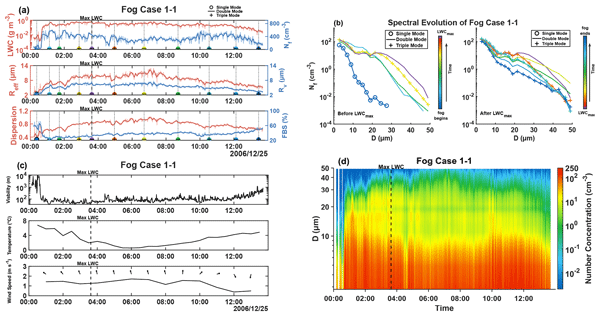
Abstract. Influenced by numerous physical factors, the evolution of fog droplet size distributions (DSDs) during the fog lifecycle is not yet fully understood and difficult to represent realistically in numerical models, constraining the accuracy of fog forecasting. To improve understanding of the fog evolution, field observations under a polluted background were conducted during the winters of 2006–2009 and 2017–2018 in Nanjing, China. Among the 27 observed fog events, microphysical properties such as fog number concentration (Nf), liquid water content (LWC), volume-mean radius (Rv) and effective radius (Reff) vary substantially. The unimodal (3 μm), bimodal (3, 21 μm) and trimodal (around 3, 13, 21 μm) DSD were observed. As the fog developed, the DSDs evolved from unimodal to multimodal. The third mode centered at 13 μm in trimodal cases appeared after the other two modes, typically around the time LWC reached its maximum, corresponding to the mature stage of fog. For all mode types, the probability density function decreased with increasing Nf and LWC. Rv is generally greater than 4 μm and Reff greater than 6 μm for trimodal DSDs. Based on the observational findings, a segmented gamma fitting was applied to the mean DSD with partition points at 10 and 21 μm. Comparison between microphysical parameters derived from the fitted DSD and those from observations indicates that the three-segment fitting provides more accurate estimates of Nf and LWC. Moreover, the three-segment gamma fitting substantially improves the representation of Reff, absorption coefficient and optical thickness, with most deviations constrained within 20 %.
-
Notice on discussion status
The requested preprint has a corresponding peer-reviewed final revised paper. You are encouraged to refer to the final revised version.
-
Preprint
(2775 KB)
-
The requested preprint has a corresponding peer-reviewed final revised paper. You are encouraged to refer to the final revised version.
- Preprint
(2775 KB) - Metadata XML
- BibTeX
- EndNote
- Final revised paper


Journal article(s) based on this preprint
Interactive discussion
Status: closed
-
RC1: 'Comment on egusphere-2025-3632', Anonymous Referee #1, 19 Sep 2025
- AC1: 'Reply on RC1', Jingwen Zhang, 29 Nov 2025
-
RC2: 'Comment on egusphere-2025-3632', Anonymous Referee #2, 08 Oct 2025
- AC2: 'Reply on RC2', Jingwen Zhang, 29 Nov 2025
Peer review completion


Interactive discussion
Status: closed
-
RC1: 'Comment on egusphere-2025-3632', Anonymous Referee #1, 19 Sep 2025
This study may contain important contributions to fog microphysics, but I have difficulty trusting much of the content in the authors’ results. This is not to say I suspect the results are incorrect, but rather that the authors have not provided sufficient methodological detail nor considered alternative hypotheses to the degree necessary for a scientific publication. I recommend major revisions.
- The article focuses on DSDs with different modes—unimodal, bimodal, and trimodal. However, after reading the introduction, I am still unclear on what the three modes of a fog DSD refer to, the underlying physics driving their development, and why the modes center on the highlighted diameters. Since the study emphasizes the identification and implications of DSD modes, the authors should provide more theoretical discussion and relevant literature on fog DSDs.
- Most results in Sections 3.2 and 3.3 rely on identifying multimodal DSDs, yet these modes often appear to be determined by the behavior of a single size bin. This raises concerns about sampling errors, which the authors have not adequately addressed. They briefly mention using local minima to quantify the number of PSD modes, but the cited reference appears to distinguish only between unimodal and bimodal DSDs. Furthermore, the role of time averaging is not discussed in the data section, and the fact that results are based on 5-minute averages is only noted in figure captions. A better discussion of how the multimodal DSDs are defined and distinguished is necessary.
- I find the interpretation of results in Section 3.2 difficult to follow. Figures 2b, d, f, and h contain overlapping DSDs in multiple colors that are not consistently referenced in the results or discussion. I recommend highlighting only the DSDs relevant to the discussion and removing or de-emphasizing distracting information.
- Section 3.4 compares a triply partitioned PDF fit—implicitly tied to the three modes of fog DSDs—to that of a single gamma distribution. However, a major null hypothesis remains unaddressed: any DSD is likely to be better represented by a partitioned PDF than a single PDF, particularly when large DSDs (which may be assigned as trimodal) are examined. The authors should test their partition points against arbitrary alternatives to demonstrate that the observed improvements are physically meaningful and not simply an artifact of partitioning.
- I am also uncertain about the gamma PDF fitting methodology used in this section. In Figure 5a, the “gamma fit” appears indistinguishable from an exponential distribution. Since the gamma DSD is inherently multimodal—limiting to a power law for small particles and an exponential form for larger particles—it is unclear why the fit reduces to a simple exponential capturing only a handful of data points. A gamma PDF with a negative μ parameter would typically capture the tail behavior more effectively. My impression is that the authors restricted μ > 0, but no explanation of the fitting procedure or parameter constraints is provided, which is also an issue.
Some final opinions on the structure of the paper, but these aren't science related. Lines 124–127 should be research questions in the introduction, and the discussion section is unnecessary in it's current form since the two paragraphs could be moved to the introduction and conclusion.
Citation: https://doi.org/10.5194/egusphere-2025-3632-RC1 - AC1: 'Reply on RC1', Jingwen Zhang, 29 Nov 2025
-
RC2: 'Comment on egusphere-2025-3632', Anonymous Referee #2, 08 Oct 2025
- AC2: 'Reply on RC2', Jingwen Zhang, 29 Nov 2025
Peer review completion
Journal article(s) based on this preprint
Data sets
Fog Droplet Size Distribution for Fog 1-1, Fog 6, Fog 10 and Fog 12 Jingwen Zhang https://doi.org/10.5281/zenodo.16883670
Viewed
| HTML | XML | Total | BibTeX | EndNote | |
|---|---|---|---|---|---|
| 5,387 | 491 | 96 | 5,974 | 113 | 113 |
- HTML: 5,387
- PDF: 491
- XML: 96
- Total: 5,974
- BibTeX: 113
- EndNote: 113
Viewed (geographical distribution)
| Country | # | Views | % |
|---|
| Total: | 0 |
| HTML: | 0 |
| PDF: | 0 |
| XML: | 0 |
- 1
Jingwen Zhang

Zhenya An
The requested preprint has a corresponding peer-reviewed final revised paper. You are encouraged to refer to the final revised version.
- Preprint
(2775 KB) - Metadata XML
This study may contain important contributions to fog microphysics, but I have difficulty trusting much of the content in the authors’ results. This is not to say I suspect the results are incorrect, but rather that the authors have not provided sufficient methodological detail nor considered alternative hypotheses to the degree necessary for a scientific publication. I recommend major revisions.
- The article focuses on DSDs with different modes—unimodal, bimodal, and trimodal. However, after reading the introduction, I am still unclear on what the three modes of a fog DSD refer to, the underlying physics driving their development, and why the modes center on the highlighted diameters. Since the study emphasizes the identification and implications of DSD modes, the authors should provide more theoretical discussion and relevant literature on fog DSDs.
- Most results in Sections 3.2 and 3.3 rely on identifying multimodal DSDs, yet these modes often appear to be determined by the behavior of a single size bin. This raises concerns about sampling errors, which the authors have not adequately addressed. They briefly mention using local minima to quantify the number of PSD modes, but the cited reference appears to distinguish only between unimodal and bimodal DSDs. Furthermore, the role of time averaging is not discussed in the data section, and the fact that results are based on 5-minute averages is only noted in figure captions. A better discussion of how the multimodal DSDs are defined and distinguished is necessary.
- I find the interpretation of results in Section 3.2 difficult to follow. Figures 2b, d, f, and h contain overlapping DSDs in multiple colors that are not consistently referenced in the results or discussion. I recommend highlighting only the DSDs relevant to the discussion and removing or de-emphasizing distracting information.
- Section 3.4 compares a triply partitioned PDF fit—implicitly tied to the three modes of fog DSDs—to that of a single gamma distribution. However, a major null hypothesis remains unaddressed: any DSD is likely to be better represented by a partitioned PDF than a single PDF, particularly when large DSDs (which may be assigned as trimodal) are examined. The authors should test their partition points against arbitrary alternatives to demonstrate that the observed improvements are physically meaningful and not simply an artifact of partitioning.
- I am also uncertain about the gamma PDF fitting methodology used in this section. In Figure 5a, the “gamma fit” appears indistinguishable from an exponential distribution. Since the gamma DSD is inherently multimodal—limiting to a power law for small particles and an exponential form for larger particles—it is unclear why the fit reduces to a simple exponential capturing only a handful of data points. A gamma PDF with a negative μ parameter would typically capture the tail behavior more effectively. My impression is that the authors restricted μ > 0, but no explanation of the fitting procedure or parameter constraints is provided, which is also an issue.
Some final opinions on the structure of the paper, but these aren't science related. Lines 124–127 should be research questions in the introduction, and the discussion section is unnecessary in it's current form since the two paragraphs could be moved to the introduction and conclusion.