
the Creative Commons Attribution 4.0 License.
the Creative Commons Attribution 4.0 License.
 | 19 Sep 2025
Meteotsunami prediction in km-scale regional systems coupled at high frequency
Abstract. Meteorological tsunamis, or meteotsunamis, are anomalous waves triggered by atmospheric disturbances such as thunderstorms, gravity waves, squalls, or cyclones. While meteotsunamis have been studied extensively in regions like the Mediterranean and the United States, research in the Northwest European shelf remains limited, as meteotsunamis were considered rare and low-risk until recently. New evidence suggests they are often undetected due to insufficient tide gauge resolution. Reports indicate that meteotsunamis pose risks to infrastructure and have caused fatalities in the United Kingdom.
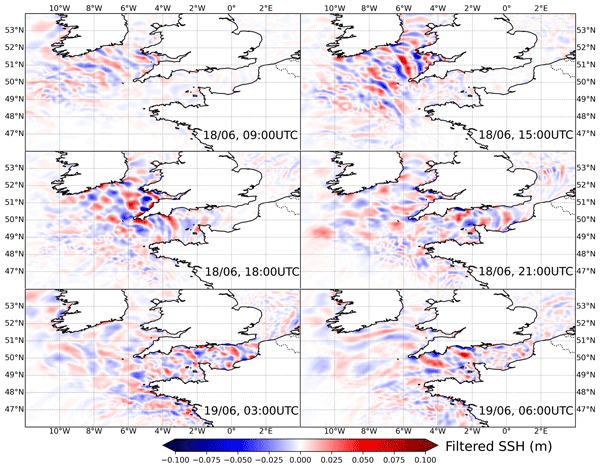
This study evaluates the capability of the Met Office's atmosphere-ocean-wave regional coupled model (UKC4) and Météo-France’s atmosphere-ocean regional coupled model (AROBASE) to capture and predict meteotsunamis. Configured at km-scale and with 10-minute coupling frequency, the models were tested on the strongest meteotsunami event (up to 1 m) recorded so far in Ireland, which occurred in June 2022. The whole event lasted for hours and significantly impacted Ireland, the UK and France. This case has been widely studied but the exact atmospheric drivers of such a widespread event remain unknown. The two models are able to represent the meteotsunami: the Met Office model is more successful in the Celtic Sea around the UK, Ireland and the English Channel and the Météo-France model captures a weak signal in the Bay of Biscay and English Channel. Analysis of the atmospheric situation suggests two slow-moving low-pressure systems, with colliding cold and dry Arctic air and extremely warm and dry continental air. This generates a shallow stable layer near the surface, which gets disrupted by convective downdrafts, generating gravity waves which propagate in the stable layer at the same speed as ocean disturbance, leading to Proudman resonance and to meteotsunamis in three different countries. Finally, for the first time for this region, we show that a km-scale regional coupled ensemble can successfully forecast this meteotsunami event.
-
Notice on discussion status
The requested preprint has a corresponding peer-reviewed final revised paper. You are encouraged to refer to the final revised version.
-
Preprint
(37495 KB)
-
The requested preprint has a corresponding peer-reviewed final revised paper. You are encouraged to refer to the final revised version.
- Preprint
(37495 KB) - Metadata XML
- BibTeX
- EndNote
- Final revised paper


Journal article(s) based on this preprint
Interactive discussion
Status: closed
-
RC1: 'Comment on egusphere-2025-3555', Anonymous Referee #1, 09 Oct 2025
- AC1: 'Reply on RC1', Nefeli Makrygianni, 06 May 2026
-
RC2: 'Comment on egusphere-2025-3555', Anonymous Referee #2, 20 Feb 2026
Review of "Meteotsunami prediction in km-scale regional systems coupled at high frequency"
The manuscript investigates the capability of high-resolution regional coupled models to predict meteotsunamis, focusing on the event that occurred in June 2022 and affected Ireland, the UK, and France. The event generated waves of up to 1 meter and caused substantial damage to coastal community.
Study used two different high resolution regional climate models, the Met Office’s UKC4 - a coupled atmosphere–ocean–wave system, and Météo-France’s AROBASE - a coupled atmosphere–ocean system.
This study is significant because it demonstrates that a kilometer-scale, high-frequency coupled regional system can successfully forecast meteotsunamis. However forecast is shown only for the UK4 model while AROBASE only shows the representation of the meteotsunamis and therefore the manuscript requires a major revision to be accepted for publication.Moreover, at times it gets hard to follow due to poor referencing of the figures and the figures themselves are not well explained in the captions.
Major comments
--------------------------------------1.) Since the manuscript title "Meteotsunami prediction in km-scale regional systems coupled at high frequency" is about meteotsunami prediction in km-scale regional systems (plural) the concerning part is why AROBASE forecast is not shown for 1 and 3 day prediction as UK4 model such as for Milford Heaven station. This seems to be a part of the manuscript (Fig. 19) on which conclusions about forecast for 1 and 3 day are based.
2.) There is a lack of uncertainty estimation for forecast. This should be included in the Fig. 19.
Minor comments
---------------------------------------------------
Line 11-13:
The sentence does not read well and needs paraphrasing. If the Met Office system is more successful over certain area the sentence implies that the Météo-France system is worse or less successful in representation over those area. But this is not completely true since in lines 356-357 is written that in the Bay of Biscay as the forecast progresses the Météo-France system (AROBASE) outperforms the Met Office (UK4) system.Line 23:
Sentence "Their period is between 2 and 120 min." is missing a reference.Line 35-36:
In sentence "Even though these phenomena can cause significant disturbances and even be high risk for coastal infrastructures, property and human life, they are usually underestimated and overlooked."change "be high risk" to "be of high risk". Also, the word "even" is repeating. Paraphrase for clarity and smoothness.
Line 47:
"However, their …" change to "However, the study of meteotsunamis remain rare …"Line 50-52:
Sentence: "In 2013, with an update in 2018, O’Brien et al. attempted to give a catalogue of extreme wave events in Ireland that included meteotsunamis (O’Brien et al., 2013, 2018)."Paraphrase the sentence to something like:
"A catalogue by O’Brien et al. (2013), with an updated version in 2018 (O’Brien et al., 2018), documented extreme wave events in Ireland, including meteotsunamis." since in the original "O’Brien et al." it reads like a citation with missing year.
Also "attempted"? Were they not successful? If not, write why.Line 54-55:
Sentence: "From their analysis,..." change to "According to their analysis,...."Line 56-57:
"It was only until very recently..." only + until seems redundant. Keep it simple, "It was only very recently that their importance and frequency around the UK have begun to be studied in more detail, with studies trying to understand and update the records of their occurrence."Line 135:
Add long name before SSH since abbreviation is mentioned for the first time in the text but its long name "sea surface height (SSH)" is for the first time written in the line 247.Line 268:
Repentance of long name "sea surface height (SSH)" which is written in line 247 but should be already in 135.Line 337-339:
There are open water locations written for Celtic Sea and Bay of Biscay while English Channel is missing the locations and it is only written that those are locations from the lightships. What were the locations of the lightships? Write those as well.Line 343-344:
"In the Celtic Sea (Fig. 9), UKC4 consistently shows higher disturbance amplitudes, reaching around 200Pa at all three locations."
Figure 9 only shows two locations. Also, higher than what? Write than you mean higher than AROBASE.Line 351:
"The plots ..." write "the Figs. 9-12"Line 355-356:
"At the two locations in the Bay of Biscay (Fig. 11), the AROBASE system shows a noticeable improvement in capturing high-frequency pressure disturbances, with amplitudes approaching 400Pa, comparable to those produced by UKC4."
Is the UK4 a reference?Line 356-357:
How is it proved that AROBASE is outperforming UK4 if no observations were used?Line 361-363:
Please refer to the figures which show meteotsunami signal (Brest in Fig. 5 and Le Havre in Fig. 4).
In addition, UK4 does not have doubled the AROBASE amplitude in Le Havre, where actually around 09:00 UTC the AROBASE is showing higher amplitude.Line 366:
"which" change to "whose"Line 413:
Add Fig. 14 (bottom panel) after "higher than 4mmh−1".
Add Fig. 7 after "In this area, isobars are not smooth" for better readability.Line 434:
"...first in the Celtic Sea ..." no need for first if second is not mentioned later on.Line 439:
"up" write updrafts insteadLine 462-465:
The pressure disturbance observation for Dieppe station is not shown in any of the figures. It can hardly be referred as Greenwich location noted with blue star in Fig. 8 whose pressure disturbance is shown only from model simulation in Fig. 10. (right-hand side).Line 513:
"...even if high resolution..." change "if" with "...with high resolution..." or "...of high resolution..."Line 517:
"not sent back the atmosphere" change to: "not send back to the atmosphere"Line 548:
"either" requires second parameter. Either one or the other.Line 551:
"to have" change to "having"Line 553-554:
"Finally, both systems show a weak signal in the Bay of Biscay (Fig. 5)"
Write which variable shows a weak signal and is shown in Fig. 5. Which is SSH.Line 576:
"This can conclude". Write, "From this it can be concluded ..."Line 589-590:
Indicate that pressure data are only from model (except Brest and Le Havre). Clearly state this here.Line 610-612:
Give reference for "one significant event every five years"Line 621:
In "The importance of high-frequency observational data is further illustrated in Figure A2" write "is further illustrated for Union Hall station (Fig. A2)" since in the original writing the Union Hall station is not linked with any figure in the text.Line 622:
If the model has temporal resolution of 10 min than in "... a 5 min observation ...." should be "... at 5 min observation ...".
Comments regarding figures
-----------------------------------------------------Most of the figures have very small labels, especially Fig. 13. Increase the labels i Figs 9-13. and Figs. 17-19.
Also it would be better if longitude is written in SW/NE notation not 0-360 and without noting it is degrees on x axis.
Figure 2. Add the meaning of the station colours in the caption.Figure 8. Add the meaning of the colours in the caption.
Figs. 9-12 Clearly state that the MSLP data are from models, not lightships, as indicated in the text on line 247. Only Fig. 12 shows the MSLP observations.
As currently written, it may give the impression that all MSLP time series are based on observations.Figure 10. is missing coordinates in the caption and in the text.
Figure 15. In caption: upper level warm front is marked with full semi-circles not empty.
Figure 16: there is something like watermark above the figure showing a) 12:00 UTC - can this be removed? Probably an artifact of figure cutting and pdf conversion.
Figure 19: Add the meaning of the colours.
Fig. A1 is missing the station name. while A2 has it in the tile. Write the station name in caption for both.
Legend is not explained anywehere.
MO data in Fig. A1 as well as 5 min data in Fig. A2 seems to be cut by the y axis limits. Show full range of 5 min data.
Similar is cut in Fig.3 also for Milford Heaven station.Mixing of "Fig. X" and "Figure X" in text. Use Figure in full only at the beginning of a sentence and in figures captions.
Comments regarding references:
------------------------------------------------------------
Angove, M., Kozlosky, L., Chu, P., Dusek, G., Mann, G., Anderson, E., Gridley, J., Arcas, D., Titov, V., Eble, M., McMahon, K., Hirsch, B.,and Zaleski, W.: Addressing the meteotsunami risk in the United States, Natural Hazards, 106, 1467–1487, https://doi.org/10.1007/s11069020-04499-3, 2021.Kain, J. S. and Fritsch, J. M.: A One-Dimensional Entraining/Detraining Plume Model and Its Application in Convective Parameterization.,
Journal of the Atmospheric Sciences, 47, 2784–2802, https://doi.org/10.1175/1520-0469(1990)047<2784:AODEPM>2.0.CO;2, 1990.Also some papers do have functioning links but those are not included, i.e.:
O’Brien, L., Dudley, J., and Dias, F.: Extreme wave events in Ireland: 14680 BP to 2012, Nat. Hazards Earth Syst. Sci., 13, 625–648, 2013.
O’Brien, L., Renzi, E., Dudley, J., Clancy, C., and Dias, F.: Catalogue of extreme wave events in Ireland: revised and updated for 14680 BP to 2017, Nat. Hazards Earth Syst. Sci., 18, 729–758, 2018.
Citation: https://doi.org/10.5194/egusphere-2025-3555-RC2 - AC2: 'Reply on RC2', Nefeli Makrygianni, 06 May 2026
Peer review completion


Interactive discussion
Status: closed
-
RC1: 'Comment on egusphere-2025-3555', Anonymous Referee #1, 09 Oct 2025
Review of “Meteotsunami prediction in km-scale regional systems coupled at high frequency”
The manuscript presents an operational, km-scale coupled atmosphere–ocean workflow with 10-minute exchanges, and demonstrates the procedure by simulating the 18 June 2022 meteotsunami. The paper requires major revision to be accepted for publication.
Major comments
1) Verification of resonance
The meteotsunamis are amplified by several resonances - Proudman, Greenspan, harbor/bay. It is necessary that the suggested scheme can properly capture these resonances. Although the local(bay/harbor) resonances can be captured using finer grids, it is necessary to add two concise, idealized verifications (can be included in appendix or supplementary):
- Proudman test (uniform depth): Force with a translating Gaussian pressure and report SSH amplitude vs translating time when the translating speed is equal to the resonance speed.
- Greenspan / edge-wave test (sloping shelf): Apply an alongshore-moving pressure near the shelf-mode speed and demonstrate a sustained steady alongshore response (shape and phase). This confirms the solver’s behavior near the steady state.
2) Atmospheric pressure input
Because MSLP is the input of the meteotsunami genesis, it is necessary to provide what field is exchanged, and how 10-min fields are temporally interpolated to the ocean time step. Then, cross-validate your pressure against the records used by Renzi et al. 2023 for the same event using the same filtering.
3) Grid resolution vs tide-gauge representativeness
At 1–2.5 km, many harbors and tide gauges may not be properly captured and local seiching/geometry effects may not be solved by the model. Please specify how the model handles this situation and the limitations related to the size of the grid.
Figures & presentation
- Figs 3–5 (SSH obs vs models): Improve readability with a clear style. Ensure axis units (m) and consistent y-limits. At Union Hall (Fig 3), show the full observed range (as reported in Renzi et al. 2023) and state whether the extremes were spikes removed by QC or retained after filtering.
- Figs 9–12 (MSLP): Make captions and legends explicit about what’s shown.
- Legends & panel letters: Ensure legends in every multi-curve panel (esp. Figs 10–12, 19).
Minor comments (grammar, wording, consistency)
- “For the UK For the UK …” → “For the UK, …”
- “5 mn / 1 mn” → “5 min / 1 min” (captions and text).
- Double words “the the” (e.g., around L 320 and L 480) → remove duplication.
- Fig. 19 caption dates: use 2022 (not 2023) for the June event runs.
- Replace “left/right hand-side” with “left/right panel” throughout figure captions.
- Keep tense consistent (present for methods, past for results), and ensure subject–verb agreement in captions.
Citation: https://doi.org/10.5194/egusphere-2025-3555-RC1 - AC1: 'Reply on RC1', Nefeli Makrygianni, 06 May 2026
- Proudman test (uniform depth): Force with a translating Gaussian pressure and report SSH amplitude vs translating time when the translating speed is equal to the resonance speed.
-
RC2: 'Comment on egusphere-2025-3555', Anonymous Referee #2, 20 Feb 2026
Review of "Meteotsunami prediction in km-scale regional systems coupled at high frequency"
The manuscript investigates the capability of high-resolution regional coupled models to predict meteotsunamis, focusing on the event that occurred in June 2022 and affected Ireland, the UK, and France. The event generated waves of up to 1 meter and caused substantial damage to coastal community.
Study used two different high resolution regional climate models, the Met Office’s UKC4 - a coupled atmosphere–ocean–wave system, and Météo-France’s AROBASE - a coupled atmosphere–ocean system.
This study is significant because it demonstrates that a kilometer-scale, high-frequency coupled regional system can successfully forecast meteotsunamis. However forecast is shown only for the UK4 model while AROBASE only shows the representation of the meteotsunamis and therefore the manuscript requires a major revision to be accepted for publication.Moreover, at times it gets hard to follow due to poor referencing of the figures and the figures themselves are not well explained in the captions.
Major comments
--------------------------------------1.) Since the manuscript title "Meteotsunami prediction in km-scale regional systems coupled at high frequency" is about meteotsunami prediction in km-scale regional systems (plural) the concerning part is why AROBASE forecast is not shown for 1 and 3 day prediction as UK4 model such as for Milford Heaven station. This seems to be a part of the manuscript (Fig. 19) on which conclusions about forecast for 1 and 3 day are based.
2.) There is a lack of uncertainty estimation for forecast. This should be included in the Fig. 19.
Minor comments
---------------------------------------------------
Line 11-13:
The sentence does not read well and needs paraphrasing. If the Met Office system is more successful over certain area the sentence implies that the Météo-France system is worse or less successful in representation over those area. But this is not completely true since in lines 356-357 is written that in the Bay of Biscay as the forecast progresses the Météo-France system (AROBASE) outperforms the Met Office (UK4) system.Line 23:
Sentence "Their period is between 2 and 120 min." is missing a reference.Line 35-36:
In sentence "Even though these phenomena can cause significant disturbances and even be high risk for coastal infrastructures, property and human life, they are usually underestimated and overlooked."change "be high risk" to "be of high risk". Also, the word "even" is repeating. Paraphrase for clarity and smoothness.
Line 47:
"However, their …" change to "However, the study of meteotsunamis remain rare …"Line 50-52:
Sentence: "In 2013, with an update in 2018, O’Brien et al. attempted to give a catalogue of extreme wave events in Ireland that included meteotsunamis (O’Brien et al., 2013, 2018)."Paraphrase the sentence to something like:
"A catalogue by O’Brien et al. (2013), with an updated version in 2018 (O’Brien et al., 2018), documented extreme wave events in Ireland, including meteotsunamis." since in the original "O’Brien et al." it reads like a citation with missing year.
Also "attempted"? Were they not successful? If not, write why.Line 54-55:
Sentence: "From their analysis,..." change to "According to their analysis,...."Line 56-57:
"It was only until very recently..." only + until seems redundant. Keep it simple, "It was only very recently that their importance and frequency around the UK have begun to be studied in more detail, with studies trying to understand and update the records of their occurrence."Line 135:
Add long name before SSH since abbreviation is mentioned for the first time in the text but its long name "sea surface height (SSH)" is for the first time written in the line 247.Line 268:
Repentance of long name "sea surface height (SSH)" which is written in line 247 but should be already in 135.Line 337-339:
There are open water locations written for Celtic Sea and Bay of Biscay while English Channel is missing the locations and it is only written that those are locations from the lightships. What were the locations of the lightships? Write those as well.Line 343-344:
"In the Celtic Sea (Fig. 9), UKC4 consistently shows higher disturbance amplitudes, reaching around 200Pa at all three locations."
Figure 9 only shows two locations. Also, higher than what? Write than you mean higher than AROBASE.Line 351:
"The plots ..." write "the Figs. 9-12"Line 355-356:
"At the two locations in the Bay of Biscay (Fig. 11), the AROBASE system shows a noticeable improvement in capturing high-frequency pressure disturbances, with amplitudes approaching 400Pa, comparable to those produced by UKC4."
Is the UK4 a reference?Line 356-357:
How is it proved that AROBASE is outperforming UK4 if no observations were used?Line 361-363:
Please refer to the figures which show meteotsunami signal (Brest in Fig. 5 and Le Havre in Fig. 4).
In addition, UK4 does not have doubled the AROBASE amplitude in Le Havre, where actually around 09:00 UTC the AROBASE is showing higher amplitude.Line 366:
"which" change to "whose"Line 413:
Add Fig. 14 (bottom panel) after "higher than 4mmh−1".
Add Fig. 7 after "In this area, isobars are not smooth" for better readability.Line 434:
"...first in the Celtic Sea ..." no need for first if second is not mentioned later on.Line 439:
"up" write updrafts insteadLine 462-465:
The pressure disturbance observation for Dieppe station is not shown in any of the figures. It can hardly be referred as Greenwich location noted with blue star in Fig. 8 whose pressure disturbance is shown only from model simulation in Fig. 10. (right-hand side).Line 513:
"...even if high resolution..." change "if" with "...with high resolution..." or "...of high resolution..."Line 517:
"not sent back the atmosphere" change to: "not send back to the atmosphere"Line 548:
"either" requires second parameter. Either one or the other.Line 551:
"to have" change to "having"Line 553-554:
"Finally, both systems show a weak signal in the Bay of Biscay (Fig. 5)"
Write which variable shows a weak signal and is shown in Fig. 5. Which is SSH.Line 576:
"This can conclude". Write, "From this it can be concluded ..."Line 589-590:
Indicate that pressure data are only from model (except Brest and Le Havre). Clearly state this here.Line 610-612:
Give reference for "one significant event every five years"Line 621:
In "The importance of high-frequency observational data is further illustrated in Figure A2" write "is further illustrated for Union Hall station (Fig. A2)" since in the original writing the Union Hall station is not linked with any figure in the text.Line 622:
If the model has temporal resolution of 10 min than in "... a 5 min observation ...." should be "... at 5 min observation ...".
Comments regarding figures
-----------------------------------------------------Most of the figures have very small labels, especially Fig. 13. Increase the labels i Figs 9-13. and Figs. 17-19.
Also it would be better if longitude is written in SW/NE notation not 0-360 and without noting it is degrees on x axis.
Figure 2. Add the meaning of the station colours in the caption.Figure 8. Add the meaning of the colours in the caption.
Figs. 9-12 Clearly state that the MSLP data are from models, not lightships, as indicated in the text on line 247. Only Fig. 12 shows the MSLP observations.
As currently written, it may give the impression that all MSLP time series are based on observations.Figure 10. is missing coordinates in the caption and in the text.
Figure 15. In caption: upper level warm front is marked with full semi-circles not empty.
Figure 16: there is something like watermark above the figure showing a) 12:00 UTC - can this be removed? Probably an artifact of figure cutting and pdf conversion.
Figure 19: Add the meaning of the colours.
Fig. A1 is missing the station name. while A2 has it in the tile. Write the station name in caption for both.
Legend is not explained anywehere.
MO data in Fig. A1 as well as 5 min data in Fig. A2 seems to be cut by the y axis limits. Show full range of 5 min data.
Similar is cut in Fig.3 also for Milford Heaven station.Mixing of "Fig. X" and "Figure X" in text. Use Figure in full only at the beginning of a sentence and in figures captions.
Comments regarding references:
------------------------------------------------------------
Angove, M., Kozlosky, L., Chu, P., Dusek, G., Mann, G., Anderson, E., Gridley, J., Arcas, D., Titov, V., Eble, M., McMahon, K., Hirsch, B.,and Zaleski, W.: Addressing the meteotsunami risk in the United States, Natural Hazards, 106, 1467–1487, https://doi.org/10.1007/s11069020-04499-3, 2021.Kain, J. S. and Fritsch, J. M.: A One-Dimensional Entraining/Detraining Plume Model and Its Application in Convective Parameterization.,
Journal of the Atmospheric Sciences, 47, 2784–2802, https://doi.org/10.1175/1520-0469(1990)047<2784:AODEPM>2.0.CO;2, 1990.Also some papers do have functioning links but those are not included, i.e.:
O’Brien, L., Dudley, J., and Dias, F.: Extreme wave events in Ireland: 14680 BP to 2012, Nat. Hazards Earth Syst. Sci., 13, 625–648, 2013.
O’Brien, L., Renzi, E., Dudley, J., Clancy, C., and Dias, F.: Catalogue of extreme wave events in Ireland: revised and updated for 14680 BP to 2017, Nat. Hazards Earth Syst. Sci., 18, 729–758, 2018.
Citation: https://doi.org/10.5194/egusphere-2025-3555-RC2 - AC2: 'Reply on RC2', Nefeli Makrygianni, 06 May 2026
Peer review completion
Journal article(s) based on this preprint
Data sets
Scripts and Data for Meteotsunami prediction in km-scale regional systems coupled at high frequency Nefeli Makrygianni https://zenodo.org/records/16370112
Viewed
| HTML | XML | Total | BibTeX | EndNote | |
|---|---|---|---|---|---|
| 7,640 | 3,414 | 176 | 11,230 | 184 | 218 |
- HTML: 7,640
- PDF: 3,414
- XML: 176
- Total: 11,230
- BibTeX: 184
- EndNote: 218
Viewed (geographical distribution)
| Country | # | Views | % |
|---|
| Total: | 0 |
| HTML: | 0 |
| PDF: | 0 |
| XML: | 0 |
- 1
Nefeli Makrygianni

Ségolène Berthou
David L. A. Flack
Cindy Lebeaupin Brossier
Jonathan Beuvier
Juan Manuel Castillo
Emiliano Renzi
Clare O’Neill
Daniel Peláez-Zapata
Frederic Dias
Huw Lewis
Diego Bruciaferri
The requested preprint has a corresponding peer-reviewed final revised paper. You are encouraged to refer to the final revised version.
- Preprint
(37495 KB) - Metadata XML
Review of “Meteotsunami prediction in km-scale regional systems coupled at high frequency”
The manuscript presents an operational, km-scale coupled atmosphere–ocean workflow with 10-minute exchanges, and demonstrates the procedure by simulating the 18 June 2022 meteotsunami. The paper requires major revision to be accepted for publication.
Major comments
1) Verification of resonance
The meteotsunamis are amplified by several resonances - Proudman, Greenspan, harbor/bay. It is necessary that the suggested scheme can properly capture these resonances. Although the local(bay/harbor) resonances can be captured using finer grids, it is necessary to add two concise, idealized verifications (can be included in appendix or supplementary):
2) Atmospheric pressure input
Because MSLP is the input of the meteotsunami genesis, it is necessary to provide what field is exchanged, and how 10-min fields are temporally interpolated to the ocean time step. Then, cross-validate your pressure against the records used by Renzi et al. 2023 for the same event using the same filtering.
3) Grid resolution vs tide-gauge representativeness
At 1–2.5 km, many harbors and tide gauges may not be properly captured and local seiching/geometry effects may not be solved by the model. Please specify how the model handles this situation and the limitations related to the size of the grid.
Figures & presentation
Minor comments (grammar, wording, consistency)