
the Creative Commons Attribution 4.0 License.
the Creative Commons Attribution 4.0 License.
 | 05 Nov 2025
Atmospheric Forcing of Dust Source Activation across East Asia
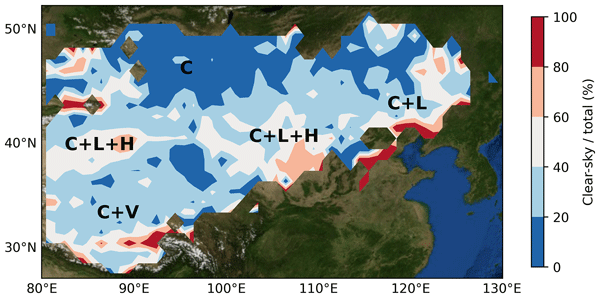
Abstract. East Asian dust storms impact the health and livelihoods of millions but the atmospheric processes responsible are far from fully understood because suitable observations are lacking. Here we analyse dust source activation (DSA) frequency data for East Asia (80–130° E, 27–52° N, January 2016 through December 2023, Chen et al., 2025, https://doi.org/10.1088/1748-9326/addee6) to understand atmospheric controls on dust activation. We show that East Asia's two primary dust source regions (Chen et al., 2025) display distinct diurnal and seasonal variations in DSA frequency. A southern region, sandwiched between the Mongolian Plateau and the Tibetan Plateau, chiefly consisting of the Taklimakan Desert and the Alashan Plateau, is active year-round, with 40–60 % of events predominantly occurring during late morning (09:00–12:00 local solar time; LST) under clear-sky conditions. We show that breakdown of the Low-level Jet (LLJ) is a major control on dust activation across this region (not only the Taklimakan Desert), driven by morning heating of the land surface, deepening the convective boundary layer and momentum transfer to the land surface. A northern region, centred on the Mongolian Plateau-Gobi Desert is dust-active from morning to afternoon (08:00–14:00 LST), primarily under cloudy conditions, driven by the passage of low-pressure systems. A third (less active) dust source region, the Tibetan Plateau, is typically active during winter afternoons in response to strong mountain-valley winds. Meso- and local-scale winds are more extensive drivers of dust activation across East Asia than previously documented, adding uncertainty to model predictions of future dust emissions in East Asia under a warming climate.
-
Notice on discussion status
The requested preprint has a corresponding peer-reviewed final revised paper. You are encouraged to refer to the final revised version.
-
Preprint
(1794 KB)
-
Supplement
(704 KB)
-
The requested preprint has a corresponding peer-reviewed final revised paper. You are encouraged to refer to the final revised version.
- Preprint
(1794 KB) - Metadata XML
-
Supplement
(704 KB) - BibTeX
- EndNote
- Final revised paper


Journal article(s) based on this preprint
Interactive discussion
Status: closed
-
RC1: 'Comment on egusphere-2025-3077', Anonymous Referee #2, 23 Nov 2025
-
AC1: 'Reply on RC1', Lingle Chen, 06 Feb 2026
Response to Reviewer #RC1
This study analyzed the spatial distribution and diurnal characteristics of dust source activation frequency in East Asia, with the attribution of the mechanism based on the comparison of dust source activation frequency from Himawari-8/9 satellite imagery and wind fields from EAR5. The scope of the study is important, but I am concerned about the validity of the method and the associated interpretation. The dust source activation frequency and the mechanism attribution need to be strengthened.
General Comments
- This study relied on the dust source activation frequency data they constructed from Himawari-8/9 satellite imagery a lot. It is not clear that how the local dust emissions and transported dust plumes are distinguished against each other.
Response 1: Helpful feedback, thank you. Our DSAF dataset was collected using a method specifically designed to determine dust source activation without the bias introduced into other data sets by dust plume transportation in the atmosphere. What makes this possible is the high temporal resolution of our Himawari data set (every 10 mins). This allows us to track the dynamical evolution of dust plumes back to their source by running our animations of consecutive images backwards in time to establish the first appearance of dust plumes at their source. We have improved our wording in Section 3.1, Page 5, Lines 132–134 to clear up any potential for confusion.
- How does dust source activation frequency associated with dust emission flux, or how does the dust emission flux vary for each dust source activation event?
Response 2: Dust source activation frequency quantifies how often the surface is activated as a dust source, rather than the amount of dust emitted during individual events. Dust emission flux is a function of wind speed and soil surface characteristics determining the susceptibility to deflation.
The relationship between dust source activation and dust emission can be qualitatively inferred through the cross-comparison (Figure S2) between daily aerosol optical depth at 550 nm (AOD550) from the AERONET site at Dalanzadgad (43.577°N, 104.419°E) and the timing of dust source activation (DSA) identified from Himawari-8/9 observations. This comparison shows that AOD peaks vary substantially among different DSA events. It should be emphasised that AOD is not a direct measure of dust emission flux, but rather an integrated air column proxy of atmospheric dust loading that is also influenced by transport and removal processes. Therefore, quantitatively converting DSA occurrences into dust-emission fluxes would require additional constraints and modelling and is therefore beyond the scope of this study. We have clarified this limitation in the revised manuscript (Section 3.1, Page 6, Lines 151–152).
- The study relied on the different attributed mechanisms responsible for the dust activation. How does that attribution conduct? For low-level jet specifically, is it based on the co-occurrence of low-level jet and dust events?
Response 3: This is an excellent question. Our attribution of LLJ-associated dust source activation in the revised manuscript is now updated and performed on an event-by-event basis. For each clear-sky DSA event, we examine the simultaneous ERA5 wind field across multiple pressure levels at the event location and time. LLJ-associated DSA is diagnosed when dust source activation occurs under clear-sky conditions and the wind-speed difference between the jet-nose level and the near-surface level exceeds 5 m s-1 at 06:00 LST on the day of activation. Events not meeting this dynamical criterion are attributed to other mechanisms (e.g. synoptic pressure gradients, troughs, or cold surges). Thus, attribution is based on diagnosing the dominant atmospheric process for each individual event rather than on long-term co-occurrence statistics. We clarify this in Section 3.4, Page 8, Lines 205–206; Section 4.4.2, Page 15, Lines 391–393)
- Although the study argued that their data source of Himawari-8/9 satellite is at high temporal (10-min) and spatial (2 km by 2 km) resolutions, the study actually used the gridded data at 1 by 1 degree, or 100 km by 100 km, at hourly resolution. The meteorological data of EAR5 which they relied on is also at 31 km spatial resolution. How spatially representative are the study, especially given the highly localized feature of dust emissions? In addition, the subregions in East Asia are only represented by one or several 1x1 grid cell, would the conclusion be generalizable to the region?
Response 4: We appreciate this important point. T
We agree, dust activation can be highly localised. However, our objective is to identify meso- to synoptic-scale drivers of dust-source activation across East Asia, rather than to resolve fine-scale geomorphic source units. The 1°grid therefore represents broader dust-source provinces, while ERA5 provides wind and pressure fields at appropriate spatial scales for diagnosing the large-scale mechanisms responsible for activation.
Our choice to focus on representative grid cells, rather than aggregating all grids within a region, was intended to isolate major dust activation areas that exhibit the clearest and most persistent diurnal signals, thereby enabling a more direct and physically meaningful comparison with wind patterns (Section 4.3, Page 10, Lines 260–262). Taking this approach bases our interpretations on solid observations from which conclusions can be generalised at this regional/synoptic scale.
Specific Comments
- Line 114, corresponding to general comment #4, is the gridded data at 1x1 degree actually used for the study?
Response 5: This point is addressed in the first paragraph of Response 4, where we clarify the distinction between the native Himawari-8/9 observations and our derived gridded DSAF product (Page 6, Lines 146–147).
- Line 181-183: given 1 by 1 degree gridded data, does that mean the regions discussed are only represented by one grid cell? In addition, the spatial domain of 1 degree specified in the caption is not consistent with the maps, which seems indicating much larger domain for MP and NP. It is also inconsistent with the discussion in Line 188 stating the spatial domain is 2 degree for TK and Line 201 for TP. Please clarify and check the consistency throughout the paper.
Response 6: Thank you for pointing out the inconsistency in Figs. 4 and 5. To ensure consistency, we have revised the manuscript so that all grids used in the analysis for Figs. 4, 5 and 7 are defined uniformly at 2° × 2°, and we updated all grid references in the text accordingly.
- Line 203-205: is the mountain-valley wind attributed dust source activation only from this deduction? is there any direct evidence to support the cause of TP dust events?
Response 7: There is limited evidence for directly identifying the drivers of local dust emissions on the Tibetan Plateau because meteorological stations in this region are sparse and it is difficult to distinguish locally generated dust from remotely transported dust. To our knowledge, our study pioneers this effort and attempts to establish this linkage for the first time. Our argument is based on the diurnal peaks—specifically the co-occurrence of late-afternoon peaks in dust activation and surface gusts—which we interpret as evidence for mountain–valley wind forcing. To clarify this point, we have added the corresponding explanation in the Page 12, Lines 301–311.
- Line 222, why is the local time of 9 am specifically chosen? Is it the same reason stated in line 258-261? If so, it is better to move the stated reason in section 4.3.1.
Response 8: In the previous version, we used different early-morning times for diagnosing LLJ occurrence (06:00 LST) and for LLJ-associated dust activity (09:00 LST), which may appear inconsistent. To avoid confusion in the revised manuscript, we now consistently adopt 06:00 LST throughout the revised manuscript. This choice is physically motivated, as 06:00 LST corresponds to the typical maximum intensity of the LLJ and is also consistent with previous studies over the Sahara (Schepanski et al., 2009). The revised text is in Page 15, Lines 367–369. This revision improves methodological consistency and does not affect the results or conclusions of the study.
- Line 250-251, is day-round suggesting only daytime? Please clarify.
Response 9: Thank you for this comment. The term “day-round” was intended to refer to the full 24-hour period, not daytime only. In the revised manuscript, however, we have removed this formulation, as the LLJ contribution is now evaluated using an event-based attribution framework.
- Line 256-258: this sentence is so confusing. Is it stating the same thing as what is in line 248-251? Specifically, is the proportion calculated as the LLJ contributions under clear-sky conditions from 9 am to 12 pm local solar time, divided by the total dust source activation frequency under both cloudy and clear-sky conditions during all daytime? Please clarify.
Response 10: In the previous version, to evaluate the LLJ contribution to dust activity, we calculate the proportion of dust source activation events that occur between 09:00 and 12:00 LST under clear-sky conditions and divide this by the total number of dust source activation events under both clear-sky and cloud-associated conditions during the entire daytime period.
However, we have removed this formulation, as the LLJ contribution is now evaluated using an event-based attribution framework. We now attribute individual DSA events to LLJ conditions based on their co-occurrence with LLJ diagnostics. LLJ-associated DSA events were defined when DSA occurred during the later morning (i.e., 09:00–12:00 LST) under clear-sky conditions and when an LLJ was present at 06:00 LST on the same day. We have revised this text to improve clarity in Section 3.4, Page 8, Lines 206–208; Section 4.4.2, Page 15, Lines 390–392.
- Line 271, why is 6am LST chosen here?
Response 11: Nice question. We examine the LLJ at 06:00 LST, when it reaches its maximum intensity and provides the strongest vertical shear, preconditioning the boundary layer for dust uplift, typically observed around 09:00 LST associated with disturbance triggered by LLJ-breakdown. Text revised to improve clarity, Page 15, Lines 367–370.
- Line 293-294, dust emission mechanisms are directly parametrized to surface wind speed. The relationship between dust emissions and surface wind is not linear. How can the temporal correspondence between surface gusts and dust source activation frequency indicate any association with the synoptic cyclones? On the other hand, how can the less agreement between them indicate any non-association with the synoptic cyclones?
Response 12: In response to RC3 comments, we have reframed the manuscript to emphasise that wind gusts can be generated by multiple meteorological processes before going on to assess their importance.
Technical Comments:
- Line 116, typo of “cloud clover”. Need to be replaced to “cloud cover”.
Response 13: Thanks for the correction. We have replaced to ‘cloud cover’.
- Figure 7, the color scheme for vertical wind profile needs to be replaced by a more distinguishable one. It is hard to tell the color difference between 00-02 and 21-23.
Response 14: We have replaced Figure 7 with the heatmap as suggested by reviewer #RC3.
Citation: https://doi.org/10.5194/egusphere-2025-3077-AC1 -
AC4: 'Reply on RC1', Lingle Chen, 06 Feb 2026
The comment was uploaded in the form of a supplement: https://egusphere.copernicus.org/preprints/2025/egusphere-2025-3077/egusphere-2025-3077-AC4-supplement.pdf
-
AC1: 'Reply on RC1', Lingle Chen, 06 Feb 2026
-
RC2: 'Comment on egusphere-2025-3077', Anonymous Referee #3, 25 Nov 2025
This study performed a systematic analysis of the spatial pattern and time series of the dust source activation frequency in East Asia derived from satellite-based observations. By comparison with the meteorological conditions derived from ERA5, the authors attributed the dust source activation events into three mechanisms, low pressure cyclones, breakdown of low-level jet, and mountain valley winds. The authors further provided statistical results indicating the relative importance of these three mechanisms in different dust source regions. This study provides solid observational evidence of the systems dominating dust emissions in East Asia, and I suggest considering publication after the following comments are addressed.
- When looking at the dust activation frequency data, I’m always confused about the definition of a dust activation event. For example, assuming a single dust emitting event lasts for a few hours within a day, is the ‘dust activation frequency’ the fraction of time with dust emission? The authors should make it clear in the data & method section.
- The authors spend a lot of effort to give a comprehensive review of the mechanisms responsible for dust emissions in East Asia in section 2, and I feel like this should be shorted and put into introduction. Rather than stating the dominant mechanism in each region, I suggest the authors focus more on the limitations of previous studies.
- When analyzing breakdown of low-level jets in Fig. 6, the authors chose to use the wind speed maxima at 3 UTC. Is it more reasonable to use local time because of the diurnal characteristic of these systems? The frequency of the low-level jet is also confusing. Is it the fraction of days that have low-level jets? Also using local time might help identifying low-level jet occurrence.
- It seems that in Fig. 7 the authors tried to compare the wind speed profiles under dusty or non-dusty days. Are they the average wind profiles across all dusty and non-dusty days? Meanwhile the wind share at 0 UTC is compared, why not 3 UTC?
- Attribution of different dust activation events. It seems that the authors tried to attribute each event to different mechanisms by comparing their time series. However, there might be overlaps of different systems, for example the breakdown of low-level jet might occur together with cyclones. In Fig. 8, breakdown of low-level jets could also contribute to an increase in 10-m wind speed.
- I agree with the comments from reviewer #2 that in Fig. 4 you should count in all the regions defined on the left rather than only check a single grid cell.
Citation: https://doi.org/10.5194/egusphere-2025-3077-RC2 -
AC2: 'Reply on RC2', Lingle Chen, 06 Feb 2026
Response to Reviewer #RC2
This study performed a systematic analysis of the spatial pattern and time series of the dust source activation frequency in East Asia derived from satellite-based observations. By comparison with the meteorological conditions derived from ERA5, the authors attributed the dust source activation events into three mechanisms, low pressure cyclones, breakdown of low-level jet, and mountain valley winds. The authors further provided statistical results indicating the relative importance of these three mechanisms in different dust source regions. This study provides solid observational evidence of the systems dominating dust emissions in East Asia, and I suggest considering publication after the following comments are addressed.
- When looking at the dust activation frequency data, I’m always confused about the definition of a dust activation event. For example, assuming a single dust emitting event lasts for a few hours within a day, is the ‘dust activation frequency’ the fraction of time with dust emission? The authors should make it clear in the data & method section.
Response 1: Thanks for highlighting the confusion. In our study, a dust source activation (DSA) event is defined as the occurrence of dust emission within a given 1° × 1° grid cell on a particular day, as identified from 10-minute Himawari-8 imagery. If dust emission is detected at any time during the day within that grid cell, the day is counted as one DSA event for that cell. The DSA frequency (DSAF) therefore represents the number of days with dust activation and does not correspond to the fraction of time or number of hours with dust emission within a day. We have revised the manuscript text to clarify, explicitly stating the definition and formulation of DSAF, including an equation and an explanatory note in Section 3.1.
- The authors spend a lot of effort to give a comprehensive review of the mechanisms responsible for dust emissions in East Asia in section 2, and I feel like this should be shorted and put into introduction. Rather than stating the dominant mechanism in each region, I suggest the authors focus more on the limitations of previous studies.
Response 1: Good point, we have shortened Section 2 by removing detailed discussions of synoptic-scale mechanisms and reducing region-specific descriptions, and have refocused the section on key gaps in the existing literature. Most previous studies of East Asian dust have examined individual regions, specific event types, or seasonal to synoptic variability, and there has been no systematic, observation-based assessment of the diurnal cycle of dust source activation across the entire East Asian domain.
To our knowledge, this study provides the first continent-scale quantification of the diurnal cycle of dust source activation frequency using high-temporal-resolution geostationary satellite observations. We therefore combine this with a systematic assessment of the meteorological processes governing these diurnal variations. We decide to retain a concise overview of relevant mechanisms in Section 2 to provide essential physical context for interpreting dust activation on diurnal timescales.
- When analyzing breakdown of low-level jets in Fig. 6, the authors chose to use the wind speed maxima at 3 UTC. Is it more reasonable to use local time because of the diurnal characteristic of these systems? The frequency of the low-level jet is also confusing. Is it the fraction of days that have low-level jets? Also using local time might help identifying low-level jet occurrence.
Response 3: In the preprint version, we referred to different early-morning times for LLJ diagnostics (06:00 LST) and for LLJ-associated dust occurrence (09:00 LST), which may appear inconsistent. To avoid confusion in the revised manuscript, we now consistently adopt 06:00 LST throughout the revised manuscript, as 06:00 LST corresponds to the typical maximum intensity of the LLJ and is also consistent with previous studies over the Sahara (Schepanski et al., 2009). This revision improves methodological consistency and does not affect the results or conclusions of the study.
The LLJ frequency is defined as the number of days with a diagnosed low-level jet divided by the total number of observation days. This definition is now clarified in both the Methods section (Page 8, Lines 205–208) and the figure 6a caption to avoid ambiguity.
- It seems that in Fig. 7 the authors tried to compare the wind speed profiles under dusty or non-dusty days. Are they the average wind profiles across all dusty and non-dusty days? Meanwhile the wind share at 0 UTC is compared, why not 3 UTC?
Response 3: Yes, we averaged the wind profiles across all dusty days under clear-sky condition and non-dust days. We have now clarified this in the caption. The comparison was shown for 06:00 LST (00:00 UTC in the initial version of the manuscript) because this time corresponds most closely to the peak occurrence and maximum intensity of the LLJ over the study regions, preconditioning peak dust activation at 09:00 UTC when surface disturbances are maximised by LLJ-breakdown. Thus, 06:00 LST is a representative time to illustrate the characteristic LLJ-related wind-speed contrast between dusty and non-dusty conditions (Page 13, Lines 346–348).
- Attribution of different dust activation events. It seems that the authors tried to attribute each event to different mechanisms by comparing their time series. However, there might be overlaps of different systems, for example the breakdown of low-level jet might occur together with cyclones. In Fig. 8, breakdown of low-level jets could also contribute to an increase in 10-m wind speed.
Response 5: We thank the reviewer for this insightful comment. We agree that dust activation mechanisms are not mutually exclusive, and that different atmospheric systems may overlap during individual events. Cloud-associated activations indicate a higher likelihood of synoptic-scale influence (e.g. cyclones), whereas clear-sky activations more commonly occur under conditions favourable for boundary-layer processes, including low-level jets. We explicitly acknowledge that these processes may coexist and interact during individual dust activation events
To address this point, we have revised the caption and interpretation of Figure 8 to emphasise regime dominance rather than one-to-one attribution, and to explicitly note the potential for overlapping mechanisms (e.g. low-level jet breakdown occurring together with cyclones). See revised text in Page 20, Lines 494–496.
- I agree with the comments from reviewer #2 that in Fig. 4 you should count in all the regions defined on the left rather than only check a single grid cell.
Response 6: Sorry for the confusion. We have updated the analysis to focus on five representative regions: the Mongolia Plateau (MP; 103–105°E, 43–45°N), the Northeast Plain (NP; 121–123°E, 43–45°N), the Alashan Plateau (ALS; 100–102°E, 41–43°N), the Taklimakan Desert (TK; 88–90°E, 39–41°N), and the Tibetan Plateau (TP; 91–93°E, 34–36°N). Each region is represented by four 2° × 2° grid cells.
Citation: https://doi.org/10.5194/egusphere-2025-3077-AC2
-
RC3: 'Comment on egusphere-2025-3077', Yan Yu, 25 Nov 2025
This study analyzes a recently published dust source activation dataset compiled by the same group of authors and tries to attribute the atmospheric forcings responsible for dust activation across East Asia, with an emphasis on the diurnal time scale. Built on the temporal resolution of geostationary satellite, this study examines the resolved details about space and time of dust activation. Therefore, it provides important additions to the existing knowledge about dust emission processes in East Asia. But these new insights could be strengthened upon improved analysis and presentation. Therefore, I recommend a major revision before the manuscript is considered for publication at ACP.
Major questions and suggestions:
- The authors have classified dust source activation events into clear-sky and cloudy situations, and subsequent attribute them to different atmospheric causes. Naturally, one would expect larger uncertainty in the manual identification of dust source activation under clouds. Do you have any uncertainty estimation regarding the time and location of DSA identification in clear-sky and cloudy situations?
- You have attributed the cloudy situations to cyclone-type of DSA. However, convective storms, especially the cold pools associated with them, can also initiate dust emission (Fiedler et al., 2013; Heinold et al., 2013). These convective dust storms, mostly seen in local summer and afternoon, can at least partially explain the summer, afternoon DSAs in Taklamakan and Alashan.
- On the organization of the contents, I recommend reducing the text about the seasonal cycle and expanding the analysis on shorter time scales, as these are better seen in the currently analyzed geostationary satellite data. To expand on the shorter time scales, I recommend the following additional analysis and/or clarifications: (1) The authors seem to treat wind gusts, Mongolia Cyclone, and break down of LLJ as different atmospheric forcings. But the latter two processes, along with the convective storms I mentioned earlier, could also introduce high wind gusts. Therefore, I don’t like the current framing of section 4.4 that mainly attributes the variations in wind gusts to mountain-valley wind. Indeed, I think a better way to establish the linkage between wind gust (possibly caused by different atmospheric forcings) and DSA is to add the diurnal cycle of wind gust by season on top of the barchart of DSA in Figure 4. It might be helpful to further separate the clear-sky and cloudy cases, dusty and non-dusty cases. From such a figure, we get an overview of the importance of wind gust in driving dust emission. (2) Towards the end of the results section, you can still present the monthly time series (Figure 8). But as a reader I’m curious about at what time of day the temporal variation in wind gust is most closely related to that of DSA. Could provide this information (maybe in a table or heatmap showing correlation coefficients between DSA and wind gusts at different time of day). (3) Attribution of DSA to LLJ could be done in a more specific way. Currently you are inferring the contribution of LLJ by morning DSA over total DSA. But these morning DSA could be partially caused by cyclones too. Could you collocate the DSA with LLJ spatio-temporally and see how much of the DSA in each grid is genuinely caused by LLJ? (4) Figure 3 is a nice summary of the peak hour of DSA. But I believe in some dust sources especially those only active during the overpass of Mongolian Cyclones, there is no distinct pattern of diurnal variation. I recommend the analysis of variance framework, as used in our analysis about diurnal variability in dust optical depth (Yu et al. 2021). Using this framework, you can easily tell if diurnal variability is truly a leading component of DSA’s temporal variability by comparing the variance on the diurnal time scale to that on the seasonal time scale and day-to-day time scale, for each grid.
Minor questions and suggestions:
- On line 111, you state that “dust plumes were identified by manual inspection of daily animations”. Did you specially require that the DSA of each plume has to be tracked within the same day? If so, you are possibly splitting multi-day events into separate daily events and miss-identifying fake sources.
- On line 127, you state that “we used ERA5 monthly averaged data to analyze the monthly variations in wind speed and gusts”. Are you referring only to Section 4.4? It appears that in Figs. 6 and 7, for example, hourly wind speed at different levels is analyzed.
- In Figure 4 and other relevant analysis, rather than picking the grid with highest dust source activation frequency, why don’t aggregate all grids in a specific region to expand the sample?
- You don’t have to say that wind data is from ERA5 every time in the figure captions.
- In Fig. 6, you say that the LLJ is identified based for 9:00 local solar time, but I believe at this time LLJs are starting to break down. Whereas in Fig. 7, it is at 6:00 local solar time. I wonder if it is a typo in the caption of Fig. 6.
- In Fig. 7, the lines are hard to distinguish from each other, maybe consider using a heat map with x-axis for time of day, and y-axis for vertical level, and color representing the wind speed.
Reference:
Fiedler, S., Schepanski, K., Heinold, B., Knippertz, P., and Tegen, I.: Climatology of nocturnal low-level jets over North Africa and implications for modeling mineral dust emission, J. Geophys. Res.-Atmos., 118, 6100–6121, https://doi.org/10.1002/jgrd.50394, 2013.
Heinold, B., Knippertz, P., Marsham, J. H., Fiedler, S., Dixon, N. S., Schepanski, K., Laurent, B., and Tegen, I.: The role of deep convection and nocturnal low-level jets for dust emission in summertime West Africa: Estimates from convection-permitting simulations, J. Geophys. Res.-Atmos., 118, 4385–4400, https://doi.org/10.1002/jgrd.50402, 2013.
Yu, Y., Kalashnikova, O. V., Garay, M. J., Lee, H., Choi, M., Okin, G. S., Yorks, J. E., Campbell, J. R., and Marquis, J.: A global analysis of diurnal variability in dust and dust mixture using CATS observations, Atmos. Chem. Phys., 21, 1427–1447, https://doi.org/10.5194/acp-21-1427-2021, 2021.
Citation: https://doi.org/10.5194/egusphere-2025-3077-RC3 -
AC3: 'Reply on RC3', Lingle Chen, 06 Feb 2026
Response to Reviewer #RC3
This study analyzes a recently published dust source activation dataset compiled by the same group of authors and tries to attribute the atmospheric forcings responsible for dust activation across East Asia, with an emphasis on the diurnal time scale. Built on the temporal resolution of geostationary satellite, this study examines the resolved details about space and time of dust activation. Therefore, it provides important additions to the existing knowledge about dust emission processes in East Asia. But these new insights could be strengthened upon improved analysis and presentation. Therefore, I recommend a major revision before the manuscript is considered for publication at ACP.
Major questions and suggestions:
- The authors have classified dust source activation events into clear-sky and cloudy situations, and subsequent attribute them to different atmospheric causes. Naturally, one would expect larger uncertainty in the manual identification of dust source activation under clouds. Do you have any uncertainty estimation regarding the time and location of DSA identification in clear-sky and cloudy situations?
Response 1: Our DSAF data set is derived taking a conservative approach: a DSA event is flagged only when (i) dust can be unambiguously distinguished from cloud in RGB/IR composites and (ii) its apparent source lies within a grid cell for at least one 10-min frame. Potentially obscured cases are not counted as DSA events but are documented separately and summarised in a map of cloud-obscured conditions (Figure. S1).
We also compare our DSA dataset with daily aerosol optical depth at 550 nm () from the AERONET Dalanzadgad site (43.577° N, 104.419° E) (Figure. S2). Our comparison demonstrates the reproducibility of DSA timing of Himawari-8/9-identified DSA relative to peaks reported from AERONET.
To assess uncertainty in the manual identification of DSA events, we conducted an inter-operator consistency test in which a randomly selected four-month subset of dust RGB imagery was independently re-labelled by a second operator (Figure. S3). The results are virtually indistinguishable when the DSAF maps are compared to one another (compare Figure S3 a, b, c to d, e, f, respectively). Unmatched events are largely confined to regions at the margins of frequent dust activity.
We also conducted a Critical Success Index (CSI) analysis to further clarify the origin of these mismatches. Under strict matching criteria (0 h, 0°), CSI values are ~ 0.3. CSI increases rapidly with modest relaxation of the matching tolerances, reaching moderate to high values (0.5–0.6) at ±1 h and ±1°. The relatively high CSI values, together with the similar CSI obtained for clear-sky and cloud-associated events, indicate that many mismatches arise from differences in event classification (clear-sky versus cloud-associated) rather than from inconsistent event detection. Together with cross-comparison with our DSA dataset against independent AERONET observations, this analysis demonstrates that human subjectivity introduces no substantial bias into our DSA estimates. These clarifications have been added to the manuscript (see Page 6, Line146–152, and section 3.2).
- You have attributed the cloudy situations to cyclone-type of DSA. However, convective storms, especially the cold pools associated with them, can also initiate dust emission (Fiedler et al., 2013; Heinold et al., 2013). These convective dust storms, mostly seen in local summer and afternoon, can at least partially explain the summer, afternoon DSAs in Taklamakan and Alashan.
Response 2: Good point. We have added section 2.3 to explicitly acknowledge convective activities (e.g., haboobs) as another processes for dust activation in East Asia and we now assess for DSA events associated with summer afternoon convection (section 4.5).
- On the organization of the contents, I recommend reducing the text about the seasonal cycle and expanding the analysis on shorter time scales, as these are better seen in the currently analyzed geostationary satellite data. To expand on the shorter time scales, I recommend the following additional analysis and/or clarifications: (1) The authors seem to treat wind gusts, Mongolia Cyclone, and break down of LLJ as different atmospheric forcings. But the latter two processes, along with the convective storms I mentioned earlier, could also introduce high wind gusts. Therefore, I don’t like the current framing of section 4.4 that mainly attributes the variations in wind gusts to mountain-valley wind. Indeed, I think a better way to establish the linkage between wind gust (possibly caused by different atmospheric forcings) and DSA is to add the diurnal cycle of wind gust by season on top of the barchart of DSA in Figure 4. It might be helpful to further separate the clear-sky and cloudy cases, dusty and non-dusty cases. From such a figure, we get an overview of the importance of wind gust in driving dust emission.
Response 3.1: Thank you for this very constructive suggestion. We have revised the framing of Section 4.3 to emphasise the broader role of wind gusts arising from multiple atmospheric forcings in driving DSA. In addition, we have added the diurnal cycle of wind gusts to the bar chart of DSA in Fig. 4 and separated the analysis into clear-sky and cloud-associated conditions. This revised figure provides a more comprehensive assessment of the relationship between wind gusts and DSA.
(2) Towards the end of the results section, you can still present the monthly time series (Figure 8). But as a reader I’m curious about at what time of day the temporal variation in wind gust is most closely related to that of DSA. Could provide this information (maybe in a table or heatmap showing correlation coefficients between DSA and wind gusts at different time of day).
Response 3.2: We thank the reviewer for this suggestion. Following the reviewer’s recommendation, we now focus on the diurnal scale rather than the monthly scale and have therefore removed Fig. 8.
The update implemented to Fig. 3, as proposed by the reviewer, already presents the relationship between DSA and wind gusts in a physically meaningful manner. In our analysis, DSA is treated as a discrete, event-based variable with at most one activation time per grid cell per day, whereas wind gustiness is sampled at hourly resolution throughout the day. Because DSA does not constitute a time series with temporal sampling comparable to wind gusts, correlation-based heatmaps are not the most appropriate diagnostic for the relationship between these two data sets. We can, nevertheless, qualitatively identify the relationship between DSA timing and hourly wind gusts illustrated in Fig. 3. We have clarified in the text that dust activation is governed by the exceedance of a critical wind-gust threshold rather than by the absolute daily maximum wind speed (Page 12, Lines 309–311).
(3) Attribution of DSA to LLJ could be done in a more specific way. Currently you are inferring the contribution of LLJ by morning DSA over total DSA. But these morning DSA could be partially caused by cyclones too. Could you collocate the DSA with LLJ spatio-temporally and see how much of the DSA in each grid is genuinely caused by LLJ?
Response 3.3: Thank you for this suggestion. We performed an explicit spatiotemporal collocation between DSA events and identified LLJ occurrences at the same 1° × 1° grid cell and time. We quantify, for each grid cell, the proportion of DSA events that coincide with LLJ conditions (i.e., LLJ-associated DSA). This approach provides a more direct and physically based attribution of DSA to LLJ influence than the morning-fraction metric alone. We have therefore added figure 6b and related text in section 3.4 (Page 8, Lines 205–218) and section 4.4.2 (Page 15, Lines 390–399).
(4) Figure 3 is a nice summary of the peak hour of DSA. But I believe in some dust sources especially those only active during the overpass of Mongolian Cyclones, there is no distinct pattern of diurnal variation. I recommend the analysis of variance framework, as used in our analysis about diurnal variability in dust optical depth (Yu et al. 2021). Using this framework, you can easily tell if diurnal variability is truly a leading component of DSA’s temporal variability by comparing the variance on the diurnal time scale to that on the seasonal time scale and day-to-day time scale, for each grid.
Response 3.4: Thank you for this excellent suggestion. We have now implemented an ANOVA-based framework fooling Yu et al. (2021) to quantify the statistical significance and relative importance of diurnal variability in dust source activation frequency. The method is described in Section 3.3. We have therefore updated our figure 3 to indicate the different variances.
Minor questions and suggestions:
- On line 111, you state that “dust plumes were identified by manual inspection of daily animations”. Did you specially require that the DSA of each plume has to be tracked within the same day? If so, you are possibly splitting multi-day events into separate daily events and miss-identifying fake sources.
Response 5: We appreciate the reviewer’s concern but, in our workflow, dust plumes are not binned into single-day windows. Our animations are viewed on a daily basis, but all plumes are continuously tracked across consecutive days when they persist across day boundaries, ensuring that multi-day events are treated as continuous dust episodes rather than as separate daily occurrences. We have added ‘Dust plumes were identified by manual inspection of daily animations and traced back in time to their source seamlessly across day boundaries’ in Section 3.1, Page 5, Lines 131–132.
- On line 127, you state that “we used ERA5 monthly averaged data to analyze the monthly variations in wind speed and gusts”. Are you referring only to Section 4.4? It appears that in Figs. 6 and 7, for example, hourly wind speed at different levels is analyzed.
Response 6: Thank you for pointing this out. Since we diagnose the meteorological processes associated with dust source activation using an event-based approach, in the revised manuscript, we have updated all of our analyses to use hourly ERA5 wind fields at multiple pressure levels. We have revised Section 3.3 accordingly.
- In Figure 4 and other relevant analysis, rather than picking the grid with highest dust source activation frequency, why don’t aggregate all grids in a specific region to expand the sample?
Response 7: Our representative grid cells were chosen to assess the LLJ / convection mechanisms by focusing on core source regions with the clearest and most persistent diurnal signals. This enables a more direct and physically meaningful comparison between dust source activation and LLJ/convection occurrence and timing in the context of East Asia’s complex topography. We therefore retain the representative-grid analysis, clarify this rationale in Section 4.3 (Page 10, Lines 260–261), and conduct the broader spatiotemporal analysis over the full region in Section 4.4.2 and 4.5.2.
- You don’t have to say that wind data is from ERA5 every time in the figure captions.
Response 8: Thanks, deleted in figure 7.
- In Fig. 6, you say that the LLJ is identified based for 9:00 local solar time, but I believe at this time LLJs are starting to break down. Whereas in Fig. 7, it is at 6:00 local solar time. I wonder if it is a typo in the caption of Fig. 6.
Response 9: Sorry for this confusion. In the previous preprint version, we used different early-morning times for LLJ diagnostics (06:00 LST) and for LLJ-associated DSA (09:00 LST). This choice was physically motivated, because 06:00 LST corresponds to the typical maximum LLJ intensity while dust activation is triggered by breakdown of the LLJ which occurs later (Schepanski et al., 2009), typically closer to 09:00 LST over East Asia. However, we appreciate that this approach introduces potential for confusion, so we now consistently adopt 06:00 LST throughout the revised manuscript. This revision improves methodological clarity and does not materially affect the results or conclusions of the study.
- In Fig. 7, the lines are hard to distinguish from each other, maybe consider using a heat map with x-axis for time of day, and y-axis for vertical level, and color representing the wind speed.
Response 10: We thank the reviewer for this very helpful suggestion. We have revised figure 5 accordingly by presenting the diurnal–vertical wind structure as heatmaps.
Reference:
Fiedler, S., Schepanski, K., Heinold, B., Knippertz, P., and Tegen, I.: Climatology of nocturnal low-level jets over North Africa and implications for modeling mineral dust emission, J. Geophys. Res.-Atmos., 118, 6100–6121, https://doi.org/10.1002/jgrd.50394, 2013.
Heinold, B., Knippertz, P., Marsham, J. H., Fiedler, S., Dixon, N. S., Schepanski, K., Laurent, B., and Tegen, I.: The role of deep convection and nocturnal low-level jets for dust emission in summertime West Africa: Estimates from convection-permitting simulations, J. Geophys. Res.-Atmos., 118, 4385–4400, https://doi.org/10.1002/jgrd.50402, 2013.
Yu, Y., Kalashnikova, O. V., Garay, M. J., Lee, H., Choi, M., Okin, G. S., Yorks, J. E., Campbell, J. R., and Marquis, J.: A global analysis of diurnal variability in dust and dust mixture using CATS observations, Atmos. Chem. Phys., 21, 1427–1447, https://doi.org/10.5194/acp-21-1427-2021, 2021.
Peer review completion


Interactive discussion
Status: closed
-
RC1: 'Comment on egusphere-2025-3077', Anonymous Referee #2, 23 Nov 2025
This study analyzed the spatial distribution and diurnal characteristics of dust source activation frequency in East Asia, with the attribution of the mechanism based on the comparison of dust source activation frequency from Himawari-8/9 satellite imagery and wind fields from EAR5. The scope of the study is important, but I am concerned about the validity of the method and the associated interpretation. The dust source activation frequency and the mechanism attribution need to be strengthened.
General Comments
- This study relied on the dust source activation frequency data they constructed from Himawari-8/9 satellite imagery a lot. It is not clear that how the local dust emissions and transported dust plumes are distinguished against each other.
- How does dust source activation frequency associated with dust emission flux, or how does the dust emission flux vary for each dust source activation event?
- The study relied on the different attributed mechanisms responsible for the dust activation. How does that attribution conduct? For low-level jet specifically, is it based on the co-occurrence of low-level jet and dust events?
- Although the study argued that their data source of Himawari-8/9 satellite is at high temporal (10-min) and spatial (2 km by 2 km) resolutions, the study actually used the gridded data at 1 by 1 degree, or 100 km by 100 km, at hourly resolution. The meteorological data of EAR5 which they relied on is also at 31 km spatial resolution. How spatially representative are the study, especially given the highly localized feature of dust emissions? In addition, the subregions in East Asia are only represented by one or several 1x1 grid cell, would the conclusion be generalizable to the region?
Specific Comments
- Line 114, corresponding to general comment #4, is the gridded data at 1x1 degree actually used for the study?
- Line 181-183: given 1 by 1 degree gridded data, does that mean the regions discussed are only represented by one grid cell? In addition, the spatial domain of 1 degree specified in the caption is not consistent with the maps, which seems indicating much larger domain for MP and NP. It is also inconsistent with the discussion in Line 188 stating the spatial domain is 2 degree for TK and Line 201 for TP. Please clarify and check the consistency throughout the paper.
- Line 203-205: is the mountain-valley wind attributed dust source activation only from this deduction? is there any direct evidence to support the cause of TP dust evenets?
- Line 222, why is the local time of 9 am specifically chosen? Is it the same reason stated in line 258-261? If so, it is better to move the stated reason in section 4.3.1.
- Line 250-251, is day-round suggesting only daytime? Please clarify.
- Line 256-258: this sentence is so confusing. Is it stating the same thing as what is in line 248-251? Specifically, is the proportion calculated as the LLJ contributions under clear-sky conditions from 9 am to 12 pm local solar time, divided by the total dust source activation frequency under both cloudy and clear-sky conditions during all daytime? Please clarify.
- Line 271, why is 6am LST chosen here?
- Line 293-294, dust emission mechanisms are directly parametrized to surface wind speed. The relationship between dust emissions and surface wind is not linear. How can the temporal correspondence between surface gusts and dust source activation frequency indicate any association with the synoptic cyclones? On the other hand, how can the less agreement between them indicate any non-association with the synoptic cyclones?
Technical Comments:
- Line 116, typo of “cloud clover”. Need to be replaced to “cloud cover”.
- Figure 7, the color scheme for vertical wind profile needs to be replaced by a more distinguishable one. It is hard to tell the color difference between 00-02 and 21-23.
Citation: https://doi.org/10.5194/egusphere-2025-3077-RC1 -
AC1: 'Reply on RC1', Lingle Chen, 06 Feb 2026
Response to Reviewer #RC1
This study analyzed the spatial distribution and diurnal characteristics of dust source activation frequency in East Asia, with the attribution of the mechanism based on the comparison of dust source activation frequency from Himawari-8/9 satellite imagery and wind fields from EAR5. The scope of the study is important, but I am concerned about the validity of the method and the associated interpretation. The dust source activation frequency and the mechanism attribution need to be strengthened.
General Comments
- This study relied on the dust source activation frequency data they constructed from Himawari-8/9 satellite imagery a lot. It is not clear that how the local dust emissions and transported dust plumes are distinguished against each other.
Response 1: Helpful feedback, thank you. Our DSAF dataset was collected using a method specifically designed to determine dust source activation without the bias introduced into other data sets by dust plume transportation in the atmosphere. What makes this possible is the high temporal resolution of our Himawari data set (every 10 mins). This allows us to track the dynamical evolution of dust plumes back to their source by running our animations of consecutive images backwards in time to establish the first appearance of dust plumes at their source. We have improved our wording in Section 3.1, Page 5, Lines 132–134 to clear up any potential for confusion.
- How does dust source activation frequency associated with dust emission flux, or how does the dust emission flux vary for each dust source activation event?
Response 2: Dust source activation frequency quantifies how often the surface is activated as a dust source, rather than the amount of dust emitted during individual events. Dust emission flux is a function of wind speed and soil surface characteristics determining the susceptibility to deflation.
The relationship between dust source activation and dust emission can be qualitatively inferred through the cross-comparison (Figure S2) between daily aerosol optical depth at 550 nm (AOD550) from the AERONET site at Dalanzadgad (43.577°N, 104.419°E) and the timing of dust source activation (DSA) identified from Himawari-8/9 observations. This comparison shows that AOD peaks vary substantially among different DSA events. It should be emphasised that AOD is not a direct measure of dust emission flux, but rather an integrated air column proxy of atmospheric dust loading that is also influenced by transport and removal processes. Therefore, quantitatively converting DSA occurrences into dust-emission fluxes would require additional constraints and modelling and is therefore beyond the scope of this study. We have clarified this limitation in the revised manuscript (Section 3.1, Page 6, Lines 151–152).
- The study relied on the different attributed mechanisms responsible for the dust activation. How does that attribution conduct? For low-level jet specifically, is it based on the co-occurrence of low-level jet and dust events?
Response 3: This is an excellent question. Our attribution of LLJ-associated dust source activation in the revised manuscript is now updated and performed on an event-by-event basis. For each clear-sky DSA event, we examine the simultaneous ERA5 wind field across multiple pressure levels at the event location and time. LLJ-associated DSA is diagnosed when dust source activation occurs under clear-sky conditions and the wind-speed difference between the jet-nose level and the near-surface level exceeds 5 m s-1 at 06:00 LST on the day of activation. Events not meeting this dynamical criterion are attributed to other mechanisms (e.g. synoptic pressure gradients, troughs, or cold surges). Thus, attribution is based on diagnosing the dominant atmospheric process for each individual event rather than on long-term co-occurrence statistics. We clarify this in Section 3.4, Page 8, Lines 205–206; Section 4.4.2, Page 15, Lines 391–393)
- Although the study argued that their data source of Himawari-8/9 satellite is at high temporal (10-min) and spatial (2 km by 2 km) resolutions, the study actually used the gridded data at 1 by 1 degree, or 100 km by 100 km, at hourly resolution. The meteorological data of EAR5 which they relied on is also at 31 km spatial resolution. How spatially representative are the study, especially given the highly localized feature of dust emissions? In addition, the subregions in East Asia are only represented by one or several 1x1 grid cell, would the conclusion be generalizable to the region?
Response 4: We appreciate this important point. T
We agree, dust activation can be highly localised. However, our objective is to identify meso- to synoptic-scale drivers of dust-source activation across East Asia, rather than to resolve fine-scale geomorphic source units. The 1°grid therefore represents broader dust-source provinces, while ERA5 provides wind and pressure fields at appropriate spatial scales for diagnosing the large-scale mechanisms responsible for activation.
Our choice to focus on representative grid cells, rather than aggregating all grids within a region, was intended to isolate major dust activation areas that exhibit the clearest and most persistent diurnal signals, thereby enabling a more direct and physically meaningful comparison with wind patterns (Section 4.3, Page 10, Lines 260–262). Taking this approach bases our interpretations on solid observations from which conclusions can be generalised at this regional/synoptic scale.
Specific Comments
- Line 114, corresponding to general comment #4, is the gridded data at 1x1 degree actually used for the study?
Response 5: This point is addressed in the first paragraph of Response 4, where we clarify the distinction between the native Himawari-8/9 observations and our derived gridded DSAF product (Page 6, Lines 146–147).
- Line 181-183: given 1 by 1 degree gridded data, does that mean the regions discussed are only represented by one grid cell? In addition, the spatial domain of 1 degree specified in the caption is not consistent with the maps, which seems indicating much larger domain for MP and NP. It is also inconsistent with the discussion in Line 188 stating the spatial domain is 2 degree for TK and Line 201 for TP. Please clarify and check the consistency throughout the paper.
Response 6: Thank you for pointing out the inconsistency in Figs. 4 and 5. To ensure consistency, we have revised the manuscript so that all grids used in the analysis for Figs. 4, 5 and 7 are defined uniformly at 2° × 2°, and we updated all grid references in the text accordingly.
- Line 203-205: is the mountain-valley wind attributed dust source activation only from this deduction? is there any direct evidence to support the cause of TP dust events?
Response 7: There is limited evidence for directly identifying the drivers of local dust emissions on the Tibetan Plateau because meteorological stations in this region are sparse and it is difficult to distinguish locally generated dust from remotely transported dust. To our knowledge, our study pioneers this effort and attempts to establish this linkage for the first time. Our argument is based on the diurnal peaks—specifically the co-occurrence of late-afternoon peaks in dust activation and surface gusts—which we interpret as evidence for mountain–valley wind forcing. To clarify this point, we have added the corresponding explanation in the Page 12, Lines 301–311.
- Line 222, why is the local time of 9 am specifically chosen? Is it the same reason stated in line 258-261? If so, it is better to move the stated reason in section 4.3.1.
Response 8: In the previous version, we used different early-morning times for diagnosing LLJ occurrence (06:00 LST) and for LLJ-associated dust activity (09:00 LST), which may appear inconsistent. To avoid confusion in the revised manuscript, we now consistently adopt 06:00 LST throughout the revised manuscript. This choice is physically motivated, as 06:00 LST corresponds to the typical maximum intensity of the LLJ and is also consistent with previous studies over the Sahara (Schepanski et al., 2009). The revised text is in Page 15, Lines 367–369. This revision improves methodological consistency and does not affect the results or conclusions of the study.
- Line 250-251, is day-round suggesting only daytime? Please clarify.
Response 9: Thank you for this comment. The term “day-round” was intended to refer to the full 24-hour period, not daytime only. In the revised manuscript, however, we have removed this formulation, as the LLJ contribution is now evaluated using an event-based attribution framework.
- Line 256-258: this sentence is so confusing. Is it stating the same thing as what is in line 248-251? Specifically, is the proportion calculated as the LLJ contributions under clear-sky conditions from 9 am to 12 pm local solar time, divided by the total dust source activation frequency under both cloudy and clear-sky conditions during all daytime? Please clarify.
Response 10: In the previous version, to evaluate the LLJ contribution to dust activity, we calculate the proportion of dust source activation events that occur between 09:00 and 12:00 LST under clear-sky conditions and divide this by the total number of dust source activation events under both clear-sky and cloud-associated conditions during the entire daytime period.
However, we have removed this formulation, as the LLJ contribution is now evaluated using an event-based attribution framework. We now attribute individual DSA events to LLJ conditions based on their co-occurrence with LLJ diagnostics. LLJ-associated DSA events were defined when DSA occurred during the later morning (i.e., 09:00–12:00 LST) under clear-sky conditions and when an LLJ was present at 06:00 LST on the same day. We have revised this text to improve clarity in Section 3.4, Page 8, Lines 206–208; Section 4.4.2, Page 15, Lines 390–392.
- Line 271, why is 6am LST chosen here?
Response 11: Nice question. We examine the LLJ at 06:00 LST, when it reaches its maximum intensity and provides the strongest vertical shear, preconditioning the boundary layer for dust uplift, typically observed around 09:00 LST associated with disturbance triggered by LLJ-breakdown. Text revised to improve clarity, Page 15, Lines 367–370.
- Line 293-294, dust emission mechanisms are directly parametrized to surface wind speed. The relationship between dust emissions and surface wind is not linear. How can the temporal correspondence between surface gusts and dust source activation frequency indicate any association with the synoptic cyclones? On the other hand, how can the less agreement between them indicate any non-association with the synoptic cyclones?
Response 12: In response to RC3 comments, we have reframed the manuscript to emphasise that wind gusts can be generated by multiple meteorological processes before going on to assess their importance.
Technical Comments:
- Line 116, typo of “cloud clover”. Need to be replaced to “cloud cover”.
Response 13: Thanks for the correction. We have replaced to ‘cloud cover’.
- Figure 7, the color scheme for vertical wind profile needs to be replaced by a more distinguishable one. It is hard to tell the color difference between 00-02 and 21-23.
Response 14: We have replaced Figure 7 with the heatmap as suggested by reviewer #RC3.
Citation: https://doi.org/10.5194/egusphere-2025-3077-AC1 -
AC4: 'Reply on RC1', Lingle Chen, 06 Feb 2026
The comment was uploaded in the form of a supplement: https://egusphere.copernicus.org/preprints/2025/egusphere-2025-3077/egusphere-2025-3077-AC4-supplement.pdf
-
RC2: 'Comment on egusphere-2025-3077', Anonymous Referee #3, 25 Nov 2025
This study performed a systematic analysis of the spatial pattern and time series of the dust source activation frequency in East Asia derived from satellite-based observations. By comparison with the meteorological conditions derived from ERA5, the authors attributed the dust source activation events into three mechanisms, low pressure cyclones, breakdown of low-level jet, and mountain valley winds. The authors further provided statistical results indicating the relative importance of these three mechanisms in different dust source regions. This study provides solid observational evidence of the systems dominating dust emissions in East Asia, and I suggest considering publication after the following comments are addressed.
- When looking at the dust activation frequency data, I’m always confused about the definition of a dust activation event. For example, assuming a single dust emitting event lasts for a few hours within a day, is the ‘dust activation frequency’ the fraction of time with dust emission? The authors should make it clear in the data & method section.
- The authors spend a lot of effort to give a comprehensive review of the mechanisms responsible for dust emissions in East Asia in section 2, and I feel like this should be shorted and put into introduction. Rather than stating the dominant mechanism in each region, I suggest the authors focus more on the limitations of previous studies.
- When analyzing breakdown of low-level jets in Fig. 6, the authors chose to use the wind speed maxima at 3 UTC. Is it more reasonable to use local time because of the diurnal characteristic of these systems? The frequency of the low-level jet is also confusing. Is it the fraction of days that have low-level jets? Also using local time might help identifying low-level jet occurrence.
- It seems that in Fig. 7 the authors tried to compare the wind speed profiles under dusty or non-dusty days. Are they the average wind profiles across all dusty and non-dusty days? Meanwhile the wind share at 0 UTC is compared, why not 3 UTC?
- Attribution of different dust activation events. It seems that the authors tried to attribute each event to different mechanisms by comparing their time series. However, there might be overlaps of different systems, for example the breakdown of low-level jet might occur together with cyclones. In Fig. 8, breakdown of low-level jets could also contribute to an increase in 10-m wind speed.
- I agree with the comments from reviewer #2 that in Fig. 4 you should count in all the regions defined on the left rather than only check a single grid cell.
Citation: https://doi.org/10.5194/egusphere-2025-3077-RC2 -
AC2: 'Reply on RC2', Lingle Chen, 06 Feb 2026
Response to Reviewer #RC2
This study performed a systematic analysis of the spatial pattern and time series of the dust source activation frequency in East Asia derived from satellite-based observations. By comparison with the meteorological conditions derived from ERA5, the authors attributed the dust source activation events into three mechanisms, low pressure cyclones, breakdown of low-level jet, and mountain valley winds. The authors further provided statistical results indicating the relative importance of these three mechanisms in different dust source regions. This study provides solid observational evidence of the systems dominating dust emissions in East Asia, and I suggest considering publication after the following comments are addressed.
- When looking at the dust activation frequency data, I’m always confused about the definition of a dust activation event. For example, assuming a single dust emitting event lasts for a few hours within a day, is the ‘dust activation frequency’ the fraction of time with dust emission? The authors should make it clear in the data & method section.
Response 1: Thanks for highlighting the confusion. In our study, a dust source activation (DSA) event is defined as the occurrence of dust emission within a given 1° × 1° grid cell on a particular day, as identified from 10-minute Himawari-8 imagery. If dust emission is detected at any time during the day within that grid cell, the day is counted as one DSA event for that cell. The DSA frequency (DSAF) therefore represents the number of days with dust activation and does not correspond to the fraction of time or number of hours with dust emission within a day. We have revised the manuscript text to clarify, explicitly stating the definition and formulation of DSAF, including an equation and an explanatory note in Section 3.1.
- The authors spend a lot of effort to give a comprehensive review of the mechanisms responsible for dust emissions in East Asia in section 2, and I feel like this should be shorted and put into introduction. Rather than stating the dominant mechanism in each region, I suggest the authors focus more on the limitations of previous studies.
Response 1: Good point, we have shortened Section 2 by removing detailed discussions of synoptic-scale mechanisms and reducing region-specific descriptions, and have refocused the section on key gaps in the existing literature. Most previous studies of East Asian dust have examined individual regions, specific event types, or seasonal to synoptic variability, and there has been no systematic, observation-based assessment of the diurnal cycle of dust source activation across the entire East Asian domain.
To our knowledge, this study provides the first continent-scale quantification of the diurnal cycle of dust source activation frequency using high-temporal-resolution geostationary satellite observations. We therefore combine this with a systematic assessment of the meteorological processes governing these diurnal variations. We decide to retain a concise overview of relevant mechanisms in Section 2 to provide essential physical context for interpreting dust activation on diurnal timescales.
- When analyzing breakdown of low-level jets in Fig. 6, the authors chose to use the wind speed maxima at 3 UTC. Is it more reasonable to use local time because of the diurnal characteristic of these systems? The frequency of the low-level jet is also confusing. Is it the fraction of days that have low-level jets? Also using local time might help identifying low-level jet occurrence.
Response 3: In the preprint version, we referred to different early-morning times for LLJ diagnostics (06:00 LST) and for LLJ-associated dust occurrence (09:00 LST), which may appear inconsistent. To avoid confusion in the revised manuscript, we now consistently adopt 06:00 LST throughout the revised manuscript, as 06:00 LST corresponds to the typical maximum intensity of the LLJ and is also consistent with previous studies over the Sahara (Schepanski et al., 2009). This revision improves methodological consistency and does not affect the results or conclusions of the study.
The LLJ frequency is defined as the number of days with a diagnosed low-level jet divided by the total number of observation days. This definition is now clarified in both the Methods section (Page 8, Lines 205–208) and the figure 6a caption to avoid ambiguity.
- It seems that in Fig. 7 the authors tried to compare the wind speed profiles under dusty or non-dusty days. Are they the average wind profiles across all dusty and non-dusty days? Meanwhile the wind share at 0 UTC is compared, why not 3 UTC?
Response 3: Yes, we averaged the wind profiles across all dusty days under clear-sky condition and non-dust days. We have now clarified this in the caption. The comparison was shown for 06:00 LST (00:00 UTC in the initial version of the manuscript) because this time corresponds most closely to the peak occurrence and maximum intensity of the LLJ over the study regions, preconditioning peak dust activation at 09:00 UTC when surface disturbances are maximised by LLJ-breakdown. Thus, 06:00 LST is a representative time to illustrate the characteristic LLJ-related wind-speed contrast between dusty and non-dusty conditions (Page 13, Lines 346–348).
- Attribution of different dust activation events. It seems that the authors tried to attribute each event to different mechanisms by comparing their time series. However, there might be overlaps of different systems, for example the breakdown of low-level jet might occur together with cyclones. In Fig. 8, breakdown of low-level jets could also contribute to an increase in 10-m wind speed.
Response 5: We thank the reviewer for this insightful comment. We agree that dust activation mechanisms are not mutually exclusive, and that different atmospheric systems may overlap during individual events. Cloud-associated activations indicate a higher likelihood of synoptic-scale influence (e.g. cyclones), whereas clear-sky activations more commonly occur under conditions favourable for boundary-layer processes, including low-level jets. We explicitly acknowledge that these processes may coexist and interact during individual dust activation events
To address this point, we have revised the caption and interpretation of Figure 8 to emphasise regime dominance rather than one-to-one attribution, and to explicitly note the potential for overlapping mechanisms (e.g. low-level jet breakdown occurring together with cyclones). See revised text in Page 20, Lines 494–496.
- I agree with the comments from reviewer #2 that in Fig. 4 you should count in all the regions defined on the left rather than only check a single grid cell.
Response 6: Sorry for the confusion. We have updated the analysis to focus on five representative regions: the Mongolia Plateau (MP; 103–105°E, 43–45°N), the Northeast Plain (NP; 121–123°E, 43–45°N), the Alashan Plateau (ALS; 100–102°E, 41–43°N), the Taklimakan Desert (TK; 88–90°E, 39–41°N), and the Tibetan Plateau (TP; 91–93°E, 34–36°N). Each region is represented by four 2° × 2° grid cells.
Citation: https://doi.org/10.5194/egusphere-2025-3077-AC2
-
RC3: 'Comment on egusphere-2025-3077', Yan Yu, 25 Nov 2025
This study analyzes a recently published dust source activation dataset compiled by the same group of authors and tries to attribute the atmospheric forcings responsible for dust activation across East Asia, with an emphasis on the diurnal time scale. Built on the temporal resolution of geostationary satellite, this study examines the resolved details about space and time of dust activation. Therefore, it provides important additions to the existing knowledge about dust emission processes in East Asia. But these new insights could be strengthened upon improved analysis and presentation. Therefore, I recommend a major revision before the manuscript is considered for publication at ACP.
Major questions and suggestions:
- The authors have classified dust source activation events into clear-sky and cloudy situations, and subsequent attribute them to different atmospheric causes. Naturally, one would expect larger uncertainty in the manual identification of dust source activation under clouds. Do you have any uncertainty estimation regarding the time and location of DSA identification in clear-sky and cloudy situations?
- You have attributed the cloudy situations to cyclone-type of DSA. However, convective storms, especially the cold pools associated with them, can also initiate dust emission (Fiedler et al., 2013; Heinold et al., 2013). These convective dust storms, mostly seen in local summer and afternoon, can at least partially explain the summer, afternoon DSAs in Taklamakan and Alashan.
- On the organization of the contents, I recommend reducing the text about the seasonal cycle and expanding the analysis on shorter time scales, as these are better seen in the currently analyzed geostationary satellite data. To expand on the shorter time scales, I recommend the following additional analysis and/or clarifications: (1) The authors seem to treat wind gusts, Mongolia Cyclone, and break down of LLJ as different atmospheric forcings. But the latter two processes, along with the convective storms I mentioned earlier, could also introduce high wind gusts. Therefore, I don’t like the current framing of section 4.4 that mainly attributes the variations in wind gusts to mountain-valley wind. Indeed, I think a better way to establish the linkage between wind gust (possibly caused by different atmospheric forcings) and DSA is to add the diurnal cycle of wind gust by season on top of the barchart of DSA in Figure 4. It might be helpful to further separate the clear-sky and cloudy cases, dusty and non-dusty cases. From such a figure, we get an overview of the importance of wind gust in driving dust emission. (2) Towards the end of the results section, you can still present the monthly time series (Figure 8). But as a reader I’m curious about at what time of day the temporal variation in wind gust is most closely related to that of DSA. Could provide this information (maybe in a table or heatmap showing correlation coefficients between DSA and wind gusts at different time of day). (3) Attribution of DSA to LLJ could be done in a more specific way. Currently you are inferring the contribution of LLJ by morning DSA over total DSA. But these morning DSA could be partially caused by cyclones too. Could you collocate the DSA with LLJ spatio-temporally and see how much of the DSA in each grid is genuinely caused by LLJ? (4) Figure 3 is a nice summary of the peak hour of DSA. But I believe in some dust sources especially those only active during the overpass of Mongolian Cyclones, there is no distinct pattern of diurnal variation. I recommend the analysis of variance framework, as used in our analysis about diurnal variability in dust optical depth (Yu et al. 2021). Using this framework, you can easily tell if diurnal variability is truly a leading component of DSA’s temporal variability by comparing the variance on the diurnal time scale to that on the seasonal time scale and day-to-day time scale, for each grid.
Minor questions and suggestions:
- On line 111, you state that “dust plumes were identified by manual inspection of daily animations”. Did you specially require that the DSA of each plume has to be tracked within the same day? If so, you are possibly splitting multi-day events into separate daily events and miss-identifying fake sources.
- On line 127, you state that “we used ERA5 monthly averaged data to analyze the monthly variations in wind speed and gusts”. Are you referring only to Section 4.4? It appears that in Figs. 6 and 7, for example, hourly wind speed at different levels is analyzed.
- In Figure 4 and other relevant analysis, rather than picking the grid with highest dust source activation frequency, why don’t aggregate all grids in a specific region to expand the sample?
- You don’t have to say that wind data is from ERA5 every time in the figure captions.
- In Fig. 6, you say that the LLJ is identified based for 9:00 local solar time, but I believe at this time LLJs are starting to break down. Whereas in Fig. 7, it is at 6:00 local solar time. I wonder if it is a typo in the caption of Fig. 6.
- In Fig. 7, the lines are hard to distinguish from each other, maybe consider using a heat map with x-axis for time of day, and y-axis for vertical level, and color representing the wind speed.
Reference:
Fiedler, S., Schepanski, K., Heinold, B., Knippertz, P., and Tegen, I.: Climatology of nocturnal low-level jets over North Africa and implications for modeling mineral dust emission, J. Geophys. Res.-Atmos., 118, 6100–6121, https://doi.org/10.1002/jgrd.50394, 2013.
Heinold, B., Knippertz, P., Marsham, J. H., Fiedler, S., Dixon, N. S., Schepanski, K., Laurent, B., and Tegen, I.: The role of deep convection and nocturnal low-level jets for dust emission in summertime West Africa: Estimates from convection-permitting simulations, J. Geophys. Res.-Atmos., 118, 4385–4400, https://doi.org/10.1002/jgrd.50402, 2013.
Yu, Y., Kalashnikova, O. V., Garay, M. J., Lee, H., Choi, M., Okin, G. S., Yorks, J. E., Campbell, J. R., and Marquis, J.: A global analysis of diurnal variability in dust and dust mixture using CATS observations, Atmos. Chem. Phys., 21, 1427–1447, https://doi.org/10.5194/acp-21-1427-2021, 2021.
Citation: https://doi.org/10.5194/egusphere-2025-3077-RC3 -
AC3: 'Reply on RC3', Lingle Chen, 06 Feb 2026
Response to Reviewer #RC3
This study analyzes a recently published dust source activation dataset compiled by the same group of authors and tries to attribute the atmospheric forcings responsible for dust activation across East Asia, with an emphasis on the diurnal time scale. Built on the temporal resolution of geostationary satellite, this study examines the resolved details about space and time of dust activation. Therefore, it provides important additions to the existing knowledge about dust emission processes in East Asia. But these new insights could be strengthened upon improved analysis and presentation. Therefore, I recommend a major revision before the manuscript is considered for publication at ACP.
Major questions and suggestions:
- The authors have classified dust source activation events into clear-sky and cloudy situations, and subsequent attribute them to different atmospheric causes. Naturally, one would expect larger uncertainty in the manual identification of dust source activation under clouds. Do you have any uncertainty estimation regarding the time and location of DSA identification in clear-sky and cloudy situations?
Response 1: Our DSAF data set is derived taking a conservative approach: a DSA event is flagged only when (i) dust can be unambiguously distinguished from cloud in RGB/IR composites and (ii) its apparent source lies within a grid cell for at least one 10-min frame. Potentially obscured cases are not counted as DSA events but are documented separately and summarised in a map of cloud-obscured conditions (Figure. S1).
We also compare our DSA dataset with daily aerosol optical depth at 550 nm () from the AERONET Dalanzadgad site (43.577° N, 104.419° E) (Figure. S2). Our comparison demonstrates the reproducibility of DSA timing of Himawari-8/9-identified DSA relative to peaks reported from AERONET.
To assess uncertainty in the manual identification of DSA events, we conducted an inter-operator consistency test in which a randomly selected four-month subset of dust RGB imagery was independently re-labelled by a second operator (Figure. S3). The results are virtually indistinguishable when the DSAF maps are compared to one another (compare Figure S3 a, b, c to d, e, f, respectively). Unmatched events are largely confined to regions at the margins of frequent dust activity.
We also conducted a Critical Success Index (CSI) analysis to further clarify the origin of these mismatches. Under strict matching criteria (0 h, 0°), CSI values are ~ 0.3. CSI increases rapidly with modest relaxation of the matching tolerances, reaching moderate to high values (0.5–0.6) at ±1 h and ±1°. The relatively high CSI values, together with the similar CSI obtained for clear-sky and cloud-associated events, indicate that many mismatches arise from differences in event classification (clear-sky versus cloud-associated) rather than from inconsistent event detection. Together with cross-comparison with our DSA dataset against independent AERONET observations, this analysis demonstrates that human subjectivity introduces no substantial bias into our DSA estimates. These clarifications have been added to the manuscript (see Page 6, Line146–152, and section 3.2).
- You have attributed the cloudy situations to cyclone-type of DSA. However, convective storms, especially the cold pools associated with them, can also initiate dust emission (Fiedler et al., 2013; Heinold et al., 2013). These convective dust storms, mostly seen in local summer and afternoon, can at least partially explain the summer, afternoon DSAs in Taklamakan and Alashan.
Response 2: Good point. We have added section 2.3 to explicitly acknowledge convective activities (e.g., haboobs) as another processes for dust activation in East Asia and we now assess for DSA events associated with summer afternoon convection (section 4.5).
- On the organization of the contents, I recommend reducing the text about the seasonal cycle and expanding the analysis on shorter time scales, as these are better seen in the currently analyzed geostationary satellite data. To expand on the shorter time scales, I recommend the following additional analysis and/or clarifications: (1) The authors seem to treat wind gusts, Mongolia Cyclone, and break down of LLJ as different atmospheric forcings. But the latter two processes, along with the convective storms I mentioned earlier, could also introduce high wind gusts. Therefore, I don’t like the current framing of section 4.4 that mainly attributes the variations in wind gusts to mountain-valley wind. Indeed, I think a better way to establish the linkage between wind gust (possibly caused by different atmospheric forcings) and DSA is to add the diurnal cycle of wind gust by season on top of the barchart of DSA in Figure 4. It might be helpful to further separate the clear-sky and cloudy cases, dusty and non-dusty cases. From such a figure, we get an overview of the importance of wind gust in driving dust emission.
Response 3.1: Thank you for this very constructive suggestion. We have revised the framing of Section 4.3 to emphasise the broader role of wind gusts arising from multiple atmospheric forcings in driving DSA. In addition, we have added the diurnal cycle of wind gusts to the bar chart of DSA in Fig. 4 and separated the analysis into clear-sky and cloud-associated conditions. This revised figure provides a more comprehensive assessment of the relationship between wind gusts and DSA.
(2) Towards the end of the results section, you can still present the monthly time series (Figure 8). But as a reader I’m curious about at what time of day the temporal variation in wind gust is most closely related to that of DSA. Could provide this information (maybe in a table or heatmap showing correlation coefficients between DSA and wind gusts at different time of day).
Response 3.2: We thank the reviewer for this suggestion. Following the reviewer’s recommendation, we now focus on the diurnal scale rather than the monthly scale and have therefore removed Fig. 8.
The update implemented to Fig. 3, as proposed by the reviewer, already presents the relationship between DSA and wind gusts in a physically meaningful manner. In our analysis, DSA is treated as a discrete, event-based variable with at most one activation time per grid cell per day, whereas wind gustiness is sampled at hourly resolution throughout the day. Because DSA does not constitute a time series with temporal sampling comparable to wind gusts, correlation-based heatmaps are not the most appropriate diagnostic for the relationship between these two data sets. We can, nevertheless, qualitatively identify the relationship between DSA timing and hourly wind gusts illustrated in Fig. 3. We have clarified in the text that dust activation is governed by the exceedance of a critical wind-gust threshold rather than by the absolute daily maximum wind speed (Page 12, Lines 309–311).
(3) Attribution of DSA to LLJ could be done in a more specific way. Currently you are inferring the contribution of LLJ by morning DSA over total DSA. But these morning DSA could be partially caused by cyclones too. Could you collocate the DSA with LLJ spatio-temporally and see how much of the DSA in each grid is genuinely caused by LLJ?
Response 3.3: Thank you for this suggestion. We performed an explicit spatiotemporal collocation between DSA events and identified LLJ occurrences at the same 1° × 1° grid cell and time. We quantify, for each grid cell, the proportion of DSA events that coincide with LLJ conditions (i.e., LLJ-associated DSA). This approach provides a more direct and physically based attribution of DSA to LLJ influence than the morning-fraction metric alone. We have therefore added figure 6b and related text in section 3.4 (Page 8, Lines 205–218) and section 4.4.2 (Page 15, Lines 390–399).
(4) Figure 3 is a nice summary of the peak hour of DSA. But I believe in some dust sources especially those only active during the overpass of Mongolian Cyclones, there is no distinct pattern of diurnal variation. I recommend the analysis of variance framework, as used in our analysis about diurnal variability in dust optical depth (Yu et al. 2021). Using this framework, you can easily tell if diurnal variability is truly a leading component of DSA’s temporal variability by comparing the variance on the diurnal time scale to that on the seasonal time scale and day-to-day time scale, for each grid.
Response 3.4: Thank you for this excellent suggestion. We have now implemented an ANOVA-based framework fooling Yu et al. (2021) to quantify the statistical significance and relative importance of diurnal variability in dust source activation frequency. The method is described in Section 3.3. We have therefore updated our figure 3 to indicate the different variances.
Minor questions and suggestions:
- On line 111, you state that “dust plumes were identified by manual inspection of daily animations”. Did you specially require that the DSA of each plume has to be tracked within the same day? If so, you are possibly splitting multi-day events into separate daily events and miss-identifying fake sources.
Response 5: We appreciate the reviewer’s concern but, in our workflow, dust plumes are not binned into single-day windows. Our animations are viewed on a daily basis, but all plumes are continuously tracked across consecutive days when they persist across day boundaries, ensuring that multi-day events are treated as continuous dust episodes rather than as separate daily occurrences. We have added ‘Dust plumes were identified by manual inspection of daily animations and traced back in time to their source seamlessly across day boundaries’ in Section 3.1, Page 5, Lines 131–132.
- On line 127, you state that “we used ERA5 monthly averaged data to analyze the monthly variations in wind speed and gusts”. Are you referring only to Section 4.4? It appears that in Figs. 6 and 7, for example, hourly wind speed at different levels is analyzed.
Response 6: Thank you for pointing this out. Since we diagnose the meteorological processes associated with dust source activation using an event-based approach, in the revised manuscript, we have updated all of our analyses to use hourly ERA5 wind fields at multiple pressure levels. We have revised Section 3.3 accordingly.
- In Figure 4 and other relevant analysis, rather than picking the grid with highest dust source activation frequency, why don’t aggregate all grids in a specific region to expand the sample?
Response 7: Our representative grid cells were chosen to assess the LLJ / convection mechanisms by focusing on core source regions with the clearest and most persistent diurnal signals. This enables a more direct and physically meaningful comparison between dust source activation and LLJ/convection occurrence and timing in the context of East Asia’s complex topography. We therefore retain the representative-grid analysis, clarify this rationale in Section 4.3 (Page 10, Lines 260–261), and conduct the broader spatiotemporal analysis over the full region in Section 4.4.2 and 4.5.2.
- You don’t have to say that wind data is from ERA5 every time in the figure captions.
Response 8: Thanks, deleted in figure 7.
- In Fig. 6, you say that the LLJ is identified based for 9:00 local solar time, but I believe at this time LLJs are starting to break down. Whereas in Fig. 7, it is at 6:00 local solar time. I wonder if it is a typo in the caption of Fig. 6.
Response 9: Sorry for this confusion. In the previous preprint version, we used different early-morning times for LLJ diagnostics (06:00 LST) and for LLJ-associated DSA (09:00 LST). This choice was physically motivated, because 06:00 LST corresponds to the typical maximum LLJ intensity while dust activation is triggered by breakdown of the LLJ which occurs later (Schepanski et al., 2009), typically closer to 09:00 LST over East Asia. However, we appreciate that this approach introduces potential for confusion, so we now consistently adopt 06:00 LST throughout the revised manuscript. This revision improves methodological clarity and does not materially affect the results or conclusions of the study.
- In Fig. 7, the lines are hard to distinguish from each other, maybe consider using a heat map with x-axis for time of day, and y-axis for vertical level, and color representing the wind speed.
Response 10: We thank the reviewer for this very helpful suggestion. We have revised figure 5 accordingly by presenting the diurnal–vertical wind structure as heatmaps.
Reference:
Fiedler, S., Schepanski, K., Heinold, B., Knippertz, P., and Tegen, I.: Climatology of nocturnal low-level jets over North Africa and implications for modeling mineral dust emission, J. Geophys. Res.-Atmos., 118, 6100–6121, https://doi.org/10.1002/jgrd.50394, 2013.
Heinold, B., Knippertz, P., Marsham, J. H., Fiedler, S., Dixon, N. S., Schepanski, K., Laurent, B., and Tegen, I.: The role of deep convection and nocturnal low-level jets for dust emission in summertime West Africa: Estimates from convection-permitting simulations, J. Geophys. Res.-Atmos., 118, 4385–4400, https://doi.org/10.1002/jgrd.50402, 2013.
Yu, Y., Kalashnikova, O. V., Garay, M. J., Lee, H., Choi, M., Okin, G. S., Yorks, J. E., Campbell, J. R., and Marquis, J.: A global analysis of diurnal variability in dust and dust mixture using CATS observations, Atmos. Chem. Phys., 21, 1427–1447, https://doi.org/10.5194/acp-21-1427-2021, 2021.
Peer review completion
Journal article(s) based on this preprint
Viewed
| HTML | XML | Total | Supplement | BibTeX | EndNote | |
|---|---|---|---|---|---|---|
| 2,339 | 1,322 | 243 | 3,904 | 296 | 260 | 291 |
- HTML: 2,339
- PDF: 1,322
- XML: 243
- Total: 3,904
- Supplement: 296
- BibTeX: 260
- EndNote: 291
Viewed (geographical distribution)
| Country | # | Views | % |
|---|
| Total: | 0 |
| HTML: | 0 |
| PDF: | 0 |
| XML: | 0 |
- 1

Kerstin Schepanski
Anya J. Crocker
Chuang Xuan
Paul A. Wilson
The requested preprint has a corresponding peer-reviewed final revised paper. You are encouraged to refer to the final revised version.
- Preprint
(1794 KB) - Metadata XML
-
Supplement
(704 KB) - BibTeX
- EndNote
- Final revised paper
This study analyzed the spatial distribution and diurnal characteristics of dust source activation frequency in East Asia, with the attribution of the mechanism based on the comparison of dust source activation frequency from Himawari-8/9 satellite imagery and wind fields from EAR5. The scope of the study is important, but I am concerned about the validity of the method and the associated interpretation. The dust source activation frequency and the mechanism attribution need to be strengthened.
General Comments
Specific Comments
Technical Comments: