
the Creative Commons Attribution 4.0 License.
the Creative Commons Attribution 4.0 License.
 | 14 Jul 2025
Revealing the Influence of Topography and Vegetation on Hydrological Processes Using a Stepwise Modelling Approach in Cold Alpine Basins of the Mongolian Plateau
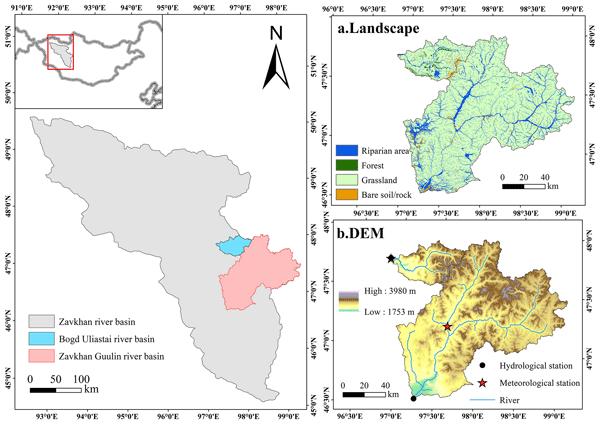
Abstract. Topography and vegetation are critical factors influencing catchment hydrology; however, their individual contributions are often underestimated in hydrological models. This limitation is particularly evident in cold, mountainous regions such as the Mongolian Plateau, where observational data are sparse. To address this, we employed a stepwise, top-down modelling strategy based on the FLEX framework to systematically assess the influence of topography and vegetation on hydrological processes in the Bogd Uliastai and Zavkhan Guulin river basins. Beginning with a lumped model (FLEXL), we successively integrated snow processes (FLEXL-S), topographic distribution (FLEXD), and finally, a landscape-based parameterization accounting for vegetation heterogeneity (FLEXT). Both FLEXD and FLEXT outperformed the lumped models in simulating runoff and SWE. Interestingly, FLEXT showed similar performance to FLEXD—likely due to limited vegetation heterogeneity—it offers more physically realistic parameterization by explicitly representing landscape units, suggesting its potential in more complex basins. Snowmelt contributions to streamflow were quantified as 23.5 %±1.3 % and 14.7 %±1.6 % in the Bogd Uliastai and Zavkhan Guulin river basins, respectively, with peaks in spring and a clear increase with elevation. At high elevations, delayed snowmelt resulted in sustained runoff, while lower elevations responded more rapidly to rainfall. The explicit representation of vegetation heterogeneity further improved the model’s capacity to capture landscape complexity and dominant hydrological mechanisms. This study underscores the pivotal roles of topography and vegetation in runoff generation and demonstrates the effectiveness of a stepwise modelling framework for improving hydrological understanding in cryospheric and data-scarce regions.
Competing interests: At least one of the (co-)authors is a member of the editorial board of Hydrology and Earth System Sciences. The peer-review process was guided by an independent editor, and the authors also have no other competing interests to declare.
Publisher's note: Copernicus Publications remains neutral with regard to jurisdictional claims made in the text, published maps, institutional affiliations, or any other geographical representation in this paper. While Copernicus Publications makes every effort to include appropriate place names, the final responsibility lies with the authors. Views expressed in the text are those of the authors and do not necessarily reflect the views of the publisher.-
Notice on discussion status
The requested preprint has a corresponding peer-reviewed final revised paper. You are encouraged to refer to the final revised version.
-
Preprint
(2139 KB)
-
The requested preprint has a corresponding peer-reviewed final revised paper. You are encouraged to refer to the final revised version.
- Preprint
(2139 KB) - Metadata XML
- BibTeX
- EndNote
- Final revised paper


Journal article(s) based on this preprint
Interactive discussion
Status: closed
-
RC1: 'Comment on egusphere-2025-3062', Anonymous Referee #1, 31 Jul 2025
-
CC1: 'Reply on RC1', Leilei Yong, 08 Oct 2025
The comment was uploaded in the form of a supplement: https://egusphere.copernicus.org/preprints/2025/egusphere-2025-3062/egusphere-2025-3062-CC1-supplement.pdf
-
CC2: 'Reply on RC1', Leilei Yong, 08 Oct 2025
Publisher’s note: this comment is a copy of CC1 and its content was therefore removed on 9 October 2025.
Citation: https://doi.org/10.5194/egusphere-2025-3062-CC2 - AC2: 'Reply on RC1', Hongkai Gao, 06 Nov 2025
-
CC1: 'Reply on RC1', Leilei Yong, 08 Oct 2025
-
RC2: 'Comment on egusphere-2025-3062', Anonymous Referee #2, 05 Nov 2025
This manuscript investigated the impact of topography and vegetation on catchment hydrology in two cold mountainous basins of the Mongolian Plateau using stepwise top-down modelling approaches. It is very interesting and scientifically sound. Also, it is suitable for Hydrology and Earth System Sciences. However, some improvements are still required.
Detailed comments
- The annual precipitation is ~200mm and ~160mm in the two basins, which belongs to sub-arid region. Therefore, most quick runoff should generate from infiltration excess runoff. On the other hand, in the FLEX, runoff generation is described as saturation excess generation. The reliability of the conclusion and the rationality of the method should be further assessed. At least, more explanations and discussions are requested.
- This study selected two alpine Basins as the study basin. In the study basins, there is only one meteorological station for each basin. To represent the spatial variation of precipitation, the authors a precipitation increase rate of 4.2% from the Heihe River basin in China. Does the precipitation increase rate of 4.2% conform to the study basins? More explanations and discussions are requested.
- In the study basins, winter temperature falls below -30 degree. It’s better to discuss the impact of frozen soil.
- Lines 259-260, there is a mistake on the description of the method for actual evaporation, i.e. “Ep” should be “Ep - Ei” (potential evaporation minus interception evaporation).
- The authors conducted relevant researches in other alpines basins, such as Heihe River basin. In this study, it's more useful to discuss both the similarities and the differences in order to gain a clearer understanding.
Citation: https://doi.org/10.5194/egusphere-2025-3062-RC2 - AC1: 'Reply on RC2', Hongkai Gao, 06 Nov 2025
Peer review completion


Interactive discussion
Status: closed
-
RC1: 'Comment on egusphere-2025-3062', Anonymous Referee #1, 31 Jul 2025
This study investigates the roles of topography and vegetation in hydrological processes within cold alpine basins of the Mongolian Plateau using a stepwise FLEX modeling framework. This manuscript presents a valuable contribution to cold-region hydrology in Mongolian Plateau. The research is scientifically sound, methodologically rigorous, and addresses the gap in hydrological modeling for data-scarce, cryospheric regions in Mongolia. With the suggested revisions—particularly in methodology clarity, discussion depth, and figure improvements—it will be suitable for publication. The manuscript falls between minor and moderate revisions, with the following specific recommendations.
Comments
- The background is well-presented, but the uniqueness of the study area (e.g., extreme climate, sparse vegetation, and cryospheric dynamics) could be emphasized more to justify the novelty. Moreover, this work aligns well with the objectives of the new IAHS HELPING (Hydrology Engaging Local People IN one Global world) Decade (2023–2032), which emphasizes interdisciplinary approaches to address local hydrological challenges. I recommend to add this in either the Introduction or the Discussion.
- The literature review should include more recent studies (post-2020) on cold-region hydrology, particularly those addressing snowmelt and vegetation interactions in similar environments (e.g., Central Asia, Tibetan Plateau).
- The similar performance of FLEX-T and FLEX-D is attributed to low vegetation heterogeneity. However, is this finding generalizable to other basins with higher vegetation variability? A comparative discussion would be valuable.
- Line 428-433: Please provide the exact dates (year, month, and day) of these two precipitation events to enable a more precise understanding and validation of the related hydrological processes.
- The discussion should explicitly address limitations, such as the lack of direct validation (e.g., snowpit measurements, isotope tracers) and the impact of data scarcity on model uncertainty.
- Line 582: Provide a clearer explanation of the relationship between the proportion of snowfall in precipitation (Ps/P) and the contribution of snowmelt to streamflow (QM/Q), while ensuring that the related terminology and trend descriptions are accurate and consistent, to enhance the coherence between figures and text, as well as overall readability.
- Line 673-675: The description of high infiltration rates in dry grassland soils leading to reduced runoff in arid regions is rather general; it is recommended to provide relevant references to strengthen the argument.
Minor Comments
- Some acronyms (e.g., SWE, HRUs, NDVI) should be defined at first use.
- The use of technical terms throughout the manuscript should be consistent (e.g., “modelling” and “modeling”, “elevation zones” and “elevation areas” ).
- Line 193: The URL http://srtm.csi.cgiar.org is hosted by the CGIAR Consortium for Spatial Information (CGIAR-CSI), rather than the International Center for Tropical Agriculture (CIAT). Please revise the data source attribution to reflect this accurately.
- 3 illustrates the elevation band division based on DEM data, it would be more appropriate to place it in Section 3.2.
- Some figures (e.g., Fig. 5, Fig. 8) need clearer labels and legends. Fig. 13 needs better visualization.
- Line 692: "soi/rock" should be "soil/rock".
- Please correct the punctuation errors (e.g., Line 637, Line 711 ).
- The conclusions are well-supported but should be more concise.
Citation: https://doi.org/10.5194/egusphere-2025-3062-RC1 -
CC1: 'Reply on RC1', Leilei Yong, 08 Oct 2025
The comment was uploaded in the form of a supplement: https://egusphere.copernicus.org/preprints/2025/egusphere-2025-3062/egusphere-2025-3062-CC1-supplement.pdf
-
CC2: 'Reply on RC1', Leilei Yong, 08 Oct 2025
Publisher’s note: this comment is a copy of CC1 and its content was therefore removed on 9 October 2025.
Citation: https://doi.org/10.5194/egusphere-2025-3062-CC2 - AC2: 'Reply on RC1', Hongkai Gao, 06 Nov 2025
-
RC2: 'Comment on egusphere-2025-3062', Anonymous Referee #2, 05 Nov 2025
This manuscript investigated the impact of topography and vegetation on catchment hydrology in two cold mountainous basins of the Mongolian Plateau using stepwise top-down modelling approaches. It is very interesting and scientifically sound. Also, it is suitable for Hydrology and Earth System Sciences. However, some improvements are still required.
Detailed comments
- The annual precipitation is ~200mm and ~160mm in the two basins, which belongs to sub-arid region. Therefore, most quick runoff should generate from infiltration excess runoff. On the other hand, in the FLEX, runoff generation is described as saturation excess generation. The reliability of the conclusion and the rationality of the method should be further assessed. At least, more explanations and discussions are requested.
- This study selected two alpine Basins as the study basin. In the study basins, there is only one meteorological station for each basin. To represent the spatial variation of precipitation, the authors a precipitation increase rate of 4.2% from the Heihe River basin in China. Does the precipitation increase rate of 4.2% conform to the study basins? More explanations and discussions are requested.
- In the study basins, winter temperature falls below -30 degree. It’s better to discuss the impact of frozen soil.
- Lines 259-260, there is a mistake on the description of the method for actual evaporation, i.e. “Ep” should be “Ep - Ei” (potential evaporation minus interception evaporation).
- The authors conducted relevant researches in other alpines basins, such as Heihe River basin. In this study, it's more useful to discuss both the similarities and the differences in order to gain a clearer understanding.
Citation: https://doi.org/10.5194/egusphere-2025-3062-RC2 - AC1: 'Reply on RC2', Hongkai Gao, 06 Nov 2025
Peer review completion
Journal article(s) based on this preprint
Viewed
| HTML | XML | Total | BibTeX | EndNote | |
|---|---|---|---|---|---|
| 2,176 | 656 | 130 | 2,962 | 100 | 107 |
- HTML: 2,176
- PDF: 656
- XML: 130
- Total: 2,962
- BibTeX: 100
- EndNote: 107
Viewed (geographical distribution)
| Country | # | Views | % |
|---|
| Total: | 0 |
| HTML: | 0 |
| PDF: | 0 |
| XML: | 0 |
- 1
Leilei Yong
Yahui Wang
Batsuren Dorjsuren
Zheng Duan

The requested preprint has a corresponding peer-reviewed final revised paper. You are encouraged to refer to the final revised version.
- Preprint
(2139 KB) - Metadata XML
This study investigates the roles of topography and vegetation in hydrological processes within cold alpine basins of the Mongolian Plateau using a stepwise FLEX modeling framework. This manuscript presents a valuable contribution to cold-region hydrology in Mongolian Plateau. The research is scientifically sound, methodologically rigorous, and addresses the gap in hydrological modeling for data-scarce, cryospheric regions in Mongolia. With the suggested revisions—particularly in methodology clarity, discussion depth, and figure improvements—it will be suitable for publication. The manuscript falls between minor and moderate revisions, with the following specific recommendations.
Comments
Minor Comments