
the Creative Commons Attribution 4.0 License.
the Creative Commons Attribution 4.0 License.
 | 14 Jul 2025
An assessment of multiple variables predicting the psychological effects of flooding: Case study in Peninsular Malaysia
Abstract. Floods are among the most disastrous environmental hazards, causing devastating tangible and intangible impacts. The psychological impact, which can be classified as intangible damage, is an important aspect of human’s well- being. The psychological impact of flooding has begun to receive attention in recent years, but the complexity of measuring it makes it less attractive to be considered in actual flood damage and risk studies. The present study seeks to evaluate the psychological impact of flooding experienced by households and business premises and the different factors that could be the determining variables of the psychological impact. A total of 217 respondents have participated in the empirical face-to-face survey conducted in different vulnerable places in Peninsular Malaysia. Through the willingness-to-pay (WTP) method, only 107 and 34 respondents from residential and business premises, respectively, expressed their agreement to spend on flood risk reduction efforts. The study found that flood durations and family sizes are statistically significant contributors to intangible damages for households, reflecting the intangible damages to residential sector. The results suggest a greater investment to support affected people’s welfare by improving community awareness and shelter facilities. These will enhance risk management efforts and reduce the psychological impacts to people at risk of flooding. The findings also revealed a key challenge: the inability to reliably infer intangible flood damages for business sectors through empirical evidence.
-
Notice on discussion status
The requested preprint has a corresponding peer-reviewed final revised paper. You are encouraged to refer to the final revised version.
-
Preprint
(953 KB)
-
The requested preprint has a corresponding peer-reviewed final revised paper. You are encouraged to refer to the final revised version.
- Preprint
(953 KB) - Metadata XML
- BibTeX
- EndNote
- Final revised paper


Journal article(s) based on this preprint
Interactive discussion
Status: closed
-
RC1: 'Comment on egusphere-2025-2917', Anonymous Referee #1, 15 Jul 2025
-
AC7: 'Reply on RC1', Shabir A. Kabirzad, 07 Oct 2025
1. The methodological description to be insufficiently robust. But not to the extent of describing specific approach. Crucial details such as whether a dichotomous choice Willingness-To-Pay (WTP) question was employed, the range of random bid values presented (if applicable) to cover the distribution of values, the precise wording of the WTP question, and the payment vehicle through which respondents were expected to contribute.
We thank you for the valuable comment. The explanation is as follows:
During the in-person engagement, conversations with household heads, business managers, and owners in flood-exposed areas were generally conducted in Malay, as many residents felt more comfortable speaking their native language. Initially, the conversations were informal but shifted to a more formal tone once participants were willing to engage further. The engagement was conducted cautiously to ensure interviewees received sufficient information about the study's purpose before delving deeper into the willingness-to-pay (WTP) questions.
Dealing with flood victims requires a delicate approach because they can be quite emotional about their past flood experiences (Joseph et al., 2015). Providing them with space to express their feelings and experiences builds trust and encourages deeper conversation. It also serves as a way to validate the hardships they have endured during flood events. While descriptions of the psychological and mental health effects of flooding were readily provided to interviewees, allowing self-expression helps them rationalize the importance of measures to reduce anxiety and stress.
To ensure that respondents had a consistent understanding, all interviewees were briefed on the effects of stress and anxiety. Additionally, they were informed about the challenges of monetizing intangible flood damage, which requires the adoption of the contingent valuation method (e.g., Markantonis et al., 2012; Semrau et al., 2016; Joseph et al., 2015). To avoid confusing intangible losses with tangible losses (as seen in Kabirzad et al., 2024) and to focus willingness-to-pay (WTP) responses solely on psychological and mental health effects, the distinction between the two was clearly explained to the interviewees. They were advised not to include financial or asset losses in their WTP values (e.g., Foudi et al., 2022)
Respondents were presented with a dichotomous choice question on whether they are willing to pay for flood mitigation that could reduce the intangible damage of flooding. Respondents who answered "yes" were then asked an open-ended question on how much they are willing to pay. Those who stated “no” were asked for their reasons. The other considered information that could be a factor in the intangible damage was then collected from the respondents who were willing to participate. It was obvious that most of those who refused to pay were because of disagreement with the payment vehicle – they argued that investment in flood measures should come from the government of the day and not from the people. Such a protest bid is common in social studies where people are given the choice to either participate or not in interviews. Exclusions of protest bids are also necessary to reduce bias in the analysis.
Respondents were presented with a dichotomous choice question asking whether they were willing to pay for flood mitigation measures that could reduce the intangible damage caused by flooding. Those who answered 'yes' were then asked an open-ended question about how much they were willing to pay. Respondents who answered 'no' were asked to provide their reasons. Additional information regarding factors that could influence intangible damage was collected from respondents willing to participate further. It was evident that most who refused to pay did so because they disagreed with the payment vehicle—arguing that investments in flood measures should come from the government rather than individuals. Such protest bids are common in social studies where participants have the choice to participate or not in interviews. Excluding protest bids is necessary to reduce bias in the analysis
Using examples of hypothetical and real cases, the amount of money they are willing to/they have paid to reduce the stress and anxiety level was asked (e.g., Rogers et al., 2019; Foudi & Osés-Eraso, 2022). The case used was linked to the worst flood event that they had experienced in the past 10 years at the time when the interviews were conducted. Some of the interviewees have actually implemented concrete barriers at the opening of their house to protect from flooding. Such a real case was used as a proxy for the willingness to pay value in reducing the psychological effects of flooding. Example questions are:
Using examples of hypothetical and real cases, respondents were asked about the amount of money they are willing to pay or have paid to reduce their stress and anxiety levels related to flooding (e.g., Rogers et al., 2019; Foudi & Osés-Eraso, 2022). The cases referenced were linked to the worst flood events they had experienced within the ten years preceding the interviews. Some interviewees had actually implemented concrete barriers at their house entrances to protect against flooding. Such real cases were used as proxies for the willingness-to-pay (WTP) values aimed at reducing the psychological effects of flooding. Example questions include‘How much are you willing to allocate to make yourself better prepared and reduce your stress and anxiety if the same flood event were to occur?’
‘If the same event is going to happen, and you were not at home, is the barriers that you constructed able to bring you peace of mind and not be affected as much as when it is not there? How much did you spend to prevent flooding?’
The above explanation will be included in the improved manuscript.
2. Analysis of why respondents declined to answer the WTP question or rejected the offered bid values.
Obtaining positive first impressions and responses during engagement and interviews, as well as during the elicitation of values for psychological impacts, was challenging. While the sequential steps and tailored approach undertaken during the interview were performed to gain respondents' trust, some have shown disagreement when asked about their willingness to contribute monetarily to safeguard themselves from the psychological effects of flooding. Some of the people approached declined to pay.
As mentioned in the first comment above, it was obvious during the in-person interviews that people who refused to pay were likely due to their disagreement with the payment vehicle – they argued that investment in measures that may be able to reduce their stress and anxiety due to flooding should be borne by the government of the day, and not by the affected people. In the present study, 35% people that are approached declined to pay. Such a protest bid is common in social studies and requires exclusion to reduce bias in the analysis (Foudi et al, 2022). Essentially, people are given the choice to either participate or not in interviews.
The additions above will be included in the improved manuscript.
3. A conceptual question regarding intangible damage comparability across businesses and individuals (might lie in the pathway through which the damage manifests).
We thank you for the valuable comment. The explanation is as follows:
Individuals who were interviewed for intangible losses to businesses were informed about the possible manifestation of stress and anxiety that they could have experienced during flood events. The collected information of the WTP represents the anxiety and stress at their personal level related to the businesses that they are managing, and the stress and anxiety stemming from impacts on productivity and disruption of sales, etc., manifested from the condition of flood events that they are in. For example, concerns about employees' well-being, which affects daily operations and services, as well as the difficulty in managing loss in assets, sales, and recovery to the normal state (Lekuthai and Vongvisessomjai, 2001). Whilst there are overlapping pathways of intangible damages on individuals and the businesses that they own or work in, the present study does not express a distinction between the two as it is perceived that the intangible damages can be of any sort of disturbance to the running of the businesses that cannot be monetised, whether it stems from a personal level of the business owner/worker related to the businesses, or from a more specific losses to business, such as loss of opportunity that they are stress and anxious about. The WTP does not consider economic losses that can be monetised indirectly, for example, due to business downtime, and this was made clear during the interview (e.g., Darnkachatarn & Kajitani, 2025)
Nevertheless, we are aware of the myriad characteristics of ‘flood damage receptors’ that can be of significance to influence the intangible economic losses in the business sector. They are inevitably influencing the WTP. Future studies can look into detailing the determinants, such as (1) the respondent's job title, (2) the type of products that they are selling, and (3) the nature of their businesses (e.g., using an online platform to sell products more than physical)(Joseph et al., 2015; Guntu et al., 2025). The study proves that the variables and sample size provided are not sufficient to address the intangible losses despite the face-to-face efforts. Refinement to the method is necessary, yet the challenge remains due to the nature of businesses.
The additions above will be included in the improved manuscript.
4. absence of a table indicating the proportion of Small and Medium-sized Enterprises (SMEs) among business owners.
The proportions of different business types are as follows: Micro-sized businesses are 86% of the total respondents of the business premises, and small to medium-sized enterprises are 24%. The categorization of business premises was based on the total number of workers, as specified by SME Corporation Malaysia (2022). If the number of workers exceeds five permanent employees, the business is classified as small to medium, while businesses with fewer than five employees are categorized as micro-sized businesses.
The additions above will be included in the improved manuscript.
5. Include flood histories of the case study areas
We thank you for the valuable comment. The explanation is as follows:
Flood-prone locations with the stated descriptions in the submitted manuscript were identified through a rigorous review of authorized documents and reports related to floods, such as those published by the Department of Irrigation and Drainage (2012), Kuala Lumpur City Hall (2015), and the National Statistics Department. The selection was also supported by available GIS information, such as the Open Street Map to locate and verify places. Grey literature and open-source websites were also consulted to verify and confirm area selection.
"In Kuala Lumpur, the Segambut district was chosen due to evidence of frequent flooding and large-scale evacuations among residents. For instance, in the 2013 flood event, approximately 2,000 residents evacuated from the area (Khairi et al., 2013). In-person interviews with the Kuala Lumpur City Hall authority (DBKL) in 2020 also verified the area's vulnerability to flooding. Similarly, Kajang and Dengkil, in the state of Selangor, have experienced multiple flood events, some of which resulted in significant evacuations. Both areas are situated within the Langat River basin, which has a notable history of flooding. According to state-level flood reports, a 2020 event forced around 200 people in Kajang to evacuate and 500 residents in Dengkil to seek shelter. In the Kelantan state, Kota Bharu city has experienced numerous flood events. One example is the devastating flood in 2014, when 20,000 residents were forced to evacuate (Abdullah, 2014).
6. Is it that individuals are inherently more susceptible to flooding, or is it that, when focusing on intangible damage, there is simply greater scope for experiencing intangible losses when a flood impacts one's home compared to one's place of business?
For residential buildings, intangible damages primarily affect personal well-being, including family- or self-related worries, stress, sleep disturbances, and difficulties in managing possessions or recovering to normalcy. In the case of businesses, intangible damages center on concerns about employees' well-being, which impacts daily operations and services, as well as challenges in managing asset losses, drops in sales, and recovery to normal operations. Therefore, comparing intangible damage assessments between households and businesses is difficult, as each context presents distinct forms of evidence for evaluating impact.
This is consistent with findings from residential households, where lower income or larger business size does not necessarily mean their willingness to pay (WTP) significantly differs from those with higher income or small to medium business size
When comparing the willingness to pay (WTP) of residential households and businesses, residential households report greater intangible losses. The higher WTP among residential households reflects their increased perceived need for interventions to reduce psychological and mental distress caused by floods. However, separate analyses of residential and business WTP, in terms of median values across all income and business size groups, suggest that the findings are not fully conclusive. The comparable median WTP values across different income groups and business sizes indicate that the assumption of income being a decisive factor in reducing intangible damage cannot be confirmed through single-variable analysis. It is important to note that WTP values across groups might vary with a larger sample size. This represents one of the ongoing challenges in collecting data from first-hand flood victims.7. A clear delineation between intangible and tangible damages. The WTP question (at least as I infer it from the context) likely conflates both tangible and intangible damages with an individual's perceived budget for implementing risk reduction measures.
Tangible flood damages refer to the impacts on the financial and economic conditions of structures exposed to flooding, whether directly or indirectly (e.g., Kabirzad et al., 2024). In contrast, intangible damages relate to the psychological effects experienced by people exposed to floods impacting their homes or business premises. These effects include enduring unprecedented experiences such as losing possessions, impacts on physical health, disruptions to livelihoods, or even the loss of loved ones (e.g., Stanke et al., 2012; Yoda et al., 2017).
To distinguish tangible losses of assets and other direct tangible damages, financial impacts were set aside to focus on psychological impacts (e.g., Foudi et al., 2022). This distinction was made clear during the interviews, where respondents’ willingness to pay to alleviate psychological and mental burdens during floods was explicitly separated from the tangible losses they had experienced. Additional factors related to intangible damage were then collected from respondents who were willing to participate.
Using examples of hypothetical and real cases, the amount of money they are willing to/they have paid to reduce the stress and anxiety level was asked (e.g., Rogers et al., 2019; Foudi & Osés-Eraso, 2022). The case used was linked to the worst flood event that they had experienced in the past 10 years of the time when the interviews were conducted. Some of the interviewees have actually implemented concrete barriers at the opening of their house to protect from flooding. Such a real case was used as a proxy for the willingness to pay value in reducing the psychological effects of flooding. Example questions are:
‘How much are you willing to allocate to make yourself better prepared and reduce your stress and anxiety if the same flood event were to occur?’
‘If the same event is going to happen, and you were not at home, is the barriers that you constructed able to bring you peace of mind and not be affected as much as when it is not there? How much did you spend to prevent flooding?’
The additions above will be included in the improved manuscript.
8. The survey was conducted post-flood; significant variations in recovery rates would be expected. Therefore, why is it that the regression modeling/survey did not incorporate any variables related to the recovery process?
The study aimed to assess intangible damage using multiple possible contributing variables, focusing on conditions related to the flood, building, and socioeconomic characteristics of the particular household or business premises during the flood events only. The recovery rates are not explicitly informed, but are assumed to be implicit in other variables. However, we agree that the response recovery is a valuable indicator for intangible flood damage and can lead to a more specific non-structural measure to reduce intangible damage. The manuscript will highlight that further study should account for the response recovery as one of the governing variables.
9. Absence of a regression analysis for the business observations. Some form of variable reduction process was undertaken (Table 4)
Among all ten independent variables, only seven were considered for the business regression analysis because variables related to households—such as family size, having children, and/or elderly members—apply only to household characteristics. Income showed a positive correlation, while business duration (in years) was negatively correlated. Meanwhile, multicollinearity was checked to identify highly correlated independent variables. After assessing correlations with coefficients greater than 0.5, the variance inflation factor (VIF) scores of those variables were evaluated. Variables with high VIF scores, such as flood duration, were removed from the analysis
The regression analysis for business premises is as follows: the p-value associated with the regression model is 0.15, which exceeds the threshold, suggesting a failure to reject the null hypothesis. This indicates that the selected factors do not significantly predict intangible damage within the business sector. Among all considered variables, only income shows a statistically significant relationship with intangible damage. Another study by Czajkowski and Cunha (2020) found that income is not a significant variable for intangible damage to business premises, unlike flood duration, building type, and building heightAn R² value of 0.28 indicates that the independent variables explain 28% of the variability in the outcome. While this may be considered low in some contexts, an R² of 0.10 or even lower can be acceptable in certain situations, as numerous other factors could also influence the outcome (Hair et al., 2018). It is noteworthy that the findings on variable significance contrast with other research. Other flood damage studies have commonly used a p-value threshold of 0.05 to determine significance (Wijayanti et al., 2017; Svenningsen et al., 2020). This result leads to the acceptance of the null hypothesis, indicating that the factors under consideration do not significantly predict intangible damage within the business sector.
The additions above will be included in the improved manuscript.
10. At best, the CVM, within the constraints of an individual's budget, provides a measure of their willingness to pay to reduce such damage. However, this is not synonymous with the actual intangible damage itself, although the two are undeniably related.
Willingness to pay (WTP) is employed in this paper as a method to elicit value, supported by the contingent valuation (CV) stated preference method. The aim is to quantify the psychological and health impacts—a form of intangible damage—associated with residential buildings and business premises. Using these methods, the article estimates the non-market value of stress, distress, and worries, capturing the intangible effects of flooding.
The actual intangible damages associated with the exposed elements can be comparatively very high and include cultural loss, ecosystem damage, environmental loss, loss of memorabilia, trauma, and loss of trust (Hammond et al., 2013; Nafari & Mendis, 2018; Olesen et al., 2017). These represent other types of intangible damage that can be considered in future research
The additions above will be included in the improved manuscript.
11. "An Assessment of the Willingness to Pay for Flood Risk Reduction: A Case Study in Peninsular Malaysia," which, while still valuable, addresses a slightly less novel research question. Addressing this question would require a different framing of the paper, and which would open further questions about why the socio-psychological domain of variables and welfare with was not included in the paper (e.g., where are risk perceptions as someone who expects to be flooded again may have even larger intangible impacts because they are "stuck") given that psychological damage is psychological and will be driven by the interaction with other tangible and intangible factors.
Thank you for the suggestion.
The study defines psychological health impacts as stress, emotional instability, wariness, and anxiety that befall people directly experienced with flooding, and attempts to monetize the impacts using the WTP method. We are aware of the possible conceptual arguments that may arise with respect to the factors that can lead to psychological health impacts of flooding, but we are limiting the variables to a number that are manageable in the context of the present study.
As for the people’s perception, this is a topic that is also important and will influence the WTP. The people being interviewed in the present study were those who had experienced flooding at the place where they were interviewed (post-event). It is assumed that they are aware of the risk that they are exposed to, and the WTP that they have provided was in view of floods that may occur again in the future. In fact, the questions that were put forward for them to provide the WTP were based on the depth and duration of the same extreme event that they had experienced. Therefore, it is assumed that the influence of perception on the WTP that they provided is minimal.
The present study attempts to frame the psychological health impact in the context of cost-benefit analysis, where a monetary metric was used as the decision support metric. The CBA often neglects the intangible damages that could lead to malinvestment in flood risk mitigation efforts. Even if investments were allocated for reducing mental burden, justifications were difficult to make in terms of how much public spending a case would require. Moreover, allocations to reduce psychological effects are usually prompted reactively. The present study attempts to incorporate the subjective experiences of people exposed to flooding in the risk-based flood investment decision-making.
Although the wide range of extended research avenues that can be explored under the theme of psychological effects of flooding, the present study is part of the limited studies attempting to provide evidence of intangible flood damages of the residential and business sectors. Depending on a study’s perspective, future work can discern the type and degree of intangible losses and incorporate more social variables into the intangible flood losses analysis.
12.Typo Error: We will do a thorough check and proofread in the improved manuscript
Thank you for the suggestion. The ‘intangible losses’ is a common term used in flood damage analysis in the context of flood risk management literature, hence it is deemed necessary to be maintained in the title.
-
AC7: 'Reply on RC1', Shabir A. Kabirzad, 07 Oct 2025
-
RC2: 'Comment on egusphere-2025-2917', Anonymous Referee #2, 22 Jul 2025
This paper addresses an important issue in understanding the intangible impacts of flooding, an area that is often underrepresented in flood risk assessments, and I enjoyed reading this manuscript. Applying WTP to capture these impacts is a novel and potentially valuable contribution. However, the study primarily reiterates established correlations, and its results are limited by small sample sizes, particularly in business.
Overall concept: While the authors describe intangible damage as psychological distress, they do not adequately justify the use of WTP as a proxy for such impacts. WTP is traditionally applied to non-market goods, but using it to value mental health effects requires strong support. It assumes that WTP correlates with psychological damage, yet it is heavily influenced by other considerations, and so interpreting WTP as a direct measure is misleading. A clearer rationale and discussion of its limitations are needed. The lack of detail explaining the CVM, as mentioned by the other reviewer, undermines not only the validity of the WTP as a proxy for psychological impact.
Introduction: There need to be more citations, depth, and restructuring. It would benefit from an in-depth literature review; could you include recent work on flood resilience and mental health in SE Asia? Some claims in the introduction lack evidence.
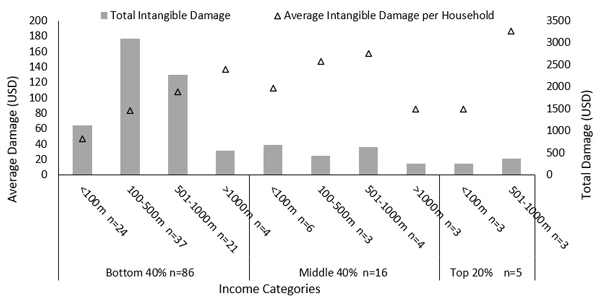
Methods: The authors use regression models, but they do not justify the variable selection, and there is no discussion around the low R2 values. What unmeasured variables might explain the variance? The authors removed variables but gave no detail as to how they tested multicollinearity. The comparison of total damages is misleading without accounting for sample size differences. You should consider focusing on average damage values to make comparisons more meaningful. The paper does not account for the time elapsed since the flood events. When were the interviews done? If the study was done shortly after the floods, psychological effects might not yet be fully visible.
Discussion: The discussion section is overly descriptive, repeating findings without offering deeper analysis. For instance, the observation that B40 households report lower average intangible damages than T20 contradicts expectations, yet no explanation is offered. The finding that income is not a significant predictor is not examined for its implications. Rather than simply citing studies with similar or differing results, the authors should critically assess why the results agree or diverge. The authors should engage more critically with their data, exploring possible explanations and linking findings to concrete policy recommendations or planning strategies. There are sweeping statements and generalisations that are problematic.
Ethical framing: There needs to be a more ethical tone in the summarising of the results. The refusal to contribute does not equate to a lack of impact but may reflect structural constraints or emotional exhaustion or other factors. A bit more sensitivity in writing up these findings would be effective. Do you have any reflections on the ethics of monetising trauma?
Writing quality: The manuscript is weakened by poor sentence structure and grammar issues, which undermine the quality. There is a lot of repetition, Figs 3 and 4 are hard to interpret (lack of labelling and descriptive captions), and editing is strongly recommended.
Minor points: Instead of elderlies, elderly people should be used. There are some formatting issues. Some tables are hard to interpret such as lacking units. Parts of your results are in the methods part. See attached doc.
Please see the minor comments in the attached document.
Overall, this study addresses an important topic. However, it requires a more rigorous application and explanation of the CVM methodology, clearer justification for its use as a proxy for psychological impacts, and deeper engagement with contextual, policy, and ethical dimensions.
-
AC6: 'Reply on RC2', Shabir A. Kabirzad, 07 Oct 2025
1. Validity of WTP as a proxy for psychological impact - A clearer rationale and discussion of its limitations are needed
Thank you for the comments. Responses mentioned in the previous texts have addressed the methods in which WTP questions were asked. Below are the copies:
Willingness to pay (WTP) is employed in the paper as a method to elicit value, supported by the contingent valuation (CV) state preference method. The aim is to quantify the psychological and health impact—a form of intangible damage—associated with residential buildings and business premises. Using these methods, the study estimates the non-market value of stress, distress, and worries, which captures the intangible effects of flooding. The application of non-market valuation in flood damage assessment, particularly for informing decision-making in flood damage and risk management, is infrequently used and remains relatively new (Rogers et al., 2019).
The psychological health impact is framed in the context of cost-benefit analysis, where a monetary metric was used as the decision support metric. The CBA often neglects the intangible damages that could lead to malinvestment in flood risk mitigation efforts. Even if investments were allocated for reducing mental burden, justifications were difficult to make in terms of how much public spending a case would require. Moreover, allocations to reduce psychological effects are usually prompted reactively. The present study attempts to incorporate the subjective experiences of people exposed to flooding in the risk-based flood investment decision-making.
We are aware of the possible conceptual arguments that may arise with respect to the factors that can lead to psychological health impacts of flooding, but we are limiting the variables to a number that are manageable in the context of the present study. The present study is part of the limited studies attempting to provide evidence of intangible flood damages of residential and business sectors. Depending on a study’s perspective, future work can discern the type and degree of intangible losses and incorporate more social variables into the intangible flood losses analysis.
As for the results of the present study, one limitation that stood out is related to the lack of association between the variables and the psychological burden of the business premises. The lack of association has led to non-significant p-values among most of the considered variables. This is influenced by the small sample sizes among the respondents from the business sector, despite the efforts of the in-person interviews.
2. There needs to be more citations, depth, and restructuring. It would benefit from an in-depth literature review; could you include recent work on flood resilience and mental health in SE Asia? Some claims in the introduction lack evidence.
The introduction has been restructured to add more citations related to Southeast Asia countries in terms of the intangible damages, despite the lack of references. The following addresses the reviewers’ concern:
The Southeast Asian region has suffered adverse mental health effects due to extreme weather hazards and floods, leading to high levels of depression, anxiety, and stress compared to other extreme weather events (Patwary et al., 2024). One significant consequence of flooding is the psychological impact on exposed individuals, who endure unprecedented experiences such as loss of possessions, physical health challenges, livelihoods, or, even worse, the lives of loved ones (Law et al., 2025). Psychological effects can be defined as the emotional and mental responses individuals experience due to disruptions in daily life, including anxiety, depression, and stress, often exacerbated by isolation and changes in routine (Veale, 1987)In the past decade, the analysis of flood consequences has expanded from primarily focusing on conventional tangible damages, such as physical and economic losses, to also understanding psychological effects as a subset of the adverse consequences of flooding (e.g., Stanke et al., 2012; Yoda et al., 2017). Factors contributing to the coping capacity of a community, such as strong social networks among community members and organized shelter systems, have been shown to reduce anxiety and stress during flood recovery periods (Zahari & Hashim, 2018; Akhir et al., 2021). The current consensus is that understanding the psychological effects of flooding is important to enhance decision-making in flood management (Ti et al., 2016; Nawi et al., 2021; Sulong & Romali, 2022). Some studies have claimed that intangible flood damages are more severe than tangible losses (Nga et al., 2018; Han et al., 2023). It is widely accepted that intangible damage is a crucial factor in risk assessment, particularly for households (Joseph et al., 2015)
3.
a. Justify the variable selection
A range of variables, identified based on expert knowledge from different domains, are considered important for assessing intangible flood damage. These variables relate to flood characteristics, building factors, socio-economic characteristics, and damages to households and businesses (a full list is provided). Building type, business size, the presence of elderly or children, and ownership status were treated as binary variables. The analysis was conducted for both binary and continuous variables, followed by assessments of correlation and regression coefficients.
b. discussion around the low R2 values - What unmeasured variables might explain the variance?
Explanation is added to the R² result section. The regression model for intangible damage yielded a coefficient of determination (R²) of 0.23, indicating that 23% of the variation in the dependent variable is explained by the independent variables. While an R² of 0.25 may be considered weak in some contexts, its interpretation is highly dependent on the field of study. The value of 0.23 is considered acceptable for this study on intangible damage, consistent with findings in other research that have reported similar values (Wijayanti et al., 2017)
It is important to note that a low R² does not necessarily imply a weak model, as its value is heavily influenced by the inherent variability of the data (Hamilton et al., 2015). In fact, in some research fields dealing with human behavior, an R² of 0.10 or lower can be considered acceptable, since its significance depends entirely on the research context (Hair et al., 2018).
The model's explanatory power could likely be improved by incorporating a broader set of variables. Future studies should consider including additional physical, economic, and environmental characteristics in a multiple regression analysis to account for a greater portion of the variation in intangible damage.
c. How they tested multicollinearity?
The regression analysis on intangible damage indicated multicollinearity between two independent factors: flood duration and distance from the river in residential buildings. Therefore, the distance from the river was excluded to improve both the accuracy and reliability of the regression analysis, leaving nine independent variables. For commercial buildings, the datasets remained untransformed except for income data, which was log-transformed. All other variables met the normality criteria (Gaussian distribution). The assessment of multicollinearity was based on two diagnostic measures: the correlation coefficient and the Variance Inflation Factor (VIF). A correlation coefficient greater than 0.5 between independent variables, supported by VIF analysis, indicated the presence of multicollinearity.
d.Focusing on average damage values to make comparisons more meaningful. Account for the time elapsed since the flood events. When were the interviews done? If the study was done shortly after the floods, psychological effects might not yet be fully visible.
The intangible damage variations of residential households and businesses, according to income groups, business size, and the distance of their buildings from the river, were analyzed in terms of total and average values. The total values refer to the cumulative willingness to pay (WTP) from all respondents within each category. Meanwhile, the average values represent the mean WTP within the respective categories. The damage analysis compares both average and total damage across income groups (Figures 4 and 5)
This study is based on a survey conducted in 2020. Respondents were asked to report on flood-related impacts from events occurring within the ten-year period from 2010 to 2020.
4. The discussion section is overly descriptive, repeating findings without offering deeper analysis. For instance, the observation that B40 households report lower average intangible damages than T20 contradicts expectations, yet no explanation is offered. Not just cite. But critically assess why the results agree or diverge. The authors should engage more critically with their data, exploring possible explanations and linking findings to concrete policy recommendations or planning strategies.There are sweeping statements and generalisations that are problematic.
We thank for the valuable suggestion :
The discussion has been revised accordingly. It has been updated to avoid repetition and critically assess areas of agreement or divergence with other researchers. Additionally, it provides a clear link between the findings and their implications for policymakers and planners in future flood management.Here is example for the income variables:
This study's results also demonstrated that income does not affect a household's intangible damage. Families prioritize addressing the mental health effects on their members regardless of their wealth or income. However, other studies have found that household monthly income shows a statistically significant contribution to flood-related mental health impacts (Ghanbarpour et al., 2014; Yusmah et al., 2020). Others reported that the middle-income group of households is willing to contribute to the willingness to pay and plan for the flood prevention measures, but higher-income households were reluctant to respond to the willingness to pay. The older individuals have a lower demand for protection, even though they are also the most financially vulnerable (Foudi & Osés-Eraso, 2022). The current study also found that middle-income households show participation in efforts to prevent the mental health impact. Addressing intangible damage may help households mentally prepare for flooding or improve their ability to cope with the flood effect. The contribution of income to intangible damage may encourage the community to integrate of multiple prevention measures, enhancing risk reduction strategies. However, it requires the combined efforts of all stakeholders (Mishra & Sinha, 2020).
The additions above will be included in the improved manuscript.
5. The manuscript is weakened by poor sentence structure and grammar issues, which undermine the quality. There is a lot of repetition, Figs 3 and 4 are hard to interpret (lack of labelling and descriptive captions), and editing is strongly recommended. Instead of the elderly, elderly people should be used. There are some formatting issues. Some tables are hard to interpret, such as lacking units. Parts of your results are in the methods part.
The article has been revised by the author and co-authors for grammar and sentence structure.
-
AC6: 'Reply on RC2', Shabir A. Kabirzad, 07 Oct 2025
-
RC3: 'Comment on egusphere-2025-2917', Anonymous Referee #3, 10 Aug 2025
The paper addresses an important aspect of flood risk assessment and management: psychological effects of flooding on affected people and how to integrate this in quantitative risk assessments. The paper presents a (small) dataset from Malaysia from 107 residents and 34 businesses, in which they applied a "willingness to pay" (WTP) approach to derive a monetary proxy for psychological effects of flooding. Regressions are used to explore relations between this dependent variable and other variables.
In line with the other two reviews I acknowledge the relevance of the topic, but I see similar weaknesses in the current presentation: the justification of the WTP approach and curcial details on its implementation in the questionnaire are widely missing. Therefore, it is hard to assess the overall quality of the study. However, the fact that only 141 out of 380 respondents answered the WTP question, reveals that there were difficulties with this approach which probably led to uncertain data. The authors should comment on this in much more detail. It remains unclear why only 217 out of 380 responses were valid at all and why so many refused to answer the WTP question. How do you assess the general validity of your data?
Further concerns are:
- In the introduction, several statements (see attached file) should be supported by references. Please add the relevant literature. Provide an overview of studies that have investigated psychological effects of flooding (also called: mental health effects or effects on well-being). Please use common risk terminology (e.g. exposure).
- Also add some more information on the processes and impacts of 2014-event in Malaysia.
- Clearly distinguish methods from results and clearly present your hypotheses at the end of the introduction (and not just in line 168/169; see my comments in the attachment). Please restructure the paper accordingly and avoid repetitions.
- Please provide some official statistics on socio-economics of the population in the study area and compare the numbers with the findings from your dataset.
- Due to the small size of the sub-samples in the figures 3 and 4, some bins should be merged.
- In fact, I do like the suggestion in the first review on how to frame the work in a different way and how to change the title.
- Please have a look at the attached file.
-
AC1: 'Reply on RC3', Shabir A. Kabirzad, 07 Oct 2025
Publisher’s note: this comment is a copy of AC8 and its content was therefore removed on 9 October 2025.
Citation: https://doi.org/10.5194/egusphere-2025-2917-AC1 -
AC2: 'Reply on RC3 : Analysis of why respondents declined to answer the WTP question or rejected the offered bid values.', Shabir A. Kabirzad, 07 Oct 2025
Publisher’s note: this comment is a copy of AC8 and its content was therefore removed on 9 October 2025.
Citation: https://doi.org/10.5194/egusphere-2025-2917-AC2 -
AC3: 'Reply on RC3 : Method/analysis', Shabir A. Kabirzad, 07 Oct 2025
Publisher’s note: this comment is a copy of AC8 and its content was therefore removed on 9 October 2025.
Citation: https://doi.org/10.5194/egusphere-2025-2917-AC3 -
AC4: 'Reply on RC3', Shabir A. Kabirzad, 07 Oct 2025
Publisher’s note: this comment is a copy of AC8 and its content was therefore removed on 9 October 2025.
Citation: https://doi.org/10.5194/egusphere-2025-2917-AC4 -
AC5: 'Reply on RC3', Shabir A. Kabirzad, 07 Oct 2025
Publisher’s note: this comment is a copy of AC8 and its content was therefore removed on 9 October 2025.
Citation: https://doi.org/10.5194/egusphere-2025-2917-AC5 -
AC8: 'Reply on RC3', Shabir A. Kabirzad, 07 Oct 2025
1. The justification of the WTP approach and crucial details on its implementation in the questionnaire are widely missing.
We thank you for the comments
This study's results indicate that income does not significantly affect a household's intangible damage. Families tend to prioritize addressing the mental health effects on their members regardless of their wealth or income. However, other studies have found that household monthly income shows a statistically significant contribution to flood-related mental health impacts (Ghanbarpour et al., 2014; Yusmah et al., 2020). Some research reports that middle-income households are more willing to contribute to flood prevention measures through willingness to pay, while higher-income households are more reluctant to respond. Older individuals, despite being the most financially vulnerable, reportedly have a lower demand for protection (Foudi & Osés-Eraso, 2022). Consistent with this, the current study also found that middle-income households participate more in efforts to prevent mental health impacts. Addressing intangible damage may help households mentally prepare for flooding or improve their ability to cope with flood effects. The contribution of income to intangible damage may encourage communities to integrate multiple prevention measures, enhancing risk reduction strategies. However, this requires the combined efforts of all stakeholders (Mishra & Sinha, 2020)
The addition above will be included in the manuscript
2. Only 141 out of 380 respondents answered the WTP question, which reveals that there were difficulties with this approach, which probably led to uncertain data. The authors should comment on this in much more detail why only 217 out of 380 responses were valid at all and why so many refused to answer the WTP question. How do you assess the general validity of your data?
Business respondents were often unavailable due to busy schedules, resulting in longer wait times for interviews. In some cases, businesses had already relocated. The majority of interviews were conducted with residents from residential buildings, although some residential respondents declined to participate. The total sample size collected was 271 respondents from both groups.
The addition above will be included in manuscript.
3. Why were only 217 out of 380 responses valid at all, and why so many refused to answer the WTP question? How do you assess the general validity of your data?
The total collected sample size was 217, as 163 people declined to participate in the interview. Some business respondents were unavailable due to their busy schedules, resulting in longer wait times for interviews. In certain cases, businesses had already relocated. The majority of interviews were conducted with residents from residential buildings. The validity of the data relied on expert judgment, given the challenges in collecting socio-economic and psychological data.
The addition above will be included in the manuscript
4. Refer to the referee documents where comments are.
Thank you for the comments and the manuscript revised according to the comments.
-
AC9: 'Reply on RC3', Shabir A. Kabirzad, 07 Oct 2025
Publisher’s note: this comment is a copy of AC8 and its content was therefore removed on 9 October 2025.
Citation: https://doi.org/10.5194/egusphere-2025-2917-AC9
-
AC1: 'Reply on RC3', Shabir A. Kabirzad, 07 Oct 2025
Peer review completion


Interactive discussion
Status: closed
-
RC1: 'Comment on egusphere-2025-2917', Anonymous Referee #1, 15 Jul 2025
I appreciate the authors' submission and found the paper to be of significant interest. My comments below are intended to assist in further refining the manuscript:
-
The paper states the application of the Contingent Valuation Method (CVM) for valuing intangible impacts, which is theoretically sound given its ability as a stated preference method to holistically capture intangible impacts compared to revealed preference methods. However, I find the methodological description to be insufficiently robust. While variations in the CVM approach exist, the guidelines established by Arrow et al. (1993) have been highly influential in shaping key aspects of CVM studies. For instance, the paper lacks crucial details such as whether a dichotomous choice Willingness-To-Pay (WTP) question was employed, the range of random bid values presented (if applicable) to cover the distribution of values, the precise wording of the WTP question, and the payment vehicle through which respondents were expected to contribute. While I do not seek to prescribe a specific approach, the absence of this information makes replication of the CVM methodology impossible. I am left to assume that respondents were simply asked to provide a hypothetical WTP value. While all stated preference studies are susceptible to hypothetical bias, the unguided elicitation of a raw value from respondents represents the weakest form of CVM.
-
Given the pivotal role of the WTP question in the calculation of intangible damages, it would be beneficial to include an analysis of why respondents declined to answer the WTP question or rejected the offered bid values. Understanding these reasons could provide valuable insights into the valuation process.
-
The focus on intangible damage raises a conceptual question regarding its comparability across businesses and individuals. It appears that the study may primarily be examining the psychological intangible damage experienced by the respondent. I note the absence of a table indicating the proportion of Small and Medium-sized Enterprises (SMEs) among business owners. It is conceivable that for many smaller businesses, the business entity and the owner are practically indistinguishable. Rather than distinct categories of damage, it seems the differentiation between businesses and individuals might lie in the pathway through which the damage manifests.
-
Line 99: The sentence appears to be incomplete.
-
The flood histories of the case study areas are only briefly mentioned. Expanding on the frequency and magnitude of significant flood events within the last 10 years would greatly enrich the background context for potential respondents and their experiences.
-
Line 235: Clarification is needed. Is it that individuals are inherently more susceptible to flooding, or is it that, when focusing on intangible damage, there is simply greater scope for experiencing intangible losses when a flood impacts one's home compared to one's place of business?
-
A clear delineation between intangible and tangible damages is essential. The WTP question (at least as I infer it from the context) likely conflates both tangible and intangible damages with an individual's perceived budget for implementing risk reduction measures. For example, an individual might experience significant psychological distress and heightened anxiety post-flood, yet only be willing to spend $5,000 on flood defenses due to budget constraints. This $5,000, while a personal maximum, may still represent a lower bound on their perceived total flood damage. This point seems to be echoed in the statement that poorer respondents report less flood damage due to having fewer physical assets. However, there is no inherent reason why this principle should extend to the emotional or intangible damage suffered during a flood.
-
Given that the survey was conducted post-flood, significant variations in recovery rates would be expected. Therefore, why is it that the regression modeling/survey did not incorporate any variables related to the recovery process. Furthermore, access to recovery mechanisms is likely to intersect with several of the socio-demographic variables already included.
-
I observed the absence of a regression analysis for the business observations. Am I correct in inferring from Table 4 that some form of variable reduction process was undertaken? Further clarification on this would be helpful.
-
Overall, I am not entirely convinced by the paper's approach to calculating intangible damage. At best, the CVM, within the constraints of an individual's budget, provides a measure of their willingness to pay to reduce such damage. However, this is not synonymous with the actual intangible damage itself, although the two are undeniably related. Consequently, a more accurate title for the paper might be, "An Assessment of the Willingness to Pay for Flood Risk Reduction: A Case Study in Peninsular Malaysia," which, while still valuable, addresses a slightly less novel research question. Addressing this question would require a different framing of the paper, and which would open further questions about why the socio-psychological domain of variables and welfare with was not included in the paper (e.g., where are risk perceptions as someone who expects to be flooded again may have even larger intangible impacts because they are "stuck") given that psychological damage is psychological and will be driven by the interaction with other tangible and intangible factors.
Citation: https://doi.org/10.5194/egusphere-2025-2917-RC1 -
AC7: 'Reply on RC1', Shabir A. Kabirzad, 07 Oct 2025
1. The methodological description to be insufficiently robust. But not to the extent of describing specific approach. Crucial details such as whether a dichotomous choice Willingness-To-Pay (WTP) question was employed, the range of random bid values presented (if applicable) to cover the distribution of values, the precise wording of the WTP question, and the payment vehicle through which respondents were expected to contribute.
We thank you for the valuable comment. The explanation is as follows:
During the in-person engagement, conversations with household heads, business managers, and owners in flood-exposed areas were generally conducted in Malay, as many residents felt more comfortable speaking their native language. Initially, the conversations were informal but shifted to a more formal tone once participants were willing to engage further. The engagement was conducted cautiously to ensure interviewees received sufficient information about the study's purpose before delving deeper into the willingness-to-pay (WTP) questions.
Dealing with flood victims requires a delicate approach because they can be quite emotional about their past flood experiences (Joseph et al., 2015). Providing them with space to express their feelings and experiences builds trust and encourages deeper conversation. It also serves as a way to validate the hardships they have endured during flood events. While descriptions of the psychological and mental health effects of flooding were readily provided to interviewees, allowing self-expression helps them rationalize the importance of measures to reduce anxiety and stress.
To ensure that respondents had a consistent understanding, all interviewees were briefed on the effects of stress and anxiety. Additionally, they were informed about the challenges of monetizing intangible flood damage, which requires the adoption of the contingent valuation method (e.g., Markantonis et al., 2012; Semrau et al., 2016; Joseph et al., 2015). To avoid confusing intangible losses with tangible losses (as seen in Kabirzad et al., 2024) and to focus willingness-to-pay (WTP) responses solely on psychological and mental health effects, the distinction between the two was clearly explained to the interviewees. They were advised not to include financial or asset losses in their WTP values (e.g., Foudi et al., 2022)
Respondents were presented with a dichotomous choice question on whether they are willing to pay for flood mitigation that could reduce the intangible damage of flooding. Respondents who answered "yes" were then asked an open-ended question on how much they are willing to pay. Those who stated “no” were asked for their reasons. The other considered information that could be a factor in the intangible damage was then collected from the respondents who were willing to participate. It was obvious that most of those who refused to pay were because of disagreement with the payment vehicle – they argued that investment in flood measures should come from the government of the day and not from the people. Such a protest bid is common in social studies where people are given the choice to either participate or not in interviews. Exclusions of protest bids are also necessary to reduce bias in the analysis.
Respondents were presented with a dichotomous choice question asking whether they were willing to pay for flood mitigation measures that could reduce the intangible damage caused by flooding. Those who answered 'yes' were then asked an open-ended question about how much they were willing to pay. Respondents who answered 'no' were asked to provide their reasons. Additional information regarding factors that could influence intangible damage was collected from respondents willing to participate further. It was evident that most who refused to pay did so because they disagreed with the payment vehicle—arguing that investments in flood measures should come from the government rather than individuals. Such protest bids are common in social studies where participants have the choice to participate or not in interviews. Excluding protest bids is necessary to reduce bias in the analysis
Using examples of hypothetical and real cases, the amount of money they are willing to/they have paid to reduce the stress and anxiety level was asked (e.g., Rogers et al., 2019; Foudi & Osés-Eraso, 2022). The case used was linked to the worst flood event that they had experienced in the past 10 years at the time when the interviews were conducted. Some of the interviewees have actually implemented concrete barriers at the opening of their house to protect from flooding. Such a real case was used as a proxy for the willingness to pay value in reducing the psychological effects of flooding. Example questions are:
Using examples of hypothetical and real cases, respondents were asked about the amount of money they are willing to pay or have paid to reduce their stress and anxiety levels related to flooding (e.g., Rogers et al., 2019; Foudi & Osés-Eraso, 2022). The cases referenced were linked to the worst flood events they had experienced within the ten years preceding the interviews. Some interviewees had actually implemented concrete barriers at their house entrances to protect against flooding. Such real cases were used as proxies for the willingness-to-pay (WTP) values aimed at reducing the psychological effects of flooding. Example questions include‘How much are you willing to allocate to make yourself better prepared and reduce your stress and anxiety if the same flood event were to occur?’
‘If the same event is going to happen, and you were not at home, is the barriers that you constructed able to bring you peace of mind and not be affected as much as when it is not there? How much did you spend to prevent flooding?’
The above explanation will be included in the improved manuscript.
2. Analysis of why respondents declined to answer the WTP question or rejected the offered bid values.
Obtaining positive first impressions and responses during engagement and interviews, as well as during the elicitation of values for psychological impacts, was challenging. While the sequential steps and tailored approach undertaken during the interview were performed to gain respondents' trust, some have shown disagreement when asked about their willingness to contribute monetarily to safeguard themselves from the psychological effects of flooding. Some of the people approached declined to pay.
As mentioned in the first comment above, it was obvious during the in-person interviews that people who refused to pay were likely due to their disagreement with the payment vehicle – they argued that investment in measures that may be able to reduce their stress and anxiety due to flooding should be borne by the government of the day, and not by the affected people. In the present study, 35% people that are approached declined to pay. Such a protest bid is common in social studies and requires exclusion to reduce bias in the analysis (Foudi et al, 2022). Essentially, people are given the choice to either participate or not in interviews.
The additions above will be included in the improved manuscript.
3. A conceptual question regarding intangible damage comparability across businesses and individuals (might lie in the pathway through which the damage manifests).
We thank you for the valuable comment. The explanation is as follows:
Individuals who were interviewed for intangible losses to businesses were informed about the possible manifestation of stress and anxiety that they could have experienced during flood events. The collected information of the WTP represents the anxiety and stress at their personal level related to the businesses that they are managing, and the stress and anxiety stemming from impacts on productivity and disruption of sales, etc., manifested from the condition of flood events that they are in. For example, concerns about employees' well-being, which affects daily operations and services, as well as the difficulty in managing loss in assets, sales, and recovery to the normal state (Lekuthai and Vongvisessomjai, 2001). Whilst there are overlapping pathways of intangible damages on individuals and the businesses that they own or work in, the present study does not express a distinction between the two as it is perceived that the intangible damages can be of any sort of disturbance to the running of the businesses that cannot be monetised, whether it stems from a personal level of the business owner/worker related to the businesses, or from a more specific losses to business, such as loss of opportunity that they are stress and anxious about. The WTP does not consider economic losses that can be monetised indirectly, for example, due to business downtime, and this was made clear during the interview (e.g., Darnkachatarn & Kajitani, 2025)
Nevertheless, we are aware of the myriad characteristics of ‘flood damage receptors’ that can be of significance to influence the intangible economic losses in the business sector. They are inevitably influencing the WTP. Future studies can look into detailing the determinants, such as (1) the respondent's job title, (2) the type of products that they are selling, and (3) the nature of their businesses (e.g., using an online platform to sell products more than physical)(Joseph et al., 2015; Guntu et al., 2025). The study proves that the variables and sample size provided are not sufficient to address the intangible losses despite the face-to-face efforts. Refinement to the method is necessary, yet the challenge remains due to the nature of businesses.
The additions above will be included in the improved manuscript.
4. absence of a table indicating the proportion of Small and Medium-sized Enterprises (SMEs) among business owners.
The proportions of different business types are as follows: Micro-sized businesses are 86% of the total respondents of the business premises, and small to medium-sized enterprises are 24%. The categorization of business premises was based on the total number of workers, as specified by SME Corporation Malaysia (2022). If the number of workers exceeds five permanent employees, the business is classified as small to medium, while businesses with fewer than five employees are categorized as micro-sized businesses.
The additions above will be included in the improved manuscript.
5. Include flood histories of the case study areas
We thank you for the valuable comment. The explanation is as follows:
Flood-prone locations with the stated descriptions in the submitted manuscript were identified through a rigorous review of authorized documents and reports related to floods, such as those published by the Department of Irrigation and Drainage (2012), Kuala Lumpur City Hall (2015), and the National Statistics Department. The selection was also supported by available GIS information, such as the Open Street Map to locate and verify places. Grey literature and open-source websites were also consulted to verify and confirm area selection.
"In Kuala Lumpur, the Segambut district was chosen due to evidence of frequent flooding and large-scale evacuations among residents. For instance, in the 2013 flood event, approximately 2,000 residents evacuated from the area (Khairi et al., 2013). In-person interviews with the Kuala Lumpur City Hall authority (DBKL) in 2020 also verified the area's vulnerability to flooding. Similarly, Kajang and Dengkil, in the state of Selangor, have experienced multiple flood events, some of which resulted in significant evacuations. Both areas are situated within the Langat River basin, which has a notable history of flooding. According to state-level flood reports, a 2020 event forced around 200 people in Kajang to evacuate and 500 residents in Dengkil to seek shelter. In the Kelantan state, Kota Bharu city has experienced numerous flood events. One example is the devastating flood in 2014, when 20,000 residents were forced to evacuate (Abdullah, 2014).
6. Is it that individuals are inherently more susceptible to flooding, or is it that, when focusing on intangible damage, there is simply greater scope for experiencing intangible losses when a flood impacts one's home compared to one's place of business?
For residential buildings, intangible damages primarily affect personal well-being, including family- or self-related worries, stress, sleep disturbances, and difficulties in managing possessions or recovering to normalcy. In the case of businesses, intangible damages center on concerns about employees' well-being, which impacts daily operations and services, as well as challenges in managing asset losses, drops in sales, and recovery to normal operations. Therefore, comparing intangible damage assessments between households and businesses is difficult, as each context presents distinct forms of evidence for evaluating impact.
This is consistent with findings from residential households, where lower income or larger business size does not necessarily mean their willingness to pay (WTP) significantly differs from those with higher income or small to medium business size
When comparing the willingness to pay (WTP) of residential households and businesses, residential households report greater intangible losses. The higher WTP among residential households reflects their increased perceived need for interventions to reduce psychological and mental distress caused by floods. However, separate analyses of residential and business WTP, in terms of median values across all income and business size groups, suggest that the findings are not fully conclusive. The comparable median WTP values across different income groups and business sizes indicate that the assumption of income being a decisive factor in reducing intangible damage cannot be confirmed through single-variable analysis. It is important to note that WTP values across groups might vary with a larger sample size. This represents one of the ongoing challenges in collecting data from first-hand flood victims.7. A clear delineation between intangible and tangible damages. The WTP question (at least as I infer it from the context) likely conflates both tangible and intangible damages with an individual's perceived budget for implementing risk reduction measures.
Tangible flood damages refer to the impacts on the financial and economic conditions of structures exposed to flooding, whether directly or indirectly (e.g., Kabirzad et al., 2024). In contrast, intangible damages relate to the psychological effects experienced by people exposed to floods impacting their homes or business premises. These effects include enduring unprecedented experiences such as losing possessions, impacts on physical health, disruptions to livelihoods, or even the loss of loved ones (e.g., Stanke et al., 2012; Yoda et al., 2017).
To distinguish tangible losses of assets and other direct tangible damages, financial impacts were set aside to focus on psychological impacts (e.g., Foudi et al., 2022). This distinction was made clear during the interviews, where respondents’ willingness to pay to alleviate psychological and mental burdens during floods was explicitly separated from the tangible losses they had experienced. Additional factors related to intangible damage were then collected from respondents who were willing to participate.
Using examples of hypothetical and real cases, the amount of money they are willing to/they have paid to reduce the stress and anxiety level was asked (e.g., Rogers et al., 2019; Foudi & Osés-Eraso, 2022). The case used was linked to the worst flood event that they had experienced in the past 10 years of the time when the interviews were conducted. Some of the interviewees have actually implemented concrete barriers at the opening of their house to protect from flooding. Such a real case was used as a proxy for the willingness to pay value in reducing the psychological effects of flooding. Example questions are:
‘How much are you willing to allocate to make yourself better prepared and reduce your stress and anxiety if the same flood event were to occur?’
‘If the same event is going to happen, and you were not at home, is the barriers that you constructed able to bring you peace of mind and not be affected as much as when it is not there? How much did you spend to prevent flooding?’
The additions above will be included in the improved manuscript.
8. The survey was conducted post-flood; significant variations in recovery rates would be expected. Therefore, why is it that the regression modeling/survey did not incorporate any variables related to the recovery process?
The study aimed to assess intangible damage using multiple possible contributing variables, focusing on conditions related to the flood, building, and socioeconomic characteristics of the particular household or business premises during the flood events only. The recovery rates are not explicitly informed, but are assumed to be implicit in other variables. However, we agree that the response recovery is a valuable indicator for intangible flood damage and can lead to a more specific non-structural measure to reduce intangible damage. The manuscript will highlight that further study should account for the response recovery as one of the governing variables.
9. Absence of a regression analysis for the business observations. Some form of variable reduction process was undertaken (Table 4)
Among all ten independent variables, only seven were considered for the business regression analysis because variables related to households—such as family size, having children, and/or elderly members—apply only to household characteristics. Income showed a positive correlation, while business duration (in years) was negatively correlated. Meanwhile, multicollinearity was checked to identify highly correlated independent variables. After assessing correlations with coefficients greater than 0.5, the variance inflation factor (VIF) scores of those variables were evaluated. Variables with high VIF scores, such as flood duration, were removed from the analysis
The regression analysis for business premises is as follows: the p-value associated with the regression model is 0.15, which exceeds the threshold, suggesting a failure to reject the null hypothesis. This indicates that the selected factors do not significantly predict intangible damage within the business sector. Among all considered variables, only income shows a statistically significant relationship with intangible damage. Another study by Czajkowski and Cunha (2020) found that income is not a significant variable for intangible damage to business premises, unlike flood duration, building type, and building heightAn R² value of 0.28 indicates that the independent variables explain 28% of the variability in the outcome. While this may be considered low in some contexts, an R² of 0.10 or even lower can be acceptable in certain situations, as numerous other factors could also influence the outcome (Hair et al., 2018). It is noteworthy that the findings on variable significance contrast with other research. Other flood damage studies have commonly used a p-value threshold of 0.05 to determine significance (Wijayanti et al., 2017; Svenningsen et al., 2020). This result leads to the acceptance of the null hypothesis, indicating that the factors under consideration do not significantly predict intangible damage within the business sector.
The additions above will be included in the improved manuscript.
10. At best, the CVM, within the constraints of an individual's budget, provides a measure of their willingness to pay to reduce such damage. However, this is not synonymous with the actual intangible damage itself, although the two are undeniably related.
Willingness to pay (WTP) is employed in this paper as a method to elicit value, supported by the contingent valuation (CV) stated preference method. The aim is to quantify the psychological and health impacts—a form of intangible damage—associated with residential buildings and business premises. Using these methods, the article estimates the non-market value of stress, distress, and worries, capturing the intangible effects of flooding.
The actual intangible damages associated with the exposed elements can be comparatively very high and include cultural loss, ecosystem damage, environmental loss, loss of memorabilia, trauma, and loss of trust (Hammond et al., 2013; Nafari & Mendis, 2018; Olesen et al., 2017). These represent other types of intangible damage that can be considered in future research
The additions above will be included in the improved manuscript.
11. "An Assessment of the Willingness to Pay for Flood Risk Reduction: A Case Study in Peninsular Malaysia," which, while still valuable, addresses a slightly less novel research question. Addressing this question would require a different framing of the paper, and which would open further questions about why the socio-psychological domain of variables and welfare with was not included in the paper (e.g., where are risk perceptions as someone who expects to be flooded again may have even larger intangible impacts because they are "stuck") given that psychological damage is psychological and will be driven by the interaction with other tangible and intangible factors.
Thank you for the suggestion.
The study defines psychological health impacts as stress, emotional instability, wariness, and anxiety that befall people directly experienced with flooding, and attempts to monetize the impacts using the WTP method. We are aware of the possible conceptual arguments that may arise with respect to the factors that can lead to psychological health impacts of flooding, but we are limiting the variables to a number that are manageable in the context of the present study.
As for the people’s perception, this is a topic that is also important and will influence the WTP. The people being interviewed in the present study were those who had experienced flooding at the place where they were interviewed (post-event). It is assumed that they are aware of the risk that they are exposed to, and the WTP that they have provided was in view of floods that may occur again in the future. In fact, the questions that were put forward for them to provide the WTP were based on the depth and duration of the same extreme event that they had experienced. Therefore, it is assumed that the influence of perception on the WTP that they provided is minimal.
The present study attempts to frame the psychological health impact in the context of cost-benefit analysis, where a monetary metric was used as the decision support metric. The CBA often neglects the intangible damages that could lead to malinvestment in flood risk mitigation efforts. Even if investments were allocated for reducing mental burden, justifications were difficult to make in terms of how much public spending a case would require. Moreover, allocations to reduce psychological effects are usually prompted reactively. The present study attempts to incorporate the subjective experiences of people exposed to flooding in the risk-based flood investment decision-making.
Although the wide range of extended research avenues that can be explored under the theme of psychological effects of flooding, the present study is part of the limited studies attempting to provide evidence of intangible flood damages of the residential and business sectors. Depending on a study’s perspective, future work can discern the type and degree of intangible losses and incorporate more social variables into the intangible flood losses analysis.
12.Typo Error: We will do a thorough check and proofread in the improved manuscript
Thank you for the suggestion. The ‘intangible losses’ is a common term used in flood damage analysis in the context of flood risk management literature, hence it is deemed necessary to be maintained in the title.
-
-
RC2: 'Comment on egusphere-2025-2917', Anonymous Referee #2, 22 Jul 2025
This paper addresses an important issue in understanding the intangible impacts of flooding, an area that is often underrepresented in flood risk assessments, and I enjoyed reading this manuscript. Applying WTP to capture these impacts is a novel and potentially valuable contribution. However, the study primarily reiterates established correlations, and its results are limited by small sample sizes, particularly in business.
Overall concept: While the authors describe intangible damage as psychological distress, they do not adequately justify the use of WTP as a proxy for such impacts. WTP is traditionally applied to non-market goods, but using it to value mental health effects requires strong support. It assumes that WTP correlates with psychological damage, yet it is heavily influenced by other considerations, and so interpreting WTP as a direct measure is misleading. A clearer rationale and discussion of its limitations are needed. The lack of detail explaining the CVM, as mentioned by the other reviewer, undermines not only the validity of the WTP as a proxy for psychological impact.
Introduction: There need to be more citations, depth, and restructuring. It would benefit from an in-depth literature review; could you include recent work on flood resilience and mental health in SE Asia? Some claims in the introduction lack evidence.
Methods: The authors use regression models, but they do not justify the variable selection, and there is no discussion around the low R2 values. What unmeasured variables might explain the variance? The authors removed variables but gave no detail as to how they tested multicollinearity. The comparison of total damages is misleading without accounting for sample size differences. You should consider focusing on average damage values to make comparisons more meaningful. The paper does not account for the time elapsed since the flood events. When were the interviews done? If the study was done shortly after the floods, psychological effects might not yet be fully visible.
Discussion: The discussion section is overly descriptive, repeating findings without offering deeper analysis. For instance, the observation that B40 households report lower average intangible damages than T20 contradicts expectations, yet no explanation is offered. The finding that income is not a significant predictor is not examined for its implications. Rather than simply citing studies with similar or differing results, the authors should critically assess why the results agree or diverge. The authors should engage more critically with their data, exploring possible explanations and linking findings to concrete policy recommendations or planning strategies. There are sweeping statements and generalisations that are problematic.
Ethical framing: There needs to be a more ethical tone in the summarising of the results. The refusal to contribute does not equate to a lack of impact but may reflect structural constraints or emotional exhaustion or other factors. A bit more sensitivity in writing up these findings would be effective. Do you have any reflections on the ethics of monetising trauma?
Writing quality: The manuscript is weakened by poor sentence structure and grammar issues, which undermine the quality. There is a lot of repetition, Figs 3 and 4 are hard to interpret (lack of labelling and descriptive captions), and editing is strongly recommended.
Minor points: Instead of elderlies, elderly people should be used. There are some formatting issues. Some tables are hard to interpret such as lacking units. Parts of your results are in the methods part. See attached doc.
Please see the minor comments in the attached document.
Overall, this study addresses an important topic. However, it requires a more rigorous application and explanation of the CVM methodology, clearer justification for its use as a proxy for psychological impacts, and deeper engagement with contextual, policy, and ethical dimensions.
-
AC6: 'Reply on RC2', Shabir A. Kabirzad, 07 Oct 2025
1. Validity of WTP as a proxy for psychological impact - A clearer rationale and discussion of its limitations are needed
Thank you for the comments. Responses mentioned in the previous texts have addressed the methods in which WTP questions were asked. Below are the copies:
Willingness to pay (WTP) is employed in the paper as a method to elicit value, supported by the contingent valuation (CV) state preference method. The aim is to quantify the psychological and health impact—a form of intangible damage—associated with residential buildings and business premises. Using these methods, the study estimates the non-market value of stress, distress, and worries, which captures the intangible effects of flooding. The application of non-market valuation in flood damage assessment, particularly for informing decision-making in flood damage and risk management, is infrequently used and remains relatively new (Rogers et al., 2019).
The psychological health impact is framed in the context of cost-benefit analysis, where a monetary metric was used as the decision support metric. The CBA often neglects the intangible damages that could lead to malinvestment in flood risk mitigation efforts. Even if investments were allocated for reducing mental burden, justifications were difficult to make in terms of how much public spending a case would require. Moreover, allocations to reduce psychological effects are usually prompted reactively. The present study attempts to incorporate the subjective experiences of people exposed to flooding in the risk-based flood investment decision-making.
We are aware of the possible conceptual arguments that may arise with respect to the factors that can lead to psychological health impacts of flooding, but we are limiting the variables to a number that are manageable in the context of the present study. The present study is part of the limited studies attempting to provide evidence of intangible flood damages of residential and business sectors. Depending on a study’s perspective, future work can discern the type and degree of intangible losses and incorporate more social variables into the intangible flood losses analysis.
As for the results of the present study, one limitation that stood out is related to the lack of association between the variables and the psychological burden of the business premises. The lack of association has led to non-significant p-values among most of the considered variables. This is influenced by the small sample sizes among the respondents from the business sector, despite the efforts of the in-person interviews.
2. There needs to be more citations, depth, and restructuring. It would benefit from an in-depth literature review; could you include recent work on flood resilience and mental health in SE Asia? Some claims in the introduction lack evidence.
The introduction has been restructured to add more citations related to Southeast Asia countries in terms of the intangible damages, despite the lack of references. The following addresses the reviewers’ concern:
The Southeast Asian region has suffered adverse mental health effects due to extreme weather hazards and floods, leading to high levels of depression, anxiety, and stress compared to other extreme weather events (Patwary et al., 2024). One significant consequence of flooding is the psychological impact on exposed individuals, who endure unprecedented experiences such as loss of possessions, physical health challenges, livelihoods, or, even worse, the lives of loved ones (Law et al., 2025). Psychological effects can be defined as the emotional and mental responses individuals experience due to disruptions in daily life, including anxiety, depression, and stress, often exacerbated by isolation and changes in routine (Veale, 1987)In the past decade, the analysis of flood consequences has expanded from primarily focusing on conventional tangible damages, such as physical and economic losses, to also understanding psychological effects as a subset of the adverse consequences of flooding (e.g., Stanke et al., 2012; Yoda et al., 2017). Factors contributing to the coping capacity of a community, such as strong social networks among community members and organized shelter systems, have been shown to reduce anxiety and stress during flood recovery periods (Zahari & Hashim, 2018; Akhir et al., 2021). The current consensus is that understanding the psychological effects of flooding is important to enhance decision-making in flood management (Ti et al., 2016; Nawi et al., 2021; Sulong & Romali, 2022). Some studies have claimed that intangible flood damages are more severe than tangible losses (Nga et al., 2018; Han et al., 2023). It is widely accepted that intangible damage is a crucial factor in risk assessment, particularly for households (Joseph et al., 2015)
3.
a. Justify the variable selection
A range of variables, identified based on expert knowledge from different domains, are considered important for assessing intangible flood damage. These variables relate to flood characteristics, building factors, socio-economic characteristics, and damages to households and businesses (a full list is provided). Building type, business size, the presence of elderly or children, and ownership status were treated as binary variables. The analysis was conducted for both binary and continuous variables, followed by assessments of correlation and regression coefficients.
b. discussion around the low R2 values - What unmeasured variables might explain the variance?
Explanation is added to the R² result section. The regression model for intangible damage yielded a coefficient of determination (R²) of 0.23, indicating that 23% of the variation in the dependent variable is explained by the independent variables. While an R² of 0.25 may be considered weak in some contexts, its interpretation is highly dependent on the field of study. The value of 0.23 is considered acceptable for this study on intangible damage, consistent with findings in other research that have reported similar values (Wijayanti et al., 2017)
It is important to note that a low R² does not necessarily imply a weak model, as its value is heavily influenced by the inherent variability of the data (Hamilton et al., 2015). In fact, in some research fields dealing with human behavior, an R² of 0.10 or lower can be considered acceptable, since its significance depends entirely on the research context (Hair et al., 2018).
The model's explanatory power could likely be improved by incorporating a broader set of variables. Future studies should consider including additional physical, economic, and environmental characteristics in a multiple regression analysis to account for a greater portion of the variation in intangible damage.
c. How they tested multicollinearity?
The regression analysis on intangible damage indicated multicollinearity between two independent factors: flood duration and distance from the river in residential buildings. Therefore, the distance from the river was excluded to improve both the accuracy and reliability of the regression analysis, leaving nine independent variables. For commercial buildings, the datasets remained untransformed except for income data, which was log-transformed. All other variables met the normality criteria (Gaussian distribution). The assessment of multicollinearity was based on two diagnostic measures: the correlation coefficient and the Variance Inflation Factor (VIF). A correlation coefficient greater than 0.5 between independent variables, supported by VIF analysis, indicated the presence of multicollinearity.
d.Focusing on average damage values to make comparisons more meaningful. Account for the time elapsed since the flood events. When were the interviews done? If the study was done shortly after the floods, psychological effects might not yet be fully visible.
The intangible damage variations of residential households and businesses, according to income groups, business size, and the distance of their buildings from the river, were analyzed in terms of total and average values. The total values refer to the cumulative willingness to pay (WTP) from all respondents within each category. Meanwhile, the average values represent the mean WTP within the respective categories. The damage analysis compares both average and total damage across income groups (Figures 4 and 5)
This study is based on a survey conducted in 2020. Respondents were asked to report on flood-related impacts from events occurring within the ten-year period from 2010 to 2020.
4. The discussion section is overly descriptive, repeating findings without offering deeper analysis. For instance, the observation that B40 households report lower average intangible damages than T20 contradicts expectations, yet no explanation is offered. Not just cite. But critically assess why the results agree or diverge. The authors should engage more critically with their data, exploring possible explanations and linking findings to concrete policy recommendations or planning strategies.There are sweeping statements and generalisations that are problematic.
We thank for the valuable suggestion :
The discussion has been revised accordingly. It has been updated to avoid repetition and critically assess areas of agreement or divergence with other researchers. Additionally, it provides a clear link between the findings and their implications for policymakers and planners in future flood management.Here is example for the income variables:
This study's results also demonstrated that income does not affect a household's intangible damage. Families prioritize addressing the mental health effects on their members regardless of their wealth or income. However, other studies have found that household monthly income shows a statistically significant contribution to flood-related mental health impacts (Ghanbarpour et al., 2014; Yusmah et al., 2020). Others reported that the middle-income group of households is willing to contribute to the willingness to pay and plan for the flood prevention measures, but higher-income households were reluctant to respond to the willingness to pay. The older individuals have a lower demand for protection, even though they are also the most financially vulnerable (Foudi & Osés-Eraso, 2022). The current study also found that middle-income households show participation in efforts to prevent the mental health impact. Addressing intangible damage may help households mentally prepare for flooding or improve their ability to cope with the flood effect. The contribution of income to intangible damage may encourage the community to integrate of multiple prevention measures, enhancing risk reduction strategies. However, it requires the combined efforts of all stakeholders (Mishra & Sinha, 2020).
The additions above will be included in the improved manuscript.
5. The manuscript is weakened by poor sentence structure and grammar issues, which undermine the quality. There is a lot of repetition, Figs 3 and 4 are hard to interpret (lack of labelling and descriptive captions), and editing is strongly recommended. Instead of the elderly, elderly people should be used. There are some formatting issues. Some tables are hard to interpret, such as lacking units. Parts of your results are in the methods part.
The article has been revised by the author and co-authors for grammar and sentence structure.
-
AC6: 'Reply on RC2', Shabir A. Kabirzad, 07 Oct 2025
-
RC3: 'Comment on egusphere-2025-2917', Anonymous Referee #3, 10 Aug 2025
The paper addresses an important aspect of flood risk assessment and management: psychological effects of flooding on affected people and how to integrate this in quantitative risk assessments. The paper presents a (small) dataset from Malaysia from 107 residents and 34 businesses, in which they applied a "willingness to pay" (WTP) approach to derive a monetary proxy for psychological effects of flooding. Regressions are used to explore relations between this dependent variable and other variables.
In line with the other two reviews I acknowledge the relevance of the topic, but I see similar weaknesses in the current presentation: the justification of the WTP approach and curcial details on its implementation in the questionnaire are widely missing. Therefore, it is hard to assess the overall quality of the study. However, the fact that only 141 out of 380 respondents answered the WTP question, reveals that there were difficulties with this approach which probably led to uncertain data. The authors should comment on this in much more detail. It remains unclear why only 217 out of 380 responses were valid at all and why so many refused to answer the WTP question. How do you assess the general validity of your data?
Further concerns are:
- In the introduction, several statements (see attached file) should be supported by references. Please add the relevant literature. Provide an overview of studies that have investigated psychological effects of flooding (also called: mental health effects or effects on well-being). Please use common risk terminology (e.g. exposure).
- Also add some more information on the processes and impacts of 2014-event in Malaysia.
- Clearly distinguish methods from results and clearly present your hypotheses at the end of the introduction (and not just in line 168/169; see my comments in the attachment). Please restructure the paper accordingly and avoid repetitions.
- Please provide some official statistics on socio-economics of the population in the study area and compare the numbers with the findings from your dataset.
- Due to the small size of the sub-samples in the figures 3 and 4, some bins should be merged.
- In fact, I do like the suggestion in the first review on how to frame the work in a different way and how to change the title.
- Please have a look at the attached file.
-
AC1: 'Reply on RC3', Shabir A. Kabirzad, 07 Oct 2025
Publisher’s note: this comment is a copy of AC8 and its content was therefore removed on 9 October 2025.
Citation: https://doi.org/10.5194/egusphere-2025-2917-AC1 -
AC2: 'Reply on RC3 : Analysis of why respondents declined to answer the WTP question or rejected the offered bid values.', Shabir A. Kabirzad, 07 Oct 2025
Publisher’s note: this comment is a copy of AC8 and its content was therefore removed on 9 October 2025.
Citation: https://doi.org/10.5194/egusphere-2025-2917-AC2 -
AC3: 'Reply on RC3 : Method/analysis', Shabir A. Kabirzad, 07 Oct 2025
Publisher’s note: this comment is a copy of AC8 and its content was therefore removed on 9 October 2025.
Citation: https://doi.org/10.5194/egusphere-2025-2917-AC3 -
AC4: 'Reply on RC3', Shabir A. Kabirzad, 07 Oct 2025
Publisher’s note: this comment is a copy of AC8 and its content was therefore removed on 9 October 2025.
Citation: https://doi.org/10.5194/egusphere-2025-2917-AC4 -
AC5: 'Reply on RC3', Shabir A. Kabirzad, 07 Oct 2025
Publisher’s note: this comment is a copy of AC8 and its content was therefore removed on 9 October 2025.
Citation: https://doi.org/10.5194/egusphere-2025-2917-AC5 -
AC8: 'Reply on RC3', Shabir A. Kabirzad, 07 Oct 2025
1. The justification of the WTP approach and crucial details on its implementation in the questionnaire are widely missing.
We thank you for the comments
This study's results indicate that income does not significantly affect a household's intangible damage. Families tend to prioritize addressing the mental health effects on their members regardless of their wealth or income. However, other studies have found that household monthly income shows a statistically significant contribution to flood-related mental health impacts (Ghanbarpour et al., 2014; Yusmah et al., 2020). Some research reports that middle-income households are more willing to contribute to flood prevention measures through willingness to pay, while higher-income households are more reluctant to respond. Older individuals, despite being the most financially vulnerable, reportedly have a lower demand for protection (Foudi & Osés-Eraso, 2022). Consistent with this, the current study also found that middle-income households participate more in efforts to prevent mental health impacts. Addressing intangible damage may help households mentally prepare for flooding or improve their ability to cope with flood effects. The contribution of income to intangible damage may encourage communities to integrate multiple prevention measures, enhancing risk reduction strategies. However, this requires the combined efforts of all stakeholders (Mishra & Sinha, 2020)
The addition above will be included in the manuscript
2. Only 141 out of 380 respondents answered the WTP question, which reveals that there were difficulties with this approach, which probably led to uncertain data. The authors should comment on this in much more detail why only 217 out of 380 responses were valid at all and why so many refused to answer the WTP question. How do you assess the general validity of your data?
Business respondents were often unavailable due to busy schedules, resulting in longer wait times for interviews. In some cases, businesses had already relocated. The majority of interviews were conducted with residents from residential buildings, although some residential respondents declined to participate. The total sample size collected was 271 respondents from both groups.
The addition above will be included in manuscript.
3. Why were only 217 out of 380 responses valid at all, and why so many refused to answer the WTP question? How do you assess the general validity of your data?
The total collected sample size was 217, as 163 people declined to participate in the interview. Some business respondents were unavailable due to their busy schedules, resulting in longer wait times for interviews. In certain cases, businesses had already relocated. The majority of interviews were conducted with residents from residential buildings. The validity of the data relied on expert judgment, given the challenges in collecting socio-economic and psychological data.
The addition above will be included in the manuscript
4. Refer to the referee documents where comments are.
Thank you for the comments and the manuscript revised according to the comments.
-
AC9: 'Reply on RC3', Shabir A. Kabirzad, 07 Oct 2025
Publisher’s note: this comment is a copy of AC8 and its content was therefore removed on 9 October 2025.
Citation: https://doi.org/10.5194/egusphere-2025-2917-AC9
-
AC1: 'Reply on RC3', Shabir A. Kabirzad, 07 Oct 2025
Peer review completion
Journal article(s) based on this preprint
Viewed
| HTML | XML | Total | BibTeX | EndNote | |
|---|---|---|---|---|---|
| 3,975 | 510 | 149 | 4,634 | 140 | 158 |
- HTML: 3,975
- PDF: 510
- XML: 149
- Total: 4,634
- BibTeX: 140
- EndNote: 158
Viewed (geographical distribution)
| Country | # | Views | % |
|---|
| Total: | 0 |
| HTML: | 0 |
| PDF: | 0 |
| XML: | 0 |
- 1
Shabir Ahmad Kabirzad

Zed Diyana Zulkafli
Badronnisa Yusuf
Bakti Hasan-Basri
Mohd Ekhwan Toriman
Edmund C. Penning-Rowsell
The requested preprint has a corresponding peer-reviewed final revised paper. You are encouraged to refer to the final revised version.
- Preprint
(953 KB) - Metadata XML
I appreciate the authors' submission and found the paper to be of significant interest. My comments below are intended to assist in further refining the manuscript:
The paper states the application of the Contingent Valuation Method (CVM) for valuing intangible impacts, which is theoretically sound given its ability as a stated preference method to holistically capture intangible impacts compared to revealed preference methods. However, I find the methodological description to be insufficiently robust. While variations in the CVM approach exist, the guidelines established by Arrow et al. (1993) have been highly influential in shaping key aspects of CVM studies. For instance, the paper lacks crucial details such as whether a dichotomous choice Willingness-To-Pay (WTP) question was employed, the range of random bid values presented (if applicable) to cover the distribution of values, the precise wording of the WTP question, and the payment vehicle through which respondents were expected to contribute. While I do not seek to prescribe a specific approach, the absence of this information makes replication of the CVM methodology impossible. I am left to assume that respondents were simply asked to provide a hypothetical WTP value. While all stated preference studies are susceptible to hypothetical bias, the unguided elicitation of a raw value from respondents represents the weakest form of CVM.
Given the pivotal role of the WTP question in the calculation of intangible damages, it would be beneficial to include an analysis of why respondents declined to answer the WTP question or rejected the offered bid values. Understanding these reasons could provide valuable insights into the valuation process.
The focus on intangible damage raises a conceptual question regarding its comparability across businesses and individuals. It appears that the study may primarily be examining the psychological intangible damage experienced by the respondent. I note the absence of a table indicating the proportion of Small and Medium-sized Enterprises (SMEs) among business owners. It is conceivable that for many smaller businesses, the business entity and the owner are practically indistinguishable. Rather than distinct categories of damage, it seems the differentiation between businesses and individuals might lie in the pathway through which the damage manifests.
Line 99: The sentence appears to be incomplete.
The flood histories of the case study areas are only briefly mentioned. Expanding on the frequency and magnitude of significant flood events within the last 10 years would greatly enrich the background context for potential respondents and their experiences.
Line 235: Clarification is needed. Is it that individuals are inherently more susceptible to flooding, or is it that, when focusing on intangible damage, there is simply greater scope for experiencing intangible losses when a flood impacts one's home compared to one's place of business?
A clear delineation between intangible and tangible damages is essential. The WTP question (at least as I infer it from the context) likely conflates both tangible and intangible damages with an individual's perceived budget for implementing risk reduction measures. For example, an individual might experience significant psychological distress and heightened anxiety post-flood, yet only be willing to spend $5,000 on flood defenses due to budget constraints. This $5,000, while a personal maximum, may still represent a lower bound on their perceived total flood damage. This point seems to be echoed in the statement that poorer respondents report less flood damage due to having fewer physical assets. However, there is no inherent reason why this principle should extend to the emotional or intangible damage suffered during a flood.
Given that the survey was conducted post-flood, significant variations in recovery rates would be expected. Therefore, why is it that the regression modeling/survey did not incorporate any variables related to the recovery process. Furthermore, access to recovery mechanisms is likely to intersect with several of the socio-demographic variables already included.
I observed the absence of a regression analysis for the business observations. Am I correct in inferring from Table 4 that some form of variable reduction process was undertaken? Further clarification on this would be helpful.
Overall, I am not entirely convinced by the paper's approach to calculating intangible damage. At best, the CVM, within the constraints of an individual's budget, provides a measure of their willingness to pay to reduce such damage. However, this is not synonymous with the actual intangible damage itself, although the two are undeniably related. Consequently, a more accurate title for the paper might be, "An Assessment of the Willingness to Pay for Flood Risk Reduction: A Case Study in Peninsular Malaysia," which, while still valuable, addresses a slightly less novel research question. Addressing this question would require a different framing of the paper, and which would open further questions about why the socio-psychological domain of variables and welfare with was not included in the paper (e.g., where are risk perceptions as someone who expects to be flooded again may have even larger intangible impacts because they are "stuck") given that psychological damage is psychological and will be driven by the interaction with other tangible and intangible factors.