
the Creative Commons Attribution 4.0 License.
the Creative Commons Attribution 4.0 License.
 | 22 Jul 2025
Diffuse sources of TFA: atmospheric and terrestrial inputs, retention and pathways at the catchment scale
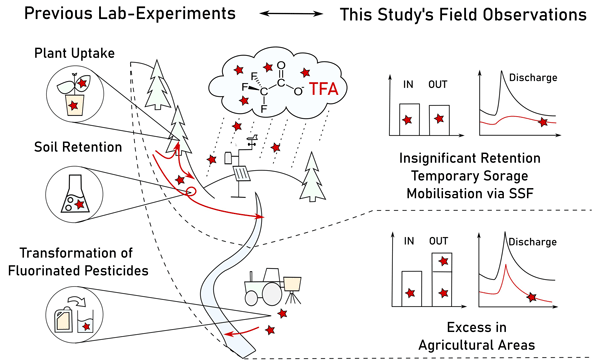
Abstract. Trifluoroacetate (TFA) is a contaminant from various human sources. The degradation of fluorinated gases in the atmosphere leads to a ubiquitous input through precipitation. Degradation of certain agricultural pesticides and wastewater-borne pharmaceuticals adds to the amount of TFA pollution. Once released into the aquatic environment, TFA is nearly conservative due to its negative charge, high water solubility, and absence of degradation pathways. Consequently, TFA concentrations in the environment are constantly increasing, following the production of precursor substances. Previous studies suggested the accumulation of TFA in plants and its retention in organic soil. This knowledge, however, is based on a small number of environmental samples or laboratory experiments. Catchment-scale studies are so far missing. In particular, hydrological processes controlling the retention and mobilization of TFA are poorly understood. Therefore, we analyzed a two-year dataset of weekly water samples for major ions and isotope tracers with TFA in the mountainous Dreisam catchment (Black Forest, Germany). We sampled precipitation, the discharge of three nested catchments, and a hillslope spring. A balancing approach suggested that TFA was not permanently retained in forested headwaters. Therefore, we were able to estimate evapotranspiration in the sub-catchments from two years of TFA concentrations in streamflow. In agricultural areas, we found a surplus of TFA, which totaled an annual input of 11.4 ± 3.9 kg km-² for arable land. A correlation analysis using environmental tracers, combined with knowledge of runoff generation in the study catchment, suggested that previously retained TFA was flushed from soils under wet conditions, with subsurface stormflow serving as a primary transport path. These findings indicate that TFA concentrations in soils may be higher than average concentrations found in rain or streamflow. Therefore, future research should focus on TFA retention in the unsaturated zone.
-
Notice on discussion status
The requested preprint has a corresponding peer-reviewed final revised paper. You are encouraged to refer to the final revised version.
-
Preprint
(2843 KB)
-
The requested preprint has a corresponding peer-reviewed final revised paper. You are encouraged to refer to the final revised version.
- Preprint
(2843 KB) - Metadata XML
- BibTeX
- EndNote
- Final revised paper


Journal article(s) based on this preprint
Interactive discussion
Status: closed
-
RC1: 'Comment on egusphere-2025-2882', Anonymous Referee #1, 12 Aug 2025
-
AC1: 'Reply on RC1', Immanuel Frenzel, 21 Oct 2025
The comment was uploaded in the form of a supplement: https://egusphere.copernicus.org/preprints/2025/egusphere-2025-2882/egusphere-2025-2882-AC1-supplement.pdf
-
AC1: 'Reply on RC1', Immanuel Frenzel, 21 Oct 2025
-
RC2: 'Comment on egusphere-2025-2882', Anonymous Referee #2, 11 Sep 2025
The comment was uploaded in the form of a supplement: https://egusphere.copernicus.org/preprints/2025/egusphere-2025-2882/egusphere-2025-2882-RC2-supplement.pdf
-
AC2: 'Reply on RC2', Immanuel Frenzel, 21 Oct 2025
The comment was uploaded in the form of a supplement: https://egusphere.copernicus.org/preprints/2025/egusphere-2025-2882/egusphere-2025-2882-AC2-supplement.pdf
-
AC2: 'Reply on RC2', Immanuel Frenzel, 21 Oct 2025
-
RC3: 'Comment on egusphere-2025-2882', Anonymous Referee #3, 07 Oct 2025
This study presents a valuable and comprehensive investigation into the atmospheric and terrestrial pathways, retention, and export of trifluoroacetate (TFA) at the catchment scale. The two-year dataset and multi-compartment sampling approach (precipitation, streamflow, springs, WWTPs) provide an important basis for understanding TFA dynamics. The manuscript is generally well written and organized; however, several methodological clarifications and interpretations should be addressed before publication.
Line 160–165:
Please clarify the rationale for choosing this separation column for TFA analysis. What are its advantages compared with other commonly used columns for PFAS analysis, such as the Hypersil Gold C18 column?
Line 165–170:
The role of 50 mM ammonium hydrogen carbonate in pure water as mobile phase A should be clarified. If the separation column is hydrophilic, the use of methanol as mobile phase B may not be ideal. Please confirm the column chemistry and justify the chosen mobile phase composition.
Line 175–176:
You mention Mill-Q blank samples as procedural blanks. Were these blanks also used to assess potential TFA contamination from the LC–MS system (e.g., tubing, fittings, internal components)? Please describe any specific cleaning or pre-conditioning procedures used to minimize TFA background signals from the instrument.
Line 190–195:
It is mentioned that the same separation and guard columns used for LC–MS analysis were also used for IC analysis of major anions and cations. Does this imply that the IC system could potentially be used for TFA determination as well? If so, was this tested or verified?
Additionally, please clarify whether “supplier” refers to the supplier of the IC instrument or of the columns. Did you determine quantification limits for each ion using your own calibration curves under actual operating conditions, which might be more accurate than supplier-provided values?
Line 275–276:
Please elaborate on the factors leading to the highest TFA levels in the Dreisam River during the 2023–2024 winter.
Figure 2:
Does the gray shading in panels (a–c) represent dry and wet conditions? Please specify this in the figure caption.
Line 303–304:
Based on the correlation data in Table 2, it seems that TFA showed positive correlations with all tracers except nitrate. Please confirm and revise accordingly.
Line 306:
The sentence “The same was true for the negative correlation with deuterium excess” is ambiguous. Please rephrase for clarity (e.g., “Similarly, TFA exhibited a negative correlation with deuterium excess”).
Line 364–365:
You state that “Potassium negatively correlated with TFA; however, concentrations were below LOQ and could not be reliably interpreted.” How was the correlation established if potassium concentrations were not quantifiable? Please clarify or reconsider this statement.
Line 366–367:
Given that the spring pH is around 6, the previously cited finding that “TFA sorption to soils decreased with increasing pH up to pH 5” (Richey et al., 1997) may not adequately explain the observed behavior at the Zipfeldobel spring. Please discuss this limitation.
Line 428–430:
Considering TFA’s high mobility, the lack of significant retention in water bodies contrasts with reported TFA retention in plants and soils (Likens et al., 1997; Berger et al., 1997). Please elaborate on possible mechanisms or environmental conditions explaining this discrepancy.
Line 430:
The sentence “Potentially, differences originate from the study design of both field experiments” should include more detail on what specific design differences (e.g., sampling frequency, soil types, hydrological setting) might explain the divergent results.
Line 447–449:
Please provide references supporting the statement that patterns/concentrations “were attributed to the distribution of TFA precursor molecules in the atmosphere.”
Line 380 vs. Line 470:
You stated that “our hypothesis of a temporal TFA storage, most likely associated with organic soil, seems valid,” yet later conclude that “We identified the organic soil zone as a primary TFA storage.” Since the data suggest only temporary accumulation, the latter conclusion may overstate the findings. Please rephrase to maintain consistency and avoid overinterpretation.
Line 475:
You compare TFA loads from farming activities with values reported for precursor PPP degradation in Joerss et al. (2024). If those values were derived from a different catchment, the comparison may not be meaningful. Please clarify whether the data are directly comparable.
-
AC3: 'Reply on RC3', Immanuel Frenzel, 21 Oct 2025
The comment was uploaded in the form of a supplement: https://egusphere.copernicus.org/preprints/2025/egusphere-2025-2882/egusphere-2025-2882-AC3-supplement.pdf
-
AC3: 'Reply on RC3', Immanuel Frenzel, 21 Oct 2025
Peer review completion


Interactive discussion
Status: closed
-
RC1: 'Comment on egusphere-2025-2882', Anonymous Referee #1, 12 Aug 2025
General comments:
The authors made a comprehensive and interesting study on the size and applicability of TFA concentration on catchment scale. The study includes many data that may be used by others interested in similar catchment scale studies or in other study types. In general discussions and conclusions are both interesting and justified. However, I am skeptical about the justification of the calculations on agricultural input. While the higher TFA concentrations at the Dreisam Gauge is likely to be caused by an input from agricultural activity, as the authors suggest, I think the numbers used in the calculations in combination with the general understanding of agricultural sources are so uncertain that the calculated mass of TFA from agriculture makes no sense and should be removed from the abstract and probably from the article and more emphasis should be put on the need for more research into this important aspect of the study. Please see specific comments for more details on this.
Specific comments:
Line 51 "the lack of transformation rates". Not only transformation rates are lacking but for most potential TFA-pesticides also whether the pesticides are transformed into TFA at all.
Line 93: How were HFCs (and which) used as tracers? Normally you would expect CFCs to be used as tracers. Are HFC/CFC data in Uhlenbrook et al, I cannot find them?
Line 95-96: “HOF" and "SOF" are these abbreviations necessary - they are not used any further?
Line 143: "a polyethylene (PE) tank located below the funnel". This is not much information on the precipitation collection. What material was the funnel made of? Did you test that it did not leach or adsorb TFA? Was it assured that there was not evaporation from the tank? Was it a constantly open funnel, so that also some of the dry deposition would be sampled? In general, dry deposition is not considered in the study, but some studies claim that it is a substantial fraction of atmospheric TFA input (most extreme case by Zhuang et al (https://www.sciencedirect.com/science/article/abs/pii/S0304389424009622), and most studies estimate at least some dry deposition. I guess there will also be quite some fog/mist in the area, that can be captured by especially conifers, but will probably not be captured by the precipitation sampler, or?
Line 147: "Storage time was up to four months". Stored how?
Line 275: "the highest TFA levels in the Dreisam River were observed during the 2023/2024 winter". To me this is not clear from the figure - it looks relatively constant, when considering the fluctuation from sample to sample...?
Line 277: "TFA concentrations increased with discharge". Is this statistically significant - it is not so easy to see from the figure, I think. Sometimes there seem to be a clear positive relationship between the two, sometimes not...
Line 334: "The Dreisam River exported 48 ± 21 % more TFA." This seems like a very uncertain calculation, since according to the figure in 2023 there was no surplus and in 2024 the surplus was around 100%? Taking average of two such different numbers makes no sense to me. Furthermore, how can the uncertainty be so small when taking average of two so different years? There should be input from agriculture in both years unless there is a very good (hydrological) reason for this to be so different. Although quantifying the contribution from agriculture is very important, I am not convinced it is scientifically reasonable to do from these data as apparently uncertainty is very high (which is actually expected for a whole catchment exercise)
Line 341: "main Dreisam catchment" is this the same as what is denoted DRC throughout the text?
Figure 4: Why use standard error, not standard deviation, so that it is easier to compare statistical significance?
Table 5: “Eq. 9” Do you mean Eq.8? I see no eq. 9.
Line 382: In general, water isotopes seem to show minor seasonal fluctuation, compared to what you would expect in the precipitation (though precipitation isotopes for the present study seems not to be shown). It guess this would suggest the rivers are mainly fed by groundwater? Does this fit with your understanding of the system? Does it fit with the fluctuations in TFA? Do you have stable isotope data for precipitation that could be included?
Section 4.2: Although highly interesting, this section seems very speculative and I think it should be minimized and uncertainties put more forward.
Line 421-427: Taking an average of two very different years (in terms of hydrology and TFA balance) doesn´t make sense to me even if the average precipitation volume of the area lies between the two.
Line 444: 100% molar yield is highly unlikely (pesticides are rarely degraded 100% to one compound, and a significant fraction of TFA and possibly the pesticides themselves will be removed with the crops). It is important to mention that this is highly unlikely, and also important to mention that so far, TFA from PPP is mainly hypothetical/potential (Joerss et al use the term "estimations of TFA formation potentials "). For the few compounds, where TFA was demonstrated in the EFSA conclusions and elsewhere, (much) smaller fractions than 100% was found.
Line 445: I doubt that manure will add much TFA compared to pesticides, but I guess you could calculate from published values for TFA in manure, mentioned in the Introduction?
Line 454: “Eq. 9” Do you mean Eq.8? I see is no eq. 9.
Line 458-465: What about the year-to-year variation that may be quite large, as you show in table 4 and which has also been shown by others (much higher than the 5% you mention as an average yearly increase). Maybe this should be discussed here as well?
Line 475: "reported for the degradation of precursor PPP". I would suggest to change into "reported for the potential degradation of precursor PPP"
Line 478: "mean residence times of 2-5 years". Why not shorter than 2 years? Is it not applicable for one year (11-16 months, line 460) as in the present manuscript?
Citation: https://doi.org/10.5194/egusphere-2025-2882-RC1 -
AC1: 'Reply on RC1', Immanuel Frenzel, 21 Oct 2025
The comment was uploaded in the form of a supplement: https://egusphere.copernicus.org/preprints/2025/egusphere-2025-2882/egusphere-2025-2882-AC1-supplement.pdf
-
AC1: 'Reply on RC1', Immanuel Frenzel, 21 Oct 2025
-
RC2: 'Comment on egusphere-2025-2882', Anonymous Referee #2, 11 Sep 2025
The comment was uploaded in the form of a supplement: https://egusphere.copernicus.org/preprints/2025/egusphere-2025-2882/egusphere-2025-2882-RC2-supplement.pdf
-
AC2: 'Reply on RC2', Immanuel Frenzel, 21 Oct 2025
The comment was uploaded in the form of a supplement: https://egusphere.copernicus.org/preprints/2025/egusphere-2025-2882/egusphere-2025-2882-AC2-supplement.pdf
-
AC2: 'Reply on RC2', Immanuel Frenzel, 21 Oct 2025
-
RC3: 'Comment on egusphere-2025-2882', Anonymous Referee #3, 07 Oct 2025
This study presents a valuable and comprehensive investigation into the atmospheric and terrestrial pathways, retention, and export of trifluoroacetate (TFA) at the catchment scale. The two-year dataset and multi-compartment sampling approach (precipitation, streamflow, springs, WWTPs) provide an important basis for understanding TFA dynamics. The manuscript is generally well written and organized; however, several methodological clarifications and interpretations should be addressed before publication.
Line 160–165:
Please clarify the rationale for choosing this separation column for TFA analysis. What are its advantages compared with other commonly used columns for PFAS analysis, such as the Hypersil Gold C18 column?
Line 165–170:
The role of 50 mM ammonium hydrogen carbonate in pure water as mobile phase A should be clarified. If the separation column is hydrophilic, the use of methanol as mobile phase B may not be ideal. Please confirm the column chemistry and justify the chosen mobile phase composition.
Line 175–176:
You mention Mill-Q blank samples as procedural blanks. Were these blanks also used to assess potential TFA contamination from the LC–MS system (e.g., tubing, fittings, internal components)? Please describe any specific cleaning or pre-conditioning procedures used to minimize TFA background signals from the instrument.
Line 190–195:
It is mentioned that the same separation and guard columns used for LC–MS analysis were also used for IC analysis of major anions and cations. Does this imply that the IC system could potentially be used for TFA determination as well? If so, was this tested or verified?
Additionally, please clarify whether “supplier” refers to the supplier of the IC instrument or of the columns. Did you determine quantification limits for each ion using your own calibration curves under actual operating conditions, which might be more accurate than supplier-provided values?
Line 275–276:
Please elaborate on the factors leading to the highest TFA levels in the Dreisam River during the 2023–2024 winter.
Figure 2:
Does the gray shading in panels (a–c) represent dry and wet conditions? Please specify this in the figure caption.
Line 303–304:
Based on the correlation data in Table 2, it seems that TFA showed positive correlations with all tracers except nitrate. Please confirm and revise accordingly.
Line 306:
The sentence “The same was true for the negative correlation with deuterium excess” is ambiguous. Please rephrase for clarity (e.g., “Similarly, TFA exhibited a negative correlation with deuterium excess”).
Line 364–365:
You state that “Potassium negatively correlated with TFA; however, concentrations were below LOQ and could not be reliably interpreted.” How was the correlation established if potassium concentrations were not quantifiable? Please clarify or reconsider this statement.
Line 366–367:
Given that the spring pH is around 6, the previously cited finding that “TFA sorption to soils decreased with increasing pH up to pH 5” (Richey et al., 1997) may not adequately explain the observed behavior at the Zipfeldobel spring. Please discuss this limitation.
Line 428–430:
Considering TFA’s high mobility, the lack of significant retention in water bodies contrasts with reported TFA retention in plants and soils (Likens et al., 1997; Berger et al., 1997). Please elaborate on possible mechanisms or environmental conditions explaining this discrepancy.
Line 430:
The sentence “Potentially, differences originate from the study design of both field experiments” should include more detail on what specific design differences (e.g., sampling frequency, soil types, hydrological setting) might explain the divergent results.
Line 447–449:
Please provide references supporting the statement that patterns/concentrations “were attributed to the distribution of TFA precursor molecules in the atmosphere.”
Line 380 vs. Line 470:
You stated that “our hypothesis of a temporal TFA storage, most likely associated with organic soil, seems valid,” yet later conclude that “We identified the organic soil zone as a primary TFA storage.” Since the data suggest only temporary accumulation, the latter conclusion may overstate the findings. Please rephrase to maintain consistency and avoid overinterpretation.
Line 475:
You compare TFA loads from farming activities with values reported for precursor PPP degradation in Joerss et al. (2024). If those values were derived from a different catchment, the comparison may not be meaningful. Please clarify whether the data are directly comparable.
-
AC3: 'Reply on RC3', Immanuel Frenzel, 21 Oct 2025
The comment was uploaded in the form of a supplement: https://egusphere.copernicus.org/preprints/2025/egusphere-2025-2882/egusphere-2025-2882-AC3-supplement.pdf
-
AC3: 'Reply on RC3', Immanuel Frenzel, 21 Oct 2025
Peer review completion
Journal article(s) based on this preprint
Viewed
| HTML | XML | Total | BibTeX | EndNote | |
|---|---|---|---|---|---|
| 2,888 | 737 | 125 | 3,750 | 91 | 87 |
- HTML: 2,888
- PDF: 737
- XML: 125
- Total: 3,750
- BibTeX: 91
- EndNote: 87
Viewed (geographical distribution)
| Country | # | Views | % |
|---|
| Total: | 0 |
| HTML: | 0 |
| PDF: | 0 |
| XML: | 0 |
- 1
Immanuel Frenzel

Dario Nöltge
Finnian Freeling
Michael Müller
Jens Lange
The requested preprint has a corresponding peer-reviewed final revised paper. You are encouraged to refer to the final revised version.
- Preprint
(2843 KB) - Metadata XML
General comments:
The authors made a comprehensive and interesting study on the size and applicability of TFA concentration on catchment scale. The study includes many data that may be used by others interested in similar catchment scale studies or in other study types. In general discussions and conclusions are both interesting and justified. However, I am skeptical about the justification of the calculations on agricultural input. While the higher TFA concentrations at the Dreisam Gauge is likely to be caused by an input from agricultural activity, as the authors suggest, I think the numbers used in the calculations in combination with the general understanding of agricultural sources are so uncertain that the calculated mass of TFA from agriculture makes no sense and should be removed from the abstract and probably from the article and more emphasis should be put on the need for more research into this important aspect of the study. Please see specific comments for more details on this.
Specific comments:
Line 51 "the lack of transformation rates". Not only transformation rates are lacking but for most potential TFA-pesticides also whether the pesticides are transformed into TFA at all.
Line 93: How were HFCs (and which) used as tracers? Normally you would expect CFCs to be used as tracers. Are HFC/CFC data in Uhlenbrook et al, I cannot find them?
Line 95-96: “HOF" and "SOF" are these abbreviations necessary - they are not used any further?
Line 143: "a polyethylene (PE) tank located below the funnel". This is not much information on the precipitation collection. What material was the funnel made of? Did you test that it did not leach or adsorb TFA? Was it assured that there was not evaporation from the tank? Was it a constantly open funnel, so that also some of the dry deposition would be sampled? In general, dry deposition is not considered in the study, but some studies claim that it is a substantial fraction of atmospheric TFA input (most extreme case by Zhuang et al (https://www.sciencedirect.com/science/article/abs/pii/S0304389424009622), and most studies estimate at least some dry deposition. I guess there will also be quite some fog/mist in the area, that can be captured by especially conifers, but will probably not be captured by the precipitation sampler, or?
Line 147: "Storage time was up to four months". Stored how?
Line 275: "the highest TFA levels in the Dreisam River were observed during the 2023/2024 winter". To me this is not clear from the figure - it looks relatively constant, when considering the fluctuation from sample to sample...?
Line 277: "TFA concentrations increased with discharge". Is this statistically significant - it is not so easy to see from the figure, I think. Sometimes there seem to be a clear positive relationship between the two, sometimes not...
Line 334: "The Dreisam River exported 48 ± 21 % more TFA." This seems like a very uncertain calculation, since according to the figure in 2023 there was no surplus and in 2024 the surplus was around 100%? Taking average of two such different numbers makes no sense to me. Furthermore, how can the uncertainty be so small when taking average of two so different years? There should be input from agriculture in both years unless there is a very good (hydrological) reason for this to be so different. Although quantifying the contribution from agriculture is very important, I am not convinced it is scientifically reasonable to do from these data as apparently uncertainty is very high (which is actually expected for a whole catchment exercise)
Line 341: "main Dreisam catchment" is this the same as what is denoted DRC throughout the text?
Figure 4: Why use standard error, not standard deviation, so that it is easier to compare statistical significance?
Table 5: “Eq. 9” Do you mean Eq.8? I see no eq. 9.
Line 382: In general, water isotopes seem to show minor seasonal fluctuation, compared to what you would expect in the precipitation (though precipitation isotopes for the present study seems not to be shown). It guess this would suggest the rivers are mainly fed by groundwater? Does this fit with your understanding of the system? Does it fit with the fluctuations in TFA? Do you have stable isotope data for precipitation that could be included?
Section 4.2: Although highly interesting, this section seems very speculative and I think it should be minimized and uncertainties put more forward.
Line 421-427: Taking an average of two very different years (in terms of hydrology and TFA balance) doesn´t make sense to me even if the average precipitation volume of the area lies between the two.
Line 444: 100% molar yield is highly unlikely (pesticides are rarely degraded 100% to one compound, and a significant fraction of TFA and possibly the pesticides themselves will be removed with the crops). It is important to mention that this is highly unlikely, and also important to mention that so far, TFA from PPP is mainly hypothetical/potential (Joerss et al use the term "estimations of TFA formation potentials "). For the few compounds, where TFA was demonstrated in the EFSA conclusions and elsewhere, (much) smaller fractions than 100% was found.
Line 445: I doubt that manure will add much TFA compared to pesticides, but I guess you could calculate from published values for TFA in manure, mentioned in the Introduction?
Line 454: “Eq. 9” Do you mean Eq.8? I see is no eq. 9.
Line 458-465: What about the year-to-year variation that may be quite large, as you show in table 4 and which has also been shown by others (much higher than the 5% you mention as an average yearly increase). Maybe this should be discussed here as well?
Line 475: "reported for the degradation of precursor PPP". I would suggest to change into "reported for the potential degradation of precursor PPP"
Line 478: "mean residence times of 2-5 years". Why not shorter than 2 years? Is it not applicable for one year (11-16 months, line 460) as in the present manuscript?