
the Creative Commons Attribution 4.0 License.
the Creative Commons Attribution 4.0 License.
 | 23 Jul 2025
Emerging Climate Signals in Oxygen Minimum Zones
Abstract. The ocean is losing oxygen due to anthropogenic climate change. This loss is particularly worrying when it occurs in naturally low-oxygen regions, such as the Oxygen Minimum Zones (OMZs) found at mid-depth in tropical oceans, because the expansion of OMZs reduces habitable space for marine life and threatens oxygen-dependent ecosystems. However, detecting the emergence of climate-driven signals is challenging due to internal variability. Here, we isolate externally forced signals of OMZ volume change and regional deoxygenation, and determine their time of emergence using the IPSL-CM6A-LR Large Ensemble. We apply time of emergence analysis to identify when climate-driven signals become statistically distinguishable from natural variability. Our results show that OMZ edges consistently expand, with emergence occurring in the second half of the 20th century, which is in phase with regional mean deoxygenation in the tropical Pacific and tropical Atlantic. In contrast, we reveal a marked spatial asymmetry in the emergence of OMZ core and hypoxic volumes between the northern and southern parts of OMZs. While OMZ core volumes in the tropical North Pacific and hypoxic volumes in the tropical North Atlantic expand, their southern counterparts contract due to a sudden, ventilation-driven oxygen increase from the Southern Ocean at the start of the 21st century. Uncertainties in emergence timing range from 20 to 30 years across ensemble members, and increase substantially in regions influenced by abrupt changes in OMZ ventilation. By linking the emergence of regional deoxygenation to that of OMZ volume changes, climate-driven expansions of OMZ volumes are likely already beginning to emerge, with distinct dynamics between northern and southern tropical oceans.
-
Notice on discussion status
The requested preprint has a corresponding peer-reviewed final revised paper. You are encouraged to refer to the final revised version.
-
Preprint
(47974 KB)
-
The requested preprint has a corresponding peer-reviewed final revised paper. You are encouraged to refer to the final revised version.
- Preprint
(47974 KB) - Metadata XML
- BibTeX
- EndNote
- Final revised paper


Journal article(s) based on this preprint
Interactive discussion
Status: closed
-
RC1: 'Comment on egusphere-2025-2805', Anonymous Referee #1, 14 Sep 2025
The manuscript "Emerging Climate Signals in Oxygen Minimum Zones" by Delteil et al provides an a comprehensive analysis of oxygen minimum zones across the worlds oceans within the IPSL large ensemble including both spatial and volumetric metrics, correlating mechanistic drivers such as solubility, nutrients, and age and multiple metrics of time of emergence of change. It is well written with only a few points requiring attention specified below. I recommend publication after attention to these technical issues.
Specific comments:
24 - This is also true in regions where temperature is high reducing solubility
55 - "dynamics" should be "dynamic"57-58 - suggest replacing "rise" with "emerge" and deleting ". The detectability thus becomes a signal to noise ratio problem, where emergence occurs"61 - suggest removing "the moment" as this is a retrospective statement of accumulated behavior rather than a single "moment"65 - suggest replacing "this method" with "single simulation analysis"69-70 - suggest removing "performed with the same Earth system model" as the phrase seems unnecessarily specific and draws the criticism that multi-model analysis is even better as it captures structural uncertainty (Hawkins and Sutton, 2009)91-98 - This belongs in the discussion103 - suggest replacing "used in of" with "contributing to"173 - Why is "Core" capitalized - If it is a special definition, that should be made explicit, and for "Oxygen Minimum Zones" either use previously defined acronym instead of writing it out or redefine it by adding "(OMZ)"175 - Why is "Low" capitalized? If it is a special definition, that should be made explicit.185 - How much is PO4 underestimated? This should be explicit - and what about solubility and the other physical mechanisms? Are the waters biased cold? That would be another explanation? Are they overventilated with respect to CFC's or 14C? I recognize that these are treated as trends later on, but a more comprehensive discussion of the mean state biases is warranted here.185 - The weakness of the undercurrent oxygen transport is also a resolution issue (Busecke, J. J., Resplandy, L., & Dunne, J. P. (2019). The equatorial undercurrent and the oxygen minimum zone in the Pacific. Geophysical Research Letters, 46(12), 6716-6725.) such that even if the physical transport is correct, the oxygen supply is underestimated - but this would tend to go in the other direction, suggesting that the model would be even more biased in oxygen if the undercurrent oxygen transport were correct.206 - Why show the three sets of numbers both as long term change and annual change? One presentation method would seem sufficient. Given the importance of the annual change in the next paragraph, I think that would be the superior approach.~260 - It is not clear if this analysis accounts for WOA underestimating hypoxic volumes Bianchi, D., Dunne, J. P., Sarmiento, J. L., & Galbraith, E. D. (2012). Data‐based estimates of suboxia, denitrification, and N2O production in the ocean and their sensitivities to dissolved O2. Global Biogeochemical Cycles, 26(2).347 - "the" belongs between "in" and "tropical"351 - Does "variability" meaning one standard deviation?377-378 - Does "twice the magnitude of time-dependant internal variability" mean 2 standard deviations, or 95% confidence?400 - "signal" should be "signals"425 - suggest deleting "an annual increase of"504 - suggest "shown in" or "exhibited by" in place of "show by"507 - Why assume that the model is wrong on the trend emergence in the North Indian? Is this just because of the model mean state bias, or is there observational evidence to the contrary?Citation: https://doi.org/10.5194/egusphere-2025-2805-RC1 -
AC1: 'Reply on RC1', Mathieu Delteil, 16 Feb 2026
REVIEWER #1
All suggestions were considered and the issues raised were addressed, which in our opinion led to increasing the clarity of the revised manuscript.
Below are the authors’ point-by-point responses to the comments. Reviewer comments are in bold and responses are in normal font. Changes to the manuscript are in italics. Line numbers mentioned below refer to the revised manuscript.
General Comment:
The manuscript "Emerging Climate Signals in Oxygen Minimum Zones" by Delteil et al provides an a comprehensive analysis of oxygen minimum zones across the worlds oceans within the IPSL large ensemble including both spatial and volumetric metrics, correlating mechanistic drivers such as solubility, nutrients, and age and multiple metrics of time of emergence of change. It is well written with only a few points requiring attention specified below. I recommend publication after attention to these technical issues.
The authors would like to thank Reviewer #1 for their useful comments.
Specific comments:
- 24 - This is also true in regions where temperature is high reducing solubility
Thank you for the comment. In this study, we focus exclusively on permanent subsurface open-ocean OMZs, whose persistence is maintained by weak ventilation in so-called “shadow zones” and by high oxygen consumption associated with eastern boundary upwelling systems (Pedlosky, 1983). Whereas coastal hypoxic zones are primarily driven by enhanced eutrophication and warming (Breitburg et al., 2018). To clarify, the definition of OMZs has been refined to explicitly define the regions of interest considered by this study. The sentence now reads as follows:
P1 L24-26: Permanent open-ocean OMZs are typically located in poorly ventilated regions of the ocean and beneath zones of high biological productivity, where oxygen consumption is elevated
- 55 - "dynamics" should be "dynamic"
Done
- 57-58 - suggest replacing "rise" with "emerge" and deleting ". The detectability thus becomes a signal to noise ratio problem, where emergence occurs"
Thank you for this comment. The sentence has been reworded accordingly:
P2 L58-59: For a forced signal to be detectable, the externally forced trend must persistently emerge above internal variability, which is considered as noise Hasselmann, 1993; Santer et al., 1994).
- 61 - suggest removing "the moment" as this is a retrospective statement of accumulated behavior rather than a single "moment"
We agree with this comment. The term as been removed from the revised manuscript.
- 65 - suggest replacing "this method" with "single simulation analysis"
The sentence has been reworded accordingly.
- 69-70 - suggest removing "performed with the same Earth system model" as the phrase seems unnecessarily specific and draws the criticism that multi-model analysis is even better as it captures structural uncertainty (Hawkins and Sutton, 2009)
We agree with this comment, and the corresponding text has been removed from the revised manuscript.
- 91-98 - This belongs in the discussion
Yes, we agree with the reviewer’s comment. The paragraph at Line 91-98 in the preprint manuscript was removed as its content was already included in the discussion section.
- 103 - suggest replacing "used in of" with "contributing to"
Done
- 173 - Why is "Core" capitalized - If it is a special definition, that should be made explicit, and for "Oxygen Minimum Zones" either use previously defined acronym instead of writing it out or redefine it by adding "(OMZ)"
Thank you for your comment. OMZ core, hypoxic volumes, and low-oxygen volumes are defined using the three oxygen thresholds of interest: 20 µmol kg−1, 60 µmol kg−1, 120 µmol kg−1, respectively. For consistency, the term “OMZ core” has been uncapitalised throughout the revised manuscript. The OMZ acronym defined before has been used to refer to the Oxygen Minimum Zone.
- 175 - Why is "Low" capitalized? If it is a special definition, that should be made explicit.
As for OMZ core, low-oxygen volumes has been uncapitalised throughout the revised manuscript.
- 185 - How much is PO4 underestimated? This should be explicit - and what about solubility and the other physical mechanisms? Are the waters biased cold? That would be another explanation? Are they overventilated with respect to CFC’s or 14C? I recognize that these are treated as trends later on, but a more comprehensive discussion of the mean state biases is warranted here.
In this study, we focus on oxygen concentration biases, as they directly affect the definition of OMZ volumes. A comprehensive evaluation of biogeochemical variables in IPSL-CM6A-LR has been provided by Séférian et al. (2020). In the tropical Pacific, IPSL underestimates nutrient concentrations by approximately 2 µmol L−1 (Séférian et al., 2020).
The tropical Pacific is overventilated in the model, partly due to excessively strong deep convection in the Southern Ocean (Boucher et al., 2020). To assess large-scale ventilation, we compare age since surface contact at the end of the piControl simulation (years 3840–3850) with two data-driven inverse models: the Total Matrix Intercomparison (TMI) and the Ocean Circulation Inverse Model (OCIM) (Millet et al., 2025). The IPSL simulation reproduces shadow zones in the tropical regions of interest, indicating the representation of large-scale physical ventilation of tropical regions (Figure A5).
We have reworded and further detailed the discussion of IPSL-CM6A-LR biogeochemical biases. As suggested by Reviewer #2, this paragraph has been moved to Section 4.5 (Limitations).
P25 L560-567: The IPSL-CM6A-LR model exhibits a positive bias in dissolved oxygen concentrations, particularly in the OMZ regions. This oxygen overestimation in tropical OMZs is linked to the IPSL-CM6A-LR coarse spatial resolution, which leads to weaker equatorial currents Busecke et al., 2019; Calil, 2023). We compare age since surface contact at the end of the piControl simulation (years 3840–3850) with two data-driven inverse models: the Total Matrix Intercomparison (TMI) and the Ocean Circulation Inverse Model (OCIM) (Millet et al., 2025). The IPSL model reproduces shadow zones in the tropical regions of interest, indicating the representation of large-scale physical ventilation of tropical regions (Figure A5). The oxygen overestimation is then also linked to too strong deep convection in the Southern Ocean (Boucher et al., 2020).
- 185 - The weakness of the undercurrent oxygen transport is also a resolution issue (Busecke, J. J., Resplandy, L., & Dunne, J. P. (2019). The equatorial undercurrent and the oxygen minimum zone in the Pacific. Geophysical Research Letters, 46(12), 6716-6725.) such that even if the physical transport is correct, the oxygen supply is underestimated - but this would tend to go in the other direction, suggesting that the model would be even more biased in oxygen if the undercurrent oxygen transport were correct.
Thank you for this insightful comment. The IPSL model uses at a coarse spatial resolution. Busecke et al. (2019); Calil (2023) have shown that eddy-non-resolving models weaken the equatorial undercurrent in the tropical Pacific and the equatorial zonal currents in the tropical Atlantic. In both basins, such models also fail to adequately represent countercurrents that limit the vertical and lateral transport of dissolved oxygen. As a result, coarse-resolution models tend to simulate higher dissolved oxygen concentrations in the western basins and smaller OMZs in the eastern tropical basins. The impact of model resolution has been added to the discussion of OMZ biases and moved to the section 4.5 (Limitations), as suggested by Reviewer #2. The revised text now reads as follows:
P25 L560-567: The IPSL-CM6A-LR model exhibits a positive bias in dissolved oxygen concentrations, particularly in the OMZ regions. This oxygen overestimation in tropical OMZs is linked to the IPSL-CM6A-LR coarse spatial resolution, which leads to weaker equatorial currents Busecke et al., 2019; Calil, 2023). To assess large-scale physical ventilation, we compare age since surface contact at the end of the piControl simulation (years 3840–3850) with two data-driven inverse models: the Total Matrix Intercomparison (TMI) and the Ocean Circulation Inverse Model (OCIM) (Millet et al., 2025). The IPSL model reproduces shadow zones in the tropical regions of interest, indicating the representation of large-scale physical ventilation of tropical regions (Figure A5). The oxygen overestimation is then also linked to too strong deep convection in the Southern Ocean (Boucher et al., 2020).
- 206 - Why show the three sets of numbers both as long term change and annual change? One presentation method would seem sufficient. Given the importance of the annual change in the next paragraph, I think that would be the superior approach.
This section provides the only opportunity to compare the global decrease of oxygen of the global oceans. We chose to present both the long-term changes, which can be compared to the historical observational decrease of ∼2 %, and the dissolved oxygen trends required for the computation of the time of emergence in this study.
- 260 - It is not clear if this analysis accounts for WOA underestimating hypoxic volumes Bianchi, D., Dunne, J. P., Sarmiento, J. L., & Galbraith, E. D. (2012). Data-based estimates of suboxia, denitrification, and N2O production in the ocean and their sensitivities to dissolved O2. Global Biogeochemical Cycles, 26(2).
Thank you for this insightful comment. In this study, WOA18 is used as the observational reference to define OMZs in the model. This approach does not explicitly account for biases inherent to the WOA18 dataset. (Bianchi et al., 2012) showed that the World Ocean Atlas underestimates hypoxic volumes, which may lead to an underestimation of the volume percentiles used to define OMZ volumes in the IPSL-CM6A-LR Large Ensemble. (Kwiecinski and Babbin, 2021) used high-frequency oxygen measurements to characterise oxygen-deficient zones, allowing them to resolve the fine-scale vertical and horizontal structure of these regions that is not captured in gridded climatologies such as WOA18. They further showed that products such as WOA18 misplace both the upper boundary and the vertical extent of hypoxic volumes. To account for these uncertainties, we evaluate the sensitivity of our results to alternative OMZ definitions (fixed-threshold versus fixed-percentile), such that the resulting range of responses encompasses uncertainties inherent to IPSL oxygen overestimation and WOA18 underestimation of OMZ volumes.
The biases of the World Ocean Atlas are now discussed in Section 4.5 (Limitations).
P25 L568-572: However, the fixed-percentile approach does not correct for biases inherent to WOA18, which is known to underestimate hypoxic volumes (Bianchi et al., 2012; Kwiecinski and Babbin, 2021).
To account for these uncertainties, we evaluate the sensitivity of our results to alternative OMZ definitions (fixed-threshold versus fixed-percentile), such that the resulting range of responses encompasses uncertainties from IPSL oxygen overestimation and WOA18 underestimation of OMZ volumes (Figure A6).
- 347 - "the" belongs between "in" and "tropical"
Done
- 351 - Does "variability" meaning one standard deviation?
"Variability" referred here to one Large Ensemble standard deviation. Accordingly, we reworded the sentence. It now reads as follows:
P16 L342-344: The tropical Atlantic shows the lowest Large Ensemble standard deviation, thus the lowest internal variability, with hypoxic and low-oxygen volumes varying by 2.3 ×10¹³ m3 and 1.2 ×10¹⁴ m3, respectively.
- 377-378 - Does "twice the magnitude of time-dependant internal variability" mean 2 standard deviations, or 95% confidence?
Here, internal variability is measured using the Large Ensemble standard deviation. Accordingly, internal variability refers to the ensemble standard deviation throughout the manuscript. An emergence beyond twice the standard deviation also corresponds to a 95% confidence interval for the time of emergence. This has been clarified in the revised version.
P17 L376-378: We also examine the time of emergence of these climate-driven signals, defined as the year when the forced signal exceeds twice the magnitude of time-dependent internal variability, quantified here as the Large Ensemble standard deviation (Figure 7, Table 3).
- 400 - "signal" should be "signals"
Done
- 425 - suggest deleting "an annual increase of"
Done
- 504 - suggest "shown in" or "exhibited by" in place of "show by"
Yes. We modified the text accordingly as follows:
P23 L506-508 This oxygenation trend in the tropical South Atlantic basin is also exhibited by CMIP6 multi-model mean over the present-day period in Takano et al., 2023 and by the end of the 21st century over SSP1-2.6 and SSP5-8.5 in Kwiatkowski et al., 2020.
- 507 - Why assume that the model is wrong on the trend emergence in the North Indian? Is this just because of the model mean state bias, or is there observational evidence to the contrary?
The misrepresentation of the trend emergence for the OMZ core primarily arises from its mislocation in the model. In IPSL-CM6A-LR, the OMZ core is simulated in the Bay of Bengal rather than in the Arabian Sea. In addition, the historical trend of dissolved oxygen in the tropical North Indian Ocean is biased in the model, which fails to reproduce the oxygenation–deoxygenation dipole reported by Ditkovsky et al. (2023). However, no observational dataset is sufficiently resolved to detect the emergence of OMZ volumes. We can therefore only compare trends in dissolved oxygen. In the North Indian Ocean, the model shows an emergence of deoxygenation in the early 21st century at 10°S-30°S (Figure A3), whereas Tan et al. (2026) report no detectable emergence of deoxygenation in observations prior to 2023.
References
Bianchi, D., Dunne, J. P., Sarmiento, J. L., and Galbraith, E. D.: Data-based estimates of suboxia, denitrification, and N2 O production in the ocean and their sensitivities to dissolved O2, Global Biogeochemical Cycles, 26, 2011GB004 209, https://doi.org/10.1029/2011GB004209, 2012.
Boucher, O., Servonnat, J., Albright, A. L., Aumont, O., Balkanski, Y., Bastrikov, V., Bekki, S., Bonnet, R., Bony, S., Bopp, L., Braconnot, P., Brockmann, P., Cadule, P., Caubel, A., Cheruy, F., Codron, F., Cozic, A., Cugnet, D., D’Andrea, F., Davini, P., de Lavergne, C., Denvil, S., Deshayes, J., Devilliers, M., Ducharne, A., Dufresne, J.-L., Dupont, E., Éthé, C., Fairhead, L., Falletti, L., Flavoni, S., Foujols, M.-A., Gardoll, S., Gastineau, G., Ghattas, J., Grandpeix, J.-Y., Guenet, B., Guez, E., L., Guilyardi, E., Guimberteau, M., Hauglustaine, D., Hourdin, F., Idelkadi, A., Joussaume, S., Kageyama, M., Khodri, M., Krinner, G., Lebas, N., Levavasseur, G., Lévy, C., Li, L., Lott, F., Lurton, T., Luyssaert, S., Madec, G., Madeleine, J.-B., Maignan, F., Marchand, M., Marti, O., Mellul, L., Meurdesoif, Y., Mignot, J., Musat, I., Ottlé, C., Peylin, P., Planton, Y., Polcher, J., Rio, C., Rochetin, N., Rousset, C., Sepulchre, P., Sima, A., Swingedouw, D., Thiéblemont, R., Traore, A. K., Vancoppenolle, M., Vial, J., Vialard, J., Viovy, N., and Vuichard, N.: Presentation and Evaluation of the IPSL-CM6A-LR Climate Model, Journal of Advances in Modeling Earth Systems, 12, e2019MS002 010, https://doi.org/10.1029/2019MS002010, 2020.
Breitburg, D., Levin, L. A., Oschlies, A., Grégoire, M., Chavez, F. P., Conley, D. J., Garçon, V., Gilbert, D., Gutiérrez, D., Isensee, K., Jacinto, G. S., Limburg, K. E., Montes, I., Naqvi, S. W. A., Pitcher, G. C., Rabalais, N. N., Roman, M. R., Rose, K. A., Seibel, B. A., Telszewski, M., Yasuhara, M., and Zhang, J.: Declining oxygen in the global ocean and coastal waters, Science, 359, eaam7240, https://doi.org/10.1126/science.aam7240, 2018.
Busecke, J. J. M., Resplandy, L., and Dunne, J. P.: The Equatorial Undercurrent and the Oxygen Minimum Zone in the Pacific, Geophysical Research Letters, 46, 6716–6725, https://doi.org/10.1029/2019GL082692, 2019.
Calil, P. H. R.: High-Resolution, Basin-Scale Simulations Reveal the Impact of Intermediate Zonal Jets on the Atlantic Oxygen Minimum Zones, Journal of Advances in Modeling Earth Systems, 15, e2022MS003 158, https://doi.org/10.1029/2022MS003158, 2023.
Ditkovsky, S., Resplandy, L., and Busecke, J.: Unique ocean circulation pathways reshape the Indian Ocean oxygen minimum zone with warming, Biogeosciences, 20, 4711–4736, https://doi.org/10.5194/bg-20-4711-2023, 2023.
Kwiecinski, J. V. and Babbin, A. R.: A High-Resolution Atlas of the Eastern Tropical Pacific Oxygen Deficient Zones, Global Biogeochemical Cycles, 35, e2021GB007 001, https://doi.org/10.1029/2021GB007001, 2021.
Millet, B., De Lavergne, C., Gray, W. R., Éthé, C., Madec, G., Holzer, M., DeVries, T., Gebbie, G., and Roche, D. M.: Deep Ocean Ventilation: A Comparison Between a General Circulation Model and Data-Constrained Inverse Models, Journal of Advances in Modeling Earth Systems, 17, e2024MS004 914, https://doi.org/10.1029/2024MS004914, 2025.
Pedlosky, J.: Eastern Boundary Ventilation and the Structure of the Thermocline, Journal of Physical Oceanography, 13, 2038–2044, https://doi.org/10.1175/1520-0485(1983)013%3C2038:EBVATS%3E2.0.CO;2, 1983.
Séférian, R., Berthet, S., Yool, A., Palmiéri, J., Bopp, L., Tagliabue, A., Kwiatkowski, L., Aumont, O., Christian, J., Dunne, J., Gehlen, M., Ilyina, T., John, J. G., Li, H., Long, M. C., Luo, J. Y., Nakano, H., Romanou, A., Schwinger, J., Stock, C., Santana-Falcón, Y., Takano, Y., Tjiputra, J., Tsujino, H., Watanabe, M., Wu, T., Wu, F., and Yamamoto, A.: Tracking Improvement in Simulated Marine Biogeochemistry Between CMIP5 and CMIP6, Current Climate Change Reports, 6, 95–119, https://doi.org/10.1007/s40641-020-00160-0, 2020.
Tan, Z., Von Schuckmann, K., Speich, S., Bopp, L., Zhu, J., and Cheng, L.: Observed large- scale and deep-reaching compound ocean state changes over the past 60 years, Nature Climate Change, 16, 58–68, https://doi.org/10.1038/s41558-025-02484-x, 2026.
Citation: https://doi.org/10.5194/egusphere-2025-2805-AC1
-
AC1: 'Reply on RC1', Mathieu Delteil, 16 Feb 2026
-
CC1: 'Comment on egusphere-2025-2805', Sam J. Ditkovsky, 14 Oct 2025
Dear authors,
Thank you for the interesting study. It’s great to see that the oxygen water mass framework is inspiring new work. However, there are some key ways in which the methodology in Section 2.3 of this manuscript differs from that of Ditkovsky and Resplandy (2025; hereafter D&R25) regarding regional bias correction. That is not to say that the methods of the present study are incorrect in any way, but they perhaps need justifications beyond references to D&R25.
Key differences in the methods of the present study compared to D&R25 are the regional constraints on OMZs and the direct mapping of simulated oxygen concentrations onto observed concentrations. (1) In D&R25, the oxygen-percentile framework is applied to the global ocean, but in the present study it is applied to local OMZ regions. When the oxygen-percentile framework is applied to constrained regions with open horizontal and vertical boundaries rather than to the global ocean, some key generalities are lost. For example, one can no longer assume that mixing-driven and redistribution-driven changes will sum to zero. (2) The present study goes beyond the scope of D&R25 by directly mapping modeled oxygen concentrations onto observed concentrations. This is a salient extension of the methodology, especially given the extreme biases in the IPSL model that are being corrected. Given both of these considerations, the approach of the present study feels much closer to a quantile-mapping bias correction (as used in e.g. precipitation studies) rather than a water mass framework. The authors may want to consult some papers dedicated to these approaches (e.g. Cannon et al., 2015, Journal of Climate) for some variations on this approach and the strengths and weaknesses of such approaches.
In my interpretation, an oxygen-based bias correction is sound if the biases in the IPSL model can be attributed primarily to biogeochemical processes, rather than physical processes. An oxygen-based coordinate system is meant to capture the behavior of physical pathways, taking advantage of the fact that remineralization differentiates waters along ventilation pathways. If the model simulates realistic ventilation pathways, then even unrealistic remineralization rates will differentiate waters along that pathway in oxygen-percentile space. However, if the model does not simulate realistic ventilation pathways– for example, if there is no effective shadow zone in the model– then the mapping of simulated regimes onto observations seems to me to have little physical significance. So, if the authors can support the claim that the oxygen biases in the IPSL model come primarily from biogeochemical processes, I believe that would strengthen the study significantly. One approach to this (but certainly not the only) could be evaluating temperature and salinity distributions in oxygen-percentile space for each region.
As a final note, the terms “geographic-space” and “ventilation-space” coined in D&R25 seem to be used incorrectly in the methods (Section 2.3) of the present study. To clarify, a result in geographic space is any distribution which uses latitude, longitude and depth as coordinates. So, both oxygen and oxygen-percentiles are represented in geographic space when shown on a map or section. Meanwhile, a result in ventilation-space is any distribution that uses an oxygen-based (or some other non-conservative) tracer coordinate. The frequency distribution of oxygen concentration values (as used in Busecke et al. 2022) and the oxygen-percentile relation are both examples of distributions in ventilation space.
I hope this is helpful, and good luck with the manuscript!
Best wishes,
Sam Ditkovsky
Cannon, A. J., Sobie, S. R., & Murdock, T. Q. (2015). Bias correction of GCM precipitation by quantile mapping: how well do methods preserve changes in quantiles and extremes?. Journal of Climate, 28(17), 6938-6959.
Citation: https://doi.org/10.5194/egusphere-2025-2805-CC1 -
AC2: 'Reply on CC1', Mathieu Delteil, 18 Feb 2026
COMMUNITY COMMENT #1
All suggestions were considered and the issues raised were addressed, which in our opinion led to increasing the clarity of the revised manuscript.
Below are the authors’ response to the comment. Community comment is in bold and response is in normal font. The supplementary figure (Figure A5) supporting the response to CC1 is provided in the supplement file.
Dear authors,
Thank you for the interesting study. It’s great to see that the oxygen water mass framework is inspiring new work. However, there are some key ways in which the methodology in Section 2.3 of this manuscript differs from that of Ditkovsky and Resplandy (2025; hereafter D&R25) regarding regional bias correction. That is not to say that the methods of the present study are incorrect in any way, but they perhaps need justifications beyond references to D&R25.
Key differences in the methods of the present study compared to D&R25 are the regional constraints on OMZs and the direct mapping of simulated oxygen concentrations onto observed concentrations. (1) In D&R25, the oxygen-percentile framework is applied to the global ocean, but in the present study it is applied to local OMZ regions. When the oxygen-percentile framework is applied to constrained regions with open horizontal and vertical boundaries rather than to the global ocean, some key generalities are lost. For example, one can no longer assume that mixing-driven and redistribution-driven changes will sum to zero. (2) The present study goes beyond the scope of D&R25 by directly mapping modeled oxygen concentrations onto observed concentrations. This is a salient extension of the methodology, especially given the extreme biases in the IPSL model that are being corrected. Given both of these considerations, the approach of the present study feels much closer to a quantile-mapping bias correction (as used in e.g. precipitation studies) rather than a water mass framework. The authors may want to consult some papers dedicated to these approaches (e.g. Cannon et al., 2015, Journal of Climate) for some variations on this approach and the strengths and weaknesses of such approaches.
In my interpretation, an oxygen-based bias correction is sound if the biases in the IPSL model can be attributed primarily to biogeochemical processes, rather than physical processes. An oxygen-based coordinate system is meant to capture the behavior of physical pathways, taking advantage of the fact that remineralization differentiates waters along ventilation pathways. If the model simulates realistic ventilation pathways, then even unrealistic remineralization rates will differentiate waters along that pathway in oxygen-percentile space. However, if the model does not simulate realistic ventilation pathways – for example, if there is no effective shadow zone in the model – then the mapping of simulated regimes onto observations seems to me to have little physical significance. So, if the authors can support the claim that the oxygen biases intheIPSLmodelcomeprimarilyfrombiogeochemicalprocesses, Ibelievethatwould strengthen the study significantly. One approach to this (but certainly not the only) could be evaluating temperature and salinity distributions in oxygen-percentile space for each region.
As a final note, the terms “geographic-space” and “ventilation-space” coined in D&R25 seem to be used incorrectly in the methods (Section 2.3) of the present study. To clarify, a result in geographic space is any distribution which uses latitude, longitude and depth as coordinates. So, both oxygen and oxygen-percentiles are represented in geographic space when shown on a map or section. Meanwhile, a result in ventilation-space is any distribution that uses an oxygen-based (or some other non-conservative) tracer coordinate. The frequency distribution of oxygen concentration values (as used in Busecke et al. 2022) and the oxygen-percentile relation are both examples of distributions in ventilation space.
I hope this is helpful, and good luck with the manuscript!
Best wishes,
Sam Ditkovsky
Cannon, A. J., Sobie, S. R., & Murdock, T. Q. (2015). Bias correction of GCM precipitation by quantile mapping: how well do methods preserve changes in quantiles and extremes?. Journal of Climate, 28(17), 6938-6959.
The authors would like to thank Sam Ditkovsky, for this detailed and insightful comment.
We agree that our approach differs from Ditkovsky and Resplandy (2025), and we would like to clarify our methodology and its rationale.
In our study, the oxygen-percentile framework is applied regionally within each OMZ, rather than at the global scale. We acknowledge that this does not describe a global redistribution as in Ditkovsky and Resplandy (2025). Nevertheless, IPSL-CM6A-LR represents “shadow zones” in the five OMZ regions considered in this study.
To assess large-scale ocean ventilation in the IPSL model, we compare the age since surface contact from the IPSL piControl simulation with two data-driven inverse models: the Total Matrix Intercomparison (TMI) and the Ocean Circulation Inverse Model (OCIM) (Millet et al., 2025). In the IPSL-CM6A-LR piControl simulation, age since surface contact was initialised in 1750 at the beginning of the piControl spin-up, and therefore the variable is not initially in equilibrium. In this study, the associated drift is accounted for by detrending the age since surface contact (see Model drift correction section), and analyses are conducted in relative values with respect to the pre-industrial period of each historical member. However, for comparison with TMI and OCIM, absolute values are required. We therefore analyse the climatological mean over years 3840–3850 of the piControl simulation, a period during which age since surface contact has stabilised. Between 100 and 1000 m depth, the IPSL model reproduces the tropical regional patterns of ocean ventilation seen in the TMI and OCIM models with comparable age since surface contact (Figure A5). In particular, it captures shadow zones in all five OMZ regions considered here (tropical North Pacific, tropical South Pacific, tropical North Atlantic, tropical South Atlantic, and North Indian Ocean). The IPSL model, however, fails to reproduce the subarctic North Pacific shadow zone, which may explain the misrepresentation of OMZ volumes in this region (Figure2b). Consequently, this region has been excluded from the analysis.
In each tropical region of interest, the representation of physical ventilation, and thus of shadow zones, is comparable between the IPSL model and the data-driven inverse models. Consequently, biases in oxygen concentration are likely primarily attributable to biogeochemical processes rather than to large-scale ventilation biases.
Our method does not aim to perform a bias correction in the classical sense or to adjust the model’s absolute oxygen levels. Rather, we use the cumulative oxygen-percentile function to define the volumes of interest (OMZ core, hypoxic, and low-oxygen waters) in each region. Then its spatial representation is tracked over time to analyse climate-driven changes. The approach thus preserves the model’s internal dynamics and focuses on relative spatial patterns of low-oxygen, despite the known overestimation of absolute oxygen concentrations in IPSL-CM6A-LR.
The employment of the terms “geographic-space” and “ventilation-space” have been revised and corrected in the section 2.3, Deoxygenation and OMZ metrics.
Ditkovsky, S. and Resplandy, L.: Unifying Future Ocean Oxygen Projections Using an Oxygen Water Mass Framework, Journal of Geophysical Research: Oceans, 130, e2025JC022 333, https://doi.org/10.1029/2025JC022333, 2025.
Millet, B., De Lavergne, C., Gray, W. R., Éthé, C., Madec, G., Holzer, M., DeVries, T., Gebbie, G., and Roche, D. M.: Deep Ocean Ventilation: A Comparison Between a General Circulation Model and Data-Constrained Inverse Models, Journal of Advances in Modeling Earth Systems, 17, e2024MS004 914, https://doi.org/10.1029/2024MS004914, 2025.
-
AC2: 'Reply on CC1', Mathieu Delteil, 18 Feb 2026
-
RC2: 'Comment on egusphere-2025-2805', Anonymous Referee #2, 15 Jan 2026
First let me congratulate the authors on a generally well-written paper. The are a few minor quirks with the English, but on the whole it is very good.
I have a few main conceptual points and long list of minor quibbles.
(1) The subarctic Pacific (SAP) is largely ignored, and possibly the title and Abstract should be altered to better reflect the exclusive focus on tropical and subtropical latitudes. There is a strong OMZ in the subarctic Pacific, which generally ESMs do a poor job of reproducing (Figure 2). It is ignored in the subsequent analysis (Figure 5), yet the casual reader of the title and Abstract could easily infer that the analysis is global. In Figure 5, data outside the boxes are included for the observations but not the model, and the caption does not explain why or make any mention of it.
(2) The exact method or criterion for choosing variable intervals along the piControl is not explained (118). The interval varies between 20 and 40 years and there is no explanation of how the specific years were chosen. Possibly this is explained in Bonnet et al 2021, but a brief summary of the core conceptual approach is warranted here.
(3) 20 umol/kg seems high for a choice of threshold to define the OMZ core, and is similarly not explained. I think the assertion that nitrous oxide is produced in <20 uM is a misreading of Ji et al.. Possibly there is some enhancement of N2O production from nitrification in this concentration range, but there is little or no denitrification above 6 uM (e.g., Devol 2008, 10.1016/B978-0-12-372522-6.00006-2). I think that almost all of the net N2O production in OMZs occurs below 6 uM.
(4) I often counsel authors to try alternate methods of data presentation such as histograms or scatterplots, rather than relying solely on visual comparison of colour maps. This seems like an obvious case. A statement like "Across all regions, the IPSL simulations systematically overestimate oxygen concentrations compared to observations" (190-191) seems made for such an analysis. If some histograms and/or scatterplots were included as Supplementary figures the reader could more easily and quantitatively evaluate this bias. (Note also that this passage makes no mention of the SAP.)
On 344 we have "Internal variability of OMZ volumes remains stable throughout the SSP2-4.5 scenario (Figure 6)" This may be true but it's not clear that the reader can verify it from the figure. Another possible example of where additional Supplementary figures with different data-presentation approaches could be useful.
(5) I was also surprised not to see any reference to the data product of Kwiecinski and Babbin (10.1029/2021GB007001). I think this is not a 'gridded' data product in the sense that WOA uses optimal interpolation to produce a continuous field, but it does address some of the deficiencies of the WOA in the ETNP and ETSP (see 150-151). I don't want to call for major new analysis at this stage, but it would nice if it were at least mentioned in the Discussion (e.g., what are the implications of alleviation of these biases for the paper's conclusions?)
(6) The methodology for emergence of individual ensemble members is not really explained (Figure 9). Because the ensemble mean has fairly low internal variability, its emergence from the envelope is usually monotonic. But individual ensemble members are more likely to meander in and out of the envelope for some time, and the text should clearly state whether it is the first or the last crossing of the envelope upper/lower bound that is recorded as ToE. Also on 456-457 it states that "They are members with either stronger forced trends or lower internal variability". Does this make sense? I think it does not. Why would one ensemble member have a stronger forced signal than another? Is not the whole premise of the experiment that the forced signal is common to all members? Some reconsideration of the wording is warranted here. Also what does it mean to say that the ensemble mean 'underestimates' ToE vs the median (460)? How do we know which is 'right'? Wouldn't it be better to just say that one is generally earlier/later?
(7) The Conclusion states that "extratropical ventilation pathways play a key role in maintaining oxygen levels". But this paper does not directly address ventilation pathways or mechanisms. It examines regional mean values of AOU and water age to infer that the ventilation pathways or mechanisms identified in some of the cited literature are important. There's nothing wrong with this but I would suggest that the Abstract and Conclusion be reworded to reflect what was actually done. Other than this the Discussion and Conclusions are generally good, although I find section 4.3 a bit vague and confusing (what does 'dispersion' mean in this context?), and 4.5 a bit repetitive. A little effort here could makes these both shorter and clearer.
Terminology/formatting
There are a few quirks about the way that numbers and units are represented, like not leaving a space between a number and its unit (e.g., 1000m), or using a . instead of space (e.g., mol.kg-1). Both of these occur numerous times.
O2 and AOU are usually italicized and should not be.
The sign convention is confusing. AOU is usually expressed as positive, i.e., if I say that AOU is 40 uM it is implicitly understood that O2sat>O2. There are numerous places in this MS where e.g., AOU is said to have decreased by -X uM (e.g., 407-410), which really means that it increased by X uM, which is the opposite of what is intended (see also e.g., 206-207, 226, 229, 381-382, 442-445, 449).
The number of significant figures is sometimes inconsistent and sometimes excessive. Generally it is good practice to use a consistent number of sf rather than of decimal places (e.g., 2.5+/-0.90). For example, on 225-229 some numbers have 2sf, some 3 and some 4. I think 2 is all that is justified by the actual precision of the data. On e.g., 291 the number of sf seems excessive. On 320-342 most numbers have 3sf, some have 2. I think 2 is all that is really justified or necessary here. Same for 381-386 and 408-415. On 426-449 some numbers have 4sf and some 3. 3 might be justifiable but 2 is probably adequate, and most of these numbers don't really require scientific notation, e.g., one could write 32.57e-1 as 3.3 or 3.78e-2 as 0.038.
There are quite a lot of cases where an unnecessary 's' is tacked onto a word (e.g., confuses singular and plural subject), or where there should be an 's' but it is missing (e.g., 55, 219, 295, 364, 365, 370, 373, 513, 526, 562).
There are quite a few "microparagraphs" consisting of single sentence (e.g., 237, 283, 362). Consider joining these to the preceding paragraph.
There are several figures where the subpanels are numbered abcde… but these are not mentioned in the caption (Figs 4, 5, 6, 7, 8, 9). The subpanels are referenced in the text, and in general there is no ambiguity. I don't know if this journal has a policy on this, but generally if you are going to number the subplots it is usual to define the labels in the caption.
The phrase, "In contrast" appears 13 times. I prefer, "By contrast", but I question whether all of the uses of this phrase are necessary at all. On 96 for example, I think it could be deleted without losing anything important. I would recommend to excise as many as possible.
On 382 for example, we have "These losses are stronger than those observed in their southern counterparts" I find this terminology vague and I think it would be easier on the reader to say e.g., "These losses are greater in the northern hemisphere OMZs than in the southern hemisphere OMZs of the same basin". Large gain in clarity for small number of extra words. (see also 389, 429, 485, 493, 523, 525).
On 178 and elsewhere: don't use 'significant' as a generalized term of emphasis (12 total occurrences; not all are necessarily inappropriate but some are)
Some details
15 "likely already beginning" is this consistent with IPCC-approved use of "likely" or more colloquial?
24-25 I am supportive of citing seminal historical papers like Luyten. The ur-reference on this topic is Wyrtki 1962 (Deep Sea Res 9: 11), which could possibly be included here.
35 change "severity" to "intensity"
42 "parameterization" misspelled
44 delete "the" before "Phase 5"
72 change "extract" to "identify"
105, 109 change "oceanic" to "ocean"
110 change "at 1/3" to "to 1/3"
123 change "then" to "and"
125 and "ensemble" after "IPSL-CM6A-LR"
127 and elsewhere "inter-member" strikes me as an unnecessary jargon term that could be avoided (~20 total occurrences). " Large Ensemble inter-member mean" could just be "Large Ensemble mean" and "the inter-member spread" could be "the spread among members".
182-183 change "the IPSL Hypoxic waters account for only 10% of the observed Hypoxic waters" to "in the IPSL model the volume of Hypoxic water is only 10% of that in the observational data product"
184-186 this sort of speculation properly belongs in the Discussion
189 "it fails" unclear antecedent
193-194 "CMIP6 models fail to capture OMZ core waters in the North Indian Ocean, with an oxygen minimum in the Arabian Sea rather than in the Bay of Bengal" appears to have the place names reversed
203 and elsewhere "Storch and Swiers 1999" both authors' names are misspelled. Zwiers is spelled with a "Z" and von Storch's surname is "von Storch"
203-204 "A 90% confidence interval is applied, accounting for the reduction in degrees of freedom" A vague and essentially meaningless statement. Reword and explain clearly what methods were used and what assumptions were made.
221 "fail to reproduce the observed dipole" "dipole is a jargony word that is probably unnecessary, and it isn't really clear what it refers to here
249 Equation (2): The text below the integral signs is not a limit of integration as is usual practice. It might be better to just drop the equation and explain this in words: V is the total volume of water with O2<O2*. I don't think the equation adds much value.
255 change "29st" to "29th" (I think French does not have this unfortunate quirk, it's just 'e' across the board)
269 should this specify OMZ core? (Figure 2)
297, 378, 488 "dependent" misspelled (https://www.grammarly.com/commonly-confused-words/dependant-vs-dependent)
297 "prevents underestimating variability" vague; reword
309 add "with" after "along"
321 "the tropical North Pacific shows the fastest growth" I'm not sure this is a meaningful comparison, as the volumes in the preindustrial climate vary. If it is the largest to begin with, does comparing rates of expansion in m^3/y really indicate the "fastest growth"?
333 add "about" before "2004"? I'm not sure this number is known this precisely. (see also 422)
349 "OMZ Core volumes being smaller" not clear if this refers to the mean or the variance
351 "relative variability of North Atlantic Hypoxic volume is the highest across all regions" appears to contradict the statement on 477 that "earlier emergence is not due to faster expansion, but rather to lower internal variability of the tropical Atlantic Low-oxygen volumes"; possibly these do not refer to the same [O2] ranges
363 , should be a ; (after "simulation")
375 elsewhere O2sat does not have a comma
381 "dissolved" misspelled
392 missing . after parenthesis
398 "increases in the tropical South Pacific and the tropical South Pacific" ???
400 "decrease signal" is another unnecessary bit of jargon where clarity could be increased with only a small amount of rewording. For example, what if they reworded "In all regions, the O2sat decrease signal emerges after the deoxygenation signal (Figure 7, Table 3). These signal decline gradually until 2000, after which it accelerates sharply" as "In all regions, O2sat emerges after deoxygenation (Figure 7, Table 3). Both O2 and O2sat decline gradually until about 2000, after which the decline accelerates sharply"
402 "the decline rate increases by a factor 10" Another assertion that is probably true but the reader can not necessarily verify from the plot. Possibly include a Supplemental table that would present the actual statistics.
404 and elsewhere I'm not sure any of the uses of "inflection point" (or "inflections" on 465) are valid or necessary. This term has a specific meaning in mathematics, i.e., the point at which d2X/dt2 changes sign (e.g., if supralinear growth become sublinear)
431 Figure 8 b, d, e should be d, h, j?
488-490 "Moreover, Northern Hemisphere ecosystems may face earlier and more intense disruptions from expanding low-oxygen volumes, while Southern Hemisphere systems may experience more gradual but persistent changes." Vague; reword
499 delete "such as the future ocean,"
500 delete "through"
501 "via the Agulhas Current" could use a literature ref
504 change "show" to "shown"
505 delete "showed"
507 add "Ocean" after "Indian"
508 add "model" after "IPSL"
512 according to the title, Schmidt et al., 2021 is about CMIP5 models. I'm not sure this is useful as a basis for generalizing about the present ensemble. Some CMIP5 models (notably IPSL-CM5A-LR) had very coarse resolution (ORCA2) and very weak ventilation of some intermediate ocean areas. In my experience the difference between ORCA2 and ORCA1 in terms of ventilation processes is large.
608 Code availability section not completed
660 Ditkovsky reference incomplete
Figure 1 caption delete "millennial polynomial"
Figure 3 the boxes referenced in the caption are not visible on the maps
Table 1 why not show values for the WOA as well?
Figure 6 consider using different y axes for different panels; also "The time of emergence …b occurs when (solid line) the ensemble mean exceeds (coloured area) the standard deviation over the Large Ensemble" may be true but it's not clear how the reader verifies this, as the envelope of preindustrial variability is not shown on the plots.
Table 2 change "has not emerged from twice the ensemble standard deviation" to "has not emerged at the level of twice the ensemble standard deviation"; change "absence of OMZ volume" to "absence of OMZ core"
Table 3 2986 should be 1986?
Figure 8 caption seems to imply that the criterion for emergence is 1sd rather than 2
Figure 10 For the North Atlantic, the dark blue star is not visible. The text states that O2 emerges before OMZ volume (521) but it appears they are concurrent in this case.
Citation: https://doi.org/10.5194/egusphere-2025-2805-RC2 -
AC3: 'Reply on RC2', Mathieu Delteil, 18 Feb 2026
REVIEWER #2
All suggestions were considered and the issues raised were addressed, which in our opinion led to increasing the clarity of the revised manuscript.
Below are the authors’ point-by-point responses to the comments. Reviewer comments are in bold and responses are in normal font. Changes to the manuscript are in italics. Line numbers mentioned below refer to the revised manuscript. The supplementary figures (Figures A1 and A2) supporting the response to RC2 are provided in the supplement file.
General Comment:
First let me congratulate the authors on a generally well-written paper. The are a few minor quirks with the English, but on the whole it is very good.
I have a few main conceptual points and long list of minor quibbles.
The authors would like to thank Reviewer #2 for their useful comments.
Specific comments:
- (1) The subarctic Pacific (SAP) is largely ignored, and possibly the title and Abstract should be altered to better reflect the exclusive focus on tropical and subtropical latitudes. There is a strong OMZ in the subarctic Pacific, which generally ESMs do a poor job of reproducing (Figure 2). It is ignored in the subsequent analysis (Figure 5), yet the casual reader of the title and Abstract could easily infer that the analysis is global. In Figure 5, data outside the boxes are included for the observations but not the model, and the caption does not explain why or make any mention of it.
Thank you for this insightful comment. The IPSL-CM6A-LR model does not represent the subarctic Pacific OMZ within the 100−1000 m depth range considered in this study (Figure 2). Consequently, this OMZ is not included in our analysis, which focuses instead on five regional boxes encompassing the major tropical OMZs. OMZ volume metrics in IPSL-CM6A-LR are therefore computed exclusively within these regional boxes.
The title and abstract have been revised to explicitly mention the restriction of the study to tropical OMZs. The misrepresentation of the subarctic Pacific OMZ in Earth System models is now discussed in the 2.2.2 section (Model evaluation of oxygen) and it is now clearly stated in the 2.3 section (Deoxygenation and OMZ metrics) that the subarctic Pacific OMZ is not considered in this study. In Figure 5, data outside the selected regional boxes have been excluded in order to focus the comparison of OMZ thickness on the regions of interest.
Title: Emerging Climate Signals in Tropical Oxygen Minimum Zones
Abstract: The ocean is losing oxygen due to anthropogenic climate change. This loss is particularly worrying when it occurs in naturally low-oxygen regions, such as the Oxygen Minimum Zones (OMZs) found at mid-depth in tropical oceans, because the expansion of OMZs reduces habitable space for marine life and threatens oxygen-dependent ecosystems. However, detecting the emergence of climate-driven signals is challenging due to internal variability. Here, we isolate externally forced signals of tropical OMZ volume change and regional deoxygenation, and determine their time of emergence using the IPSL-CM6A-LR Large Ensemble. We apply time of emergence analysis to identify when climate-driven signals become statistically distinguishable from natural variability. Our results show that tropical OMZ edges consistently expand, with emergence occurring in the second half of the 20th century, which is in phase with regional mean deoxygenation in the tropical Pacific and tropical Atlantic. By contrast, we reveal a marked spatial asymmetry in the emergence of OMZ core and hypoxic volumes between the northern and southern parts of tropical OMZs. While OMZ core volumes in the tropical North Pacific and hypoxic volumes in the tropical North Atlantic expand, the tropical South Pacific OMZ core and the tropical South Atlantic hypoxic volume contract. This contraction in the southern hemisphere is due to a sudden, ventilation-driven, oxygen increase at the start of the 21st century. Uncertainties in emergence timing range from 20 to 30 years across ensemble members, and increase substantially in regions influenced by abrupt changes in OMZ ventilation. By linking the emergence of regional deoxygenation to that of OMZ volume changes, climate-driven expansions of tropical OMZ volumes appear to be beginning to emerge, with distinct dynamics between northern and southern tropical oceans.
P7 L168-169: The IPSL-CM6A-LR model fails to capture hypoxic waters in the subarctic Pacific (Figure 2a and b).
P9 L224-227: We define five fixed regional boxes corresponding to the major tropical OMZs (Figure 2, 5): tropical North Pacific (0°S-30°N/120°E-295°E), tropical South Pacific (30°S-0°N/120°E-295°E), tropical North Atlantic (0◦S-30◦N/60◦W-20◦E), tropical South Atlantic (30°S-0°N/60°W-20°E) and North Indian (0°S-30°N/35°E-120°E). As the IPSL-CM6A-LR model fails to represent oxygen minimum in the subarctic Pacific, this OMZ region has not been included in the analysis.
- (2) The exact method or criterion for choosing variable intervals along the piControl is not explained (118). The interval varies between 20 and 40 years and there is no explanation of how the specific years were chosen. Possibly this is explained in Bonnet et al 2021, but a brief summary of the core conceptual approach is warranted here.
TheIPSL-CM6A-LRpiControlsimulationexhibitsabicentennialvariabilityinglobalmeansurface air temperature (Bonnet et al., 2021). To adequately sample this low-frequency variability, 32 piControl initial conditions were selected a t20-year intervals, starting from year 20 of the piControl simulation. Due to two corrupted members (members 2 and 16), the final subsample of initial conditions includes 20-year spacing overall, with 40-year gaps between members 1 and 4 and between members 15 and 17.
For clarity, the procedure used to initialise the historical ensemble has been simplified in the revised manuscript and is now described as a regular 20-year sampling. The presence of two corrupted members (members 2 and 16), which were excluded from the analysis, is discussed separately.
P4L108-111: Initialisation conditions of historical-EXT ensemble are picked out from the piControl experiment every 20 years, in order to sample the phases of the bicentennial variability present in global mean surface air temperature of the model (Bonnet et al., 2021). Thus, initialisations of historical-EXT occur between the 20th and the 830th year of piControl simulation time, collectively sampling three cycles of this low-frequency variability.
- (3) 20 umol/kg seems high for a choice of threshold to define the OMZ core, and is similarly not explained. I think the assertion that nitrous oxide is produced in <20 uM is a misreading of Ji et al.. Possibly there is some enhancement of N2O production from nitrification in this concentration range, but there is little or no denitrification above 6 uM (e.g., Devol 2008, 10.1016/B978-0-12-372522-6.00006-2). I think that almost all of the net N2O production in OMZs occurs below 6 uM.
Thank you for this comment. Nitrous oxide is produced by denitrification under suboxic conditions ([O2] < 5µM) within the Oxygen Minimum Zone. However, Bianchi et al. (2018) highlight the importance of accounting for low-oxygen niche due to sinking particules. These niches can sustain denitrification in hypoxic waters. For this reason, we adopt a threshold of 20 µmol kg−1 to define the OMZ core.
The reference of Bianchi et al. (2018) has been added to the manuscript to clarify the choice of the threshold used to define the OMZ core.
P3 L77-81: Following the regimes identified by Ditkovsky et al. (2023), we distinguish three OMZ volume classes: OMZ core volumes ([O2] < 20 µmol kg−1), where nitrous oxide is produced (Ji et al., 2015; Bianchi et al., 2018); hypoxic volumes ([O2] < 60 µmol kg−1), which are harmful to many marine organisms (Miller et al., 2002; Vaquer-Sunyer and Duarte, 2008); and low-oxygen volumes ([O2] <120 µmol kg−1), which influence the distribution of marine ecosystems (Bertrand et al., 2011).
- (4) I often counsel authors to try alternate methods of data presentation such as histograms or scatterplots, rather than relying solely on visual comparison of colour maps. This seems like an obvious case. A statement like "Across all regions, the IPSL simulations systematically overestimate oxygen concentrations compared to observations" (190-191) seems made for such an analysis. If some histograms and/or scatterplots were included as Supplementary figures the reader could more easily and quantitatively evaluate this bias. (Note also that this passage makes no mention of the SAP.) On 344 we have "Internal variability of OMZ volumes remains stable throughout the SSP2-4.5 scenario (Figure 6)" This may be true but it’s not clear that the reader can verify it from the figure. Another possible example of where additional Supplementary figures with different data-presentation approaches could be useful.
We agree with the reviewer’s comment. A comparison between observational and modelled data is not sufficiently clear when relying solely on Figure 2. Scatterplot representation reinforces the assessment of biases in the modelled dissolved oxygen concentrations.
Accordingly, scatterplots comparing observed and modelled dissolved oxygen have been produced for each tropical OMZ region considered in this study and added to the Supplementary Material as Figure A1. Figure A1 is now referenced in section 2.2.2 (Model evaluation of oxygen) to better evaluate the distribution of modelled dissolved oxygen concentrations.
P7 L179-180: Across all regions, the IPSL simulations systematically overestimate oxygen concentrations compared to observations (Figure 2a and Figure A1).
P8 L186: Overall, the IPSL-CM6A-LR climatology simulates higher oxygen levels than the CMIP6 multi-model mean (Figure A1).
As justified in our response to the comment(1), a comparison of modelled oxygen in the subarctic Pacific has also been added to section 2.2.2 (Model evaluation of oxygen) and this region has not been included in the subsequent analysis.
We also agree that the evolution of internal variability in OMZ volumes is difficult to discern from the shaded areas shown in Figure 6. To support this analysis, Figure A2 has been added to the Supplementary Material, explicitly showing the temporal evolution of Large Ensemble standard deviation anomalies of OMZ volumes, relative to pre-industrial period (1850-1900). Figure A2 is now referenced in section 3.1.2 (OMZ volume variability). The sentence has also been reworded to better represent the variability of OMZ volumes.
P16 L338-352: The Internal variability is quantified by the Large Ensemble standard deviation of OMZ volumes (Figure 6). In both the tropical North and South Pacific, internal variability of OMZ volumes is higher than in the other regions with maximum Large ensemble standard deviation for the hypoxic volumes in the tropical North Pacific (4.0x10¹⁴ m3) and minimum for the tropical South OMZ core (2.1x10¹⁴ m3) (Figure 6a,b). Thus, in the tropical Pacific, internal variability is of comparable magnitude across all OMZ volume classes, despite differences in Large Ensemble mean absolute volume (Figure 6a,b). The tropical Atlantic shows the lowest Large Ensemble standard deviation, thus the lowest internal variability, with hypoxic and low-oxygen volumes varying by 2.3x10¹³ m3 and 1.2x10¹⁴ m3, respectively. In the North Indian Ocean, hypoxic and OMZ core volumes exhibit greater mean variability (1.3x10¹⁴ m3 and 1.9x10¹⁴ m3, respectively) compared to low-oxygen volumes (2.7x10¹³ m3).
Over the SSP2-4.5 period (2014–2060), OMZ volumes in the Tropical South Pacific and Tropical North Pacific, as well as hypoxic and low-oxygen volumes in the North Indian Ocean, exhibit a decrease in the Large Ensemble standard deviation relative to their pre-industrial (1850–1900) mean value. The reduction reaches 40 % for hypoxic volume in the Tropical South Pacific and low-oxygen volume in the Tropical North Pacific, and about 50 % in the North Indian Ocean (Figure A2g, h, and j). Over the same period, only the OMZ core volume in the North Indian Ocean shows an increase in the Large Ensemble standard deviation, of about 60 % (Figure A2j). All other OMZ volumes display a standard deviation that remains within 20 % of their respective pre-industrial values (Figure A2).
- (5) I was also surprised not to see any reference to the data product of Kwiecinski and Babbin (10.1029/2021GB007001). I think this is not a ’gridded’ data product in the sense that WOA uses optimal interpolation to produce a continuous field, but it does address some of the deficiencies of the WOA in the ETNP and ETSP (see 150-151). I don’t want to call for major new analysis at this stage, but it would nice if it were at least mentioned in the Discussion (e.g., what are the implications of alleviation of these biases for the paper’s conclusions?)
Thank you for this insightful comment. Kwiecinski and Babbin (2021) use high-frequency oxygen measurements to characterise Oxygen Deficient Zones, allowing them to resolve the fine-scale vertical and horizontal structure of these regions that is not captured in gridded climatologies as WOA18. Products as WOA18, misplace the top and the horizontal extend of hypoxic volumes. Bianchi et al. (2012) show that the World Ocean Atlas underestimates hypoxic volumes, which can lead to an underestimation of the volume percentiles used to define OMZ volumes in the IPSL-CM6A-LR Large Ensemble. To account for these uncertainties, we evaluate the sensitivity of our results to alternative OMZ definitions (fixed-threshold versus fixed-percentile), such that the resulting range of responses encompasses uncertainties from IPSL oxygen overestimation and WOA18 underestimation of OMZ volumes. We find that both the sign of the climate-driven trends and the timing of emergence are only weakly affected by the OMZ definition. Both references have been added to the Discussion, and the biases of the World Ocean Atlas are now discussed in section 4.5 (Limitations).
P24 L568-577: However, this approach does not correct for biases inherent to WOA18, which is known to underestimate hypoxic volumes (Bianchi et al., 2012; Kwiecinski and Babbin, 2021).
To account for these uncertainties, we evaluate the sensitivity of our results to alternative OMZ definitions (fixed-threshold versus fixed-percentile), such that the resulting range of responses encompasses uncertainties from IPSL oxygen overestimation and WOA18 underestimation of OMZ volumes (Figure A6). The sign of the climate-driven emergence trends are consistent across both definitions (Figure A6e–j). However, the percentile-based approach allows to detect the emergence of OMZ core and hypoxic volume signals, where the fixed-threshold method fails (Figure A6e–j). This reflects the fact that the classical method underestimates or misses the climate-driven signal due to the biased baseline in oxygen levels. The time of emergence of low-oxygen volumes is relatively insensitive to the OMZ defini tion used, reflecting the smaller oxygen bias at higher concentrations in IPSL-CM6A-LR (Figure A6k–o).
(6) The methodology for emergence of individual ensemble members is not really explained (Figure 9). Because the ensemble mean has fairly low internal variability, its emergence from the envelope is usually monotonic. But individual ensemble members are more likely to meander in and out of the envelope for some time, and the text should clearly state whether it is the first or the last crossing of the envelope upper/lower bound that is recorded as ToE. Also on 456-457 it states that "They are members with either stronger forced trends or lower internal variability". Does this make sense? I think it does not. Why would one ensemble member have a stronger forced signal than another? Is not the whole premise of the experiment that the forced signal is common to all members? Some reconsideration of the wording is warranted here. Also what does it mean to say that the ensemble mean ’underestimates’ ToE vs the median (460)? How do we know which is ’right’? Wouldn’t it be better to just say that one is generally earlier/later?
Thank you for this comment. Yes, individual ensemble members are more likely to cross the envelope of twice the internal variability multiple times. The time of emergence is therefore defined as the last time step after which the climate-forced signal remains, in absolute value, larger than twice the internal variability. This definition isalready provided in section 2.5 (Time of emergence). In addition, the captions of Figures 6, 7, 8, 9, A4, A6, and A7 have been revised to clarify this definition:
Figure 6: The time of emergence, indicated by the symbol star in all panels, is the last time step at which (solid line) the Large Ensemble mean exceeds twice (coloured area) the Large Ensemble standard deviation.
Figure 7: The time of emergence (indicated by the star symbol) is defined as the last point at which (a, b, c, d and e) the Large Ensemble mean concentration anomalies, and (f, g, h, i and j) the Large Ensemble mean percentage of pre-industrial concentrations exceed twice (coloured areas) their respective Large Ensemble standard deviations.
Figure 8: Star symbols indicate the time of emergence, defined as the last point at which (solid lines) the Large Ensemble mean exceeds twice (coloured areas) the Large Ensemble standard deviation.
Figure 9: The star symbol represents the time of emergence for the Large Ensemble mean, defined as the last time at which it exceeds twice the Large Ensemble standard deviation. The dots represent the time of emergence of individual ensemble members signal, defined as the last time at which each member individually exceeds twice the Large Ensemble standard deviation.
Figure A4: The star symbol represents the time of emergence for the Large Ensemble mean, defined as the last time at which it exceeds twice the Large Ensemble standard deviation. The dots represent the time of emergence for individual ensemble members signal, defined as the last time at which each member exceeds twice the Large Ensemble standard deviation.
Figure A6: The star symbol represents the time of emergence for the Large Ensemble mean, defined as the last time at which it exceeds twice the Large Ensemble standard deviation. The dots represent the time of emergence for individual ensemble members signal, defined as the last time at which each member exceeds twice the Large Ensemble standard deviation.
Figure A7: The star symbol represents the time of emergence for the Large Ensemble mean, defined as the last time at which it exceeds twice the noise. The dots represent the time of emergence for individual ensemble members signal, defined as the last time at which each member exceeds twice the noise.
All ensemble members are forced by the same external scenario and therefore have the same externally forced trend. However, due to their different initial conditions, which sample the model’s internal variability, each member exhibits distinct variability around this forced trend. Consequently, members showing earlier emergence correspond to realizations with larger internal variability, allowing them to exceed the Large Ensemble standard deviation earlier. The sentence has been reworded accordingly:
P21 L456-458: They correspond to members exhibiting stronger variability around the externally forced trend, and thereby corroborate the trend direction of the ensemble mean.
We agree that we cannot directly evaluate the absolute time of emergence, and therefore cannot determine which estimate is “right”. Only relative comparisons can be made, in terms of earlier or later emergence, between the Large Ensemble mean and the distribution across individual ensemble members. The sentence has been modified accordingly:
P21 L460-461: Across all OMZ regions, the ensemble mean time of emergence is generally earlier than the ensemble median, with large spread quantified by the interquartile range (Figure 9).
- (7) The Conclusion states that "extratropical ventilation pathways play a key role in maintaining oxygen levels". But this paper does not directly address ventilation pathways or mechanisms. It examines regional mean values of AOU and water age to infer that the ventilation pathways or mechanisms identified in some of the cited literature are important. There’s nothing wrong with this but I would suggest that the Abstract and Conclusion be reworded to reflect what was actually done. Other than this the Discussion and Conclusions are generally good, although I find section 4.3 a bit vague and confusing (what does ’dispersion’ mean in this context?), and 4.5 a bit repetitive. A little effort here could makes these both shorter and clearer.
Thank you for this comment. Accordingly, we rewrote the Discussion and the Abstract reflecting the analyses actually done in the study. The specific sentences now read as follows:
P1 L11-14: While OMZ core volumes in the tropical North Pacific and hypoxic volumes in the tropical North Atlantic expand, their southern counterparts contract due to a sudden, ventilation-driven oxygen increase at the start of the 21st century.
P26 L593-596: This contraction is particularly evident in the Southern Hemisphere, where oxygen concentrations are maintained by physical ventilation associated with a decrease in water-mass age. This is consistent with the findings of Gnanadesikan et al. (2007, 2012), which highlight the importance of extra-tropical ventilation pathways in controlling the ventilation of OMZ cores.
In the section 4.3 (Time of emergence of regional deoxygenation relative to OMZ volumes), the term dispersion refers to the spatial standard deviation of the local time of emergence distribution, within each OMZ region. We revised both section 4.3 (Time of emergence of regional deoxygenation relative to OMZ volumes) and 4.5 (Limitations), they read now as follow:
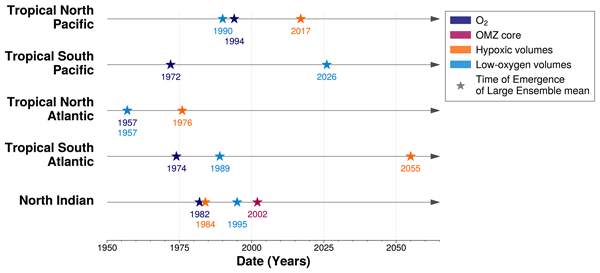
P24 L522-541: In the IPSL Large Ensemble, the OMZ regions mean deoxygenation signals emerges from natural variability before the end of the 20th century (Figure 10). However, tropical Pacific and tropical Atlantic OMZs exhibit an asymmetry in the relative timing of emergence between deoxygenation and OMZ volume signals (Figure 10). In the tropical North Pacific and tropical North Atlantic, the emergence of deoxygenation coincides with the expansion of low-oxygen volumes (Figures 10). In these regions, regional mean deoxygenation provides an indicator of OMZ boundaries expansion, with implications for the distribution of marine ecosystems. In the southern parts of the tropical Pacific and tropical Atlantic OMZs, the regional mean climate-driven deoxygenation signals emerge earlier than the expansion of low-oxygen and other OMZ volumes (Figure 10). hypoxic waters, which are harmful or lethal to many marine organisms, emerge later than mean deoxygenation, with delays of 27 years in the tropical North Pacific and 19 years in the tropical North Atlantic (Figure 10).
Although the emergence of regional mean dissolved oxygen captures the regional-scale evolution of low-oxygen waters in IPSL simulations, the emergence of local oxygen trends exhibits temporal heterogeneity. Consistent with the multi-model analysis of Hameau et al. (2020), who computed time of emergence at each grid point using CMIP5 models under the RCP8.5 scenario (Moss et al., 2010), the IPSL-CM6A-LR spatial median of local emergence occurs later than the regional mean deoxygenation signal in each OMZs regions (Figure A3, Table A1). Except for the tropical North Atlantic, where the median emergence occurs in 1983, spatial median emergence times are in the first half of the 21st century (Table A1). This is consistent with Hameau et al. (2020), who exhibited a global mean oxygen emergence in 2019 for the CMIP5 IPSL-CM5A-LR model. Within OMZ regions, local emergence times shows a standard deviations ranging from 7 to 24 years (Figure A3, Table A1). This is consistent with results of Long et al. (2016), who used the Community Earth System Model large ensemble (CESM Large Ensemble, Kay et al. (2015)) under RCP8.5 to assess local deoxygenation time of emergence. The standard deviation of time of emergence within the OMZ regions reflects the delay of emergence between the three OMZ volumes of interest.
P25 L560-577: The IPSL-CM6A-LR model exhibits a positive bias in dissolved oxygen concentrations, particularly in the OMZ regions. This oxygen overestimation in tropical OMZs is linked to the IPSL-CM6A-LR coarse spatial resolution, which leads to weaker equatorial currents (Busecke et al., 2019; Calil, 2023). To assess large-scale physical ventilation, we compare age since surface contact at the end of the piControl simulation (years 3840–3850) with two data-driven inverse models: the Total Matrix Intercomparison (TMI) and the Ocean Circulation Inverse Model (OCIM) (Millet et al., 2025). The IPSL model reproduces shadow zones in the tropical regions of interest, indicating the representation of large-scale physical ventilation of tropical regions (Figure A5). The oxygen overestimation is then also linked to too strong deep convection in the Southern Ocean (Boucher et al., 2020).
However, this approach does not correct for biases inherent to WOA18, which is known to underestimate hypoxic volumes (Bianchi et al., 2012; Kwiecinski and Babbin, 2021).
To evaluate the sensitivity of our results to the choice of OMZ volume definition, we compare time of emergence estimates obtained using both fixed oxygen thresholds and fixed volume-percentile approaches (Figure A6). The sign of the climate-driven emergence trends are consistent across both definitions (Figure A6e–j). However, the percentile-based approach allows to detect the emergence of OMZ core and hypoxic volume signals, where the fixed-threshold method fails (Figure A6e–j). This reflects the fact that the classical method underestimates or misses the climate-driven signal due to the biased baseline in oxygen levels. The time of emergence of low-oxygen volumes is relatively insensitive to the OMZ definition used, reflecting the smaller oxygen bias at higher concentrations in IPSL-CM6A-LR (Figure A6k–o).
The time of emergence is highly sensitive to the representation and the quantification of the internal variability of the signal of interest (Hameau et al., 2019). In this study, internal variability was measured by the standard deviation of the IPSL Large Ensemble. The 2000-years piControl simulation provides an alternative estimate of internal variability, capturing decadal to millennial fluctuations. However, as it is conducted under pre-industrial forcing conditions, it does not account for changes in internal variability induced by historical and SSP2-4.5 forcing.
To evaluate the impact of the variability measure, we computed time of emergence using, for the noise term, the Large Ensemble standard deviation and the constant standard deviation derived from the full piControl simulation. The emergence the ensemble mean signal is not substantially affected by the choice of variability estimate (Figure A7). However, when internal variability is estimated from the piControl simulation, the emergence distribution across ensemble members shifts towards later times (Figure A7). Consistent with previous findings of Hameau et al. (2019) using the CESM1 model under the RCP8.5 scenario, piControl-based variability tends to overestimate internal variability, resulting in a later time of emergence.
Terminology/formatting
- There are a few quirks about the way that numbers and units are represented, like not leaving a space between a number and its unit (e.g., 1000m), or using a . instead of space (e.g., mol.kg-1). Both of these occur numerous times.
Thanks for spotting this. The corrections have been made throughout the revised manuscript.
- O2 and AOU are usually italicized and should not be.
Thank you for spotting this. It has been corrected in the revised manuscript.
- The sign convention is confusing. AOU is usually expressed as positive, i.e., if I say that AOU is 40 uM it is implicitly understood that O2sat>O2. There are numerous places in this MS where e.g., AOU is said to have decreased by -X uM (e.g., 407-410), which really means that it increased by X uM, which is the opposite of what is intended (see also e.g., 206-207, 226, 229, 381-382, 442-445, 449).
Thank you for this comment. In the study, we focus on deoxygenation trends, thus it has been chosen to use -AOU such so that a decrease in -AOU corresponds to a decrease in dissolved oxygen. The manuscript has been revised in order to correct all formulations in which decreases in -AOU were previously reported with negative signs.
- The number of significant figures is some times inconsistent and sometimes excessive. Generally it is good practice to use a consistent number of sf rather than of decimal places (e.g., 2.5+/-0.90). For example, on 225-229 some numbers have 2sf, some 3 and some 4. I think 2 is all that is justified by the actual precision of the data. On e.g., 291 the number of sf seems excessive. On 320-342 most numbers have 3sf, some have 2. I think 2 is all that is really justified or necessary here. Same for 381-386 and 408-415. On 426-449 some numbers have 4sf and some 3. 3 might be justifiable but 2 is probably adequate, and most of these numbers don’t really require scientific notation, e.g., one could write 32.57e-1 as 3.3 or 3.78e-2 as 0.038.
Thank you for this insightful comment. We agree on the importance of using a consistent number of significant figures throughout the manuscript. Given the precision of the data, only two significant figures are justified. All numerical values presented in the manuscript have therefore been revised accordingly.
- There are quite a lot of cases where an unnecessary ’s’ is tacked onto a word (e.g., confuses singular and plural subject), or where there should be an ’s’ but it is missing (e.g., 55, 219, 295, 364, 365, 370, 373, 513, 526, 562).
Thank you for spotting this. It has been corrected in the revised manuscript.
- There are quite a few "microparagraphs" consisting of single sentence (e.g., 237, 283, 362). Consider joining these to the preceding paragraph.
The first microparagraph at Lines 237 in the preprint manuscript describes the ocean deoxygenation metric used in this study, whereas the preceding paragraph focuses on the geographical restriction of the analysis and the following paragraph defines the OMZ metrics. It was therefore kept separate to maintain a clear distinction between these concepts.
The microparagraph at Lines 283 in the preprint manuscript aims to specify the methodology applied to the variables described in the two preceding paragraphs. For this reason, it was not merged solely with the immediately preceding paragraph.
The microparagraph at Lines 362 in the preprint manuscript describes the time of emergence of climate-driven OMZ volume signals, which closely relates to the content of the preceding paragraph. These two paragraphs have been merged.
P16 L354-362: With the exception of the North Indian Ocean, the climate-driven signal in low-oxygen volumes emerges from internal variability earlier than in the other types of OMZ volumes, making it the earliest detectable signal of change in all OMZ regions. Emergence of this signal occurs as early as 1957 in the tropical North Atlantic, followed by 1989 in the tropical South Atlantic, 1990 in the tropical North Pacific, and 2026 in the tropical South Pacific (Figure 6a–d, Table 2). These timings reveal a hemispheric asymmetry: the signal emerges 36 years earlier in the tropical North Pacific than in the tropical South Pacific, and 32 years earlier in the tropical North Atlantic than in the tropical South Atlantic (Figure 6a–c, Table 2). However, emergence in the tropical North Atlantic leads that of the tropical North Pacific by 33 years (Figure 6a, c, Table 2). In the North Indian Ocean, however, although all three volume categories show detectable climate-driven signals emergence before the end of the simulation ; the low-oxygen volume climate-driven signal emerges in 1995 (Figure 6e).
- There are several figures where the subpanels are numbered abcde... but these are not mentioned in the caption (Figs 4, 5, 6, 7, 8, 9). The subpanels are referenced in the text, and in general there is no ambiguity. I don’t know if this journal has a policy on this, but generally if you are going to number the subplots it is usual to define the labels in the caption.
The captions of Figures 4, 5, 6, 7, 8, 9, A4, A6, and A7 have been adapted to use subpanel numbering.
- The phrase, "In contrast" appears 13 times. I prefer, "By contrast", but I question whether all of the uses of this phrase are necessary at all. On 96 for example, I think it could be deleted without losing anything important. I would recommend to excise as many as possible.
The majority of occurrences of the phrase “in contrast” have been removed from the manuscript. Only five instances of “by contrast” have been retained, where they are used to specify the North–South asymmetry highlighted in the study (eg P1 L10, P16 L362, P18 L391, P20 L428 and P26 L583).
- On 382 for example, we have "These losses are stronger than those observed in their southern counterparts" I find this terminology vague and I think it would be easier on the reader to say e.g., "These losses are greater in the northern hemisphere OMZs than in the southern hemisphere OMZs of the same basin". Large gain in clarity for small number of extra words. (see also 389, 429, 485, 493, 523, 525).
The formulation has been revised throughout the manuscript.
P18 L382: These losses are greater than in the southern hemisphere OMZs of the same basin
P18 L388: the tropical North Atlantic at more than five times the rate of the tropical South Atlantic
P19 L427-429: The carbon export rates are higher in the southern hemisphere OMZ regions, with values of 1.9 gC m−2 year−1 in the tropical South Pacific and 2.3 gC m−2 year−1 in the tropical South Atlantic, than in the northern hemisphere OMZs of the same basin, which have an export of 1.6 and 1.8 gC m−2 year−1, respectively.
P22 L484-485: climate-driven declines in oxygen concentrations are stronger in the northern hemisphere OMZs than in the southern hemisphere OMZs of the same basin
P23 L496-497: The core of the OMZs only expands in the northern hemisphere by the end of the simulation while they are shrinking in the southerner hemisphere OMZs of the same basin
- On 178 and elsewhere: don’t use ’significant’ as a generalized term of emphasis (12 total occurrences; not all are necessarily inappropriate but some are) We agree. The term “significant” has been removed where it was used for emphasis, and retained only when referring to statistical significance of linear adjustment.
P2 L54: Despite statistically significant trends in OMZ volumes identified using CMIP6 models
P15 L329-330: Meanwhile, the tropical South Pacific hypoxic volume shows no statistically significant net change at the end of the simulation. P16 L367-368: the hypoxic volume signal in the tropical South Pacific does not emerge before the end of the simulation with no statistically significant changes compared to pre-industrial era P19 L437: the age since surface contact shows no statistically significant variations in any OMZ regions
Some details:
- 15 "likely already beginning" is this consistent with IPCC-approved use of "likely" or more colloquial?
The IPCC likelihood scale uses the term “likely” to indicate a probability greater than 66%. In the present manuscript, the term was intended in a more colloquial sense. To avoid any potential ambiguity, the sentence has been reworded and the term “likely” has been removed from the revised manuscript for clarity:
P1 L15-17: By linking the emergence of regional deoxygenation to that of OMZ volume changes, climate-driven expansions of tropical OMZ volumes appear to be beginning to emerge, with distinct dynamics between northern and southern tropical oceans.
- 24-25 I am supportive of citing seminal historical papers like Luyten. The ur-reference on this topic is Wyrtki 1962 (Deep Sea Res 9: 11), which could possibly be included here.
Thank you for your insightful comment. The original reference has been added to the revised manuscript.
P1 L24-26: Permanent open-ocean OMZs are typically located in poorly ventilated regions of the ocean and beneath zones of high biological productivity, where oxygen consumption is elevated (Wyrtki, 1962; Luyten et al., 1983; Paulmier and Ruiz-Pino, 2009).
- 35 change "severity" to "intensity"
Done
- 42 "parameterization" misspelled
Thank you for spotting this. It has been corrected in the revised paper.
- 44 delete "the" before "Phase 5"
Done
- 72 change "extract" to "identify"
Done
- 105, 109 change "oceanic" to "ocean"
Done
- 110 change "at 1/3" to "to 1/3"
Done
- 123 change "then" to "and"
Done
- 125 and "ensemble" after "IPSL-CM6A-LR"
Done
- 127 and elsewhere "inter-member" strikes me as an unnecessary jargon term that could be avoided ( 20 total occurrences). " Large Ensemble inter-member mean" could just be "Large Ensemble mean" and "the inter-member spread" could be "the spread among members".
Sentences using the term “inter-member” have been reworded, and the term has been removed from the revised manuscript.
- 182-183 change "the IPSL hypoxic waters account for only 10% of the observed Hypoxic waters" to "in the IPSL model the volume of Hypoxic water is only 10% of that in the observational data product"
Done
- 184-186 this sort of speculation properly belongs in the Discussion
We agree that this sentence belongs in the Discussion. It has been moved to Section 4.5 (Limitations), where biases in OMZ representation due to oxygen misrepresentation are discussed.
P25L561-562: This oxygen overestimation in tropical OMZs is primarily linked to the IPSL-CM6A-LR coarse spatial resolution, which leads to weaker equatorial currents (Busecke et al., 2019; Calil, 2023).
- 189 "it fails" unclear antecedent
’It’ refers to the IPSL model. It has been clarify, the sentence now reads as follow:
P7 L178-179: IPSL model fails to reproduce the low-oxygen waters structure in the tropical Atlantic basin, where only the tropical South Atlantic low-oxygen waters are simulated (Figure 2b).
- 193-194"CMIP6 models fail to capture OMZ core waters in the North Indian Ocean, with an oxygen minimum in the Arabian Sea rather than in the Bay of Bengal" appears to have the place names reversed
Thank you for spotting this, the named has been correctly reversed.
- 203 and elsewhere "Storch and Swiers 1999" both authors’ names are misspelled. Zwiers is spelled with a "Z" and von Storch’s surname is "von Storch"
Thank you for spotting this. Authors’ names has been corrected.
- 203-204 "A 90% confidence interval is applied, accounting for the reduction in degrees of freedom" A vague and essentially meaningless statement. Reword and explain clearly what methods were used and what assumptions were made.
The uncertainties of the trends are estimated based on ?: [a+ t5%sa; a+ t95%sa] where a is the estimated trend, t5% and t95% are the 5% and 95% percentiles for a Student law taking into account the degrees of freedom and sa is the standard error of the estimated trend. It has been clarified accordingly in the revised manuscript:
P8 L192-195: The uncertainties of the trends are estimated based on von Storch and Zwiers (1999): [a+ t5%sa; a+ t95%sa] where a is the estimated trend, t5% and t95% are the 5% and 95% percentiles for a Student law taking into account the degrees of freedom and sa is the standard error of the estimated trend.
- 221"fail to reproduce the observed dipole" "dipole is a jargony word that is probably unnecessary, and it isn’t really clear what it refers to here
Thank you for the comment. The sentence has been reworded in the revised manuscript.
P9 L211-214: Similarly, in the North Indian Ocean, the IPSL simulations fail to reproduce the observed spatial pattern of oxygenation and deoxygenation. Both the IAP dataset and the CMIP6 multi-model mean indicate oxygenation in the central basin, surrounded by deoxygenation to the north and south (Figure 3).
- 249 Equation (2): The text below the integral signs is not a limit of integration as is usual practice. It might be better to just drop the equation and explain this in words: V is the total volume of water with O2<O2*. I don’t think the equation adds much value.
Thank you for your comment. The integral signs have been removed, and the sentence now reads as follows:
P10 L241: [...] with VT being the total volume considered and V(O*2 ,t) is the volume of water with O2 <O*2.
- 255 change "29st" to "29th" (I think French does not have this unfortunate quirk, it’s just ’e’ across the board)
Done
- 269 should this specify OMZ core? (Figure 2)
The IPSL model exhibits a strong bias in the North Indian Ocean, with no representation of the OMZ core in the Arabian Sea. The modelled hypoxic waters are also geographically biased, predominating in the Bay of Bengal, whereas WOA18 shows hypoxic conditions in both the Arabian Sea and the Bay of Bengal (Figure 5). Low-oxygen waters represent most of the regional North Indian OMZ box and are therefore less geographically biased. The sentence has been reworded to specifically refer to the OMZ core and hypoxic volumes:
P11 L260-262: Additionally, the North Indian OMZ core and hypoxic volume in the model are predominantly located in the Bay of Bengal, whereas observations indicate a signal both in the Arabian Sea and the Bay of Bengal (Figure 5).
- 297, 378, 488 "dependent" misspelled (https://www.grammarly.com/commonly-confused-words/dependant-vs-dependent)
Done
- 297 "prevents underestimating variability" vague; reword
The sentence has been clarified:
P13 L289-293: Anomalies are calculated relative to the pre-industrial period for all Large Ensemble members, which eliminates the advantage of the different initial conditions in sampling the model’s internal variability. As a result, anomalies underestimate internal variability during the pre-industrial period. The use of time dependant internal variability is particularly relevant given that internal variability can evolve under climate change scenarios.
- 309 add "with" after "along"
Done
- 321 "the tropical North Pacific shows the fastest growth" I’m not sure this is a meaningful comparison, as the volumes in the preindustrial climate vary. If it is the largest to begin with, does comparing rates of expansion in m3/y really indicate the "fastest growth"?
We agree that the larger growth observed in the tropical North and South Pacific is due to their greater pre-industrial OMZ volumes compared with other regions. Expressing OMZ volume changes as a percentage of their pre-industrial reference provides a clearer perspective on relative changes (Figure 6f–j). Accordingly, the sentence has been rewritten as follows:
P15 L315-317: Other OMZ regions exhibit a monotonic expansion under SSP2-4.5, with the tropical North Pacific growing at 4.2x10¹³ m3 year−1, the tropical North Atlantic at 2.3x10¹³ m3 year−1, the tropical South Pacific at 1.2x10¹³ m3 year−1, and the North Indian Ocean at 1.6x10¹² m3 year−1 (Figure 6a–c, e).
- 333 add "about" before "2004"? I’m not sure this number is known this precisely. (see also 422)
We agree with this comment. It has been added to the revised manuscript.
- 349 "OMZ core volumes being smaller" not clear if this refers to the mean or the variance
This refers to the differences in the Large Ensemble mean absolute volumes of the OMZ core, hypoxic waters, and low-oxygen waters. The sentence has been simplified for clarity
P16 L341-342: Thus, in the tropical Pacific, internal variability is of comparable magnitude across all OMZ volume classes, despite differences in Large Ensemble mean absolute volume (Figure 6a,b and Figure A2a,b).
- 351 "relative variability of North Atlantic Hypoxic volume is the highest across all regions" appears to contradict the statement on 477 that "earlier emergence is not due to faster expansion, but rather to lower internal variability of the tropical Atlantic lo-oxygen volumes"; possibly these do not refer to the same [O2] ranges
The relative hypoxic volume of the tropical South Atlantic has the largest relative variability. However, for low-oxygen volumes, the relatice
Thank you for the comment. The relative internal variability of hypoxic volumes is largest in the tropical South Atlantic, whereas the internal variability of low-oxygen volumes is lower there than in the tropical South Pacific. Consequently, while both the magnitude of the climate-driven trend and internal variability influence the time of emergence, the earlier emergence of low-oxygen volumes in the tropical South Atlantic appears to be associated with its lower internal variability.
- 363 , should be a ; (after "simulation")
Done
- 375 elsewhere O2sat does not have a comma
Done
- 381 "dissolved" misspelled
Done
- 392 missing . after parenthesis
Done
- 398 "increases in the tropical South Pacific and the tropical South Pacific" ???
Thank you for spotting this. The sentence refers to tropical South Pacific and tropical South Atlantic. It has been corrected:
P18 L398: increases in the tropical South Atlantic and the tropical South Pacific
- 400 "decrease signal" is another unnecessary bit of jargon where clarity could be increased with only a small amount of rewording. For example, what if they reworded "In all regions, the O2sat decrease signal emerges after the deoxygenation signal (Figure 7, Table 3). These signal decline gradually until 2000, after which it accelerates sharply" as "In all regions, O2sat emerges after deoxygenation (Figure 7, Table 3). Both O2 and O2sat decline gradually until about 2000, after which the decline accelerates sharply"
Thank you for your comment. It has been reworded accordingly:
P18 L400-401: In all regions, O2sat emerges after deoxygenation (Figure 7, Table 3). Both O2 and O2sat decline gradually until about 2000, after which the decline accelerates sharply
- 402 "the decline rate increases by a factor 10" Another assertion that is probably true but the reader can not necessarily verify from the plot. Possibly include a Supplemental table that would present the actual statistics.
Thank you for this comment. Trends have been computed before and after the regime shift around 2004 and have been compiled in an additional table (Table ??). This table has been added to the Supplementary Material and is now referenced in the Results section.
- 404 and elsewhere I’m not sure any of the uses of "inflection point" (or "inflections" on 465) are valid or necessary. This term has a specific meaning in mathematics, i.e., the point at which d2X/dt2 changes sign (e.g., if supralinear growth become sublinear)
We agree with the meaning of the use ’inflection’. Here, it mean a change in the sign of sign of the climate-driven trend. It has been changed in the revised paper by ’regime shift’:
P18 L403-405: Emergence occurs close to or shortly after this regime shift: in 2003 in the North Pacific, 2004 in the South Atlantic, 2008 in the North Atlantic, 2018 in the South Pacific, and 2022 in the North Indian Ocean (Figure 7, Table 3). The acceleration is accompanied by a reduction in signal variability, consistent with emergence occurring near the regime shift (Figure 7).
P19 L413-414: In the tropical South Pacific, the -AOU signal does not show a distinct regime shift point but shows a slower decreasing trend during SSP2-4.5 period
P21 L463-466: In other regions, broader spreads are linked either to weaker trend magnitudes at the time of emergence, as in the tropical South Pacific where deoxygenation shows an interquartile range of 54 years, or to regime shifts that change the trend sign, such as in the tropical South Atlantic where the low-oxygen volume signal displays a 71-year spread (Figure 9b, d).
- 431 Figure 8 b, d, e should be d, h, j?
Thank you for spotting this. The figure has been corrected to name subplots along each row.
- 488-490 "Moreover, Northern Hemisphere ecosystems may face earlier and more intense disruptions from expanding low-oxygen volumes, while Southern Hemisphere systems may experience more gradual but persistent changes." Vague; reword
Thank you for this comment. It has been reworded in the revised paper and it now reads as follow:
P22 L489-491: Moreover, the expansion of low-oxygen waters is stronger in the Northern Hemisphere than in the Southern Hemisphere, leading to uneven impacts on marine ecosystems between hemispheres.
- 499 delete "such as the future ocean,"
Done
- 500 delete "through"
Done
- 501 "via the Agulhas Current" could use a literature ref
De Ruijter et al. (1999) demonstrate the interconnection between the South Atlantic and Indian Oceans via the Agulhas system. This reference has been added to the revised manuscript.
P23 L503-504: In the tropical South Atlantic, ventilation is provided by younger subsurface waters originating from the South Indian Ocean, which are advected into the South Atlantic via the Agulhas Current (De Ruijter et al., 1999).
- 504 change "show" to "shown"
Done
- 505 delete "showed"
Done
- 507 add "Ocean" after "Indian"
Done
- 508 add "model" after "IPSL"
Done
- 512 according to the title, Schmidt et al., 2021 is about CMIP5 models. I’m not sure this is useful as a basis for generalizing about the present ensemble. Some CMIP5 models (notably IPSL-CM5A-LR) had very coarse resolution (ORCA2) and very weak ventilation of some intermediate ocean areas. In my experience the difference between ORCA2 and ORCA1 in terms of ventilation processes is large.
We agree that the very coarse resolution strongly impacts the representation of ventilation pathways. In CMIP5, the IPSL-CM5A-LR model used ORCA2 with a refinement of 0.5° at the equator, thus having the same resolution than IPSL-CM6A-LR at the equator. Furthermore, oxygen inflows from marginal seas into the Arabian Sea have been little evaluated in the CMIP6 ensemble.
- 608 Code availability section not completed
All code developed for this study has been made publicly available. Accordingly, the code availability section has been completed and now reads as follows:
P32 L591: The code needed to compute OMZ metrics and reproduce the figures are openly available from Zenodo https://doi.org/10.5281/zenodo.18672219 (Delteil, 2026).
- 660 Ditkovsky reference incomplete
Thank you for spotting this. The reference has been completed:
P36 L663-664: Ditkovsky, S., Resplandy, L., and Busecke, J.: Unique ocean circulation pathways reshape the Indian Ocean oxygen minimum zone with warming, Biogeosciences, 20, 4711–4736, https://doi.org/10.5194/bg-20-4711-2023, 2023.
- Figure 1 caption delete "millennial polynomial"
The term has been erased in the revised manuscript.
- Figure 3 the boxes referenced in the caption are not visible on the maps
Thank you for spotting this. The boxes have been added to the Figure 3.
- Table 1 why not show values for the WOA as well?
Thank you for this comment. The volume percentile values are computed from the World Ocean Atlas 2018 and subsequently applied to the IPSL-CM6A-LR Large Ensemble. The caption has been reworded to clarify this point.
Table 1: Volume percentile of interest derived from World Ocean Atlas 2018 and applied to the IPSL-CM6A-LR for each OMZ spatial box. The volume percentile is computed as fraction (%) of the total volume of respective OMZ spatial box.
- Figure 6 consider using different y axes for different panels; also "The time of emergence ...b occurs when (solid line) the ensemble mean exceeds (coloured area) the standard deviation over the Large Ensemble" may be true but it’s not clear how the reader verifies this, as the envelope of preindustrial variability is not shown on the plots.
Thank you for this comment. We agree that Figure 6 could be made clearer using different y-axes. We did so in the revised manuscript. However, to allow a direct comparison of signals from both the Northern and Southern Hemispheres within the same OMZ basin, we opted to use the same y-axis for each basin. Moreover, the time of emergence is defined as the last time step at which the Large Ensemble mean exceeds twice the Large Ensemble standard deviation. In Figure 6, this corresponds to the point where the solid line surpasses twice the coloured area.
- Table 2 change "has not emerged from twice the ensemble standard deviation" to "has not emerged at the level of twice the ensemble standard deviation"; change "absence of OMZ volume" to "absence of OMZ core"
Done
- Table 3 2986 should be 1986?
Thank for spotting this. Done
- Figure 8 caption seems to imply that the criterion for emergence is 1sd rather than 2
The emergence is define as the last time step when climate-driven signal exceeds twice the noise. It has been clarify in the captions of Figures 6, 7, 8, 9, A4, A6 and A7, now specifying "The star symbol represents the time of emergence for the Large Ensemble mean, defined as the last time at which it exceeds twice the Large Ensemble standard deviation."
- Figure 10 For the North Atlantic, the dark NavyBlue star is not visible. The text states that O2 emerges before OMZ volume (521) but it appears they are concurrent in this case.
The stars plotted in the Figure 10 has been been made bigger to be more visible. And the text associated has been revised accordingly with previous comment. It now reads as follow:
P24 L523-525: However, tropical Pacific and tropical Atlantic OMZs exhibit an asymmetry in the relative timing of emergence between deoxygenation and OMZ volume signals (Figure 10). In the tropical North Pacific and tropical North Atlantic, the emergence of deoxygenation coincides with the expansion of low-oxygen volumes (Figures 10).
Bianchi, D., Dunne, J. P., Sarmiento, J. L., and Galbraith, E. D.: Data-based estimates of suboxia, denitrification, and N2 O production in the ocean and their sensitivities to dissolved O2, Global Biogeochemical Cycles, 26, 2011GB004 209, https://doi.org/10.1029/2011GB004209, 2012.
Bianchi, D., Weber, T. S., Kiko, R., and Deutsch, C.: Global niche of marine anaerobic metabolisms expanded by particle microenvironments, Nature Geoscience, 11, 263–268, https://doi.org/10.1038/s41561-018-0081-0, 2018.
Bonnet, R., Boucher, O., Deshayes, J., Gastineau, G., Hourdin, F., Mignot, J., Servonnat, J., and Swingedouw, D.: Presentation and Evaluation of the IPSL-CM6A-LR Ensemble of Extended Historical Simulations, Journal of Advances in Modeling Earth Systems, 13, e2021MS002 565, https://doi.org/10.1029/2021MS002565, 2021.
De Ruijter, W. P. M., Biastoch, A., Drijfhout, S. S., Lutjeharms, J. R. E., Matano, R. P., Pichevin, T., Van Leeuwen, P. J., and Weijer, W.: Indian-Atlantic interocean exchange: Dynamics, estimation and impact, Journal of Geophysical Research: Oceans, 104, 20 885–20 910, https://doi.org/10.1029/1998JC900099, 1999.
Delteil, M.: Supplementary materials - Emerging Climate Signals in Tropical Oxygen Minimum Zones, https://doi.org/10.5281/zenodo.18672219, 2026.
Kwiecinski, J. V. and Babbin, A. R.: A High-Resolution Atlas of the Eastern Tropical Pacific Oxygen Deficient Zones, Global Biogeochemical Cycles, 35, e2021GB007 001, https://doi.org/10.1029/2021GB007001, 2021.
-
AC3: 'Reply on RC2', Mathieu Delteil, 18 Feb 2026
Peer review completion


Interactive discussion
Status: closed
-
RC1: 'Comment on egusphere-2025-2805', Anonymous Referee #1, 14 Sep 2025
The manuscript "Emerging Climate Signals in Oxygen Minimum Zones" by Delteil et al provides an a comprehensive analysis of oxygen minimum zones across the worlds oceans within the IPSL large ensemble including both spatial and volumetric metrics, correlating mechanistic drivers such as solubility, nutrients, and age and multiple metrics of time of emergence of change. It is well written with only a few points requiring attention specified below. I recommend publication after attention to these technical issues.
Specific comments:
24 - This is also true in regions where temperature is high reducing solubility
55 - "dynamics" should be "dynamic"57-58 - suggest replacing "rise" with "emerge" and deleting ". The detectability thus becomes a signal to noise ratio problem, where emergence occurs"61 - suggest removing "the moment" as this is a retrospective statement of accumulated behavior rather than a single "moment"65 - suggest replacing "this method" with "single simulation analysis"69-70 - suggest removing "performed with the same Earth system model" as the phrase seems unnecessarily specific and draws the criticism that multi-model analysis is even better as it captures structural uncertainty (Hawkins and Sutton, 2009)91-98 - This belongs in the discussion103 - suggest replacing "used in of" with "contributing to"173 - Why is "Core" capitalized - If it is a special definition, that should be made explicit, and for "Oxygen Minimum Zones" either use previously defined acronym instead of writing it out or redefine it by adding "(OMZ)"175 - Why is "Low" capitalized? If it is a special definition, that should be made explicit.185 - How much is PO4 underestimated? This should be explicit - and what about solubility and the other physical mechanisms? Are the waters biased cold? That would be another explanation? Are they overventilated with respect to CFC's or 14C? I recognize that these are treated as trends later on, but a more comprehensive discussion of the mean state biases is warranted here.185 - The weakness of the undercurrent oxygen transport is also a resolution issue (Busecke, J. J., Resplandy, L., & Dunne, J. P. (2019). The equatorial undercurrent and the oxygen minimum zone in the Pacific. Geophysical Research Letters, 46(12), 6716-6725.) such that even if the physical transport is correct, the oxygen supply is underestimated - but this would tend to go in the other direction, suggesting that the model would be even more biased in oxygen if the undercurrent oxygen transport were correct.206 - Why show the three sets of numbers both as long term change and annual change? One presentation method would seem sufficient. Given the importance of the annual change in the next paragraph, I think that would be the superior approach.~260 - It is not clear if this analysis accounts for WOA underestimating hypoxic volumes Bianchi, D., Dunne, J. P., Sarmiento, J. L., & Galbraith, E. D. (2012). Data‐based estimates of suboxia, denitrification, and N2O production in the ocean and their sensitivities to dissolved O2. Global Biogeochemical Cycles, 26(2).347 - "the" belongs between "in" and "tropical"351 - Does "variability" meaning one standard deviation?377-378 - Does "twice the magnitude of time-dependant internal variability" mean 2 standard deviations, or 95% confidence?400 - "signal" should be "signals"425 - suggest deleting "an annual increase of"504 - suggest "shown in" or "exhibited by" in place of "show by"507 - Why assume that the model is wrong on the trend emergence in the North Indian? Is this just because of the model mean state bias, or is there observational evidence to the contrary?Citation: https://doi.org/10.5194/egusphere-2025-2805-RC1 -
AC1: 'Reply on RC1', Mathieu Delteil, 16 Feb 2026
REVIEWER #1
All suggestions were considered and the issues raised were addressed, which in our opinion led to increasing the clarity of the revised manuscript.
Below are the authors’ point-by-point responses to the comments. Reviewer comments are in bold and responses are in normal font. Changes to the manuscript are in italics. Line numbers mentioned below refer to the revised manuscript.
General Comment:
The manuscript "Emerging Climate Signals in Oxygen Minimum Zones" by Delteil et al provides an a comprehensive analysis of oxygen minimum zones across the worlds oceans within the IPSL large ensemble including both spatial and volumetric metrics, correlating mechanistic drivers such as solubility, nutrients, and age and multiple metrics of time of emergence of change. It is well written with only a few points requiring attention specified below. I recommend publication after attention to these technical issues.
The authors would like to thank Reviewer #1 for their useful comments.
Specific comments:
- 24 - This is also true in regions where temperature is high reducing solubility
Thank you for the comment. In this study, we focus exclusively on permanent subsurface open-ocean OMZs, whose persistence is maintained by weak ventilation in so-called “shadow zones” and by high oxygen consumption associated with eastern boundary upwelling systems (Pedlosky, 1983). Whereas coastal hypoxic zones are primarily driven by enhanced eutrophication and warming (Breitburg et al., 2018). To clarify, the definition of OMZs has been refined to explicitly define the regions of interest considered by this study. The sentence now reads as follows:
P1 L24-26: Permanent open-ocean OMZs are typically located in poorly ventilated regions of the ocean and beneath zones of high biological productivity, where oxygen consumption is elevated
- 55 - "dynamics" should be "dynamic"
Done
- 57-58 - suggest replacing "rise" with "emerge" and deleting ". The detectability thus becomes a signal to noise ratio problem, where emergence occurs"
Thank you for this comment. The sentence has been reworded accordingly:
P2 L58-59: For a forced signal to be detectable, the externally forced trend must persistently emerge above internal variability, which is considered as noise Hasselmann, 1993; Santer et al., 1994).
- 61 - suggest removing "the moment" as this is a retrospective statement of accumulated behavior rather than a single "moment"
We agree with this comment. The term as been removed from the revised manuscript.
- 65 - suggest replacing "this method" with "single simulation analysis"
The sentence has been reworded accordingly.
- 69-70 - suggest removing "performed with the same Earth system model" as the phrase seems unnecessarily specific and draws the criticism that multi-model analysis is even better as it captures structural uncertainty (Hawkins and Sutton, 2009)
We agree with this comment, and the corresponding text has been removed from the revised manuscript.
- 91-98 - This belongs in the discussion
Yes, we agree with the reviewer’s comment. The paragraph at Line 91-98 in the preprint manuscript was removed as its content was already included in the discussion section.
- 103 - suggest replacing "used in of" with "contributing to"
Done
- 173 - Why is "Core" capitalized - If it is a special definition, that should be made explicit, and for "Oxygen Minimum Zones" either use previously defined acronym instead of writing it out or redefine it by adding "(OMZ)"
Thank you for your comment. OMZ core, hypoxic volumes, and low-oxygen volumes are defined using the three oxygen thresholds of interest: 20 µmol kg−1, 60 µmol kg−1, 120 µmol kg−1, respectively. For consistency, the term “OMZ core” has been uncapitalised throughout the revised manuscript. The OMZ acronym defined before has been used to refer to the Oxygen Minimum Zone.
- 175 - Why is "Low" capitalized? If it is a special definition, that should be made explicit.
As for OMZ core, low-oxygen volumes has been uncapitalised throughout the revised manuscript.
- 185 - How much is PO4 underestimated? This should be explicit - and what about solubility and the other physical mechanisms? Are the waters biased cold? That would be another explanation? Are they overventilated with respect to CFC’s or 14C? I recognize that these are treated as trends later on, but a more comprehensive discussion of the mean state biases is warranted here.
In this study, we focus on oxygen concentration biases, as they directly affect the definition of OMZ volumes. A comprehensive evaluation of biogeochemical variables in IPSL-CM6A-LR has been provided by Séférian et al. (2020). In the tropical Pacific, IPSL underestimates nutrient concentrations by approximately 2 µmol L−1 (Séférian et al., 2020).
The tropical Pacific is overventilated in the model, partly due to excessively strong deep convection in the Southern Ocean (Boucher et al., 2020). To assess large-scale ventilation, we compare age since surface contact at the end of the piControl simulation (years 3840–3850) with two data-driven inverse models: the Total Matrix Intercomparison (TMI) and the Ocean Circulation Inverse Model (OCIM) (Millet et al., 2025). The IPSL simulation reproduces shadow zones in the tropical regions of interest, indicating the representation of large-scale physical ventilation of tropical regions (Figure A5).
We have reworded and further detailed the discussion of IPSL-CM6A-LR biogeochemical biases. As suggested by Reviewer #2, this paragraph has been moved to Section 4.5 (Limitations).
P25 L560-567: The IPSL-CM6A-LR model exhibits a positive bias in dissolved oxygen concentrations, particularly in the OMZ regions. This oxygen overestimation in tropical OMZs is linked to the IPSL-CM6A-LR coarse spatial resolution, which leads to weaker equatorial currents Busecke et al., 2019; Calil, 2023). We compare age since surface contact at the end of the piControl simulation (years 3840–3850) with two data-driven inverse models: the Total Matrix Intercomparison (TMI) and the Ocean Circulation Inverse Model (OCIM) (Millet et al., 2025). The IPSL model reproduces shadow zones in the tropical regions of interest, indicating the representation of large-scale physical ventilation of tropical regions (Figure A5). The oxygen overestimation is then also linked to too strong deep convection in the Southern Ocean (Boucher et al., 2020).
- 185 - The weakness of the undercurrent oxygen transport is also a resolution issue (Busecke, J. J., Resplandy, L., & Dunne, J. P. (2019). The equatorial undercurrent and the oxygen minimum zone in the Pacific. Geophysical Research Letters, 46(12), 6716-6725.) such that even if the physical transport is correct, the oxygen supply is underestimated - but this would tend to go in the other direction, suggesting that the model would be even more biased in oxygen if the undercurrent oxygen transport were correct.
Thank you for this insightful comment. The IPSL model uses at a coarse spatial resolution. Busecke et al. (2019); Calil (2023) have shown that eddy-non-resolving models weaken the equatorial undercurrent in the tropical Pacific and the equatorial zonal currents in the tropical Atlantic. In both basins, such models also fail to adequately represent countercurrents that limit the vertical and lateral transport of dissolved oxygen. As a result, coarse-resolution models tend to simulate higher dissolved oxygen concentrations in the western basins and smaller OMZs in the eastern tropical basins. The impact of model resolution has been added to the discussion of OMZ biases and moved to the section 4.5 (Limitations), as suggested by Reviewer #2. The revised text now reads as follows:
P25 L560-567: The IPSL-CM6A-LR model exhibits a positive bias in dissolved oxygen concentrations, particularly in the OMZ regions. This oxygen overestimation in tropical OMZs is linked to the IPSL-CM6A-LR coarse spatial resolution, which leads to weaker equatorial currents Busecke et al., 2019; Calil, 2023). To assess large-scale physical ventilation, we compare age since surface contact at the end of the piControl simulation (years 3840–3850) with two data-driven inverse models: the Total Matrix Intercomparison (TMI) and the Ocean Circulation Inverse Model (OCIM) (Millet et al., 2025). The IPSL model reproduces shadow zones in the tropical regions of interest, indicating the representation of large-scale physical ventilation of tropical regions (Figure A5). The oxygen overestimation is then also linked to too strong deep convection in the Southern Ocean (Boucher et al., 2020).
- 206 - Why show the three sets of numbers both as long term change and annual change? One presentation method would seem sufficient. Given the importance of the annual change in the next paragraph, I think that would be the superior approach.
This section provides the only opportunity to compare the global decrease of oxygen of the global oceans. We chose to present both the long-term changes, which can be compared to the historical observational decrease of ∼2 %, and the dissolved oxygen trends required for the computation of the time of emergence in this study.
- 260 - It is not clear if this analysis accounts for WOA underestimating hypoxic volumes Bianchi, D., Dunne, J. P., Sarmiento, J. L., & Galbraith, E. D. (2012). Data-based estimates of suboxia, denitrification, and N2O production in the ocean and their sensitivities to dissolved O2. Global Biogeochemical Cycles, 26(2).
Thank you for this insightful comment. In this study, WOA18 is used as the observational reference to define OMZs in the model. This approach does not explicitly account for biases inherent to the WOA18 dataset. (Bianchi et al., 2012) showed that the World Ocean Atlas underestimates hypoxic volumes, which may lead to an underestimation of the volume percentiles used to define OMZ volumes in the IPSL-CM6A-LR Large Ensemble. (Kwiecinski and Babbin, 2021) used high-frequency oxygen measurements to characterise oxygen-deficient zones, allowing them to resolve the fine-scale vertical and horizontal structure of these regions that is not captured in gridded climatologies such as WOA18. They further showed that products such as WOA18 misplace both the upper boundary and the vertical extent of hypoxic volumes. To account for these uncertainties, we evaluate the sensitivity of our results to alternative OMZ definitions (fixed-threshold versus fixed-percentile), such that the resulting range of responses encompasses uncertainties inherent to IPSL oxygen overestimation and WOA18 underestimation of OMZ volumes.
The biases of the World Ocean Atlas are now discussed in Section 4.5 (Limitations).
P25 L568-572: However, the fixed-percentile approach does not correct for biases inherent to WOA18, which is known to underestimate hypoxic volumes (Bianchi et al., 2012; Kwiecinski and Babbin, 2021).
To account for these uncertainties, we evaluate the sensitivity of our results to alternative OMZ definitions (fixed-threshold versus fixed-percentile), such that the resulting range of responses encompasses uncertainties from IPSL oxygen overestimation and WOA18 underestimation of OMZ volumes (Figure A6).
- 347 - "the" belongs between "in" and "tropical"
Done
- 351 - Does "variability" meaning one standard deviation?
"Variability" referred here to one Large Ensemble standard deviation. Accordingly, we reworded the sentence. It now reads as follows:
P16 L342-344: The tropical Atlantic shows the lowest Large Ensemble standard deviation, thus the lowest internal variability, with hypoxic and low-oxygen volumes varying by 2.3 ×10¹³ m3 and 1.2 ×10¹⁴ m3, respectively.
- 377-378 - Does "twice the magnitude of time-dependant internal variability" mean 2 standard deviations, or 95% confidence?
Here, internal variability is measured using the Large Ensemble standard deviation. Accordingly, internal variability refers to the ensemble standard deviation throughout the manuscript. An emergence beyond twice the standard deviation also corresponds to a 95% confidence interval for the time of emergence. This has been clarified in the revised version.
P17 L376-378: We also examine the time of emergence of these climate-driven signals, defined as the year when the forced signal exceeds twice the magnitude of time-dependent internal variability, quantified here as the Large Ensemble standard deviation (Figure 7, Table 3).
- 400 - "signal" should be "signals"
Done
- 425 - suggest deleting "an annual increase of"
Done
- 504 - suggest "shown in" or "exhibited by" in place of "show by"
Yes. We modified the text accordingly as follows:
P23 L506-508 This oxygenation trend in the tropical South Atlantic basin is also exhibited by CMIP6 multi-model mean over the present-day period in Takano et al., 2023 and by the end of the 21st century over SSP1-2.6 and SSP5-8.5 in Kwiatkowski et al., 2020.
- 507 - Why assume that the model is wrong on the trend emergence in the North Indian? Is this just because of the model mean state bias, or is there observational evidence to the contrary?
The misrepresentation of the trend emergence for the OMZ core primarily arises from its mislocation in the model. In IPSL-CM6A-LR, the OMZ core is simulated in the Bay of Bengal rather than in the Arabian Sea. In addition, the historical trend of dissolved oxygen in the tropical North Indian Ocean is biased in the model, which fails to reproduce the oxygenation–deoxygenation dipole reported by Ditkovsky et al. (2023). However, no observational dataset is sufficiently resolved to detect the emergence of OMZ volumes. We can therefore only compare trends in dissolved oxygen. In the North Indian Ocean, the model shows an emergence of deoxygenation in the early 21st century at 10°S-30°S (Figure A3), whereas Tan et al. (2026) report no detectable emergence of deoxygenation in observations prior to 2023.
References
Bianchi, D., Dunne, J. P., Sarmiento, J. L., and Galbraith, E. D.: Data-based estimates of suboxia, denitrification, and N2 O production in the ocean and their sensitivities to dissolved O2, Global Biogeochemical Cycles, 26, 2011GB004 209, https://doi.org/10.1029/2011GB004209, 2012.
Boucher, O., Servonnat, J., Albright, A. L., Aumont, O., Balkanski, Y., Bastrikov, V., Bekki, S., Bonnet, R., Bony, S., Bopp, L., Braconnot, P., Brockmann, P., Cadule, P., Caubel, A., Cheruy, F., Codron, F., Cozic, A., Cugnet, D., D’Andrea, F., Davini, P., de Lavergne, C., Denvil, S., Deshayes, J., Devilliers, M., Ducharne, A., Dufresne, J.-L., Dupont, E., Éthé, C., Fairhead, L., Falletti, L., Flavoni, S., Foujols, M.-A., Gardoll, S., Gastineau, G., Ghattas, J., Grandpeix, J.-Y., Guenet, B., Guez, E., L., Guilyardi, E., Guimberteau, M., Hauglustaine, D., Hourdin, F., Idelkadi, A., Joussaume, S., Kageyama, M., Khodri, M., Krinner, G., Lebas, N., Levavasseur, G., Lévy, C., Li, L., Lott, F., Lurton, T., Luyssaert, S., Madec, G., Madeleine, J.-B., Maignan, F., Marchand, M., Marti, O., Mellul, L., Meurdesoif, Y., Mignot, J., Musat, I., Ottlé, C., Peylin, P., Planton, Y., Polcher, J., Rio, C., Rochetin, N., Rousset, C., Sepulchre, P., Sima, A., Swingedouw, D., Thiéblemont, R., Traore, A. K., Vancoppenolle, M., Vial, J., Vialard, J., Viovy, N., and Vuichard, N.: Presentation and Evaluation of the IPSL-CM6A-LR Climate Model, Journal of Advances in Modeling Earth Systems, 12, e2019MS002 010, https://doi.org/10.1029/2019MS002010, 2020.
Breitburg, D., Levin, L. A., Oschlies, A., Grégoire, M., Chavez, F. P., Conley, D. J., Garçon, V., Gilbert, D., Gutiérrez, D., Isensee, K., Jacinto, G. S., Limburg, K. E., Montes, I., Naqvi, S. W. A., Pitcher, G. C., Rabalais, N. N., Roman, M. R., Rose, K. A., Seibel, B. A., Telszewski, M., Yasuhara, M., and Zhang, J.: Declining oxygen in the global ocean and coastal waters, Science, 359, eaam7240, https://doi.org/10.1126/science.aam7240, 2018.
Busecke, J. J. M., Resplandy, L., and Dunne, J. P.: The Equatorial Undercurrent and the Oxygen Minimum Zone in the Pacific, Geophysical Research Letters, 46, 6716–6725, https://doi.org/10.1029/2019GL082692, 2019.
Calil, P. H. R.: High-Resolution, Basin-Scale Simulations Reveal the Impact of Intermediate Zonal Jets on the Atlantic Oxygen Minimum Zones, Journal of Advances in Modeling Earth Systems, 15, e2022MS003 158, https://doi.org/10.1029/2022MS003158, 2023.
Ditkovsky, S., Resplandy, L., and Busecke, J.: Unique ocean circulation pathways reshape the Indian Ocean oxygen minimum zone with warming, Biogeosciences, 20, 4711–4736, https://doi.org/10.5194/bg-20-4711-2023, 2023.
Kwiecinski, J. V. and Babbin, A. R.: A High-Resolution Atlas of the Eastern Tropical Pacific Oxygen Deficient Zones, Global Biogeochemical Cycles, 35, e2021GB007 001, https://doi.org/10.1029/2021GB007001, 2021.
Millet, B., De Lavergne, C., Gray, W. R., Éthé, C., Madec, G., Holzer, M., DeVries, T., Gebbie, G., and Roche, D. M.: Deep Ocean Ventilation: A Comparison Between a General Circulation Model and Data-Constrained Inverse Models, Journal of Advances in Modeling Earth Systems, 17, e2024MS004 914, https://doi.org/10.1029/2024MS004914, 2025.
Pedlosky, J.: Eastern Boundary Ventilation and the Structure of the Thermocline, Journal of Physical Oceanography, 13, 2038–2044, https://doi.org/10.1175/1520-0485(1983)013%3C2038:EBVATS%3E2.0.CO;2, 1983.
Séférian, R., Berthet, S., Yool, A., Palmiéri, J., Bopp, L., Tagliabue, A., Kwiatkowski, L., Aumont, O., Christian, J., Dunne, J., Gehlen, M., Ilyina, T., John, J. G., Li, H., Long, M. C., Luo, J. Y., Nakano, H., Romanou, A., Schwinger, J., Stock, C., Santana-Falcón, Y., Takano, Y., Tjiputra, J., Tsujino, H., Watanabe, M., Wu, T., Wu, F., and Yamamoto, A.: Tracking Improvement in Simulated Marine Biogeochemistry Between CMIP5 and CMIP6, Current Climate Change Reports, 6, 95–119, https://doi.org/10.1007/s40641-020-00160-0, 2020.
Tan, Z., Von Schuckmann, K., Speich, S., Bopp, L., Zhu, J., and Cheng, L.: Observed large- scale and deep-reaching compound ocean state changes over the past 60 years, Nature Climate Change, 16, 58–68, https://doi.org/10.1038/s41558-025-02484-x, 2026.
Citation: https://doi.org/10.5194/egusphere-2025-2805-AC1
-
AC1: 'Reply on RC1', Mathieu Delteil, 16 Feb 2026
-
CC1: 'Comment on egusphere-2025-2805', Sam J. Ditkovsky, 14 Oct 2025
Dear authors,
Thank you for the interesting study. It’s great to see that the oxygen water mass framework is inspiring new work. However, there are some key ways in which the methodology in Section 2.3 of this manuscript differs from that of Ditkovsky and Resplandy (2025; hereafter D&R25) regarding regional bias correction. That is not to say that the methods of the present study are incorrect in any way, but they perhaps need justifications beyond references to D&R25.
Key differences in the methods of the present study compared to D&R25 are the regional constraints on OMZs and the direct mapping of simulated oxygen concentrations onto observed concentrations. (1) In D&R25, the oxygen-percentile framework is applied to the global ocean, but in the present study it is applied to local OMZ regions. When the oxygen-percentile framework is applied to constrained regions with open horizontal and vertical boundaries rather than to the global ocean, some key generalities are lost. For example, one can no longer assume that mixing-driven and redistribution-driven changes will sum to zero. (2) The present study goes beyond the scope of D&R25 by directly mapping modeled oxygen concentrations onto observed concentrations. This is a salient extension of the methodology, especially given the extreme biases in the IPSL model that are being corrected. Given both of these considerations, the approach of the present study feels much closer to a quantile-mapping bias correction (as used in e.g. precipitation studies) rather than a water mass framework. The authors may want to consult some papers dedicated to these approaches (e.g. Cannon et al., 2015, Journal of Climate) for some variations on this approach and the strengths and weaknesses of such approaches.
In my interpretation, an oxygen-based bias correction is sound if the biases in the IPSL model can be attributed primarily to biogeochemical processes, rather than physical processes. An oxygen-based coordinate system is meant to capture the behavior of physical pathways, taking advantage of the fact that remineralization differentiates waters along ventilation pathways. If the model simulates realistic ventilation pathways, then even unrealistic remineralization rates will differentiate waters along that pathway in oxygen-percentile space. However, if the model does not simulate realistic ventilation pathways– for example, if there is no effective shadow zone in the model– then the mapping of simulated regimes onto observations seems to me to have little physical significance. So, if the authors can support the claim that the oxygen biases in the IPSL model come primarily from biogeochemical processes, I believe that would strengthen the study significantly. One approach to this (but certainly not the only) could be evaluating temperature and salinity distributions in oxygen-percentile space for each region.
As a final note, the terms “geographic-space” and “ventilation-space” coined in D&R25 seem to be used incorrectly in the methods (Section 2.3) of the present study. To clarify, a result in geographic space is any distribution which uses latitude, longitude and depth as coordinates. So, both oxygen and oxygen-percentiles are represented in geographic space when shown on a map or section. Meanwhile, a result in ventilation-space is any distribution that uses an oxygen-based (or some other non-conservative) tracer coordinate. The frequency distribution of oxygen concentration values (as used in Busecke et al. 2022) and the oxygen-percentile relation are both examples of distributions in ventilation space.
I hope this is helpful, and good luck with the manuscript!
Best wishes,
Sam Ditkovsky
Cannon, A. J., Sobie, S. R., & Murdock, T. Q. (2015). Bias correction of GCM precipitation by quantile mapping: how well do methods preserve changes in quantiles and extremes?. Journal of Climate, 28(17), 6938-6959.
Citation: https://doi.org/10.5194/egusphere-2025-2805-CC1 -
AC2: 'Reply on CC1', Mathieu Delteil, 18 Feb 2026
COMMUNITY COMMENT #1
All suggestions were considered and the issues raised were addressed, which in our opinion led to increasing the clarity of the revised manuscript.
Below are the authors’ response to the comment. Community comment is in bold and response is in normal font. The supplementary figure (Figure A5) supporting the response to CC1 is provided in the supplement file.
Dear authors,
Thank you for the interesting study. It’s great to see that the oxygen water mass framework is inspiring new work. However, there are some key ways in which the methodology in Section 2.3 of this manuscript differs from that of Ditkovsky and Resplandy (2025; hereafter D&R25) regarding regional bias correction. That is not to say that the methods of the present study are incorrect in any way, but they perhaps need justifications beyond references to D&R25.
Key differences in the methods of the present study compared to D&R25 are the regional constraints on OMZs and the direct mapping of simulated oxygen concentrations onto observed concentrations. (1) In D&R25, the oxygen-percentile framework is applied to the global ocean, but in the present study it is applied to local OMZ regions. When the oxygen-percentile framework is applied to constrained regions with open horizontal and vertical boundaries rather than to the global ocean, some key generalities are lost. For example, one can no longer assume that mixing-driven and redistribution-driven changes will sum to zero. (2) The present study goes beyond the scope of D&R25 by directly mapping modeled oxygen concentrations onto observed concentrations. This is a salient extension of the methodology, especially given the extreme biases in the IPSL model that are being corrected. Given both of these considerations, the approach of the present study feels much closer to a quantile-mapping bias correction (as used in e.g. precipitation studies) rather than a water mass framework. The authors may want to consult some papers dedicated to these approaches (e.g. Cannon et al., 2015, Journal of Climate) for some variations on this approach and the strengths and weaknesses of such approaches.
In my interpretation, an oxygen-based bias correction is sound if the biases in the IPSL model can be attributed primarily to biogeochemical processes, rather than physical processes. An oxygen-based coordinate system is meant to capture the behavior of physical pathways, taking advantage of the fact that remineralization differentiates waters along ventilation pathways. If the model simulates realistic ventilation pathways, then even unrealistic remineralization rates will differentiate waters along that pathway in oxygen-percentile space. However, if the model does not simulate realistic ventilation pathways – for example, if there is no effective shadow zone in the model – then the mapping of simulated regimes onto observations seems to me to have little physical significance. So, if the authors can support the claim that the oxygen biases intheIPSLmodelcomeprimarilyfrombiogeochemicalprocesses, Ibelievethatwould strengthen the study significantly. One approach to this (but certainly not the only) could be evaluating temperature and salinity distributions in oxygen-percentile space for each region.
As a final note, the terms “geographic-space” and “ventilation-space” coined in D&R25 seem to be used incorrectly in the methods (Section 2.3) of the present study. To clarify, a result in geographic space is any distribution which uses latitude, longitude and depth as coordinates. So, both oxygen and oxygen-percentiles are represented in geographic space when shown on a map or section. Meanwhile, a result in ventilation-space is any distribution that uses an oxygen-based (or some other non-conservative) tracer coordinate. The frequency distribution of oxygen concentration values (as used in Busecke et al. 2022) and the oxygen-percentile relation are both examples of distributions in ventilation space.
I hope this is helpful, and good luck with the manuscript!
Best wishes,
Sam Ditkovsky
Cannon, A. J., Sobie, S. R., & Murdock, T. Q. (2015). Bias correction of GCM precipitation by quantile mapping: how well do methods preserve changes in quantiles and extremes?. Journal of Climate, 28(17), 6938-6959.
The authors would like to thank Sam Ditkovsky, for this detailed and insightful comment.
We agree that our approach differs from Ditkovsky and Resplandy (2025), and we would like to clarify our methodology and its rationale.
In our study, the oxygen-percentile framework is applied regionally within each OMZ, rather than at the global scale. We acknowledge that this does not describe a global redistribution as in Ditkovsky and Resplandy (2025). Nevertheless, IPSL-CM6A-LR represents “shadow zones” in the five OMZ regions considered in this study.
To assess large-scale ocean ventilation in the IPSL model, we compare the age since surface contact from the IPSL piControl simulation with two data-driven inverse models: the Total Matrix Intercomparison (TMI) and the Ocean Circulation Inverse Model (OCIM) (Millet et al., 2025). In the IPSL-CM6A-LR piControl simulation, age since surface contact was initialised in 1750 at the beginning of the piControl spin-up, and therefore the variable is not initially in equilibrium. In this study, the associated drift is accounted for by detrending the age since surface contact (see Model drift correction section), and analyses are conducted in relative values with respect to the pre-industrial period of each historical member. However, for comparison with TMI and OCIM, absolute values are required. We therefore analyse the climatological mean over years 3840–3850 of the piControl simulation, a period during which age since surface contact has stabilised. Between 100 and 1000 m depth, the IPSL model reproduces the tropical regional patterns of ocean ventilation seen in the TMI and OCIM models with comparable age since surface contact (Figure A5). In particular, it captures shadow zones in all five OMZ regions considered here (tropical North Pacific, tropical South Pacific, tropical North Atlantic, tropical South Atlantic, and North Indian Ocean). The IPSL model, however, fails to reproduce the subarctic North Pacific shadow zone, which may explain the misrepresentation of OMZ volumes in this region (Figure2b). Consequently, this region has been excluded from the analysis.
In each tropical region of interest, the representation of physical ventilation, and thus of shadow zones, is comparable between the IPSL model and the data-driven inverse models. Consequently, biases in oxygen concentration are likely primarily attributable to biogeochemical processes rather than to large-scale ventilation biases.
Our method does not aim to perform a bias correction in the classical sense or to adjust the model’s absolute oxygen levels. Rather, we use the cumulative oxygen-percentile function to define the volumes of interest (OMZ core, hypoxic, and low-oxygen waters) in each region. Then its spatial representation is tracked over time to analyse climate-driven changes. The approach thus preserves the model’s internal dynamics and focuses on relative spatial patterns of low-oxygen, despite the known overestimation of absolute oxygen concentrations in IPSL-CM6A-LR.
The employment of the terms “geographic-space” and “ventilation-space” have been revised and corrected in the section 2.3, Deoxygenation and OMZ metrics.
Ditkovsky, S. and Resplandy, L.: Unifying Future Ocean Oxygen Projections Using an Oxygen Water Mass Framework, Journal of Geophysical Research: Oceans, 130, e2025JC022 333, https://doi.org/10.1029/2025JC022333, 2025.
Millet, B., De Lavergne, C., Gray, W. R., Éthé, C., Madec, G., Holzer, M., DeVries, T., Gebbie, G., and Roche, D. M.: Deep Ocean Ventilation: A Comparison Between a General Circulation Model and Data-Constrained Inverse Models, Journal of Advances in Modeling Earth Systems, 17, e2024MS004 914, https://doi.org/10.1029/2024MS004914, 2025.
-
AC2: 'Reply on CC1', Mathieu Delteil, 18 Feb 2026
-
RC2: 'Comment on egusphere-2025-2805', Anonymous Referee #2, 15 Jan 2026
First let me congratulate the authors on a generally well-written paper. The are a few minor quirks with the English, but on the whole it is very good.
I have a few main conceptual points and long list of minor quibbles.
(1) The subarctic Pacific (SAP) is largely ignored, and possibly the title and Abstract should be altered to better reflect the exclusive focus on tropical and subtropical latitudes. There is a strong OMZ in the subarctic Pacific, which generally ESMs do a poor job of reproducing (Figure 2). It is ignored in the subsequent analysis (Figure 5), yet the casual reader of the title and Abstract could easily infer that the analysis is global. In Figure 5, data outside the boxes are included for the observations but not the model, and the caption does not explain why or make any mention of it.
(2) The exact method or criterion for choosing variable intervals along the piControl is not explained (118). The interval varies between 20 and 40 years and there is no explanation of how the specific years were chosen. Possibly this is explained in Bonnet et al 2021, but a brief summary of the core conceptual approach is warranted here.
(3) 20 umol/kg seems high for a choice of threshold to define the OMZ core, and is similarly not explained. I think the assertion that nitrous oxide is produced in <20 uM is a misreading of Ji et al.. Possibly there is some enhancement of N2O production from nitrification in this concentration range, but there is little or no denitrification above 6 uM (e.g., Devol 2008, 10.1016/B978-0-12-372522-6.00006-2). I think that almost all of the net N2O production in OMZs occurs below 6 uM.
(4) I often counsel authors to try alternate methods of data presentation such as histograms or scatterplots, rather than relying solely on visual comparison of colour maps. This seems like an obvious case. A statement like "Across all regions, the IPSL simulations systematically overestimate oxygen concentrations compared to observations" (190-191) seems made for such an analysis. If some histograms and/or scatterplots were included as Supplementary figures the reader could more easily and quantitatively evaluate this bias. (Note also that this passage makes no mention of the SAP.)
On 344 we have "Internal variability of OMZ volumes remains stable throughout the SSP2-4.5 scenario (Figure 6)" This may be true but it's not clear that the reader can verify it from the figure. Another possible example of where additional Supplementary figures with different data-presentation approaches could be useful.
(5) I was also surprised not to see any reference to the data product of Kwiecinski and Babbin (10.1029/2021GB007001). I think this is not a 'gridded' data product in the sense that WOA uses optimal interpolation to produce a continuous field, but it does address some of the deficiencies of the WOA in the ETNP and ETSP (see 150-151). I don't want to call for major new analysis at this stage, but it would nice if it were at least mentioned in the Discussion (e.g., what are the implications of alleviation of these biases for the paper's conclusions?)
(6) The methodology for emergence of individual ensemble members is not really explained (Figure 9). Because the ensemble mean has fairly low internal variability, its emergence from the envelope is usually monotonic. But individual ensemble members are more likely to meander in and out of the envelope for some time, and the text should clearly state whether it is the first or the last crossing of the envelope upper/lower bound that is recorded as ToE. Also on 456-457 it states that "They are members with either stronger forced trends or lower internal variability". Does this make sense? I think it does not. Why would one ensemble member have a stronger forced signal than another? Is not the whole premise of the experiment that the forced signal is common to all members? Some reconsideration of the wording is warranted here. Also what does it mean to say that the ensemble mean 'underestimates' ToE vs the median (460)? How do we know which is 'right'? Wouldn't it be better to just say that one is generally earlier/later?
(7) The Conclusion states that "extratropical ventilation pathways play a key role in maintaining oxygen levels". But this paper does not directly address ventilation pathways or mechanisms. It examines regional mean values of AOU and water age to infer that the ventilation pathways or mechanisms identified in some of the cited literature are important. There's nothing wrong with this but I would suggest that the Abstract and Conclusion be reworded to reflect what was actually done. Other than this the Discussion and Conclusions are generally good, although I find section 4.3 a bit vague and confusing (what does 'dispersion' mean in this context?), and 4.5 a bit repetitive. A little effort here could makes these both shorter and clearer.
Terminology/formatting
There are a few quirks about the way that numbers and units are represented, like not leaving a space between a number and its unit (e.g., 1000m), or using a . instead of space (e.g., mol.kg-1). Both of these occur numerous times.
O2 and AOU are usually italicized and should not be.
The sign convention is confusing. AOU is usually expressed as positive, i.e., if I say that AOU is 40 uM it is implicitly understood that O2sat>O2. There are numerous places in this MS where e.g., AOU is said to have decreased by -X uM (e.g., 407-410), which really means that it increased by X uM, which is the opposite of what is intended (see also e.g., 206-207, 226, 229, 381-382, 442-445, 449).
The number of significant figures is sometimes inconsistent and sometimes excessive. Generally it is good practice to use a consistent number of sf rather than of decimal places (e.g., 2.5+/-0.90). For example, on 225-229 some numbers have 2sf, some 3 and some 4. I think 2 is all that is justified by the actual precision of the data. On e.g., 291 the number of sf seems excessive. On 320-342 most numbers have 3sf, some have 2. I think 2 is all that is really justified or necessary here. Same for 381-386 and 408-415. On 426-449 some numbers have 4sf and some 3. 3 might be justifiable but 2 is probably adequate, and most of these numbers don't really require scientific notation, e.g., one could write 32.57e-1 as 3.3 or 3.78e-2 as 0.038.
There are quite a lot of cases where an unnecessary 's' is tacked onto a word (e.g., confuses singular and plural subject), or where there should be an 's' but it is missing (e.g., 55, 219, 295, 364, 365, 370, 373, 513, 526, 562).
There are quite a few "microparagraphs" consisting of single sentence (e.g., 237, 283, 362). Consider joining these to the preceding paragraph.
There are several figures where the subpanels are numbered abcde… but these are not mentioned in the caption (Figs 4, 5, 6, 7, 8, 9). The subpanels are referenced in the text, and in general there is no ambiguity. I don't know if this journal has a policy on this, but generally if you are going to number the subplots it is usual to define the labels in the caption.
The phrase, "In contrast" appears 13 times. I prefer, "By contrast", but I question whether all of the uses of this phrase are necessary at all. On 96 for example, I think it could be deleted without losing anything important. I would recommend to excise as many as possible.
On 382 for example, we have "These losses are stronger than those observed in their southern counterparts" I find this terminology vague and I think it would be easier on the reader to say e.g., "These losses are greater in the northern hemisphere OMZs than in the southern hemisphere OMZs of the same basin". Large gain in clarity for small number of extra words. (see also 389, 429, 485, 493, 523, 525).
On 178 and elsewhere: don't use 'significant' as a generalized term of emphasis (12 total occurrences; not all are necessarily inappropriate but some are)
Some details
15 "likely already beginning" is this consistent with IPCC-approved use of "likely" or more colloquial?
24-25 I am supportive of citing seminal historical papers like Luyten. The ur-reference on this topic is Wyrtki 1962 (Deep Sea Res 9: 11), which could possibly be included here.
35 change "severity" to "intensity"
42 "parameterization" misspelled
44 delete "the" before "Phase 5"
72 change "extract" to "identify"
105, 109 change "oceanic" to "ocean"
110 change "at 1/3" to "to 1/3"
123 change "then" to "and"
125 and "ensemble" after "IPSL-CM6A-LR"
127 and elsewhere "inter-member" strikes me as an unnecessary jargon term that could be avoided (~20 total occurrences). " Large Ensemble inter-member mean" could just be "Large Ensemble mean" and "the inter-member spread" could be "the spread among members".
182-183 change "the IPSL Hypoxic waters account for only 10% of the observed Hypoxic waters" to "in the IPSL model the volume of Hypoxic water is only 10% of that in the observational data product"
184-186 this sort of speculation properly belongs in the Discussion
189 "it fails" unclear antecedent
193-194 "CMIP6 models fail to capture OMZ core waters in the North Indian Ocean, with an oxygen minimum in the Arabian Sea rather than in the Bay of Bengal" appears to have the place names reversed
203 and elsewhere "Storch and Swiers 1999" both authors' names are misspelled. Zwiers is spelled with a "Z" and von Storch's surname is "von Storch"
203-204 "A 90% confidence interval is applied, accounting for the reduction in degrees of freedom" A vague and essentially meaningless statement. Reword and explain clearly what methods were used and what assumptions were made.
221 "fail to reproduce the observed dipole" "dipole is a jargony word that is probably unnecessary, and it isn't really clear what it refers to here
249 Equation (2): The text below the integral signs is not a limit of integration as is usual practice. It might be better to just drop the equation and explain this in words: V is the total volume of water with O2<O2*. I don't think the equation adds much value.
255 change "29st" to "29th" (I think French does not have this unfortunate quirk, it's just 'e' across the board)
269 should this specify OMZ core? (Figure 2)
297, 378, 488 "dependent" misspelled (https://www.grammarly.com/commonly-confused-words/dependant-vs-dependent)
297 "prevents underestimating variability" vague; reword
309 add "with" after "along"
321 "the tropical North Pacific shows the fastest growth" I'm not sure this is a meaningful comparison, as the volumes in the preindustrial climate vary. If it is the largest to begin with, does comparing rates of expansion in m^3/y really indicate the "fastest growth"?
333 add "about" before "2004"? I'm not sure this number is known this precisely. (see also 422)
349 "OMZ Core volumes being smaller" not clear if this refers to the mean or the variance
351 "relative variability of North Atlantic Hypoxic volume is the highest across all regions" appears to contradict the statement on 477 that "earlier emergence is not due to faster expansion, but rather to lower internal variability of the tropical Atlantic Low-oxygen volumes"; possibly these do not refer to the same [O2] ranges
363 , should be a ; (after "simulation")
375 elsewhere O2sat does not have a comma
381 "dissolved" misspelled
392 missing . after parenthesis
398 "increases in the tropical South Pacific and the tropical South Pacific" ???
400 "decrease signal" is another unnecessary bit of jargon where clarity could be increased with only a small amount of rewording. For example, what if they reworded "In all regions, the O2sat decrease signal emerges after the deoxygenation signal (Figure 7, Table 3). These signal decline gradually until 2000, after which it accelerates sharply" as "In all regions, O2sat emerges after deoxygenation (Figure 7, Table 3). Both O2 and O2sat decline gradually until about 2000, after which the decline accelerates sharply"
402 "the decline rate increases by a factor 10" Another assertion that is probably true but the reader can not necessarily verify from the plot. Possibly include a Supplemental table that would present the actual statistics.
404 and elsewhere I'm not sure any of the uses of "inflection point" (or "inflections" on 465) are valid or necessary. This term has a specific meaning in mathematics, i.e., the point at which d2X/dt2 changes sign (e.g., if supralinear growth become sublinear)
431 Figure 8 b, d, e should be d, h, j?
488-490 "Moreover, Northern Hemisphere ecosystems may face earlier and more intense disruptions from expanding low-oxygen volumes, while Southern Hemisphere systems may experience more gradual but persistent changes." Vague; reword
499 delete "such as the future ocean,"
500 delete "through"
501 "via the Agulhas Current" could use a literature ref
504 change "show" to "shown"
505 delete "showed"
507 add "Ocean" after "Indian"
508 add "model" after "IPSL"
512 according to the title, Schmidt et al., 2021 is about CMIP5 models. I'm not sure this is useful as a basis for generalizing about the present ensemble. Some CMIP5 models (notably IPSL-CM5A-LR) had very coarse resolution (ORCA2) and very weak ventilation of some intermediate ocean areas. In my experience the difference between ORCA2 and ORCA1 in terms of ventilation processes is large.
608 Code availability section not completed
660 Ditkovsky reference incomplete
Figure 1 caption delete "millennial polynomial"
Figure 3 the boxes referenced in the caption are not visible on the maps
Table 1 why not show values for the WOA as well?
Figure 6 consider using different y axes for different panels; also "The time of emergence …b occurs when (solid line) the ensemble mean exceeds (coloured area) the standard deviation over the Large Ensemble" may be true but it's not clear how the reader verifies this, as the envelope of preindustrial variability is not shown on the plots.
Table 2 change "has not emerged from twice the ensemble standard deviation" to "has not emerged at the level of twice the ensemble standard deviation"; change "absence of OMZ volume" to "absence of OMZ core"
Table 3 2986 should be 1986?
Figure 8 caption seems to imply that the criterion for emergence is 1sd rather than 2
Figure 10 For the North Atlantic, the dark blue star is not visible. The text states that O2 emerges before OMZ volume (521) but it appears they are concurrent in this case.
Citation: https://doi.org/10.5194/egusphere-2025-2805-RC2 -
AC3: 'Reply on RC2', Mathieu Delteil, 18 Feb 2026
REVIEWER #2
All suggestions were considered and the issues raised were addressed, which in our opinion led to increasing the clarity of the revised manuscript.
Below are the authors’ point-by-point responses to the comments. Reviewer comments are in bold and responses are in normal font. Changes to the manuscript are in italics. Line numbers mentioned below refer to the revised manuscript. The supplementary figures (Figures A1 and A2) supporting the response to RC2 are provided in the supplement file.
General Comment:
First let me congratulate the authors on a generally well-written paper. The are a few minor quirks with the English, but on the whole it is very good.
I have a few main conceptual points and long list of minor quibbles.
The authors would like to thank Reviewer #2 for their useful comments.
Specific comments:
- (1) The subarctic Pacific (SAP) is largely ignored, and possibly the title and Abstract should be altered to better reflect the exclusive focus on tropical and subtropical latitudes. There is a strong OMZ in the subarctic Pacific, which generally ESMs do a poor job of reproducing (Figure 2). It is ignored in the subsequent analysis (Figure 5), yet the casual reader of the title and Abstract could easily infer that the analysis is global. In Figure 5, data outside the boxes are included for the observations but not the model, and the caption does not explain why or make any mention of it.
Thank you for this insightful comment. The IPSL-CM6A-LR model does not represent the subarctic Pacific OMZ within the 100−1000 m depth range considered in this study (Figure 2). Consequently, this OMZ is not included in our analysis, which focuses instead on five regional boxes encompassing the major tropical OMZs. OMZ volume metrics in IPSL-CM6A-LR are therefore computed exclusively within these regional boxes.
The title and abstract have been revised to explicitly mention the restriction of the study to tropical OMZs. The misrepresentation of the subarctic Pacific OMZ in Earth System models is now discussed in the 2.2.2 section (Model evaluation of oxygen) and it is now clearly stated in the 2.3 section (Deoxygenation and OMZ metrics) that the subarctic Pacific OMZ is not considered in this study. In Figure 5, data outside the selected regional boxes have been excluded in order to focus the comparison of OMZ thickness on the regions of interest.
Title: Emerging Climate Signals in Tropical Oxygen Minimum Zones
Abstract: The ocean is losing oxygen due to anthropogenic climate change. This loss is particularly worrying when it occurs in naturally low-oxygen regions, such as the Oxygen Minimum Zones (OMZs) found at mid-depth in tropical oceans, because the expansion of OMZs reduces habitable space for marine life and threatens oxygen-dependent ecosystems. However, detecting the emergence of climate-driven signals is challenging due to internal variability. Here, we isolate externally forced signals of tropical OMZ volume change and regional deoxygenation, and determine their time of emergence using the IPSL-CM6A-LR Large Ensemble. We apply time of emergence analysis to identify when climate-driven signals become statistically distinguishable from natural variability. Our results show that tropical OMZ edges consistently expand, with emergence occurring in the second half of the 20th century, which is in phase with regional mean deoxygenation in the tropical Pacific and tropical Atlantic. By contrast, we reveal a marked spatial asymmetry in the emergence of OMZ core and hypoxic volumes between the northern and southern parts of tropical OMZs. While OMZ core volumes in the tropical North Pacific and hypoxic volumes in the tropical North Atlantic expand, the tropical South Pacific OMZ core and the tropical South Atlantic hypoxic volume contract. This contraction in the southern hemisphere is due to a sudden, ventilation-driven, oxygen increase at the start of the 21st century. Uncertainties in emergence timing range from 20 to 30 years across ensemble members, and increase substantially in regions influenced by abrupt changes in OMZ ventilation. By linking the emergence of regional deoxygenation to that of OMZ volume changes, climate-driven expansions of tropical OMZ volumes appear to be beginning to emerge, with distinct dynamics between northern and southern tropical oceans.
P7 L168-169: The IPSL-CM6A-LR model fails to capture hypoxic waters in the subarctic Pacific (Figure 2a and b).
P9 L224-227: We define five fixed regional boxes corresponding to the major tropical OMZs (Figure 2, 5): tropical North Pacific (0°S-30°N/120°E-295°E), tropical South Pacific (30°S-0°N/120°E-295°E), tropical North Atlantic (0◦S-30◦N/60◦W-20◦E), tropical South Atlantic (30°S-0°N/60°W-20°E) and North Indian (0°S-30°N/35°E-120°E). As the IPSL-CM6A-LR model fails to represent oxygen minimum in the subarctic Pacific, this OMZ region has not been included in the analysis.
- (2) The exact method or criterion for choosing variable intervals along the piControl is not explained (118). The interval varies between 20 and 40 years and there is no explanation of how the specific years were chosen. Possibly this is explained in Bonnet et al 2021, but a brief summary of the core conceptual approach is warranted here.
TheIPSL-CM6A-LRpiControlsimulationexhibitsabicentennialvariabilityinglobalmeansurface air temperature (Bonnet et al., 2021). To adequately sample this low-frequency variability, 32 piControl initial conditions were selected a t20-year intervals, starting from year 20 of the piControl simulation. Due to two corrupted members (members 2 and 16), the final subsample of initial conditions includes 20-year spacing overall, with 40-year gaps between members 1 and 4 and between members 15 and 17.
For clarity, the procedure used to initialise the historical ensemble has been simplified in the revised manuscript and is now described as a regular 20-year sampling. The presence of two corrupted members (members 2 and 16), which were excluded from the analysis, is discussed separately.
P4L108-111: Initialisation conditions of historical-EXT ensemble are picked out from the piControl experiment every 20 years, in order to sample the phases of the bicentennial variability present in global mean surface air temperature of the model (Bonnet et al., 2021). Thus, initialisations of historical-EXT occur between the 20th and the 830th year of piControl simulation time, collectively sampling three cycles of this low-frequency variability.
- (3) 20 umol/kg seems high for a choice of threshold to define the OMZ core, and is similarly not explained. I think the assertion that nitrous oxide is produced in <20 uM is a misreading of Ji et al.. Possibly there is some enhancement of N2O production from nitrification in this concentration range, but there is little or no denitrification above 6 uM (e.g., Devol 2008, 10.1016/B978-0-12-372522-6.00006-2). I think that almost all of the net N2O production in OMZs occurs below 6 uM.
Thank you for this comment. Nitrous oxide is produced by denitrification under suboxic conditions ([O2] < 5µM) within the Oxygen Minimum Zone. However, Bianchi et al. (2018) highlight the importance of accounting for low-oxygen niche due to sinking particules. These niches can sustain denitrification in hypoxic waters. For this reason, we adopt a threshold of 20 µmol kg−1 to define the OMZ core.
The reference of Bianchi et al. (2018) has been added to the manuscript to clarify the choice of the threshold used to define the OMZ core.
P3 L77-81: Following the regimes identified by Ditkovsky et al. (2023), we distinguish three OMZ volume classes: OMZ core volumes ([O2] < 20 µmol kg−1), where nitrous oxide is produced (Ji et al., 2015; Bianchi et al., 2018); hypoxic volumes ([O2] < 60 µmol kg−1), which are harmful to many marine organisms (Miller et al., 2002; Vaquer-Sunyer and Duarte, 2008); and low-oxygen volumes ([O2] <120 µmol kg−1), which influence the distribution of marine ecosystems (Bertrand et al., 2011).
- (4) I often counsel authors to try alternate methods of data presentation such as histograms or scatterplots, rather than relying solely on visual comparison of colour maps. This seems like an obvious case. A statement like "Across all regions, the IPSL simulations systematically overestimate oxygen concentrations compared to observations" (190-191) seems made for such an analysis. If some histograms and/or scatterplots were included as Supplementary figures the reader could more easily and quantitatively evaluate this bias. (Note also that this passage makes no mention of the SAP.) On 344 we have "Internal variability of OMZ volumes remains stable throughout the SSP2-4.5 scenario (Figure 6)" This may be true but it’s not clear that the reader can verify it from the figure. Another possible example of where additional Supplementary figures with different data-presentation approaches could be useful.
We agree with the reviewer’s comment. A comparison between observational and modelled data is not sufficiently clear when relying solely on Figure 2. Scatterplot representation reinforces the assessment of biases in the modelled dissolved oxygen concentrations.
Accordingly, scatterplots comparing observed and modelled dissolved oxygen have been produced for each tropical OMZ region considered in this study and added to the Supplementary Material as Figure A1. Figure A1 is now referenced in section 2.2.2 (Model evaluation of oxygen) to better evaluate the distribution of modelled dissolved oxygen concentrations.
P7 L179-180: Across all regions, the IPSL simulations systematically overestimate oxygen concentrations compared to observations (Figure 2a and Figure A1).
P8 L186: Overall, the IPSL-CM6A-LR climatology simulates higher oxygen levels than the CMIP6 multi-model mean (Figure A1).
As justified in our response to the comment(1), a comparison of modelled oxygen in the subarctic Pacific has also been added to section 2.2.2 (Model evaluation of oxygen) and this region has not been included in the subsequent analysis.
We also agree that the evolution of internal variability in OMZ volumes is difficult to discern from the shaded areas shown in Figure 6. To support this analysis, Figure A2 has been added to the Supplementary Material, explicitly showing the temporal evolution of Large Ensemble standard deviation anomalies of OMZ volumes, relative to pre-industrial period (1850-1900). Figure A2 is now referenced in section 3.1.2 (OMZ volume variability). The sentence has also been reworded to better represent the variability of OMZ volumes.
P16 L338-352: The Internal variability is quantified by the Large Ensemble standard deviation of OMZ volumes (Figure 6). In both the tropical North and South Pacific, internal variability of OMZ volumes is higher than in the other regions with maximum Large ensemble standard deviation for the hypoxic volumes in the tropical North Pacific (4.0x10¹⁴ m3) and minimum for the tropical South OMZ core (2.1x10¹⁴ m3) (Figure 6a,b). Thus, in the tropical Pacific, internal variability is of comparable magnitude across all OMZ volume classes, despite differences in Large Ensemble mean absolute volume (Figure 6a,b). The tropical Atlantic shows the lowest Large Ensemble standard deviation, thus the lowest internal variability, with hypoxic and low-oxygen volumes varying by 2.3x10¹³ m3 and 1.2x10¹⁴ m3, respectively. In the North Indian Ocean, hypoxic and OMZ core volumes exhibit greater mean variability (1.3x10¹⁴ m3 and 1.9x10¹⁴ m3, respectively) compared to low-oxygen volumes (2.7x10¹³ m3).
Over the SSP2-4.5 period (2014–2060), OMZ volumes in the Tropical South Pacific and Tropical North Pacific, as well as hypoxic and low-oxygen volumes in the North Indian Ocean, exhibit a decrease in the Large Ensemble standard deviation relative to their pre-industrial (1850–1900) mean value. The reduction reaches 40 % for hypoxic volume in the Tropical South Pacific and low-oxygen volume in the Tropical North Pacific, and about 50 % in the North Indian Ocean (Figure A2g, h, and j). Over the same period, only the OMZ core volume in the North Indian Ocean shows an increase in the Large Ensemble standard deviation, of about 60 % (Figure A2j). All other OMZ volumes display a standard deviation that remains within 20 % of their respective pre-industrial values (Figure A2).
- (5) I was also surprised not to see any reference to the data product of Kwiecinski and Babbin (10.1029/2021GB007001). I think this is not a ’gridded’ data product in the sense that WOA uses optimal interpolation to produce a continuous field, but it does address some of the deficiencies of the WOA in the ETNP and ETSP (see 150-151). I don’t want to call for major new analysis at this stage, but it would nice if it were at least mentioned in the Discussion (e.g., what are the implications of alleviation of these biases for the paper’s conclusions?)
Thank you for this insightful comment. Kwiecinski and Babbin (2021) use high-frequency oxygen measurements to characterise Oxygen Deficient Zones, allowing them to resolve the fine-scale vertical and horizontal structure of these regions that is not captured in gridded climatologies as WOA18. Products as WOA18, misplace the top and the horizontal extend of hypoxic volumes. Bianchi et al. (2012) show that the World Ocean Atlas underestimates hypoxic volumes, which can lead to an underestimation of the volume percentiles used to define OMZ volumes in the IPSL-CM6A-LR Large Ensemble. To account for these uncertainties, we evaluate the sensitivity of our results to alternative OMZ definitions (fixed-threshold versus fixed-percentile), such that the resulting range of responses encompasses uncertainties from IPSL oxygen overestimation and WOA18 underestimation of OMZ volumes. We find that both the sign of the climate-driven trends and the timing of emergence are only weakly affected by the OMZ definition. Both references have been added to the Discussion, and the biases of the World Ocean Atlas are now discussed in section 4.5 (Limitations).
P24 L568-577: However, this approach does not correct for biases inherent to WOA18, which is known to underestimate hypoxic volumes (Bianchi et al., 2012; Kwiecinski and Babbin, 2021).
To account for these uncertainties, we evaluate the sensitivity of our results to alternative OMZ definitions (fixed-threshold versus fixed-percentile), such that the resulting range of responses encompasses uncertainties from IPSL oxygen overestimation and WOA18 underestimation of OMZ volumes (Figure A6). The sign of the climate-driven emergence trends are consistent across both definitions (Figure A6e–j). However, the percentile-based approach allows to detect the emergence of OMZ core and hypoxic volume signals, where the fixed-threshold method fails (Figure A6e–j). This reflects the fact that the classical method underestimates or misses the climate-driven signal due to the biased baseline in oxygen levels. The time of emergence of low-oxygen volumes is relatively insensitive to the OMZ defini tion used, reflecting the smaller oxygen bias at higher concentrations in IPSL-CM6A-LR (Figure A6k–o).
(6) The methodology for emergence of individual ensemble members is not really explained (Figure 9). Because the ensemble mean has fairly low internal variability, its emergence from the envelope is usually monotonic. But individual ensemble members are more likely to meander in and out of the envelope for some time, and the text should clearly state whether it is the first or the last crossing of the envelope upper/lower bound that is recorded as ToE. Also on 456-457 it states that "They are members with either stronger forced trends or lower internal variability". Does this make sense? I think it does not. Why would one ensemble member have a stronger forced signal than another? Is not the whole premise of the experiment that the forced signal is common to all members? Some reconsideration of the wording is warranted here. Also what does it mean to say that the ensemble mean ’underestimates’ ToE vs the median (460)? How do we know which is ’right’? Wouldn’t it be better to just say that one is generally earlier/later?
Thank you for this comment. Yes, individual ensemble members are more likely to cross the envelope of twice the internal variability multiple times. The time of emergence is therefore defined as the last time step after which the climate-forced signal remains, in absolute value, larger than twice the internal variability. This definition isalready provided in section 2.5 (Time of emergence). In addition, the captions of Figures 6, 7, 8, 9, A4, A6, and A7 have been revised to clarify this definition:
Figure 6: The time of emergence, indicated by the symbol star in all panels, is the last time step at which (solid line) the Large Ensemble mean exceeds twice (coloured area) the Large Ensemble standard deviation.
Figure 7: The time of emergence (indicated by the star symbol) is defined as the last point at which (a, b, c, d and e) the Large Ensemble mean concentration anomalies, and (f, g, h, i and j) the Large Ensemble mean percentage of pre-industrial concentrations exceed twice (coloured areas) their respective Large Ensemble standard deviations.
Figure 8: Star symbols indicate the time of emergence, defined as the last point at which (solid lines) the Large Ensemble mean exceeds twice (coloured areas) the Large Ensemble standard deviation.
Figure 9: The star symbol represents the time of emergence for the Large Ensemble mean, defined as the last time at which it exceeds twice the Large Ensemble standard deviation. The dots represent the time of emergence of individual ensemble members signal, defined as the last time at which each member individually exceeds twice the Large Ensemble standard deviation.
Figure A4: The star symbol represents the time of emergence for the Large Ensemble mean, defined as the last time at which it exceeds twice the Large Ensemble standard deviation. The dots represent the time of emergence for individual ensemble members signal, defined as the last time at which each member exceeds twice the Large Ensemble standard deviation.
Figure A6: The star symbol represents the time of emergence for the Large Ensemble mean, defined as the last time at which it exceeds twice the Large Ensemble standard deviation. The dots represent the time of emergence for individual ensemble members signal, defined as the last time at which each member exceeds twice the Large Ensemble standard deviation.
Figure A7: The star symbol represents the time of emergence for the Large Ensemble mean, defined as the last time at which it exceeds twice the noise. The dots represent the time of emergence for individual ensemble members signal, defined as the last time at which each member exceeds twice the noise.
All ensemble members are forced by the same external scenario and therefore have the same externally forced trend. However, due to their different initial conditions, which sample the model’s internal variability, each member exhibits distinct variability around this forced trend. Consequently, members showing earlier emergence correspond to realizations with larger internal variability, allowing them to exceed the Large Ensemble standard deviation earlier. The sentence has been reworded accordingly:
P21 L456-458: They correspond to members exhibiting stronger variability around the externally forced trend, and thereby corroborate the trend direction of the ensemble mean.
We agree that we cannot directly evaluate the absolute time of emergence, and therefore cannot determine which estimate is “right”. Only relative comparisons can be made, in terms of earlier or later emergence, between the Large Ensemble mean and the distribution across individual ensemble members. The sentence has been modified accordingly:
P21 L460-461: Across all OMZ regions, the ensemble mean time of emergence is generally earlier than the ensemble median, with large spread quantified by the interquartile range (Figure 9).
- (7) The Conclusion states that "extratropical ventilation pathways play a key role in maintaining oxygen levels". But this paper does not directly address ventilation pathways or mechanisms. It examines regional mean values of AOU and water age to infer that the ventilation pathways or mechanisms identified in some of the cited literature are important. There’s nothing wrong with this but I would suggest that the Abstract and Conclusion be reworded to reflect what was actually done. Other than this the Discussion and Conclusions are generally good, although I find section 4.3 a bit vague and confusing (what does ’dispersion’ mean in this context?), and 4.5 a bit repetitive. A little effort here could makes these both shorter and clearer.
Thank you for this comment. Accordingly, we rewrote the Discussion and the Abstract reflecting the analyses actually done in the study. The specific sentences now read as follows:
P1 L11-14: While OMZ core volumes in the tropical North Pacific and hypoxic volumes in the tropical North Atlantic expand, their southern counterparts contract due to a sudden, ventilation-driven oxygen increase at the start of the 21st century.
P26 L593-596: This contraction is particularly evident in the Southern Hemisphere, where oxygen concentrations are maintained by physical ventilation associated with a decrease in water-mass age. This is consistent with the findings of Gnanadesikan et al. (2007, 2012), which highlight the importance of extra-tropical ventilation pathways in controlling the ventilation of OMZ cores.
In the section 4.3 (Time of emergence of regional deoxygenation relative to OMZ volumes), the term dispersion refers to the spatial standard deviation of the local time of emergence distribution, within each OMZ region. We revised both section 4.3 (Time of emergence of regional deoxygenation relative to OMZ volumes) and 4.5 (Limitations), they read now as follow:
P24 L522-541: In the IPSL Large Ensemble, the OMZ regions mean deoxygenation signals emerges from natural variability before the end of the 20th century (Figure 10). However, tropical Pacific and tropical Atlantic OMZs exhibit an asymmetry in the relative timing of emergence between deoxygenation and OMZ volume signals (Figure 10). In the tropical North Pacific and tropical North Atlantic, the emergence of deoxygenation coincides with the expansion of low-oxygen volumes (Figures 10). In these regions, regional mean deoxygenation provides an indicator of OMZ boundaries expansion, with implications for the distribution of marine ecosystems. In the southern parts of the tropical Pacific and tropical Atlantic OMZs, the regional mean climate-driven deoxygenation signals emerge earlier than the expansion of low-oxygen and other OMZ volumes (Figure 10). hypoxic waters, which are harmful or lethal to many marine organisms, emerge later than mean deoxygenation, with delays of 27 years in the tropical North Pacific and 19 years in the tropical North Atlantic (Figure 10).
Although the emergence of regional mean dissolved oxygen captures the regional-scale evolution of low-oxygen waters in IPSL simulations, the emergence of local oxygen trends exhibits temporal heterogeneity. Consistent with the multi-model analysis of Hameau et al. (2020), who computed time of emergence at each grid point using CMIP5 models under the RCP8.5 scenario (Moss et al., 2010), the IPSL-CM6A-LR spatial median of local emergence occurs later than the regional mean deoxygenation signal in each OMZs regions (Figure A3, Table A1). Except for the tropical North Atlantic, where the median emergence occurs in 1983, spatial median emergence times are in the first half of the 21st century (Table A1). This is consistent with Hameau et al. (2020), who exhibited a global mean oxygen emergence in 2019 for the CMIP5 IPSL-CM5A-LR model. Within OMZ regions, local emergence times shows a standard deviations ranging from 7 to 24 years (Figure A3, Table A1). This is consistent with results of Long et al. (2016), who used the Community Earth System Model large ensemble (CESM Large Ensemble, Kay et al. (2015)) under RCP8.5 to assess local deoxygenation time of emergence. The standard deviation of time of emergence within the OMZ regions reflects the delay of emergence between the three OMZ volumes of interest.
P25 L560-577: The IPSL-CM6A-LR model exhibits a positive bias in dissolved oxygen concentrations, particularly in the OMZ regions. This oxygen overestimation in tropical OMZs is linked to the IPSL-CM6A-LR coarse spatial resolution, which leads to weaker equatorial currents (Busecke et al., 2019; Calil, 2023). To assess large-scale physical ventilation, we compare age since surface contact at the end of the piControl simulation (years 3840–3850) with two data-driven inverse models: the Total Matrix Intercomparison (TMI) and the Ocean Circulation Inverse Model (OCIM) (Millet et al., 2025). The IPSL model reproduces shadow zones in the tropical regions of interest, indicating the representation of large-scale physical ventilation of tropical regions (Figure A5). The oxygen overestimation is then also linked to too strong deep convection in the Southern Ocean (Boucher et al., 2020).
However, this approach does not correct for biases inherent to WOA18, which is known to underestimate hypoxic volumes (Bianchi et al., 2012; Kwiecinski and Babbin, 2021).
To evaluate the sensitivity of our results to the choice of OMZ volume definition, we compare time of emergence estimates obtained using both fixed oxygen thresholds and fixed volume-percentile approaches (Figure A6). The sign of the climate-driven emergence trends are consistent across both definitions (Figure A6e–j). However, the percentile-based approach allows to detect the emergence of OMZ core and hypoxic volume signals, where the fixed-threshold method fails (Figure A6e–j). This reflects the fact that the classical method underestimates or misses the climate-driven signal due to the biased baseline in oxygen levels. The time of emergence of low-oxygen volumes is relatively insensitive to the OMZ definition used, reflecting the smaller oxygen bias at higher concentrations in IPSL-CM6A-LR (Figure A6k–o).
The time of emergence is highly sensitive to the representation and the quantification of the internal variability of the signal of interest (Hameau et al., 2019). In this study, internal variability was measured by the standard deviation of the IPSL Large Ensemble. The 2000-years piControl simulation provides an alternative estimate of internal variability, capturing decadal to millennial fluctuations. However, as it is conducted under pre-industrial forcing conditions, it does not account for changes in internal variability induced by historical and SSP2-4.5 forcing.
To evaluate the impact of the variability measure, we computed time of emergence using, for the noise term, the Large Ensemble standard deviation and the constant standard deviation derived from the full piControl simulation. The emergence the ensemble mean signal is not substantially affected by the choice of variability estimate (Figure A7). However, when internal variability is estimated from the piControl simulation, the emergence distribution across ensemble members shifts towards later times (Figure A7). Consistent with previous findings of Hameau et al. (2019) using the CESM1 model under the RCP8.5 scenario, piControl-based variability tends to overestimate internal variability, resulting in a later time of emergence.
Terminology/formatting
- There are a few quirks about the way that numbers and units are represented, like not leaving a space between a number and its unit (e.g., 1000m), or using a . instead of space (e.g., mol.kg-1). Both of these occur numerous times.
Thanks for spotting this. The corrections have been made throughout the revised manuscript.
- O2 and AOU are usually italicized and should not be.
Thank you for spotting this. It has been corrected in the revised manuscript.
- The sign convention is confusing. AOU is usually expressed as positive, i.e., if I say that AOU is 40 uM it is implicitly understood that O2sat>O2. There are numerous places in this MS where e.g., AOU is said to have decreased by -X uM (e.g., 407-410), which really means that it increased by X uM, which is the opposite of what is intended (see also e.g., 206-207, 226, 229, 381-382, 442-445, 449).
Thank you for this comment. In the study, we focus on deoxygenation trends, thus it has been chosen to use -AOU such so that a decrease in -AOU corresponds to a decrease in dissolved oxygen. The manuscript has been revised in order to correct all formulations in which decreases in -AOU were previously reported with negative signs.
- The number of significant figures is some times inconsistent and sometimes excessive. Generally it is good practice to use a consistent number of sf rather than of decimal places (e.g., 2.5+/-0.90). For example, on 225-229 some numbers have 2sf, some 3 and some 4. I think 2 is all that is justified by the actual precision of the data. On e.g., 291 the number of sf seems excessive. On 320-342 most numbers have 3sf, some have 2. I think 2 is all that is really justified or necessary here. Same for 381-386 and 408-415. On 426-449 some numbers have 4sf and some 3. 3 might be justifiable but 2 is probably adequate, and most of these numbers don’t really require scientific notation, e.g., one could write 32.57e-1 as 3.3 or 3.78e-2 as 0.038.
Thank you for this insightful comment. We agree on the importance of using a consistent number of significant figures throughout the manuscript. Given the precision of the data, only two significant figures are justified. All numerical values presented in the manuscript have therefore been revised accordingly.
- There are quite a lot of cases where an unnecessary ’s’ is tacked onto a word (e.g., confuses singular and plural subject), or where there should be an ’s’ but it is missing (e.g., 55, 219, 295, 364, 365, 370, 373, 513, 526, 562).
Thank you for spotting this. It has been corrected in the revised manuscript.
- There are quite a few "microparagraphs" consisting of single sentence (e.g., 237, 283, 362). Consider joining these to the preceding paragraph.
The first microparagraph at Lines 237 in the preprint manuscript describes the ocean deoxygenation metric used in this study, whereas the preceding paragraph focuses on the geographical restriction of the analysis and the following paragraph defines the OMZ metrics. It was therefore kept separate to maintain a clear distinction between these concepts.
The microparagraph at Lines 283 in the preprint manuscript aims to specify the methodology applied to the variables described in the two preceding paragraphs. For this reason, it was not merged solely with the immediately preceding paragraph.
The microparagraph at Lines 362 in the preprint manuscript describes the time of emergence of climate-driven OMZ volume signals, which closely relates to the content of the preceding paragraph. These two paragraphs have been merged.
P16 L354-362: With the exception of the North Indian Ocean, the climate-driven signal in low-oxygen volumes emerges from internal variability earlier than in the other types of OMZ volumes, making it the earliest detectable signal of change in all OMZ regions. Emergence of this signal occurs as early as 1957 in the tropical North Atlantic, followed by 1989 in the tropical South Atlantic, 1990 in the tropical North Pacific, and 2026 in the tropical South Pacific (Figure 6a–d, Table 2). These timings reveal a hemispheric asymmetry: the signal emerges 36 years earlier in the tropical North Pacific than in the tropical South Pacific, and 32 years earlier in the tropical North Atlantic than in the tropical South Atlantic (Figure 6a–c, Table 2). However, emergence in the tropical North Atlantic leads that of the tropical North Pacific by 33 years (Figure 6a, c, Table 2). In the North Indian Ocean, however, although all three volume categories show detectable climate-driven signals emergence before the end of the simulation ; the low-oxygen volume climate-driven signal emerges in 1995 (Figure 6e).
- There are several figures where the subpanels are numbered abcde... but these are not mentioned in the caption (Figs 4, 5, 6, 7, 8, 9). The subpanels are referenced in the text, and in general there is no ambiguity. I don’t know if this journal has a policy on this, but generally if you are going to number the subplots it is usual to define the labels in the caption.
The captions of Figures 4, 5, 6, 7, 8, 9, A4, A6, and A7 have been adapted to use subpanel numbering.
- The phrase, "In contrast" appears 13 times. I prefer, "By contrast", but I question whether all of the uses of this phrase are necessary at all. On 96 for example, I think it could be deleted without losing anything important. I would recommend to excise as many as possible.
The majority of occurrences of the phrase “in contrast” have been removed from the manuscript. Only five instances of “by contrast” have been retained, where they are used to specify the North–South asymmetry highlighted in the study (eg P1 L10, P16 L362, P18 L391, P20 L428 and P26 L583).
- On 382 for example, we have "These losses are stronger than those observed in their southern counterparts" I find this terminology vague and I think it would be easier on the reader to say e.g., "These losses are greater in the northern hemisphere OMZs than in the southern hemisphere OMZs of the same basin". Large gain in clarity for small number of extra words. (see also 389, 429, 485, 493, 523, 525).
The formulation has been revised throughout the manuscript.
P18 L382: These losses are greater than in the southern hemisphere OMZs of the same basin
P18 L388: the tropical North Atlantic at more than five times the rate of the tropical South Atlantic
P19 L427-429: The carbon export rates are higher in the southern hemisphere OMZ regions, with values of 1.9 gC m−2 year−1 in the tropical South Pacific and 2.3 gC m−2 year−1 in the tropical South Atlantic, than in the northern hemisphere OMZs of the same basin, which have an export of 1.6 and 1.8 gC m−2 year−1, respectively.
P22 L484-485: climate-driven declines in oxygen concentrations are stronger in the northern hemisphere OMZs than in the southern hemisphere OMZs of the same basin
P23 L496-497: The core of the OMZs only expands in the northern hemisphere by the end of the simulation while they are shrinking in the southerner hemisphere OMZs of the same basin
- On 178 and elsewhere: don’t use ’significant’ as a generalized term of emphasis (12 total occurrences; not all are necessarily inappropriate but some are) We agree. The term “significant” has been removed where it was used for emphasis, and retained only when referring to statistical significance of linear adjustment.
P2 L54: Despite statistically significant trends in OMZ volumes identified using CMIP6 models
P15 L329-330: Meanwhile, the tropical South Pacific hypoxic volume shows no statistically significant net change at the end of the simulation. P16 L367-368: the hypoxic volume signal in the tropical South Pacific does not emerge before the end of the simulation with no statistically significant changes compared to pre-industrial era P19 L437: the age since surface contact shows no statistically significant variations in any OMZ regions
Some details:
- 15 "likely already beginning" is this consistent with IPCC-approved use of "likely" or more colloquial?
The IPCC likelihood scale uses the term “likely” to indicate a probability greater than 66%. In the present manuscript, the term was intended in a more colloquial sense. To avoid any potential ambiguity, the sentence has been reworded and the term “likely” has been removed from the revised manuscript for clarity:
P1 L15-17: By linking the emergence of regional deoxygenation to that of OMZ volume changes, climate-driven expansions of tropical OMZ volumes appear to be beginning to emerge, with distinct dynamics between northern and southern tropical oceans.
- 24-25 I am supportive of citing seminal historical papers like Luyten. The ur-reference on this topic is Wyrtki 1962 (Deep Sea Res 9: 11), which could possibly be included here.
Thank you for your insightful comment. The original reference has been added to the revised manuscript.
P1 L24-26: Permanent open-ocean OMZs are typically located in poorly ventilated regions of the ocean and beneath zones of high biological productivity, where oxygen consumption is elevated (Wyrtki, 1962; Luyten et al., 1983; Paulmier and Ruiz-Pino, 2009).
- 35 change "severity" to "intensity"
Done
- 42 "parameterization" misspelled
Thank you for spotting this. It has been corrected in the revised paper.
- 44 delete "the" before "Phase 5"
Done
- 72 change "extract" to "identify"
Done
- 105, 109 change "oceanic" to "ocean"
Done
- 110 change "at 1/3" to "to 1/3"
Done
- 123 change "then" to "and"
Done
- 125 and "ensemble" after "IPSL-CM6A-LR"
Done
- 127 and elsewhere "inter-member" strikes me as an unnecessary jargon term that could be avoided ( 20 total occurrences). " Large Ensemble inter-member mean" could just be "Large Ensemble mean" and "the inter-member spread" could be "the spread among members".
Sentences using the term “inter-member” have been reworded, and the term has been removed from the revised manuscript.
- 182-183 change "the IPSL hypoxic waters account for only 10% of the observed Hypoxic waters" to "in the IPSL model the volume of Hypoxic water is only 10% of that in the observational data product"
Done
- 184-186 this sort of speculation properly belongs in the Discussion
We agree that this sentence belongs in the Discussion. It has been moved to Section 4.5 (Limitations), where biases in OMZ representation due to oxygen misrepresentation are discussed.
P25L561-562: This oxygen overestimation in tropical OMZs is primarily linked to the IPSL-CM6A-LR coarse spatial resolution, which leads to weaker equatorial currents (Busecke et al., 2019; Calil, 2023).
- 189 "it fails" unclear antecedent
’It’ refers to the IPSL model. It has been clarify, the sentence now reads as follow:
P7 L178-179: IPSL model fails to reproduce the low-oxygen waters structure in the tropical Atlantic basin, where only the tropical South Atlantic low-oxygen waters are simulated (Figure 2b).
- 193-194"CMIP6 models fail to capture OMZ core waters in the North Indian Ocean, with an oxygen minimum in the Arabian Sea rather than in the Bay of Bengal" appears to have the place names reversed
Thank you for spotting this, the named has been correctly reversed.
- 203 and elsewhere "Storch and Swiers 1999" both authors’ names are misspelled. Zwiers is spelled with a "Z" and von Storch’s surname is "von Storch"
Thank you for spotting this. Authors’ names has been corrected.
- 203-204 "A 90% confidence interval is applied, accounting for the reduction in degrees of freedom" A vague and essentially meaningless statement. Reword and explain clearly what methods were used and what assumptions were made.
The uncertainties of the trends are estimated based on ?: [a+ t5%sa; a+ t95%sa] where a is the estimated trend, t5% and t95% are the 5% and 95% percentiles for a Student law taking into account the degrees of freedom and sa is the standard error of the estimated trend. It has been clarified accordingly in the revised manuscript:
P8 L192-195: The uncertainties of the trends are estimated based on von Storch and Zwiers (1999): [a+ t5%sa; a+ t95%sa] where a is the estimated trend, t5% and t95% are the 5% and 95% percentiles for a Student law taking into account the degrees of freedom and sa is the standard error of the estimated trend.
- 221"fail to reproduce the observed dipole" "dipole is a jargony word that is probably unnecessary, and it isn’t really clear what it refers to here
Thank you for the comment. The sentence has been reworded in the revised manuscript.
P9 L211-214: Similarly, in the North Indian Ocean, the IPSL simulations fail to reproduce the observed spatial pattern of oxygenation and deoxygenation. Both the IAP dataset and the CMIP6 multi-model mean indicate oxygenation in the central basin, surrounded by deoxygenation to the north and south (Figure 3).
- 249 Equation (2): The text below the integral signs is not a limit of integration as is usual practice. It might be better to just drop the equation and explain this in words: V is the total volume of water with O2<O2*. I don’t think the equation adds much value.
Thank you for your comment. The integral signs have been removed, and the sentence now reads as follows:
P10 L241: [...] with VT being the total volume considered and V(O*2 ,t) is the volume of water with O2 <O*2.
- 255 change "29st" to "29th" (I think French does not have this unfortunate quirk, it’s just ’e’ across the board)
Done
- 269 should this specify OMZ core? (Figure 2)
The IPSL model exhibits a strong bias in the North Indian Ocean, with no representation of the OMZ core in the Arabian Sea. The modelled hypoxic waters are also geographically biased, predominating in the Bay of Bengal, whereas WOA18 shows hypoxic conditions in both the Arabian Sea and the Bay of Bengal (Figure 5). Low-oxygen waters represent most of the regional North Indian OMZ box and are therefore less geographically biased. The sentence has been reworded to specifically refer to the OMZ core and hypoxic volumes:
P11 L260-262: Additionally, the North Indian OMZ core and hypoxic volume in the model are predominantly located in the Bay of Bengal, whereas observations indicate a signal both in the Arabian Sea and the Bay of Bengal (Figure 5).
- 297, 378, 488 "dependent" misspelled (https://www.grammarly.com/commonly-confused-words/dependant-vs-dependent)
Done
- 297 "prevents underestimating variability" vague; reword
The sentence has been clarified:
P13 L289-293: Anomalies are calculated relative to the pre-industrial period for all Large Ensemble members, which eliminates the advantage of the different initial conditions in sampling the model’s internal variability. As a result, anomalies underestimate internal variability during the pre-industrial period. The use of time dependant internal variability is particularly relevant given that internal variability can evolve under climate change scenarios.
- 309 add "with" after "along"
Done
- 321 "the tropical North Pacific shows the fastest growth" I’m not sure this is a meaningful comparison, as the volumes in the preindustrial climate vary. If it is the largest to begin with, does comparing rates of expansion in m3/y really indicate the "fastest growth"?
We agree that the larger growth observed in the tropical North and South Pacific is due to their greater pre-industrial OMZ volumes compared with other regions. Expressing OMZ volume changes as a percentage of their pre-industrial reference provides a clearer perspective on relative changes (Figure 6f–j). Accordingly, the sentence has been rewritten as follows:
P15 L315-317: Other OMZ regions exhibit a monotonic expansion under SSP2-4.5, with the tropical North Pacific growing at 4.2x10¹³ m3 year−1, the tropical North Atlantic at 2.3x10¹³ m3 year−1, the tropical South Pacific at 1.2x10¹³ m3 year−1, and the North Indian Ocean at 1.6x10¹² m3 year−1 (Figure 6a–c, e).
- 333 add "about" before "2004"? I’m not sure this number is known this precisely. (see also 422)
We agree with this comment. It has been added to the revised manuscript.
- 349 "OMZ core volumes being smaller" not clear if this refers to the mean or the variance
This refers to the differences in the Large Ensemble mean absolute volumes of the OMZ core, hypoxic waters, and low-oxygen waters. The sentence has been simplified for clarity
P16 L341-342: Thus, in the tropical Pacific, internal variability is of comparable magnitude across all OMZ volume classes, despite differences in Large Ensemble mean absolute volume (Figure 6a,b and Figure A2a,b).
- 351 "relative variability of North Atlantic Hypoxic volume is the highest across all regions" appears to contradict the statement on 477 that "earlier emergence is not due to faster expansion, but rather to lower internal variability of the tropical Atlantic lo-oxygen volumes"; possibly these do not refer to the same [O2] ranges
The relative hypoxic volume of the tropical South Atlantic has the largest relative variability. However, for low-oxygen volumes, the relatice
Thank you for the comment. The relative internal variability of hypoxic volumes is largest in the tropical South Atlantic, whereas the internal variability of low-oxygen volumes is lower there than in the tropical South Pacific. Consequently, while both the magnitude of the climate-driven trend and internal variability influence the time of emergence, the earlier emergence of low-oxygen volumes in the tropical South Atlantic appears to be associated with its lower internal variability.
- 363 , should be a ; (after "simulation")
Done
- 375 elsewhere O2sat does not have a comma
Done
- 381 "dissolved" misspelled
Done
- 392 missing . after parenthesis
Done
- 398 "increases in the tropical South Pacific and the tropical South Pacific" ???
Thank you for spotting this. The sentence refers to tropical South Pacific and tropical South Atlantic. It has been corrected:
P18 L398: increases in the tropical South Atlantic and the tropical South Pacific
- 400 "decrease signal" is another unnecessary bit of jargon where clarity could be increased with only a small amount of rewording. For example, what if they reworded "In all regions, the O2sat decrease signal emerges after the deoxygenation signal (Figure 7, Table 3). These signal decline gradually until 2000, after which it accelerates sharply" as "In all regions, O2sat emerges after deoxygenation (Figure 7, Table 3). Both O2 and O2sat decline gradually until about 2000, after which the decline accelerates sharply"
Thank you for your comment. It has been reworded accordingly:
P18 L400-401: In all regions, O2sat emerges after deoxygenation (Figure 7, Table 3). Both O2 and O2sat decline gradually until about 2000, after which the decline accelerates sharply
- 402 "the decline rate increases by a factor 10" Another assertion that is probably true but the reader can not necessarily verify from the plot. Possibly include a Supplemental table that would present the actual statistics.
Thank you for this comment. Trends have been computed before and after the regime shift around 2004 and have been compiled in an additional table (Table ??). This table has been added to the Supplementary Material and is now referenced in the Results section.
- 404 and elsewhere I’m not sure any of the uses of "inflection point" (or "inflections" on 465) are valid or necessary. This term has a specific meaning in mathematics, i.e., the point at which d2X/dt2 changes sign (e.g., if supralinear growth become sublinear)
We agree with the meaning of the use ’inflection’. Here, it mean a change in the sign of sign of the climate-driven trend. It has been changed in the revised paper by ’regime shift’:
P18 L403-405: Emergence occurs close to or shortly after this regime shift: in 2003 in the North Pacific, 2004 in the South Atlantic, 2008 in the North Atlantic, 2018 in the South Pacific, and 2022 in the North Indian Ocean (Figure 7, Table 3). The acceleration is accompanied by a reduction in signal variability, consistent with emergence occurring near the regime shift (Figure 7).
P19 L413-414: In the tropical South Pacific, the -AOU signal does not show a distinct regime shift point but shows a slower decreasing trend during SSP2-4.5 period
P21 L463-466: In other regions, broader spreads are linked either to weaker trend magnitudes at the time of emergence, as in the tropical South Pacific where deoxygenation shows an interquartile range of 54 years, or to regime shifts that change the trend sign, such as in the tropical South Atlantic where the low-oxygen volume signal displays a 71-year spread (Figure 9b, d).
- 431 Figure 8 b, d, e should be d, h, j?
Thank you for spotting this. The figure has been corrected to name subplots along each row.
- 488-490 "Moreover, Northern Hemisphere ecosystems may face earlier and more intense disruptions from expanding low-oxygen volumes, while Southern Hemisphere systems may experience more gradual but persistent changes." Vague; reword
Thank you for this comment. It has been reworded in the revised paper and it now reads as follow:
P22 L489-491: Moreover, the expansion of low-oxygen waters is stronger in the Northern Hemisphere than in the Southern Hemisphere, leading to uneven impacts on marine ecosystems between hemispheres.
- 499 delete "such as the future ocean,"
Done
- 500 delete "through"
Done
- 501 "via the Agulhas Current" could use a literature ref
De Ruijter et al. (1999) demonstrate the interconnection between the South Atlantic and Indian Oceans via the Agulhas system. This reference has been added to the revised manuscript.
P23 L503-504: In the tropical South Atlantic, ventilation is provided by younger subsurface waters originating from the South Indian Ocean, which are advected into the South Atlantic via the Agulhas Current (De Ruijter et al., 1999).
- 504 change "show" to "shown"
Done
- 505 delete "showed"
Done
- 507 add "Ocean" after "Indian"
Done
- 508 add "model" after "IPSL"
Done
- 512 according to the title, Schmidt et al., 2021 is about CMIP5 models. I’m not sure this is useful as a basis for generalizing about the present ensemble. Some CMIP5 models (notably IPSL-CM5A-LR) had very coarse resolution (ORCA2) and very weak ventilation of some intermediate ocean areas. In my experience the difference between ORCA2 and ORCA1 in terms of ventilation processes is large.
We agree that the very coarse resolution strongly impacts the representation of ventilation pathways. In CMIP5, the IPSL-CM5A-LR model used ORCA2 with a refinement of 0.5° at the equator, thus having the same resolution than IPSL-CM6A-LR at the equator. Furthermore, oxygen inflows from marginal seas into the Arabian Sea have been little evaluated in the CMIP6 ensemble.
- 608 Code availability section not completed
All code developed for this study has been made publicly available. Accordingly, the code availability section has been completed and now reads as follows:
P32 L591: The code needed to compute OMZ metrics and reproduce the figures are openly available from Zenodo https://doi.org/10.5281/zenodo.18672219 (Delteil, 2026).
- 660 Ditkovsky reference incomplete
Thank you for spotting this. The reference has been completed:
P36 L663-664: Ditkovsky, S., Resplandy, L., and Busecke, J.: Unique ocean circulation pathways reshape the Indian Ocean oxygen minimum zone with warming, Biogeosciences, 20, 4711–4736, https://doi.org/10.5194/bg-20-4711-2023, 2023.
- Figure 1 caption delete "millennial polynomial"
The term has been erased in the revised manuscript.
- Figure 3 the boxes referenced in the caption are not visible on the maps
Thank you for spotting this. The boxes have been added to the Figure 3.
- Table 1 why not show values for the WOA as well?
Thank you for this comment. The volume percentile values are computed from the World Ocean Atlas 2018 and subsequently applied to the IPSL-CM6A-LR Large Ensemble. The caption has been reworded to clarify this point.
Table 1: Volume percentile of interest derived from World Ocean Atlas 2018 and applied to the IPSL-CM6A-LR for each OMZ spatial box. The volume percentile is computed as fraction (%) of the total volume of respective OMZ spatial box.
- Figure 6 consider using different y axes for different panels; also "The time of emergence ...b occurs when (solid line) the ensemble mean exceeds (coloured area) the standard deviation over the Large Ensemble" may be true but it’s not clear how the reader verifies this, as the envelope of preindustrial variability is not shown on the plots.
Thank you for this comment. We agree that Figure 6 could be made clearer using different y-axes. We did so in the revised manuscript. However, to allow a direct comparison of signals from both the Northern and Southern Hemispheres within the same OMZ basin, we opted to use the same y-axis for each basin. Moreover, the time of emergence is defined as the last time step at which the Large Ensemble mean exceeds twice the Large Ensemble standard deviation. In Figure 6, this corresponds to the point where the solid line surpasses twice the coloured area.
- Table 2 change "has not emerged from twice the ensemble standard deviation" to "has not emerged at the level of twice the ensemble standard deviation"; change "absence of OMZ volume" to "absence of OMZ core"
Done
- Table 3 2986 should be 1986?
Thank for spotting this. Done
- Figure 8 caption seems to imply that the criterion for emergence is 1sd rather than 2
The emergence is define as the last time step when climate-driven signal exceeds twice the noise. It has been clarify in the captions of Figures 6, 7, 8, 9, A4, A6 and A7, now specifying "The star symbol represents the time of emergence for the Large Ensemble mean, defined as the last time at which it exceeds twice the Large Ensemble standard deviation."
- Figure 10 For the North Atlantic, the dark NavyBlue star is not visible. The text states that O2 emerges before OMZ volume (521) but it appears they are concurrent in this case.
The stars plotted in the Figure 10 has been been made bigger to be more visible. And the text associated has been revised accordingly with previous comment. It now reads as follow:
P24 L523-525: However, tropical Pacific and tropical Atlantic OMZs exhibit an asymmetry in the relative timing of emergence between deoxygenation and OMZ volume signals (Figure 10). In the tropical North Pacific and tropical North Atlantic, the emergence of deoxygenation coincides with the expansion of low-oxygen volumes (Figures 10).
Bianchi, D., Dunne, J. P., Sarmiento, J. L., and Galbraith, E. D.: Data-based estimates of suboxia, denitrification, and N2 O production in the ocean and their sensitivities to dissolved O2, Global Biogeochemical Cycles, 26, 2011GB004 209, https://doi.org/10.1029/2011GB004209, 2012.
Bianchi, D., Weber, T. S., Kiko, R., and Deutsch, C.: Global niche of marine anaerobic metabolisms expanded by particle microenvironments, Nature Geoscience, 11, 263–268, https://doi.org/10.1038/s41561-018-0081-0, 2018.
Bonnet, R., Boucher, O., Deshayes, J., Gastineau, G., Hourdin, F., Mignot, J., Servonnat, J., and Swingedouw, D.: Presentation and Evaluation of the IPSL-CM6A-LR Ensemble of Extended Historical Simulations, Journal of Advances in Modeling Earth Systems, 13, e2021MS002 565, https://doi.org/10.1029/2021MS002565, 2021.
De Ruijter, W. P. M., Biastoch, A., Drijfhout, S. S., Lutjeharms, J. R. E., Matano, R. P., Pichevin, T., Van Leeuwen, P. J., and Weijer, W.: Indian-Atlantic interocean exchange: Dynamics, estimation and impact, Journal of Geophysical Research: Oceans, 104, 20 885–20 910, https://doi.org/10.1029/1998JC900099, 1999.
Delteil, M.: Supplementary materials - Emerging Climate Signals in Tropical Oxygen Minimum Zones, https://doi.org/10.5281/zenodo.18672219, 2026.
Kwiecinski, J. V. and Babbin, A. R.: A High-Resolution Atlas of the Eastern Tropical Pacific Oxygen Deficient Zones, Global Biogeochemical Cycles, 35, e2021GB007 001, https://doi.org/10.1029/2021GB007001, 2021.
-
AC3: 'Reply on RC2', Mathieu Delteil, 18 Feb 2026
Peer review completion
Journal article(s) based on this preprint
Viewed
| HTML | XML | Total | BibTeX | EndNote | |
|---|---|---|---|---|---|
| 2,946 | 728 | 146 | 3,820 | 128 | 168 |
- HTML: 2,946
- PDF: 728
- XML: 146
- Total: 3,820
- BibTeX: 128
- EndNote: 168
Viewed (geographical distribution)
| Country | # | Views | % |
|---|
| Total: | 0 |
| HTML: | 0 |
| PDF: | 0 |
| XML: | 0 |
- 1
Mathieu Delteil

Marina Lévy
Laurent Bopp
The requested preprint has a corresponding peer-reviewed final revised paper. You are encouraged to refer to the final revised version.
- Preprint
(47974 KB) - Metadata XML