
the Creative Commons Attribution 4.0 License.
the Creative Commons Attribution 4.0 License.
 | 08 Aug 2025
Spring melting season methane emissions in northern high latitude wetlands are governed by the length of the season and presence of permafrost
Abstract. Northern high latitude wetlands are significant sources of methane, with emissions driven by seasonal soil freezing and thawing. To better understand the seasonality of northern high latitude methane emissions, we defined the spring melting season using the remote sensing Soil Moisture and Ocean Salinity Freeze/Thaw data from 2011–2021. To estimate methane emissions in the northern high latitudes, we used the atmospheric inverse model CarbonTracker Europe-CH4. The melting season was defined for three permafrost zones and for seasonally frozen non-permafrost region using two approaches: region-based, which considered climatological conditions of permafrost regions, and grid-based, which defines the melting season at a finer 1° × 1° scale.
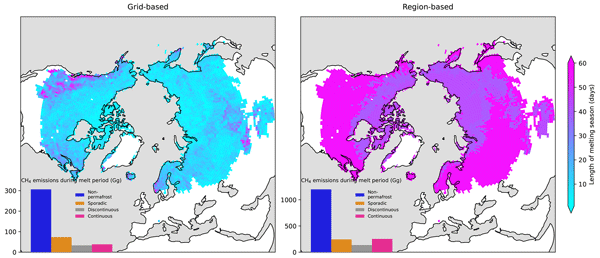
The length and timing of the melting season varied significantly depending on the approach. The melting season generally occurred between March and June and was influenced by the air temperature, with a negative correlation between the length and the mean temperature. The longest melting season was in the non-permafrost zone and the shortest varied between the two methods. The spring melting season emissions were on average 1.83 Tg with the region-based approach and 0.45 Tg with the grid-based approach, the non-permafrost zone having the largest share of the spring emissions. The emissions were largely dependent on the season’s length. Year-to-year variation was modest, within 15 % (region-based) and 23 % (grid-based) of average emissions, and there was also no trend during the study period. Our dual-method approach allows for robust comparison with both large-scale regional studies and localized site-level research.
-
Notice on discussion status
The requested preprint has a corresponding peer-reviewed final revised paper. You are encouraged to refer to the final revised version.
-
Preprint
(13282 KB)
-
The requested preprint has a corresponding peer-reviewed final revised paper. You are encouraged to refer to the final revised version.
- Preprint
(13282 KB) - Metadata XML
- BibTeX
- EndNote
- Final revised paper


Journal article(s) based on this preprint
Interactive discussion
Status: closed
-
RC1: 'Comment on egusphere-2025-2794', Anonymous Referee #1, 05 Sep 2025
The comment was uploaded in the form of a supplement: https://egusphere.copernicus.org/preprints/2025/egusphere-2025-2794/egusphere-2025-2794-RC1-supplement.pdfCitation: https://doi.org/
10.5194/egusphere-2025-2794-RC1 - AC1: 'Reply on RC1', Sara Hyvärinen, 13 Feb 2026
-
RC2: 'Comment on egusphere-2025-2794', Anonymous Referee #2, 16 Dec 2025
General comments
The study attempts to technically redefine the seasons/time period of spring melting in northern high-latitudes using SMOS satellite freeze/thaw data by accurately identifying the start of melting season and examine how it relates to the total methane flux emissions. Authors have attempted two different approaches to mark the beginning and end of melting seasons using a region-based estimation and a grid cell-based estimation. Both the methods provide largely variable results but they serve different purposes, which I would suggest needs to be made clear in the manuscript. The work is solid, and would be a valuable contribution to the high-latitude methane research. However, I would suggest the authors to address the following comments which I believe would make it methodologically stronger.
Specific comments- The Introduction section should clearly articulate the practical benefits and added value of redefining the melting season boundaries using the study's specific criteria rather than relying on the standard (MAM) period. How can redefining the spring melting season help improving the modelling (process-based or inverse) of hydrology and methane emissions in the northern high latitudes? Please include them in the introduction.
- Total melting-season emissions differ a lot between methods (region and grid) yet both are presented as valid “melting season” totals. This 4 times difference is large and needs a clear methodological explanation beyond just “region based vs grid based”. Authors are suggested to clearly mention the purpose of each method in the abstract and conclusion.
- The implication of the following statement in the conclusion is not clear to me. “Increasing temperatures could lead to shorter melting seasons and lower melting season methane emissions but also a longer thaw season”. If total melt‑season emissions directly change with melt‑season length, then a shorter melt season would reduce emissions in that window, but the longer thawed period outside that window may increase annual emissions. Thus, can lead to confusions about the future total CH₄. The relations between temperature, season length and methane emission relationship needs to be explained better as it could confuse readers about whether warming increases or decreases overall emissions.
- The thresholds (e.g., +10% from min thaw, 80% of max) feel somewhat arbitrary without sensitivity tests or comparison to ground data (e.g., soil temps, snowmelt onset).
- The original feedback suggests the title may be confusing because the definition of the season is based on the melting process, yet the term "spring melting season" might be too specific or misleading.
- Soil Moisture and Ocean Salinity Freeze/Thaw data from 2011–2021. Were there specific data quality or processing limitations that demanded ending the analysis in 2021?
- Line 95 -100: who developed The SMOS F/T soil state detection algorithm? Give details
- Line 98 – 100: We require additional detail regarding the methodology used for soil categorization and thawed soil identification. How are the thresholds for soil categorisation estimated? Please provide a brief but explicit explanation of the algorithm used to identify and classify thawed soil based on the observations? What is the estimated uncertainty of this spoil classification?
- Line 102 -104: What exactly are the reasons for this? Attenuation?
- Line 108: not very clear to me. what fraction of the combining pixels is considered to be taken as a thawed pixel?
- Line 184 – 185: “However, methane emissions are possible even at the very beginning of the melting season because the air temperature rises above zero and melted water can trickle into the soil”. Please add references for the statement.
- The second condition in region-based approach is not very clear to me. Do you mean that the spring melt must start after the day when the zone reaches its minimum annual mean thawing fraction?
- Line 205: “The mean thawing fraction of all grid-cells in a permafrost zone was then calculated.” How does this solve the problem? Do you mean an area weighted average?
Technical comments
- Line 8 – 10: Statement not complete. Length and the mean temperature?
- Section 2.2.2: Please mention which parameters are measured at these stations. surface variables or CH4?
- I would suggest move figure 1 to section 2.3.
Citation: https://doi.org/10.5194/egusphere-2025-2794-RC2 - AC2: 'Reply on RC2', Sara Hyvärinen, 13 Feb 2026
Peer review completion


Interactive discussion
Status: closed
-
RC1: 'Comment on egusphere-2025-2794', Anonymous Referee #1, 05 Sep 2025
The comment was uploaded in the form of a supplement: https://egusphere.copernicus.org/preprints/2025/egusphere-2025-2794/egusphere-2025-2794-RC1-supplement.pdf
- AC1: 'Reply on RC1', Sara Hyvärinen, 13 Feb 2026
-
RC2: 'Comment on egusphere-2025-2794', Anonymous Referee #2, 16 Dec 2025
General comments
The study attempts to technically redefine the seasons/time period of spring melting in northern high-latitudes using SMOS satellite freeze/thaw data by accurately identifying the start of melting season and examine how it relates to the total methane flux emissions. Authors have attempted two different approaches to mark the beginning and end of melting seasons using a region-based estimation and a grid cell-based estimation. Both the methods provide largely variable results but they serve different purposes, which I would suggest needs to be made clear in the manuscript. The work is solid, and would be a valuable contribution to the high-latitude methane research. However, I would suggest the authors to address the following comments which I believe would make it methodologically stronger.
Specific comments- The Introduction section should clearly articulate the practical benefits and added value of redefining the melting season boundaries using the study's specific criteria rather than relying on the standard (MAM) period. How can redefining the spring melting season help improving the modelling (process-based or inverse) of hydrology and methane emissions in the northern high latitudes? Please include them in the introduction.
- Total melting-season emissions differ a lot between methods (region and grid) yet both are presented as valid “melting season” totals. This 4 times difference is large and needs a clear methodological explanation beyond just “region based vs grid based”. Authors are suggested to clearly mention the purpose of each method in the abstract and conclusion.
- The implication of the following statement in the conclusion is not clear to me. “Increasing temperatures could lead to shorter melting seasons and lower melting season methane emissions but also a longer thaw season”. If total melt‑season emissions directly change with melt‑season length, then a shorter melt season would reduce emissions in that window, but the longer thawed period outside that window may increase annual emissions. Thus, can lead to confusions about the future total CH₄. The relations between temperature, season length and methane emission relationship needs to be explained better as it could confuse readers about whether warming increases or decreases overall emissions.
- The thresholds (e.g., +10% from min thaw, 80% of max) feel somewhat arbitrary without sensitivity tests or comparison to ground data (e.g., soil temps, snowmelt onset).
- The original feedback suggests the title may be confusing because the definition of the season is based on the melting process, yet the term "spring melting season" might be too specific or misleading.
- Soil Moisture and Ocean Salinity Freeze/Thaw data from 2011–2021. Were there specific data quality or processing limitations that demanded ending the analysis in 2021?
- Line 95 -100: who developed The SMOS F/T soil state detection algorithm? Give details
- Line 98 – 100: We require additional detail regarding the methodology used for soil categorization and thawed soil identification. How are the thresholds for soil categorisation estimated? Please provide a brief but explicit explanation of the algorithm used to identify and classify thawed soil based on the observations? What is the estimated uncertainty of this spoil classification?
- Line 102 -104: What exactly are the reasons for this? Attenuation?
- Line 108: not very clear to me. what fraction of the combining pixels is considered to be taken as a thawed pixel?
- Line 184 – 185: “However, methane emissions are possible even at the very beginning of the melting season because the air temperature rises above zero and melted water can trickle into the soil”. Please add references for the statement.
- The second condition in region-based approach is not very clear to me. Do you mean that the spring melt must start after the day when the zone reaches its minimum annual mean thawing fraction?
- Line 205: “The mean thawing fraction of all grid-cells in a permafrost zone was then calculated.” How does this solve the problem? Do you mean an area weighted average?
Technical comments
- Line 8 – 10: Statement not complete. Length and the mean temperature?
- Section 2.2.2: Please mention which parameters are measured at these stations. surface variables or CH4?
- I would suggest move figure 1 to section 2.3.
Citation: https://doi.org/10.5194/egusphere-2025-2794-RC2 - AC2: 'Reply on RC2', Sara Hyvärinen, 13 Feb 2026
Peer review completion
Journal article(s) based on this preprint
Viewed
| HTML | XML | Total | BibTeX | EndNote | |
|---|---|---|---|---|---|
| 8,957 | 1,760 | 230 | 10,947 | 293 | 291 |
- HTML: 8,957
- PDF: 1,760
- XML: 230
- Total: 10,947
- BibTeX: 293
- EndNote: 291
Viewed (geographical distribution)
| Country | # | Views | % |
|---|
| Total: | 0 |
| HTML: | 0 |
| PDF: | 0 |
| XML: | 0 |
- 1
Cited



Maria Katariina Tenkanen
Aki Tsuruta
Anttoni Erkkilä
Kimmo Rautiainen
Hermanni Aaltonen
Motoki Sasakawa
Tuula Aalto
The requested preprint has a corresponding peer-reviewed final revised paper. You are encouraged to refer to the final revised version.
- Preprint
(13282 KB) - Metadata XML