
the Creative Commons Attribution 4.0 License.
the Creative Commons Attribution 4.0 License.
 | 02 Jun 2025
The microbial community model MCoM 1.0: A scalable framework for modelling phototroph-heterotrophic interactions in diverse microbial communities
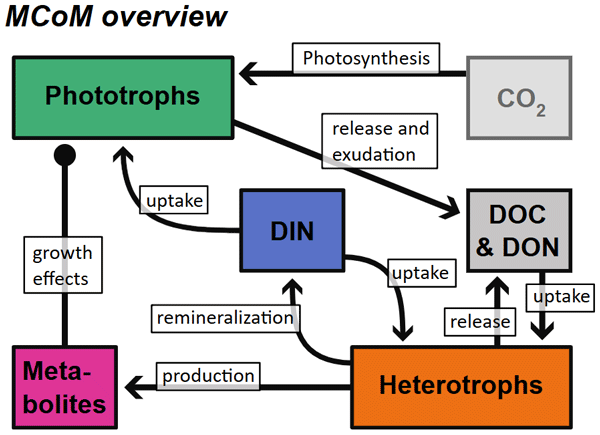
Abstract. Microbial communities, comprising phototrophic and heterotrophic microorganisms, play a crucial role in global biogeochemical cycles. However, existing biogeochemical models rarely take into account the complex interactions between these groups, usually focusing on competition for resources. In this work, we introduce the Microbial Community Model (MCoM), a framework for simulating the dynamics of diverse microbial communities. MCoM incorporates a wide range of interactions, such as cross-feeding, metabolite effects, and competition for nutrients. The model differentiates between dissolved organic nutrients (DON) and carbon (DOC), accounts for phytoplankton and heterotrophic bacterial species-specific organic matter release and uptake profiles, and simulates the impacts of bacterial metabolites on phytoplankton growth. Implemented as a box model, MCoM tracks phototrophic and heterotrophic biomass, active metabolites, DOC, DON, and inorganic nutrients through non-linear differential equations, enabling the exploration of emergent properties and feedbacks. We demonstrate the model's capabilities through simulations of experimental data of pairwise co-cultures of heterotrophic and phototrophic microorganisms, and find overall good agreement. Due to the scalable implementation, interaction matrices for larger, i.e. hundreds, of microbial groups can easily be realised. We show examples for such applications of MCoM in assessing emergent dynamics, including periodic succession patterns and multi-stability. MCoM provides a versatile, scalable, and customizable platform for assessing the range from pairwise interactions to complex microbial communities and their impact on biogeochemical fluxes.
-
Notice on discussion status
The requested preprint has a corresponding peer-reviewed final revised paper. You are encouraged to refer to the final revised version.
-
Preprint
(2764 KB)
-
The requested preprint has a corresponding peer-reviewed final revised paper. You are encouraged to refer to the final revised version.
- Preprint
(2764 KB) - Metadata XML
- BibTeX
- EndNote
- Final revised paper


Journal article(s) based on this preprint
Interactive discussion
Status: closed
-
RC1: 'Comment on egusphere-2025-2227', Anonymous Referee #1, 30 Jul 2025
The comment was uploaded in the form of a supplement: https://egusphere.copernicus.org/preprints/2025/egusphere-2025-2227/egusphere-2025-2227-RC1-supplement.pdfCitation: https://doi.org/
10.5194/egusphere-2025-2227-RC1 - AC1: 'Reply on RC1', Leonhard Lücken, 09 Jan 2026
-
RC2: 'Comment on egusphere-2025-2227', Pearse Buchanan, 03 Nov 2025
Lücken et al. – The microbial community model MCoM 1.0: A sclable framework for modelling phototroph-heterotroph interactions in diverse microbial communities
Summary
Lücken and colleagues present a 0D box model of pjototroph-heterotroph-DOM-nutrient interactions. The paper is simple and easy to read and understand. The model equations and motivations are well stated. The outcomes are clearly drawn via use cases against some experimental data.
I have minor comments given that the paper is well written, well presented, and doesn’t overreach. It is a simple model, and the authors are able to fit/explain some experimental data with phototroph-heterotroph interactions with only simple tweaks to their model parameters. While these explanations are not deeply convincing, it does convince me that the model is useful for exploratory studies.
My only comments are:
- Line 79: Can you please define X and Y sub- super-scripts and what these are referring to exactly. Is X flux in and Y flux out?
- Line 308: While this is one way to explain the data, it’s not super convincing. However, you are also not saying that this result is the ultimate explainer… So, I think that’s fine. Perhaps just make a note here that there are other possible processes/mechanisms that could explain this.
- Line 334: by reducing loss rates right?
- Figure 8, panel f: can you give a more clear explanation of this figure for the reader in the text? It took me some time to figure out exactly what was going on here. Your explanation is already okay, but perhaps too concise to allow for smooth interpretation.
Thank you for considering my input to your research,
Pearse J. Buchanan.
Citation: https://doi.org/10.5194/egusphere-2025-2227-RC2 - AC2: 'Reply on RC2', Leonhard Lücken, 09 Jan 2026


Interactive discussion
Status: closed
-
RC1: 'Comment on egusphere-2025-2227', Anonymous Referee #1, 30 Jul 2025
The comment was uploaded in the form of a supplement: https://egusphere.copernicus.org/preprints/2025/egusphere-2025-2227/egusphere-2025-2227-RC1-supplement.pdf
- AC1: 'Reply on RC1', Leonhard Lücken, 09 Jan 2026
-
RC2: 'Comment on egusphere-2025-2227', Pearse Buchanan, 03 Nov 2025
Lücken et al. – The microbial community model MCoM 1.0: A sclable framework for modelling phototroph-heterotroph interactions in diverse microbial communities
Summary
Lücken and colleagues present a 0D box model of pjototroph-heterotroph-DOM-nutrient interactions. The paper is simple and easy to read and understand. The model equations and motivations are well stated. The outcomes are clearly drawn via use cases against some experimental data.
I have minor comments given that the paper is well written, well presented, and doesn’t overreach. It is a simple model, and the authors are able to fit/explain some experimental data with phototroph-heterotroph interactions with only simple tweaks to their model parameters. While these explanations are not deeply convincing, it does convince me that the model is useful for exploratory studies.
My only comments are:
- Line 79: Can you please define X and Y sub- super-scripts and what these are referring to exactly. Is X flux in and Y flux out?
- Line 308: While this is one way to explain the data, it’s not super convincing. However, you are also not saying that this result is the ultimate explainer… So, I think that’s fine. Perhaps just make a note here that there are other possible processes/mechanisms that could explain this.
- Line 334: by reducing loss rates right?
- Figure 8, panel f: can you give a more clear explanation of this figure for the reader in the text? It took me some time to figure out exactly what was going on here. Your explanation is already okay, but perhaps too concise to allow for smooth interpretation.
Thank you for considering my input to your research,
Pearse J. Buchanan.
Citation: https://doi.org/10.5194/egusphere-2025-2227-RC2 - AC2: 'Reply on RC2', Leonhard Lücken, 09 Jan 2026
Peer review completion
Journal article(s) based on this preprint
Viewed
| HTML | XML | Total | BibTeX | EndNote | |
|---|---|---|---|---|---|
| 2,109 | 177 | 34 | 2,320 | 30 | 50 |
- HTML: 2,109
- PDF: 177
- XML: 34
- Total: 2,320
- BibTeX: 30
- EndNote: 50
Viewed (geographical distribution)
| Country | # | Views | % |
|---|
| Total: | 0 |
| HTML: | 0 |
| PDF: | 0 |
| XML: | 0 |
- 1
Leonhard Lücken
Michael J. Follows
Jason G. Bragg
Sinikka T. Lennartz
The requested preprint has a corresponding peer-reviewed final revised paper. You are encouraged to refer to the final revised version.
- Preprint
(2764 KB) - Metadata XML