
the Creative Commons Attribution 4.0 License.
the Creative Commons Attribution 4.0 License.
 | 20 May 2025
Investigating the multi-millennial evolution and stability of the Greenland ice sheet using remapped surface mass balance forcing
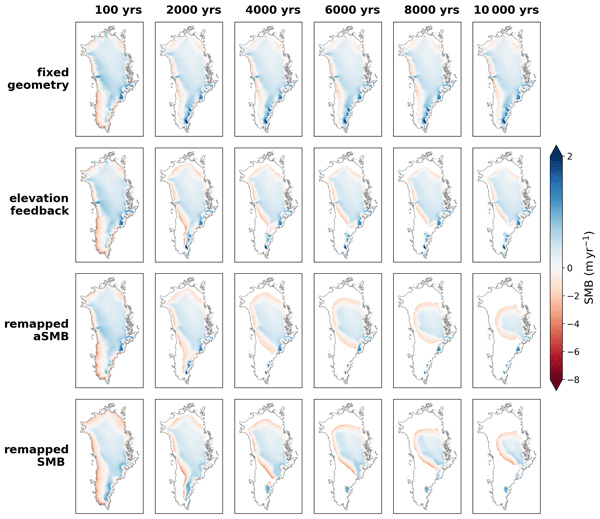
Abstract. Surface mass balance (SMB) forcing for projections of the future evolution of the Greenland ice sheet with stand-alone modeling approaches has been commonly derived from regional climate models (RCMs) on a fixed ice sheet topography. However, over long time scales, changes in ice sheet geometry become substantial, and using SMB fields that do not account for these changes can introduce non-physical biases. Therefore, conducting projections for the long term evolution and stability of the Greenland ice sheet usually requires a computationally expensive coupled climate-ice sheet modeling setup. In this study we use a SMB remapping procedure to capture the first order feedbacks of the coupled climate-ice sheet system within a computationally efficient stand-alone modeling approach. Following a remapping procedure that was originally developed to apply SMB forcing to a range of modeled steady-state ice sheet geometries, we produce SMB forcing that adapts to the changing ice sheet geometry as it evolves over time. SMB fields from a regional climate model are translated from a function of absolute geographic location to a function of surface elevation, allowing for SMB updates when elevation changes. To reflect the heterogeneous elevation response across the ice sheet we separate the ice sheet into 25 regional drainage basins, which allows for a spatially resolved adjustment of SMB. We evaluate this approach using forcing from multiple emission scenarios from the CMIP6 archive and compare the results with those from standard parameterizations of the SMB–elevation feedback. Our results show that the remapping method better preserves the structure of the ablation zone and reduces non-physical biases compared to conventional SMB–elevation feedback parameterizations, while still leveraging high-quality forcing data.
-
Notice on discussion status
The requested preprint has a corresponding peer-reviewed final revised paper. You are encouraged to refer to the final revised version.
-
Preprint
(8289 KB)
-
The requested preprint has a corresponding peer-reviewed final revised paper. You are encouraged to refer to the final revised version.
- Preprint
(8289 KB) - Metadata XML
- BibTeX
- EndNote
- Final revised paper


Journal article(s) based on this preprint
Interactive discussion
Status: closed
-
RC1: 'Comment on egusphere-2025-2192', Alison Delhasse, 25 Jun 2025
-
AC2: 'Reply on RC1', Charlotte Rahlves, 04 Aug 2025
The comment was uploaded in the form of a supplement: https://egusphere.copernicus.org/preprints/2025/egusphere-2025-2192/egusphere-2025-2192-AC2-supplement.pdf
-
AC2: 'Reply on RC1', Charlotte Rahlves, 04 Aug 2025
-
RC2: 'Comment on egusphere-2025-2192', Anonymous Referee #2, 27 Jun 2025
The comment was uploaded in the form of a supplement: https://egusphere.copernicus.org/preprints/2025/egusphere-2025-2192/egusphere-2025-2192-RC2-supplement.pdf
-
AC1: 'Reply on RC2', Charlotte Rahlves, 04 Aug 2025
The comment was uploaded in the form of a supplement: https://egusphere.copernicus.org/preprints/2025/egusphere-2025-2192/egusphere-2025-2192-AC1-supplement.pdf
-
AC1: 'Reply on RC2', Charlotte Rahlves, 04 Aug 2025


Interactive discussion
Status: closed
-
RC1: 'Comment on egusphere-2025-2192', Alison Delhasse, 25 Jun 2025
Please find the review comments in the attached file.
-
AC2: 'Reply on RC1', Charlotte Rahlves, 04 Aug 2025
The comment was uploaded in the form of a supplement: https://egusphere.copernicus.org/preprints/2025/egusphere-2025-2192/egusphere-2025-2192-AC2-supplement.pdf
-
AC2: 'Reply on RC1', Charlotte Rahlves, 04 Aug 2025
-
RC2: 'Comment on egusphere-2025-2192', Anonymous Referee #2, 27 Jun 2025
The comment was uploaded in the form of a supplement: https://egusphere.copernicus.org/preprints/2025/egusphere-2025-2192/egusphere-2025-2192-RC2-supplement.pdf
-
AC1: 'Reply on RC2', Charlotte Rahlves, 04 Aug 2025
The comment was uploaded in the form of a supplement: https://egusphere.copernicus.org/preprints/2025/egusphere-2025-2192/egusphere-2025-2192-AC1-supplement.pdf
-
AC1: 'Reply on RC2', Charlotte Rahlves, 04 Aug 2025
Peer review completion


Journal article(s) based on this preprint
Viewed
| HTML | XML | Total | BibTeX | EndNote | |
|---|---|---|---|---|---|
| 956 | 75 | 26 | 1,057 | 28 | 49 |
- HTML: 956
- PDF: 75
- XML: 26
- Total: 1,057
- BibTeX: 28
- EndNote: 49
Viewed (geographical distribution)
| Country | # | Views | % |
|---|
| Total: | 0 |
| HTML: | 0 |
| PDF: | 0 |
| XML: | 0 |
- 1
Charlotte Rahlves
Heiko Goelzer
Andreas Born
Petra M. Langebroek
The requested preprint has a corresponding peer-reviewed final revised paper. You are encouraged to refer to the final revised version.
- Preprint
(8289 KB) - Metadata XML
Please find the review comments in the attached file.