
the Creative Commons Attribution 4.0 License.
the Creative Commons Attribution 4.0 License.
 | 04 Apr 2025
Climate and ocean circulation changes toward a modern snowball Earth
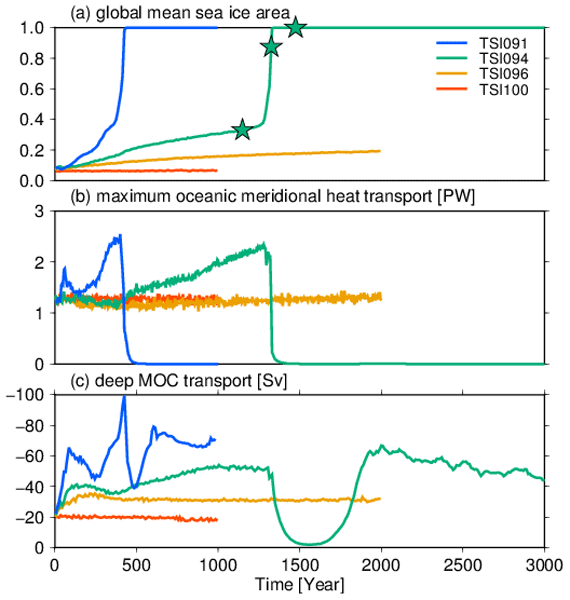
Abstract. In the past, Earth experienced snowball events, where its surface became completely covered with ice. Previous studies used general circulation models to investigate the onset and climate of such snowball events. Using the MIROC4m coupled atmosphere-ocean climate model, this study examined the changes in the oceanic circulation during the onset of a modern snowball Earth and elucidated their evolution to steady states under the snowball climate. Abruptly changing the solar constant to 94 % of its present-day value caused the modern Earth climate to turn into a snowball state after 1300 years and initiated rapid increase in sea ice thickness. During onset of the snowball event, extensive sea ice formation and melting of sea ice in the mid-latitudes caused substantial freshening of surface waters and salinity stratification. By contrast, such salinity stratification was absent if the duration necessary for snowball onset was short because of stronger solar constant forcing. After snowball onset, the global sea ice cover reduced air–sea fluxes and caused drastic weakening in the deep ocean circulation. However, as the ocean temperature and salinity fields approached near constant states, the meridional overturning circulation resumed in the steady-state snowball climate. Although the evolution of the oceanic circulation would depend on model setting, particularly regarding the treatment of air–sea fluxes and the continental distribution, our results highlight the importance of the oceanic circulation and associated biogeochemical changes in the climate system feedback and sequence of snowball events.
-
Notice on discussion status
The requested preprint has a corresponding peer-reviewed final revised paper. You are encouraged to refer to the final revised version.
-
Preprint
(2155 KB)
-
The requested preprint has a corresponding peer-reviewed final revised paper. You are encouraged to refer to the final revised version.
- Preprint
(2155 KB) - Metadata XML
- BibTeX
- EndNote
- Final revised paper


Journal article(s) based on this preprint
Interactive discussion
Status: closed
-
RC1: 'Comment on egusphere-2025-1484', Yonggang Liu, 04 May 2025
The comment was uploaded in the form of a supplement: https://egusphere.copernicus.org/preprints/2025/egusphere-2025-1484/egusphere-2025-1484-RC1-supplement.pdfCitation: https://doi.org/
10.5194/egusphere-2025-1484-RC1 - AC1: 'Reply on RC1', Takashi Obase, 30 Jul 2025
-
RC2: 'Comment on egusphere-2025-1484', Anonymous Referee #2, 09 May 2025
The manuscript by Takashi Obase and colleagues presents simulation results from climate experiments of transitioning from a modern-day climate state to a snowball-Earth state in response to an abrupt reduction in incoming solar radiation. The authors use the MIROC4m atmosphere–ocean general circulation model (AOGCM), which—in principle—seems a good choice for this kind of study and enables them to investigate the evolution of ocean and atmosphere during and after that transition.
I think the study is interesting especially with regard to the ocean dynamics and the results are discussed in an enlightening way. However, I would suggest a few general and a number of specific minor revisions before publication.
Minor revisions (general)
The authors acknowledge that their results differ from previous studies in some important points, which is not a problem in its own right, of course. However, two assumptions appear very critical to me, as outlined below. Ideally, a study would mostly cover the sensitivity of the results to these assumptions, but seeing that the scope of the paper would considerably grow and the discussed results do not need to be “most realistic”, I would suggest an even deeper discussion of the following points.
-
I think it is a strong assumption and maybe a large perturbation for the model to abruptly replace all land surface with ice sheets once the oceans are fully covered in sea ice. The effect of this assumption on the results (especially regarding the hydrological cycle) should be discussed.
-
The comparatively strong momentum transfer from the wind to the ocean in the case of very thick sea ice is already discussed. Ideally, one would need a sensitivity run to see the differences in the model. This is not absolutely necessary from my point of view, but it should be stressed at a prominent point of the manuscript that the assumption is probably unrealistic.
That said, it is notable that the authors included a discussion and sensitivity test regarding the minimal thermal diffusion coefficient over the ocean surface, because this is another critical point.
Minor revisions (specific)
-
L8: I find it not clear what is meant by “necessary”. Maybe replace the formulation by “the duration between the change in solar constant and snowball onset” or something similar.
-
L17f.: “iron formation” is too general.
-
L20: “… 94% of its …” without “that”
-
L27: “… equilibrium solution of the climate" instead of “planet”
-
L38: “… the same AOGCM[s]” is not correct. E.g., the study by Poulsen et al. (2002) used FOAM, which the studies mentioned before did not employ. Voigt (2013) used an AGCM. The study by Eberhard et al. (2023) differs from the ones mentioned before, as they used a model of intermediate complexity (which is not an AOGCM) and focused on a large set of sensitivity runs instead.
-
L39: The terms “Marinoan” and “Sturtian” have to be switched. The Marinoan is the younger one.
-
L65 and other instances: It appears that sometimes the names MIROC and MIROC4m are synonymous. Are they? If not, please make a clearer distinction.
-
L95: I think this value of the ECS is for doubling CO2 in a modern climate state, right? If so, please mention this, as for states with more ice the ECS is sometimes expected to be much higher.
-
L112f.: Is it likely that this nonconservation of global water volume and salinity introduces any artificial long-term salinity trends for “stable” climate states which could be relevant for the snowball simulations? One could, e.g., check the discussed TS100 run for the long-term evolution of total salinity. I ask because sometimes this can happen in the case of nonconservative schemes.
-
L120: What is the reason for using this value for the solar constant? Basically, I am wondering where the .12 comes from.
-
L120: “changed from 91 to 100%” or “set to 91–100%”
-
L135ff.: I realize the difficulty to run the TS096 simulation for even longer, but it is not evident for me that this one will stay in a non-snowball state forever. Sea-ice area and SAT still have considerable trends and might reach the transition point eventually. I suggest to at least mention this in the manuscript and, for example, weaken the statement in L139f: “… was determined to be between 94 and 96%”.
-
L155: “Fig. 2c blue”—Please check whether you indicated the right color.
-
L190f.: “The sea ice formation …” is a repetition of a similar statement in L184ff.
-
L192: It would make sense to add a reference to Fig. 5c, as well.
-
L196: “maximum sea ice thickness along the western side of the Pacific Ocean”—This is difficult to see in the figure.
-
L203f.: This last sentence is partly a repetition of a similar earlier statement in L199f.
-
L246: “.. from that in a multimodel study”, similar in L249f.
-
L284: “… depends on radiative forcing”—This sounds as if the radiative forcing directly influenced the salinity stratification. Maybe: “depends on the rate of cooling”?
-
L284f.: Please specify what you mean with “external forcing”, this could even be early in the paper. Some people describe the insolation itself as a forcing, and then it would sound strange to speak of a stronger external forcing for reduced insolation.
-
L289: “as opposed to” instead of “than”?
-
L347: “… coupled with an EBM”
-
L359: Please carefully revise the values given. Liu et al. (2013) find thresholds between 80 and 150 ppm, but thresholds even below 80 ppm for another aerosol parametrization. Feulner and Kienert (2014) find thresholds of 100–110 ppm for the Sturtian and 120–130 ppm for the Marinoan.
Citation: https://doi.org/10.5194/egusphere-2025-1484-RC2 - AC2: 'Reply on RC2', Takashi Obase, 30 Jul 2025
-
Peer review completion


Interactive discussion
Status: closed
-
RC1: 'Comment on egusphere-2025-1484', Yonggang Liu, 04 May 2025
The comment was uploaded in the form of a supplement: https://egusphere.copernicus.org/preprints/2025/egusphere-2025-1484/egusphere-2025-1484-RC1-supplement.pdf
- AC1: 'Reply on RC1', Takashi Obase, 30 Jul 2025
-
RC2: 'Comment on egusphere-2025-1484', Anonymous Referee #2, 09 May 2025
The manuscript by Takashi Obase and colleagues presents simulation results from climate experiments of transitioning from a modern-day climate state to a snowball-Earth state in response to an abrupt reduction in incoming solar radiation. The authors use the MIROC4m atmosphere–ocean general circulation model (AOGCM), which—in principle—seems a good choice for this kind of study and enables them to investigate the evolution of ocean and atmosphere during and after that transition.
I think the study is interesting especially with regard to the ocean dynamics and the results are discussed in an enlightening way. However, I would suggest a few general and a number of specific minor revisions before publication.
Minor revisions (general)
The authors acknowledge that their results differ from previous studies in some important points, which is not a problem in its own right, of course. However, two assumptions appear very critical to me, as outlined below. Ideally, a study would mostly cover the sensitivity of the results to these assumptions, but seeing that the scope of the paper would considerably grow and the discussed results do not need to be “most realistic”, I would suggest an even deeper discussion of the following points.
-
I think it is a strong assumption and maybe a large perturbation for the model to abruptly replace all land surface with ice sheets once the oceans are fully covered in sea ice. The effect of this assumption on the results (especially regarding the hydrological cycle) should be discussed.
-
The comparatively strong momentum transfer from the wind to the ocean in the case of very thick sea ice is already discussed. Ideally, one would need a sensitivity run to see the differences in the model. This is not absolutely necessary from my point of view, but it should be stressed at a prominent point of the manuscript that the assumption is probably unrealistic.
That said, it is notable that the authors included a discussion and sensitivity test regarding the minimal thermal diffusion coefficient over the ocean surface, because this is another critical point.
Minor revisions (specific)
-
L8: I find it not clear what is meant by “necessary”. Maybe replace the formulation by “the duration between the change in solar constant and snowball onset” or something similar.
-
L17f.: “iron formation” is too general.
-
L20: “… 94% of its …” without “that”
-
L27: “… equilibrium solution of the climate" instead of “planet”
-
L38: “… the same AOGCM[s]” is not correct. E.g., the study by Poulsen et al. (2002) used FOAM, which the studies mentioned before did not employ. Voigt (2013) used an AGCM. The study by Eberhard et al. (2023) differs from the ones mentioned before, as they used a model of intermediate complexity (which is not an AOGCM) and focused on a large set of sensitivity runs instead.
-
L39: The terms “Marinoan” and “Sturtian” have to be switched. The Marinoan is the younger one.
-
L65 and other instances: It appears that sometimes the names MIROC and MIROC4m are synonymous. Are they? If not, please make a clearer distinction.
-
L95: I think this value of the ECS is for doubling CO2 in a modern climate state, right? If so, please mention this, as for states with more ice the ECS is sometimes expected to be much higher.
-
L112f.: Is it likely that this nonconservation of global water volume and salinity introduces any artificial long-term salinity trends for “stable” climate states which could be relevant for the snowball simulations? One could, e.g., check the discussed TS100 run for the long-term evolution of total salinity. I ask because sometimes this can happen in the case of nonconservative schemes.
-
L120: What is the reason for using this value for the solar constant? Basically, I am wondering where the .12 comes from.
-
L120: “changed from 91 to 100%” or “set to 91–100%”
-
L135ff.: I realize the difficulty to run the TS096 simulation for even longer, but it is not evident for me that this one will stay in a non-snowball state forever. Sea-ice area and SAT still have considerable trends and might reach the transition point eventually. I suggest to at least mention this in the manuscript and, for example, weaken the statement in L139f: “… was determined to be between 94 and 96%”.
-
L155: “Fig. 2c blue”—Please check whether you indicated the right color.
-
L190f.: “The sea ice formation …” is a repetition of a similar statement in L184ff.
-
L192: It would make sense to add a reference to Fig. 5c, as well.
-
L196: “maximum sea ice thickness along the western side of the Pacific Ocean”—This is difficult to see in the figure.
-
L203f.: This last sentence is partly a repetition of a similar earlier statement in L199f.
-
L246: “.. from that in a multimodel study”, similar in L249f.
-
L284: “… depends on radiative forcing”—This sounds as if the radiative forcing directly influenced the salinity stratification. Maybe: “depends on the rate of cooling”?
-
L284f.: Please specify what you mean with “external forcing”, this could even be early in the paper. Some people describe the insolation itself as a forcing, and then it would sound strange to speak of a stronger external forcing for reduced insolation.
-
L289: “as opposed to” instead of “than”?
-
L347: “… coupled with an EBM”
-
L359: Please carefully revise the values given. Liu et al. (2013) find thresholds between 80 and 150 ppm, but thresholds even below 80 ppm for another aerosol parametrization. Feulner and Kienert (2014) find thresholds of 100–110 ppm for the Sturtian and 120–130 ppm for the Marinoan.
Citation: https://doi.org/10.5194/egusphere-2025-1484-RC2 - AC2: 'Reply on RC2', Takashi Obase, 30 Jul 2025
-
Peer review completion
Journal article(s) based on this preprint
Viewed
| HTML | XML | Total | BibTeX | EndNote | |
|---|---|---|---|---|---|
| 3,231 | 985 | 129 | 4,345 | 136 | 168 |
- HTML: 3,231
- PDF: 985
- XML: 129
- Total: 4,345
- BibTeX: 136
- EndNote: 168
Viewed (geographical distribution)
| Country | # | Views | % |
|---|
| Total: | 0 |
| HTML: | 0 |
| PDF: | 0 |
| XML: | 0 |
- 1

Takanori Kodama
Takao Kawasaki
Sam Sherriff-Tadano
Daisuke Takasuka
Ayako Abe-Ouchi
Masakazu Fujii
The requested preprint has a corresponding peer-reviewed final revised paper. You are encouraged to refer to the final revised version.
- Preprint
(2155 KB) - Metadata XML