
the Creative Commons Attribution 4.0 License.
the Creative Commons Attribution 4.0 License.
 | 31 Jan 2025
Historical trends of seasonal droughts in Australia
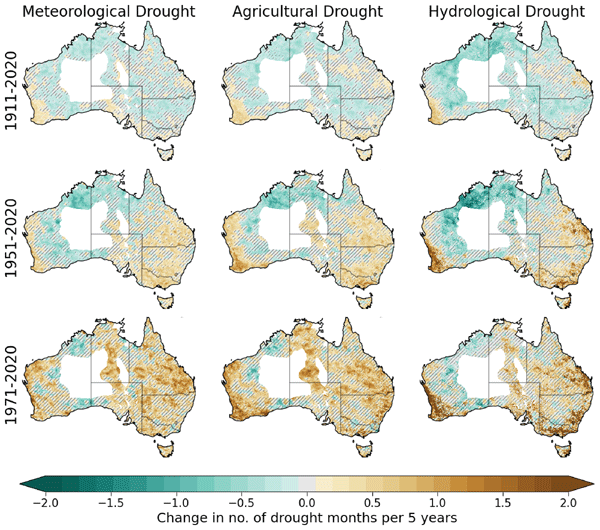
Abstract. Australia frequently experiences severe and widespread droughts, causing impacts on food security, the economy, and human health. Despite this, recent research to comprehensively understand the past trends in Australian droughts is lacking. We analyse the past changes in seasonal-scale meteorological, agricultural and hydrological droughts – defined using the 15th percentile threshold of precipitation, soil moisture, and runoff, respectively. We complement these traditional metrics with an impact-based drought indicator built from government drought reports using machine learning. Calculating trends in time and area under drought, for the various drought types, we find that while there have been widespread decreases in Australian droughts since the early 20th century, extensive regions have experienced an increase in recent decades. However, these recent changes largely remain within the range of observed variability, suggesting they are not unprecedented in the context of the historical drought events. The drivers behind these drought trends are multi-faceted and we show that the trends can be driven by both mean and variability changes in the underlying hydrological variable. Additionally, using explainable machine learning techniques, we unpick the key hydrometeorological variables contributing to agricultural and hydrological drought trends. The influence of these variables varies considerably between regions and seasons, with precipitation often shown to be important but rarely the main driver behind observed drought trends. This suggests the need to consider multiple drivers when assessing drought trends.
-
Notice on discussion status
The requested preprint has a corresponding peer-reviewed final revised paper. You are encouraged to refer to the final revised version.
-
Preprint
(3284 KB)
-
Supplement
(2536 KB)
-
The requested preprint has a corresponding peer-reviewed final revised paper. You are encouraged to refer to the final revised version.
- Preprint
(3284 KB) - Metadata XML
-
Supplement
(2536 KB) - BibTeX
- EndNote
- Final revised paper


Journal article(s) based on this preprint
Interactive discussion
Status: closed
-
RC1: 'Comment on egusphere-2024-4024', Anonymous Referee #1, 23 Feb 2025
- AC1: 'Reply on RC1', Matt Grant, 01 May 2025
-
RC2: 'Comment on egusphere-2024-4024', Anonymous Referee #2, 04 Apr 2025
The manuscript presents a statistical assessment of the historical trends of drought in Australia. The methodology and the analysis are well designed and contain elements of novelty, while the results are interesting, relevant and generally well discussed. There are, however, area where the manuscript could be improved, in particular with regards to the explanation of some of the methodologies and their contribution to the final results, as well as discussion of the implication of the statistical choices made.
Overall, the manuscript is of good quality and I recommend its publication in HESS with minor amendments.
- AC2: 'Reply on RC2', Matt Grant, 01 May 2025


Interactive discussion
Status: closed
-
RC1: 'Comment on egusphere-2024-4024', Anonymous Referee #1, 23 Feb 2025
This manuscript analyzes historical drought trends in Australia using multiple drought indicators and explainable machine learning to assess hydrometeorological drivers and variability influences. While well-structured with a robust methodology and significant findings, improvements in clarity, statistical transparency, and rigor are needed. The attached document evaluates the manuscript against HESS criteria with recommendations to enhance its impact and alignment.
- AC1: 'Reply on RC1', Matt Grant, 01 May 2025
-
RC2: 'Comment on egusphere-2024-4024', Anonymous Referee #2, 04 Apr 2025
The manuscript presents a statistical assessment of the historical trends of drought in Australia. The methodology and the analysis are well designed and contain elements of novelty, while the results are interesting, relevant and generally well discussed. There are, however, area where the manuscript could be improved, in particular with regards to the explanation of some of the methodologies and their contribution to the final results, as well as discussion of the implication of the statistical choices made.
Overall, the manuscript is of good quality and I recommend its publication in HESS with minor amendments.
- AC2: 'Reply on RC2', Matt Grant, 01 May 2025
Peer review completion


Journal article(s) based on this preprint
Viewed
| HTML | XML | Total | Supplement | BibTeX | EndNote | |
|---|---|---|---|---|---|---|
| 955 | 148 | 24 | 1,127 | 67 | 27 | 42 |
- HTML: 955
- PDF: 148
- XML: 24
- Total: 1,127
- Supplement: 67
- BibTeX: 27
- EndNote: 42
Viewed (geographical distribution)
| Country | # | Views | % |
|---|
| Total: | 0 |
| HTML: | 0 |
| PDF: | 0 |
| XML: | 0 |
- 1
Anna M. Ukkola
Elisabeth Vogel
Sanaa Hobeichi
Andy J. Pitman
Alex Raymond Borowiak
Keirnan Fowler
The requested preprint has a corresponding peer-reviewed final revised paper. You are encouraged to refer to the final revised version.
- Preprint
(3284 KB) - Metadata XML
-
Supplement
(2536 KB) - BibTeX
- EndNote
- Final revised paper
This manuscript analyzes historical drought trends in Australia using multiple drought indicators and explainable machine learning to assess hydrometeorological drivers and variability influences. While well-structured with a robust methodology and significant findings, improvements in clarity, statistical transparency, and rigor are needed. The attached document evaluates the manuscript against HESS criteria with recommendations to enhance its impact and alignment.